
I once entered IKEA for two hooks and came to in Lighting comparing lamps as if one would resolve my identity.
The baby had started the trip bright-eyed. By the fictional third apartment, she had moved through curiosity, outrage, and the kind of silence that means a parent has approximately nine minutes left. My list still said hooks. My cart contained a plant pot, six napkins, and no hooks.
IKEA time is not Earth time. Write the exit time down.
The trip works when you shop the mission, not the maze. You do not need to complete every showroom to earn the checkout.
◇ short list
◌ baby wheels
↝ shortcut
◎ exit time

Before you leave: check this IKEA, not “IKEA” in general
Store hours, entrances, family parking, feeding or changing spaces, restaurant hours, stroller access, Småland, pickup, and loading help can vary. Start with IKEA’s official store directory, then open or call your exact location.
Confirm five things:
- Opening time and the lowest-crowd window.
- Whether the item is in stock and where it is collected.
- Which entrance is easiest with a stroller.
- Where changing and feeding spaces are located, if offered.
- Whether a shortcut, pickup order, or click-and-collect option can replace part of the maze.
If crowds are the main concern, use our guide to prepare for a crowded store.
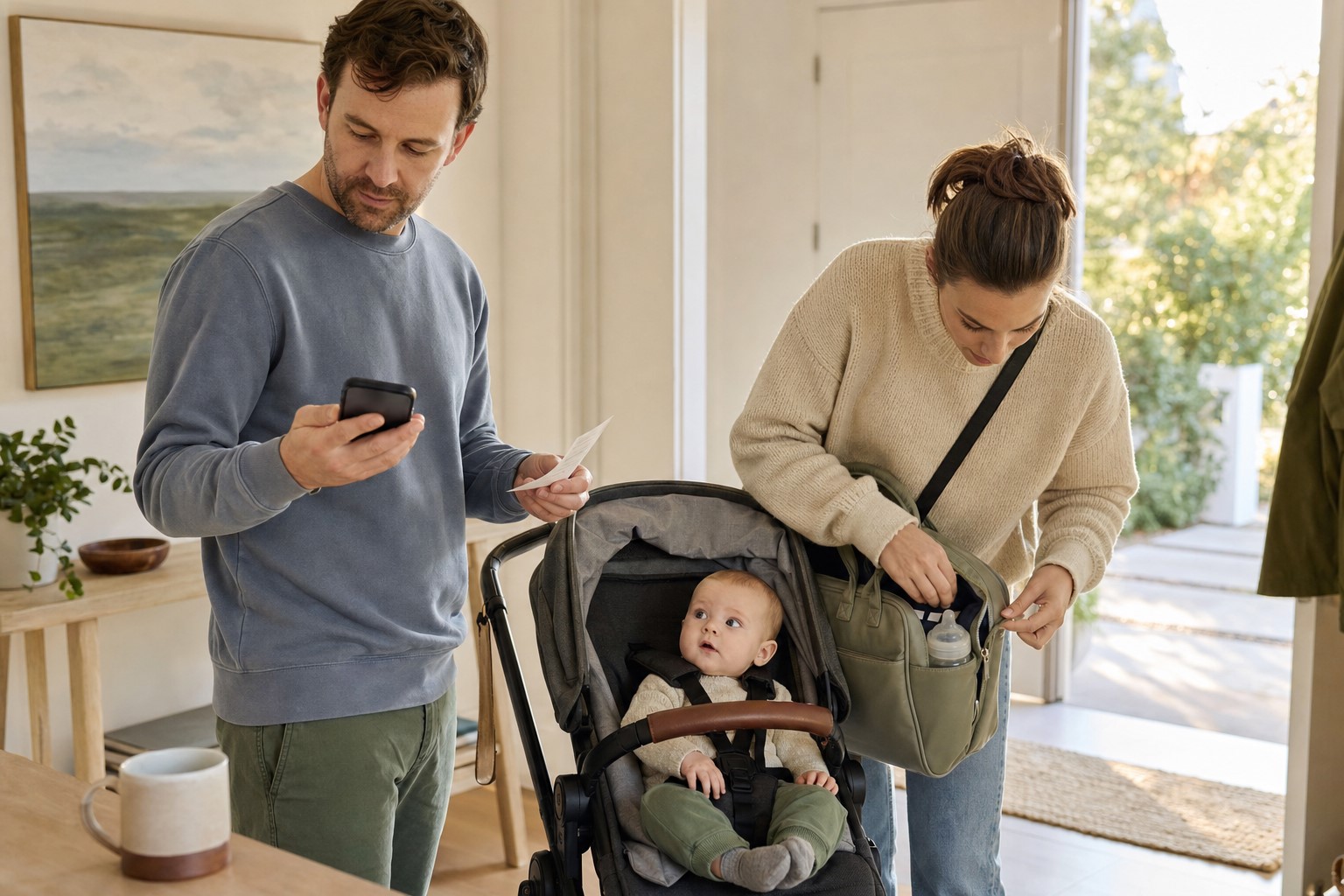
Can you take a newborn to IKEA?
A healthy newborn can go on ordinary outings, but “can” is not the same as “this is the right outing today.” A very young baby may need frequent feeding and changing, and the parent who recently gave birth may need rest, pain control, easier bathroom access, and a much shorter walk than the blue line suggests.
Ask three practical questions: Is anyone sick? Is the baby feeding and behaving normally? Can we leave instantly if either the baby or recovering parent is done? If your baby was premature, has a medical condition, has fever or breathing trouble, or your clinician has advised limiting crowds, follow that individualized advice rather than a furniture-shopping timetable.
For a first newborn trip, make the goal absurdly small: one measured item, one calm route, one adult assigned to the baby, and permission to order the rest. The win is not finishing IKEA. The win is returning home with everyone regulated enough to recover.
What is the best time to take a baby to IKEA?
The best time is the overlap between your baby’s most predictable calm window and your exact store’s quieter period. For many families that is shortly after opening and shortly after a feed, but do not force a famously unpredictable baby into an internet-approved hour. Check live hours and local events, then choose the window that gives you the most margin before the next feed or nap.
Weekday mornings may be calmer than weekends, holidays, school breaks, and the hour before closing. A quieter store helps, but an earlier trip is not automatically easier if it starts with a rushed feed, a skipped nap, or a parent who has not eaten. Protect the humans first; optimize the foot traffic second.
Build a real exit time
Count backward from the next likely feeding or sleep pressure, then subtract checkout, loading, and drive-home time. If the baby usually stays comfortable for two hours, a 90-minute shopping plan may still be too long once parking and the ride are included. Put the exit time in your phone and treat it like the last pickup window—not a suggestion you can renegotiate in Rugs.
What should you pack—and what can stay home?
Pack for the predictable interruption, not an imaginary six-day expedition. A compact kit usually means diapers, wipes, changing pad, one full clothing change, feeding supplies, burp cloth, pacifier if used, one familiar quiet toy, hand-cleaning supplies, and a sealable bag for wet clothes. Add any medication or equipment your baby normally needs.
Bring a carrier only if you already know how to use it safely; a crowded showroom is a poor place to learn a new buckle system. Put bulky purchases on a pickup order or a second trip instead of hanging bags from stroller handles until the stroller becomes a physics lesson.
If you are going alone, shrink the mission again
A solo trip can work, but it needs one transport system and one reachable list. Use a stroller or correctly fitted carrier, keep the diaper essentials accessible, and choose items you can handle without leaving the baby or turning your back. If the purchase requires a flatbed, warehouse lifting, or complex loading, arrange pickup, delivery, or another adult.
Do not ask a stranger to watch the baby while you retrieve a box. Do not leave the baby at checkout while you run back for the shelf location. Photograph the label, ask staff for the current pickup process, and choose the boring safe solution. IKEA will still have shelves next week.
The IKEA Route Map: one loop with a bailout
The 90-Minute IKEA Route
Follow the list. Use the shortcut. Checkout is always an acceptable destination.
Feed or change if due; place the list where one adult can actually read it.
Find toilets, changing, elevator, marketplace shortcut, checkout, and exit.
See only the rooms connected to the written items. Photograph labels; do not debate every lamp.
Feed, change, move, or take five quiet minutes before marketplace density.
Collect the exact small items and skip “maybe useful someday.”
At the first true overload cue, go directly to checkout. The display bedrooms will recover.
Write the list IKEA cannot rewrite for you
A useful IKEA list has three columns: must solve today, photograph and measure, and not today. Put a maximum number of showroom stops beside it. This is not joyless shopping; it is how you keep the staged apartments from replacing your actual problem.
For each must-buy item, save the product name, current stock status, color, dimensions, package dimensions, and pickup location shown by your store. Measure the room, doorway, vehicle, and route into your home. Inventory changes, so recheck before departure and again before you commit to a warehouse loop.
Use photos instead of carrying decisions
If you like something that is not on the list, photograph its label and the room context. Decide at home after the baby is asleep and your brain is no longer under seventeen pendant lights. A photo weighs nothing, does not tip a stroller, and rarely needs to be returned.
Should two adults go?
Two adults are useful when the trip includes a flatbed, large package, restaurant stop, or long drive. Name roles instead of both half-watching everything: one person owns baby cues and care; one owns item locations, measurements, and loading. Either person can call the bailout.
One adult is enough for a short, light-item mission with a stroller or carrier and a known route. If the list becomes a wardrobe system and six boxes, the plan has changed. Switch to pickup, delivery, or a baby-free return trip rather than making the outing harder to prove that it can be done.
What if your baby cries in the showroom?
A crying baby is communicating, not violating furniture-store etiquette. Stop somewhere safe, check hunger, diaper, temperature, position, and tiredness, then lower stimulation. You do not owe nearby shoppers a frantic apology tour. You owe your baby attention and yourself a usable exit.
If the need is clear and fixable, meet it. If nothing helps quickly, move toward the door while continuing to respond. Leaving is not a failed trip; it is the exact safety valve that makes taking a baby out feel possible next time.
Choose the wheels before the automatic doors open
I want you to choose the transport mode before you are standing beside the cart stack with a baby, a car seat, and no free hand.
The Baby Transport Rail
Best for a long list, diaper bag, familiar recline, and a baby who needs space. Check the store route and keep aisles clear.
Best for hands-free shortcuts and a baby who settles close. Use the carrier correctly and keep the face and airway visible.
Only for a child who can use the designated seat as intended. Buckle the restraint and keep the child seated and supervised.
Never make a fourth lane by balancing the infant car seat on top of the cart. It can make the cart unstable and is not a safe attachment.
Shopping-cart safety is not optional
HealthyChildren recommends using alternatives such as a stroller or carrier when practical. If a child rides in a cart, use the cart’s restraint, keep the child seated, stay within reach, and do not allow riding in the basket, on the side, or underneath.
Do not place an infant carrier on top of the cart—even if it seems to “click.” That position raises the center of gravity and can tip. Follow the cart and car-seat manufacturers’ instructions rather than an improvised fit.
If you need a flatbed for furniture, one adult should manage the baby while another handles the load. Do not leave the baby unattended in a cart, stroller, car, or loading zone while you solve the sofa.
Use elevators with a stroller
Do not take a stroller onto an escalator. Follow posted store directions and use the elevator. Keep hands, wheels, straps, and dangling toys clear of doors, and let impatient shoppers take the next car rather than squeezing the stroller into a gap.
When you stop to look at a display, park out of the traffic lane and set the stroller brake. Never hang so much weight from the handle that the stroller can tip backward. If you switch from carrier to stroller, do it in a calm open area rather than beside moving carts.
Feed and change before the maze gets a vote
Feed before you leave or shortly after arrival if that matches your baby’s rhythm. Bring the same feeding setup you trust elsewhere; do not count on a particular room or chair until the store confirms it.
Your compact bag needs diapers, wipes, a change of clothes, feeding supplies, burp cloth, pacifier if used, one quiet toy, and a bag for whatever becomes damp. Add a shirt for yourself if your baby considers adult clothing part of the changing surface.
For an older baby, pack only age-appropriate food and use a clean high chair if you stop at the restaurant. You are allowed to skip the restaurant completely. Meatballs are not a required checkpoint.
Restaurant, bottle, and hot-drink reality
If you stop to eat, park the stroller where it does not block an aisle or exit. Use only a clean high chair that is appropriate for your baby’s current sitting ability, buckle the restraint, and stay within reach. Do not prop bottles or offer a new food simply because it is available. Continue the feeding method and allergen plan you use at home.
Hot coffee, soup, and trays need their own adult hands. Keep hot items away from the stroller, carrier, table edge, and baby’s reach. If one parent is feeding the baby, the other handles the tray. Alone, choose one task at a time. A pastry can wait until the bottle is finished.
Changing-room backup plan
Even if your store lists a family room, carry a compact changing mat and enough supplies to manage the next change. Ask staff for the nearest suitable changing area rather than improvising on a showroom bed, restaurant table, or the car’s exposed cargo floor.
If the baby needs a full clothing change, take the pause. A five-minute reset in a quieter room is faster than trying to negotiate with a damp, cold baby through Self-Serve Furniture.
Watch the baby, not the showroom clock
Big stores layer lights, voices, carts, smells, people, and constant scene changes. Early overload can look like turning away, frantic movement, rubbing eyes, losing interest, escalating fussing, or becoming unusually still.
Start with the first reliable cue. Lower stimulation, feed or change if needed, and move toward checkout. I would rather leave one storage bin behind than ask a done baby to survive another showroom.
Try a 10-minute quiet reset—but do not use it to overrule “done”
Some babies recover with a feed, diaper, position change, or a few quiet minutes away from the busiest aisle. Give the reset a defined limit. If the baby softens, re-engages, and the exit is close, finish the one essential item. If the cues return or intensify, leave.
The trap is using every calming trick to buy one more department. Regulation is not a permission slip to restart the maze. A calm baby at checkout is a better outcome than a second crash in Warehouses.
THE EXIT RECEIPT
Permission to stop shopping before the store stops being useful.
KEEP: the one item that solves today’s problem.
ORDER: anything bulky, uncertain, or available for pickup/delivery.
RETURN LATER: the lamp, rug, basket, frame, and entire alternate personality.
EXIT TRIGGER: hunger, diaper, sustained fussing, overheating, airway/position concern, caregiver overload, or the written exit time.
Can baby nap in the stroller or carrier at IKEA?
Lighting detour
care stop
checkout
car-nap decision
home reset
A doze can happen. Keep a baby in the stroller or carrier exactly as its instructions require, maintain a visible clear airway, and supervise. AAP safe-sleep guidance does not treat strollers, carriers, or car seats as routine sleep locations. Move the baby to a firm, flat sleep surface when practical.
Do not drape a blanket over the stroller to make a dark cave; it can reduce airflow and hide the baby’s position. Use the stroller’s designed sunshade if needed and keep checking the baby.
If the stroller nap happens in the middle of the trip
Do not turn an accidental doze into permission for another hour of shopping. Keep the baby’s airway visible, keep supervising, and move toward the shortest path out. A stroller or carrier is transport, not a replacement for the firm, flat sleep surface recommended for routine sleep.
Note when the doze started. Five minutes while you reach checkout can affect the evening differently from forty minutes through Marketplace. The number does not tell you everything, but it gives you a better bedtime decision than “I think she slept somewhere near the fake kitchens.”
Stroller covers, coats, and showroom temperature
Large stores can feel warm after a cold parking lot. Dress in removable layers and check the baby’s chest or back rather than judging temperature from hands or feet alone. Keep the face uncovered and airflow clear. A designed stroller canopy can reduce light; an improvised blanket cave can hide the baby’s position and trap heat.
Plan the ride home before checkout
The car seat belongs installed in the vehicle and used for the ride according to the seat and vehicle instructions. NHTSA recommends choosing the correct seat for the child’s age and size, installing it correctly, and keeping the child properly restrained.
If IKEA ends close to bedtime, decide before driving whether a car doze will be a bridge nap or the beginning of night sleep. If the baby falls asleep, use our guide to reset after the ride-home car nap. Do not loosen straps, add bulky layers, or leave the baby sleeping in a parked vehicle.
Once home, return to the normal sequence: feed if due, calm connection, familiar routine, bed. One odd outing does not require a new schedule. If several errands have shifted the week, adjust tomorrow’s schedule gently.
What about Småland, family parking, and loading?
Småland is generally designed for older children who meet the location’s current requirements—not as infant care. Availability and rules vary, so check the exact store rather than planning to leave a baby there.
Family parking, changing rooms, feeding spaces, shortcuts, pickup and loading help may be excellent at one location and different at another. Treat them as confirmed conveniences, not promises.
Before buying large furniture, confirm package dimensions, vehicle capacity, safe cargo placement, pickup requirements, delivery alternatives, and who will remain with the baby during loading. At home, assemble and anchor furniture exactly as the manufacturer directs.
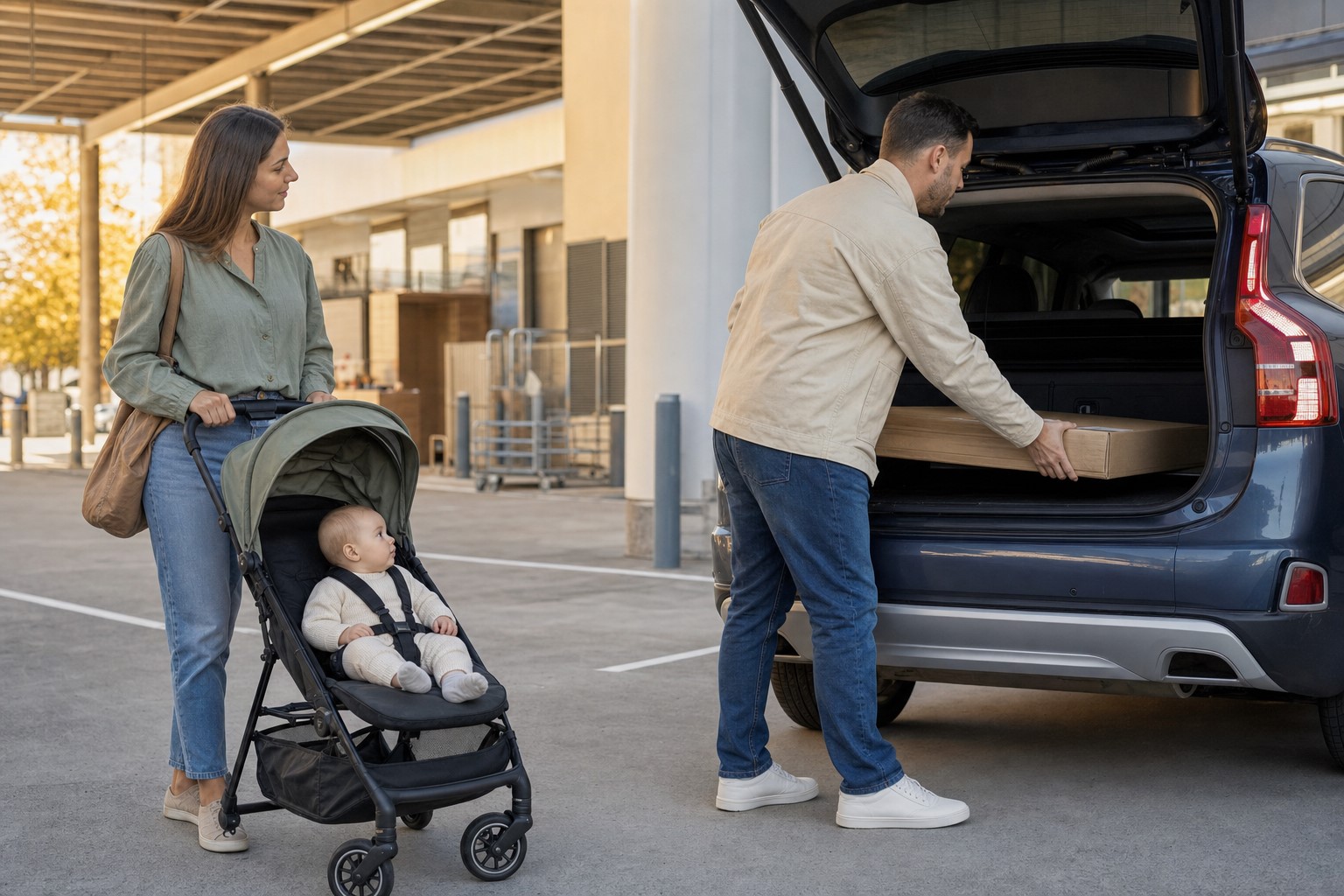
The two-adult loading rule
If two adults are present, name the roles before the first box moves: one watches the baby continuously; one handles the cart, flat packs, and vehicle. Do not both stare into the cargo area while the stroller sits behind you. Set the stroller brake in a safe place away from moving vehicles and loading traffic.
Secure cargo so it cannot shift toward the child restraint in a sudden stop. Never wedge a flat pack against the car seat, route cargo over the seat, or compromise the vehicle seat or car-seat installation. If the item does not fit safely, return it, arrange delivery, or make a second trip.
If you are loading alone
Use staff-assisted pickup or delivery when available, and confirm the current process with the store. Keep the baby with you and supervised throughout. The moment a box requires you to leave the baby, block traffic, or defeat the car-seat setup, the purchase has become a logistics problem—not a parenting test.
Your IKEA-with-baby plan in 45 seconds
- Check the item, stock, store hours, facilities, route and pickup options.
- Choose stroller, carrier, or an age-appropriate restrained cart seat.
- Feed and change near arrival; write a 60- to 90-minute exit time.
- Follow only the showroom rooms connected to the list.
- Use the care stop before marketplace and checkout at the first true overload cue.
- Load with one adult supervising baby and plan the car nap before driving.
You are not failing IKEA if you skip half of IKEA. You are completing the mission with the baby you actually brought.






What viewers said10 comments · 4 replies+
Archived comments from the original Baby Sleep Miracle presentation. Not independently verified by SleepBaby.org; individual experiences vary.
Thank you so much for this video! I had no idea about the dangers of baby swings :O
Hi Mary-Ann. I have a question: Is method in any way similar to the ones recommended by Dr Bucknam, Dr. Weissbluth or Dr. Karp? We tried those but none of them help.
Hi Regina, thank you for your question. The short answer is no. The techniques I share in my guide are based on newest scientific research and this is why I have never seen any approach similar to the one I recommend.
This method really works! I tried it on my son Jesus and after just one week he went from waking up more than 5 times a night to waking up just once or twice. You are a lifesaver, Mary-Ann!
I'm truly impressed with how much information you share in your video. And all for free! I can feel that you truly care about mothers like myself, and that's hard to find these days. I have recommended your site to several of my friends already.
Mary-Ann, our child suffers from autism. Is your approach still suited?
Chloe, I made sure my method can be used with any child, even babies who are special like yours. Please note that I'm not a doctor and that I always advice to consult with your physician because nothing is more important than the safety and well-being of your love.
Hallo Mary-Ann, I'm from Germany. Do you have your guide in German?
Hello Heide, we do! Normally you should already see our video in German. If not, please contact our support so they can guide you
Thenk you for your answer, Mary-Ann!
I just completed your approach and I have to say, it worked almost too well. Yes, it took a bit of getting used to with your bedtime routine but the difference is huge. My son George used to take 1 hours to go down and now he's firmly asleep in no more than 10 minutes! You're the best!
It seems I'm the only man watching this video, lol! What you shared about the 'emotional backpack' made immediate sense to me and I can't wait to help my little girl Mila to unpack it!
Hey there, just discovered your site and this really sounds different. Just wanted to say thanks for sharing :)
For everyone who's still thinking about getting Mary-Ann's guide I want to advise you to go ahead. I wasn't sure myself but now I'm so thankful I invested in this program. It made a huge difference in our life as a family and yes, my baby girl does sleep through the night now.