Tonight’s answer
One late dinner needs an exit plan, not a perfect performance
Taking baby to dinner past bedtime can be workable for one evening, but it may make that night messier. Keep feeding and safe sleep nonnegotiable, decide what tired cue means “ask for the check,” and leave before manageable fussiness becomes full distress. If your baby sleeps in a correctly installed car seat while the vehicle is moving, transfer them to a firm, flat, separate infant sleep surface as soon as you arrive.
Before you go, choose tonight’s route: go as planned, modify the reservation, or skip it. Then pick one adult who can leave with the baby without turning the table into a committee meeting. Tomorrow, return near your ordinary rhythm. Do not keep an exhausted baby awake, erase a needed nap, or build a punishment schedule to repay one unusual dinner.
Make the decision while everybody is still wearing both shoes
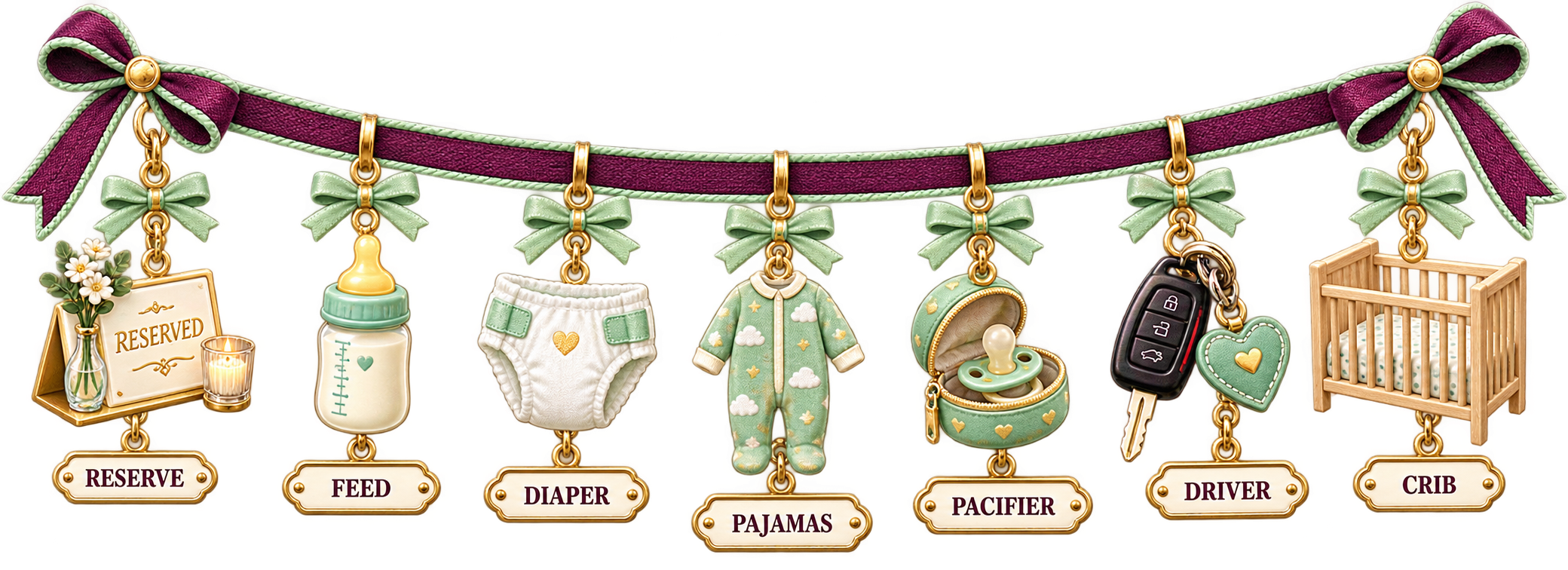
Go, modify, or skip: a one-minute decision before dinner
No study can tell you whether your particular baby will peacefully inspect a bread basket at 7:30 p.m. or object to the reservation with their whole body. Research on bedtime routines and sleep timing mostly looks at repeated patterns, not one isolated family dinner. That means the honest answer is neither “one night ruins everything” nor “one night can never matter.” The night may wobble. Your overall routine is still built by what happens most days.
Go
Baby is well, feeding is on track, the last nap was reasonably restorative, transportation is safe, and you can leave promptly. The meal is close enough to home that a hard turn does not become a long extraction.
Modify
Ask for the earliest seating, move from a long dinner to one course, order immediately, bring an approved sleep surface if you will be at a private destination, or send one adult home with baby after the main course.
Skip
Baby is ill, feeding poorly, unusually sleepy, already unraveling, or has medical or growth instructions that the outing would disrupt. Also skip when the only sleep plan is a booth, stroller, carrier, or parked car seat.
Declining does not mean the routine won. Going does not mean you are reckless. You are choosing between real tradeoffs: family connection, travel, feeding, stimulation, sleep, and how much recovery capacity the adults have tonight. If dinner logistics are the main problem, our broader guide to taking a baby to a restaurant covers venue, seating, packing, and table details. This guide stays with the bedtime decision.
A very ordinary 7:12 p.m.
The check is not coming, and the eye rubbing has started
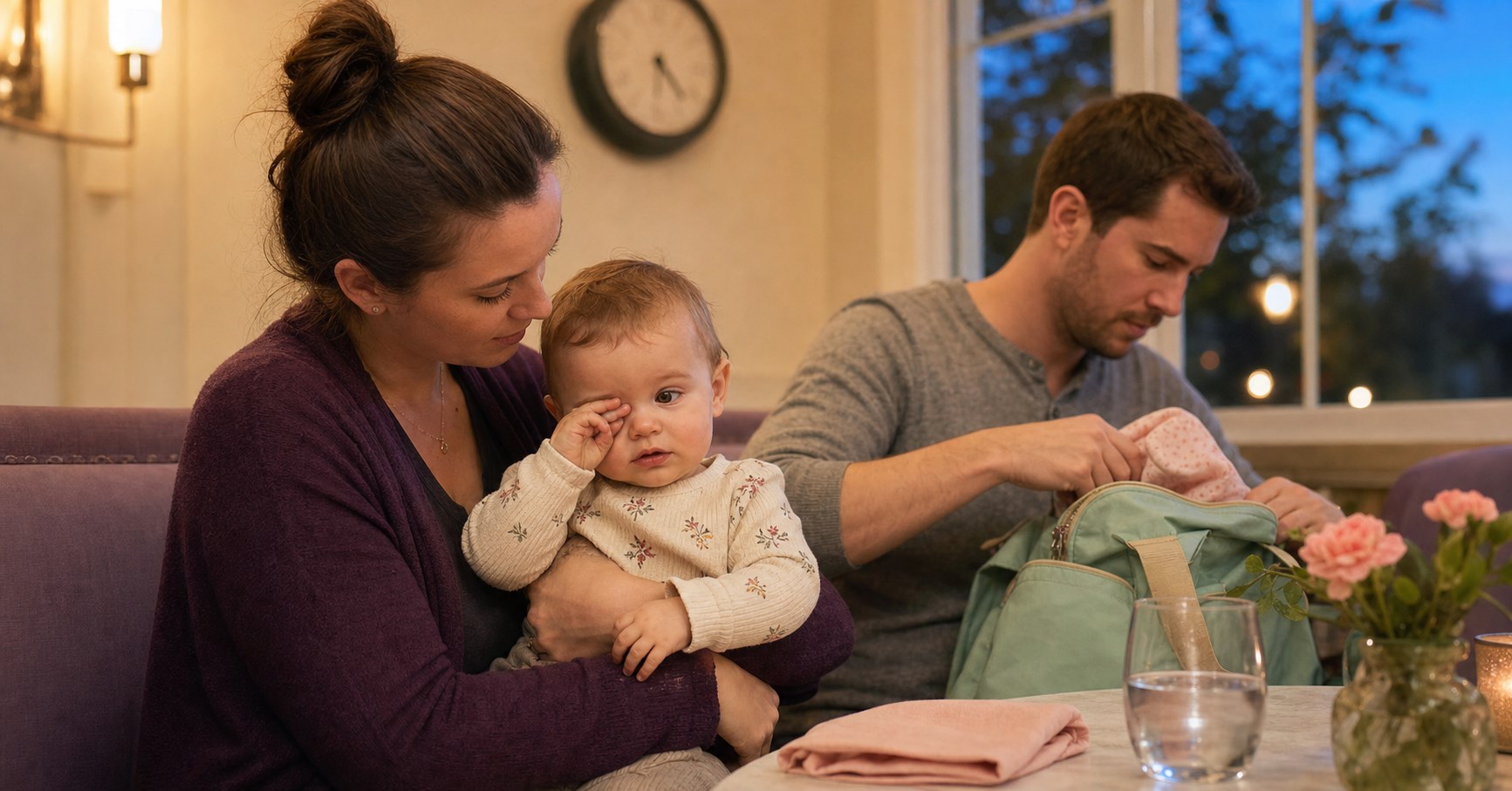
You planned well. The reservation was for 6:30. Your baby ate, wore pajamas, and arrived interested in the lights. Then the kitchen ran behind. At 7:12, one hand goes to one eye. By 7:18, the spoon is on the floor, the menu is offensive, and a relative says, “They don’t look tired to me,” as if the baby has submitted a minority report.
This is the hinge. If you wait for proof beyond reasonable doubt, the proof may be loud. I would signal the server, ask for boxes and the check together, and let the adult assigned to the exit stand up now. No apology tour is required. A baby who is still able to look around, accept comfort, and recover after a brief reset is giving you a warning. A baby who cannot be soothed or refuses needed feeding is telling you the experiment is over. Repeated stiffening, poor responsiveness, or a glazed and disconnected look are not ordinary tired cues. Stop treating this as bedtime and seek urgent medical help.
The win is not finishing dessert. Dessert is not a developmental milestone. The win is recognizing the turn while the exit is still calm enough to use.
The three clocks at the table
Read the baby clock, the meal clock, and the exit clock together
A late dinner becomes easier to manage when you stop asking one clock to answer every question. The wall clock says bedtime passed. Your baby may still be steady, or may already be done. The kitchen may be about to deliver food, or may have no estimate. The car may be five minutes away, or the coat-check line may have formed a small government.
| Clock | What to read | What changes the plan |
|---|---|---|
| Baby | Last sleep, feeding, illness, engagement, recovery after comfort, and tired cues | Distress, poor feeding, unusual sleepiness, or inability to recover means leave |
| Meal | Has food arrived? Can it be boxed? Is the check ready? Is another course actually necessary? | Uncertain delay favors shortening the meal before baby reaches the edge |
| Exit | Distance to car or home, weather, coats, parking, safe driver, and who is leaving | A complicated exit should begin earlier, not after the meltdown starts |
The American Academy of Sleep Medicine recommends 12 to 16 total hours in 24 hours for infants 4 through 12 months and 11 to 14 hours for children ages 1 through 2, both including naps.5 Those are regular sleep-duration ranges, not a rule that sleep must begin at one exact minute. For babies younger than 4 months, the panel did not set a duration range because normal patterns vary widely. Feeding, health, and individualized clinical instructions lead.
Build the exit before you leave home
The plan can fit on one phone note. It does not need color coding, a laminated pouch, or the confidence of someone who has never searched a dark restaurant floor for a pacifier.
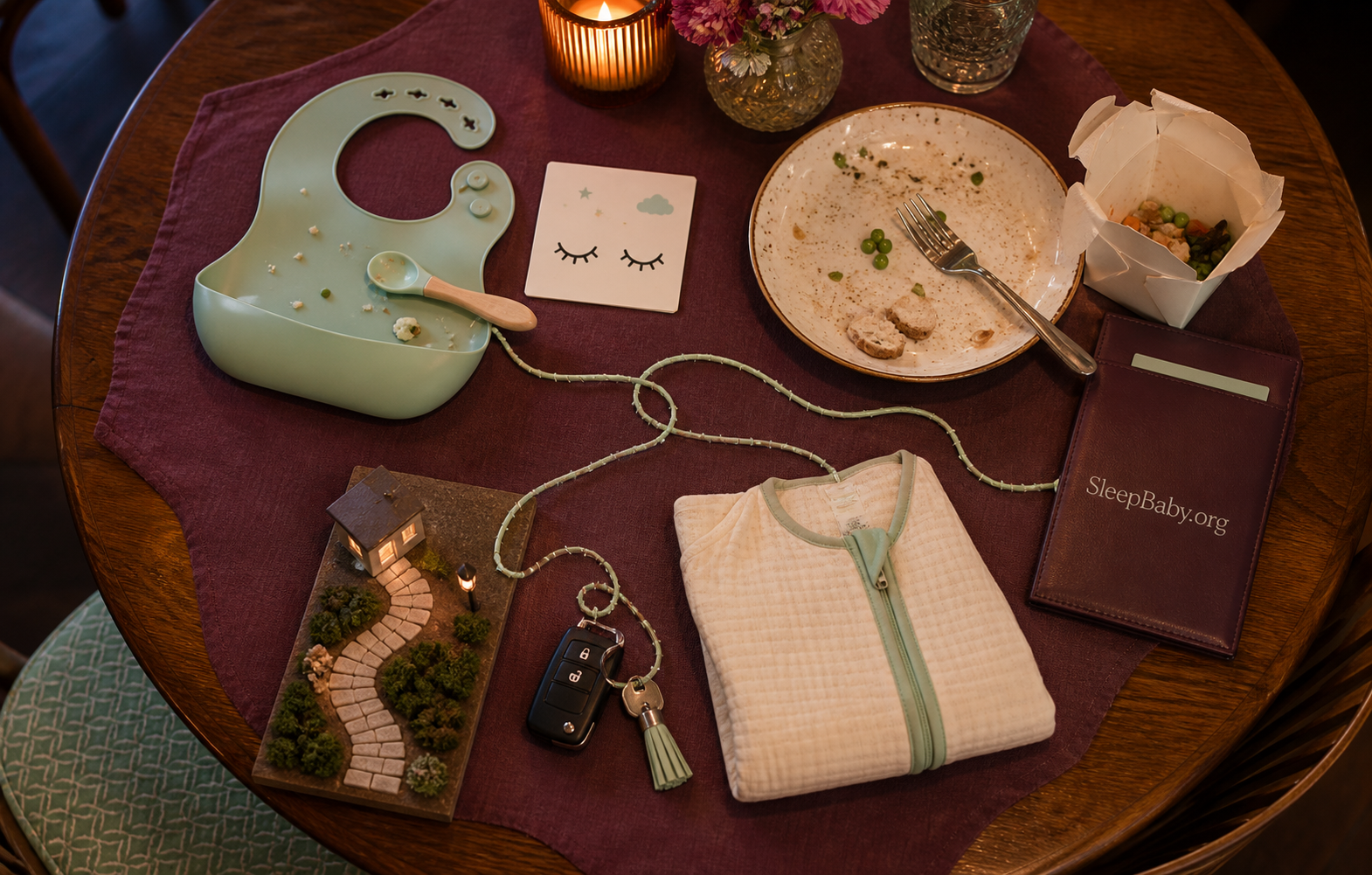
- 1. Name the earliest exit: Decide the first tired cue that will make you ask for the check. Eye rubbing plus a lost ability to re-engage is more useful than “if things get bad.”
- 2. Name the leaving adult: One person can take the baby home while the other settles the bill or stays. Agree before family pressure and hunger join the discussion.
- 3. Protect the needed feed: Bring what your baby already uses, follow storage rules, and do not delay hunger because the reservation is running late.
- 4. Name the sleep destination: Home, or a separate approved crib, bassinet, portable crib, or play yard at a private destination. A restaurant booth and travel gear are not the destination.
- 5. Protect the driver: The least tired, unimpaired adult drives. If no adult can drive safely, change transportation or leave earlier.
For a newborn, a baby born early, a baby with growth or feeding concerns, or any child with a clinician-directed feeding schedule, the medical plan outranks dinner. If you are wondering whether the clock should delay a feed, our guide to feeding versus bedtime keeps that decision separate from restaurant timing.
Pack routine cues, not sleep-space fillers
A pacifier your baby already uses, pajamas, one small book, and the same song can make the transition recognizable. If you bring a sleep sack, keep it packed until your baby is on the approved sleep surface. Do not put a bulky or unapproved layer beneath the car-seat harness. A blanket, pillow, stuffed animal, positioner, lounger, extra mattress, or stroller cover does not become a safe infant sleep item because the evening is special. For babies under 1, use a firm, flat, noninclined sleep surface intended for infant sleep, a fitted sheet, and an otherwise clear space.12

At the table, shorten the wait before you shorten your patience
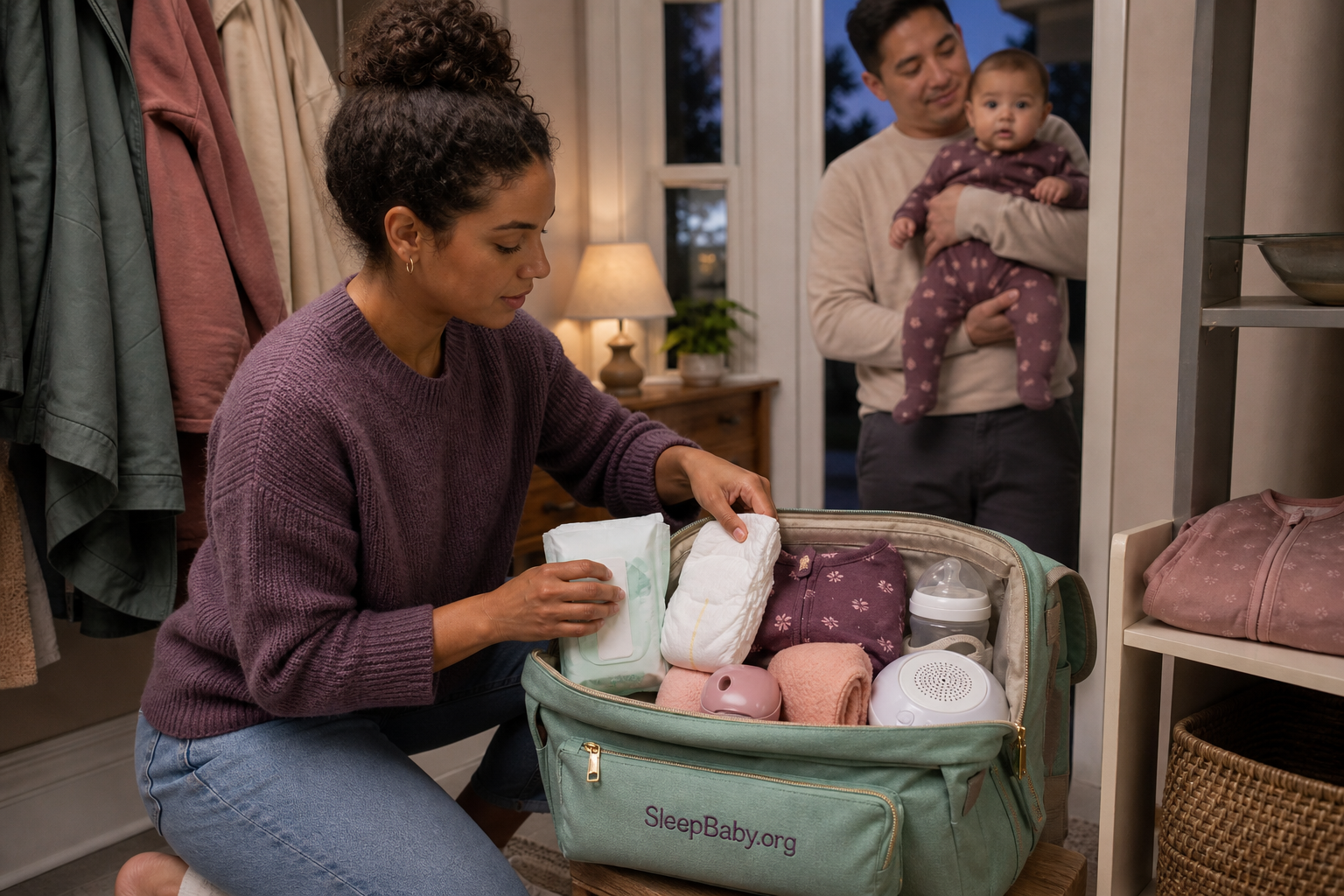
Tell the server kindly that you may need a quick exit. Ask whether the kitchen can fire the baby’s food first when appropriate, and place the full adult order early. Request the check when the main dishes arrive rather than after everyone has debated dessert. This is not rude. It is an ordinary accommodation that also makes the final ten minutes easier for the staff, the baby, and the parent currently wearing applesauce.
Seat the baby away from hot plates, sharp objects, dangling tablecloths, server traffic, and speakers. Use the high chair’s restraint system rather than treating the tray as a restraint. The Consumer Product Safety Commission’s high-chair standard addresses stability and restraints because falls and tip-overs are real hazards in both home and restaurant chairs.4 Inspect the chair before use. If it is broken, missing a strap, or unstable, ask for another plan.
Take turns eating if needed. One adult can walk with an awake baby or reset in a quieter area while the other eats, then switch. A reset is not a nap plan. Stay awake and attentive, keep the baby’s face visible, and return to the table or leave. If noise is making connection impossible, choose a quieter area or leave. The American Academy of Pediatrics advises avoiding or leaving excessively noisy settings and keeping infant sleep machines far from the baby’s head, at the lowest useful volume, for a short duration.11
Feed the baby in front of you, not the sample clock
There is no universal rule requiring every baby to finish feeding 30 or 60 minutes before bed. Follow hunger and fullness cues, the baby’s usual feeding pattern, and any individualized advice. The CDC describes hands to mouth, rooting, and lip movements as early hunger cues in younger babies, while turning away, closing the mouth, or relaxing the hands can signal fullness.6 Crying is often a late hunger cue. A late kitchen should not turn an early cue into an emergency.
Prepared formula should be used within two hours of preparation and within one hour after feeding begins; discard what remains after a feed and do not microwave it.8 Freshly expressed breast milk can generally remain at 77 degrees Fahrenheit or colder for up to four hours, with different windows once it has been warmed or offered. Follow current CDC storage guidance and use a cooler with frozen packs when needed.9
For solids, sit the baby upright in a safe high chair or other appropriate seat, prepare food for the child’s developmental skills, and watch continuously. Do not feed a baby while the car is moving, while they are reclined in a stroller, or while you are packing to leave. The CDC specifically advises seated, upright, supervised eating to reduce choking risk.10 If your child is no longer sitting upright or eating with their usual coordination, stop the meal. Milk feeds remain important through infancy, and the restaurant does not need to witness one final bite.
The dinner cue ladder
Steady, bending, done: know when to ask for the check
Steady
- Looks around and reconnects
- Accepts usual comfort
- Feeds with ordinary coordination
- Body stays relaxed
Move: Keep the meal simple and watch.
Bending
- Eye rubbing or repeated yawns
- Turns away from interaction
- Drops objects without re-engaging
- Needs more help to settle
Move: Ask for boxes and the check now.
Done
- Cannot recover with usual comfort
- Escalating cry or distressed body
- Refuses a needed feed
- Looks unusually drowsy or unwell
Move: Leave. Assess health and feeding, not manners.
A single yawn is not an evacuation order. A cluster and a clear change from your baby’s earlier state matter more. Trust the pattern you know without treating every behavior as a code you must solve perfectly.
If baby falls asleep, separate the ride from the destination
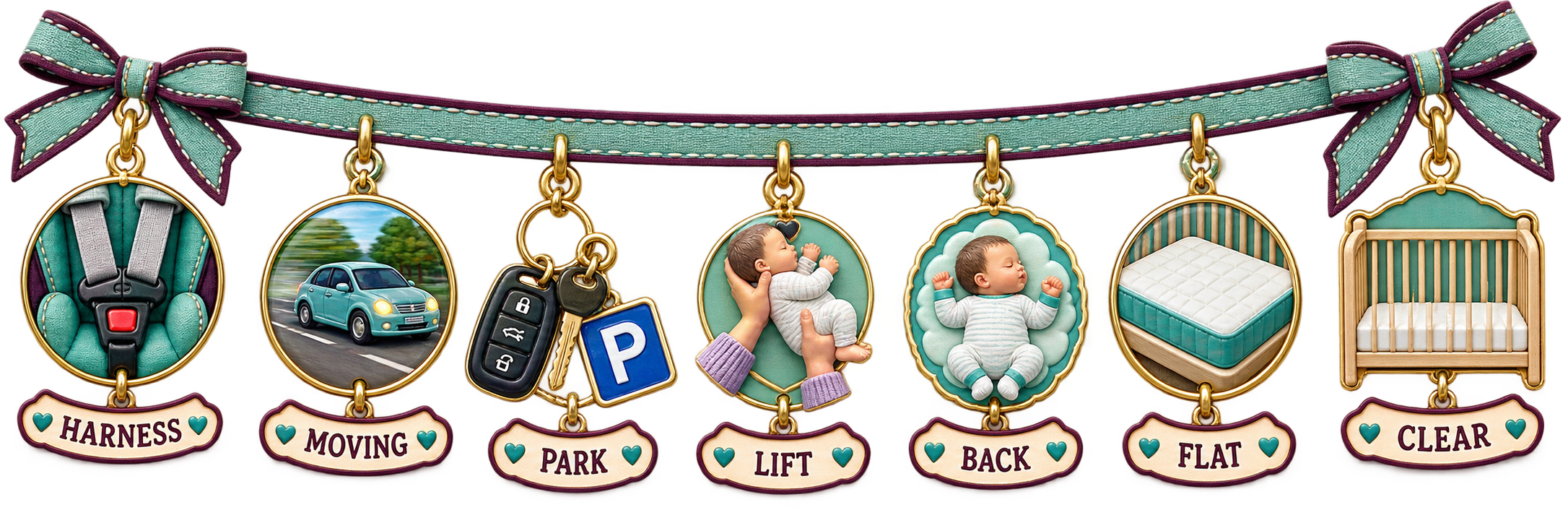
A baby may doze in a correctly installed car seat while the vehicle is moving. Keep the harness properly fitted for travel and follow the car-seat and vehicle instructions. NHTSA advises flat, untwisted straps in the correct slots, a buckled chest clip at armpit level, and a harness snug enough that extra material cannot be pinched at the shoulder.3 Do not loosen the harness to make sleep look more comfortable.
Once the ride ends, the car seat is no longer the sleep destination. The AAP advises moving a sleeping baby from a car seat, stroller, swing, carrier, or sling to a firm sleep surface on the back as soon as possible.1 Do not carry the seat into the restaurant as a plan for the whole meal, place it on a chair or table, or leave the baby sleeping in a parked vehicle. If you are dining at a relative’s home and bedtime will happen there, set up and inspect an approved crib, bassinet, portable crib, or play yard before the baby is tired.
If the ride-home doze changes bedtime, use our focused guide for when a baby falls asleep in the car before bed. The useful work here is simpler: keep travel safe, arrive, transfer, and decide bedtime from the baby’s actual state rather than waking them just to complete every decorative step of the routine.
The seven-minute landing
Shorten the routine, not the safety or connection
When you get home, meet the need in front of you. Feed if needed and appropriate, change a wet or soiled diaper, remove outerwear, and keep lights and voices low. Then use the smallest recognizable version of the normal sequence: sleep clothing, one book or song, a cuddle, and the safe sleep surface. If the baby wakes fully, respond. If they remain asleep through a careful transfer, you do not need to wake them so the bath can preserve its attendance record.
A consistent routine has evidence behind it. In a randomized trial of children ages 7 through 36 months, a repeated nightly routine improved parent-reported sleep onset, waking, and sleep continuity over three weeks.7 That supports familiar cues across ordinary nights. It does not prove that one shortened routine after dinner causes lasting trouble.
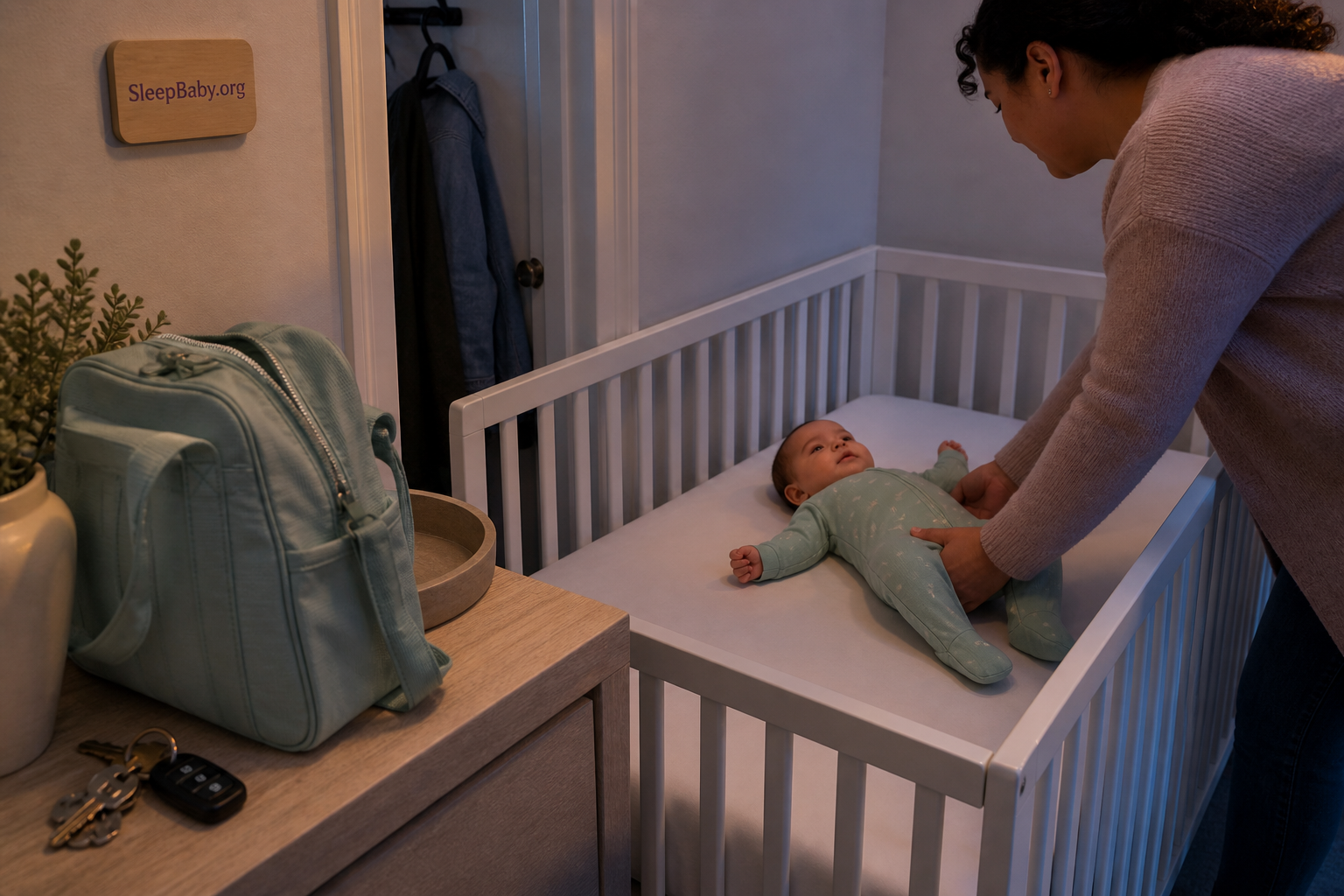
Place babies on the back for every sleep on a firm, flat, noninclined approved surface with a fitted sheet and no loose or soft objects. A baby who rolls independently may move after being placed, but you still start them on the back and keep the space clear. Never fall asleep with a baby on a sofa or armchair while trying to preserve the transfer. If you are too tired to hold safely, put the baby in the safe space and pause.
Watch: the safe destination after dinner
Five safe-sleep essentials in one minute
The American Academy of Pediatrics walks through the sleep-space check that still applies after a late meal: an approved bed, a firm flat mattress, a snug fitted sheet, a clear space, and baby placed on the back.
SleepBaby takeaway: restaurant lighting, a car doze, or a shortened routine never changes the landing. Travel gear gets you home. The approved sleep surface is where sleep continues.
Tomorrow is a return, not a repayment plan
A late dinner can produce a later bedtime, a wake during transfer, extra night waking, or an earlier morning. It can also produce very little drama. You cannot know which ending belongs to your baby before it happens, and you do not need a seven-step repair campaign at breakfast.
Tonight
- Meet feeding and comfort needs
- Transfer from travel gear
- Use the short familiar routine
- Place baby in the safe sleep space
- Respond to waking as you normally would
Tomorrow
- Begin the day near the ordinary morning
- Offer age-appropriate naps from actual wake times
- Feed responsively
- Use the usual bedtime cues
- Let one odd day remain one odd day
Do not wake dramatically early to “reset,” force a long awake stretch, delete a needed nap, or assume the baby will sleep late because bedtime was late. A small actigraphy study found that later sleep onset was associated with less nighttime sleep and only a small later shift in morning waking, though its sample was small and it cannot tell you what one dinner will cause.12 Keeping a baby up late is not a reliable sleep-in strategy.
If the entire rhythm has been difficult for several days, use a flexible baby sleep schedule to restore morning and bedtime anchors without forcing every nap onto a fixed clock. One variable at a time gives you information. Changing morning, both naps, feeding, and bedtime together gives you a very organized mystery.

If every dinner becomes a rescue, change the event instead of testing the baby
One special dinner is an experiment. A weekly reservation that repeatedly ends in distress is a pattern. Look at what repeats: the baby’s age, actual nap ending, travel time, feeding gap, noise, length of the meal, and how long the exit takes. Then change the earliest practical condition.
- Move the reservation earlier or choose lunch.
- Meet family for the first course and leave before bedtime.
- Eat at a private home with an approved sleep surface already assembled and inspected.
- Use a trusted sitter when the outing matters but the timing does not fit the baby.
- Choose takeout and keep the connection without the transition.
- Decline this season and try again after the schedule changes.
If the baby repeatedly falls apart before the ordinary bedtime even on quiet home evenings, the dinner may only be revealing a broader timing issue. Our guide to whether a baby needs an earlier bedtime helps you judge several days of sleep, mood, and settling rather than making a permanent change after one restaurant night.
I would rather see a family enjoy forty calm minutes and leave than spend two hours proving they can stay. Babies change. A 6:30 dinner that is impossible this month may be easy later. The plan is allowed to mature with the person who did not choose the reservation.
Age, health, and feeding change how much flexibility is reasonable
Newborns and young infants: Sleep and feeding are fragmented, day-night rhythms are still developing, and some babies must be awakened to feed. Follow hunger cues, growth guidance, and clinician instructions. A fixed bedtime may not be established, but safe sleep applies every time.
Older infants with a recognizable rhythm: A familiar sequence and a realistic exit can make one outing easier. Do not engineer an extra-long nap, withhold feeding, or keep the baby awake to reach dinner. Use the sleep the baby actually got.
Toddlers: They may tolerate a little more social time and make their opinions easier to identify, but overtiredness can still turn quickly. Continue to use an age-appropriate sleep surface and the restraint and choking precautions that fit their development.
Medical or developmental needs: Prematurity, poor growth, feeding or swallowing concerns, diabetes or metabolic conditions, reflux that is under medical care, medication timing, seizures, cardiorespiratory conditions, and other individualized needs can change the plan. Use the care team’s advice rather than a general dinner guide.
Seek urgent help for breathing difficulty, blue or gray color, unusual limpness, unresponsiveness, a seizure, or another acute safety concern. Call your pediatrician immediately if a baby age 3 months or younger has a rectal temperature of 100.4 degrees Fahrenheit (38 degrees Celsius) or higher.13 Contact your child’s clinician for new or persistent unusual sleepiness, poor feeding, repeated vomiting, much fewer wet diapers, pain, or a major unexplained sleep change. A schedule experiment is not the right response to a baby who seems unwell.
Questions parents ask before the reservation
Will one late bedtime ruin sleep training?
No study can promise how one evening will go, but sleep habits are built through repetition rather than one isolated clock time. Keep your response and safe-sleep setup recognizable, expect that the night may be different, and return to the ordinary rhythm tomorrow.
Should I make the last nap longer so baby can stay out?
Do not force or dramatically extend a nap for the event. Let the nap happen according to the baby’s real day. If sleep was short, move the dinner earlier, shorten it, or skip. A brief bridge nap may sometimes happen naturally for an older baby, but it can also push bedtime later.
Can baby sleep in the stroller at the restaurant?
A stroller is transportation, not a routine infant sleep destination. If a baby falls asleep in a stroller, car seat, swing, carrier, or sling, the AAP advises moving them to a firm sleep surface on the back as soon as possible. If the meal depends on a long stroller sleep, change the plan.
Should I keep baby awake in the car so bedtime still works?
No. The driver should focus on driving, and the baby should remain properly harnessed. If sleep happens during the moving ride, transfer on arrival and decide the next step from the baby’s state. Do not loosen straps or use unsafe stimulation.
What if family says we are leaving too early?
Use one sentence: “We’re at the cue we planned for, so we’re heading home.” You do not need to prove the baby will get worse. A planned exit is most useful before the room agrees with you.
Can we bring a portable crib to the restaurant?
A restaurant floor is generally not an appropriate place to set up an infant sleep product. A compliant portable crib or play yard can be useful at a private home or suitable destination when assembled exactly as instructed in a safe location. Ask the host and inspect the setup before bedtime.
Should we let baby sleep late the next morning?
Respond to the actual wake. Avoid forcing an unusually early start, but also avoid shifting the whole day dramatically after one dinner. Feed as needed, use morning light when the day begins, and offer naps from actual wake times.
Is staying out past bedtime ever worth it?
That is a family decision, not a developmental test. A meaningful celebration with a clear exit may be worth a less predictable night. A routine dinner that repeatedly leaves everyone distressed may be better as lunch, takeout, or an adult-only outing for now.
Let the evening bend without asking the baby to carry it
Return to that 7:12 table. The eye rub was not a failure, and asking for the check was not surrender. It was the moment the plan did its job. You noticed the baby while the room was still talking about dessert.
Make the decision before you go. Feed responsively. Use the cue ladder. Keep the ride safe and the sleep destination firm, flat, separate, and clear. Then let tomorrow be ordinary. A family life with a baby can include dinners out, early exits, declined invitations, and months when takeout is the most elegant option available.
The goal is not a baby who never disrupts the plan. It is a plan that knows what to do when the baby tells the truth.
Sources
- American Academy of Pediatrics: How to Keep Your Sleeping Baby Safe
- U.S. Consumer Product Safety Commission: Safe Sleep
- NHTSA: Car Seat Installation and Harness-Fit Tips
- CPSC: Federal High-Chair Safety Standard
- American Academy of Sleep Medicine: Pediatric Sleep-Duration Consensus
- CDC: Signs Your Child Is Hungry or Full
- Mindell et al.: A Nightly Bedtime Routine Randomized Trial
- CDC: Infant Formula Preparation and Storage
- CDC: Breast-Milk Storage and Preparation
- CDC: Choking Hazards and Seated, Supervised Eating
- American Academy of Pediatrics: Preventing Excessive Noise Exposure
- Infant Sleep Timing and Nighttime Sleep: Actigraphy Study
- American Academy of Pediatrics: Fever and Your Baby
When bedtime arrives before the check
Turn one strange evening into one clear next step
The reservation can run late without taking over the whole night. SleepBaby helps you connect the nap that actually happened, feeding, the ride home, the safe landing, and tomorrow’s rhythm so you can make a plan that still works when the check is slow.






What viewers said10 comments · 4 replies+
Archived comments from the original Baby Sleep Miracle presentation. Not independently verified by SleepBaby.org; individual experiences vary.
Thank you so much for this video! I had no idea about the dangers of baby swings :O
Hi Mary-Ann. I have a question: Is method in any way similar to the ones recommended by Dr Bucknam, Dr. Weissbluth or Dr. Karp? We tried those but none of them help.
Hi Regina, thank you for your question. The short answer is no. The techniques I share in my guide are based on newest scientific research and this is why I have never seen any approach similar to the one I recommend.
This method really works! I tried it on my son Jesus and after just one week he went from waking up more than 5 times a night to waking up just once or twice. You are a lifesaver, Mary-Ann!
I'm truly impressed with how much information you share in your video. And all for free! I can feel that you truly care about mothers like myself, and that's hard to find these days. I have recommended your site to several of my friends already.
Mary-Ann, our child suffers from autism. Is your approach still suited?
Chloe, I made sure my method can be used with any child, even babies who are special like yours. Please note that I'm not a doctor and that I always advice to consult with your physician because nothing is more important than the safety and well-being of your love.
Hallo Mary-Ann, I'm from Germany. Do you have your guide in German?
Hello Heide, we do! Normally you should already see our video in German. If not, please contact our support so they can guide you
Thenk you for your answer, Mary-Ann!
I just completed your approach and I have to say, it worked almost too well. Yes, it took a bit of getting used to with your bedtime routine but the difference is huge. My son George used to take 1 hours to go down and now he's firmly asleep in no more than 10 minutes! You're the best!
It seems I'm the only man watching this video, lol! What you shared about the 'emotional backpack' made immediate sense to me and I can't wait to help my little girl Mila to unpack it!
Hey there, just discovered your site and this really sounds different. Just wanted to say thanks for sharing :)
For everyone who's still thinking about getting Mary-Ann's guide I want to advise you to go ahead. I wasn't sure myself but now I'm so thankful I invested in this program. It made a huge difference in our life as a family and yes, my baby girl does sleep through the night now.