Skip to content
Parent Library Taking Baby Places

Taking Your Baby to Church: A Low-Stress First-Sunday Plan

A calm, practical plan for taking your baby to church—with real guidance for timing, feeding, crying, germs, noise, naps, and the nursery.

I once arrived twelve minutes early for church and still chose the geographical center of the longest pew. That is how I learned that aisle seats are a form of spiritual wisdom.

The diaper waited for the first hymn because apparently it respected the prelude. My bag was under three coats. The wipes were in a pocket I had not known existed. By the time I reached the lobby, I was carrying a baby, a changing pad, and the expression of a woman who had briefly forgotten how doors work.

Nothing terrible happened. We changed the baby, took a breath, and went back in.

That is the whole philosophy of taking a baby to church: arrive, adapt, step out when care requires it, and return if you want to. Your first Sunday is reconnaissance, not a final exam.
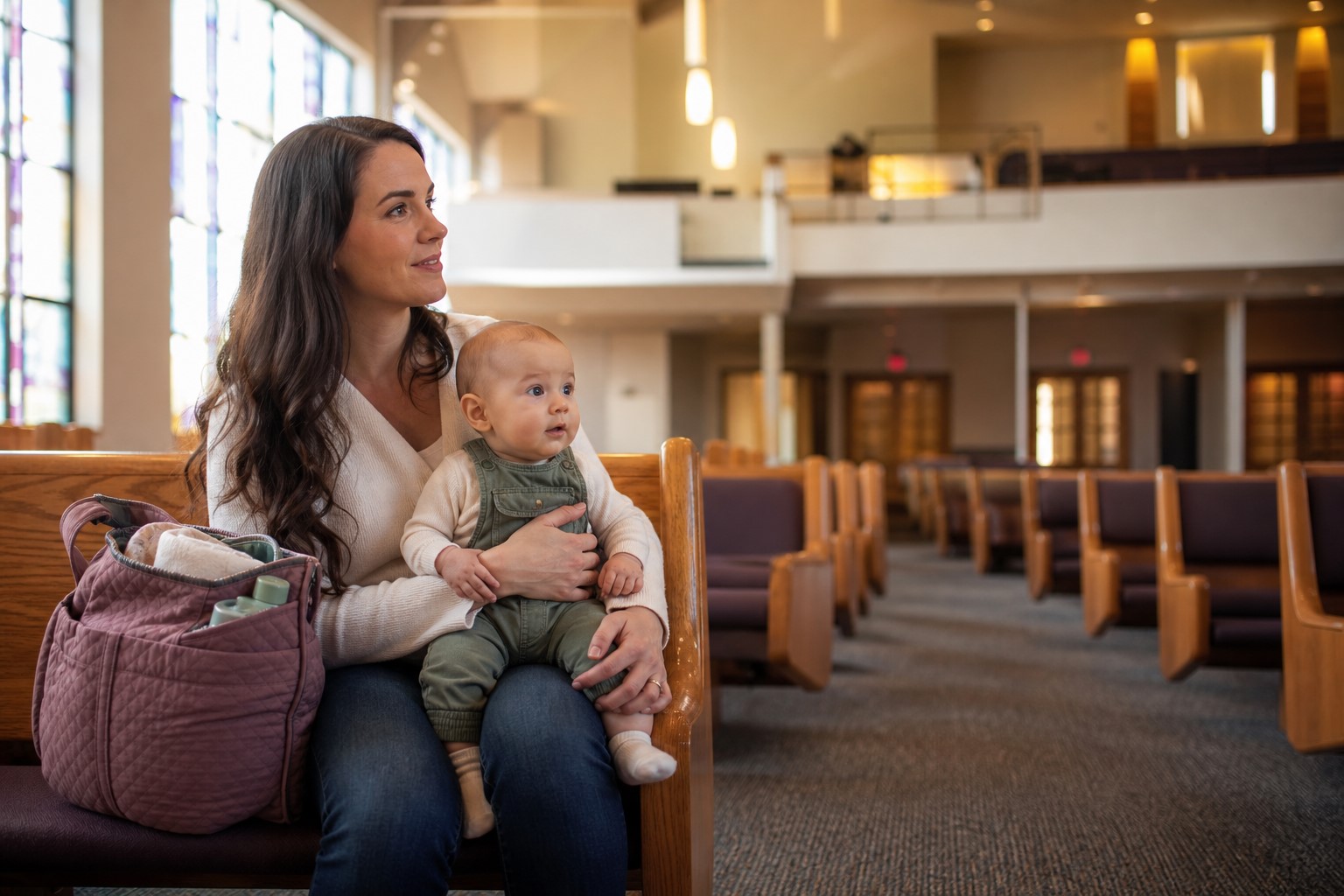
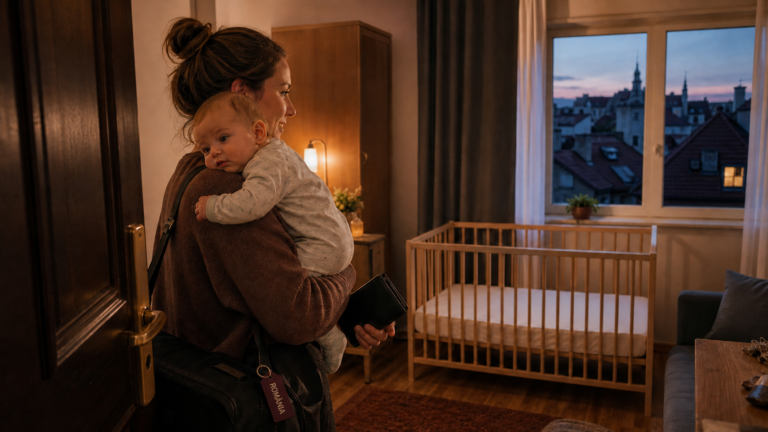
Mother holds an alert baby at the aisle end of a church pew beside an organized diaper bag.
A practical seat can lower the pressure: stay near an aisle, keep the small bag within reach, and treat movement as part of the plan—not proof that the morning failed.

When can you take a newborn to church?

There is no single age that makes every newborn ready for a crowded indoor service. Nemours KidsHealth explains that healthy newborns can go out, while parents should use extra care around crowds and sick people—especially in the early weeks. Your baby’s birth history, health, local respiratory-virus activity, and your pediatric clinician’s advice matter more than a date copied from another family.

Ask for individualized guidance before a crowded indoor gathering if your baby was premature, has an immune or heart/lung condition, has feeding or growth concerns, or has recently been ill. If your baby or anyone in your household is sick, staying home may be the kindest plan for your family and the congregation.

For a healthy baby and a comfortable caregiver, a lower-attendance service, well-ventilated space, outdoor gathering, or brief visit can be a gentler first try. You do not have to begin with Christmas Eve at maximum capacity. If your congregation runs large, use our guide to plan for a larger church crowd.

The First-Sunday Flight Plan

I want you to plan for movement without treating your baby like a disruption. You do not need to promise yourself a silent service before you are allowed to attend. The best plan is not “nothing will happen.” It is “we know what to do when something happens.”

The First-Sunday Flight Plan

Five stops. No perfect-performance requirement.

☎️ Call
Ask about entrances, feeding space, nursery, sound, and service length.
🕰️ Arrive
Come 10–15 minutes early so the building is not your first surprise.
📍 Anchor
Choose an aisle near an exit, but not beside the loudest speaker.
🤲 Care
Feed, change, soothe, move, or step out before the wheels come off.
↩ Return
Go back in, stay in the lobby, or head home. All three count.

Call ahead once and remove five surprises

Start with the questions that remove a real surprise. A two-minute call or message can tell you more than an hour of anxious guessing. Ask:

  • Which entrance is easiest with a stroller or carrier?
  • Is there a family room, quiet lobby, or feeding space?
  • Does the congregation welcome feeding in the sanctuary?
  • Is nursery care available, and what ages does it accept?
  • How loud is the music, and where is the quietest seating?
  • How long is the service, and are there moments when leaving or returning is easier?
  • For baptism, dedication, blessing, or “churching,” what does this congregation actually call it and how is it scheduled?

Traditions vary. There is no universal age for a dedication or blessing, and not every church uses the same words. The congregation can answer its own practice better than a generic baby site.

Make the first visit lower-exposure, not germ-proof

A stroller or carrier can create useful personal space, but it is not an invisible force field. Baby mittens do not prevent respiratory viruses, and a sign cannot control the room. The practical protections are less glamorous:

  • Ask people not to kiss or touch the baby’s hands and face.
  • Let anyone who holds the baby clean their hands first.
  • Skip close contact with people who are ill.
  • Choose a less crowded or better-ventilated service when that matters for your baby.
  • Keep your baby’s recommended immunizations and preventive care current with their clinician.

CDC guidance emphasizes staying home when sick, hand hygiene, cleaner air, vaccination, and extra precautions during higher respiratory-virus activity. None creates zero risk. Together, they give you a more thoughtful first outing than “wait exactly six weeks.”

Is church too loud for a baby?

Do not assume that a church is safe or unsafe based on the word church. A quiet spoken service and a sanctuary with amplified drums beside your pew are different sound environments.

Sound risk depends on volume, distance, and duration. HealthyChildren and the NIDCD advise reducing exposure to loud sound, moving farther away, and using properly fitted hearing protection when loud sound cannot be avoided. If you have to raise your voice to be heard by someone at arm’s length, treat that as a sign to move away from the speakers or leave the loud area. That rule is a practical warning, not a decibel measurement.

For consistently loud worship, use well-fitting child hearing-protection earmuffs rather than improvising something inside a baby’s ear. Check the fit before the service and supervise. Hearing protection is not a reason to sit beside the sound system; distance still helps.

Protect feeds and naps without planning a laboratory-grade Sunday

Aim for a fed, changed baby and a caregiver who has eaten something. That is enough ambition for one morning.

If timing allows, feed before you leave or soon after you arrive. Pack what your baby actually uses and plan the feed-to-sleep transition around the service rather than expecting a newborn to respect the sermon outline.

Try to place the service inside a familiar awake period or near a nap your baby can take safely afterward. But do not hold a tired baby awake just to preserve the plan. One short, odd nap does not ruin sleep development.

If your baby falls asleep in a car seat, stroller, sling, or carrier, keep the airway visible and the baby positioned correctly, and move them to a firm, flat sleep surface when practical. AAP guidance does not treat sitting devices as routine sleep spaces. A church outing does not suspend safe sleep.

Pew or nursery? Choose the setting, not the “good parent” label

Two doors. Neither is a parenting grade.

Stay together in the pew

  • You want to keep feeds and cues in your hands.
  • Baby is very young or unfamiliar with the caregivers.
  • An aisle seat and quiet lobby make movement easy.
  • The sanctuary sound is comfortable from your seat.

Try the nursery

  • You understand check-in, pickup, ratios, and notification.
  • The illness, diapering, feeding, and safe-sleep policies feel sound.
  • Volunteers are screened, identified, and supervised.
  • You and baby are ready for a short separation.

Hybrid is allowed: begin together, visit the nursery, return to the pew, or spend the whole service in the lobby. You are learning the building and your baby.

Before using a nursery, ask how caregivers contact you, who may pick up the baby, how bottles and allergies are labeled, what happens if a baby cries, and where babies sleep. “There is a nursery” is not the same as “I understand this nursery.”

What to do when your baby cries in church

First: a squeak, babble, cough, or brief fuss does not require an emergency evacuation. Babies make human sounds because they are human. Grace Chapel’s “Crying Babies Belong in Church” lands on an important truth: presence does not require silence.

Second: belonging does not mean ignoring a need. The useful question is not “Are people looking?” It is “What does my baby need next?”

The Crying Reset Path

A loop back—not a walk of shame.

1 · Listen for ten calm seconds
Brief rustle or rising need? Do not let the whole room’s imagined opinion answer.
2 · Check the ordinary list
Hunger, diaper, temperature, position, tiredness, pain, or too much sound.
3 · Soothe in place or step out
Use touch, pacifier, feeding, movement, or a quieter room according to the need.
4 · Reset the adult too
Drop your shoulders. Trade caregivers. Get water. No one performs calm by clenching harder.
5 · Return, lobby, or leave
Choose the version that serves your family today. The morning still counts.

I would rather have you step out calmly and return than spend forty minutes white-knuckling one squeak. If crying is unusual, intense, paired with breathing or color change, fever in a young infant, poor feeding, limpness, or another sign that worries you, stop treating it as a church-behavior problem and get medical guidance.

Pack a quiet church bag—not a mobile toy store

Bring fewer things you can find quickly:

  • Diapers, wipes, disposal bags, and a compact changing pad.
  • One full clothing change for baby and, if space allows, one top for the adult who believes spit-up respects formalwear.
  • Your normal feeding supplies and a burp cloth.
  • A pacifier if your baby uses one.
  • One or two quiet items: a fabric book, soft teether, or silent fidget.
  • Age-appropriate snack and water for an older baby or toddler.
  • Proper hearing-protection earmuffs if the service is loud.
  • A carrier or stroller that you already know how to use safely.

Skip toys that sing when dropped, containers that explode like maracas, and anything you have never opened before. Church is not the ideal venue for discovering that a “quiet learning cube” has a demo mode.

For a mobile baby or 10-month-old

Older babies need a little more freedom and a little less contraband. Sit where you can stand or step out without climbing over six knees. Rotate one quiet item at a time. Point softly to light, windows, music, or familiar faces. Let an older baby stand supported at your knees if it is safe and does not block the aisle.

Do not expect an hour of stillness from a child whose current life mission is finding floor crumbs. A nursery, family room, or short lobby walk may be the developmentally reasonable choice.

After church: protect the rest of the day

When you get home, do not “fix” the outing by changing everything. Feed if needed. Offer the next nap at a reasonable time. Return to the ordinary bedtime routine.

If the ride home created a surprise snooze, use our guide to handle the car nap before bedtime. If Sunday timing repeatedly shifts the whole week, make one small change at a time as you reset the sleep schedule gently.

The first service gives you data: where the quiet seats are, whether the bag worked, when baby became tired, how the nursery communicates, and whether you need the earlier service next time. That is success—even if you heard half the sermon from the lobby.

Your first-Sunday plan in one minute

  1. Choose a service that fits health, crowds, sound, and likely feeding or nap timing.
  2. Call ahead about entrances, nursery, feeding, sound, and family space.
  3. Arrive early and anchor near an aisle, away from loudspeakers.
  4. Bring one compact bag and a caregiver handoff plan.
  5. Care for the baby in place or step out without shame.
  6. Return if you want, then resume the normal rhythm at home.

Your baby does not need to prove they deserve a place in the room. You do not need to prove you can keep them silent. Show up with a plan that bends, and let the first visit be exactly what first visits are: a beginning.

Sources

  1. Nemours KidsHealth: When Can I Take My Newborn Out in Public?
  2. NIDCD: Protect Your Child’s Hearing
  3. American Academy of Pediatrics / HealthyChildren.org: How Noise Affects Children
  4. CDC: Preventing Respiratory Illnesses
  5. CDC: Taking Steps for Cleaner Air for Respiratory Virus Prevention
  6. American Academy of Pediatrics / HealthyChildren.org: How to Keep Your Sleeping Baby Safe
  7. Tushbaby: 8 Tips for Taking Baby to Church
  8. Grace Chapel: Crying Babies Belong in Church
Your baby won't sleep. Yet again. You're tired. You feel helpless – desperate to help your baby sleep...

And yet, you need to get up because it hurts your heart to hear your baby cry.

SleepBaby.org

Hi, I'm Kacey! I'm about to show you a scientific approach to help your baby fall asleep.

Kacey Bailey with Benjamin

The SleepBaby.org Method is designed to work on newborns through toddlers and does NOT involve use of the controversial "cry it out" method. Whether you have a newborn or a toddler, this sleep method can work for you. In fact, it's the only thing that has worked for my baby and I've tried almost everything to get my little one to fall asleep and STAY asleep.

Did you know that some of the standard sleep advice, such as crying it out or co-sleeping, can negatively impact your child's nervous system? Many argue that these controversial methods may increase the likelihood of your child developing anxiety disorders and possibly panic attacks later in life. For this reason, our method does NOT encourage use of the heavily debated (and potentially dangerous) "cry it out" method.

The information I am going to share with you includes impressive, scientific research. References are available upon request.

But most notably, I am a parent just like you! My baby, Benjamin, refused to fall asleep and stay asleep. I certainly understand how it pulls on your heartstrings when your baby won't sleep.

For this reason, I worked hard to create SleepBaby.org. My mission is to help parents and babies alike to finally achieve high-quality, consistent sleep. The information I'm going to share with you has helped thousands of families to finally enjoy the restful sleep they have been missing.

Our Scientific Approach Helps Your Baby Fall Asleep & STAY Asleep

If your baby won't sleep, take a deep breath. It's about to get better.

If you're anything like me or the thousands of parents I've spoken to, I suspect you've likely tried a plethora of sleep training methods. Please be aware that many of these methods, such as crying it out, can be very dangerous and are totally inefficient.

Please don't risk your little one's health by taking risky approaches. Our sleep method will help you to enjoy a happier, more relaxed and easier-to-parent child.

Imagine having a baby (or young child) who looks forward to bed-time just as much as you do!

Truth is, all babies can learn how to fall asleep and stay asleep, regardless of age. You can even get your child to stay in the crib. I know it’s hard to believe. At one point in my life, I would have been the first to doubt it, but then I had a life-changing experience...

My baby wouldn't even nap anymore!

When Benjamin was born, my husband and I were elated. Like any parent, we thought he was the cutest baby on planet Earth, but even more fortunate was our discovery that he was an incredible sleeper! Our other mom and dad friends were constantly complaining about their restless nights, all while we felt like the luckiest parents in the world! However, when Benjamin turned 5-months old, things changed... seemingly overnight!

Everything changed.

Much to our dismay and shock, Benjamin started waking up hourly, or every three hours if we were lucky. My husband and I were constantly tired. The negative impacts of our sleepless nights started to appear in other facets of life, such as work and even in our marriage.

Initially, we thought this problem would be temporary and that we would soon go back to the earlier mentioned glory days of basking in our child's excellent sleep habits.

Sadly, we couldn't have been more wrong.

I was overwhelmed.

Needless to say, I was overwhelmed. In hindsight, I should've searched for a baby sleep solution before my many restless nights started negatively impacting my life, marriage, and work. Once my patience completely expired, I went online desperately searching for a solution. Sadly, my efforts felt fruitless.

I bought the books, the tapes, and even hired a $400 sleep consultant who simply told us to let our baby cry it out. Here are three MUCH safer sleep solutions you can start using today:

3 Tips If Your Baby Won't Sleep:

Unleash the Giggle Monster

Unleash your baby's inner giggle monster! Have you ever heard the popular saying that laughter is the best medicine? Just as it's true for adults, this age-old wisdom is equally true for your baby... especially when it comes to helping your baby sleep!

Stress is often largely to blame for why your baby won't sleep. Release your baby's built-up stress with laughter! Plus, what's cuter than hearing a baby laugh?

If your baby isn't laughing much, our baby sleep method is for you! You will learn the best ways to make your baby laugh. Most importantly, you'll discover WHY laughter is such a powerful tool in helping your baby sleep.

Adjust the Bedtime

If you think a later bedtime is the answer, you are mistaken. Sure, it's easy to think that a later bedtime would mean your child is more tired.

However, if your baby has been awake too long, his/her body can become full of energizing hormones such as adrenaline and cortisol. At increased levels, these hormones can energize your baby and sabotage your bedtime efforts. The last thing you want when your baby won't sleep are energizing hormones flowing throughout your baby's body.

To help prevent your baby from being awake too long, establish a solid sleep schedule. Our sleep method explains everything you need to know to help achieve an optimal bedtime routine.

Noise Can Help

Sure, it may sound entirely counter-intuitive to imagine that a noisy environment is better than a quiet one. Yet, it is based entirely on facts.

The correct sleep sounds can have a strong impact on your child by releasing anxiety and making your baby feel safe and protected.

Scientists have discovered that music has a profound impact on babies. Later in this presentation, I will give you access to our entire collection of baby sleep sounds.

A Faster Way to Help Your Baby Sleep.

Our scientific-based sleep method can finally solve your child's sleeping problems once and for all! Additionally, parents are able to quickly implement our best practices as the information is easy to digest and follow.

What You'll Discover:

  • The most effective alternatives to nursing or rocking your baby to sleep.

  • Ways to make your baby feel loved so he/she isn't crying for extra attention when it's time to sleep.

  • Simple ways to ease your baby's anxiety so he/she is calm when bedtime arrives.

  • Scientific-based baby sleep schedules specific to your baby's age.

  • Holistic ways to release and regulate your baby's natural sleep hormones (100% safe and drug-free!)

  • Our entire collection of miracle sleep sounds designed for baby sleep. The sounds we use remind babies of life inside the womb. This translates into a calmer baby and better sleep.

... and SO much more!

Includes 3 Bonuses:

baby sleep music

baby sleep music

I've received many success stories about these sounds designed just for babies. Our collection of these amazingly effective sounds have helped parents worldwide.

Better yet, studies have shown that sounds we use remind babies of life inside the womb. This translates into a calmer baby and better sleep.

Now it's your turn to unleash their power!

deep into dreams

deep into dreams

Did you know that babies begin dreaming 2 to 3 months prior to birth?

You may notice your baby making noises as he/she transitions between the stages of sleep. This can make you wonder if you should wake your baby... especially if you suspect he or she is having a night terror!

In this free bonus, you’ll discover simple steps to encourage happy dreams so your baby can sleep peacefully and undisturbed.

sleepy siblings

sleepy siblings

Trying to make one child sleep can be hard. When you have more than one baby or child, the struggle is doubled!

This bonus is all about sleeping siblings. Learning how to help two children fall asleep simultaneously simplifies their bedtime routine and saves you time.

Whether your children share a room or sleep separately, this free bonus will give you the answers you crave on how to help siblings (or twins) fall asleep at the same time.

Anna Olson with her family

I was insanely sleep deprived when I heard about you from my son's daycare. No matter what I tried, my baby wouldn't sleep and it was driving me crazy!

Honestly, I was a bit concerned your method might be more of the same, but I admit I was wrong. Your information is very intelligent, easy to follow, and unique.

Anna OlsonTampa, Florida
Paul Deleon with his baby

As a single dad, I am already tired and my baby's sleep problems made it even worse.

I used to come home from work dreading his bedtime because I knew I'd be up half the night. Since starting your method, he now sleeps through the entire night. Thank you, thank you, thank you!

Paul DeleonSydney, Australia
Diana Erickson with her family

Thank you for helping my baby finally sleep! I know that all parents have a hard time with getting their kids to bed, but we felt like we were having the worst time and felt so stuck.

Since using your sleep method, she goes right to sleep and stays asleep. I feel so refreshed since I'm no longer waking up throughout the night. My baby is now on a sleep schedule that makes her and I both much happier during the day.

Diana EricksonBristol, England

Satisfaction guaranteed · our promise to your family

Take 60 days to decide if it’s right for your family.

You have up to 60 days to explore the complete method and all three bonuses at your own pace. If it isn’t right for your family, email refund@sleepbaby.org within 60 days of purchase and we’ll refund 100% of the amount you paid—no explanation required.

60 full daysTime to explore the complete method

One simple emailNo forms, hoops, or phone calls

Every dollar backNo questions asked

Normally $20

Family-first pricing

Choose the price that feels comfortable today.

Every allowed amount includes the complete SleepBaby Method, all three bonuses, and the same money-back guarantee—nothing is removed or held back.

One-time payment · Instant access after payment Choose your price

or enter a different price

Any amount from $1.00 to $250.00 · Complete method included.

Choose Your Payment Method:

Secure, one-time checkoutNo subscription · Instant access after payment