
You can take a baby on vacation, but the useful plan starts with where they will sleep, how you will feed them and how you will get there safely. I would settle those three details before booking activities. A room described as “family friendly” and a journey that looks short on a map don’t answer them.
For your first trip, leave room to change direction. Choose an outing you can shorten, carry what you need if luggage is delayed, and confirm an appropriate infant sleep space before arrival. If your baby is very young, was premature, is unwell or has ongoing health needs, discuss the actual itinerary with their clinician before committing.

Make a BASE before you make an itinerary
I use four questions to turn a lovely destination into a workable baby trip. BASE means Bed, Access, Supplies and Exit. It’s a planning aid, not a medical assessment. Write your answers in a phone note and share it with whoever is traveling with you.
- Bed: Where will every night begin?
- Write down the exact crib, bassinet or play yard, who provides it and how you will confirm it is suitable. “The hotel has baby things” is an unanswered question.
- Access: How do we reach the essentials?
- Count the airport transfer, stairs, parking and walk back to the room. Find nearby medical care. A beach across the road can be easier than a famous attraction an hour away.
- Supplies: How will feeding and changes work?
- Plan milk storage, safe preparation water, clean feeding equipment and a realistic place to buy your usual diapers or formula. Decide what stays with you during the journey.
- Exit: What happens when this plan stops working?
- Know how to leave an outing, replace an unsuitable crib or shorten a driving day. Include the cost of that backup when you compare trips.
For example, a rental with a kitchen sounds convenient. If the bedroom is upstairs, there is no confirmed cot and the only airport transfer has no suitable car seat, the kitchen isn’t the decision that needs your attention first. Work through the unresolved pieces before adding restaurant reservations.
Keep one adult’s own needs in the note, too: food during the journey, a realistic driving limit, prescribed medicines and a chance to rest. A plan that assumes every adult can keep going indefinitely is fragile.
Choose the trip for your baby’s current needs
There is no age that makes every vacation easy. A newborn’s feeding and medical needs are different from those of a crawling nine-month-old. I would choose for the baby you have now, rather than hoping a new milestone will arrive before departure.
For elective flying, the American Academy of Pediatrics suggests ideally waiting until about two to three months, while noting that flying is generally possible earlier. That isn’t individual clearance, an airline rule or a promise that a baby has completed their vaccines. Ask your clinician about prematurity, recent illness, heart or lung conditions and other reasons your particular plan may need to change.
For a baby who is feeding often, consider a nearby base with short outings. For a mobile baby, consider how you will inspect the room and provide supervised floor time. If you are introducing solid foods, factor in a suitable place to sit and eat, familiar foods and cleanup. These practical needs matter more than finding a supposedly perfect travel month.
Also ask what kind of break you want. Visiting relatives may bring extra help, but only if everyone agrees on care and sleep arrangements. A resort may reduce meal preparation while adding longer transfers. A short stay nearby can let you learn what your family actually uses before a bigger trip.
Ask concrete questions before booking the room
Instead of asking whether a property welcomes babies, ask what will be there when you arrive. I would put these questions in one message so the answers are easy to keep:
- What exact infant sleep equipment is available, and is it reserved or only requested?
- Does it come with its correct mattress or pad and a properly fitted sheet? Can you see the model and instructions?
- Is there enough bedroom space to use it correctly beside the adults’ sleeping area?
- Is there a refrigerator suitable for storing milk, and can its temperature be checked? A drinks cooler or unverified minibar isn’t automatically suitable.
- Where can you wash and dry feeding equipment, and what safe water will be available?
- Are there stairs, an elevator, an accessible route for the stroller and a practical unloading place?
- What happens if you arrive late or the promised equipment is unavailable?
Save the response, but inspect what actually arrives. The AAP warns that hotel cribs and play yards may not meet current standards. Ask for a replacement if you have doubts. If you cannot resolve the sleep setup, change the arrangement before bedtime; don’t let a reservation become a reason to improvise a sleep surface.
For a rental or relative’s home, include pools, balconies, accessible medicines, cords and stairs in your questions. Photographs can help you plan, but they won’t replace an arrival check. A home that worked for a preschooler may have quite different hazards for a crawling baby.
When comparing prices, add the seat your baby will use, transfers, checked equipment, laundry and any change fees. A slightly more expensive room near your main activity may save repeated journeys. That is a family tradeoff, not a universal rule about which accommodation is best.
Do the room check before opening every suitcase
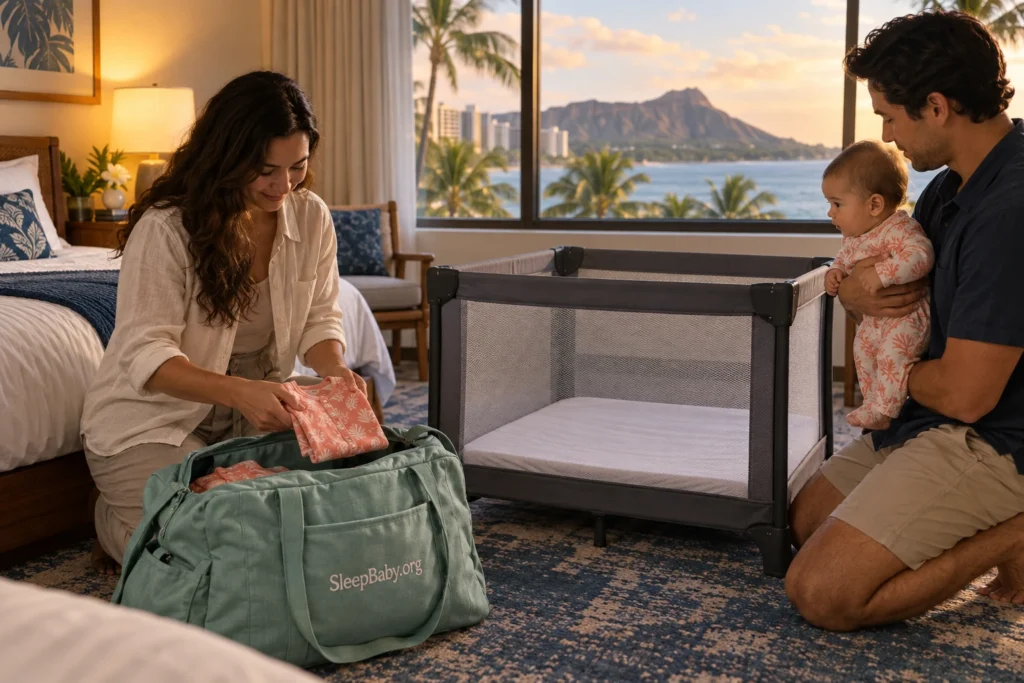
Once you arrive, I would give one adult the baby and the other the first few setup jobs. Traveling alone, put your baby in an appropriate secure place while you work, or ask for help with the luggage. Unpacking can wait.
- Inspect and assemble the sleep space. Follow its instructions, check the frame and locks, and use the correct manufacturer-provided pad. Don’t add a thicker mattress, folded blanket or topper to make a play yard feel softer.
- Make it bare. For infant sleep, use a firm, flat, level surface with its fitted sheet only. Put your baby on their back for naps and nighttime sleep. Keep pillows, loose bedding and toys out.
- Choose the position carefully. Keep the sleep space away from reachable cords, windows and heaters. Share your room, with your baby in their own sleep space, for at least the first six months.
- Set up the next feed and change. Check refrigeration, put cleaning supplies where you can find them and make a small changing station.
- Look from baby height. Check the floor for small objects, then check doors, stairs and access to water. Move medicines and cleaning products out of reach.
The NIH safe-sleep recommendations apply away from home, and CPSC recommends sleep products that meet applicable safety requirements. An adult bed, sofa, lounger or folded blanket on the floor isn’t a substitute for a suitable infant sleep space.
Before the first evening, decide who will handle a wake-up and where feeding will happen. If you are too sleepy to hold your baby safely, put them in their own sleep space and get help. Don’t plan to sleep together in an armchair.

Keep feeding familiar and plan the storage separately
Pack around the feeding method you already use. I wouldn’t make departure day the trial run for a new bottle, formula or elaborate washing system. Work through one ordinary feed from beginning to end: reaching the supplies, preparing safely, feeding, storing or discarding leftovers, and cleaning up.
For formula, follow the container’s exact mixing directions. CDC guidance says to use prepared formula within two hours of preparation and within one hour after feeding begins. If you won’t start within two hours, refrigerate it immediately and use within 24 hours. Discard leftovers after a feed. Don’t microwave bottles or dilute formula to stretch supplies.
Powdered formula is not sterile. Ask about the extra precautions for babies younger than two months, born prematurely or with weakened immune systems. Ready-to-feed liquid may be an option to discuss when safe preparation is difficult; after opening, its handling instructions still matter.
For expressed breast milk, CDC allows transport in an insulated cooler with frozen ice packs for up to 24 hours. Follow the separate rules for fresh, thawed, warmed and leftover milk; a cooler doesn’t restart a clock. Fresh milk’s room-temperature guidance assumes 77°F/25°C or cooler, so don’t apply it to a hot car or beach bag. Label milk so another adult knows which container to use first.
If you breastfeed directly, leave space in the day to feed and bring what makes that manageable for you. You don’t need to convert every feed into a bottle because you are traveling. If you pump, plan cleaning, power or batteries and what you will do if the room isn’t ready.
For a baby already eating solids, pack familiar age-appropriate food and provide a supervised seated eating opportunity. The practical question is where the next feed happens, not whether you can fit one more stop into the itinerary.
A LITTLE FAMILIAR, WHEREVER YOU LAND
The suitcase changes. The bedtime questions come with you.

The SleepBaby.org homepage introduces the SleepBaby.org Method and its information about bedtime routines and baby sleep schedules.
Once the cot is checked and the next feed is sorted, there is a smaller question: which familiar parts of bedtime will you bring into this room? A short book, a change into pajamas or the way you take turns with care can be easier to plan than a perfect holiday schedule.
If you want to spend more time thinking about ordinary routines and schedules, read about the Method on the homepage. Consider the information alongside your baby's needs and the practical guidance in this article. An unfamiliar room, a time-zone change or a missed nap doesn't come with a guaranteed sleep outcome.
Travel safety, milk handling and medical care remain separate decisions. This invitation doesn't replace a suitable infant sleep space, feeding guidance or your clinician's advice. It gives you a place to explore the everyday bedtime planning that continues both away and at home.

For a road trip, count care stops as travel time
A four-hour route on a map isn’t a four-hour baby day. Allow time to stop, feed, change and get your baby out of the seat. The AAP suggests breaks about every two hours; stop sooner when your baby needs care and follow any individual medical advice. That is a planning interval, not a guarantee that every baby should remain seated for that long.
Use a correctly installed rear-facing seat appropriate for your baby, with the harness and recline set according to the instructions. The AAP’s car-trip guidance explains why the installation angle matters: a chin-to-chest position can obstruct breathing.
I would pull over safely for feeds rather than turn feeding into another job in a moving car. Never take your baby out of their restraint to breastfeed while driving. With two adults, one can keep an eye on the baby from the back seat while everyone remains buckled.
When you arrive, move a sleeping baby to their appropriate sleep space as soon as possible once out of the vehicle. Don’t bring the car seat inside as the night’s bed. And don’t leave your baby alone in the car, even during a quick check-in.
Choose departure time around an alert driver as well as your baby’s routine. If the only way to finish is for an exhausted adult to drive through the night, split the journey or change the plan.

For a flight, plan the seat and the transfer together
The FAA says the safest place for a child under two is an approved restraint in their own aircraft seat. Buying that seat guarantees the space to use the restraint. Check its aircraft-approval label, size limits and installation instructions, and ask the airline about compatible seating before booking. A baby carrier is not a substitute for an approved aircraft restraint.
Don’t automatically choose an aisle seat for convenience. A child restraint must not block another passenger’s exit; the airline can confirm appropriate positions. Check stroller handling, baggage allowances and infant paperwork with your actual carrier. Those policies vary.
At U.S. security checkpoints, TSA allows formula, breast milk and baby food in quantities above 3.4 ounces/100 mL. Tell the officer at the beginning and remove these items for separate screening. Cooling accessories are also allowed. Screening still applies, so pack them where you can reach them without emptying the whole bag.
A pacifier, if your baby uses one, may help them swallow during pressure changes. Follow crew instructions and the restraint requirements when deciding when to feed; don’t unbuckle during required restraint periods just to follow a feeding tip. I would not use a sedating medicine to make travel easier. Ask your baby’s clinician about a medical concern.
Finally, solve the journey after landing. Reserve or bring the appropriate car seat and confirm the vehicle arrangement. The airport arrival isn’t the end of the transportation plan.
Pack a journey bag and a room bag
A short list organized by access is more useful than a long list organized by shop aisle. I would divide the supplies like this:
- Journey bag, kept with you: feeding supplies, diapers, wipes, changing mat, spare baby clothes, an adult shirt, bags for wet clothes, essential prescribed medicines, thermometer and necessary documents.
- Room bag: the rest of the clothes, laundry supplies, feeding-cleaning equipment and familiar bedtime items that are appropriate for your baby’s age and sleep setup.
- Equipment plan: car seat, stroller or carrier suited to the actual route, and confirmed sleep equipment. Practice folding or assembling unfamiliar equipment before departure.
Calculate diapers and feeds from your baby’s usual day, then add a buffer for delays and a realistic resupply plan. No universal number suits a two-hour drive, a long connection and a remote rental equally well. Essential medicines and the next feeds should not depend on checked luggage arriving with you.
Put one change into a small pouch you can remove with one hand. Keep clean feeding parts separate from used ones. If two adults travel, make sure either can find the essentials; “it’s in the blue pocket” stops helping when there are four blue pockets.
Optional: a changing kit that leaves the big bag behind
The Skip Hop Pronto Signature Changing Station is one named option to compare if retrieving your changing supplies is awkward. Check the manufacturer’s current description, dimensions and cleaning instructions against your own bag. I haven’t tested it, and the artwork here is an illustration rather than a product photograph.
Free or already-owned alternative: put your existing changing mat, diapers, wipes and a spare outfit in one small pouch. Practice reaching it without unpacking everything. A changing mat is for a supervised change, not infant sleep. Buy only if your current arrangement leaves a practical problem unsolved.
This section has no affiliate purchase link. As an Amazon Associate, SleepBaby.org earns from qualifying purchases through affiliate links elsewhere on the site.
Give each day one main outing and an easy exit
Choose one thing you particularly want to do, then build around it. I would treat a café stop, a short walk or sitting with relatives as real vacation time. Your baby doesn’t need an attractions quota.
Try making two versions of tomorrow:
- The ordinary version
- Feed and get ready without rushing, do the main outing, return for care and rest, then decide whether an optional late-afternoon activity still fits.
- The shortened version
- Stay close to the room, replace a long excursion with a brief local outing and cancel the optional plan. Use it when the journey ran late, feeding needs more attention or everyone needs a quieter day.
Decide your exit point before you are tired: the taxi stand, nearby parking or a route the stroller can actually manage. If one adult returns with the baby while another stays with older children, agree on keys, phones, supplies and transport first.
For heat, favor shade, cooler parts of the day and indoor breaks. AAP sun guidance prioritizes keeping infants under six months out of direct sun; use protective clothing and discuss sunscreen for small exposed areas when adequate shade and clothing aren’t available. Don’t drape a blanket over the stroller: NHS guidance warns it can cause overheating.
At a pool or beach, stay within arm’s reach and assign an attentive adult rather than assuming the group is watching. If your plan involves a theme park, the practical details change again; our baby’s Disney World day guide covers that specific setting.
Keep familiar bedtime steps, with room for the new clock
Choose the parts of bedtime you can reasonably repeat: feeding, a change, a familiar short book or song, and the appropriate sleep space. You may not reproduce the room, bath or exact timing. A smaller sequence is easier to carry than your entire evening at home.
Keep safe-sleep arrangements consistent even if settling takes longer. A nap in the stroller or carrier doesn’t make it a planned sleep destination; transfer your baby to an appropriate sleep surface as soon as possible. Don’t add pillows or soft padding to a travel cot because the room is unfamiliar.
With a time-zone change, expect to adjust your plans around your baby’s cues. Daylight at the destination and quieter evenings can help establish local day and night; the AAP includes light exposure in its travel advice. Avoid forcing long wake periods or withholding a feed to hit a holiday timetable. There is no dependable “one day per time zone” promise for your individual baby.
For a short visit, decide how much changing the clock is worth to your family. For a longer stay, allow some flexible days near the beginning. If naps are short, reduce the outing load before buying another sleep gadget or rebuilding the whole routine.
A baby who is unusually difficult to wake, feeding poorly or otherwise unwell needs assessment, not a bedtime experiment. Travel can disrupt routines, but it doesn’t explain every change.
Watch: a one-minute check for the sleep space
NICHD’s Safe Sleep for Your Baby is a short reminder to use when checking the room. It covers the sleep environment, not vacation logistics or a method for guaranteeing naps.
Written takeaway: give your baby a separate sleep space with a firm surface, put them on their back and keep soft objects and loose bedding out. Avoid overheating. If the player doesn’t load, read the complete official transcript or open the official NICHD video. Continue to follow current safe-sleep guidance and the equipment instructions.
Know where to get help before you need it
Save your clinician’s number, your accommodation address, the local emergency number and the nearest suitable medical service. Keep medication names, allergies and any care plan accessible. For an international trip, check insurance coverage for your baby, including how urgent care would be arranged.
Get emergency help for trouble breathing or a baby who is suddenly hard to wake. MedlinePlus identifies these as emergency warning signs. Don’t wait to return home or for the next scheduled feed.
AAP guidance says to call immediately for a rectal temperature of 100.4°F/38°C or higher in a baby three months or younger, even without other symptoms. For any age, seek medical advice when feeding falls off, wet diapers are markedly fewer, vomiting persists or your baby seems increasingly unwell. Tell the clinician where you have traveled.
Keep medicines secured and use only your baby’s prescribed or clinician-advised products and doses. A medication that helped another traveler isn’t a plan for an infant.
International trips need a separate preparation check
Bring the actual destination, departure date and activities to a pre-travel medical discussion. CDC recommends reviewing routine and travel vaccines, medicines, existing health conditions and access to care. Some destinations or activities may warrant postponing or changing the trip for a young infant.
Travel vaccine recommendations depend on age and itinerary. Don’t assume the routine home schedule alone answers the travel question. Ask early enough to make the necessary arrangements, and check current destination advisories rather than relying on another family’s past trip.
For international air travel, a baby needs their own valid passport. Confirm visas, entry requirements and any documents required when only one parent travels with the child. These depend on nationality and route. Keep copies separately from the originals.
Also confirm safe water for preparing feeds and cleaning equipment, availability of your baby’s formula, and transport compatible with an appropriate car seat. Don’t assume bottled water everywhere is suitable without treatment, or that a familiar brand name guarantees an identical formula abroad.

Leave yourself a small landing space at home
Before leaving, set aside what you will need for the first evening back: clean pajamas, feeding supplies and a usable sleep space. You will appreciate finding those before the laundry gets done.
After returning, resume familiar care and watch what your baby actually needs. I wouldn’t declare the routine ruined after one unusual night. Nor would I ignore illness because everyone is tired from the journey. Keep the first day manageable, refill the changing supplies and leave the suitcase sorting for a better moment.
Once you have caught your breath, keep two notes for next time: the thing you used constantly and the item that never left the bag. Your next packing list can come from your own trip.

Questions that come up before the first baby vacation
Is it worth taking a baby who won’t remember the trip?
The trip can be for the family’s time together. Whether it is worth the cost and effort is your decision. I would compare the actual days you could enjoy with the travel required, rather than judging the trip by photographs or how much your baby will remember.
Should I rent equipment or bring my own?
Bring what you can transport and know how to use, or verify the exact rental model, condition, instructions and availability. A rental can reduce luggage while adding uncertainty. If an essential item isn’t guaranteed, have a workable backup before booking.
Can relatives watch the baby while we go out?
Plan a clear handoff with a capable, willing caregiver: feeding instructions, sleep setup, contact details and what to do if plans change. Explain the current care routine instead of assuming everyone means the same thing by “put the baby down.” Start with an arrangement you feel comfortable using.
What if the weather ruins the plan?
Use your shortened version of the day. Choose accommodation where a quiet afternoon is possible, keep a few familiar play items handy and avoid making every meal dependent on a long outing. Booking fewer fixed commitments gives you more room to respond.
Sources
- AAP: Flying with Baby
- AAP: Travel safety tips
- AAP: Car-seat travel with an infant
- FAA: Flying with children
- CDC Yellow Book: Traveling safely with infants and children
- CDC Yellow Book: Travel vaccines for infants and children
- TSA: Traveling with children
- AAP: Sun safety and protection
- NHS: Keeping your baby safe in the sun
- CDC: Infant formula preparation and storage
- CDC: Breast milk storage and preparation
- Skip Hop: Portable changing pads / Pronto Signature Changing Station
- NIH Safe to Sleep: Reduce baby's risk
- MedlinePlus: When to use the emergency room for a child
- NICHD: Safe Sleep for Your Baby, official 60-second video transcript
- AAP: Fever and your baby
- CPSC: Safe sleep
- CPSC: Building baby safety from the ground up
- NHS: Dehydration
KEEP THE PART YOU CAN USE
Start with your BASE. Leave space for bedtime.
Confirm the bed, access, supplies and an exit plan. Then choose the familiar bedtime steps you can realistically take with you. For information about ordinary routines and baby sleep schedules, visit the SleepBaby.org homepage to read about the Method.





What viewers said10 comments · 4 replies+
Archived comments from the original Baby Sleep Miracle presentation. Not independently verified by SleepBaby.org; individual experiences vary.
Thank you so much for this video! I had no idea about the dangers of baby swings :O
Hi Mary-Ann. I have a question: Is method in any way similar to the ones recommended by Dr Bucknam, Dr. Weissbluth or Dr. Karp? We tried those but none of them help.
Hi Regina, thank you for your question. The short answer is no. The techniques I share in my guide are based on newest scientific research and this is why I have never seen any approach similar to the one I recommend.
This method really works! I tried it on my son Jesus and after just one week he went from waking up more than 5 times a night to waking up just once or twice. You are a lifesaver, Mary-Ann!
I'm truly impressed with how much information you share in your video. And all for free! I can feel that you truly care about mothers like myself, and that's hard to find these days. I have recommended your site to several of my friends already.
Mary-Ann, our child suffers from autism. Is your approach still suited?
Chloe, I made sure my method can be used with any child, even babies who are special like yours. Please note that I'm not a doctor and that I always advice to consult with your physician because nothing is more important than the safety and well-being of your love.
Hallo Mary-Ann, I'm from Germany. Do you have your guide in German?
Hello Heide, we do! Normally you should already see our video in German. If not, please contact our support so they can guide you
Thenk you for your answer, Mary-Ann!
I just completed your approach and I have to say, it worked almost too well. Yes, it took a bit of getting used to with your bedtime routine but the difference is huge. My son George used to take 1 hours to go down and now he's firmly asleep in no more than 10 minutes! You're the best!
It seems I'm the only man watching this video, lol! What you shared about the 'emotional backpack' made immediate sense to me and I can't wait to help my little girl Mila to unpack it!
Hey there, just discovered your site and this really sounds different. Just wanted to say thanks for sharing :)
For everyone who's still thinking about getting Mary-Ann's guide I want to advise you to go ahead. I wasn't sure myself but now I'm so thankful I invested in this program. It made a huge difference in our life as a family and yes, my baby girl does sleep through the night now.