
Camping with a baby can be a lovely first family adventure, but the safest version is usually not the most ambitious one. Start with one night at a developed campground, close enough to leave without a heroic drive, and bring a real infant sleep space that works just as safely inside the tent as it does at home.
Can you take a baby camping?
Many healthy babies can go car camping when the adults can provide safe sleep, clean feeding, appropriate clothing, protection from sun, smoke and insects, constant supervision, and a quick way home. There is no universal minimum camping age and no single outdoor temperature that makes every trip safe or unsafe.
Prematurity, a medical condition, current illness, feeding trouble, an extreme forecast, wildfire smoke, unreliable water, a remote site, or adults who are already running on fumes can change the answer. In those cases, simplify the trip, ask your baby’s clinician about the specific concern, or postpone.
The question is not, “Can a baby survive a night outdoors?” The useful question is, “Can we reproduce the baby’s essential care after dark, when the clean burp cloth is somehow under the firewood bag and everyone is wearing a headlamp?” That version leads to much better decisions.
The American Academy of Pediatrics and the U.S. Consumer Product Safety Commission say the safe-sleep basics do not change when a family travels: place baby on the back for every sleep, use a firm, flat, non-inclined surface in a compliant crib, bassinet, portable crib or play yard, and keep the space bare except for a fitted sheet.12 A tent is a location, not an exemption.

Make the first camping trip almost suspiciously easy
I would make the first trip almost suspiciously easy: choose a reserved, developed campground with legal overnight use, reliable drinking water or enough water you bring yourself, working toilets, a short walk from parking to the site, and a predictable drive to medical care. A one-night stay close to home teaches you more than a three-night trip that requires you to keep going after the plan has stopped working.
Look at the exact campsite map rather than the campground’s prettiest photo. Check how far the tent pad is from parking, water, toilets, open water, steep drops, cooking areas and neighboring fire rings. Ask whether a bear locker is provided, whether potable water is currently available, and whether generators, quiet hours or seasonal closures will affect bedtime. Read the local rules for food storage and fires. “We assumed” is not a useful campsite system.
A nearby campground is not a lesser adventure. It is a better laboratory. If the baby has an ordinary hard evening, you can practice settling. If the baby is unwell, smoke rolls in, the tent leaks, or both adults are too tired to make careful decisions, you can leave. The best first campsite is the one that lets you be home at 2:13 a.m. without needing a rescue story.
Run this go, simplify or postpone check
Go
Baby is well and feeding normally. The site has safe water and sanitation. Weather, smoke and fire conditions are manageable. The approved sleep space fits. Adults have clear roles and an easy exit.
Simplify
Choose one night, move closer to home, skip the fire, use ready-to-feed formula if appropriate, bring a second capable adult, or switch from a remote site to a developed campground.
Postpone
Baby is ill or feeding poorly; safe sleep does not fit; water or sanitation is unreliable; smoke, storm, heat, cold, wind or fire restrictions are concerning; or the adults cannot safely cover the night.
Practice the real setup before you leave
Pitch the actual tent at home and assemble the exact crib or play yard you intend to use. Put both inside. Confirm that the sleep surface is level, the tent walls do not press into it, ventilation remains open, and adult sleeping bags, pads, cords, packs and lanterns cannot fall into the baby’s space. Practice finding the diaper kit and feeding supplies in low light.
Pack the car so the shelter and infant sleep space come out before the decorative camping things. If you arrive late, you should be able to build a dry, safe place for baby before opening the camp chairs. A familiar short bedtime routine can help; so can accepting that the first night may still feel unfamiliar. If your baby has been struggling with the crib at home, work on the basics before adding canvas walls and an owl. Our guide to a baby who will not sleep in the crib can help you separate a sleep-space problem from a camping problem.
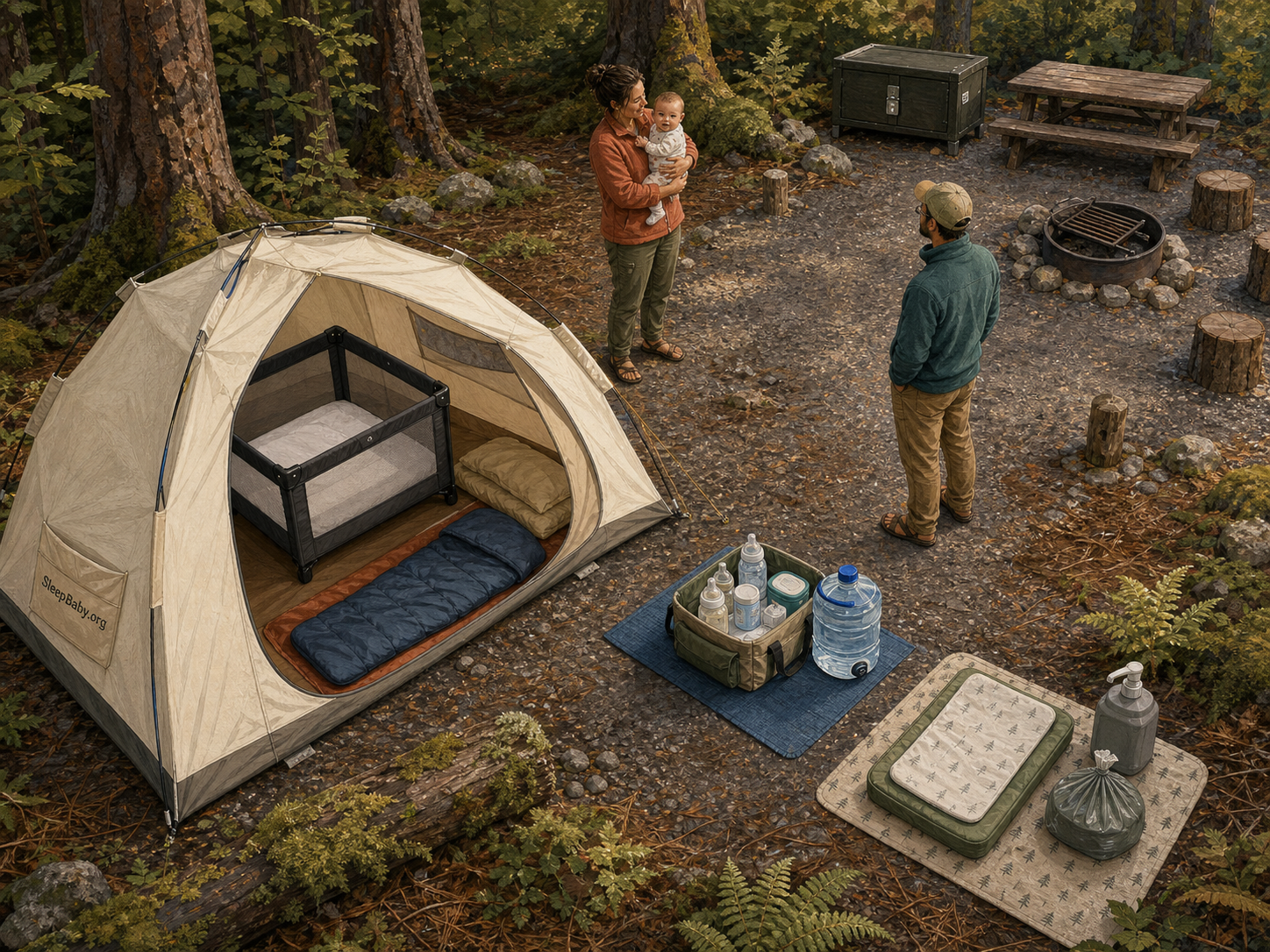
I picture the useful version of arrival this way: one adult holds the awake baby while the other, already wearing a headlamp, builds the crib and clean stations before opening the camp chairs. The matching enamel mugs can remain magnificently unphotographed.
Build four campsite zones before the gear spreads
A baby campsite works best when hot, dirty, scented and sleep-related jobs have different physical homes. Put the zones in place while there is still daylight. The goal is not magazine-level organization. The goal is to prevent a half-clean bottle from sharing a surface with a diaper bag while someone carries the baby toward a hot stove.
The four-zone campsite plan
1. Sleep and shelter
Dry, level tent; approved bare sleep space; adult sleeping area; bedtime clothes; light placed where it cannot fall or create a cord hazard.
2. Clean feeding
Safe water, clean hands, clean preparation surface, unopened food or formula, clean bottles, and a separate place for used feeding items.
3. Diaper and hand hygiene
Wash station, soap, changing mat, diapers, sealed waste, spare clothes, and a path that does not cross the feeding surface.
4. Cooking, fire and scents
Stove or fire ring, hot cookware, fuel, food, trash and scented products kept away from the tent and stored by the campground’s wildlife rules.
Setup order: shelter and crib, clean feeding station, diaper station, then cooking and scent storage. Keep one adult responsible for baby while the other handles flame, fuel, boiling water or heavy gear.
National Park Service guidance treats scented items broadly. Depending on the location, storage rules may apply not only to food and garbage but also to bottles, formula residue, dishes, wipes, sunscreen, repellent and toiletries.9 Follow the rules for that specific campground, whether that means a locker, a bear-resistant container or another approved method. Do not keep food or scented items in the sleeping tent.

Safe sleep in a tent is still safe sleep
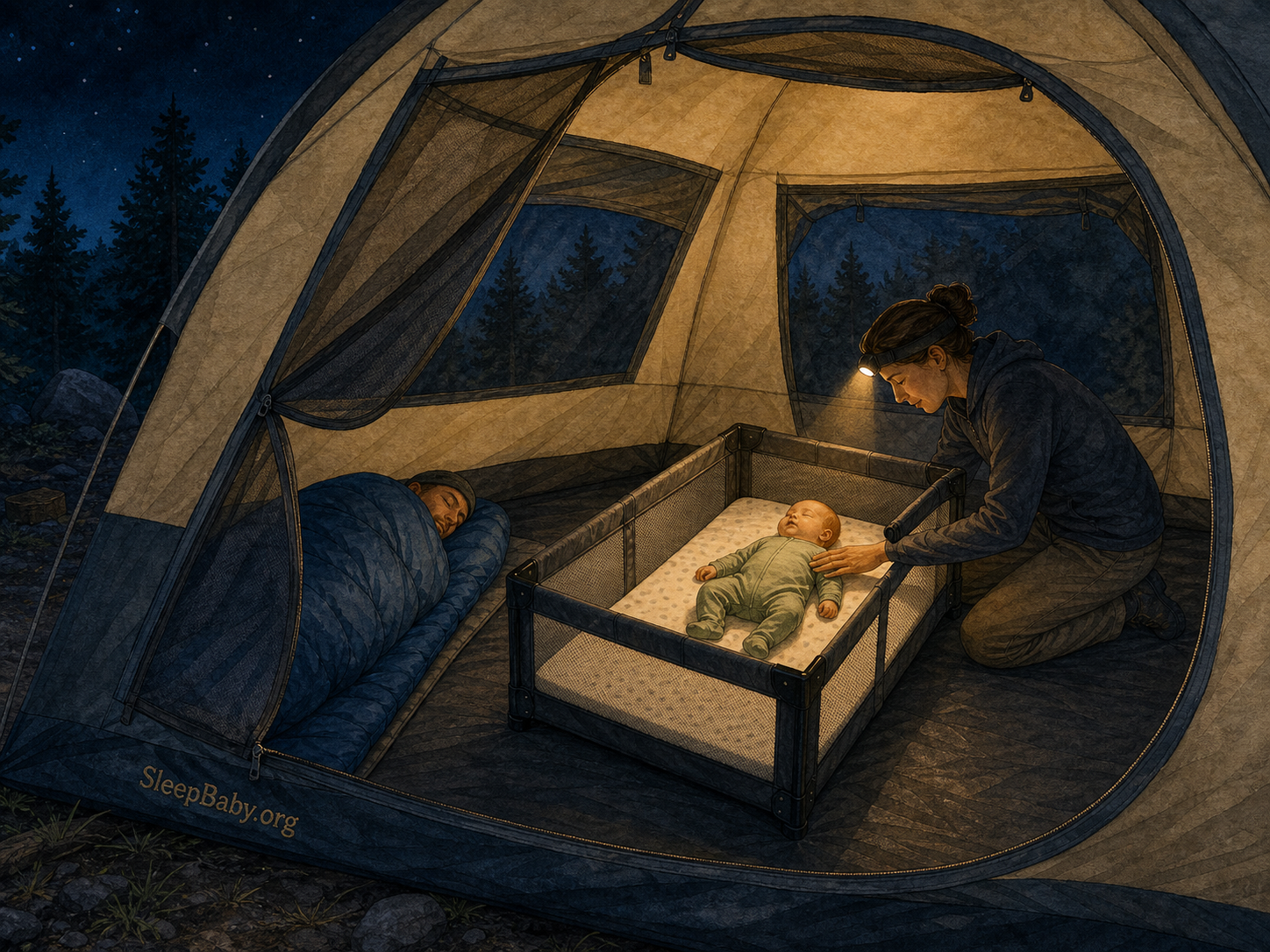
Use only a crib, bassinet, portable crib or play yard that is intended for infant sleep, meets applicable safety requirements, is appropriate for your baby’s size and developmental stage, and is assembled exactly as its instructions require. A mesh sun shelter, pop-up beach tent, camping nest, adult air mattress, hammock, padded lounger, car seat or carrier does not become an infant bed because it has a zipper and looks convenient.
Inside the approved sleep space, use only the fitted sheet designed for it. Keep out pillows, quilts, loose blankets, toys, positioners, extra mattresses, rolled towels, weighted products and hats. Put baby down on the back. If baby falls asleep in the car seat, stroller, swing, sling or carrier, move baby to the firm, flat sleep surface as soon as practical.12
Keep the infant sleep space in the same shelter area where an adult sleeps, but separate it completely from adult pads, sleeping bags and bodies. Room sharing is not bed sharing. A monitor may be useful for sound or convenience, but it does not make a separate tent, a vehicle, an improvised bed or an absent adult safe.
The six-part tent sleep check
- Approved: The product is actually intended and approved for infant sleep, not merely marketed for travel or shade.
- Flat: The frame and sleep surface are level and fully locked on a stable tent floor.
- Bare: Fitted sheet only; no adult bedding, toys, bags, pads or loose fabric can enter the space.
- Clear: Keep the crib away from tent walls, guy lines, lanterns, cords, fuel, heaters and gear that can fall.
- Comfortable: Dress baby for conditions without over-bundling, and use a properly fitted, non-weighted wearable blanket if suitable.
- Shared: An adult sleeps nearby and remains responsible. Technology is not the supervision plan.
Hard stop: If the approved sleep space will not fit safely, the trip does not have an infant sleep plan yet.
Never run a fuel-burning heater, stove or lantern inside a tent. Carbon monoxide has no smell, and combustion also creates fire and burn risks. Do not try to solve a cold night by surrounding the baby with loose bedding. Choose the forecast, shelter and clothing system that lets you keep baby comfortably warm without changing the safe-sleep surface.
If you use a sleep sack, check that it fits properly and is not weighted. A sleeping bag made for adults is not an infant sleep sack. For a fuller explanation of fit, overheating and safe use, see are baby sleeping bags safe?
Official safe-sleep video
The U.S. Consumer Product Safety Commission demonstrates the bare, firm, flat sleep baseline that still applies inside a tent or camper.
Check conditions, not one magic temperature
A fixed cutoff such as 50 degrees Fahrenheit cannot tell you whether your baby will be comfortable. Wind, dampness, elevation, sun, tent ventilation, clothing, age, health and the adults’ ability to respond all matter. Check the hourly forecast high and low, rain, wind, storms and heat risk before leaving and again before bedtime. If you cannot keep baby comfortably warm or cool without unsafe sleep products, leave.
Feel baby’s chest or back rather than relying on cool hands and feet alone. Watch for sweating, a hot chest, flushed skin or unusual sleepiness as possible signs of overheating. Watch for a body that remains cold despite appropriate dry layers, poor feeding, unusual quietness or lethargy as reasons to get warm and seek medical guidance. A camping article cannot diagnose a baby; it can tell you not to negotiate with a worsening condition in the dark.
Wildfire smoke can travel far beyond the visible fire. Check current local air-quality and wildfire information, including AirNow’s fire and smoke map, before departure and during the trip.8 A tent is not a filtered indoor room. If smoke arrives or air quality becomes inappropriate for your baby, move to clean indoor air or leave.
Conditions and the practical response
| Condition | Check | Action |
|---|---|---|
| Heat | Shade, air movement, baby’s chest, feeding and wet diapers | Use cooler hours and shade; reduce layers; leave if safe cooling is not possible. |
| Cold or damp | Forecast low, wind, rain, dry sleep clothing and tent floor | Use dry fitted clothing or an appropriate sleep sack; never add loose crib bedding; leave if comfort cannot be maintained. |
| Smoke | Air quality, fire map, odor, haze and local alerts | Move to clean indoor air or leave; do not treat tent fabric as filtration. |
| Storm or wind | Warnings, trees, runoff, lightning and tent stability | Use substantial shelter or leave before roads and packing become harder. |
| Bugs or ticks | Local disease risk, standing water, brush, exposed skin and pets | Use barriers and label-directed repellent; perform full checks. |
| Fire restriction | Posted rules, drought, wind and current closures | Skip the campfire. A fire is entertainment, not a required camping credential. |
On a narrow screen, the table scrolls sideways inside this labeled region without trapping vertical page movement.
For another outdoor-trip planning model, our guide to taking a baby to a national park covers visitor-center checks, altitude, trails and park-specific logistics. Camping adds an overnight sleep and food-storage system, so do not assume a safe day visit automatically becomes a safe night.
Keep feeding clean and uncomplicated
Bring more safe drinking water than your feeding plan requires, unless the campground confirms a currently operating potable source. Keep handwashing, bottle preparation and used-bottle storage physically separate from diaper changes and cooking. Breastfeeding families may want a supportive seat, shade, water for the feeding parent and a dry layer for nighttime feeds. Solid-food supplies should stay simple, temperature-safe and included in wildlife scent storage.
For powdered infant formula, the CDC says to use water from a safe source, clean your hands and preparation surface, measure water first, and then add the exact amount of powder listed on the label.3 Formula does not need to be warmed. A bottle warmer is not a camping necessity, and warming over a stove can create uneven heat and burn risk.
A simple formula timeline
- Before preparation: Wash hands, clean the preparation surface, confirm safe water, and use a clean bottle.
- Prepare: Add measured water first, then powder exactly as the formula label directs. Do not dilute or concentrate it.
- Start the clock: Use prepared formula within two hours of preparation if feeding has not begun.
- Once baby drinks: Use the bottle within one hour from the start of feeding.
- Afterward: Discard leftovers rather than saving them. Separate used bottles from clean supplies.
For babies younger than two months, born prematurely or immunocompromised, CDC recommends extra precautions because powdered formula is not sterile. Ask your baby’s clinician which preparation method fits your baby before a trip.
Ready-to-feed formula can remove the water-mixing step if it is appropriate for your baby and feasible for the trip, but it still needs clean handling and correct storage. Whatever method you use, rehearse it at home. At midnight, a labeled clean tote and a labeled used-bottle bin are more useful than a beautifully packed basket with no boundary.
Use shade and barriers before relying on products
For babies younger than six months, the AAP recommends keeping them out of direct sun with shade and protective clothing; sunscreen can be applied to small exposed areas when adequate shade and clothing are unavailable.6 For older babies, use broad-spectrum sunscreen and reapply according to the label and conditions. A shaded campsite is useful, but remember that sunlight moves while tents and trees do not.
For insects, start with long clothing, closed shoes when appropriate, and mosquito netting over a stroller or carrier while maintaining airflow and supervision. The AAP advises choosing an EPA-registered repellent suitable for the child and the conditions and following the label. An adult should apply it to their own hands before applying it to a young child, avoiding the child’s hands, eyes, mouth, cuts and irritated skin. Products containing oil of lemon eucalyptus or PMD should not be used on children younger than three.4
CDC tick guidance adds walking in the center of trails, treating clothing and gear with products containing 0.5 percent permethrin when the label permits, never putting permethrin directly on skin, and checking the baby, adults, gear and pets after time outdoors.5 Check warm, hidden areas carefully. Follow current local public-health guidance if you find an attached tick.
Fire, wildlife and water need an adult boundary
A campfire is optional. Before lighting one, check current restrictions and weather. Smokey Bear guidance says not to build a fire in hazardous dry or windy conditions, to keep it away from tents and flammable materials, supervise it continuously, and extinguish it completely.10 With a baby present, one adult controls the child while another controls flame, boiling water and fuel. If there is only one adult, choose no-fire meals or another setup that never requires turning away from the baby to control a hazard.
Keep the baby’s carrier, play area and path to the tent outside the cooking and fire zone. Do not place a portable crib near a fire ring for warmth. Hot drinks, pan handles, stove fuel and glowing coals all remain hazards after dinner looks finished. A separate article on taking a baby to a bonfire explains why distance, smoke and supervision matter even during a short event.
Near water, keep baby within direct adult control. Do not rely on a campsite, blanket, carrier, older child or another adult’s vague awareness as the supervision plan. Near wildlife, keep the site clean, store scents as required, and never approach or feed animals. If an animal breaches the site or food storage fails, follow ranger instructions and leave if you cannot restore a safe setup.
Use a short bedtime routine, then watch the baby in front of you
Keep the familiar parts that travel well: the same short song, sleep sack, phrase, feed-and-burp rhythm or bedtime book. Skip elaborate steps that require hot water, bright lanterns or repeated trips through the cooking zone. A campsite bedtime can be recognizable without copying every minute of home.
A practical order is: feed in the clean zone; wash or clean hands and face; change into a dry layer; dim the light; do the familiar short routine; place baby on the back in the bare approved sleep space; and keep an adult nearby. If a late car or carrier nap shifts the clock, do not force sleep simply because the reservation confirmation says this is bedtime. Protect safety, reduce stimulation, and try the next familiar cue.
Expect more stirring from zippers, birds, rain, neighboring voices and new light. That does not mean you have broken sleep. It means the environment is new. Camping success is measured by how many safe decisions remain available after dark, not by whether the baby sleeps through coyotes, rain or the neighbor who opens a cooler like it contains state secrets.


Leave early without turning it into a referendum
Make the exit plan before you need it. Keep keys, shoes, essential feeding supplies and the baby’s sleep clothing findable. Park legally with a clear route out. Know where you would go for clean indoor air, urgent medical assessment or simply a safe night at home.
The camping exit ladder
- Reset the small thing: Change a wet layer, feed, move to shade, reduce stimulation, or repair the clean/dirty boundary.
- Use the car only for transport or a supervised transition: Warm up or cool down safely, reassess, and never treat a parked vehicle or car seat as the overnight infant sleep plan.
- Leave the campground: Go when smoke, weather, water, wildlife, sleep-space damage or adult capacity makes the setup unreliable.
- Get urgent help: Breathing difficulty, unusual lethargy, a baby who cannot be awakened normally, signs of serious dehydration, severe allergic symptoms or another emergency needs prompt medical care.
Also leave or seek medical guidance for repeated vomiting, poor feeding, markedly fewer wet diapers, persistent temperature concerns, a baby who cannot be consoled, or a caregiver too impaired by exhaustion to supervise safely. I would rather unpack at home at 2:13 a.m. than turn a shaky campsite into a character test. You do not earn extra wilderness points for packing in worse conditions. Going home is one of the tools you brought.
Pack by job, not by fantasy campsite scene
Sleep and shelter
- Weather-appropriate tent with enough level floor space
- Approved crib, bassinet, portable crib or play yard and its fitted sheet
- Dry fitted sleep clothing and, if appropriate, a non-weighted wearable blanket
- Adult bedding that stays fully separate
- Battery lighting positioned outside the infant sleep space
- Repair supplies that do not create loose cords or crib hazards
Feeding and hygiene
- Safe water plus a margin for delays and washing
- Baby’s usual milk or food, prepared and stored safely
- Clean bottles or feeding equipment and a separate used-item container
- Soap, handwashing water, paper towels and a clean preparation mat
- Diapers, wipes, changing mat, sealed waste bags and spare clothes
- Any prescribed medicines with their normal storage and dosing tools
Conditions and exit
- Layered clothing, sun hat, shade and rain protection
- Age-appropriate, label-directed insect protection and mosquito netting
- First-aid kit, thermometer, charged phone and backup power
- Offline map, campground contact, nearest care location and home route
- Fire and food-storage equipment required by the site
- A car packed so the essential sleep, feeding and exit items are not buried
Do not buy a long list of novel baby camping products a week before the trip. Every new sleep product, carrier, feeding gadget and layer adds a learning curve. Familiar, compliant equipment used correctly is more valuable than a pile of gear marketed with mountains on the box.
Baby camping questions parents ask
How young is too young to take a baby camping?
There is no universal minimum age. A healthy full-term baby on a nearby, low-risk, developed car-camping trip presents a different situation from a premature newborn on a remote backcountry route. Consider health, feeding, temperature control, sleep setup, water, access to care and adult capacity. Ask your baby’s clinician about specific medical or feeding concerns.
What temperature is too cold for a baby to camp?
No single number works for every baby or campsite. Wind, dampness, elevation, shelter, clothing, age and health matter. Choose conditions in which you can keep baby comfortably warm using dry fitted clothing and an appropriate non-weighted wearable blanket, without loose bedding or a tent heater. If you cannot, postpone or leave.
Can a baby sleep in a camping bassinet or pop-up tent?
Only if the product is genuinely intended and approved for infant sleep, is appropriate for the baby’s size and stage, and is used exactly according to its instructions. A sun shelter or pop-up travel tent is not automatically a safe sleep product. When in doubt, check the product’s intended use and safety status rather than relying on its name.
Can a baby sleep in a car seat at the campsite?
A car seat is for travel. If baby falls asleep there, move baby to a firm, flat approved sleep surface as soon as practical. Do not use the car seat, stroller, carrier or parked car as the planned overnight bed.1
Will one camping night ruin the baby’s sleep?
One unusual night can create extra waking, a late nap or an earlier morning, but it does not require a dramatic schedule repair. Return to the familiar sleep space and routine, use normal age-appropriate cues, and give the next day room to settle. For broader travel planning, see taking a baby on vacation.
Should we use a baby monitor in the tent?
A monitor can be an optional convenience when used according to its instructions, but it does not replace an adult nearby, safe sleep, direct supervision around water or fire, or a secure site. It cannot make an unsafe sleep surface or separate-tent arrangement safe.
A calmer night after the campsite
Bring the familiar bedtime signals home
If zippers, a late car nap or a blue-dawn pack-up left sleep feeling scrambled, do not rebuild the entire schedule in one exhausted evening. Start with the familiar sleep space, the shortest soothing routine that still feels like yours, and the next clear sleep cue.
SleepBaby.org turns the part that felt hardest – settling, transfers, naps or bedtime timing – into a practical plan for your family. The goal is not to erase the camping night. It is to make the next night feel recognizable again.
Sources
- American Academy of Pediatrics: A Parent’s Guide to Safe Sleep.
- U.S. Consumer Product Safety Commission: Safe Sleep.
- CDC: Infant Formula Preparation and Storage.
- American Academy of Pediatrics: Insect Repellents.
- CDC: Preventing Tick Bites.
- American Academy of Pediatrics: Sun Safety.
- AirNow: Wildfires and Smoke.
- National Park Service: Storing Food and Scented Items.
- Smokey Bear: Campfire Safety.



What viewers said10 comments · 4 replies+
Archived comments from the original Baby Sleep Miracle presentation. Not independently verified by SleepBaby.org; individual experiences vary.
Thank you so much for this video! I had no idea about the dangers of baby swings :O
Hi Mary-Ann. I have a question: Is method in any way similar to the ones recommended by Dr Bucknam, Dr. Weissbluth or Dr. Karp? We tried those but none of them help.
Hi Regina, thank you for your question. The short answer is no. The techniques I share in my guide are based on newest scientific research and this is why I have never seen any approach similar to the one I recommend.
This method really works! I tried it on my son Jesus and after just one week he went from waking up more than 5 times a night to waking up just once or twice. You are a lifesaver, Mary-Ann!
I'm truly impressed with how much information you share in your video. And all for free! I can feel that you truly care about mothers like myself, and that's hard to find these days. I have recommended your site to several of my friends already.
Mary-Ann, our child suffers from autism. Is your approach still suited?
Chloe, I made sure my method can be used with any child, even babies who are special like yours. Please note that I'm not a doctor and that I always advice to consult with your physician because nothing is more important than the safety and well-being of your love.
Hallo Mary-Ann, I'm from Germany. Do you have your guide in German?
Hello Heide, we do! Normally you should already see our video in German. If not, please contact our support so they can guide you
Thenk you for your answer, Mary-Ann!
I just completed your approach and I have to say, it worked almost too well. Yes, it took a bit of getting used to with your bedtime routine but the difference is huge. My son George used to take 1 hours to go down and now he's firmly asleep in no more than 10 minutes! You're the best!
It seems I'm the only man watching this video, lol! What you shared about the 'emotional backpack' made immediate sense to me and I can't wait to help my little girl Mila to unpack it!
Hey there, just discovered your site and this really sounds different. Just wanted to say thanks for sharing :)
For everyone who's still thinking about getting Mary-Ann's guide I want to advise you to go ahead. I wasn't sure myself but now I'm so thankful I invested in this program. It made a huge difference in our life as a family and yes, my baby girl does sleep through the night now.