

Nine months is the age when a baby can look completely ready for a tidy schedule at 9:06 a.m. and then use the afternoon to file a formal complaint against clocks. A practical sleep schedule for a 9-month-old usually has two naps, about 12 to 16 total hours of sleep in 24 hours, and a bedtime roughly 3.5 to 4.25 hours after the second nap ends. That is a starting shape, not a test your baby has to pass.
I would anchor the morning first, place two naps around your baby’s actual sleepy cues and nap lengths, and let bedtime move when the day moves. Many babies do well with roughly 2.5 to 3.25 hours awake before nap one, about 3 to 3.75 hours before nap two, and about 3.5 to 4.25 hours before bed. Those ranges are observations parents can test, not medical standards. Milk feeds, hunger, illness, adjusted age, childcare, and the sleep your baby actually gets outrank a beautiful chart.
A two-nap schedule to try first
- 7:00 a.m. — Wake and milk feed. Start the day within a reasonably steady window rather than chasing the previous night’s exact minutes.
- 9:45–11:00 a.m. — Nap one. Offer it earlier after a rough night or later when your baby is alert and settling has become a wrestling match.
- 2:15–3:30 p.m. — Nap two. Build this from when nap one ended, not from what an internet graphic promised.
- 7:30 p.m. — Bedtime. Begin the short routine before your baby is falling apart, then place them in the safe sleep space according to your family’s settling approach.
SleepBaby.org starting pattern: use the sequence to see the day, then adjust the times to the baby.
This example gives about 2.5 hours of daytime sleep and an 11.5-hour night opportunity. Real sleep may be less because babies wake, feed, practice skills, need comfort, or simply have a different sleep requirement. The American Academy of Sleep Medicine’s 12–16-hour range includes naps and describes total sleep across the day; it does not promise a continuous night or require 14 hours from every infant.

Build the schedule from three anchors, not seven perfect times
I find that a 9-month schedule gets easier when I stop asking the clock to make every decision. Choose three anchors: the start of the day, the placement of nap one, and the bedtime response to nap two. Meals, milk, outdoor time, errands, and floor play can then live between those anchors without becoming a minute-by-minute infant calendar.
The anchor builder
- Morning anchor
- Pick a wake window your household can repeat most days, often within about 30 minutes. A dark 5:20 a.m. waking can stay a night response; a cheerful 6:45 a.m. waking may be the day’s honest beginning.
- Nap-one anchor
- Use the morning wake plus your baby’s demonstrated tolerance. Nap one often stabilizes before nap two because the morning begins from the clearest anchor.
- Bedtime anchor
- Choose a normal bedtime range, then move within it based on when nap two ended and how the baby is functioning. Bedtime can be a window without becoming random.
The word “consistent” is frequently mistaken for “identical.” A consistent pattern might mean wake around 6:45–7:15, nap one after a familiar breakfast-and-play sequence, nap two after lunch and another awake block, and bedtime between 7:00 and 8:00 depending on the naps. The baby’s body receives a recognizable order even when the clock shifts.

What wake windows actually tell you
A wake window is the time between leaving one sleep and beginning the next. It is useful shorthand. It is not a lab value. Two 9-month-olds can wake at 7:00, nap at different times, and both be healthy sleepers because one took a long restorative night while the other spent an hour holding a private crib meeting at 3:00 a.m.
I would use wake-window ranges as a hypothesis. If your baby regularly falls asleep within a manageable routine and the resulting nap is useful, the timing is probably close. If your baby spends twenty cheerful minutes rolling, pulling up, and studying the crib rail, the offer may be early. If they dissolve during the diaper change, fall asleep during the first line of the song, and wake after one overtired sleep cycle, it may be late.
Clock signal + baby signal
| What happens | Possible timing clue | What I would test |
|---|---|---|
| Happy, active resistance for several days | Sleep offer may be early | Move that sleep 10–15 minutes later |
| Intense fussing before the routine is complete | Sleep offer may be late, or another need is present | Check feeding, comfort and illness; then try 10–15 minutes earlier |
| Falls asleep easily but wakes after 25–35 minutes | Could be timing, environment, hunger, discomfort, or ordinary variation | Do not diagnose from one nap; compare several similar days |
| Second nap pushes bedtime very late | Nap one may be late/long, or nap two may need a cap | Change one upstream feature, not the entire day |
When parents say a wake window “stopped working,” I usually translate that into a better question: what changed around it? Night sleep may have shortened. A new skill may be consuming the settling period. Daycare may offer naps at fixed times. Feeding may be shifting. The baby may be sick. The number did not betray you; the number lost context.
Should a 9-month-old take two naps or three?
Two naps are a useful first assumption at 9 months, but not a deadline. Some babies have already settled into two substantial naps. Others still need a brief third nap after short daytime sleep, especially with an early morning, prematurity, recent illness, or a childcare pattern that leaves a long afternoon.
The nap fork
Stay with two naps when: your baby can reach nap one and nap two without repeated meltdowns; the naps carry the day; bedtime lands in a workable range; and total sleep and daytime functioning look reasonable.
Keep a third bridge nap when: both main naps are short, bedtime would otherwise be implausibly early, and the baby cannot comfortably manage the final awake stretch. Keep the bridge brief and end it early enough to preserve bedtime.
Move away from the third nap when: it becomes a nightly struggle, begins late, pushes bedtime much later, or the baby can increasingly handle the afternoon without it.
I would not force two naps by holding an exhausted baby awake for an impressive number of hours. I also would not keep offering a 5:30 p.m. nap that produces an alert social director at 9:45 p.m. The transition is a series of days, not a ceremony. You may use two naps on strong-nap days and a bridge nap on short-nap days while the rhythm settles.
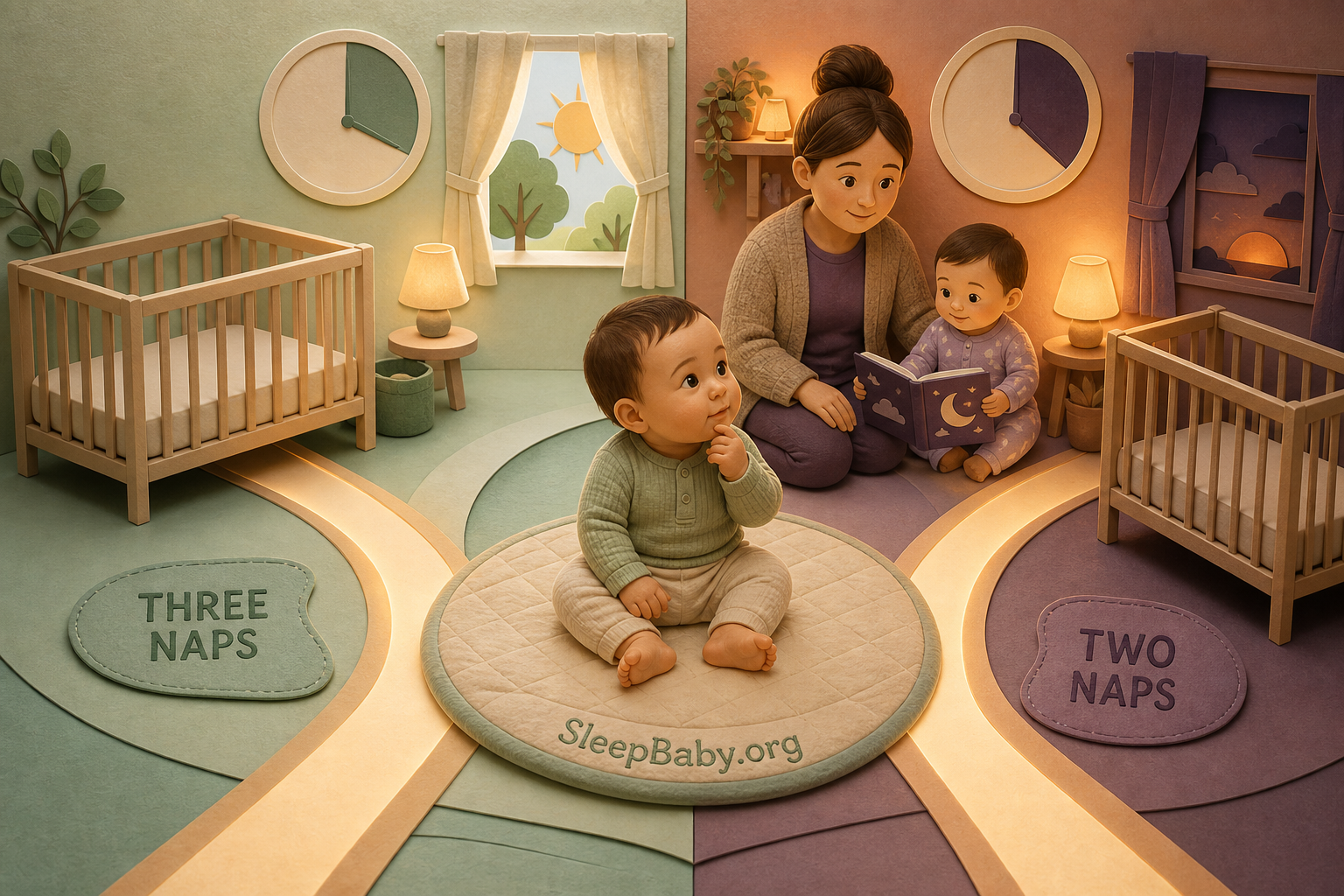

Three schedules for three very different days
A sample schedule is most useful when it shows how to think, not when it pretends your baby signed it. Here are three versions built from the same principles.
Day A: the straightforward two-nap day
- 7:00 — wake and milk
- 8:00 — breakfast solids, if developmentally ready and already part of the feeding plan
- 9:45–11:00 — nap one
- 11:00 — milk, then lunch later in the awake period
- 2:15–3:30 — nap two
- 3:30 — milk; evening meal later
- 7:00 — short bedtime routine and milk according to your feeding pattern
- 7:30 — bedtime
Day B: the early-wake day
- 6:00 — day begins after attempts to resettle are no longer useful
- 8:40–9:55 — nap one
- 1:15–2:30 — nap two
- 6:30–6:45 — bedtime, rather than stretching to the usual 7:30 at any cost
Day C: both naps were tiny
- 7:00 — wake
- 9:40–10:10 — nap one
- 1:15–1:50 — nap two
- 4:30–4:50 — optional bridge nap if the baby cannot reach an early bedtime comfortably
- 7:30–7:45 — bedtime, adjusted to whether that bridge nap happened
These are examples, not feeding prescriptions. Milk remains a primary source of nutrition at this age, and individual feeding needs vary. Offer feeds responsively and follow your baby’s clinician when there are growth, prematurity, allergy, swallowing, or medical considerations. Do not withhold a feed because “the schedule says nap in twenty minutes.” A fed baby with a shifted nap is not a failed schedule.
Fit sleep around feeding instead of making them compete
Nine months can be a messy intersection of milk, solids, finger foods, cups, naps, and the discovery that a single blueberry can be examined for the length of a feature film. I would protect milk feeds, offer complementary foods according to readiness and your feeding plan, and avoid using solids as a sleep tool.
The CDC is explicit that cereal in a bottle does not make a baby sleep longer and can increase choking risk. A larger dinner is not a treatment for night waking. If your baby wakes hungry, feeds poorly during the day, is distracted at milk feeds, or has growth concerns, bring that feeding picture to the clinician rather than repeatedly moving bedtime.
Try to leave enough room between a substantial feed and the sleep routine that you are not rushing either one. At the same time, there is no prize for an “eat-play-sleep” order that ignores hunger. Some babies feed before sleep. Some need another small feed after active play. The schedule serves care; care does not serve the graphic.

Why nine months can suddenly feel less scheduled
At 9 months, many babies are sitting, moving between positions, searching for hidden objects, making new sounds, and reacting more strongly when a caregiver leaves. Those developmental changes can appear in the crib as pulling up, calling, sitting, tossing a pacifier, or becoming very interested in whether you still exist behind the door.
I would not call every difficult week a regression. The label can make normal variation sound like a diagnosis and can tempt us to rebuild a schedule that was basically working. First check the body and the day: illness, teething discomfort, feeding, temperature, a new motor skill, a changed childcare routine, and whether total sleep has moved. Then decide whether timing needs repair.
A clearly labeled hypothetical Kacey-and-Benjamin moment: Imagine Benjamin’s second nap ends after twenty-eight minutes. At 4:45 p.m. he is sitting on the rug, delighted with a wooden spoon, while my schedule says he should be entering the sacred valley of drowsiness. I could force the “ideal” bedtime because the chart has excellent typography. Or I could notice that he is cheerful, offer the normal evening care, and move bedtime by fifteen minutes while watching the full pattern. This scene is hypothetical, not family history and not evidence. Its job is to show the difference between respecting a rhythm and obeying a screenshot.
I want the schedule to reduce decisions, not remove observation. A familiar sequence helps a baby know what comes next. Observation tells us whether today’s body can use that sequence at today’s time.

What to do when naps last 30 minutes
One short nap is a nap. A repeated short-nap pattern is information. Before changing the schedule, check the sleep environment, hunger, illness, discomfort, and whether the baby was placed in an approved safe sleep space. Then look at timing.
The short-nap repair ladder
- Pause before redesigning. Give a safe, calm opportunity to resettle if that fits your response approach. Do not leave an unwell or distressed baby because a timer says so.
- Protect the next feed. Hunger and feeding needs are not schedule defects.
- Shorten the next awake stretch slightly. After a very short nap, try the next sleep 10–20 minutes earlier rather than using the full ideal window.
- Choose bridge nap or early bedtime. Use the option that produces a workable final awake stretch without pushing the night far later.
- Look for repetition. Adjust the original nap timing only when several comparable days point in the same direction.
If nap one is reliably short but nap two is long and the night works, the short first nap may simply be part of your baby’s pattern. If both naps are short, bedtime is chaotic, and total sleep is dropping, test one timing change. I would not cap, stretch, and move both naps simultaneously; that creates a new schedule without telling you which change mattered.
Choose bedtime from nap two, then check it against the whole day
Bedtime is not just “7:00 because nine-month-olds go to bed at 7:00.” Start with when nap two ended, add the final awake stretch your baby usually tolerates, and then check whether that result fits total sleep and family life.
If nap two ends at 3:00, a bedtime around 6:45–7:15 may fit. If it ends at 4:00, bedtime may land closer to 7:30–8:00. If your baby wakes from nap two at 2:00 and cannot comfortably reach 6:00, the earlier decisions may need repair or a small bridge nap may still be appropriate.
A later bedtime does not automatically cure night waking or early rising. Sometimes it reduces sleep opportunity and makes the day harder. An earlier bedtime does not automatically create an earlier morning either. Test the smallest plausible shift across several nights while keeping morning and naps reasonably stable.

A portable cue for naps that happen in two places
The best schedule aid is usually the one that reduces friction around a real transition. When nap one happens in the nursery but nap two sometimes happens with another caregiver or during travel, carrying one familiar sound cue can make the routine more recognizable without requiring both rooms to be identical.
A practical pick for a two-location nap day
Yogasleep Hushh Portable White Noise Sound Machine
The Hushh fits this specific schedule job because it is portable and rechargeable, with a child lock and clip, so a caregiver can carry the same modest sound cue between nap locations. That makes it a better fit here than a fixed nursery-only machine. It is optional—not a sleep guarantee, monitor, medical device, or safe-sleep product. Keep the device and clip outside the crib, away from your baby’s ears, follow the manufacturer instructions, and use the lowest useful volume.
See the Yogasleep Hushh portable sound machine on Amazon
As an Amazon Associate, SleepBaby may earn from qualifying purchases.
How to know whether the schedule fits
I would judge a schedule across three to seven reasonably typical days, not one heroic nap and one chaotic Tuesday. Look for a cluster of signals.
The fit scorecard
- Settling: sleep offers are not consistently cheerful playtime or desperate collapse.
- Naps: at least one nap usually carries useful sleep, or two shorter naps still support the day.
- Bedtime: the routine and settling remain manageable more often than not.
- Night: wakings can be responded to without assuming every wake proves a schedule failure.
- Morning: wake time is reasonably stable or its variation has an understandable cause.
- Daytime: your baby has alert, engaged periods and feeding remains protected.
- Total sleep: the whole 24-hour pattern is considered, not only the longest stretch.
No schedule produces a calm baby at every transition. The question is whether the rhythm makes sleep more available without making the rest of caregiving brittle. If one nap requires canceling every feed, outing, appointment, sibling need, and weather event, it may look consistent while making family life impossible.

Troubleshoot the pattern without moving everything
Nap one keeps getting earlier
Check whether early waking has quietly moved the entire day. If you offer nap one extremely early every time morning starts early, the early rhythm can become self-reinforcing. When your baby is coping, move nap one later in small steps while responding to the early morning as night. When they are exhausted, protect sleep first and repair gradually. If the crib itself has become the sticking point, this guide to helping a baby who will not sleep in the crib addresses that next problem without pretending a clock change can solve it.
Nap two is refused
Look at nap one’s end time and length. A late, long first nap may leave too little sleep pressure for nap two. Try a slightly earlier or capped nap one only when the pattern repeats and total sleep supports the change. Do not remove nap two because it was refused once during a week of pulling to stand.
Bedtime takes an hour
If your baby is content and active, bedtime may be early relative to nap two. If they are frantic, rubbing eyes, or falling apart, it may be late—or another need may be present. Move by 10–20 minutes and compare several nights instead of shifting by an hour.
Night waking increased
Do not treat night waking as a pure scheduling equation. Hunger, illness, discomfort, temperature, developmental changes, feeding patterns, and the sleep environment matter. Keep responses safe and appropriate. Adjust the day only when the daytime evidence also points there.
The baby wakes at 5:00 a.m.
Keep the room dark and the response boring if you are still treating that time as night. Review bedtime, nap totals, light, noise, and feeding. A later bedtime may help some babies and worsen sleep for others, so test rather than assume.
Watch the non-negotiable part
Safe sleep stays the same on every schedule
The schedule examples are flexible; the sleep surface is not. This American Academy of Pediatrics video reinforces the back-to-sleep, firm-flat-clear setup that applies to nap one, nap two, bridge naps, and nights.
SleepBaby takeaway: adjust wake time, nap timing, or bedtime—not the approved sleep surface. A schedule problem never makes a couch, swing, incline, positioner, or loose crib item safe.
The schedule never changes the safe-sleep setup
For every nap and night, place your baby on their back on a firm, flat approved infant sleep surface with only the fitted sheet. Keep pillows, loose blankets, bumpers, positioners, wedges, weighted products, toys, and sound machines out of the crib. A contact nap, car ride, swing, couch, adult bed, or inclined product does not become a routine sleep space because it occurs at the scheduled nap time.
If your baby falls asleep in a sitting or carrying device, move them to the safe sleep space as soon as it is safe and practical. If you are close to falling asleep while holding or feeding the baby, put the baby in the clear crib even if they protest. The schedule can be repaired tomorrow. The sleep surface matters now.
When to stop adjusting the schedule and call
Call emergency services for severe breathing difficulty, blue or gray color, seizure, unusual limpness or unresponsiveness, or another life-threatening appearance. Contact your baby’s clinician for poor feeding, repeated vomiting, markedly fewer wet diapers, fever or illness, pain, growth concerns, persistent snoring or breathing pauses, or a sudden major change in sleep and alertness. A schedule article cannot evaluate those signs.
Ask for individualized guidance when your baby was born prematurely, has a medical condition, follows a specific feeding or growth plan, or has developmental concerns. Use adjusted age when your clinician recommends it. The calendar age can organize a search; it does not replace the baby’s actual history.
The schedule I would start tonight
Choose tomorrow’s morning anchor. Offer nap one after a familiar awake stretch, place nap two from when nap one actually ends, and set bedtime from nap two. Protect feeds. Keep the third bridge nap available for a day that genuinely needs it. Change only one timing feature at a time.
Then let the schedule be useful instead of impressive. The opening baby who rejected clocks was not rejecting rhythm. They were asking us to notice that rhythm lives in a body: sleep accumulated, milk taken, skills practiced, naps shortened, and an evening that still needs somewhere gentle to land. I can work with that. So can Benjamin. So can you.
Sources
A rhythm you can actually live with
Build tomorrow from the baby you have tonight
Anchor the morning, place naps from real wake-ups, protect feeds, and let bedtime answer the day that happened. The goal is not a screenshot-perfect schedule. It is a recognizable path from morning energy to a safe, gentle landing.
Find your next SleepBaby answer
SleepBaby offers education, not individualized medical care. Contact your child’s clinician when sleep, feeding, breathing, growth, or responsiveness concerns persist.