The clock says 2:14 p.m. Your baby has eaten, stared solemnly at the ceiling fan, yawned once, and then behaved as if sleep were an unreasonable administrative request. This is usually the moment a parent searches for a sleep schedule for a 2-month-old and wonders whether everybody else received a timetable at discharge.
At 2 months, aim for a rhythm—not a rigid schedule
A two-month-old usually does best with a flexible sequence of feeding, a brief awake period, and sleep, repeated across the day and night. Use morning light, ordinary daytime sound, calm nighttime care, and your baby’s cues to shape the rhythm. Do not force naps or delay feeds to make a printed schedule work. At this age, frequent waking, cluster feeding, uneven naps, and different days are normal parts of an immature sleep-wake system.
I would treat a sample schedule as a sketch in pencil. Feeding needs, growth, illness, prematurity, and your clinician’s instructions are written in ink. And I would not borrow the American Academy of Sleep Medicine’s 12-to-16-hour recommendation for babies 4 to 12 months and quietly apply it to a 2-month-old; that consensus range begins at 4 months.

What a normal two-month sleep pattern can look like
Two-month sleep is less like a tidy row of blocks and more like weather moving through the house. One nap lasts long enough for you to eat lunch sitting down. The next ends before the toast pops up. A baby may cluster feed in the evening, give one longer stretch after bedtime, and then wake frequently toward morning. Another healthy baby may distribute sleep differently.
That variability does not mean there is no pattern. It means the pattern is easier to see over several days than in a single heroic Tuesday. I look for repeated tendencies: when the first alert period appears, when feeding becomes clustered, which part of the day produces the easiest nap, and whether nights are gradually becoming quieter than days.
The American Academy of Pediatrics notes that newborns often sleep around 16 to 17 hours in a day, but that broad observation is not a personal quota. I would not wake a thriving baby simply because a spreadsheet says today’s total is high unless feeding or a clinician-directed plan requires it. I also would not declare a baby broken because a fragmented day adds up differently.
Variation I would observe
- Short naps mixed with longer naps
- Evening cluster feeding
- Frequent night waking to feed
- A day that shifts by 30 or 60 minutes
- More alert time than a few weeks ago
Signs I would not schedule around
- Difficulty breathing or blue or gray color
- Unusual difficulty waking
- Repeated feeding failure or dehydration signs
- Poor weight gain or fewer feeds than the care plan
- A fever in a baby younger than 3 months
Those second-column signs need prompt medical guidance. A prettier schedule is not the answer.
First, observe one whole day without trying to fix it
Before moving bedtime, extending a wake period, or buying blackout curtains, I would collect three ordinary days of information. Not a minute-by-minute surveillance operation. You are caring for a baby, not running air traffic control with a burp cloth over one shoulder.

Write down only four things: when a feed begins, when the baby becomes clearly alert, when sleep seems to begin, and when the baby wakes. Add one short note if something changed—car nap, appointment, unusually difficult feed, lots of visitors. That is enough to reveal a rhythm without making you emotionally responsible for every seven-minute wobble.
The four marks that make a pattern visible
- Feed: when nursing or a bottle begins.
- Bright eyes: when your baby is calmly alert.
- Sleep: when the body and breathing settle into sleep.
- Wake: when the baby is genuinely awake, not grunting through active sleep.
After three days, circle repeated clusters rather than comparing exact times.
SleepBaby.org original observation tool. It is not a diagnostic or feeding record.
I care more about sequence than perfection. If your notes repeatedly show feed, ten calm minutes, rising fussiness, then a hard-won nap, the useful change may be offering sleep earlier. If the fussy period follows a partial feed, the next question may be feeding—not a shorter wake window.
Amazon recommendation
See the pattern before you try to schedule it
If the hardest part is not knowing when sleep actually begins and ends, the Nanit Pro Smart Baby Monitor with Floor Stand is a useful article-specific option. Its overhead view and app summaries can help show sleep events and caregiver visits across day and night, reducing the burden of manual notes.
I think it fits this job better than a basic video-only monitor because the summaries support pattern discovery, and better than a planner because you do not have to remember every entry while holding a baby. Consider it if you also need a monitor and repeated uncertainty is the problem you want to solve. If your existing monitor and a few notes already show the pattern, keep your money.
Important limits: It is expensive, some history or analytics may require a subscription, and it relies on Wi-Fi and an app. It is not a medical monitor, cannot prevent SIDS, does not decide whether a baby may skip a feed, and never replaces adult supervision. Install the stand correctly and keep every cord completely out of reach.
Affiliate disclosure: SleepBaby may earn from qualifying purchases when Affiliate Control attaches the governed Amazon destination.

Read the baby’s state before reading the clock
A two-month-old does not move neatly from awake to sleepy. There is often a quiet-alert patch when the eyes are bright and the body is relatively still. Then movements become less organized. The gaze drifts. A yawn may arrive, although some babies treat yawning as a closing statement rather than an opening suggestion.
I would offer sleep when several cues begin to gather, not after one isolated yawn and not only when a wake-window app announces judgment. The younger the baby, the more feeding, digestion, stimulation, and simple fatigue overlap.
If your baby is breathing comfortably and remains asleep, a noisy patch may be active sleep. I would not rush in for every squeak. But I would respond immediately to breathing difficulty, color change, or unusual unresponsiveness.
An illustrative two-month rhythm—not a prescription
This example begins at 7 a.m. only because examples need a place to begin. Your day may begin at 5:45, 8:10, or after a night that has ceased respecting the concept of morning. Shift the entire picture to your baby’s natural start.

Notice what is missing: exact nap start times, a required bedtime, and a promise of a long first stretch. I would rather give you a map that survives a growth spurt than a timetable that makes a normal baby look late.
Some families find a loose morning anchor helpful. Open the curtains, speak normally, and let daytime feel like daytime. At night, use enough light to feed and move safely, keep voices soft, and skip playful stimulation. These are gentle cues, not switches. The day-night rhythm develops gradually.

Feeding belongs inside the rhythm, not underneath it
The CDC says breastfed babies in the first weeks and months commonly nurse about 8 to 12 times in 24 hours, sometimes in clusters. Formula-fed babies follow their own feeding plan and cues. Either way, I would never stretch a feed merely to rescue the next nap or bedtime.
If your baby was premature, has jaundice, has been ill, is not gaining as expected, or has a clinician-directed wake-to-feed plan, follow that plan. Ask before allowing longer sleep stretches. A schedule downloaded from the internet cannot see a weight curve, milk transfer, diaper output, or the baby in front of you.
I also separate “fell asleep while feeding” from “has a harmful sleep association.” At 2 months, feeding and sleep are close companions. You can occasionally experiment with a small gap—burp, fresh diaper, one song—when it happens naturally. You do not need to turn every feed into a lesson in independent sleep.
What to do with short naps, long naps, and the nap that vanished
When every nap is short
Start by lowering the ambition of the awake period. After feeding and a little connection, watch for the earliest cluster of sleepy cues. Darken the room if it helps, use a brief repeatable wind-down, and offer the safe sleep space. If the nap lasts 27 minutes, count it as sleep—not a personal review.
I would look at the whole day before changing five things. Is feeding complete? Is reflux discomfort or illness suspected? Is the room suddenly busy? Does one contact nap help everyone recover while another caregiver remains awake and attentive? The answer may be support and flexibility, not a stricter chart.
When one daytime nap is very long
Check the feeding plan first. Some babies can sleep longer when growth is established; others still need waking. HealthyChildren guidance about waking very young infants is context dependent, which is why I would use the baby’s clinician—not a generic schedule—as the tie-breaker.
When late afternoon falls apart
This is common territory for cluster feeding, accumulated stimulation, and brief naps. Make the room smaller: fewer faces, softer sound, less passing around. I often think parents try to build a grand bedtime routine when the baby is asking for six quiet minutes and another feed.
When day and night seem reversed
Use light and interaction gently during daytime awake periods. Keep nighttime feeds calm and boring without making care unsafe. Do not keep a tired baby awake all day hoping exhaustion will repair the night; that usually creates a distressed baby and an even more exhausted household.
The schedule I would be tempted to believe
Hypothetical Kacey-and-Benjamin scene: Imagine me at the kitchen counter with Benjamin asleep against my shoulder, one hand holding my phone and the other protecting a mug I have reheated twice. A beautiful schedule says the next nap begins at 10:30. The clock says 9:52. Benjamin’s eyes have already gone glassy.
In that scene, I know exactly what my tired brain wants: proof that following the chart will make tonight predictable. I would still put down the phone and offer sleep. The chart does not know that the last feed took longer, that the grocery delivery rang the bell, or that Benjamin spent ten astonishing minutes discovering his own fist.
The practical distinction is small but freeing: a schedule predicts; a rhythm responds. I can use yesterday to make a sensible guess. I do not have to make today’s baby obey it.


The safety rules do not flex with the schedule
For every nap and night sleep, place your baby on the back on a firm, flat, level sleep surface in a safety-approved crib, bassinet, portable crib, or play yard. Use only a fitted sheet. Keep pillows, loose blankets, toys, bumpers, positioners, and other soft objects out of the sleep space. Room sharing without bed sharing is recommended.
If your baby falls asleep in a swing, bouncer, carrier, stroller, or car seat outside travel, move the baby to a firm, flat sleep surface as soon as practical. Never plan sleep on a couch or armchair. Those rules remain true during the inconvenient nap, the desperate evening, and the 4 a.m. feed.
I would also decide before night where the baby goes if the adult feels sleep arriving. Put the bassinet within reach. Clear the bed of feeding clutter even though bed sharing is not the plan. Avoid settling into a sofa or recliner for a feed when you are likely to doze. Fatigue deserves a practical plan, not shame.
How to adjust the rhythm without changing everything
- Choose one pressure point. The hardest first nap? A chaotic evening? Day-night confusion? Do not overhaul the entire day.
- Observe for three days. Look for a repeated sequence, not an exact time.
- Move one cue. Offer the wind-down a little earlier, brighten morning awake time, or make nighttime care quieter.
- Protect feeds and safety. Never trade either for the experiment.
- Judge the household effect. Is the baby settling with less distress? Is feeding still going well? Is the plan sustainable for the caregiver?
I would keep a change that makes the next transition gentler, even if the clock remains messy. I would drop a change that creates feeding pressure, prolonged crying, or a parent spending the day chasing minutes.
A routine can be consistent even when the schedule moves
Parents are often told that babies love consistency, which can sound like an accusation when Tuesday bears no resemblance to Monday. At 2 months, consistency is usually more useful at the level of signals than times. The same two-minute sequence can happen before a 9:40 nap and a 10:25 nap: close the curtain, change the diaper if needed, hold the baby quietly, say the same simple phrase, then offer the safe sleep space.
I would keep the routine short enough that it survives real life. If it requires a bath, three books, a particular playlist, two adults, and the moon in the correct phase, it is not a routine; it is a small touring production. A repeated sensory handoff—less light, less talk, the sleep sack when appropriate, the same safe surface—is plenty.
The distinction matters because a schedule answers when, while a routine answers what happens next. Your baby may not reliably know that 7:30 means bedtime. The baby can begin to recognize that feeding is finished, the room is quieter, and the next safe place is the bassinet.
Make the rhythm transferable between caregivers
A rhythm that exists only in one adult’s head becomes fragile at the exact moment that adult needs sleep. I would give a partner, grandparent, or other caregiver three pieces of information, not a 14-row spreadsheet: when the baby last fed, what state the baby is showing now, and what usually comes next.
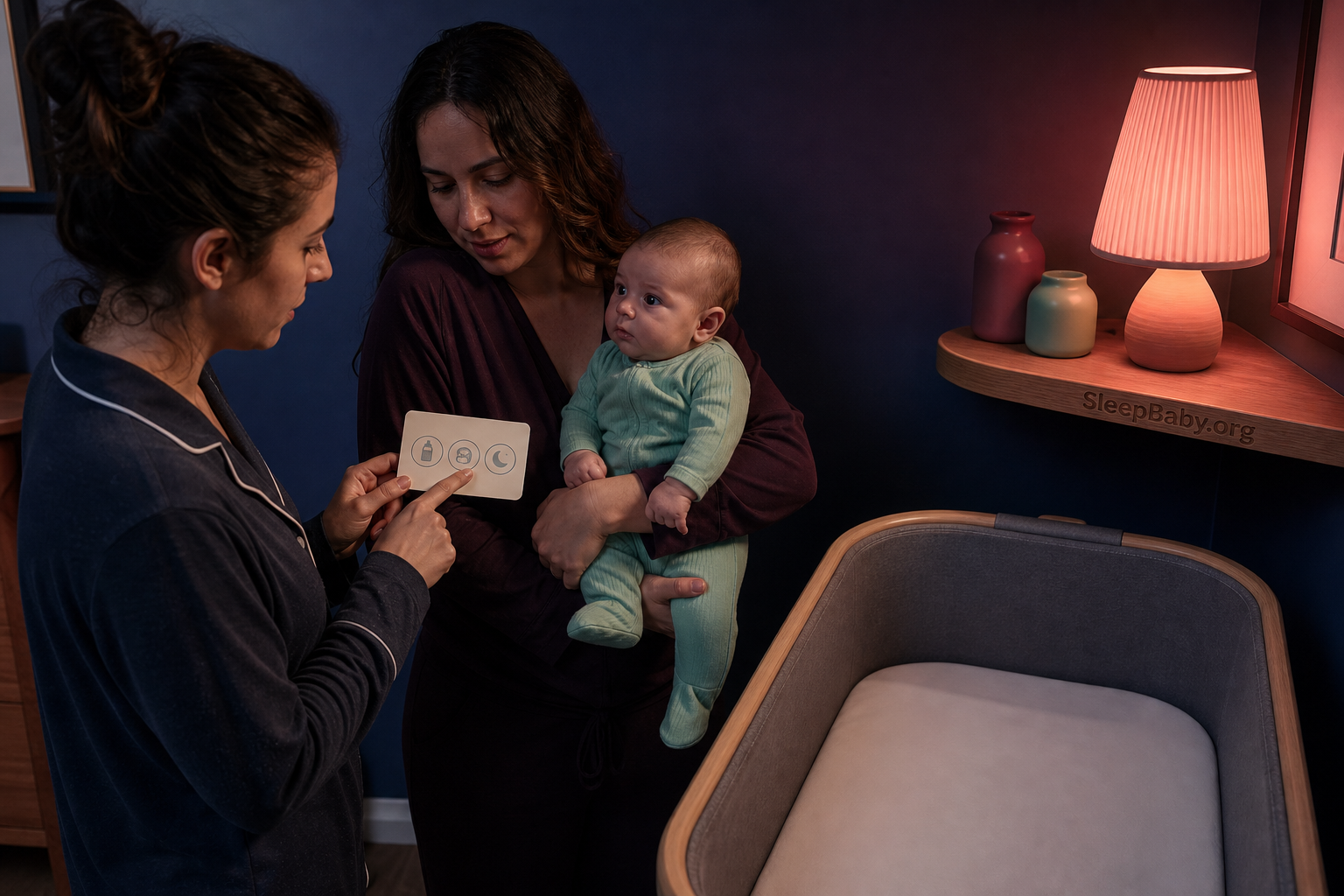
The thirty-second handoff
“The last feed began at 1:20. She has been calmly awake for a little while and is starting to look away. I would try the short wind-down now, but feed again if she shows hunger cues.”
That sentence protects the important information without asking another exhausted person to impersonate you. I would also make the safe-sleep setup identical for every caregiver: back placement, firm flat clear surface, and no improvised couch or recliner sleep.
At night, shifts can be built around responsibility rather than promised sleep blocks. One adult may handle the diaper and resettling around feeds; another may take the first evening stretch. Breastfeeding families can still share everything around the feed. The goal is not to make the baby’s waking predictable. It is to make the adult response less chaotic.
Room sharing without turning every noise into a wake-up
Room sharing can make feeding and observation easier, and it is recommended without bed sharing. It can also make new parents aware that sleeping babies are remarkably noisy roommates. Snorts, brief cries, leg lifts, and grunts may occur during active sleep.
If the baby is breathing comfortably, has normal color, and the eyes remain closed, I would pause for a few seconds before assuming the nap or night stretch has ended. That pause is not a rule to ignore crying. It is enough time to distinguish a sleep sound from a genuine waking. Sometimes the baby settles before the adult has fully sat up; sometimes the sound builds and clearly asks for a response.
Keep the sleep surface close enough for practical care but clear of adult bedding, pillows, curtains, blind cords, monitor cords, and anything else the baby could reach now or soon. The room can be shared. The sleep surface stays separate.
What happens to the rhythm on appointment and errand days?
It bends. That is not a loophole; it is the design. Feed before leaving when it matches cues, carry what you need for responsive feeding, and expect that motion may produce an unplanned nap. If the baby sleeps in a car seat while the car is moving, use the seat correctly for travel. Once you arrive, move the baby to a firm, flat sleep surface as soon as practical rather than using the car seat as the day’s bassinet.
After a fragmented outing nap, I would restart from the baby’s current state. A hungry baby gets fed. A bright-eyed baby gets a little calm connection. A tired baby gets an early sleep offer. Do not keep the baby awake until the “next scheduled nap” to repair the chart.
Travel days are also useful evidence. If your baby sleeps easily with motion but struggles in a still room, that tells you something about the transition—not that motion sleep should become the permanent plan. You can make the still-room handoff more gradual with a brief hold, dimmer light, and the same tiny routine while keeping the final sleep surface safe.
When the schedule question is really a feeding or health question
I would contact the baby’s clinician when sleep comes with a meaningful change in feeding, diaper output, alertness, comfort, breathing, color, or growth. A baby who is suddenly much sleepier and difficult to wake is different from a baby who takes one satisfying long nap. A baby who repeatedly cannot complete feeds is different from a baby who cluster feeds and then rests.
Seek prompt medical guidance for a fever in a baby younger than 3 months. Difficulty breathing, blue or gray color, severe lethargy, or a baby who cannot be awakened normally needs urgent evaluation. Do not wait for the next scheduled feed or nap to see whether the timetable fixes it.
When the concern is less urgent, bring your three-day notes. They give the clinician concrete information: feeding frequency, sleep changes, awake behavior, and the point where your baby’s usual pattern shifted. I would rather arrive with a small honest pattern than a beautifully completed chart that hid the part worrying me.
Questions parents ask about a 2-month-old schedule
What time should a 2-month-old go to bed?
There is no universal bedtime. Many two-month-olds still treat evening as a series of feeds, brief naps, and settling attempts. Watch for the most repeatable longer sleep onset, then build a tiny routine before it. Bedtime often shifts earlier over the coming months.
How long should a 2-month-old stay awake?
Use wake-window numbers as rough observational prompts, not pass-fail limits. Your baby’s feeding, alertness, stimulation, and cues matter more than reaching a published minute. I would begin winding down when calm engagement turns into looking away, jerky movement, or rising fussiness.
Should I wake my 2-month-old from a nap?
Feeding and growth context decides this. Follow any clinician-directed wake-to-feed plan. If growth and feeding are established and no special plan applies, ask your clinician how long they are comfortable letting your baby sleep rather than borrowing a rule from another age or feeding context.
Can I sleep train a 2-month-old?
A two-month-old still needs responsive feeding and caregiving and is not developmentally ready for a rigid sleep-training program. You can practice gentle cues: a short wind-down, putting the baby down when calm when it works, pausing briefly through ordinary sleep noises, and keeping nights quiet. Respond when your baby needs you.
What if my baby follows the schedule for two days and then stops?
That is useful information, not failure. Growth, feeding, stimulation, and development move quickly at this age. Return to the four marks—feed, bright eyes, sleep, wake—and find the new sequence.
A two-minute safety reset
Keep the sleep space steady while the schedule moves
The American Academy of Pediatrics demonstrates the part of a two-month rhythm that should not be improvised: place baby on their back in a firm, flat, clear sleep space. Use this as a quick visual check, not as a promise that any schedule will make a young baby sleep longer.
Takeaway: let feed and sleep timing flex; keep the safe-sleep surface consistent every time.
Let the clock become a witness
Back at 2:14 p.m., the useful question is not “What nap should happen now?” It is “What is my baby showing me, and what needs protection?” Maybe the answer is sleep. Maybe it is another feed. Maybe it is a quieter room and five minutes against your shoulder.
I want the clock nearby, but demoted. It can help you notice a rhythm. It does not get to grade your baby. When feeding is protected, sleep is safe, and you can recognize the next transition a little earlier, the day has structure—even when no two boxes line up perfectly.
Sources
- NICHD Safe to Sleep: Safe Sleep Environment
- CDC: How Much and How Often to Breastfeed
- American Academy of Sleep Medicine: Child Sleep Duration Health Advisory
- HealthyChildren: Bottle-Feeding (Formula) Questions
- HealthyChildren: How Often to Breastfeed
- HealthyChildren: Safe Sleep Tips for Sleep-Deprived Parents
- HealthyChildren: States of Consciousness in Newborns
When the day needs a softer shape
Build the next peaceful handoff—not a perfect timetable
SleepBaby helps you turn scattered observations into a bedtime approach your household can actually repeat.






What viewers said10 comments · 4 replies+
Archived comments from the original Baby Sleep Miracle presentation. Not independently verified by SleepBaby.org; individual experiences vary.
Thank you so much for this video! I had no idea about the dangers of baby swings :O
Hi Mary-Ann. I have a question: Is method in any way similar to the ones recommended by Dr Bucknam, Dr. Weissbluth or Dr. Karp? We tried those but none of them help.
Hi Regina, thank you for your question. The short answer is no. The techniques I share in my guide are based on newest scientific research and this is why I have never seen any approach similar to the one I recommend.
This method really works! I tried it on my son Jesus and after just one week he went from waking up more than 5 times a night to waking up just once or twice. You are a lifesaver, Mary-Ann!
I'm truly impressed with how much information you share in your video. And all for free! I can feel that you truly care about mothers like myself, and that's hard to find these days. I have recommended your site to several of my friends already.
Mary-Ann, our child suffers from autism. Is your approach still suited?
Chloe, I made sure my method can be used with any child, even babies who are special like yours. Please note that I'm not a doctor and that I always advice to consult with your physician because nothing is more important than the safety and well-being of your love.
Hallo Mary-Ann, I'm from Germany. Do you have your guide in German?
Hello Heide, we do! Normally you should already see our video in German. If not, please contact our support so they can guide you
Thenk you for your answer, Mary-Ann!
I just completed your approach and I have to say, it worked almost too well. Yes, it took a bit of getting used to with your bedtime routine but the difference is huge. My son George used to take 1 hours to go down and now he's firmly asleep in no more than 10 minutes! You're the best!
It seems I'm the only man watching this video, lol! What you shared about the 'emotional backpack' made immediate sense to me and I can't wait to help my little girl Mila to unpack it!
Hey there, just discovered your site and this really sounds different. Just wanted to say thanks for sharing :)
For everyone who's still thinking about getting Mary-Ann's guide I want to advise you to go ahead. I wasn't sure myself but now I'm so thankful I invested in this program. It made a huge difference in our life as a family and yes, my baby girl does sleep through the night now.