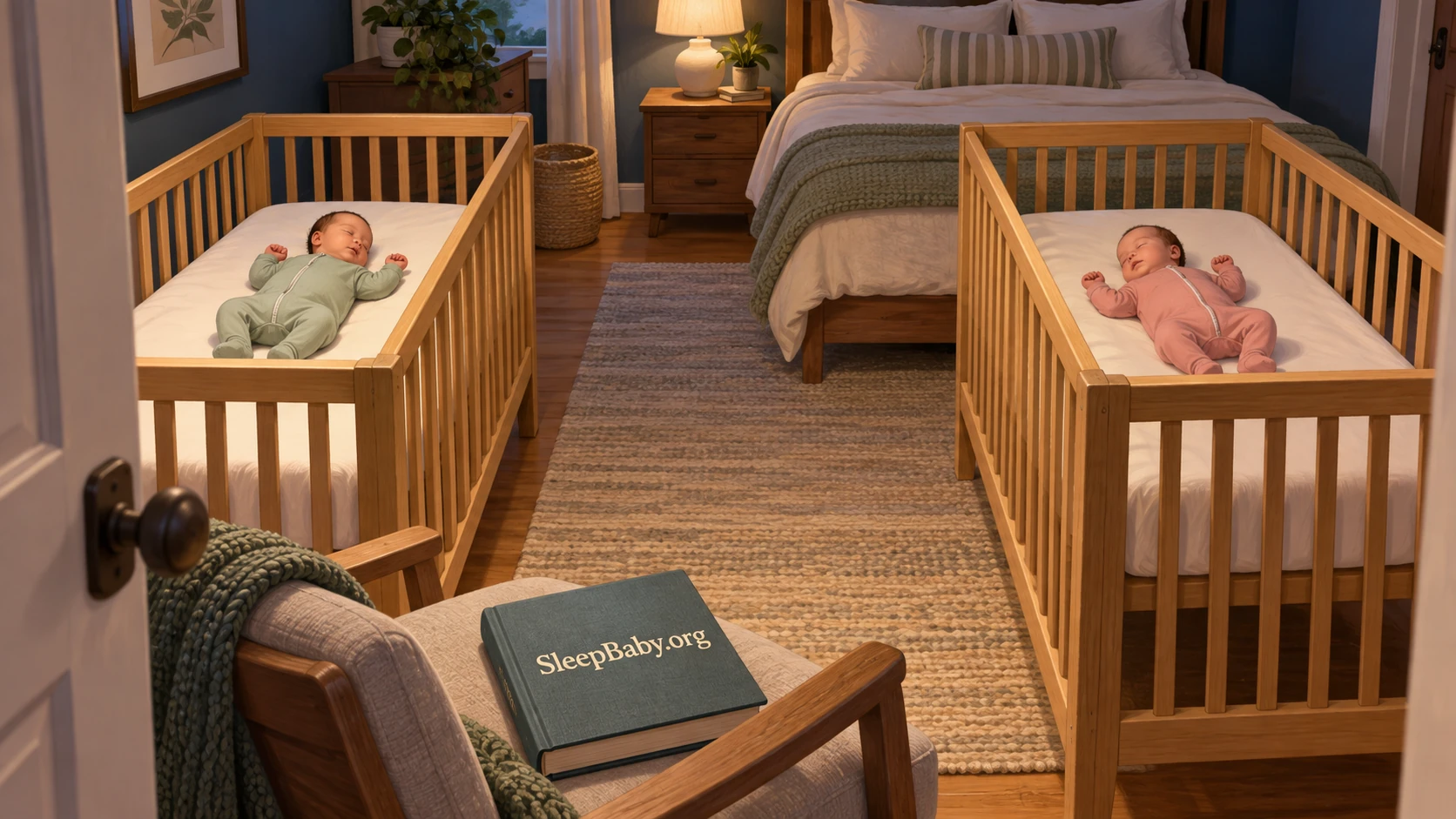
I would give each twin a separate crib, bassinet or other suitable infant sleep space from birth. That follows American Academy of Pediatrics guidance, which recommends separate sleep surfaces for twins at home and in hospital. They can share your room without sharing a mattress. Before their next sleep, check that you have one clear, correctly assembled sleep space for each baby, with the right mattress and fitted sheet. Put each baby down on their back. [1]
If you’ve read that newborn twins can share a cot, you haven’t imagined the conflicting advice. Some U.K. guidance allows it under specific conditions. I’ll explain that difference below. My recommendation here is the separate-space approach, with your babies’ own clinician helping you work through individual medical needs or a difficult room layout.
You do not need two matching nursery suites to do this. You need two appropriate places to put the babies down, and a way to reach both without climbing over furniture at night. Those are much more useful starting points than whether the room looks finished.
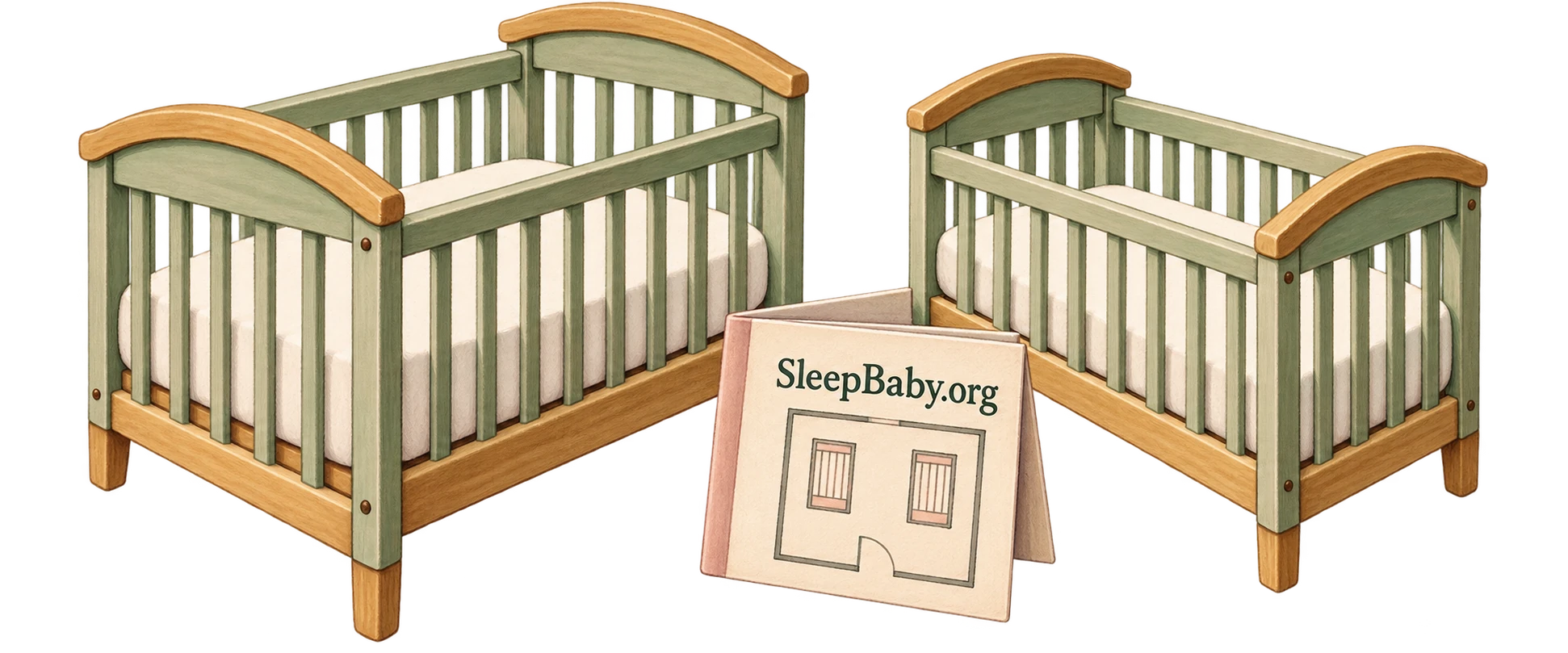
The same room and the same crib are different decisions
People use “sleep together” to mean several things. One person means two babies in the parents’ bedroom. Another means two babies on one crib mattress. A third means babies in the adult bed. Advice about one arrangement does not automatically apply to the others.
Room-sharing means the babies sleep in your room in their own infant sleep spaces. Co-bedding means the twins share a sleep surface. Bed-sharing usually means an infant shares a bed or another sleep surface with an adult. When you’re talking with a relative or clinician, describe the actual arrangement instead of relying on “co-sleeping.” [2]
I would plan for both babies to sleep in your room for at least the first six months, each in their own space, following AAP and NIH guidance. Separate mattresses do not require separate bedrooms. If your room cannot accommodate the equipment you have, that is a layout problem worth getting help with, rather than a reason to improvise inside one crib. [2]
One shared room. Two complete sleep spaces.
Check the whole setup for each baby. A safe arrangement for one twin does not finish the check for the other.
First baby’s space
- A suitable infant sleep product used as instructed.
- Its correct firm, flat, level mattress and fitted sheet.
- No other baby, loose bedding, toys or added partition.
- Back placement for every sleep.
Second baby’s space
- The same complete safety check.
- Equipment limits matched to this baby’s size and abilities.
- A clear place to return after a feed or cuddle.
- Access for the adult caring for this baby.
What they share: your room, your care and a familiar evening. The mattress stays individual. [1] [3]
SleepBaby.org · A practical setup check, not a guarantee against sleep-related harm.
Why the advice you’ve found may disagree
The AAP’s twin-specific recommendation is to avoid co-bedding and provide separate sleep surfaces. Its evidence review says the proposed benefits have not been established convincingly enough to outweigh the concerns. It discusses potential overheating, rebreathing and accidental suffocation, including when babies differ in size. This is a recommendation from birth, not permission to share until a particular birthday or the first roll. [1]
Current NHS guidance takes a different position: it allows small twins to share a cot when its safer-sleep conditions are followed. The Lullaby Trust also describes conditional early co-bedding, with separate spaces needed once either baby starts rolling or moving around. Those are real differences in published guidance, not two ways of saying the same thing. [4] [5]
I would not merge them into “all experts say one crib is fine for three months.” That claim loses the AAP’s actual recommendation and creates a deadline that does not fit every baby. If you’re in the U.K. and have been advised to co-bed, ask your health visitor or neonatal team to go through the exact equipment and each baby’s needs with you. Separate suitable spaces remain an option from the beginning.
The research also needs context. A Cochrane review of co-bedding involved six mostly small studies of preterm babies in neonatal units. It found the evidence too limited to recommend for or against that hospital practice. That is not proof that sharing a cot at home improves sleep or is equally safe. Hospital monitoring, patient selection and clinical care do not travel home with the cot. [6]
For your decision, I would put the practical question this way: can each baby sleep near you on their own suitable surface? If yes, you can choose that arrangement without having to prove whether the twins would settle faster together.

When two cribs won’t fit beside your bed
Start with measurements of the room you actually use. Include the adult bed, the door’s swing, drawers you need to open and the route you take to lift a baby. Measure the outside of the proposed sleep product, not just the mattress. A crib can fit on a floor plan and still make one baby awkward to reach.
Two full-size cribs are not the only possible arrangement. Appropriate bassinets, portable cribs or play yards can provide individual infant sleep spaces when they meet applicable standards and are used within their instructions. Choose based on both babies’ current needs and the space available. A smaller footprint is helpful only if the product is suitable for that child and its intended use. [3] [7]
One twin might use a crib while the other uses a bassinet you already own. The equipment does not need to match. It does need to be complete, correctly assembled and appropriate for the baby using it. I would spend the first round of planning on those checks before comparing finishes or ordering a pair of anything.
For example, suppose a large dresser is the reason the second crib will not fit. Moving adult storage may be simpler than buying another sleep product. In another room, the obstacle may be an inward-opening door, where changing the position of the adult bed gives a clearer route. These are possibilities to sketch and measure, not layouts that will suit every home.
Keep the feeding area separate in your planning. You may want supplies near the adult who uses them, but “nearby” does not mean resting on the crib rail or inside the mattress area. Think through where a bottle, burp cloth or phone goes when your hands are occupied. A clear adult-side surface can reduce the temptation to use an empty corner of the baby’s bed for storage.
Also plan the next stage before buying the smallest option. If a bassinet solves the first weeks, where will the baby sleep after reaching its limits? You do not need to assemble every future bed today. You do need a realistic next step that does not depend on both twins growing at the same rate.
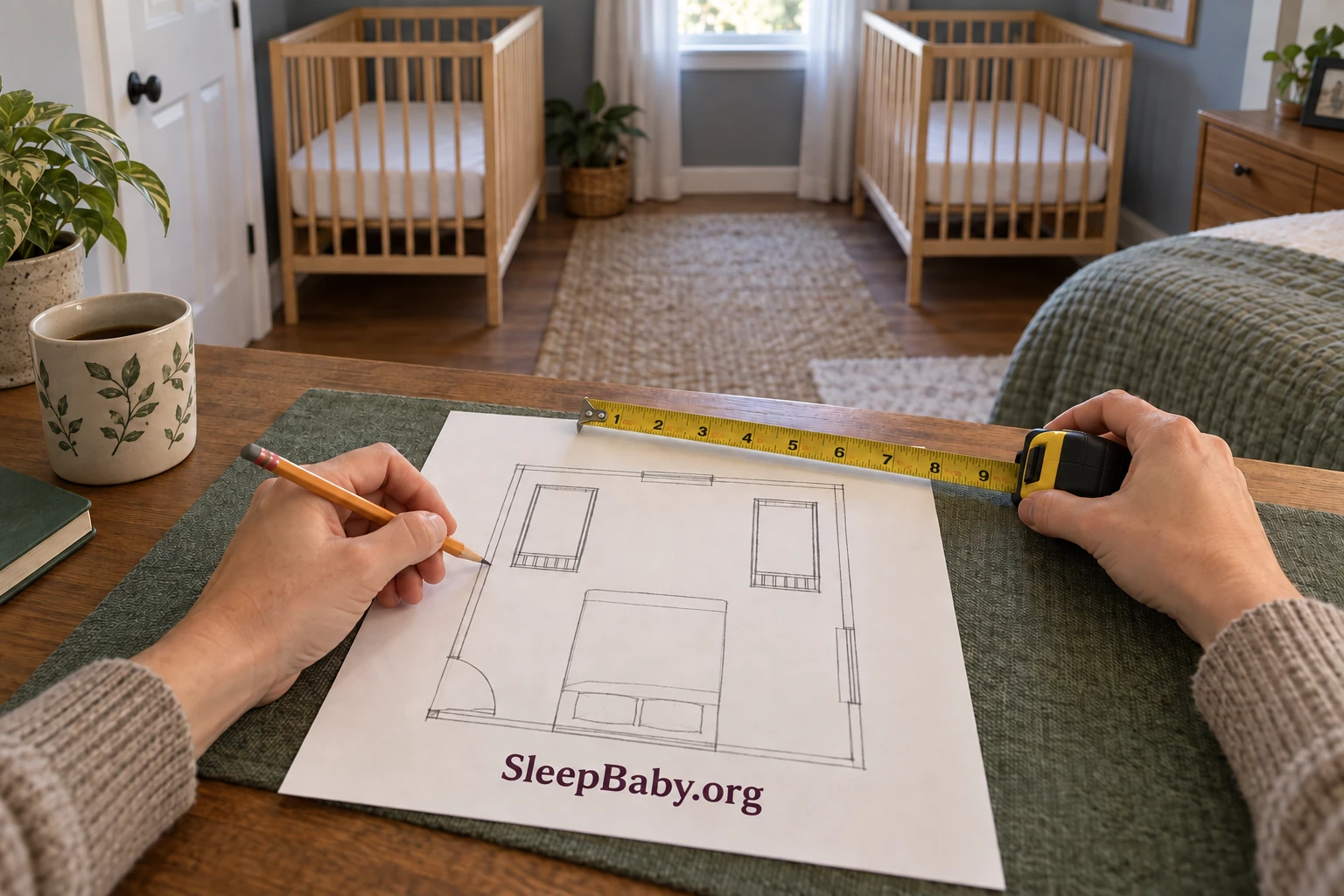
If the bedroom is still unworkable, discuss the actual layout with your pediatrician, health visitor or discharge team. One possibility to explore is moving the adult’s separate sleep place into the room where both infant spaces fit. That requires checking the whole room and keeping adult bedding away from the babies, not simply putting everyone on an adult mattress.
If cost is the problem, say so plainly when you ask for help. A hospital social worker, local public-health service or pediatric practice may know a local crib-assistance program; availability varies. For borrowed equipment, check the model, instructions, parts, condition and current recalls. I would prefer a plain, complete suitable sleep space to an elaborate setup that needs makeshift fixes.
A divider does not turn one ordinary crib into two
I would not put a pillow, rolled towel, cushion, positioner or homemade panel between the babies. Adding something to keep them apart introduces another object into the sleep space. The Lullaby Trust specifically advises against cot dividers as well as pillows or rolled towels between co-bedded babies. [5]
Two fitted sheets on one mattress do not create two separate sleep surfaces either. Neither does placing the babies at opposite ends and planning to watch them. Those are changes within a shared surface. They do not meet the separate-surface approach recommended here.
A purpose-built product marketed for twins needs a more careful check than its name. Look up the exact model and current manual. Does it provide a separate infant sleep compartment for each baby? Is that configuration intended for sleep? What are the occupancy, weight and developmental limits for each section? Are all required components present?
Do not assume that every attachment on a play yard is a sleep area. A changing station, seat or lounger can look like a convenient place to put a tired baby and still have a different purpose. If the sleep use or configuration is unclear, ask the manufacturer before using it. CPSC’s infant sleep product rules distinguish sleep products and their configurations; a reassuring product nickname is not a substitute for the instructions. [8]
The same applies when traveling. Reserve two appropriate sleep spaces explicitly and confirm what the accommodation actually supplies. “We have a crib” may mean one. If you bring your own equipment, take the correct supplied mattress or pad and sheet rather than adding padding to make an unfamiliar surface feel softer.
BABY SLEEP MIRACLE · PAID SLEEP GUIDE
Two little beds. An evening you can plan together.

Once both sleep spaces are ready, the next question is what happens around them: the feeding care, the comfort and the return to bed. If you want to explore more help with everyday sleep and settling, SleepBaby.org Workshop gives you digital access to the paid guide introduced in the Baby Sleep Miracle presentation.
Use it to consider the sleep habits and bedtime approach that fit your family. It is general sleep guidance, not a twin-specific medical plan. Keep each baby’s feeding instructions and separate sleep space in place.
SleepBaby.org Workshop
Digital access · $20 USD
One payment
The button adds the Workshop to your cart and opens secure checkout. Prefer to watch first? The free presentation remains available earlier in this article.
If your twins already share, begin with the next sleep
You don’t have to defend the decision you made with the information you had. Focus on making the next arrangement clear. If you are following the AAP approach, prepare a separate suitable space for each baby and use it for the next nap or night sleep. There is no need to wait for rolling to begin.
I would keep the familiar parts of settling that are safe and workable: the same quiet voice, feeding care and usual sequence. Change the sleep surface without simultaneously deciding that tonight must also be the night they stop needing help. A safer setup and independent settling are different tasks.
Expect to learn something about each baby’s response. One may settle with little fuss; the other may need more holding and another calm putdown. That difference does not establish that they medically need one shared mattress. It tells you that one baby needs more support with this particular change.
Make the next putdown simple
- Prepare both spaces first.
Check mattresses, fitted sheets, assembly and each baby’s equipment limits before you start the routine.
- Meet each baby’s immediate needs.
Follow the feeding plan, change a diaper if needed and offer comfort. You can settle them one at a time.
- Return each baby to their own space.
Place each on their back. A sleeping twin’s crib does not become the temporary parking place for the other.
- Tell the next caregiver exactly what changed.
Point out which space each baby uses and explain any individual feeding or care instructions.
If someone else helps overnight, make the plan visible outside the sleep spaces. Use the babies’ names and plain instructions. Avoid “put them back where they were” when the arrangement has just changed. You want the exhausted adult coming in at 2 a.m. to have fewer things to work out.
For the first few sleeps in the new arrangement, choose one small thing to notice: whether each baby settles, how often you need to return, or whether the route between the beds works. Do not interpret every unsettled minute as a verdict on the separation. Hunger, a wet diaper and needing comfort can still happen in a correctly prepared crib.
If the practical problem is that you cannot reach one baby comfortably while recovering from birth, ask someone to help rearrange the room and talk with your care team about lifting and movement. The setup needs to work for the adult’s body too. Keeping both infant spaces ready can make it easier to put a baby down before you reposition yourself.
What if one twin keeps waking the other?
First, notice what actually happens. A cry followed by a stir is different from both babies becoming fully awake and needing care. You do not have to redesign the room because one baby made a noise. Nor do you have to leave a distressed baby crying to prove that the other can tolerate it.
I would respond to the baby who needs you while keeping the other in their own safe space. If you’re alone, putting one baby down safely while you care for the other is a workable part of caring for twins. It is not a failure to provide two pairs of arms.
Try to separate the questions in your notes: who woke first, whether the second baby actually woke, and what each needed. A few clear observations are more useful than “they kept each other up all night.” If the second baby was already due a feed, moving a crib may not change the night very much.

For feeding coordination, ask your clinician what makes sense for both babies. AAP twin-feeding guidance discusses feeding both when one wakes, but an individual feeding plan still matters, particularly with prematurity, different growth patterns or a baby who must be woken for feeds. Do not stretch one baby’s required feeds to make the schedules match. [9]
Twins share a birthday, not necessarily a timetable. You may be able to keep a similar evening sequence while allowing one baby to need an earlier feed, more settling or a different sleep opportunity. If timing is becoming the separate problem, our guide to finding a workable bedtime helps you look at the day’s pattern without treating one clock time as compulsory.
Before moving either baby into another room just to manage noise, talk through how you will preserve age-appropriate room-sharing and nighttime care. You may have more options in the current room than you first thought. The aim is a workable arrangement for the whole household, with each baby’s sleep surface still clear and individual.
Premature twins need individual discharge instructions
If your babies were in neonatal care, ask the team to demonstrate the home sleep arrangement before discharge. Explain the products you have and whether both babies will be coming home together. Do not infer the home plan from one photograph or practice you saw in a monitored hospital setting.
Prematurity and low birth weight matter to sleep-related risk, and twins may not have identical medical needs. The AAP’s separate-surface recommendation includes hospital and home care. If a clinician gives an individual medical instruction, ask what it changes, why, how long it applies and when it should be reviewed. [1]
Useful questions include: Does either baby need waking for feeds? Who should we call if feeding becomes difficult? Are there prescribed medicines or equipment, and what is the exact plan for each baby? Which instructions are for both, and which belong to only one? Ask for the answers in writing so every caregiver can follow the same plan.
Keep those records separate enough that care does not get mixed up. A shared notebook can work if every entry clearly identifies the baby. “Fed at 1:15” is incomplete when there are two infants. Record the name, what happened and any clinician-requested detail, without turning ordinary sleep into an exhausting data project.
New trouble breathing, an unusually unresponsive baby or another urgent concern needs medical help, not sleep troubleshooting. Call emergency services if a baby is not breathing normally or cannot be woken. For changes in feeding, alertness or other symptoms, contact your baby’s clinician promptly and follow the discharge advice. [10]
One twin may outgrow the setup first
Check equipment limits separately for each baby. Reaching a weight limit, a height limit or a developmental limit can require a change even if the other twin is still comfortably within the product’s instructions. Follow whichever limit the manufacturer says ends that mode of use; do not wait for both children to reach it.
I would keep the manual somewhere you can find it and note the relevant limits in the care record. If you have two different products, there may be two different sets of instructions. The word “bassinet” does not give every model the same stopping point.
Check each baby against their own equipment
- Baby and current sleep space
- Write the name, exact model and configuration. “The little bed” is easy to misunderstand when caregivers switch.
- The next limit
- Find the manufacturer’s weight, height and developmental limits. Keep all of them in view.
- The replacement plan
- Identify the next appropriate individual sleep space before a limit is reached. You may need to change only one setup first.
The same principle helps with clothing. One twin may need a different size even if you bought matching garments. Follow fit instructions and choose suitable sleepwear without loose blankets in the sleep space. If a baby dislikes the garment, check the sleep-sack fit and the moment the fussing starts instead of assuming both babies need a different bed.
Later, when crib climbing or the manufacturer’s limits make a crib unsuitable, plan the next bed arrangement around each child’s abilities and the safety of the entire room. There is no universal birthday when sharing one larger bed becomes the answer. Toddler sleep and room safety need their own assessment; the newborn recommendation should not be stretched into a lifetime rule about how close siblings can be.
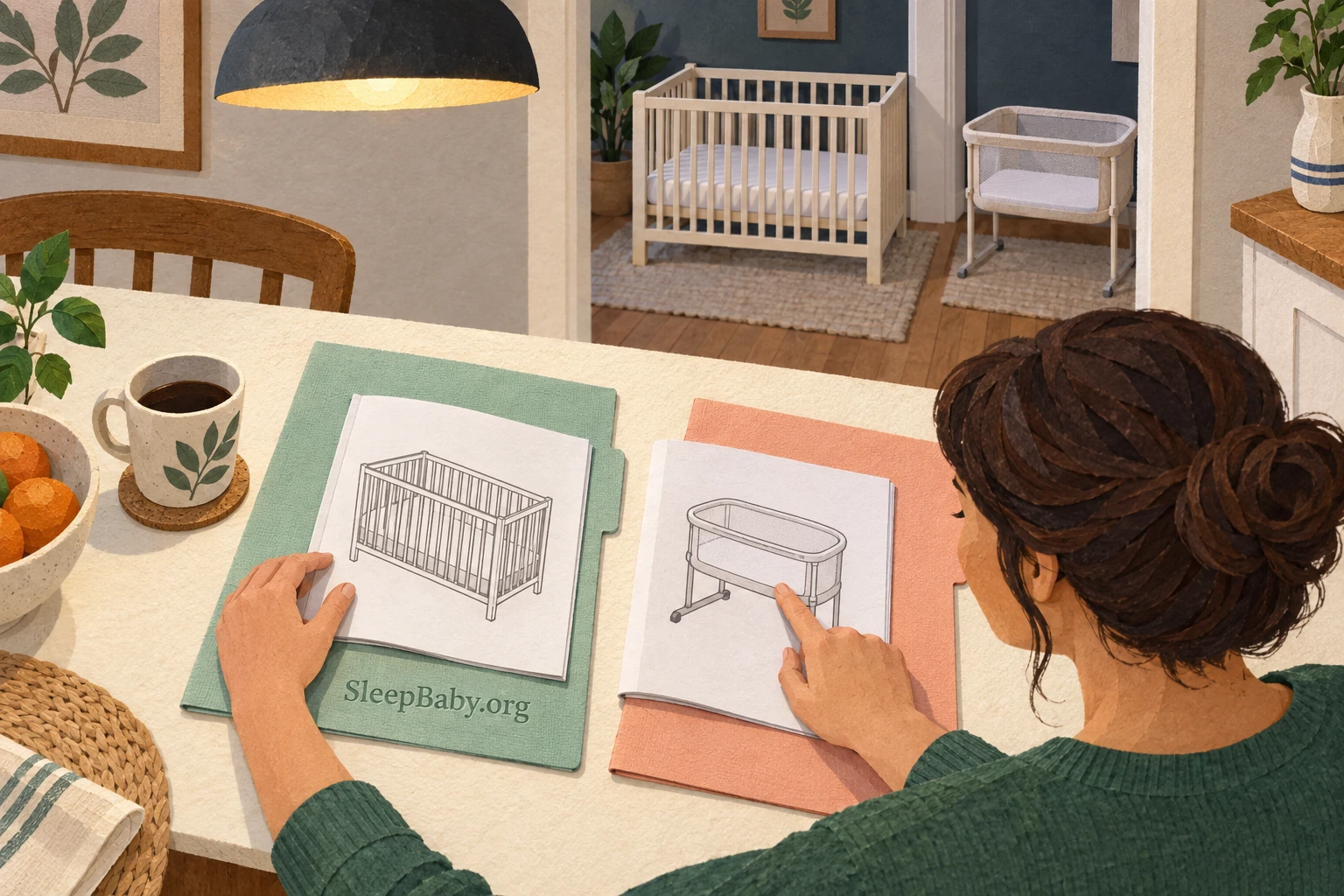
Protect the place they return to after feeding
The prepared crib matters most when you’re tired and the feed has taken longer than expected. Decide in advance where each baby will go when the feed or cuddle ends. Feeding pillows, loungers, swings, sofas and armchairs do not replace an appropriate infant sleep surface. Move a sleeping baby to their own suitable space. [3]
If you feel yourself falling asleep while holding a baby, put the baby down safely and get help if available. Do not choose a sofa or armchair as a place to stay awake with them. If an unplanned sleep happens while feeding in bed, return the baby to their separate space as soon as you wake. Plan caregiver support around the moments when you are most likely to struggle. [2]
With two adults, agree who is responsible for which task and how to hand over. With one adult, reduce the number of unnecessary steps: prepare permitted supplies, keep the route clear and leave each sleep space ready. Our guide to when both parents can rest while their newborn sleeps discusses rest and handoffs without requiring someone to watch a sleeping baby continuously.
NICHD · SAFE TO SLEEP · 1 MINUTE
Watch one sleep-space check, then repeat it for the other baby
This NICHD video shows the basics in one infant sleep space: a separate surface beside the adult bed, a firm mattress, no soft objects and back placement. Apply that check separately to each twin. It is a general safe-sleep demonstration, not a study of twins or a promise that either baby will settle faster.
If the player does not load, watch the NICHD video on YouTube or read its complete text alternative. All the checks you need for this article are also written above.
Separate sleep spaces do not make your twins less close. You can speak to them, comfort them and build familiar routines while giving each a clear place to sleep. I would judge the arrangement by whether it is appropriate for each baby and manageable for the adults, not by whether the babies look beautifully symmetrical in it.
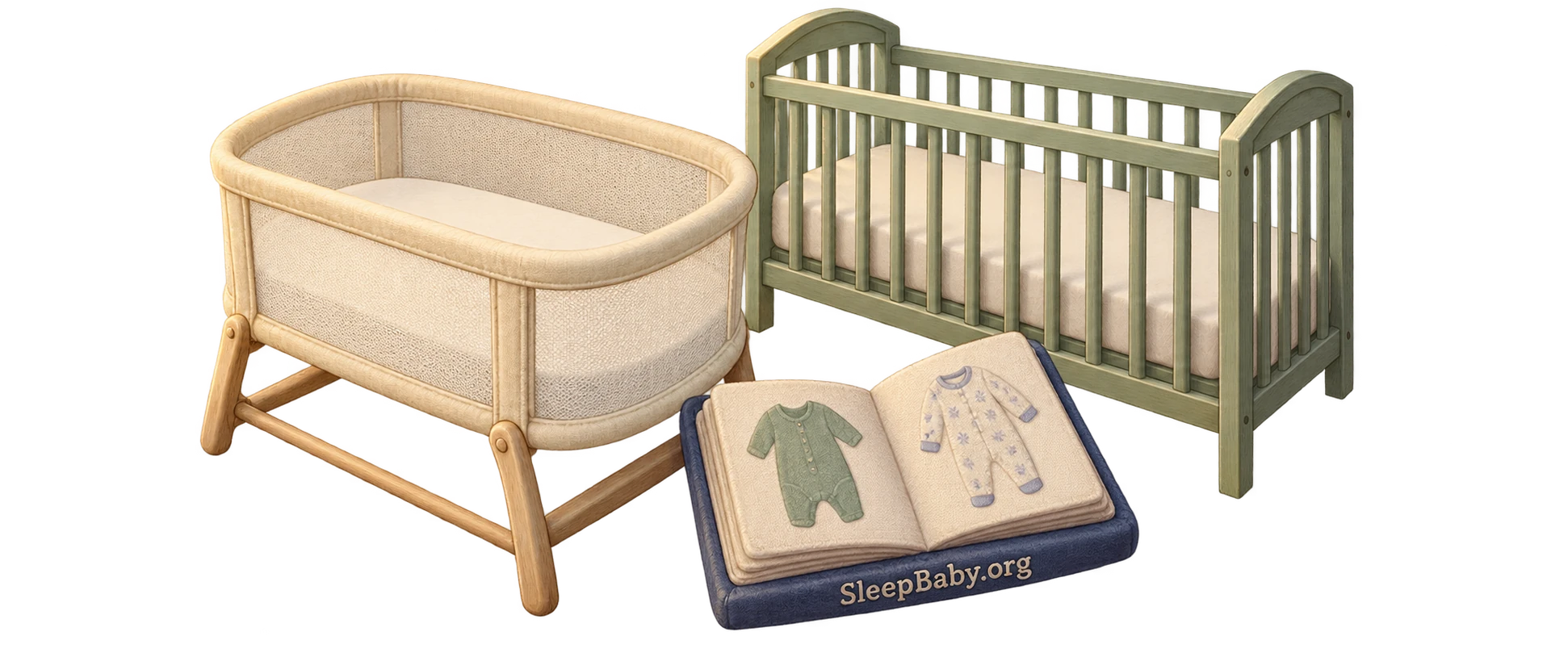
An optional individual crib to compare on Amazon
As an Amazon Associate I earn from qualifying purchases.
If you already need an individual crib and specifically want an oval design, the Stokke Sleepi Bed V3 in Natural is one model to compare. This is an option for one baby’s sleep space. The recommendation is not to place both twins in one crib or to buy a matching pair for appearance.
Why consider it
You want this specific design and have measured space for it, including a clear route to both babies.
Check before buying
Confirm V3, what the seller includes, the required matching mattress, the current manual and the total cost. The manufacturer’s guide lists the mattress separately.
Skip it when
You already have two suitable spaces, the room cannot accommodate it, or a simpler appropriate crib, bassinet or play yard fits your needs and budget.
I would choose fit, complete parts and correct use before an expensive finish. A higher price does not make a shared mattress the right arrangement. Follow the exact model’s instructions and check current recalls, including when buying used.
Compare the Stokke Sleepi Bed V3 on Amazon
Model checks: Stokke’s Sleepi V3 user guide. Seller price, stock and package contents can change.
Sources and guidance
Reviewed September 20, 2026. Guidance differs by organization; the article explains the distinction.
- American Academy of Pediatrics: 2022 safe-sleep policy and evidence review. Separate surfaces for twins; policy supported by the linked technical evidence review.
- NIH Safe to Sleep: reduce sleep-related risks. Room-sharing, separate surfaces and returning baby after feeding.
- NIH Safe to Sleep: a safe sleep environment. Appropriate firm, flat, level, bare infant sleep spaces.
- NHS: twins and sleep. U.K. guidance permitting cot-sharing under its conditions.
- The Lullaby Trust: twins and multiples. Conditional co-bedding guidance and advice against dividers.
- Cochrane: co-bedding preterm twins. Limited neonatal-unit evidence, not proof of home-sleep safety.
- U.S. Consumer Product Safety Commission: Safe Sleep. Sleep-product and bare-sleep-space guidance.
- CPSC: infant sleep product questions. Product scope and configurations intended for infant sleep.
- American Academy of Pediatrics: feeding twins on a schedule. Coordinated feeding alongside each infant's individual needs.
- NHS: urgent medical help for babies and children under 5. Urgent breathing and responsiveness warning signs.
AAP technical evidence report; video and product documents are linked beside those items.
TWO PREPARED SPACES. ONE NEXT STEP.
Now think about the evening around those two beds
Once each baby has an appropriate place to sleep, you can turn to the routine surrounding feeds, comfort and putdowns. If you’d like to explore SleepBaby.org’s approach, the free Baby Sleep Miracle video is a place to start. Keep each twin’s feeding and medical instructions at the center of your plan.






What viewers said10 comments · 4 replies+
Archived comments from the original Baby Sleep Miracle presentation. Not independently verified by SleepBaby.org; individual experiences vary.
Thank you so much for this video! I had no idea about the dangers of baby swings :O
Hi Mary-Ann. I have a question: Is method in any way similar to the ones recommended by Dr Bucknam, Dr. Weissbluth or Dr. Karp? We tried those but none of them help.
Hi Regina, thank you for your question. The short answer is no. The techniques I share in my guide are based on newest scientific research and this is why I have never seen any approach similar to the one I recommend.
This method really works! I tried it on my son Jesus and after just one week he went from waking up more than 5 times a night to waking up just once or twice. You are a lifesaver, Mary-Ann!
I'm truly impressed with how much information you share in your video. And all for free! I can feel that you truly care about mothers like myself, and that's hard to find these days. I have recommended your site to several of my friends already.
Mary-Ann, our child suffers from autism. Is your approach still suited?
Chloe, I made sure my method can be used with any child, even babies who are special like yours. Please note that I'm not a doctor and that I always advice to consult with your physician because nothing is more important than the safety and well-being of your love.
Hallo Mary-Ann, I'm from Germany. Do you have your guide in German?
Hello Heide, we do! Normally you should already see our video in German. If not, please contact our support so they can guide you
Thenk you for your answer, Mary-Ann!
I just completed your approach and I have to say, it worked almost too well. Yes, it took a bit of getting used to with your bedtime routine but the difference is huge. My son George used to take 1 hours to go down and now he's firmly asleep in no more than 10 minutes! You're the best!
It seems I'm the only man watching this video, lol! What you shared about the 'emotional backpack' made immediate sense to me and I can't wait to help my little girl Mila to unpack it!
Hey there, just discovered your site and this really sounds different. Just wanted to say thanks for sharing :)
For everyone who's still thinking about getting Mary-Ann's guide I want to advise you to go ahead. I wasn't sure myself but now I'm so thankful I invested in this program. It made a huge difference in our life as a family and yes, my baby girl does sleep through the night now.