Before you order blackout curtains at 12:47 p.m.
Your baby can nap in daylight—and a darker room can still be useful
No, your baby does not have to sleep in a completely dark room during the day. In the newborn months, daylight during awake time and ordinary daytime sounds can help make day feel different from night. Later, if light is clearly distracting your baby or ending naps early, dimming the room is a reasonable experiment. It is a settling tool, not a developmental requirement and not a promise of a longer nap.
The safest nap setup does not change with the curtains: place your baby on their back on a firm, flat, level, clear infant sleep surface. Keep window-covering cords, loose fabric, suction cups, clips and hardware completely outside the sleep space and out of reach. For at least the first six months, follow room-sharing guidance for sleep rather than moving a young infant into a separate dark nursery just to chase a better nap.
The stripe of light under the curtain can become suspicious very quickly. It sits there across the carpet while your baby sleeps for thirty-seven minutes, opens one eye, and appears personally offended that noon still exists. By the second short nap, the stripe has been promoted from “sunlight” to “the entire reason nobody in this house can rest.”
A clearly labeled composite Kacey-and-Benjamin moment
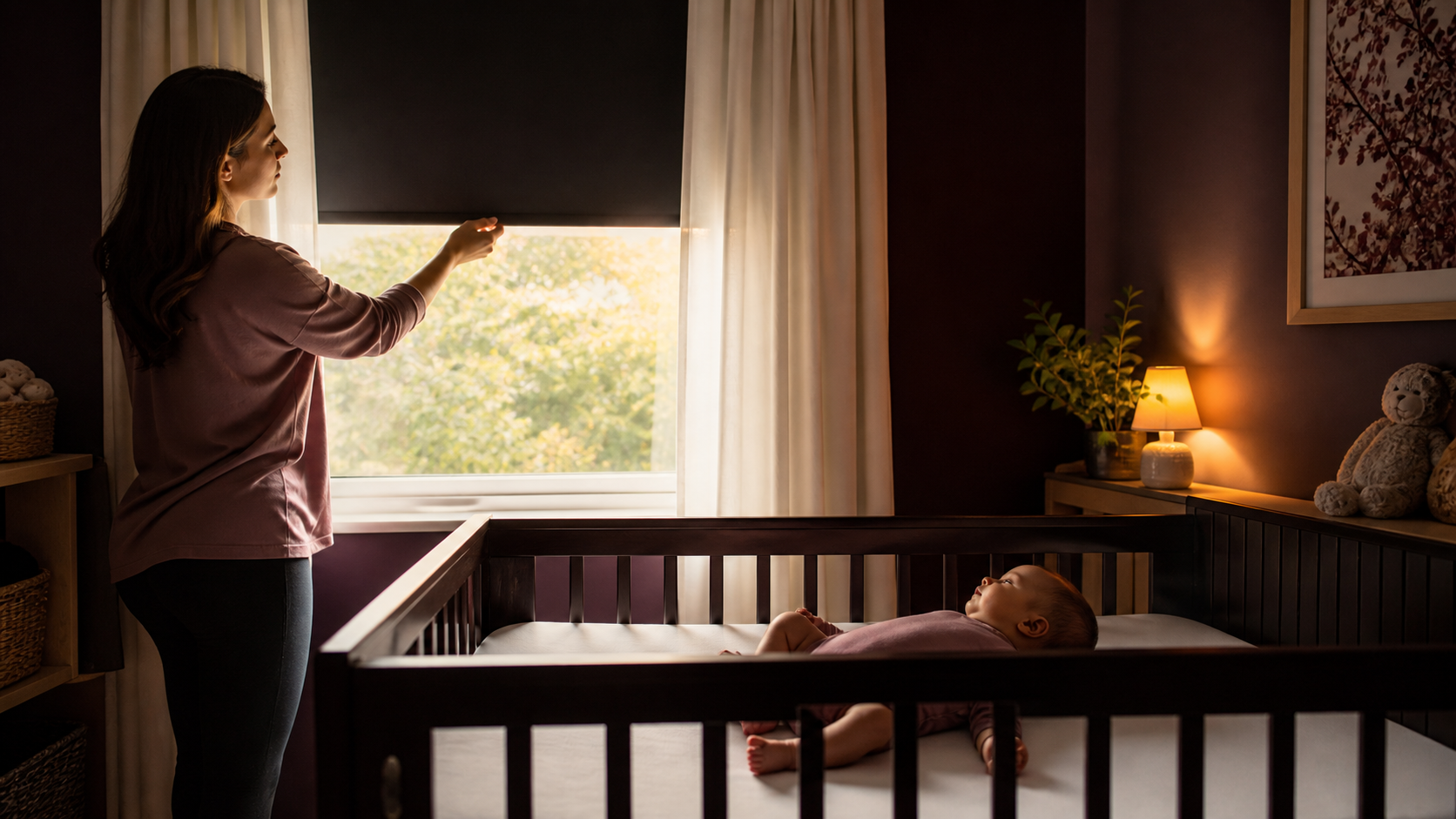
Imagine me standing in Benjamin’s doorway at midday, holding one curtain panel against the wall with my shoulder while trying to decide whether the bright edge near the baseboard has ruined his nap. In this composite scene, Benjamin is asleep in a clear crib, entirely unconcerned with my new career in amateur light engineering. I am the one studying the room as though the sun has submitted a formal complaint.
The useful turn is not “dark is good” or “daylight is good.” It is asking what job I want the room to do. Am I helping a newborn learn that daytime is active and nighttime is quiet? Am I reducing stimulation for a baby who now notices everything? Or am I trying to make one normal short nap become a two-hour event because I need lunch and a functioning thought? The room cannot answer all three questions the same way. This scene is a composite, not evidence; the distinctions below come from the cited guidance.

First decide which job the darkness is supposed to do
Parents are often handed opposite slogans: “Naps should happen in daylight so babies learn day from night” and “Make the room pitch black for every sleep.” Each slogan contains a useful idea, then stretches it past the point where it can carry a whole family.
Job one
Mark daytime
Light during waking, open curtains, conversation and ordinary household life help daytime feel different from the low-light, low-stimulation night. The distinction matters more than forcing every nap to happen under a ceiling light.
Job two
Reduce stimulation
A dim room can make it easier for a visually alert baby to settle. This is especially plausible once your baby starts interrupting their own wind-down to inspect every moving shadow, curtain edge and ceiling-fan blade.
Job three
Keep conditions steady
Some babies resettle more easily when the light does not change sharply during the nap. That does not prove darkness lengthens sleep; it simply makes brightness one reasonable variable to test.
I would not ask one set of curtains to teach the body clock, calm a busy baby, fix the schedule and extend every nap. That is an unreasonable workload for fabric. Choose the actual problem first. Then the room adjustment becomes smaller, cheaper and much easier to judge.
For a newborn, build contrast across the day—not brightness during every nap
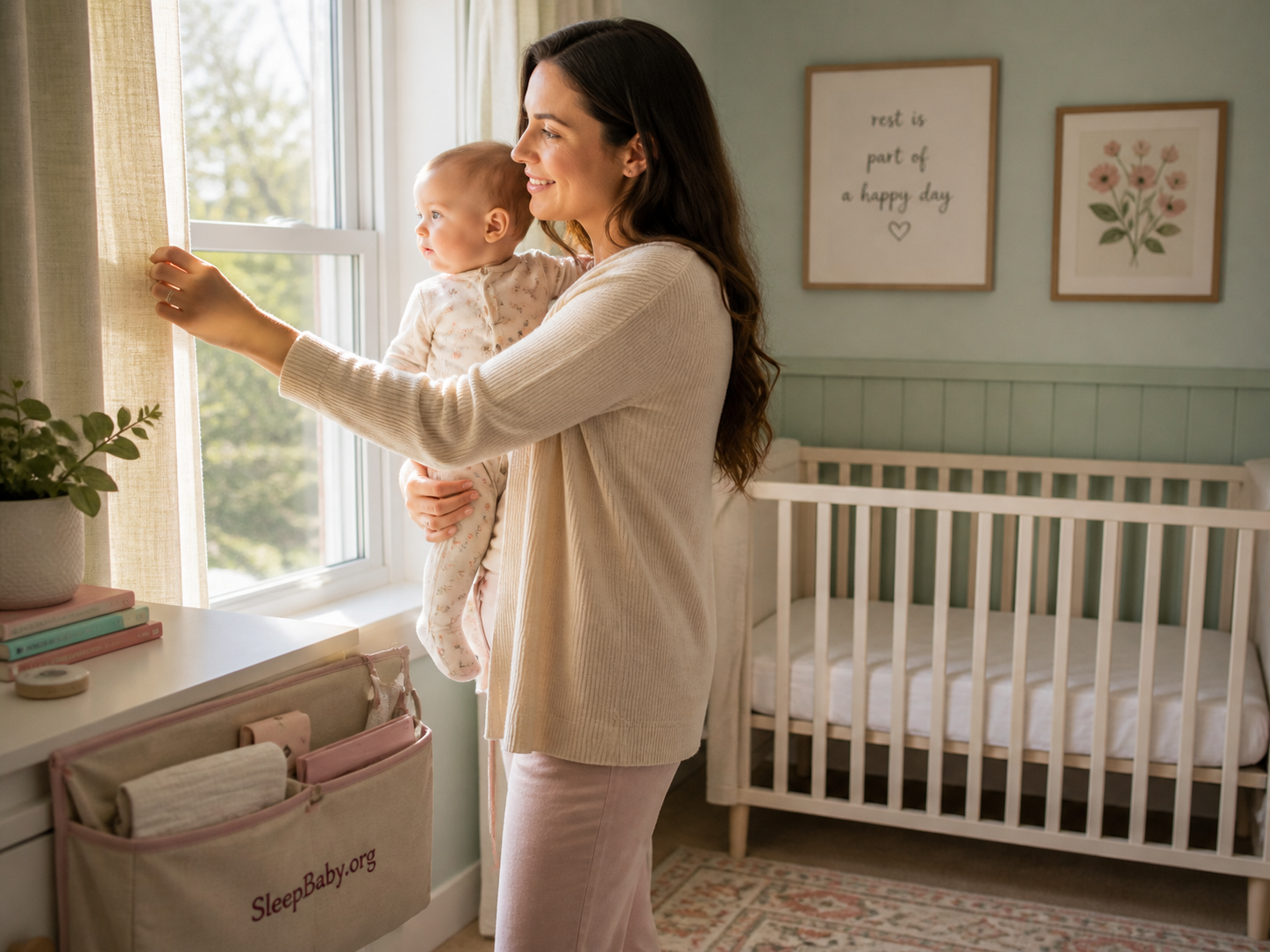
Newborn sleep is scattered. Young babies do not arrive with an adult-style day-night rhythm, and their sleep periods can be short around the clock. NHS guidance suggests making daytime recognizably daytime: open curtains, interact during awake periods and allow ordinary household noise. At night, keep lights lower, voices quieter and care less stimulating. HealthyChildren likewise describes calm, quiet nights and more interaction in the day.
Notice what this guidance does not require. It does not say a newborn must sleep under bright light. If the bassinet is in the living room and the room is naturally lit, you do not need to build a cave around it. If the light is falling directly into your baby’s face or making settling difficult, you can soften it. The larger pattern still carries the day-night message: daylight after waking, feeds and cuddles in ordinary daytime life, and a quieter, dimmer night.
This is the part I would protect from perfectionism. A newborn can nap in a dim room without permanently confusing day and night. A newborn can also nap in a light room without being “trained” to sleep badly. Their rhythm develops over time. Your job is to offer repeated cues, not to make every hour look like a laboratory condition.

As your baby notices more, dimness may become more useful
Somewhere in the early months, the room can become far more interesting. A baby who once slept through a delivery driver, a coffee grinder and the emotional collapse of a laundry basket may suddenly need to inspect the exact geometry of the blinds. This does not mean you created a bad habit. It means attention, sleep organization and nap patterns change.
A darker room can reduce visual stimulation during the short transition into sleep. It may also prevent a moving patch of sunlight from becoming the first thing your baby studies between sleep cycles. Raising Children Network notes that dimness can help babies settle and that some children may sleep better when the amount of light stays consistent. That is useful, modest language: can help, not will fix.
If your baby falls asleep comfortably in a moderately lit room and wakes rested, there is nothing to repair. If they take one short nap but sleep appropriately across twenty-four hours, a blackout room may not be the missing ingredient. If they repeatedly stop settling to watch the window, or bright light arrives at the same point in every nap, dimming is worth testing.
A practical light ladder
Start with the least dramatic change
- Remove direct glare: shift the sleep space only if the new position remains fully safe and away from windows, cords and heat sources.
- Filter the brightest light: partly close a blind or curtain while keeping every cord and fabric length secured and unreachable.
- Dim the whole room: close fitted window coverings and keep the pre-nap routine otherwise unchanged.
- Use near-blackout only if it solves a demonstrated problem: test it rather than assuming the darkest room is automatically the best room.
The goal is enough darkness for your baby to disengage from the room—not a contest to eliminate the final photon.
If you are wondering whether one dim lamp is compatible with sleep, the related guide to using a night-light without making the room stimulating answers that narrower question. A verified internal link belongs here because the reader’s next decision is about the remaining light, not because every sleep article needs a chain of links.
Try a two-day light test before redesigning the nursery
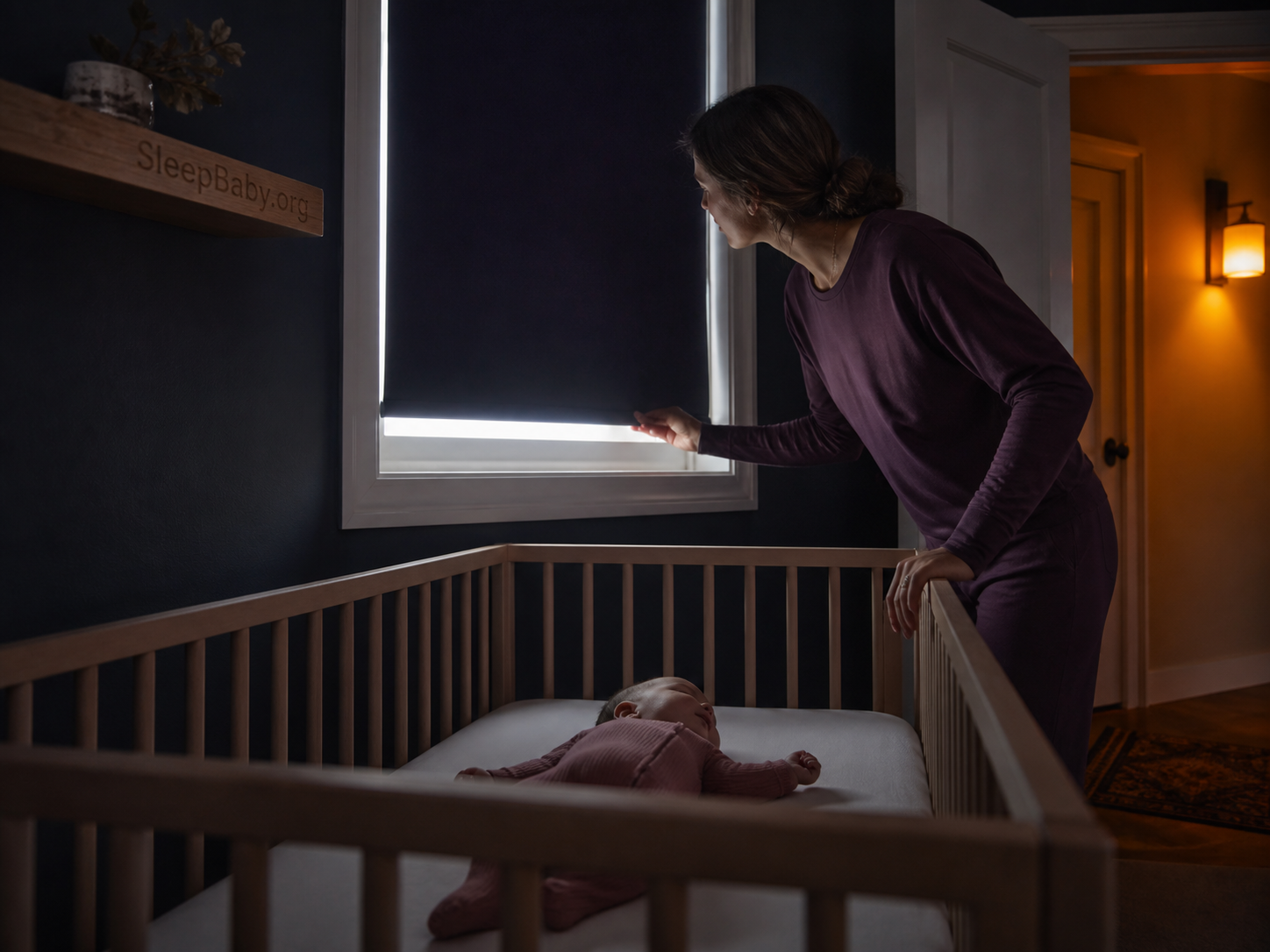
I am suspicious of any nap experiment that changes the curtains, wake window, feeding time, sound machine and pre-nap routine all at once. If the nap improves, you learn nothing except that you now own several new opinions. A useful test changes one variable and leaves the rest boring.
I would write down four things: time to settle, nap length, mood on waking and what the light did. Those details prevent the familiar parent-brain rewrite in which yesterday’s nap becomes either “three minutes” or “most of the afternoon,” depending on how badly today is going.

If the nap stays short, the curtains may be innocent
Short naps can reflect normal sleep development, nap timing, hunger, discomfort, illness, temperature, a changing schedule or simply the amount of sleep your baby needs that day. A room can be beautifully dark and still contain a baby who has finished sleeping. That is irritating, but it is not evidence that you failed to purchase a more determined curtain.
Look at the nap in context:
- Settling: Is your baby struggling because they seem alert and interested, or because they are upset, uncomfortable or overtired?
- Waking: Do they wake calm and ready to engage, or distressed and still visibly tired?
- Timing: Has the nap drifted earlier or later as your baby’s awake periods change?
- Feeding: Is hunger predictably ending the nap?
- Body clues: Are congestion, fever, reflux symptoms, teething discomfort or another concern changing sleep?
- Whole day: Is total sleep and nighttime sleep broadly workable, even if one nap is not the cinematic event you hoped for?
The deeper question is interference. Does the short nap leave your baby unable to feed, play or settle through the rest of the day? Is it part of a sudden change with illness or unusual behavior? Or is it a short but functional nap that mainly conflicts with the adult plan? I ask that gently, as someone who understands that the adult plan may have included eating while seated.
Contact your pediatric clinician when sleep changes accompany breathing difficulty, fever in a young infant, poor feeding, fewer wet diapers, unusual lethargy, persistent pain, a baby who is difficult to wake, or anything that makes you think this is more than an environment question. Lighting advice should never delay care for a body clue.
Darken the window without bringing the window into the crib
Permanent blackout blinds, fitted curtains and portable window covers can all reduce light. The important safety question is not the brand or darkness rating. It is whether the entire setup stays securely attached to the window and completely outside your baby’s reach.
Check for dangling cords, loops, chains, loose panels, detached suction cups, clips and any fabric that could fall toward the sleep space. Keep the crib or bassinet away from the window and covering. Recheck as your baby becomes mobile; “out of reach” can expire abruptly when pulling, standing and determined little hands enter the story. Follow the product’s installation instructions and inspect temporary attachments each time you use them.
Do not pin blankets, foil, towels or fabric around the crib. Do not drape anything over a bassinet or use a cover that changes airflow or creates an enclosure. If the room becomes warmer after the window is covered, dress your baby appropriately for the actual temperature and avoid overheating. The clear sleep zone remains clear, even when the room outside it gets darker.
A useful room-light test, not a sleep promise
My practical pick: Amazon Basics Portable Blackout Curtain Shade
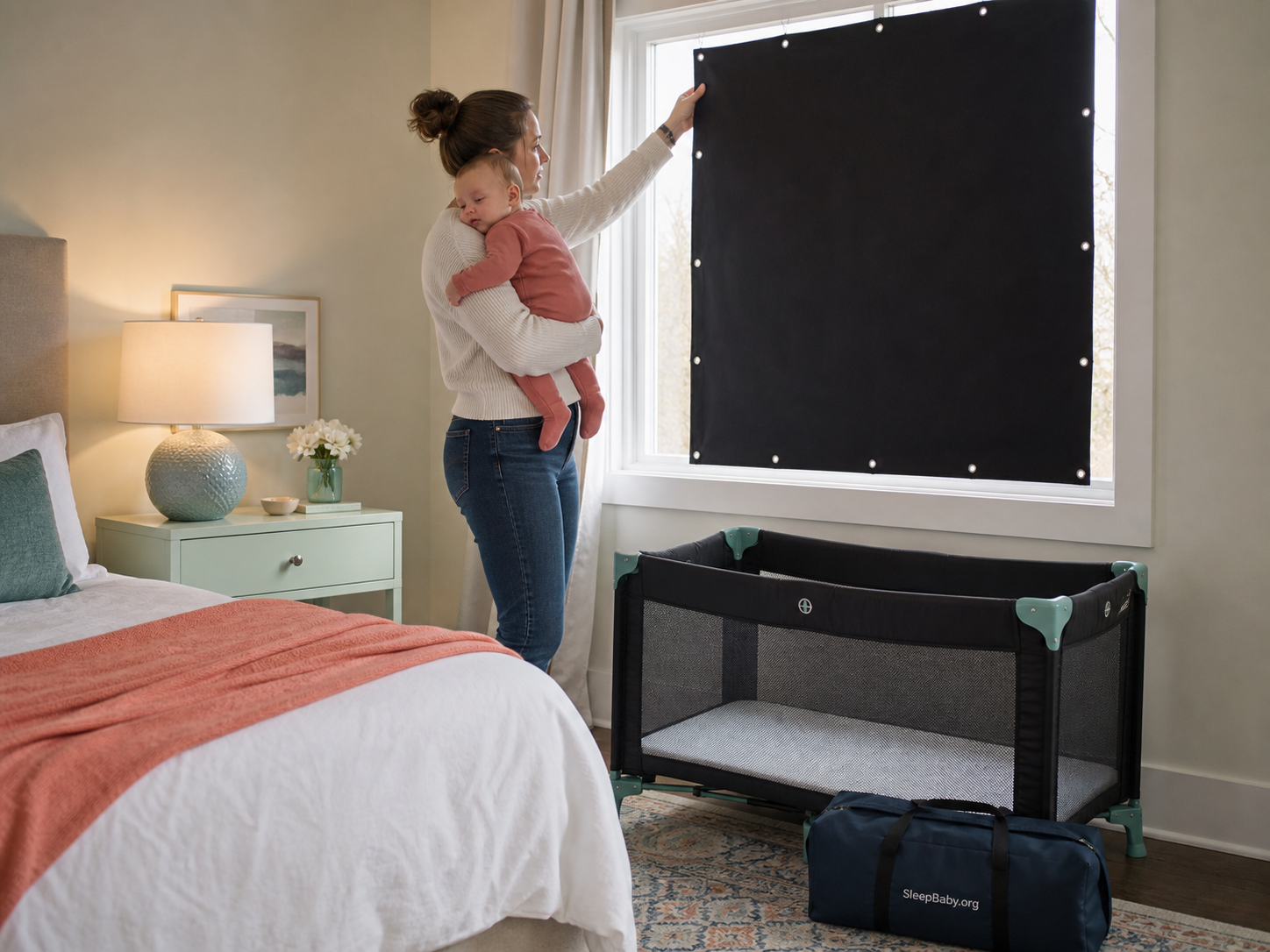
If you want to learn whether brightness is actually affecting naps before committing to fitted blackout blinds, the Amazon Basics Portable Blackout Curtain Shade with Suction Cups is a more useful first purchase than a permanent nursery overhaul. Its practical advantage is removability: you can darken one window for a controlled nap test, fold it away when you want normal daylight, and take it to a room or travel setup where permanent hardware is not possible.
I prefer that reversible job over buying a decorative night-light, heavier curtains and a new sound machine at the same time. It lets the product answer one honest question: does safely reducing this window’s light make settling easier for this baby? It does not guarantee a longer nap, improve development or replace a workable routine.
Use it only on the window, fully secured and completely outside the crib or bassinet zone. Inspect every suction cup before use, keep all fabric and hardware out of reach, and remove the shade if it loosens or changes the room temperature in a way you cannot manage comfortably.
See the portable blackout shade on Amazon
As an Amazon Associate, SleepBaby may earn from qualifying purchases.

The same room can do a different job at six weeks, six months and on vacation
A lighting recommendation without age or context is mostly a decorating opinion. The newborn family is trying to establish a gentle difference between day and night while feeding around the clock. The six-month family may be trying to help a highly alert baby disengage from a bright window. The traveling family is trying to make an unfamiliar room feel calm without rebuilding the nursery inside a suitcase.
| Situation | What light can help with | What not to assume |
|---|---|---|
| Early newborn weeks | Daylight during awake time and low-key darkness at night help create contrast. | A dim nap will not ruin the body clock, and a bright nap will not create mature sleep cycles. |
| Emerging rhythm | A short, repeatable wind-down plus softer light may signal that a nap is approaching. | The calendar does not create a universal age when blackout becomes mandatory. |
| Visually alert older baby | Reducing moving shadows and glare may make settling less interesting. | Every short nap is not a light problem. |
| Travel or temporary room | A removable shade can reproduce a familiar level of dimness without permanent hardware. | Portable fabric and suction hardware are harmless; both require secure placement and inspection. |
I would let the answer mature with the baby. In the early weeks, I care more about daylight when awake, calm nights, responsive feeding and safe sleep than about manufacturing perfect darkness. As attention sharpens, I become more willing to dim the room for settling. When travel changes everything, I preserve the simplest recognizable cues and accept that a different room may produce a different nap.
Will a dark room make your baby dependent on darkness?
Babies and adults both sleep with environmental cues. Familiar dimness can become one cue among many, but that is not the same as damage or a permanent inability to sleep elsewhere. The practical question is whether the setup serves your life. If your baby naps in a dark room at home and can sometimes sleep in a safe travel space, stroller or caregiver setting, the home preference is not automatically a problem.
If you want more flexibility, practice it gently rather than removing the useful cue during the hardest nap of the week. Keep one lower-stakes nap moderately dim instead of fully dark. Use the same sleep sack, short phrase or wind-down sequence across rooms. Let ordinary life provide occasional variation. Flexibility grows from repeated safe experiences, not from proving that a tired baby can sleep beside the blender.
I would also separate convenience from fear. You are allowed to use a darker room because it helps your baby settle and helps you plan the day. You do not have to maintain brightness as a character-building exercise. Conversely, you do not need portable blackout gear for every visit if your baby sleeps adequately without it. A tool becomes burdensome when the family is serving the tool.
A decision path for today’s nap
Use the room you have, then change only what the nap shows you
- Is the sleep space safe? If not, fix the surface, position, clear zone, room-sharing arrangement and window hazards before considering brightness.
- Is direct light bothering your baby? If light falls on the face or your baby repeatedly watches a moving bright patch, filter it safely.
- Does your baby settle and wake well enough? If yes, keep the current light level. A solution does not need upgrading because the internet owns darker curtains.
- Is the problem settling, nap length or the rest of the day? Name one outcome. Darkness may reduce stimulation; it cannot diagnose why a nap ends.
- Can you test one reversible change? Dim the room for two comparable naps, record the response, and stop if the change adds unsafe hardware, heat or household strain.
This path is intentionally unbranded and unmagical. It leaves room for the most common answer: the baby slept, the nap ended, and the curtains have no further statement at this time.
The questions that remain when the curtains are half closed
Will dark daytime naps confuse my baby’s day and night?
A dim nap room by itself is unlikely to erase the rest of the day’s cues. Keep mornings and awake periods bright and interactive, and keep nighttime care quieter and dimmer. For a very young baby, avoid making every daytime hour dark and silent merely to lengthen sleep. Think in terms of the whole twenty-four-hour contrast rather than one nap.
Does the room need to be pitch black?
No. Use enough dimness to reduce the distraction you have actually observed. If your baby settles with filtered daylight, stop there. Near-blackout conditions are a preference and a tool, not a badge of serious parenting.
Should newborn naps happen in the living room?
They can, provided your baby is on a safe infant sleep surface and room-sharing guidance is followed. A newborn does not need a separate bright-room performance for every nap. Ordinary daylight and household life around the nap can contribute to day-night contrast.
When should I start using blackout curtains?
There is no universal age. Test dimness when light appears to interfere with settling or waking, especially as your baby becomes more visually alert. Keep the change reversible and judge your baby’s response rather than the calendar.
What if daycare naps are bright but home naps are dark?
Babies can learn different cues in different places. You do not have to recreate daycare at home or send the home blackout shade with a tiny lighting specification document. A consistent short wind-down, familiar sleep clothing and a safe surface can travel across environments even when the light cannot.
Tomorrow, let the stripe of light be evidence—not a suspect
The bright line may still appear beneath the curtain. Your baby may still wake after one sleep cycle and look ready to chair a meeting. But you no longer have to decide that daylight is either essential or disastrous.
I would watch what the light actually does. If it holds your baby’s attention at settling or changes sharply during the nap, dim it safely and test again. If the room changes and the nap does not, release the curtains from responsibility and look at timing, hunger, comfort and the whole day. That is a better answer than chasing perfect darkness because it leaves you with something usable: a room that supports sleep without requiring the family to fear daylight.
Watch: settle the baby, then test the room
A calm settling routine matters more than achieving perfect darkness
This American Academy of Pediatrics video gives a useful wider frame for helping a child fall asleep. For a daytime nap, pair that calm routine with the smallest light change that solves a problem you can actually see.
Takeaway: use darkness as one quiet cue inside a repeatable nap routine—not as a test your baby or your room must pass.
When one short nap turns the whole room into a theory
Build the next nap around your baby’s clues, not perfect darkness
SleepBaby.org can help you connect nap timing, settling, room conditions and the rest of the day without changing five things at once. Start with the clue you can test, keep the sleep space safe, and let the pattern—not the curtain aisle—choose the next move.





What viewers said10 comments · 4 replies+
Archived comments from the original Baby Sleep Miracle presentation. Not independently verified by SleepBaby.org; individual experiences vary.
Thank you so much for this video! I had no idea about the dangers of baby swings :O
Hi Mary-Ann. I have a question: Is method in any way similar to the ones recommended by Dr Bucknam, Dr. Weissbluth or Dr. Karp? We tried those but none of them help.
Hi Regina, thank you for your question. The short answer is no. The techniques I share in my guide are based on newest scientific research and this is why I have never seen any approach similar to the one I recommend.
This method really works! I tried it on my son Jesus and after just one week he went from waking up more than 5 times a night to waking up just once or twice. You are a lifesaver, Mary-Ann!
I'm truly impressed with how much information you share in your video. And all for free! I can feel that you truly care about mothers like myself, and that's hard to find these days. I have recommended your site to several of my friends already.
Mary-Ann, our child suffers from autism. Is your approach still suited?
Chloe, I made sure my method can be used with any child, even babies who are special like yours. Please note that I'm not a doctor and that I always advice to consult with your physician because nothing is more important than the safety and well-being of your love.
Hallo Mary-Ann, I'm from Germany. Do you have your guide in German?
Hello Heide, we do! Normally you should already see our video in German. If not, please contact our support so they can guide you
Thenk you for your answer, Mary-Ann!
I just completed your approach and I have to say, it worked almost too well. Yes, it took a bit of getting used to with your bedtime routine but the difference is huge. My son George used to take 1 hours to go down and now he's firmly asleep in no more than 10 minutes! You're the best!
It seems I'm the only man watching this video, lol! What you shared about the 'emotional backpack' made immediate sense to me and I can't wait to help my little girl Mila to unpack it!
Hey there, just discovered your site and this really sounds different. Just wanted to say thanks for sharing :)
For everyone who's still thinking about getting Mary-Ann's guide I want to advise you to go ahead. I wasn't sure myself but now I'm so thankful I invested in this program. It made a huge difference in our life as a family and yes, my baby girl does sleep through the night now.