The 2 a.m. sock patrol is optional
Picture the composite version of this night: I am standing beside the crib at 2:07 a.m., touching two perfectly ordinary baby toes as if they have been assigned to deliver the weather report. One foot is bare. The missing sock is tucked near a calf. My brain, powered by crumbs and concern, has promoted this to an emergency meeting.
You are not silly for checking. Tiny feet feel vulnerable, and “cold feet” sounds like a verdict. But I do not want you rebuilding the whole sleep outfit around a toe test. The useful question is not “Are the feet cool?” It is “Is this baby comfortably dressed as a whole?”
Socks are one optional layer on two small body parts. They cannot correct an overheated sleep sack, an overly warm room or a draft hitting the crib. They also are not required when a baby is comfortable in a footed sleeper or appropriately rated wearable blanket.

Use the Chest-First Test before adding socks
The American Academy of Pediatrics advises dressing a baby in only one layer more than an adult would wear in the same environment and checking for overheating signs such as sweating, a hot chest or flushed skin. The Lullaby Trust likewise tells caregivers to check the chest or back of the neck rather than hands or feet, which normally feel cooler.
The Chest-First Test
Leave the outfit alone. Cool hands or feet do not automatically mean your baby needs socks.
Remove a clothing layer and reassess. Socks are not the main issue; the whole outfit is too warm.
Add one appropriate clothing layer. Well-fitted socks may be that layer, but footed sleepwear is often simpler.
A room thermometer can give context, but it does not replace checking the baby. The Lullaby Trust uses 16–20°C (about 61–68°F) as a comfortable room-temperature guide with suitable light clothing or a well-fitted sleep bag. The AAP does not require parents to hit one magic thermostat number; it emphasizes avoiding overheating and dressing for the actual environment.
That distinction matters in real houses. Sixty-eight degrees beside a sunny window can feel different from sixty-eight near an air-conditioning vent. The answer lives in the room, the clothing combination and the baby together.
Three safe-enough bedtime choices
There is no prize for choosing socks and no prize for refusing them. The best option is the simplest clothing system that keeps your baby comfortable without loose bedding.
Bare, integrated or separate
Good when the chest is comfortable and pajamas or a sleep sack already provide enough warmth. Bare feet are not a sleep problem.
A tidy choice for a baby who repeatedly kicks socks off. Check sizing so toes are not cramped and the fabric does not pull.
Reasonable when they fit smoothly, stay on, contain no loose threads or decorations, and do not make the full sleep outfit too warm.
If your baby wears a sleep sack, follow that product’s size and layer guidance. Do not treat the TOG label as permission to keep stacking layers. If the sleep sack plus pajamas already suits the room, socks are optional even when the feet feel cool.
If your baby sleeps comfortably in only a diaper during very hot weather, our guide to whether a baby can sleep in just a diaper helps you separate hot-room clothing choices from the safe-sleep surface itself.
Newborn feet look chilly before they are chilly
Newborn hands and feet can look mottled or feel cool while the center of the body is comfortable. Their circulation is still adjusting, and blood flow prioritizes the core. That does not mean every color change is normal, but it explains why a warm chest and cool toes can coexist.
For a healthy full-term newborn at home, use the same chest-first decision and one-more-layer guidance. A soft, well-fitting pair of socks can be part of that layer. A footed sleeper can do the same job with fewer loose pieces. If your newborn is premature, has circulation concerns, has recently left the NICU or has an individualized temperature plan, follow the clinical team’s instructions rather than a general clothing chart.
I want you to notice the difference between cool and concerning. Two feet that look similar, warm up with ordinary clothing and belong to a baby who is feeding and behaving normally are different from one foot that stays pale, blue, swollen or markedly colder than the other. Call the pediatric clinician for persistent asymmetry or a change that worries you.
What fabric should bedtime socks be?
Choose comfort and construction before chasing a fashionable fiber. A lightweight, smooth, breathable fabric that fits the room and does not irritate the skin is a sensible default. Cotton-rich socks often meet that description. Fine wool blends may work in a genuinely cold climate when they are soft and not bulky, but wool is not automatically safer or better for sleep.
Turn the pair inside out before first use. Long internal loops can catch a toe. Cut loose threads from the garment while it is off the baby; do not leave a freshly cut strand inside. Avoid thick traction dots or rigid seams that press into the foot during long sleep. Wash new socks according to the label and retire pairs that are stretched, pilling heavily or repeatedly disappearing.
A label that says “sleep socks” does not override fit, construction or the whole outfit. There is no magic bedtime fabric that can make an overloaded clothing system comfortable.
The sock fit test takes ten seconds
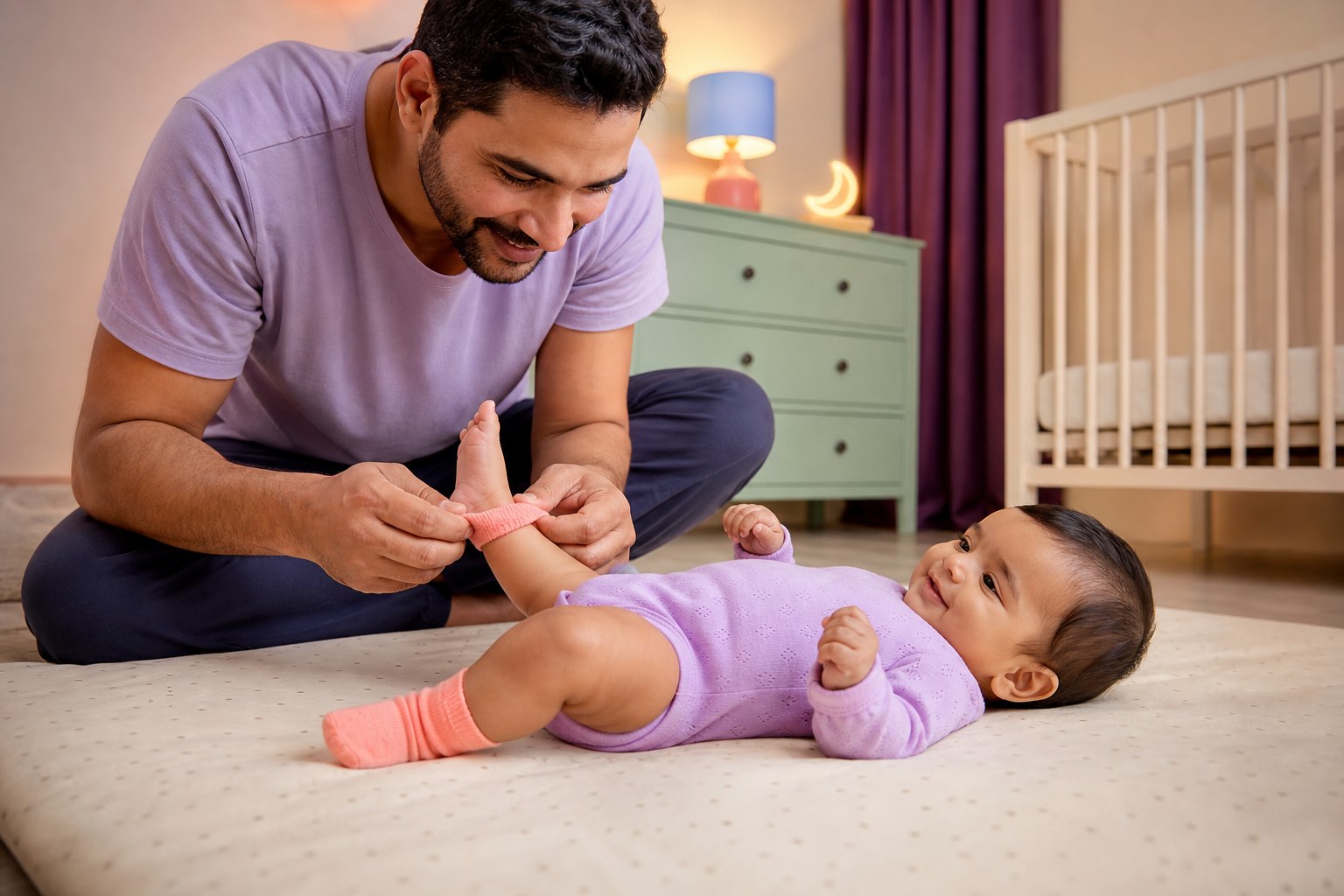
I would check a new pair in daylight before asking it to work the night shift. Put the socks on while your baby is awake, then look again after a little normal movement.
The Sock Fit Ticket
- Cuff: stays up without a deep groove, swelling or a change in skin color.
- Toes: have room; the fabric is not pulling them inward or bunching beneath them.
- Surface: clean, dry and smooth with no loose strings inside.
- Details: no pom-poms, beads, bells, buttons or detachable decoration.
- Staying power: does not slide off during ordinary kicking. If it does, choose footed sleepwear or bare feet.
A faint temporary cuff line is not the same as a deep indentation, but recurring marks deserve a different size or style. Remove socks and seek medical advice if a foot becomes swollen, persistently discolored, unusually cold on one side, painful to touch, or otherwise looks wrong. That is not ordinary bedtime-temperature troubleshooting.
What not to do for cold feet
Do not add a loose blanket to an infant sleep space. The AAP and NICHD recommend a firm, flat surface with no loose blankets, pillows, toys, bumpers or other soft objects. Use fitted sleep clothing or a wearable blanket instead.
Do not put a hot-water bottle, heating pad, electric blanket or heated rice sock in the crib. A warm crib gadget can burn or overheat a baby, and it does not belong in a clear infant sleep space.
Do not use a hat indoors for sleep. The head is an important route for heat loss. A hat plus socks plus heavy layers can turn a reasonable outfit into an overheated one.
Do not point a space heater or fan directly at the crib. Fix the room condition safely and keep cords and equipment well away from the sleep space. Then choose clothing for the environment that remains.
If cold extremities are the recurring worry, read how to tell whether a sleeping baby is actually cold and our explanation of why babies can wake with cool hands. Both bring the decision back to the chest, behavior and whole sleep setup.
If the socks keep falling off
Do not solve a loose sock with safety pins, clips, tape, elastic bands or a second tighter pair. If the socks repeatedly migrate, they are not the right bedtime tool for this baby. Switch to bare feet, a better-fitting pair or footed sleepwear.
One sock in the crib is not proof that something terrible happened. It is proof that the sock did not stay on. Remove it when you notice it and simplify the next outfit. The larger safe-sleep rule remains the same: an infant sleep space should be clear of loose objects and soft bedding.
If a baby repeatedly rubs or pulls at socks while awake, check for dampness, heat, eczema, a seam, a hair wrapped around a toe or another source of irritation. A hair tourniquet can tighten around a toe and requires prompt removal and medical care if it cannot be fully removed or the toe looks swollen or discolored.
Winter, air conditioning and fever change the context
Winter
In a genuinely cool room, socks can be a sensible part of a light layered outfit. But winter does not automatically require more of everything. Central heat, sleep sacks and fleece pajamas can already create plenty of insulation. Check the baby after settling rather than dressing for the forecast outside.
Air conditioning
Move the crib away from a direct vent if practical. A lightweight pair of well-fitting socks may make sense if the room is cool and the chest is not warm, but do not use socks to compensate for cold air blowing continuously onto the sleep space.
Fever or illness
Do not bundle a feverish baby to “sweat it out.” A baby who is unwell may need fewer layers, closer observation and medical guidance. Contact a clinician urgently for a rectal temperature of 100.4°F (38°C) or higher in a baby younger than 3 months, or for breathing difficulty, unusual sleepiness, poor feeding, dehydration, a seizure, blue or gray coloring, or anything that feels seriously wrong.
Socks do not treat fever, circulation problems or illness. If you need to measure temperature, follow a reliable method rather than using feet as a thermometer; our guide to taking a baby’s temperature under the arm explains the limitations and next steps.
Watch: why feet are the wrong temperature guide
Why it is here: The Lullaby Trust demonstrates the whole-body temperature check and explains why hands and feet are normally cooler. Watch on YouTube if you prefer.
Written takeaway: Check the chest or back of the neck, remove a layer for hot or clammy skin, and choose clothing for the room rather than reading the feet like tiny thermostats.
A one-minute answer for tonight
- Check the chest or back of the neck. Warm and dry is the goal.
- Look at the whole outfit. Socks are only one layer.
- Inspect the pair. Smooth, secure, decoration-free and not tight.
- Choose the simpler option. Bare feet or footed pajamas are perfectly reasonable.
- Keep the crib clear. Never solve cold feet with loose bedding or a heating object.
You do not need to patrol two tiny toes all night. Check the part of the baby that actually tells you more, choose one simple clothing system, and go back to bed. The missing sock can remain the least interesting character in the room.
Questions tired parents ask after the lights go out
Should a baby wear socks under footed pajamas?
Usually not. Footed pajamas already cover the feet. Add socks only if the room, garment weight and chest-first check indicate the baby truly needs another light layer and the extra fabric does not crowd the toes. In many homes, a more appropriate pajama weight is simpler than doubling the foot covering.
Should a baby wear socks under a sleep sack?
Maybe, but the sleep sack’s layer guide comes first. A footless pajama plus socks may be one suitable combination. A footed pajama under the same sack may make separate socks redundant. Check the chest after settling and change only one variable at a time.
Can a baby safely sleep barefoot?
Yes. Bare feet are fine when the baby’s chest is comfortably warm and the rest of the outfit fits the room. Barefoot sleep does not harm foot development, and cool toes alone do not prove the baby is uncomfortable.
Will cold feet wake my baby?
True whole-body discomfort can disturb sleep, but cool feet are often normal. If waking continues after the clothing setup is comfortable, do not keep escalating layers. Hunger, development, schedule, illness, environment and settling patterns are more common parts of the bigger sleep picture.
Should I put socks on after the baby falls asleep?
Only if your whole-body check shows the baby is genuinely cool and socks are the simplest appropriate layer. Otherwise, leave a comfortably sleeping baby alone. Repeatedly waking a baby to perfect an outfit can become the problem the socks were supposed to solve.
Sources
- American Academy of Pediatrics / HealthyChildren.org: How to Keep Your Sleeping Baby Safe—AAP Policy Explained (accessed July 2026).
- National Institute of Child Health and Human Development, Safe to Sleep: Safe Sleep Environment (accessed July 2026).
- The Lullaby Trust: Safer sleep for babies—overheating, temperature and overwrapping (published July 2024; reviewed July 2026).



What viewers said10 comments · 4 replies+
Archived comments from the original Baby Sleep Miracle presentation. Not independently verified by SleepBaby.org; individual experiences vary.
Thank you so much for this video! I had no idea about the dangers of baby swings :O
Hi Mary-Ann. I have a question: Is method in any way similar to the ones recommended by Dr Bucknam, Dr. Weissbluth or Dr. Karp? We tried those but none of them help.
Hi Regina, thank you for your question. The short answer is no. The techniques I share in my guide are based on newest scientific research and this is why I have never seen any approach similar to the one I recommend.
This method really works! I tried it on my son Jesus and after just one week he went from waking up more than 5 times a night to waking up just once or twice. You are a lifesaver, Mary-Ann!
I'm truly impressed with how much information you share in your video. And all for free! I can feel that you truly care about mothers like myself, and that's hard to find these days. I have recommended your site to several of my friends already.
Mary-Ann, our child suffers from autism. Is your approach still suited?
Chloe, I made sure my method can be used with any child, even babies who are special like yours. Please note that I'm not a doctor and that I always advice to consult with your physician because nothing is more important than the safety and well-being of your love.
Hallo Mary-Ann, I'm from Germany. Do you have your guide in German?
Hello Heide, we do! Normally you should already see our video in German. If not, please contact our support so they can guide you
Thenk you for your answer, Mary-Ann!
I just completed your approach and I have to say, it worked almost too well. Yes, it took a bit of getting used to with your bedtime routine but the difference is huge. My son George used to take 1 hours to go down and now he's firmly asleep in no more than 10 minutes! You're the best!
It seems I'm the only man watching this video, lol! What you shared about the 'emotional backpack' made immediate sense to me and I can't wait to help my little girl Mila to unpack it!
Hey there, just discovered your site and this really sounds different. Just wanted to say thanks for sharing :)
For everyone who's still thinking about getting Mary-Ann's guide I want to advise you to go ahead. I wasn't sure myself but now I'm so thankful I invested in this program. It made a huge difference in our life as a family and yes, my baby girl does sleep through the night now.