
A dim room can help if daylight keeps catching your baby’s attention, but every nap does not need to happen in pitch-black darkness. I’d start by closing the existing cordless blind or curtains, keeping the sleep space safe, and seeing whether settling becomes easier. You do not need to seal every little edge of light.
For a newborn, keep ordinary daylight and interaction in the day, especially while your baby is awake, and keep nighttime care quieter and dimmer. A calmer room for a nap can fit into that day. It does not mean spending the afternoon in darkness.
At the next nap, reduce the obvious glare and use your usual short settling routine. Keep feeding and comfort needs in view. If your baby still wakes after a short sleep, that alone does not tell you the room needs to be darker.
☀ A little less glare
My starting point: dim enough to settle
Close the shade. Leave the crib uncovered. Offer the nap. Judge the change by your baby’s response, not by whether a photograph of the room looks completely black.
If naps already work in a lighter room, you can keep doing what works. Darkness is an adjustment to try, not another parenting test.

How dark should a baby’s nap room be?
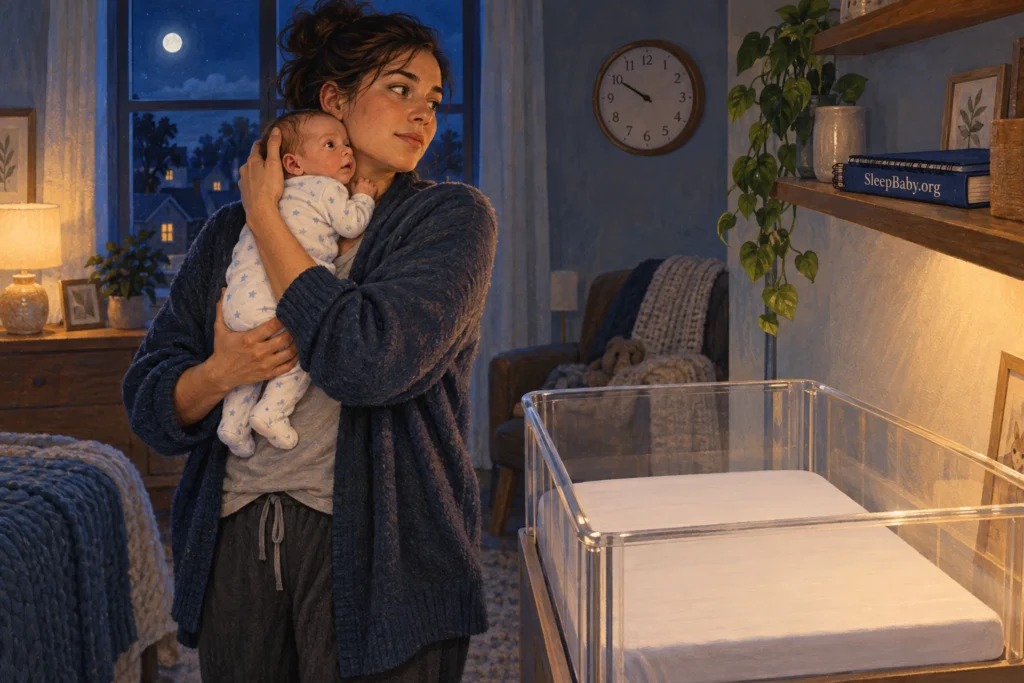
I’d aim for a comfortable, quieter-looking room rather than a blackout standard you have to measure. Think of the bright stripe crossing the mattress, the moving reflection on the wall, or the sunny window your baby keeps staring toward. Those are concrete things you can change. A faint outline around a closed door is a different problem from direct sun shining into the sleep space.
There is no light-meter number in the guidance cited here that every parent needs to reach for every infant nap. I would not download an app, stand in several corners taking readings, and treat the lowest number as the best nursery. The useful question is smaller: does reducing this particular distraction make this particular nap easier?
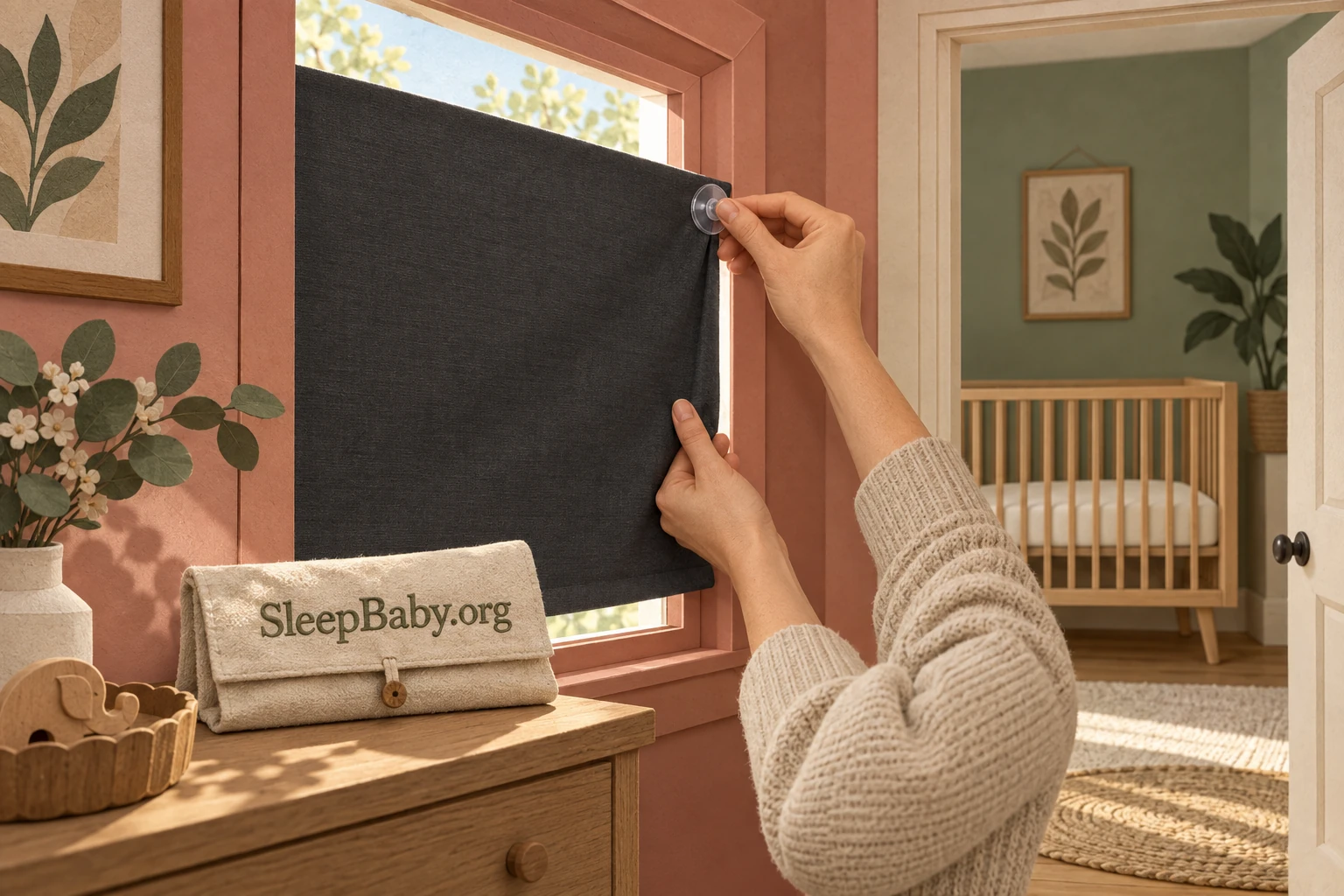
Start with the covering you already have. If it takes the bright edge off the room and your baby settles, stop there. If the room remains very bright and your baby keeps turning toward the window during settling, a properly fitted blackout covering might be worth considering. That is a practical experiment, not evidence that light caused every difficult nap.
You also need to use the room. Keep enough light available to move safely, feed, change a diaper, and check your baby. If you need to switch on a lamp to do something safely, do it. I would not make safe care harder to protect an ideal darkness level.
Look from the sleep space, not just the doorway
The doorway can make a room look brighter than the area where your baby actually rests. Before buying another covering, look at the direction the light travels. Is there direct glare at the sleep surface, or is the bright patch on an empty wall across the room? A room can have some daylight without that light being the thing interrupting settling.
Make this check before putting your baby down, using your own view of the room. You do not need to move the crib into an awkward corner, crowd it with furniture, or position a camera next to the mattress. If the present location is safe and the light there is already gentle, the more useful change may be elsewhere in the routine.
Newborn daylight and dark naps can coexist
The advice to keep daytime bright is often what makes this confusing. The NHS suggests normal daytime light and household activity, with lower light and less stimulation at night. That gives you a broad day-and-night pattern. It is not a command to put a tired baby in the brightest patch of the house.
With a newborn, I would keep that broad distinction simple. Open the curtains when you are up for the day. Talk and interact during awake time. When your baby needs sleep, offer a safe sleep space and whatever modest reduction in light seems helpful. When the nap is over, return to the ordinary day.
You do not have to keep a newborn awake to “teach” daytime, and you do not have to leave a sleepy baby struggling with glare to prove the room is different from nighttime. Feeding needs and your clinician’s instructions still come first. Closing a blind is not a reason to postpone a feed.
A small rhythm for your day
Daylight → nap → daylight
☀ Awake
Open the curtains. Feed, talk, and spend ordinary daytime together. Let the room feel like daytime.
☁ Nap
Lower distracting light if it helps. Repeat a short familiar wind-down, then use the safe sleep space.
☀ Awake again
Reopen the room when the nap is finished. You do not need to keep the house dim between sleeps.
This is a room routine, not a clock schedule. Follow your baby’s needs within it.

What changes as your baby gets older?
The American Academy of Pediatrics notes that regular sleep cycles develop around four months. That does not create a deadline for buying blackout curtains. It does explain why a newborn’s scattered sleep and an older baby’s nap pattern are not useful things to compare as though the room is the only difference.
I’d let the room routine become more predictable as your baby’s day becomes more predictable. You might close the same blind, change the diaper, offer a quiet cuddle, and use the same brief phrase before a nap. You can carry that sequence to another room without recreating every detail of the nursery.
If your baby is still very young and the bigger question is how feeds, awake time, and naps fit together, start with our flexible nap guide for an eight-week-old. A light adjustment cannot do the job of an age-appropriate day.

Try one change before you buy anything
A nap can be hard to interpret when you change everything at once. New curtains, a different sleep outfit, a later nap, a new sound machine, and a longer settling routine might produce a different afternoon, but they will not tell you which change mattered.
I’d choose one reasonably familiar nap opportunity and reduce the obvious light. Keep the other parts of care as familiar as you can. This is not a controlled experiment, and babies do not owe us tidy data. It is just a way to avoid spending money because one difficult afternoon felt like proof.
✎ Your one-nap note
Change the light. Notice the settling.
- Before: note the obvious issue, such as sunlight across the mattress or your baby watching the bright window.
- Change: close the existing safe window covering. Keep feeding, clothing, and your usual comfort routine familiar.
- Notice: did your baby seem less distracted? Was settling easier, similar, or harder? How did your baby seem after waking?
- Decide: keep a helpful adjustment. If there is no clear difference across a few similar opportunities, look beyond the light.
A longer nap is welcome, but it is not the only observation. One short nap is not a failed test.
You can jot down a sentence rather than maintain an elaborate log: “Curtain closed; less window watching; still a short nap.” That is enough to separate an improvement in settling from a change in sleep length. It also helps when another caregiver is trying the next nap and you want to explain what you noticed.
Try to compare similar opportunities. A quiet morning nap at home and a late afternoon nap after a long outing have plenty of differences besides the curtains. If the lighter-room nap went better, that does not automatically mean darkness was the problem. If the darker-room nap went better, it does not automatically mean you need blackout in every room. Look for a useful pattern without demanding a verdict from each sleep.
Set a stopping point for yourself, too. Once the obvious glare is reduced, leave the covering alone for a few ordinary opportunities unless there is a safety issue. Repeatedly opening the door, adjusting the blind, and checking the room can turn a small experiment into the whole afternoon. You are allowed to make a reasonable adjustment and get on with caring for your baby.
Do not keep going with a test when your baby is hungry, uncomfortable, or needs you. Respond first. If the attempt becomes increasingly upsetting, pause the room experiment and return to ordinary care. Darkness is not a reason to wait out distress or ignore a change that concerns you.
What if your baby naps better in the light?
Then I would keep the working setup, provided it is safe. If your baby settles comfortably, wakes looking well, and the day is manageable, there is no need to manufacture a problem because another family uses blackout blinds. Your baby’s nap does not have to match a nursery photograph.
Equally, you do not have to deliberately brighten a room to prove your baby is adaptable. Use the conditions that help now. If a different setting is coming, such as childcare, plan for that actual setting with the people who will care for your baby.
Make the window darker, not the crib
This is the line I would keep firm. Any light-blocking change belongs at a safely fitted window covering. Do not drape a blanket over a crib, bassinet, play yard, or stroller to make a little dark enclosure. Do not put fabric over your baby’s face or use an infant sleep mask.
The Consumer Product Safety Commission recommends cordless window coverings where children live or visit. Move cribs, furniture, and toys away from windows and blind cords. A cord tucked up today can become reachable later; cordless removes that cord hazard.
I would check the whole arrangement from the crib, not just admire the window. Could any fabric, bag, fitting, or cord reach the sleep area if it loosened? Is the covering secure according to its instructions? Is the crib away from the window? If you cannot make a setup safe, choose the lighter room.
Before you lower the light
The little room reset
- Window: a secure, suitable cordless covering, with the crib well away from it.
- Sleep space: baby placed on their back, on a firm, flat, approved infant sleep surface with a fitted sheet only.
- Air and warmth: no blanket tent or extra wrapping to block light. Check your baby for overheating.
- Care: a clear route to the crib and enough light available to see what you are doing.
The safe setup stays the same whether the room is bright, dim, or dark.
A dark room does not need to be a warmer room
A blackout covering does not tell you what temperature the room will be. Sunshine, weather, ventilation, and your home all matter. Recheck comfort after changing the window covering instead of assuming a darker room is automatically cooler.
The AAP’s safe-sleep guidance advises watching for overheating, including sweating or a hot chest. Keep your baby’s head uncovered indoors. If clothing needs adjusting, adjust clothing; do not add a loose blanket to the sleep space.
I would also keep the bigger sleep-safety choices separate from light. Room sharing is recommended for at least the first six months. A darker spare room is not, by itself, a reason to move a young baby away from the recommended arrangement. Ask your baby’s clinician if your home setup makes this difficult.
If you are changing sleep clothing at the same time, remember that swaddling stops when a baby shows signs of trying to roll. Our guide to sleeping without a swaddle covers that transition. A familiar dark room cannot make an unsafe wrap safe.

When a portable blackout blind is worth considering
I would consider one when the actual obstacle is bright window light and your existing covering cannot reduce it enough. It can also be useful in a temporary room where permanent curtains are impractical. I would skip the purchase if the current curtains already do the job or there is no safe place to fit it.
If the room is dark and naps are still short
I would stop tightening the blackout setup and look at the rest of the nap. A baby waking after a short sleep does not tell you whether light, hunger, timing, discomfort, development, or something else was involved. It certainly does not prove you missed a tiny gap behind the curtain.
First, look at the baby in front of you. Are they ready for a feed? Do they need a diaper change or comfort? Did they wake content and alert, or do they still look tired and upset? Then consider what happened before the nap. Was this an ordinary opportunity, or did the day already involve a late feed, an outing, or an unusually long settling attempt?
One clue, one next step
What I’d look at next
- Watching the bright window during settling
- Try reducing that light with a safe covering, then see whether settling changes.
- Settles easily, then wakes after a short nap
- Check feeding, comfort, and the wider nap pattern before changing the room again.
- Cries harder as the nap attempt continues
- Pause and respond to your baby. More darkness is not the next automatic step.
- Seems unwell or behaves unusually
- Treat that as a health concern, not a curtain problem. Contact your baby’s clinician for guidance.
For repeated short naps, our short-nap guide can help you look beyond the window. I would change one practical thing at a time where possible and keep the notes brief enough that they help you rather than become another job.
If poor feeding, unusual sleepiness, breathing concerns, or other signs of illness accompany the sleep change, seek medical advice promptly. Do not spend another afternoon troubleshooting curtains when your concern is really that your baby seems different from usual.
Will dark naps make daycare or travel harder?
Using a dark room now does not give us a reliable prediction of how your baby will nap somewhere else. I would avoid both promises: “Blackout will ruin daytime flexibility” and “Your baby will sleep anywhere if you practice enough.” Neither tells you what to do when childcare starts on Monday.
Ask the actual caregiver what their nap space is like. Can they reduce direct glare? What sleep surfaces do they use? How do they settle and check the babies? Share your baby’s usual cues and a short routine they can reasonably repeat. The useful handoff is information they can use, not a demand to reproduce your bedroom.
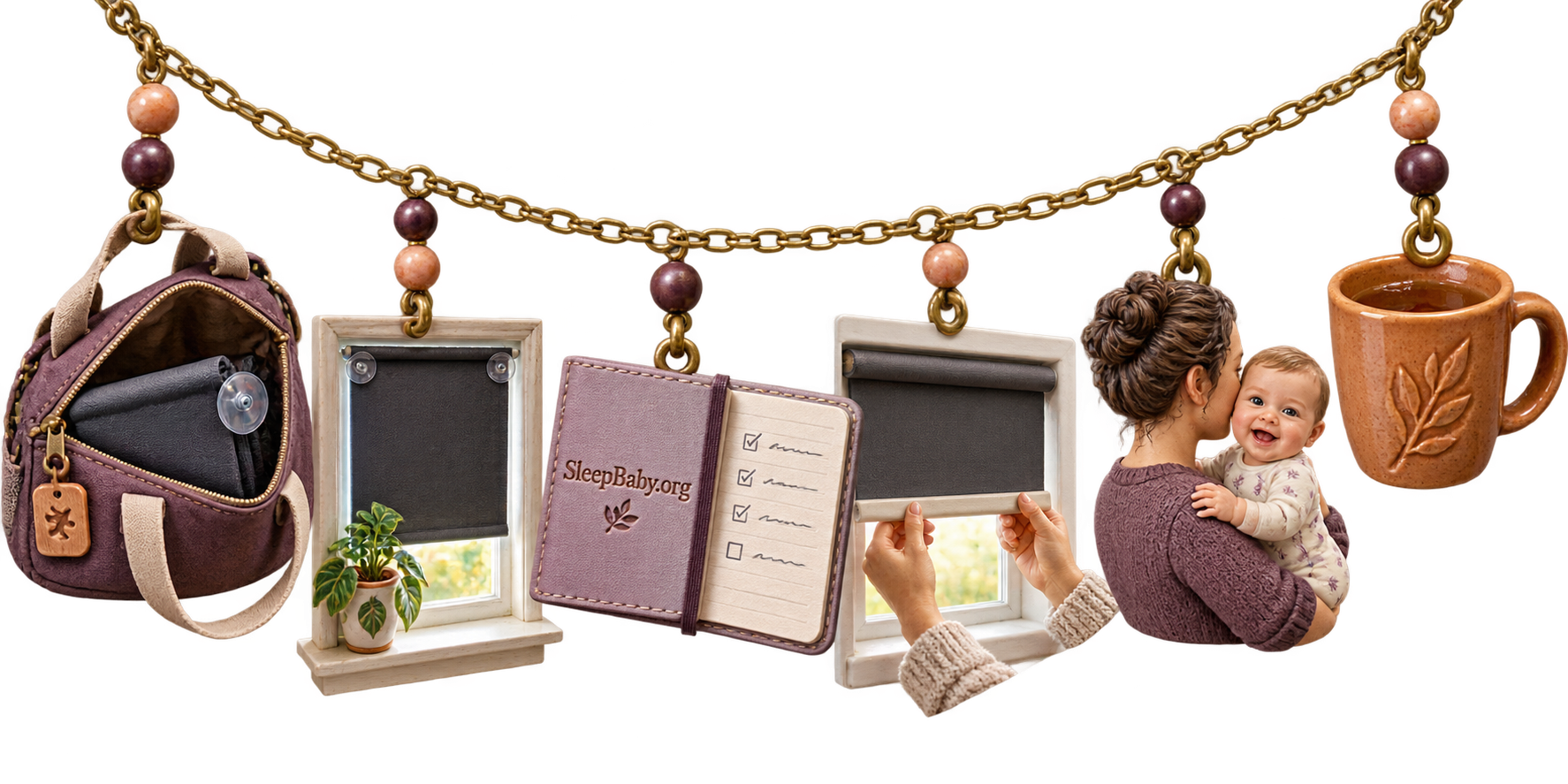
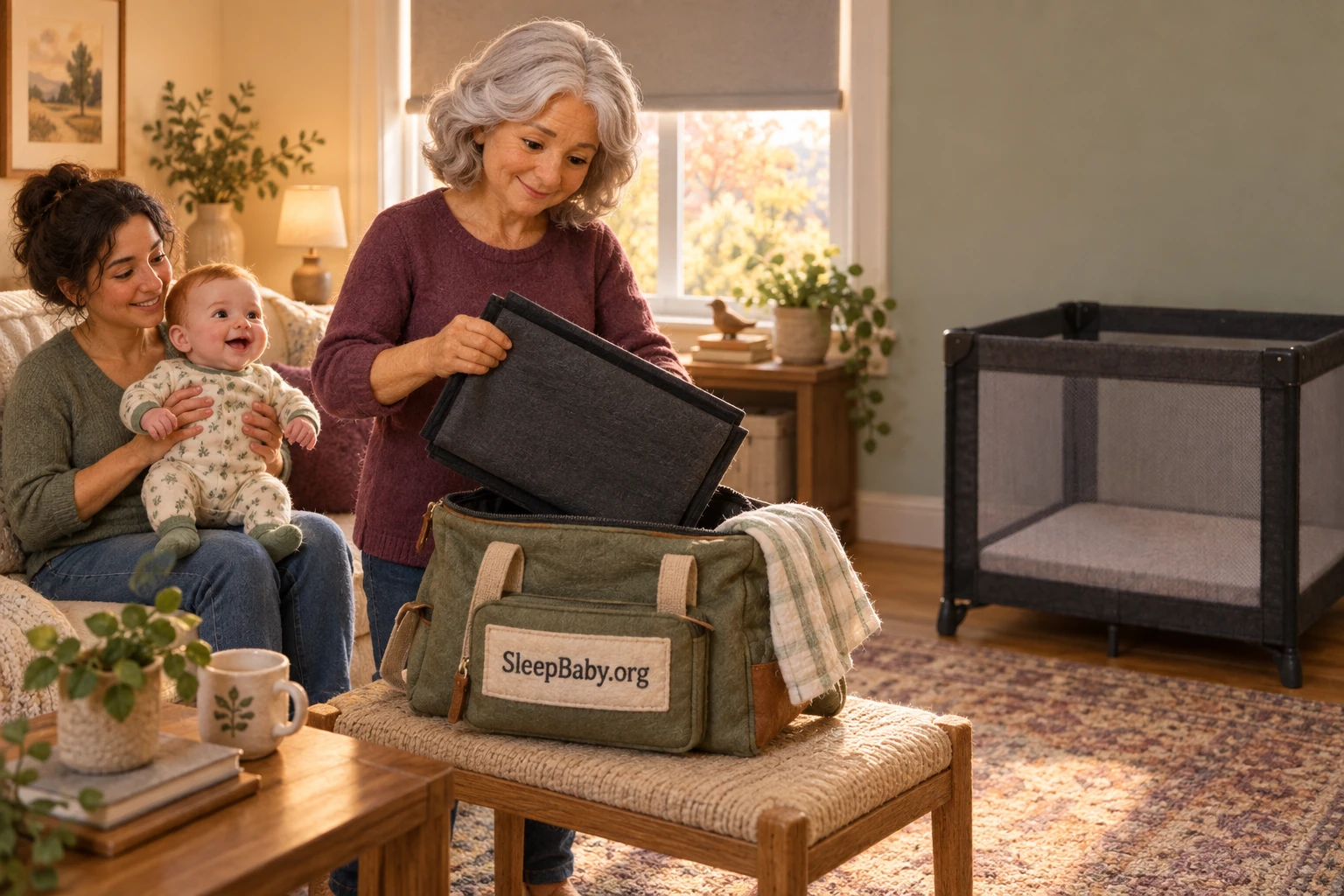
For a visit or trip, check the room before the nap becomes urgent. Locate the safe sleep surface, move it away from the window and cords, and decide whether the existing covering is enough. Bring a suitable portable blind only if you can use it according to its instructions. A makeshift dark cupboard, covered play yard, or improvised blanket canopy is not a solution.
I’d keep a few portable pieces of the routine: the same brief phrase, a familiar way of offering comfort, and suitable sleep clothing. That gives you something useful to repeat even if the room is brighter. If the nap is shorter than usual, respond to the rest of the day as it unfolds instead of treating the trip as proof that home naps were wrong.
What about a shared room or a small home?
You may not have a separate nursery to darken. Perhaps your baby’s safe sleep space is in your bedroom, or an older child needs to use the room during the day. Start with the change the household can actually maintain: close the available cordless shade for the nap, reduce direct glare, and keep a clear path to your baby. You do not need to redesign the apartment around one curtain gap.
If another person needs light to read or move around, plan that before the nap rather than making everyone guess whether they are allowed into the room. A small, directed light for the caregiver may be more workable than repeatedly turning a bright overhead light on and off. Keep lamps and their cords out of reach and away from the sleep space.
The same principle applies when another adult offers the nap. Explain the few things that matter most: the safe sleep setup, what your baby usually needs before settling, and which window covering you use. A brief shared routine is easier to carry out than a long list of exact light levels. Leave room for that caregiver to respond to the baby in front of them.
A quick visual check before changing the room
Before adding a window covering, I’d look once more at the sleep space itself. This short video from the National Institute of Child Health and Human Development shows what a clear infant sleep area looks like. The light can change; those basics stay.
Watch the room setup
Keep the sleep area clear
Official NICHD Safe to Sleep video. Use it as a visual check of the bed, then make any light adjustment at the window.
If the video will not load: place your baby on their back on a firm, flat infant sleep surface. Keep the space free of pillows, loose blankets, toys, and added covers. You can also read the NIH sleep-environment guidance.
The small questions that tend to come up
Does a daytime nap need a night-light?
Not simply because it is a nap. If you need a little light for safe care, use what you need without shining it directly into your baby’s face. I would start with the simplest room setup, not buy a special color of light on the assumption that it guarantees better infant sleep.
Should I reopen the curtains right after the nap?
Once you have decided the nap is over, returning to ordinary daytime light is a straightforward routine. There is no need for an abrupt bright-light performance the instant your baby stirs. Attend to your baby, then get on with the day.
What if sunlight changes during the afternoon?
Check the room at the time you actually use it. A window that looks comfortably dim in the morning may send a bright stripe across the room later. I would adjust the window covering for that real change, while keeping the sleep surface away from the window. You do not need to monitor every moving patch of light.
Can I hold my baby for a nap in a dark room?
The light level does not remove the risk of an adult falling asleep while holding a baby. If you feel drowsy, put your baby in their own safe sleep space. The AAP warns especially about falling asleep together on a couch or armchair. I would choose an imperfect nap in a safe space over trying to preserve sleep while you struggle to stay awake.
Sources and references
- NHS: Helping your baby to sleep, including daytime and nighttime differences.
- AAP: Getting Your Baby to Sleep, including developing sleep patterns.
- AAP: How to Keep Your Sleeping Baby Safe, updated September 11, 2026.
- CPSC: Window Covering Safety, cordless coverings and furniture placement.
- NICHD: Safe Sleep Environment, clear infant sleep spaces.
- AAP: Safe Sleep Tips for Sleep-Deprived Parents.
- Tommee Tippee: Portable blackout blind support, fitting, temporary use, and precautions.
The room is one piece
Ready to look beyond the curtains?
If you have made the room comfortable and naps still feel difficult, your next question may be about the wider sleep routine. SleepBaby.org’s homepage introduces the Baby Sleep Miracle video and offer so you can see whether that approach fits what you want help with.
Keep the useful first step from this article: reduce distracting light, keep the sleep space safe, and notice what actually changes. You do not need a perfect blackout room to begin.





What viewers said10 comments · 4 replies+
Archived comments from the original Baby Sleep Miracle presentation. Not independently verified by SleepBaby.org; individual experiences vary.
Thank you so much for this video! I had no idea about the dangers of baby swings :O
Hi Mary-Ann. I have a question: Is method in any way similar to the ones recommended by Dr Bucknam, Dr. Weissbluth or Dr. Karp? We tried those but none of them help.
Hi Regina, thank you for your question. The short answer is no. The techniques I share in my guide are based on newest scientific research and this is why I have never seen any approach similar to the one I recommend.
This method really works! I tried it on my son Jesus and after just one week he went from waking up more than 5 times a night to waking up just once or twice. You are a lifesaver, Mary-Ann!
I'm truly impressed with how much information you share in your video. And all for free! I can feel that you truly care about mothers like myself, and that's hard to find these days. I have recommended your site to several of my friends already.
Mary-Ann, our child suffers from autism. Is your approach still suited?
Chloe, I made sure my method can be used with any child, even babies who are special like yours. Please note that I'm not a doctor and that I always advice to consult with your physician because nothing is more important than the safety and well-being of your love.
Hallo Mary-Ann, I'm from Germany. Do you have your guide in German?
Hello Heide, we do! Normally you should already see our video in German. If not, please contact our support so they can guide you
Thenk you for your answer, Mary-Ann!
I just completed your approach and I have to say, it worked almost too well. Yes, it took a bit of getting used to with your bedtime routine but the difference is huge. My son George used to take 1 hours to go down and now he's firmly asleep in no more than 10 minutes! You're the best!
It seems I'm the only man watching this video, lol! What you shared about the 'emotional backpack' made immediate sense to me and I can't wait to help my little girl Mila to unpack it!
Hey there, just discovered your site and this really sounds different. Just wanted to say thanks for sharing :)
For everyone who's still thinking about getting Mary-Ann's guide I want to advise you to go ahead. I wasn't sure myself but now I'm so thankful I invested in this program. It made a huge difference in our life as a family and yes, my baby girl does sleep through the night now.