
The short answer
Newborn screening is three small screens, not one final verdict
Routine newborn screening in the United States commonly includes a dried-blood-spot screen, a hearing screen, and a pulse-ox screen for certain critical heart defects. Most happen in the first days after birth, but they do not all follow the same clock. The exact blood-spot panel and repeat plan depend on your state or territory and your baby’s circumstances.
A pass means the result was in range for what that screen could detect at that moment. A refer, non-pass, borderline, or out-of-range result means the next step matters; it does not, by itself, make a diagnosis. Before you leave the birth setting, find out which three screens were completed, where each result will appear, and who owns any follow-up.
The discharge bag can be packed, the baby can finally be asleep, and the paperwork can still look like three versions of the same important form. It is not. The heel stick, the ear equipment, and the glowing sensor on a tiny foot are asking different questions. What I would sort first is not the condition list. I would sort the three lanes: What happened? What was the result? What happens next?
That small distinction takes the article out of medical-brochure fog. Screening looks for a signal before a condition may be obvious. Diagnostic testing investigates what that signal means. The screen is the doorbell, not the person standing at the door.
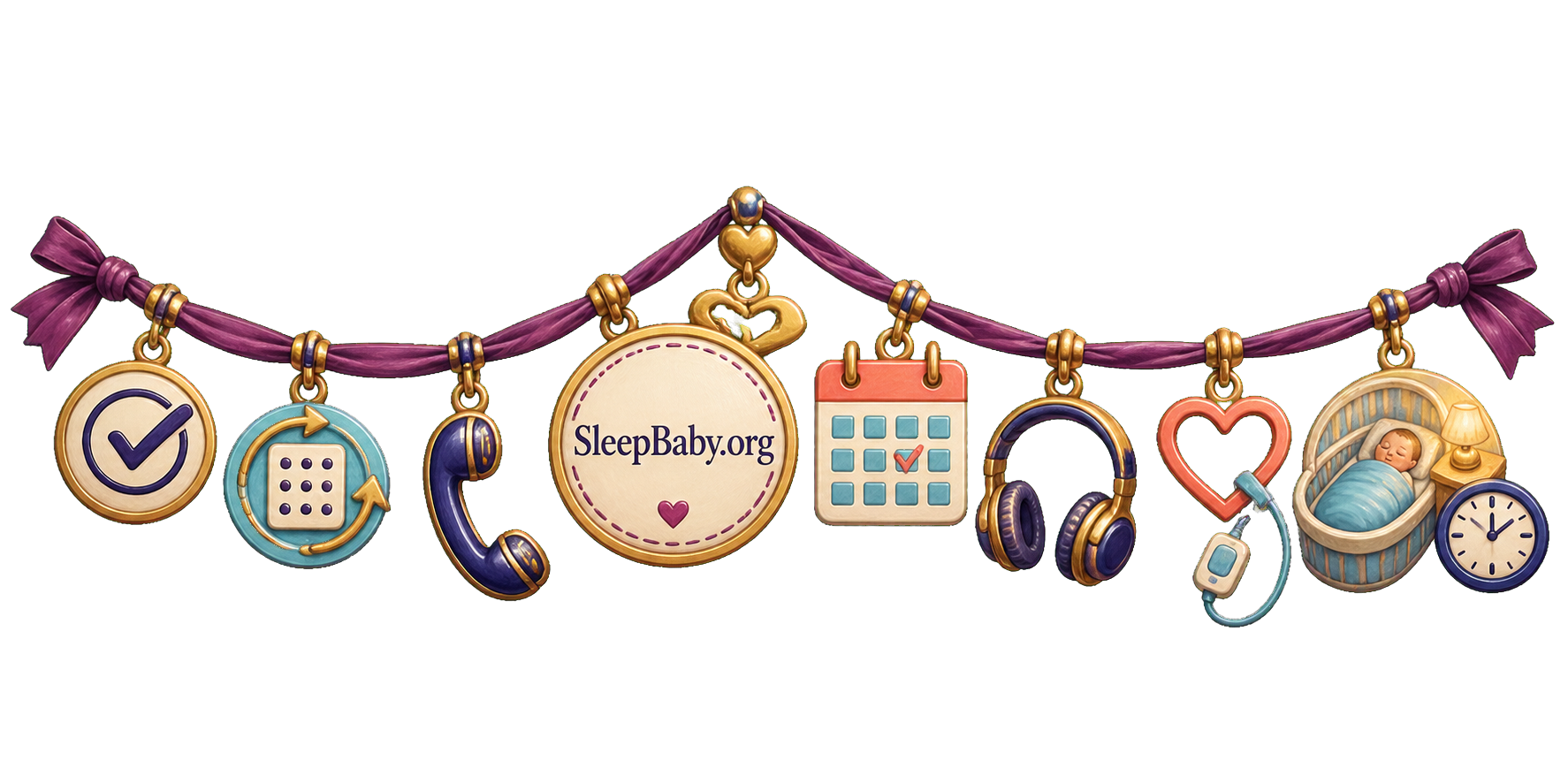
Your three-screen passport
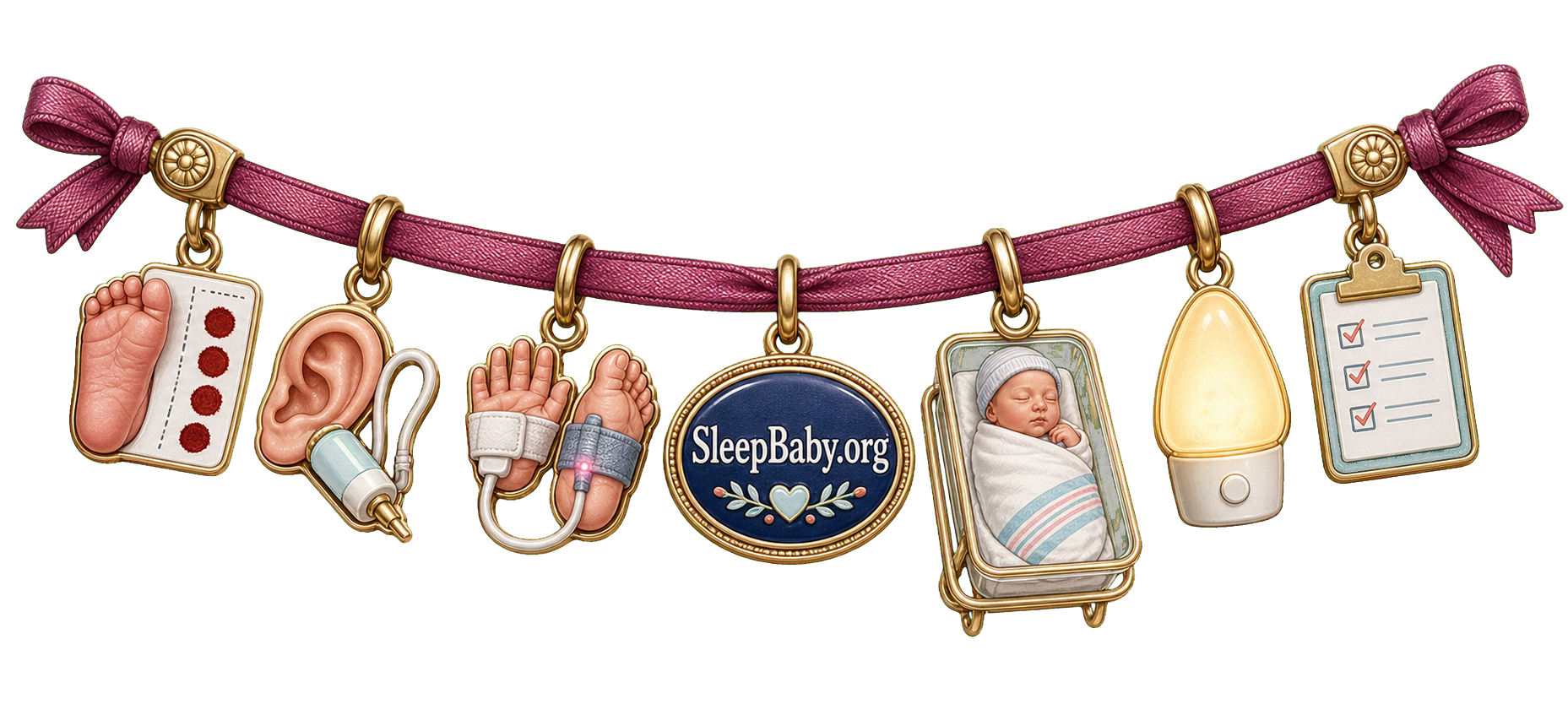
Three stations, three result languages
Keep each screen in its own lane. On a phone, these stations stack in the order families usually meet them.
Dried blood spot
Looks like: drops from a heel stick placed on a special filter-paper card.
Looks for: conditions on your state or territory’s current panel.
Result words: in-range, borderline, out-of-range, or a request for another sample.
Hearing
Looks like: a small ear probe, earphones, and sometimes sticker-like sensors.
Looks for: a measurable response to soft sounds.
Result words: pass, refer, fail, or non-pass.
Pulse ox
Looks like: soft sensors on the right hand and one foot.
Looks for: low oxygen that can be a sign of certain critical heart defects or another problem.
Result words: pass, repeat, fail, or non-pass.
The line worth keeping: a pass answers only the question that screen asked.
SleepBaby.org teaching map · Three screens, one calmer follow-up plan
The newborn blood spot test: what the heel prick is actually for
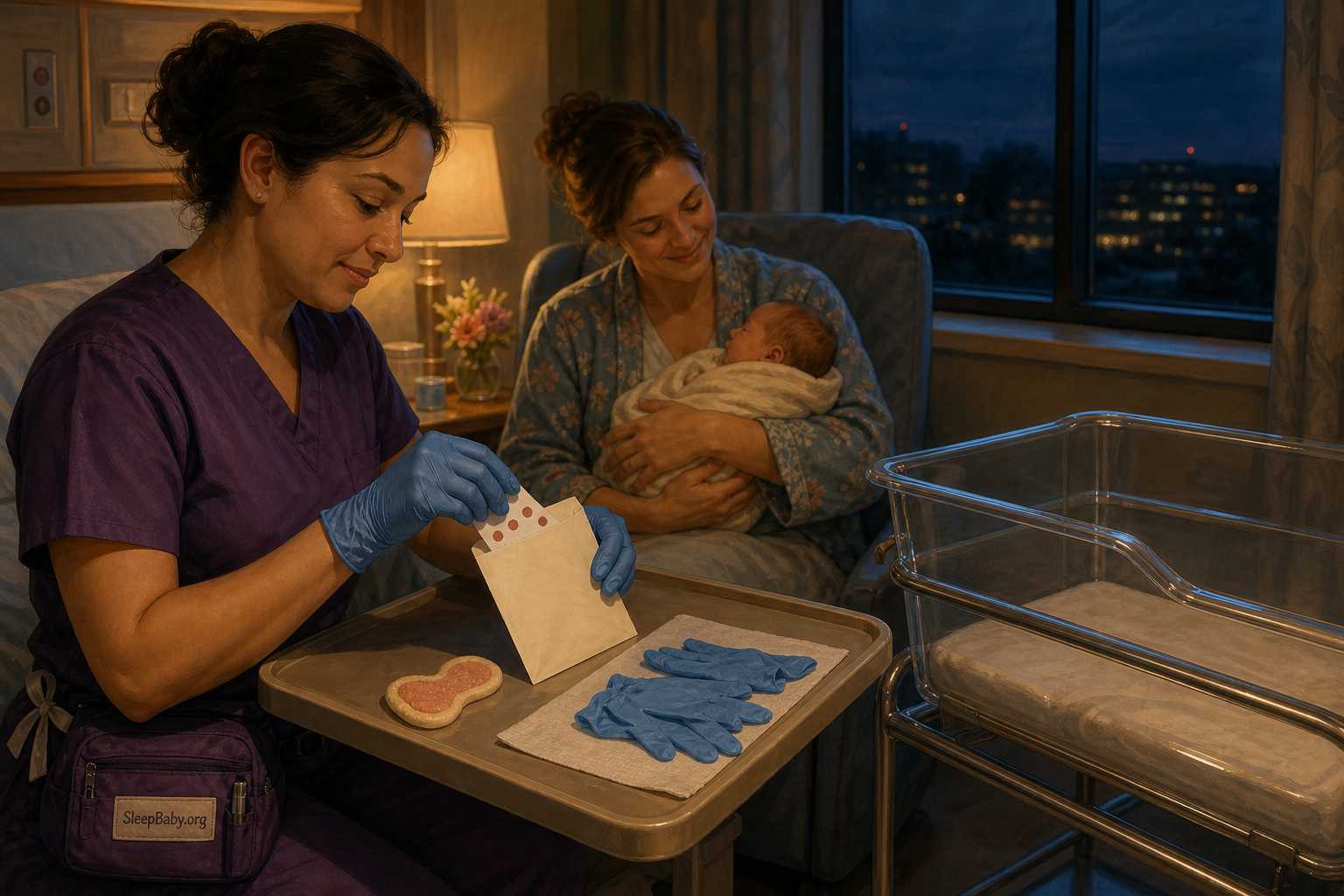
The heel stick is the part parents remember. The filter-paper card is the part the state laboratory needs. A clinician positions or warms the foot, makes a small heel stick, and fills marked circles on the card with drops of blood. The card then travels to the public-health laboratory for screening.
The blood spot is often collected around 24 to 48 hours after birth. If the sample is collected before 24 hours—because discharge is early, for example—another sample may be needed. That is not a judgment about how well the first person did the heel stick. Timing can affect what the laboratory can reliably see.
Why a baby might need another sample
An early collection is one reason. Prematurity, a transfusion, dialysis, and some medicines or nutrition exposures can also change the collection or repeat-testing plan. A smudged, insufficient, or otherwise unusable specimen may need to be recollected as well. The practical response is the same: ask why the repeat is needed, when it must happen, and which person or program is arranging it.
This is not a schedule to calculate from home. A premature baby in a neonatal unit, a baby who received blood, and a full-term baby discharged early may need different plans. Follow the birth facility, state program, and baby’s clinician for the exact timing.
When blood-spot results arrive
HRSA describes about five to seven days as a common result window, but the route and timing vary. The state laboratory often reports to the baby’s health professional rather than directly to the family. Before the discharge paperwork disappears under a swaddle, a spare onesie, and the one pen that no longer works, write down two things: where the result will appear and the date you will check if you have not heard.
“Nobody called” is not a result category. It may mean everything was in range and the report is quietly in the chart. It may also mean the result is still pending, the office expects you to view a portal, or contact information needs to be corrected. Calm confirmation is not catastrophizing; it is closing the loop.
The hearing screen: quiet equipment, useful first information
Newborn hearing screening often happens before discharge, and national benchmarks call for screening by one month of age. It works best when the baby is calm and the room is quiet—which is one of the rare moments when a newborn sleeping through an appointment is genuinely helpful.
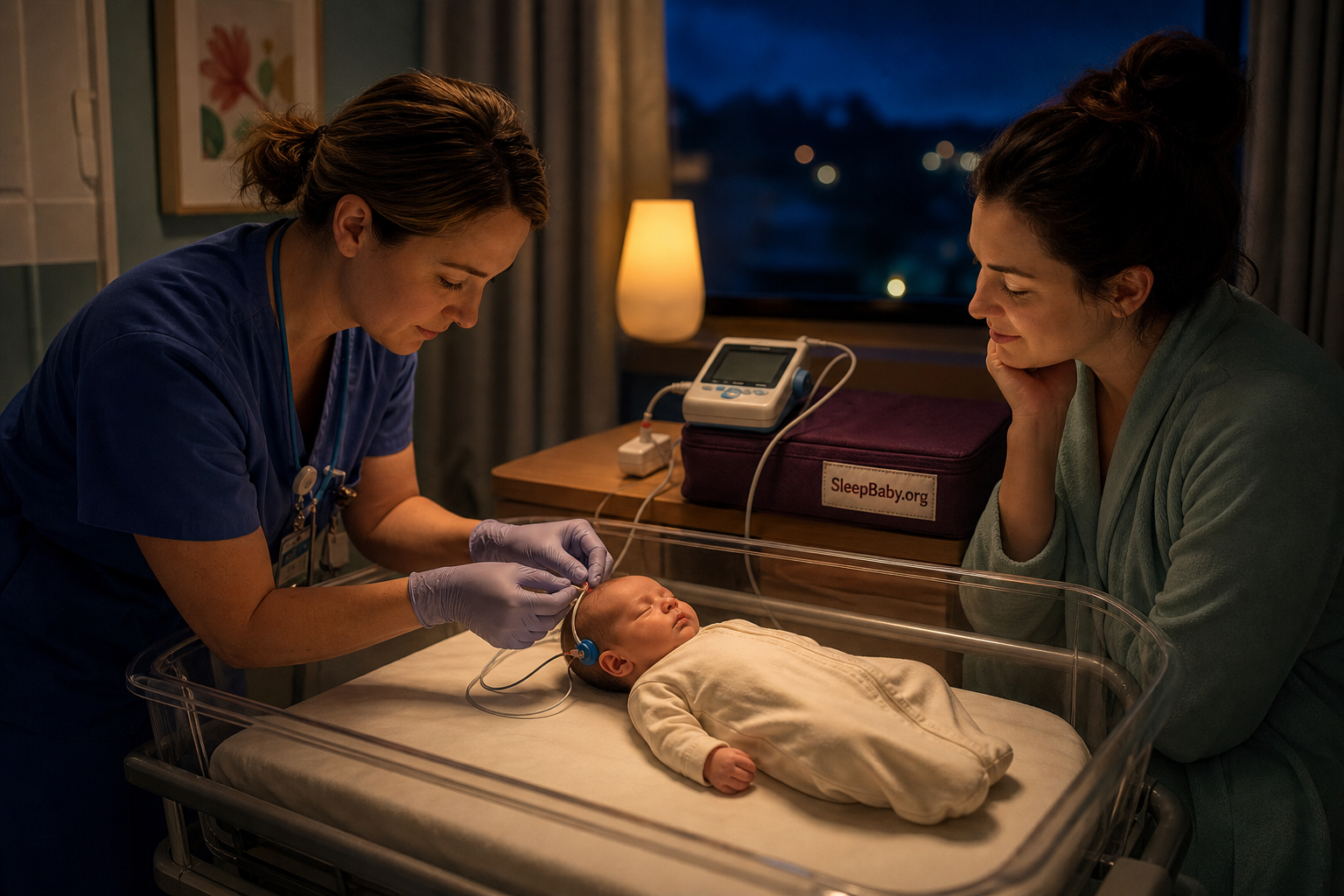
There are two common methods. Otoacoustic emissions, or OAE, uses a small ear probe that plays soft sounds and measures the inner ear’s response. Automated auditory brainstem response, or AABR, uses earphones and small sensors on the skin to measure how the hearing pathway responds. A baby may receive one method or both.
If the result says refer, fail, or non-pass
Those words can land hard. They still mean the screen needs a next step, not the screen diagnosed hearing loss. Fluid in the ear, movement, crying, room noise, or a true hearing difference can all contribute to a non-pass. The first screen cannot sort those possibilities by itself.
HRSA describes another hearing screen commonly taking place within about two weeks after discharge. If the repeat screen is also a non-pass, an audiologist should complete diagnostic testing promptly. Keep the appointment your local program gives you rather than waiting for a milestone concern to appear.
The 1–3–6 hearing benchmark
-
By 1 month: complete the newborn hearing screen. -
By 3 months: complete diagnostic evaluation when a baby does not pass screening. -
By 6 months: enroll in recommended early-intervention services when hearing loss is confirmed.
These are national benchmarks, not reasons to postpone an appointment already offered sooner.
A pass is reassuring for the moment measured, but hearing can change later. If you become concerned about how your baby responds to sound or develops communication, bring that concern to the baby’s clinician. Milestones are useful observations, not a home hearing test.
The pulse-ox heart check: what the glowing sensors can—and cannot—tell you
Pulse oximetry is a quick, noninvasive check of oxygen in the blood. For newborn screening, a soft sensor is placed on the right hand and another on one foot. Current CDC guidance calls for screening healthy-appearing newborns at 24 hours of age or later, or as late as possible before discharge when a baby leaves earlier.
The screen can help identify some critical congenital heart defects that cause low oxygen before a baby looks sick. It can also detect low oxygen from other important causes, including lung disease or infection. It does not replace the newborn examination, pregnancy and family history, or clinical judgment.

If the screen passes
The oxygen readings met the screening criteria at that time. That is useful information, but pulse ox does not detect every critical or other heart defect. New symptoms still matter.
If the team repeats it
A repeat is part of the clinical screening pathway, not a diagnosis. Let the care team complete the timed measurements and interpret them in context.
If the screen fails
Low oxygen was measured and the baby needs prompt evaluation before going home. The cause may be a critical heart defect or another condition. Evaluation often includes an echocardiogram, but the care team decides the work-up.
I would not turn the hospital algorithm into a home math problem. A consumer oximeter is not a substitute for newborn screening, and a number without the clinical setup can create false reassurance or unnecessary alarm. The parent job is simpler and more important: know the recorded result, keep the next appointment, and respond to the baby in front of you.
Watch the heart-check setup
Where the two pulse-ox sensors go—and why both matter
If the heart-check part still feels abstract, this American Academy of Pediatrics demonstration shows where the two sensors go and why the team compares them.
Takeaway: Pulse ox adds one useful layer before discharge; it does not replace the newborn exam or later attention to symptoms.
Translate the label
What newborn screening result words actually mean
The labels differ because the screens differ. Read each one as an instruction about the next step, not a forecast of your baby’s future.
| Result word | What it means | Your next move |
|---|---|---|
| In-range or pass | The measured result was in the screen’s expected range at that time. | Confirm it is recorded. Continue ordinary care and act on later symptoms or concerns. |
| Borderline or repeat | The program needs another sample, measurement, or test before closing the screen. | Ask why, when, where, and who is arranging it. Complete the repeat on schedule. |
| Out-of-range | The blood-spot screen found a result that needs prompt follow-up. It is not a diagnosis. | Follow the program or clinician’s directions for repeat or diagnostic testing promptly. |
| Refer, fail, or non-pass | The hearing or pulse-ox screen did not meet its pass criteria. | Complete the specific repeat or evaluation pathway; do not diagnose from the label. |
Two errors to avoid: “positive means my baby definitely has it” and “negative means my baby definitely cannot have it.” Screening is built to decide who needs a closer look. False alarms and missed conditions are both possible, which is why follow-up and symptoms still matter.
Close every loop
A newborn screening follow-up timeline that fits real life
Before leaving the birth setting
Ask whether blood spot, hearing, and pulse ox were each completed. Write down the exact result language, the destination of pending results, and any appointment already made. Check that the program and clinician have the correct phone number and address.
After an early discharge or incomplete screen
Leave with a place, date, and responsible person—not simply “repeat later.” If your baby was born at home, arrange screening with the midwife, baby’s clinician, local health department, birth facility, or state program.
Confirm the blood-spot result
Results commonly take several days. If the office’s expected window passes, call or check the agreed portal. Ask for the actual report rather than “we would have called if something was wrong.”
Keep the exact repeat or specialist appointment
A repeat blood sample, repeat hearing screen, audiology visit, or low-oxygen evaluation has its own urgency. If transport, insurance, relocation, or contact problems threaten the appointment, tell the program or clinician immediately so they can help preserve the handoff.
When the standard path needs an extra turn
Most families meet newborn screening as a straightforward hospital sequence. Some babies need a more individual route. None of these situations is a reason to skip screening; each is a reason to make the handoff more explicit.
- Home or out-of-hospital birth: arrange all three screens with the birth professional, baby’s clinician, local health department, or state program.
- Early discharge: ask which screen was done early or remains incomplete and leave with the repeat appointment.
- Prematurity or neonatal intensive care: timing may change with the baby’s condition, supplemental oxygen, treatment, and local protocol.
- Transfusion, dialysis, medicines, or specialized nutrition: the care team may plan additional blood-spot collection or other testing.
- Transfer between facilities or states: ask the receiving clinician to confirm what was collected, where it was sent, and which program owns the result.
- Move or phone-number change: update both the baby’s clinician and the state program when a result or repeat is pending.
The best question is not “Is this normal everywhere?” It is “Who has my baby’s result, and what date closes this loop?” That question travels well across hospitals, home births, state lines, and sleep-deprived conversations.
Do not wait for screening
The bedside safety switchboard
Call emergency services now
Your newborn cannot be awakened, is not moving or is very weak, has severe trouble breathing, or has blue or gray lips, tongue, or face.
Seek urgent medical care
Your newborn is hard to wake, has a poor suck or poor color, acts abnormal, looks very ill, or has trouble breathing that is not yet severe.
Contact the baby’s clinician promptly
You notice feeding problems, unusual sleepiness or low energy, fast breathing or grunting, blue color around the lips or skin, or poor weight gain—even if pulse ox passed.
A screening pass never asks you to ignore a sick-looking baby. This is where I would stop sorting forms and start getting help.
If your baby is otherwise well and a clinician has told you to wake for feeds or follow a feeding plan, use a calm, supported approach. Our guide to waking a sleeping baby safely keeps the medical exit clear. A baby who cannot be awakened normally does not belong in a longer list of tricks.
Your one-page discharge record
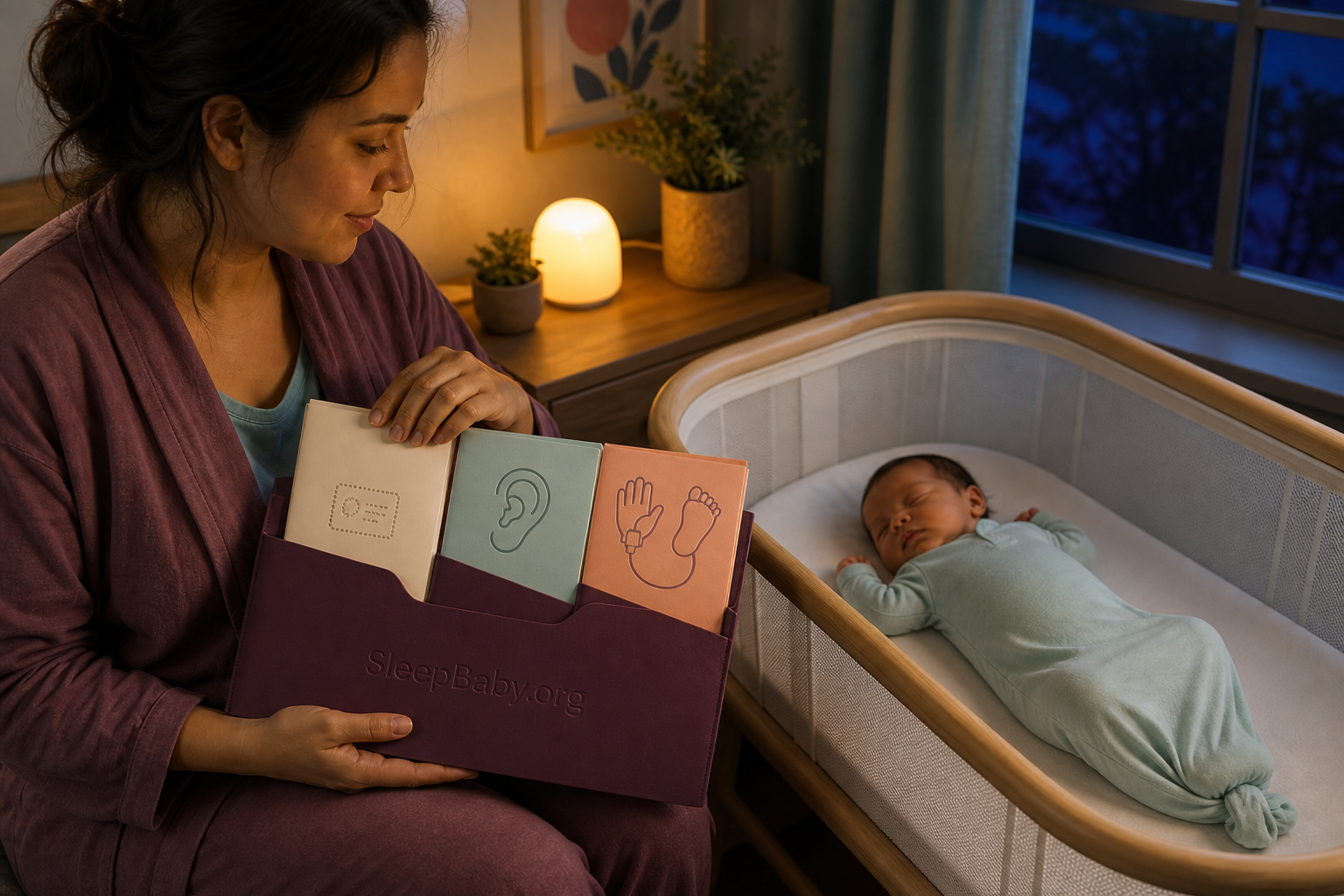
Put the result and the next action on the same line
You do not need a perfect baby binder. You need a record that still makes sense during a night feed.
- Blood spot
- Collected: ____ · Result location: ____ · Result: ____ · Repeat/diagnostic date: ____ · Person responsible: ____
- Hearing
- Method/result: ____ · Repeat date: ____ · Audiology plan if needed: ____ · Person responsible: ____
- Pulse ox
- Completed: ____ · Result: ____ · Evaluation completed if needed: ____ · Person responsible: ____
SleepBaby.org discharge card · The result, the owner, and the next date stay together
Questions worth asking before you leave—or at the first newborn visit
- Were all three screens completed, and what exact result is already available?
- Where will the blood-spot report appear, and when should I check?
- Was the blood sample collected before 24 hours, and does this program want a repeat?
- Does prematurity, transfusion, treatment, or another circumstance change the plan?
- If hearing says refer or non-pass, is the repeat appointment booked before we leave?
- If pulse ox was repeated or failed, what evaluation was completed before discharge?
- Which symptoms should make us call the office, seek urgent care, or call emergency services?
- Who should we contact if we move or our phone number changes while a result is pending?
Newborn screening questions parents ask after the room gets quiet
Does the heel prick hurt?
The heel stick can cause brief discomfort, and babies may cry. Comforting, holding, and feeding strategies may be available depending on the setting. The sample itself is small, but the screening information can identify conditions before they are otherwise obvious.
Can my baby pass one screen and not pass another?
Yes. The three screens measure different things and use different result language. A hearing refer does not change the blood-spot result; an in-range pulse-ox screen does not close an out-of-range blood-spot follow-up.
Should I worry if we are asked to repeat a test?
Take the repeat seriously without treating it as a diagnosis. Timing, sample quality, fluid in the ears, movement, an early discharge, or a measured result can all lead to another screen. Ask for the reason and complete the next step on time.
What if my baby was born at home?
Out-of-hospital birth does not remove the need for screening. Arrange the blood spot, hearing, and pulse-ox pathway with your midwife, baby’s clinician, local health department, birth facility, or state newborn-screening program.
If nobody called, can I assume the result was normal?
No. Confirm that each result was received and recorded. Blood-spot reports may go to the baby’s health professional, while hearing and pulse-ox results are often available immediately. Silence is not a result label.
Is the pulse-ox screen the same as listening to a heartbeat?
No. Pulse ox measures oxygen through sensors on the right hand and a foot after birth. It does not listen to the heartbeat and it does not replace an examination or an echocardiogram when one is needed.
For an awake, clinically well baby whose question is ordinary feeding intake rather than illness, our guide to signs a baby may still be hungry after breastfeeding can help organize what to observe. Poor feeding paired with unusual sleepiness, abnormal breathing, poor color, or a baby who is hard to wake belongs with a clinician, not another article.
Sources
- Health Resources and Services Administration. Newborn Screening Process. Reviewed December 2024.
- Health Resources and Services Administration. Newborn Screening Results and Follow-Up. Reviewed December 2024.
- Health Resources and Services Administration. Newborn Screening in Your State. Reviewed March 2026.
- Health Resources and Services Administration. Recommended Uniform Screening Panel. Accessed August 14, 2026.
- Centers for Disease Control and Prevention. Clinical Screening and Diagnosis for Critical Congenital Heart Defects. December 15, 2025.
- National Institute on Deafness and Other Communication Disorders. Your Baby’s Hearing Screening and Next Steps. 2024.
- Centers for Disease Control and Prevention. EHDI 1-3-6 Benchmarks. May 7, 2025.
- American Academy of Pediatrics / HealthyChildren.org. Newborn Pulse Oximetry Screening to Detect Critical Congenital Heart Disease. Updated February 21, 2025.
- American Academy of Pediatrics / HealthyChildren.org. Newborn Reflexes and Behavior: When To Call. Accessed August 14, 2026.
From three forms to one quiet plan
Put the screening answers beside tonight’s safe sleep setup
Write down the blood-spot result location, the hearing result or repeat date, and the pulse-ox result. Then place that one page where the next tired adult can find it. Completed follow-up will not make a newborn sleep longer, but it can stop three pieces of paperwork from circling your mind every time the room goes dark.
For the rest of the night, keep the medical plan with the medical team and choose one calm, age-appropriate sleep step at a time.
Find your next calm newborn sleep step
Sleep guidance does not replace newborn screening, diagnostic follow-up, or medical care.