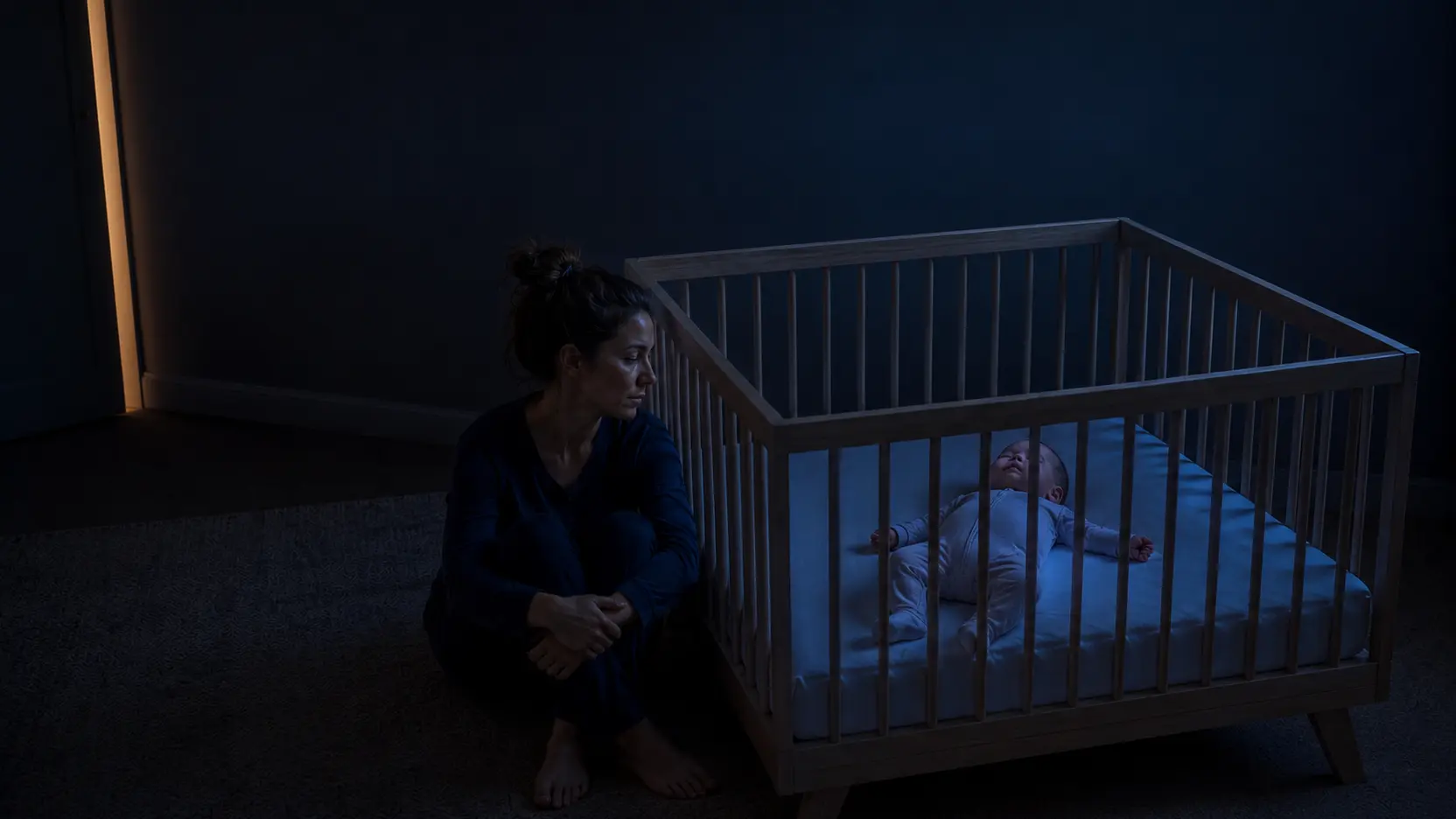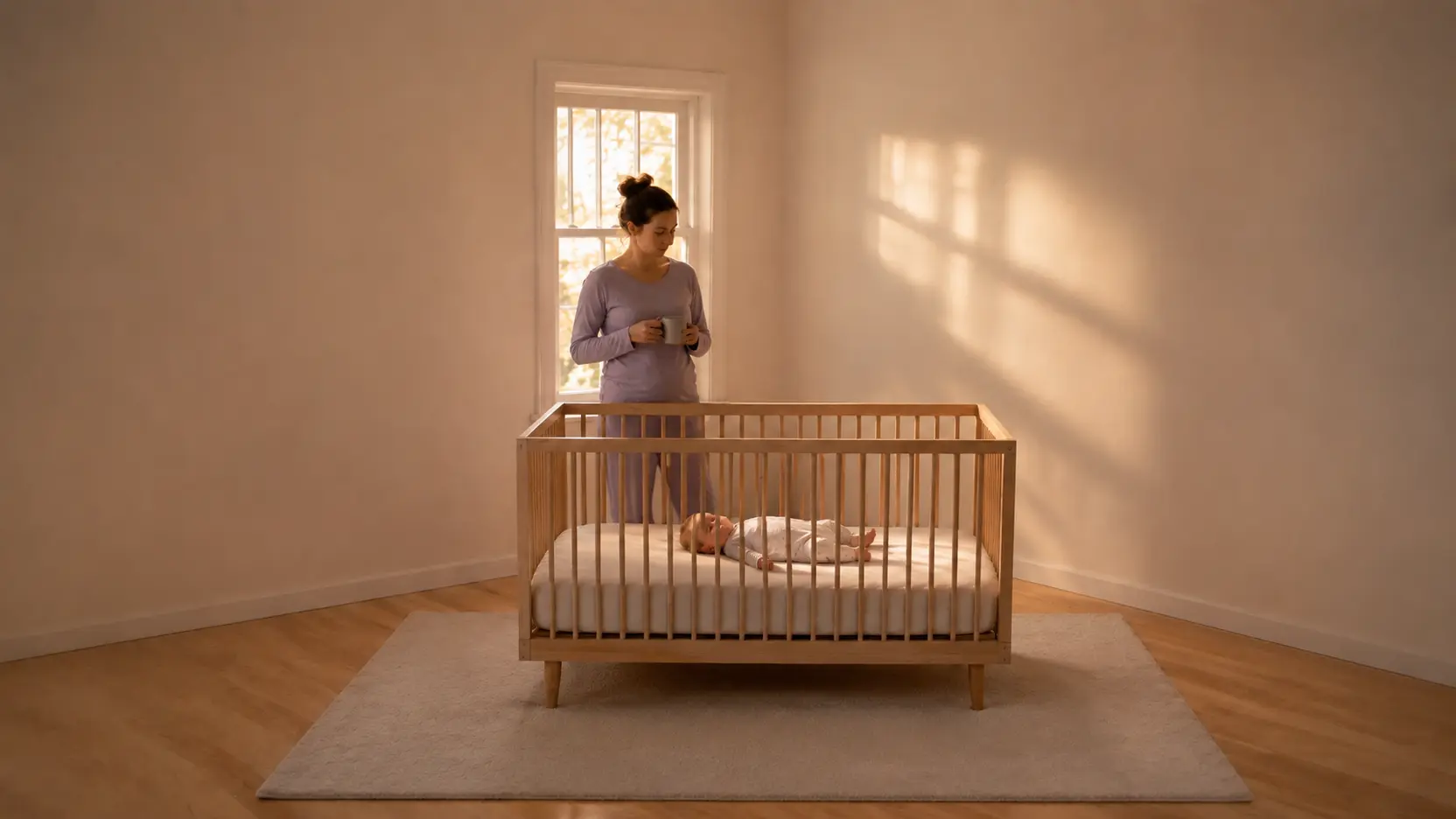

The clock says 9:42 a.m. Your 8-week-old says absolutely nothing useful about whether this is “nap time,” except for one yawn that may have been a yawn, a hiccup, or a tiny personal insult. At this age, the most realistic nap schedule is not a strict timetable. It is a flexible rhythm: feed, a short stretch of calm awake time, then another chance to sleep before your baby becomes frantic or floppy-tired.
Most 8-week-old babies still sleep in uneven pieces. One nap may last long enough for you to eat something with both hands; the next may end before the toast pops up. That variation does not automatically mean the schedule is broken. I would use the clock as a quiet assistant, not a supervisor with a clipboard. Watch when your baby woke, notice early sleepy behavior, offer a safe nap, and adjust the next cycle from what actually happened.

What can an 8-week-old nap schedule look like?
Here is a sample flow, not a prescription. If your baby starts the day earlier or later, slide the whole pattern. If a feed takes longer, a nap ends quickly, or your pediatric clinician has given feeding instructions, the sample yields immediately.
| Approximate time | What may happen | What I would watch |
|---|---|---|
| 7:00 a.m. | Wake, feed, diaper, quiet connection | Alert face, relaxed hands, comfortable feeding |
| 8:00–8:30 | First nap opportunity | Looking away, slower movement, repeated yawns, fussing that rises |
| 9:30–10:30 | Wake and feed; brief awake period | How long the first nap actually lasted, not how long it “should” have |
| 10:30–11:30 | Second nap opportunity | Whether baby settles more easily with an earlier wind-down |
| 12:00–1:30 p.m. | Feed, cuddle, short interaction, another nap | Feeding cues always outrank the sample clock |
| 2:30–4:30 | One or two variable afternoon naps | Short naps may mean the next sleep opportunity comes sooner |
| 5:00–7:00 | Evening feed cluster, brief catnap, low stimulation | Do not force a long wake to “save sleep” for night |
| Evening | Simple bedtime sequence and safe sleep | Night waking and feeding remain developmentally expected |
The exact number of naps is less useful than the shape of the day. A baby who takes several short naps may need more separate nap opportunities than a baby who occasionally gives you a longer stretch. Counting naps without considering their length can make two completely ordinary days look like opposites.
I also would not stretch an 8-week-old awake just to land on the next printed time. At this age, “we must make it to 10:30” can turn into twenty minutes of determined bouncing followed by a baby who is furious that the adults have mishandled the entire morning. The schedule should reduce friction, not create a new endurance sport.
How long should an 8-week-old stay awake?
Many families find that awake periods at this age are short—often roughly around an hour, sometimes less after a tiny nap and sometimes a little longer after a restorative one. Treat that as an observation range, not a medical rule. There is no universal stopwatch setting that fits every 8-week-old, every feed, and every part of the day.
Start the awake period when your baby truly wakes, not when feeding finishes. Feeding, burping, and a diaper change are awake time too. This one detail explains a lot of mysterious “but she was only up for thirty minutes” evenings. The baby may have been awake against your shoulder for another thirty before anyone started counting.
The cue ladder I would use
- Early shift: gaze becomes less engaged, movement slows, baby looks away repeatedly.
- Clearer request: repeated yawns, mild fussing, rooting that does not settle after a good feed, face rubbing where developmentally possible.
- Late protest: frantic crying, stiff or jerky movement, difficulty organizing around feeding or soothing.
Try to begin the wind-down during the early or clearer stage. One cue by itself is ambiguous. A cluster, plus the time since waking and the quality of the last nap, tells you more.


A clearly labeled composite Kacey-and-Benjamin moment: Imagine me at 11:18 a.m., holding Benjamin after a feed and insisting he had “barely been awake.” He was staring past my shoulder with the solemn expression of someone reconsidering our management. Then I looked backward: diaper, feed, burp, two minutes admiring the ceiling fan, another burp. He had been awake nearly an hour. The useful lesson was not that Benjamin had failed a wake window. I had started the clock halfway through the meeting.
That distinction helps because the private worry under this search is often, “Am I missing the magic schedule everybody else seems to know?” You are probably not missing a secret. You are learning a baby whose internal clock is still developing, whose stomach is small, and whose day can change because one nap lasted twelve minutes longer than yesterday.
Are short naps normal at 8 weeks?
Short, irregular naps can be common in young babies. Sleep cycles are immature, feeding needs are frequent, and settling skills are still developing. A short nap is information, but it is not automatically a problem requiring a complicated rescue plan.
After a short nap, I would ask four questions:
- Did the baby wake calm, hungry, uncomfortable, or immediately distressed?
- Was the sleep space safe and reasonably conducive to rest?
- How long had the baby been awake before the nap?
- Is this one odd nap or a repeated pattern alongside feeding, growth, breathing, or illness concerns?
If your baby wakes content after twenty-five minutes, the practical response may simply be to feed if hungry, keep the next awake period gentle, and offer sleep again sooner. If your baby repeatedly cannot settle, seems uncomfortable, feeds poorly, has fewer wet diapers than expected, is unusually difficult to wake, has breathing trouble, or is not gaining as expected, that is not a schedule puzzle. Contact your pediatric clinician.

Short nap: what next?
Baby wakes calm: Reset. Feed by cues, keep awake time low-key, and watch for the next sleepy cluster.
Baby wakes upset but settles with feeding: Hunger may have ended the nap; protect feeding rather than stretching toward a schedule.
Baby wakes upset and still looks tired: Try a brief resettle if you can do so safely, or shorten the next awake period.
Baby has concerning symptoms: Stop troubleshooting timing and call the appropriate clinician or emergency service.
The schedule never outranks safe sleep
Every nap begins with the same safety foundation: place your baby on their back on a firm, flat, noninclined surface designed for infant sleep, with only a fitted sheet. Keep pillows, loose blankets, positioners, bumpers, and stuffed objects out. The American Academy of Pediatrics recommends back sleep for every sleep, and the CDC reinforces the same firm, flat, empty-space guidance.
If your baby falls asleep in a car seat, stroller, swing, bouncer, or carrier, transfer them to a safe flat infant sleep surface as soon as practical when you are no longer using the device for its intended travel or supervised purpose. A convenient nap is not worth normalizing an unsafe sleep setting.
Contact naps can be tender and useful, but the adult holding the baby must remain awake and alert. If you feel yourself getting drowsy, move the baby to their own safe surface. Sofas and armchairs are particularly hazardous places to accidentally fall asleep with an infant. Planning the handoff before your eyelids become negotiators is much easier than relying on willpower after a broken night.

See why back sleep remains the safe starting position
The AAP’s safe-sleep explanation is useful when a relative worries that back sleeping increases choking risk.
Takeaway: reflux or spit-up does not make side or stomach positioning the routine safe choice; start every sleep on the back unless your baby’s own clinician gives a specific medical instruction.
Where feeding fits into the nap plan
At eight weeks, feeding is not an inconvenience to organize around the sleep schedule. It is one of the schedule’s central supports. Feed based on your baby’s cues and the plan from your pediatric clinician, especially if your baby was born early, has had jaundice, is being monitored for weight gain, or has been given specific instructions about waking for feeds.
A simple feed-awake-sleep rhythm can help you notice the day, but do not force every feed to happen only after a nap. Young babies may cluster-feed, fall asleep during feeds, wake hungry sooner than expected, or need another small feed before settling. Responsive feeding matters more than preserving a tidy diagram.
I would also resist using a longer awake stretch to produce a bigger feed or “earn” a longer nap. Overtired crying can make feeding and settling harder, not more efficient. If feeds are consistently difficult, painful, unusually sleepy, accompanied by choking or color change, or your baby is not producing expected wet diapers, call your clinician rather than rearranging nap boxes.
Can you help day and night begin to feel different?
You cannot command an 8-week-old circadian rhythm into maturity, but you can make day and night gently distinct. During daytime awake periods, open curtains, use ordinary household sound, talk, and offer brief supervised floor or tummy time when your baby is alert. At night, keep feeds calm, lights low, voices quiet, and the return to safe sleep boring in the best possible way.
This is not a demand for silence during naps or a pitch-black house at noon. It is a repeated environmental contrast. Morning has light and interaction. Night has low light and very little entertainment. The pattern accumulates even when tonight still includes several feeds.
And if your baby temporarily mixes up day and night, you did not cause a moral failure through one late nap. Keep offering the contrast. Protect feeds. Give the pattern time.
Three ordinary versions of an 8-week-old day
The sample table above is only one version. In real homes, I see three broad shapes that can all be workable. Naming them helps because parents often compare a “short-nap day” with somebody else’s “long-middle-nap day” and conclude that one baby has read the manual while the other has eaten it.
The many-small-naps day may contain five, six, or even more separate sleeps because several end quickly. The practical move is not to force those naps to merge. Keep feeding responsive, shorten the awake period after the shortest naps, and make repeated safe sleep opportunities available. If the baby is feeding, growing, waking normally, and having expected wet diapers, the day can look untidy without being inherently unhealthy.
The one-longer-nap day may include a more substantial morning or midday sleep surrounded by shorter naps. Let that longer nap influence the next awake stretch, but do not assume it guarantees an equally long night. Day sleep and night sleep interact, yet an 8-week-old’s feeding and neurological development still make the whole system variable.
The contact-heavy day is the day when the baby sleeps longer in an awake caregiver’s arms and wakes quickly after transfer. You can practice one safe-surface nap when you have the capacity without making every nap a transfer test. If you use a contact nap, the holder stays fully awake; when drowsiness arrives, the baby moves to their own safe infant sleep space. This boundary matters more than whether the nap reaches a particular length.
These shapes can alternate inside the same week. I would look for the recurring relationship between waking, feeding, early cues, and settling—not a single “ideal” number of naps detached from everything else.
What does a nap wind-down look like at this age?
At eight weeks, a wind-down can be three to ten minutes. It does not need a bath, five songs, a lavender-scented production, and a tiny velvet rope. The purpose is to reduce stimulation and make the next transition predictable.
- Check feeding and diaper needs first.
- Move to a dimmer, calmer room.
- Use one repeatable cue: close curtains, turn on steady sound at a safe volume, say the same short phrase, or put on an appropriate sleep garment.
- Settle in your arms if needed, then place baby on their back in the safe sleep space.
- If the attempt becomes a long battle, pause. Recheck hunger, discomfort, temperature, and whether you misread the cue.
“Drowsy but awake” is not an entrance exam. Some 8-week-olds occasionally manage it; many need substantial help settling. You can offer practice without withholding comfort. The useful skill at this age is recognizing the transition and keeping its conditions safe, not proving that your newborn can complete it independently.
When a nap attempt fails, decide whether the baby looks alert again or increasingly distressed. An alert baby may need ten quiet minutes before another try. A distressed baby may need feeding, burping, closer soothing, or an earlier attempt next time. Endless repeated put-downs can turn one missed cue into an exhausted household referendum.
What about the awkward evening catnap?
The late-afternoon or early-evening nap often causes the most second-guessing. Parents worry that allowing it will “ruin bedtime,” while keeping the baby awake may produce a red-faced protest that appears to ruin the entire postal code.
At eight weeks, a brief evening nap can be a useful bridge. If your baby has been awake a short while and shows clear sleepy behavior, offer sleep. You do not need to protect a rigid 7:00 p.m. bedtime by holding a very young baby awake for an age-inappropriate stretch. After the catnap, feed by cues, keep the environment calm, and treat the next longer sleep as nighttime when it naturally arrives.
A consistent bedtime may begin to emerge, but it can still drift. Look for a window rather than a minute: perhaps the baby often begins the longest early-night stretch sometime between 8:00 and 10:00. As that pattern becomes clearer, anchor a simple sequence before it. Do not move the whole day abruptly because one night began earlier.
Run a three-day observation, not a lifetime overhaul
If the naps feel chaotic, collect three days of simple observations. Record only:
- actual waking time;
- feed start and any notable feeding difficulty;
- first sleepy-cue cluster;
- nap attempt and approximate sleep time;
- how baby woke—calm, hungry, upset, or still sleepy.
Then ask one question: Where does settling become harder? If the hardest naps consistently follow the longest awake periods, begin the wind-down ten or fifteen minutes earlier for the next two days. If the baby fights an early attempt while bright-eyed and content, move it slightly later. If hunger repeatedly interrupts settling, center feeding rather than manipulating the clock.
Change only one timing variable. Otherwise you cannot tell whether the earlier wind-down helped, the darker room helped, the extra burp helped, or your baby simply chose Tuesday for cooperation. Babies are very comfortable accepting credit for our elaborate interventions without signing any paperwork.
Do not use the log to cap feeds, deny sleep, or postpone a response to distress. It is an observation tool. If writing it down makes you more anxious or keeps you staring at minutes instead of your baby, stop. A tool that turns the day into surveillance has missed its job.
How to repair a day that has gone sideways
A schedule for an 8-week-old should include a repair plan because the unrepairable version is called fiction. Use this three-step reset:
- Meet the immediate need. Feed, change, burp, soothe, or seek medical help as the situation requires.
- Lower the next demand. After a short nap or difficult wake, use a quieter and often shorter awake period.
- Restart from the next waking. Do not spend the entire afternoon trying to repay a “sleep debt” minute by minute.
One rough cycle does not require moving bedtime by three hours, eliminating naps, adding five new sleep products, and opening a spreadsheet called FINAL_v7. Change one meaningful variable at a time. Usually the first useful variable is when you began the wind-down relative to the actual waking.

A product that helps when every nap blurs together
My article-specific pick: the Nanit Pro Smart Baby Monitor with Floor Stand. For this exact stage, its practical value is reviewing when sleep actually began and ended after the fact, instead of watching the monitor live and manually recording every blink. That makes it a stronger fit than a paper nap log for a caregiver who wants automatically captured timing and pattern review. It will not create a schedule, diagnose a sleep problem, or prevent SIDS; it is simply a clearer way to see whether the morning nap usually starts earlier than you remember.
Check the Nanit Pro Smart Baby Monitor with Floor Stand on Amazon
As an Amazon Associate, SleepBaby.org earns from qualifying purchases.
You do not need a smart monitor to build a useful rhythm. A note with wake time, nap start, nap end, and one short observation works. The reason to buy this particular monitor is convenience: when you are tired enough to forget whether the second nap began at 10:20 or 11:20, recorded timing can show the pattern without asking you to become the household sleep stenographer.
When the issue is bigger than a nap schedule
Call your pediatric clinician if your baby is difficult to wake for feeds, feeds poorly, has fewer wet diapers than expected, is not gaining weight as expected, seems to be in pain, has persistent vomiting, or has a significant change from their normal behavior. Seek urgent help for breathing difficulty, blue or gray color, severe lethargy, or another emergency sign. A timing experiment should never delay care.
Also ask for individualized guidance if your baby was premature or has a medical condition. Corrected age, feeding needs, and clinician-directed care may make generic 8-week examples a poor fit.
What I would do tomorrow morning
Write down the first true waking time. Feed according to cues and your clinician’s plan. Count the diaper, burp, and ceiling-fan conference as awake time. When your baby’s attention begins to drift and a second sleepy sign joins it, start a short wind-down and offer a safe nap.
Then let the nap tell you what comes next. A short sleep usually means a gentler, earlier next opportunity. A longer sleep may support a little more calm awake time. The schedule is the pattern you discover, not a performance your baby must pass.
Tomorrow, 9:42 a.m. may still arrive with no useful announcement from your baby. But the clock will no longer be asking, “Are we on schedule?” It will be helping you ask a better question: “How long have you truly been awake, and what are you showing me now?” That is enough structure for this age—and enough flexibility for a real house.
When nap math is taking over the whole day
Bring the pattern, the short naps, and the evening unraveling into one calmer sleep plan built for your actual baby—not an imaginary baby who respects spreadsheets.