When the day is already off schedule by 9:17 a.m.
A flexible nap schedule for a 4-month-old

The first nap lasted 32 minutes. Your baby woke smiling, your coffee was still warm enough to recognize, and the beautiful schedule you saved last night was suddenly about as useful as a train timetable during a flood.
Most four-month-olds still need several naps, but there is no single clock schedule every healthy baby should follow. A practical day often contains three to five naps, depending on how long each nap lasts. Start with a fairly steady morning wake time, offer sleep when your baby shows a believable cluster of tired cues, and rebuild the rest of the day after the nap you actually got. Protect feeding, total sleep, and a safe sleep space before you protect a number on a chart.
The American Academy of Sleep Medicine recommends 12 to 16 total hours of sleep in 24 hours for infants ages 4 to 12 months, including naps. That wide range is useful because four months is a bridge, not a scheduling graduation ceremony. Sleep cycles are becoming more organized, yet nap length and timing can still wobble dramatically.
Use the clock as a map, not a tiny household dictator
At four months, schedules are most helpful when they show order: wake, feed, interact, notice tiredness, wind down, nap, repeat. They become less helpful when every nap is assigned a minute and the parent spends the day trying to negotiate with biology.
I would begin with two anchors. First, choose a morning start time that usually works for your household and keep it within a reasonable band most days. Second, decide how you will protect bedtime after a ragged nap day. Everything between those anchors can flex.
Many online schedules use “wake windows,” meaning the time between one sleep and the next. They can be a planning shorthand, not a diagnostic test. If clock-watching is making every nap feel like an exam, use our guide to wake-window anxiety as a reset. Your baby’s tolerance changes with the quality of the previous nap, stimulation, feeding, illness, and ordinary daily variation. A baby who slept 24 minutes may need another sleep opportunity sooner than a baby who slept 90 minutes. The clock supplies context. Your baby supplies the rest of the evidence.
Build the day one real nap at a time
- Anchor the morning. Note when the day truly began, not the first noisy squirm that ended in another stretch of sleep.
- Watch the whole baby. Slower movement, looking away, red brows, quieter play, fussing, and repeated yawns mean more together than one yawn in isolation.
- Offer a short, repeatable wind-down. Dim the room, change the diaper if needed, use the same brief phrase or song, and place baby in the safe sleep space.
- Record the nap you got. A short nap changes the next decision; it does not make the day a failure.
- Recalculate once. Move the next nap opportunity earlier after a short nap or preserve more awake time after a restorative one. Do not keep adjusting every ten minutes.

Two sample four-month nap schedules that can both be normal
These examples are not prescriptions. They show how the number of naps changes when nap length changes. Shift every time to fit your baby’s real morning, feeds, and tired cues.
A day with longer naps
- 7:00 a.m. Wake and feed
- About 8:30 a.m. Nap 1
- About 11:30 a.m. Nap 2
- About 2:45 p.m. Nap 3
- About 5:15 p.m. Brief bridge nap only if needed
- About 7:00–7:30 p.m. Bedtime routine and night sleep
A day built from short naps
- 7:00 a.m. Wake and feed
- About 8:20 a.m. Nap 1
- About 10:20 a.m. Nap 2
- About 12:30 p.m. Nap 3
- About 3:00 p.m. Nap 4
- About 5:15 p.m. Very brief Nap 5 or an earlier bedtime
- About 6:45–7:15 p.m. Bedtime routine and night sleep
The second day is not “worse” because it contains more naps. It is simply doing more frequent maintenance. I would judge the pattern by the full 24 hours, feeding, mood, and whether the baby can settle—not by whether the calendar looks elegant.
Does your baby need three, four, or five naps?
A three-nap day is more plausible when naps are reliably long enough to carry the baby through the day without a marathon stretch before bedtime. Four naps are common when naps vary. A fifth nap may still appear when several naps are short, especially if the alternative is an exhausted final stretch.
Do not force the last catnap if it turns into a long battle and bedtime can move modestly earlier instead. But do not drag a tired baby hours toward an aspirational bedtime either. The question is not, “What nap count should a four-month-old have?” The better question is, “What arrangement protects enough total sleep today without pushing bedtime into a fight?”
One day can contain four naps and the next five. That variation does not prove the schedule is broken. Look for the direction of travel across several days.
What to do after a 30-minute nap
- Pause briefly. If your baby is calm, give them a moment to see whether the nap resumes.
- Check the obvious. Hunger, a soiled diaper, temperature, congestion, pain, and a poorly timed nap can all shorten sleep.
- Try one bounded resettle. If your baby still seems tired, use the same calm method you normally use. Do not spend the entire next wake period fighting the previous nap.
- End the attempt cleanly. Feed or play as needed, then offer the next sleep opportunity somewhat earlier.
- Protect the evening. Use a small bridge nap or earlier bedtime rather than stretching an exhausted baby because the original schedule says so.
Short naps can reflect normal developmental sleep organization, timing that missed the baby’s current readiness, hunger, discomfort, or simply a baby who has not yet learned to connect daytime sleep cycles consistently. One short nap gives you a next move. A repeated pattern gives you something to investigate; the focused guide to a baby taking very short naps can help you sort that pattern without rebuilding every nap at once.
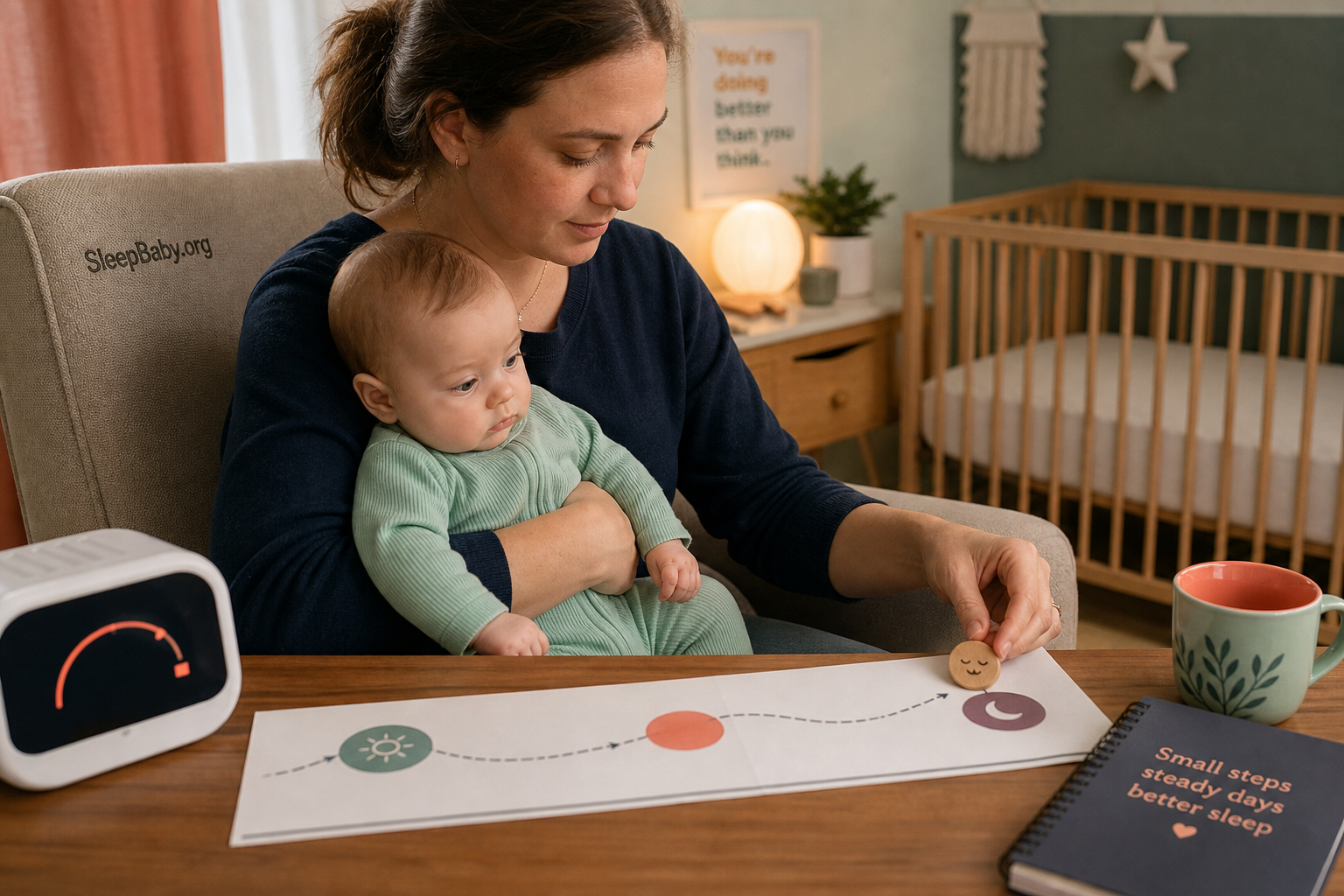
Kacey, Benjamin, and the 32-minute objection
This is a clearly labeled composite Kacey-and-Benjamin scene based on common parent concerns, not a documented family memory or evidence.
Imagine me standing in the kitchen at 9:17 a.m., holding Benjamin against one shoulder while my phone displayed the schedule I had made the night before. According to the schedule, he was still asleep. According to the cheerful baby pulling my hair, the schedule had not been consulted.
I could have spent the next hour trying to recover the missing 48 minutes as though they had been stolen from a bank vault. Instead, I would ask three smaller questions: Does he still look tired? Does he need to eat? What is the earliest sensible next nap if this one is truly over?
That is the change I want a schedule to create. It should reduce the number of decisions you make while tired, not turn ordinary variation into an emergency. Benjamin’s composite 32-minute nap does not prove he needs fewer naps, more naps, or a new philosophy. It tells me the next awake stretch may be shorter and bedtime may need protection.
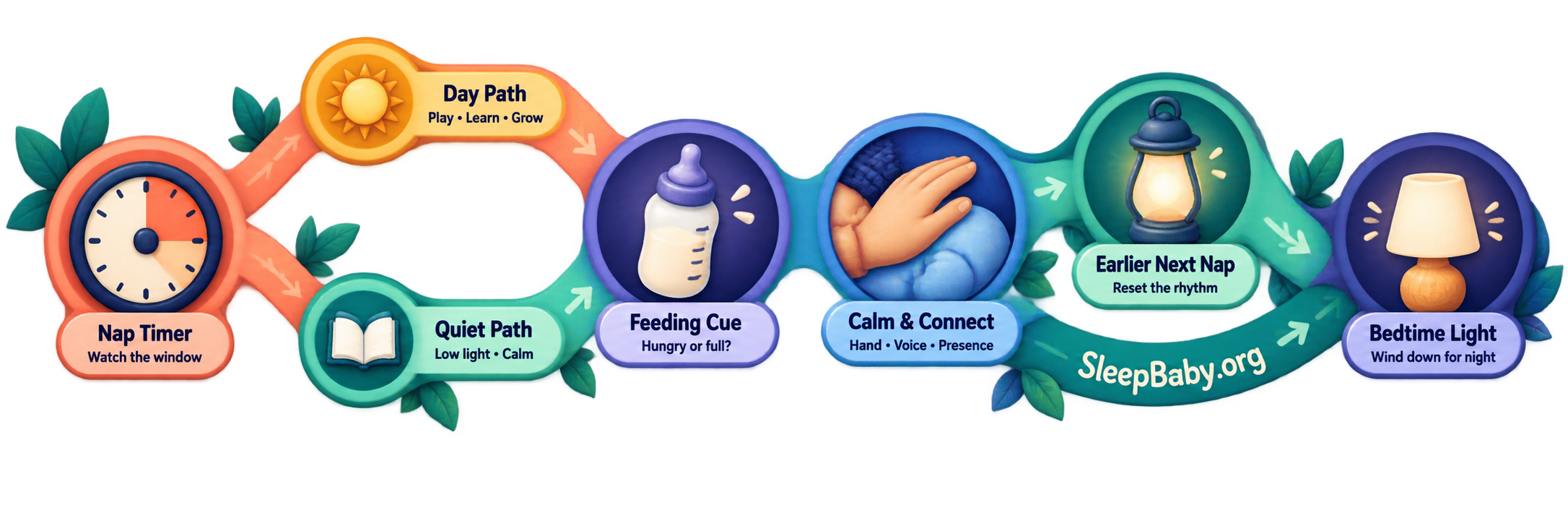
A nap routine can be five quiet minutes
A routine does not need a bath, a twelve-step sequence, or a level of household cooperation rarely observed outside architectural renderings. For naps, I like a short chain that can survive real life: lower the light, check the diaper, put on safe sleep clothing, say the same phrase, and move to the safe sleep space.
The goal is recognition. Your baby begins to learn that these few actions lead toward sleep. If every routine step must happen perfectly, the routine becomes another schedule you can fail. Keep the essential cues portable and boring enough to repeat.
If your baby protests the crib, practice one nap there when you have the most patience and use other safe, supervised support for the rest of the day. You do not have to convert every nap at once. Contact naps can be emotionally lovely or logistically suffocating; sometimes they are both before lunch. If you hold a sleeping baby, the adult must remain awake and alert. Sofas and armchairs are especially hazardous places to fall asleep with an infant.
Where feeding fits into a four-month nap day
Feeding is not an inconvenience to schedule around. Some babies feed after waking; others need a feed closer to sleep; many do both depending on growth, nap length, and the time of day. Follow hunger cues and your clinician’s feeding guidance rather than stretching a hungry baby to make the chart look tidy.
If your baby repeatedly falls asleep early in feeds, is difficult to wake for feeds, takes much less than usual, has fewer wet diapers, vomits repeatedly, or has growth concerns, call the clinician. Those details matter more than whether Nap 2 began at 10:45.
When feeding and sleep seem tangled, record the start of feeds and naps for two or three days. You may find the apparent nap problem is a hungry baby, a feed that regularly collides with the wind-down, or a late-afternoon cluster of short sleep and frequent feeding that is developmentally ordinary for your baby.
Four months is also a swaddle-transition age
Rolling attempts can arrive before the nap schedule settles. Stop swaddling as soon as your baby shows signs of trying to roll. Do not wait for a completed roll in the crib. The American Academy of Pediatrics also advises against weighted swaddles, weighted blankets, and weighted sleep products.
You can use ordinary fitted sleep clothing or a nonweighted, non-swaddling wearable blanket that allows free movement. Expect a transition period if your baby was accustomed to snug arms. Keep the rest of the routine familiar and give awake floor time for reaching, pushing up, and rolling practice. Development belongs in supervised awake time; the sleep space remains empty.
Always place your baby down on their back. If they later roll independently, follow current safe-sleep guidance and keep the sleep surface firm, flat, and free of loose objects. Never use a positioner to hold a baby in place.
When tired cues and the clock disagree
Four-month-olds are especially talented at producing ambiguous evidence. A yawn can mean tiredness, boredom, or one impressive yawn. Looking away can be a sleep cue, but it can also mean the room became too busy. Fussing can mean hunger, a wet diaper, the need for a burp, or a strong objection to the current entertainment.
I look for a cluster and a change from the baby’s recent behavior. A baby who was happily reaching and cooing, then becomes quieter, stares into the distance, rubs their face, and loses interest in play is giving a more convincing sleep signal than a baby who yawns once immediately after waking. Timing still matters: if the nap ended ten minutes ago, I would check other needs before beginning another wind-down.
Late cues matter too. Frantic crying, jerky movement, stiff arching, or an exhausted second wind can make settling harder, but they do not prove you permanently missed the correct wake window. Calm the situation, offer the feed or comfort that fits, and try again. Tomorrow gives you another data point.
How to protect bedtime after a chaotic nap day
The last nap has one job: bridge the baby to bedtime without stealing the need for night sleep. It does not need to be beautiful. A brief late-afternoon nap may be enough. If that nap will not happen, move bedtime earlier within a range your baby can handle rather than constructing an enormous final awake stretch.
Watch the tradeoff. A bridge nap that runs long or ends too close to bedtime may leave your baby ready to socialize when the room goes dark. Skipping it may create a baby who is too tired to feed calmly or settle. Make a small adjustment, then observe how bedtime begins and how the first stretch of night sleep goes.
A bad nap day also does not require an elaborate rescue bedtime. Keep the normal order recognizable. Feed as needed, lower stimulation, use the same safe sleep clothing and short routine, and put your baby down on their back. The day was complicated enough; bedtime does not need a rebrand.
Is this the four-month sleep regression or just a nap schedule problem?
“Four-month sleep regression” is an informal label, not a diagnosis. Parents often use it for a sudden increase in short naps, night waking, harder transfers, or settling trouble around the time infant sleep cycles are becoming more organized. A schedule that worked in the newborn weeks may no longer fit in the same way.
The label cannot tell you what to change. If naps shorten but your baby wakes content, feeds well, and manages the day with an extra nap, the practical answer may simply be flexibility. If bedtime becomes difficult after a long final nap, timing deserves attention. If sleep changes with congestion, fever, pain, feeding trouble, reduced wet diapers, or unusual lethargy, stop calling it a regression and call the clinician.
I would not respond to the word “regression” by removing feeds, forcing a nap count, or leaving a distressed baby without checking what changed. Describe the behavior first. The label can wait.
What if daycare or another caregiver follows a different schedule?
Ask for the facts you can use: when sleep began, when it ended, where it happened, when baby fed, and how they seemed on waking. You do not need identical minute-by-minute routines in both places. A shared short wind-down phrase, safe sleep expectations, and a predictable response to tired cues may provide more continuity than matching every clock time.
Tell every caregiver that baby must be placed on the back on a firm, flat approved surface with an empty sleep space, and that swaddling must stop when rolling attempts begin. Confirm that weighted products and unapproved sleep surfaces are not used. Safety is the part of the plan that should not become flexible during handoff.
On a short-nap childcare day, an earlier bedtime may make more sense than trying to reproduce a missed nap late in the evening. On a day with an unexpectedly long final nap, bedtime may shift later. Use the report to make one evening decision rather than interrogating the entire day.
Five common schedule problems and the first thing I would test
- Baby fights every nap.
- Begin the wind-down a little earlier for two days and make sure hunger is not arriving at the same moment.
- Baby falls asleep easily but wakes after one short cycle.
- Try one calm resettle, then shorten the next awake stretch if the nap is truly over.
- The last nap disappears.
- Use a brief supported bridge nap when safely possible or move bedtime earlier; do not force a long late nap.
- Bedtime takes an hour.
- Look at when the last nap ended and whether it ran longer than usual before altering every daytime nap.
- The schedule works for two days and falls apart on the third.
- Check feeds, illness, stimulation, travel, and development. Babies are not quality-control machines.
Each test should be small enough that you can tell what happened. A schedule becomes useful when it turns confusion into one reasonable next experiment.
Use three days of evidence before changing everything
Record only six things: morning start, feed times, nap start, nap end, mood on waking, and bedtime. Add a note for illness, travel, vaccines, unusual stimulation, or rolling practice.
- If every nap is short: test a slightly earlier wind-down for one or two naps.
- If the first naps are solid and the last nap is a battle: shorten or drop only that bridge nap and protect bedtime.
- If naps are easy but bedtime takes forever: look at the final nap’s timing and length before changing the entire day.
- If baby is sleepy throughout feeds and play: stop schedule experiments and discuss the change with the clinician.
I would change one lever at a time: the wind-down start, the next sleep opportunity after a short nap, the final bridge nap, or bedtime. If you move all four, tomorrow’s result cannot tell you which change helped. For a slower household-wide reset, the flexible seven-day sleep-schedule plan carries this one-change method forward.

See what safe sleep looks like at this age
Watch before the next nap
Back placement, an empty sleep space, and the rolling transition
This American Academy of Pediatrics sleep presentation is useful here because it keeps the visual safety setup separate from the changing clock schedule.
Takeaway: the schedule can flex. The safe sleep surface, back placement at the start of every sleep, and the empty crib do not.
When a nap problem needs more than schedule math
Call your baby’s clinician when sleep changes alongside persistent pain, fever, feeding difficulty, poor growth, fewer wet diapers, repeated vomiting, loud or troubled breathing, pauses or gasps, unusual movements, loss of skills, or a marked change in responsiveness. Ask for help when your baby’s total sleep seems consistently outside the broad expected range and they are struggling during awake time, or when exhaustion is making care unsafe for you.
Bring the short log. “Naps are terrible” is true but hard to investigate. “For three days, every nap ended after 25 to 35 minutes, she woke crying, fed much less than usual, and had fewer wet diapers” gives the clinician a clearer starting point.

At 9:17 a.m., the day is not ruined
The 32-minute nap still ended. Your baby is still awake. But the schedule has changed jobs: it is no longer a verdict on the day. It is a map you can redraw.
Feed the baby who is hungry. Offer the next nap earlier when the last one was brief. Keep the nap routine short enough to repeat. Protect a safe, empty sleep space. Stop swaddling when rolling attempts begin. And judge the pattern over several days, not by one row on a spreadsheet.
That is the rhythm I trust at four months: steady enough to reduce decisions, flexible enough to survive an actual baby. When you need the wider age-by-age view, the first-year sleep-schedule guide shows how the anchors evolve without turning another month into a rigid template.
Sources
- American Academy of Sleep Medicine: Child Sleep Duration Health Advisory
- American Academy of Pediatrics: Getting Your Baby to Sleep
- American Academy of Pediatrics: How to Keep Your Sleeping Baby Safe
- American Academy of Pediatrics: Swaddling—Is It Safe?
- CDC: Milestones by 4 Months
- NHS: Helping your baby to sleep
For the schedule that keeps meeting a real baby
Build tomorrow from the naps you actually have
SleepBaby can help you turn short naps, changing wake periods, feeds, and bedtime pressure into a calmer plan without promising perfect sleep or asking you to ignore your baby’s signals.
This educational support does not replace care from your baby’s clinician when feeding, breathing, illness, growth, development, or unusual sleepiness is a concern.






What viewers said10 comments · 4 replies+
Archived comments from the original Baby Sleep Miracle presentation. Not independently verified by SleepBaby.org; individual experiences vary.
Thank you so much for this video! I had no idea about the dangers of baby swings :O
Hi Mary-Ann. I have a question: Is method in any way similar to the ones recommended by Dr Bucknam, Dr. Weissbluth or Dr. Karp? We tried those but none of them help.
Hi Regina, thank you for your question. The short answer is no. The techniques I share in my guide are based on newest scientific research and this is why I have never seen any approach similar to the one I recommend.
This method really works! I tried it on my son Jesus and after just one week he went from waking up more than 5 times a night to waking up just once or twice. You are a lifesaver, Mary-Ann!
I'm truly impressed with how much information you share in your video. And all for free! I can feel that you truly care about mothers like myself, and that's hard to find these days. I have recommended your site to several of my friends already.
Mary-Ann, our child suffers from autism. Is your approach still suited?
Chloe, I made sure my method can be used with any child, even babies who are special like yours. Please note that I'm not a doctor and that I always advice to consult with your physician because nothing is more important than the safety and well-being of your love.
Hallo Mary-Ann, I'm from Germany. Do you have your guide in German?
Hello Heide, we do! Normally you should already see our video in German. If not, please contact our support so they can guide you
Thenk you for your answer, Mary-Ann!
I just completed your approach and I have to say, it worked almost too well. Yes, it took a bit of getting used to with your bedtime routine but the difference is huge. My son George used to take 1 hours to go down and now he's firmly asleep in no more than 10 minutes! You're the best!
It seems I'm the only man watching this video, lol! What you shared about the 'emotional backpack' made immediate sense to me and I can't wait to help my little girl Mila to unpack it!
Hey there, just discovered your site and this really sounds different. Just wanted to say thanks for sharing :)
For everyone who's still thinking about getting Mary-Ann's guide I want to advise you to go ahead. I wasn't sure myself but now I'm so thankful I invested in this program. It made a huge difference in our life as a family and yes, my baby girl does sleep through the night now.