

A toddler’s peeling palms can follow irritation, inflamed skin or a recent illness. The peeling alone cannot tell you which. First, check whether your child has fever, pain, a spreading rash, mouth sores or trouble drinking. If they seem well and only a small area is dry, wash gently, pat dry and use a plain fragrance-free moisturizer while you watch for changes.
I’d start with the child attached to that little hand: are they playing, drinking and using it comfortably? A toddler who pulls away from the towel needs a different next step from one who happily reaches for another block. Then look back at the days before the skin started lifting.
When peeling palms need medical attention
Dry flakes by themselves are different from skin that is painful, blistering or peeling across a larger area. Do not wait for a moisturizer to work when your toddler seems ill. If you are unsure how urgently they need help, describe both the skin and their overall behavior to your pediatrician’s advice line.
Fever lasting several days deserves particular attention. Kawasaki disease can involve fever, red eyes, changes to the lips or mouth, a rash and swollen hands or feet. Peeling may appear later, often two to three weeks after the fever began. The American Academy of Pediatrics advises calling about fever lasting four to five days with concerning associated signs. Do not wait for day five, or for peeling to appear, if your child seems unwell. A previous prolonged fever that was never assessed is also important to mention now. AAP: Kawasaki disease.
Arrange an appointment for unexplained, recurring or persistent peeling, or skin that interferes with play, sleep or ordinary hand use. A photo can help show a change, but it cannot replace an examination when your child has concerning symptoms. This guide helps you organize observations; it cannot identify the cause from the appearance of a palm.
The palm is one clue; the timeline is the rest of the story
A photo captures today’s flakes. It does not show last week’s fever, the sore mouth that made lunch difficult, or the new soap at daycare. Those details can make a medical conversation much more useful. I’d write them down before trying to match the hand to pictures online.
Three things worth bringing to the call
Your child now
Comfort, energy, temperature, drinking and normal hand use. Are the hands merely flaky, or sore enough to change what your toddler does?
The days before
Fever, mouth sores, a rash, sore throat or a diagnosed illness. Note when each happened, even if your child seems recovered.
What touches the hands
Soap, sanitizer, messy-play materials and repeated wetting or rubbing. Write down actual product names instead of guessing which ingredient is responsible.
This is a handoff for a clinician, not a way to choose a diagnosis at home.
Keep the description simple. Is it one palm or both? Is the peeling at the fingertips, along a crease or over the whole palm? Are the feet involved too? Can your child open the hand and hold a cup comfortably? “Both fingertips started peeling yesterday, two weeks after a fever” conveys more than “the hands look terrible.”
Use the same ordinary light for a daily photo if your clinician wants pictures. Avoid repeatedly asking your toddler to stretch sore skin for a better angle. One clear view and a short note are usually more useful to a busy parent than a camera roll full of nearly identical close-ups.
If two caregivers remember the earlier illness differently, keep both observations rather than filling the gaps with a guess. For example: “I noticed a warm forehead on Monday; daycare measured a fever on Tuesday.” Separate what you saw from what you suspect. Include a recent medicine even if it seems unrelated to the hands, and have the container available during a phone appointment. That gives the clinician a starting point without asking you to decide which detail explains the peeling.

Why a toddler’s palms might peel
Several problems can leave a similar-looking dry edge. The sections below describe clues to discuss, rather than a checklist that proves a condition. More than one factor can be present: skin recovering from an illness can also get irritated by frequent washing or friction.
Dryness and repeated irritation
Think about what changed before the hands became uncomfortable. A different hand soap, longer water play, repeated wiping or colder weather may be relevant. Frequent wetting and drying and harsh cleansers can aggravate dry, cracked skin. A new exposure is useful information, but timing alone does not establish an allergy. Seattle Children’s: dry skin.
I’d begin by putting optional new products aside and keeping necessary handwashing gentle. That is easier to assess than adding three “soothing” products at once. If a clinician asks what touched the skin, you will have a clearer answer. Keep the packaging or a photo of the ingredients; you do not need to become an ingredient detective overnight.
Eczema or another inflammatory skin problem
Itch, burning, cracks, blisters or oozing can point beyond ordinary dryness. Hand eczema can look red on lighter skin or darker brown on darker skin, and a moisturizer alone may not be enough. A clinician can distinguish eczema from other causes and decide whether prescription treatment is appropriate. AAD: hand eczema.
A toddler may not say “itchy.” Notice repeated rubbing, trying to keep the hand out of water, or waking and scratching. Tell the clinician what you observed rather than interpreting every movement as itch. If your child already has an eczema plan, follow that plan and ask whether this new location or appearance changes it. Do not borrow someone else’s steroid, antifungal or antibiotic cream.
Peeling after hand, foot and mouth disease
Hand, foot and mouth disease can cause mouth sores and a rash on the hands and feet. Peeling can follow after the rash heals, and Nationwide Children’s describes that recovery peeling as harmless. The important distinction is whether your child is recovering comfortably or has new symptoms that need attention. Do not assume every peeling palm is leftover hand, foot and mouth disease. Nationwide Children’s: hand, foot and mouth disease.
Tell the clinician if there was a known diagnosis, rather than simply a daycare notice about an outbreak. Also mention whether your toddler had mouth pain, spots on the feet, fever or difficulty drinking. If mouth discomfort is still disrupting nights, our hand, foot and mouth sleep guide focuses on comfort and when to seek help. New fever or worsening pain deserves a fresh assessment.
Peeling after scarlet fever
Scarlet fever can cause a rough, sandpaper-like rash along with fever and a sore throat. As the rash fades, skin around the fingertips, toes or groin may peel, sometimes for several weeks. A child with possible scarlet fever needs clinical assessment and appropriate testing and treatment; peeling is not a reason to start leftover antibiotics. CDC: symptoms of scarlet fever.
If your toddler was treated for a recent infection, bring the diagnosis, medicine name and dates to the conversation. If the earlier illness was never assessed, say that clearly. “It might have been strep” and “the test was positive” are different pieces of information. Neither requires you to work out the cause of today’s peeling yourself.
Repeated superficial peeling without much itch
You may find the term keratolysis exfoliativa while searching. It describes a pattern of superficial, often non-itchy palm peeling that can recur and be aggravated by water or irritants. DermNet notes that it occurs most often in young adults. An internet description of that pattern is not a diagnosis for a toddler. DermNet: keratolysis exfoliativa.
For recurring episodes, record when the skin returns to normal between them and whether the same areas peel again. Ask for an examination instead of trying adult exfoliating products. A clinician may consider several conditions; you do not need a long list of rare disorders to make a useful appointment.
Does this mean my toddler needs vitamins?
Peeling palms alone do not tell you which nutrient, if any, is missing. Do not start high-dose supplements as a skin experiment. The AAP says most healthy children eating a balanced diet do not need extra vitamin supplements. If your toddler’s diet is very restricted, growth is a concern or a clinician has identified a deficiency, discuss an individual plan. AAP: children and supplements.
A gentle hand-care routine while you arrange advice
For a well child with a small dry area and no concerning signs, keep care uncomplicated. If your toddler has a diagnosed skin condition, their clinician’s instructions take priority. The goal at home is comfort and less irritation while you learn what is going on, not removing every visible flake.
Wash → pat → moisturize
- Keep necessary washing. Use lukewarm water and a gentle cleanser. Keep cleaning hands after toileting and before eating; peeling is not a reason to abandon hygiene.
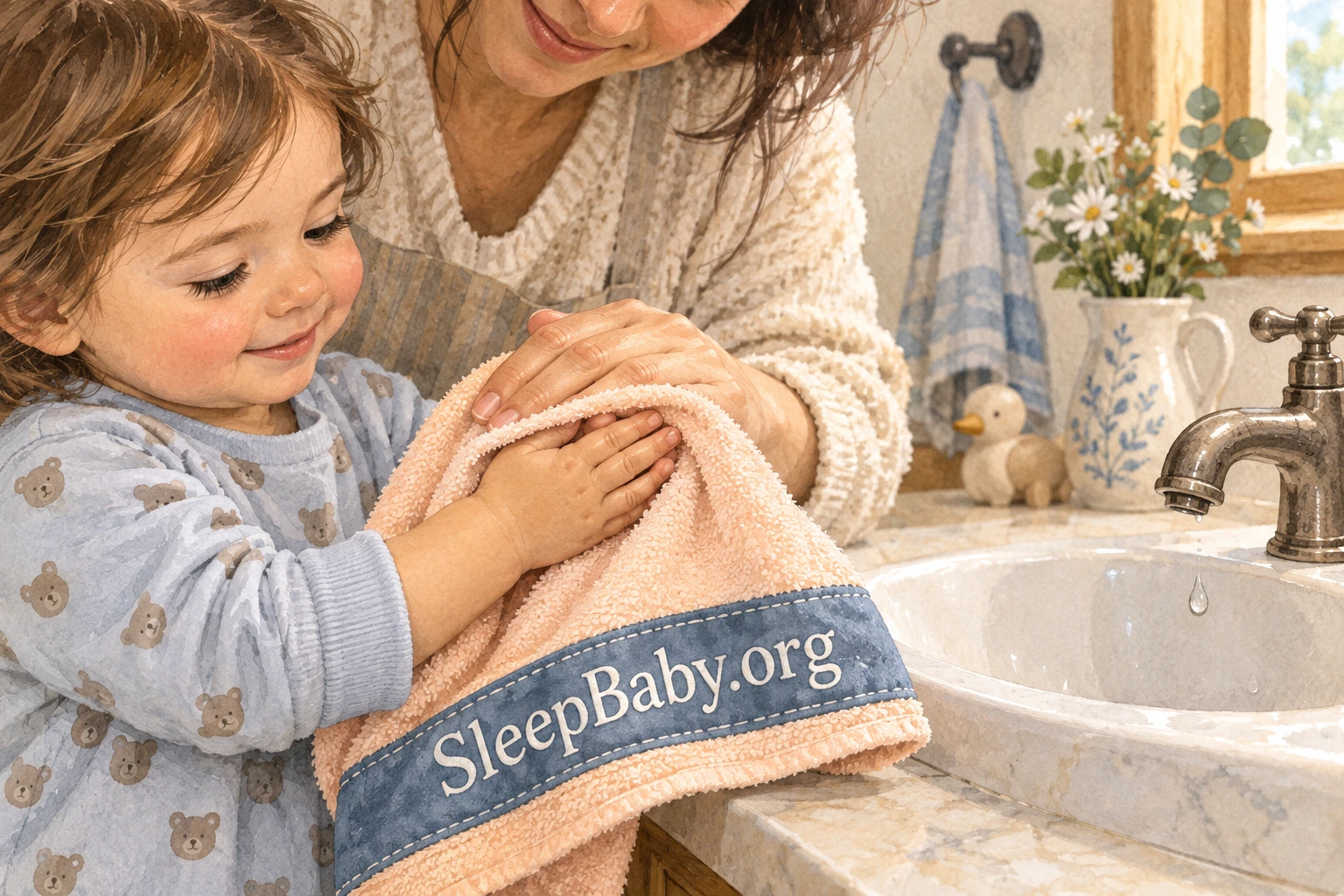
- Pat rather than scrub. Use a clean soft towel or cloth. Avoid rubbing loose edges, peeling them off or trying to polish the palm smooth.
- Use a simple moisturizer. A fragrance-free cream or ointment can be applied after drying, while the skin is still slightly damp. Follow any existing prescription plan.
The AAD recommends gentle washing and moisturizing to protect dry hands. AAD: preventing dry skin from handwashing.
Set out what you need before bringing your toddler to the sink. A familiar towel within reach makes it easier to finish without extra rubbing while you hunt through a cupboard. Offer a small choice, such as which clean towel to use, while keeping the actual care brief. Stop and reassess if even gentle contact is painful.
Keep your explanation honest and small: “I’m going to pat your hand. Tell me if it hurts.” You can demonstrate the motion on your own hand first. I wouldn’t promise that something cannot sting when you do not yet know how the skin feels. Let your toddler show you where it is uncomfortable, then report that to the clinician. A child who tolerates the back of the hand being touched but protects the palm has given you a useful observation, not a diagnosis.
For children with eczema, the AAD favors short, warm baths, gentle fragrance-free cleansing and thick creams or ointments rather than thin lotions. Keep nails trimmed and avoid overheating. Ask the child’s clinician before trying wet wraps or changing prescribed treatment. Those eczema recommendations do not establish that your toddler’s peeling is eczema. AAD: caring for a child with eczema.
I’d resist the urge to add a scented balm because the plain option looks unexciting. This is a useful time to know exactly what you are putting on the hands. Avoid homemade acids, essential oils, exfoliating scrubs and adult “peeling” treatments. Do not cover sore hands tightly with improvised wraps or gloves unless your clinician has advised a suitable approach.
If a product stings, your toddler pulls away or the skin looks worse afterward, stop that product and ask for advice. Keep the name for the clinician. A reaction after application is worth reporting, even when the label says “natural,” “baby” or “sensitive.” Those words cannot tell you how this particular patch of skin will respond.
Watch: practical eczema care from dermatologists
The American Academy of Dermatology’s “Eczema: Tips to help your child feel better” explains everyday care for children with eczema. The useful takeaway here is gentle skin care and an appropriate treatment plan. This video cannot tell you whether your toddler has eczema.
Watch the AAD video on YouTube if the player does not load. The care steps above remain available without watching.
What to watch for over the next few days
Judge progress by comfort and function, not just whether every flake has gone. Is washing easier? Is your toddler using the hand normally? Is the affected area staying small? A hand can still look untidy while you gather useful information, but worsening symptoms should change the plan.
Make a brief note once a day unless your clinician recommends something different. Include pain, itch, new areas and any fever. If you are checking the palms every hour, it may help to choose one calm moment, such as after ordinary handwashing, to write the update. That keeps observation manageable without asking your child to perform repeated inspections.
There is no single healing deadline for all causes of peeling. Ask the clinician what improvement should look like, when to report a lack of progress and what would justify an earlier call. If you already received advice but the situation has changed, say exactly what is new. “Now she will not hold her spoon” is a meaningful update even if the original photograph looked mild.
Do not use the fact that one hand looks better to dismiss a newly painful area elsewhere. If the feet are also involved, include them in your description. Our guide to peeling toes can help you organize those observations without assuming the hands and feet have the same cause.
Make the daycare and pediatrician handoff easier
Peeling skin by itself does not settle whether a child is contagious or ready for daycare. Recent illness, current symptoms and the setting’s rules all matter. Follow your clinician’s and daycare’s guidance rather than using the last loose flake as a return date. Ask the setting which soap and hand sanitizer are used, and whether staff noticed rubbing, discomfort or a rash.
If several adults help care for your toddler, agree on one simple routine and where the note lives. Otherwise a well-meaning grandparent may try a new cream while daycare uses another. Sharing the plan also reduces how often your toddler has to show the same sore hand to a different person.
At the appointment, ask three practical questions: what is the likely cause, what should we do at home, and what change should make us call again? If treatment is prescribed, clarify where to apply it, how long to use it and what to do if it stings. It is fine to ask for the instructions in writing.
Before ending the call, repeat the plan in your own words. “We will use this after washing, leave that product off, and call if this changes” can reveal a misunderstanding while someone is available to correct it. If daycare will apply anything, ask what written instructions or permission they require. Keep prescription directions with the original container rather than relying on a message passed through several adults.

When hand discomfort interrupts bedtime
A toddler who is rubbing their palms or avoiding a page turn may need comfort before another attempt at settling. I’d check the hands before treating that resistance as a bedtime habit. Pain and itch are reasons to revisit the care plan, not reasons to insist on a perfect routine.
Do the agreed skin care before the last quiet activity, so you are not introducing a stinging product at lights-out. Keep any containers out of reach afterward. A short book, a familiar phrase and your usual gentle transition can stay in place even if the evening takes longer. For a three-year-old, our three-year-old sleep routine guide offers an age-specific starting point.
If your toddler wakes, notice what is actually happening. Are they scratching, holding the hand still, feverish, thirsty or simply asking for you? That observation helps you respond and gives the clinician something concrete if nights keep being disrupted. Do not use sedating medicines or extra skin treatments to make sleep happen without appropriate medical advice.
You do not have to choose between comforting your child and keeping a recognizable bedtime. The routine can be shorter while symptoms are active. Once the discomfort has been assessed and is improving, return to the familiar sequence at a pace your child can manage. Sleep advice belongs alongside appropriate care, never in place of it.

Common questions about toddler palm peeling
Should I pull off skin that is already loose?
No. Leave it alone rather than tugging, cutting or scrubbing at attached edges. If a flap catches, a crack hurts or your child keeps picking, ask the clinician how to protect that particular area. The goal is a comfortable hand, not a perfectly smooth-looking palm by tonight.
Can my toddler still wash their hands?
Yes, keep necessary hygiene. Make washing gentle and drying brief, and follow the care plan afterward. Tell the clinician if water or cleanser is painful enough that your toddler refuses ordinary washing. Do not replace needed handwashing with a string of new wipes and fragranced products.
What if there is no fever and my toddler seems fine?
That is useful information, but it does not identify the cause. Look at comfort, hand use, recent illness and exposures as well. Mild dryness in a well child can be managed gently while you observe; unexplained, persistent or recurring peeling still deserves clinician advice. New symptoms change the situation.
Could it be an allergy?
Possibly, but peeling alone does not prove one. Bring the names of products and the timing of contact to the appointment. Do not remove major foods from your toddler’s diet based only on a palm photo or an online list. Ask what evidence would support allergy testing or a specific change.
What if the peeling returns after it looked better?
Record the dates, the areas involved and anything that changed in between. Include periods when the skin looked completely normal. Recurrence is a reason to get a clearer diagnosis and plan, especially if you are repeatedly guessing which cream to use. Bring previous advice and product names so the next conversation can build on them.
For tonight, keep the next step small and clear: check your toddler’s overall health, note the recent timeline and keep hand care gentle. If discomfort or illness is getting in the way, call for help. You do not need to solve the cause from a flake of skin.
Sources
- American Academy of Pediatrics: Kawasaki disease and children and supplements.
- American Academy of Dermatology: hand eczema, handwashing and dry skin, and childhood eczema care and video.
- Nationwide Children’s: hand, foot and mouth disease; CDC: scarlet fever symptoms.
- Seattle Children’s: dry skin; DermNet: keratolysis exfoliativa; NHS: Stevens–Johnson syndrome.
- Product specifications: Burt’s Bees Baby Golden Bee washcloths.





What viewers said10 comments · 4 replies+
Archived comments from the original Baby Sleep Miracle presentation. Not independently verified by SleepBaby.org; individual experiences vary.
Thank you so much for this video! I had no idea about the dangers of baby swings :O
Hi Mary-Ann. I have a question: Is method in any way similar to the ones recommended by Dr Bucknam, Dr. Weissbluth or Dr. Karp? We tried those but none of them help.
Hi Regina, thank you for your question. The short answer is no. The techniques I share in my guide are based on newest scientific research and this is why I have never seen any approach similar to the one I recommend.
This method really works! I tried it on my son Jesus and after just one week he went from waking up more than 5 times a night to waking up just once or twice. You are a lifesaver, Mary-Ann!
I'm truly impressed with how much information you share in your video. And all for free! I can feel that you truly care about mothers like myself, and that's hard to find these days. I have recommended your site to several of my friends already.
Mary-Ann, our child suffers from autism. Is your approach still suited?
Chloe, I made sure my method can be used with any child, even babies who are special like yours. Please note that I'm not a doctor and that I always advice to consult with your physician because nothing is more important than the safety and well-being of your love.
Hallo Mary-Ann, I'm from Germany. Do you have your guide in German?
Hello Heide, we do! Normally you should already see our video in German. If not, please contact our support so they can guide you
Thenk you for your answer, Mary-Ann!
I just completed your approach and I have to say, it worked almost too well. Yes, it took a bit of getting used to with your bedtime routine but the difference is huge. My son George used to take 1 hours to go down and now he's firmly asleep in no more than 10 minutes! You're the best!
It seems I'm the only man watching this video, lol! What you shared about the 'emotional backpack' made immediate sense to me and I can't wait to help my little girl Mila to unpack it!
Hey there, just discovered your site and this really sounds different. Just wanted to say thanks for sharing :)
For everyone who's still thinking about getting Mary-Ann's guide I want to advise you to go ahead. I wasn't sure myself but now I'm so thankful I invested in this program. It made a huge difference in our life as a family and yes, my baby girl does sleep through the night now.