
If your toddler ate Gas-X, take the medicine out of reach and call U.S. Poison Control at 1-800-222-1222 now, even if your child seems fine. Have the package with you. Gas-X comes in different strengths, and some products contain calcium carbonate as well as simethicone. The exact label and amount matter.
If your child has trouble breathing, collapses, has a seizure, or cannot be awakened, call 911 immediately. Do not make your child vomit. Outside the U.S., contact your local poison service or emergency number.
I would turn the box over before searching for stories about someone else’s child. “One Gas-X” isn’t a complete description of what was swallowed. Getting the right product in front of the poison specialist is a useful first step you can take right now.

Is Gas-X poisonous to a toddler?
There is room for reassurance, but it needs a boundary. Missouri Poison Center describes simethicone gas drops as low risk; a large amount may cause diarrhea. That information helps explain why every accidental exposure does not automatically mean serious poisoning. It does not establish a safe number of adult tablets or softgels for your child.
Gas-X is a brand name, not one fixed dose. A toddler might chew part of a tablet, swallow a softgel, or get into a product with another active ingredient. There may also be a different medicine in the same bag. Those are different questions, and the specialist needs the actual details.
I would avoid both extremes: assuming the brand is harmless, or deciding that a stronger package necessarily means severe harm. A poison specialist can assess the exposure without making you interpret a medication label as a toxicity chart.
Read “active ingredients,” not just the front of the box
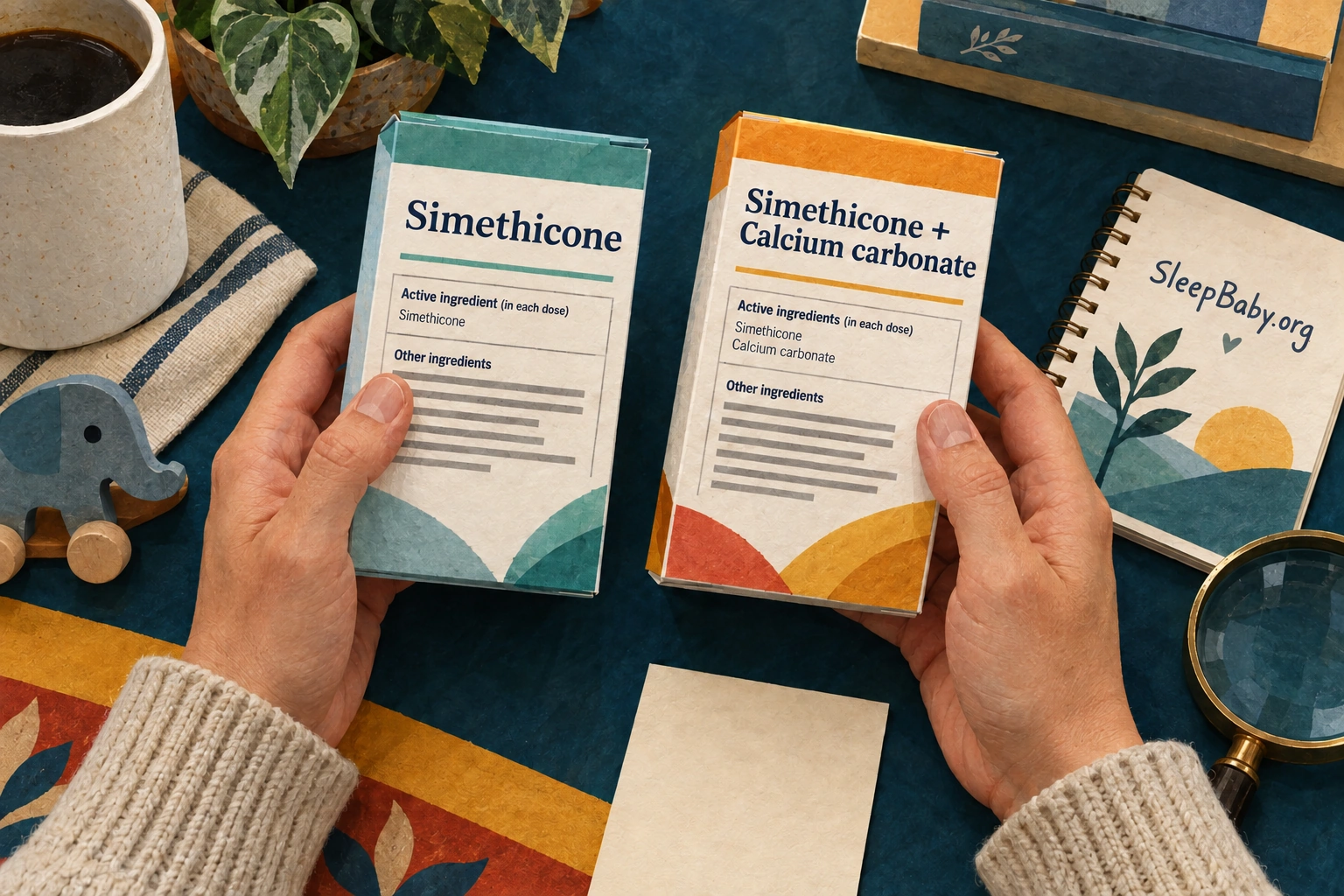
Look for the Drug Facts panel and read every active ingredient, its strength, and the unit. The illustration above shows the distinction; it is not a photograph of a specific retail package. The label in your hand is the one that matters.
Same brand, different information to report
- Extra Strength
- The current U.S. product range lists 125 mg simethicone in its Extra Strength softgels and chewables.
- Ultra, Maximum, and Ultimate Strength softgels
- The listed simethicone strengths are 180 mg, 250 mg, and 500 mg respectively.
- Total Relief Chews
- The listed combination contains 250 mg simethicone plus 750 mg calcium carbonate per tablet. Report both ingredients.
These are product-identification examples, not toddler doses or safe-ingestion limits. Packaging, country, and formulation can differ. Read the full name from your own package.
The manufacturer’s product list and the Total Relief Drug Facts label on DailyMed confirm that difference. The current Ultimate Strength and Total Relief directions are for adults and children 12 years and older. An older-child or adult direction is not an accidental-ingestion rule for a toddler.
What changes if it contains calcium carbonate?
Calcium carbonate is an antacid. Missouri Poison Center describes a one-time exposure to calcium-carbonate antacids as usually causing little difficulty, although stomach upset, constipation, or diarrhea can occur. It specifically flags kidney disease as a reason for prompt poison-center advice. This is ingredient context, not a clearance for an unknown amount of Gas-X Total Relief.
Tell the specialist about your child’s health conditions and other medicines. Don’t shorten a two-ingredient label to “just gas medicine.” If the label is unreadable, keep the container and say that you cannot identify it confidently.

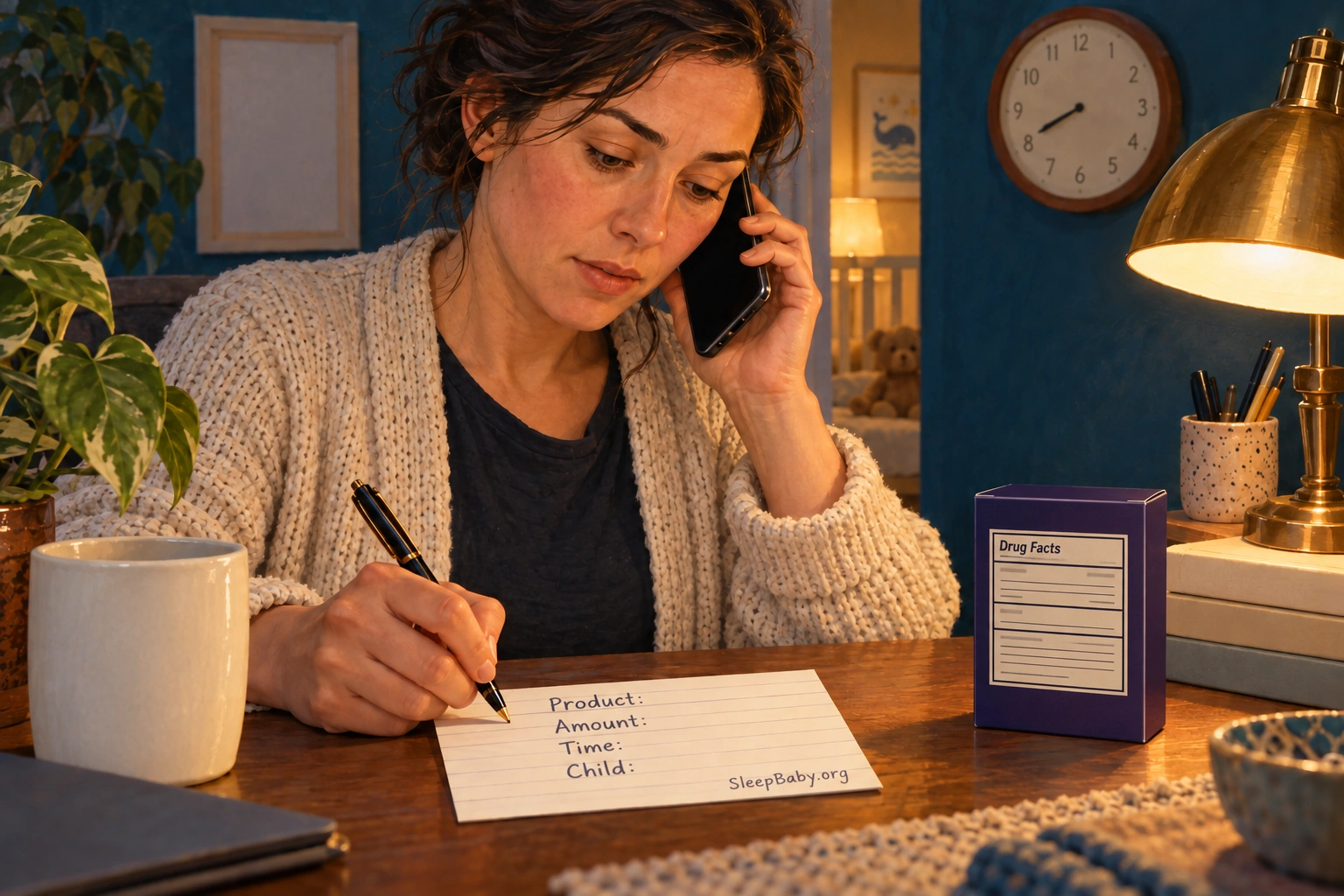
The four-part call card: label, count, clock, child
When you’re looking at an empty blister pocket, it is easy to turn a guess into a fact. I would write down four headings, then leave blanks where needed. You can start the call while gathering the information.
Keep this beside the package
LABEL
Full product name, every active ingredient, strength per tablet or softgel, and package size.
COUNT
What you actually saw in your child’s mouth or swallowed. What is missing. Whether the amount is unknown.
CLOCK
When it happened, or the period during which your child could have reached it.
CHILD
Age, known weight, current symptoms, medical conditions, allergies, and other medicines that might be involved.
A useful opening: My toddler may have swallowed this product. The label says ____. I saw ____. I don’t know ____. It happened around ____. Right now my child is ____.
Those details match the information Poison Control asks callers to provide. Its advice is free and confidential, and help is available around the clock in the U.S. Say “I don’t know the weight” if you don’t know it. Don’t delay the call to find a scale.
An empty pocket doesn’t tell the whole story
A blister strip with three empty pockets doesn’t prove that your toddler swallowed three tablets. An adult may have taken one earlier. Equally, finding one chewed piece on the floor doesn’t prove that none was swallowed. Tell the specialist what you found and distinguish it from what you watched happen.
If another adult knows how full the package was, they can help while you stay with your child. Save the packaging rather than throwing away the evidence during cleanup. Mention any missing foil, plastic, or other packaging too; that is a separate detail from the medicine itself.
WHEN THE MEDICAL PLAN IS IN PLACE
Let the label guide the call. Let a simple routine guide an ordinary bedtime.

Once you've received care instructions, you can save SleepBaby.org's free bedtime planning preview for an ordinary evening. It offers three choices and a suggested starting step, with no sign-up or card.
If you want more structure later, the SleepBaby.org Workshop is a separate optional paid guide with short lessons you can revisit and a seven-night tracker. I would use it to organize a familiar bedtime step, not to decide whether a child can sleep after swallowing medicine.
Poison Control or your clinician sets the care and monitoring plan. Neither the preview nor the Workshop provides medical advice, safety clearance, or promised sleep results. There is no need to buy anything to follow the practical steps in this article.
What if my toddler only chewed it, or seems completely fine?
Call anyway. You may be unable to tell how much was swallowed from a bitten tablet or an emptied softgel. Describe what remains, what you saw, and whether your child spat anything out. Don’t turn “some was on the floor” into “none went down.”
The lack of symptoms is information to share, not a reason to postpone asking. Poison Control explicitly advises getting help for a suspected poisoning without waiting for symptoms. You can tell them your child is playing normally and still ask for a plan.
What if several kinds of medicine were within reach?
Report all possible products. If your toddler opened a handbag or a weekly pill organizer, the nearby Gas-X box may not identify everything involved. Keep the bottles, packets, and organizer for the specialist to review. Do not assume that similar-looking pills are the same drug.
I would say plainly, “I found the Gas-X, but there were other medicines in this bag.” That changes the information the specialist has to work with. Do not use a gas-drop reassurance to assess an unidentified pill.
Should I give water, milk, food, or something to counteract it?
Ask Poison Control what is appropriate for this product and your child. Don’t force a drink or food, and don’t give another medicine to “balance it out.” The general instruction to give a drink after some exposures is not a universal antidote. If your child has trouble breathing or cannot be awakened, call 911 rather than trying anything by mouth.
Do not induce vomiting. There is also no useful reason to start a pill-swallowing lesson, crush more medicine, or give a smaller test dose after an accidental ingestion. The immediate job is assessment of what already happened.

What should I watch for after the call?
Ask for the symptoms and follow-up that apply to your child’s exact exposure. A list on a web page cannot tell you whether a particular amount, combination, or health history needs assessment. Write down the advice, including what would require another call or an emergency visit.
Tell the specialist about any vomiting, diarrhea, stomach pain, change in behavior, or swallowing difficulty you observe. These are observations to report, not a claim that Gas-X caused them. If something changes after you have been given a plan, contact the service again and describe the change.
The emergency boundary remains the same: breathing difficulty, collapse, seizure, or inability to awaken requires 911. Do not wait for a scheduled follow-up call if an emergency develops.
Can my toddler go to sleep after eating Gas-X?
Ask Poison Control or the treating clinician before relying on the usual nap schedule. I would not set a universal “wait two hours” rule, tell every family to skip sleep, or assume that bedtime means the exposure is over. The advice depends on what was swallowed and the assessment.
Tell the specialist if your child is already asleep, unusually drowsy, or harder to wake than usual. If you cannot awaken your child, call 911 immediately. Do not explain away a concerning change as tiredness without getting help.
If you are told home care is appropriate, follow the monitoring and sleep instructions you receive. A phone alarm can help you remember an instructed check, but don’t invent a schedule from this article. A baby monitor cannot decide whether an ingestion is safe.
Give the next adult the plan, not just the conclusion
If another caregiver takes over, show them the package and your notes. Include the time of exposure, the instructions, any symptoms so far, and whom to contact if something changes. “Poison Control said we’re okay” leaves out the conditions attached to that advice.
Once the medical question has been addressed and ordinary bedtime is appropriate, keep the evening familiar. You do not need to make a major sleep change because there was a frightening moment earlier. Any specific care instructions take priority over a routine, a sleep guide, or a tracking sheet.
Make the next access point harder to reach
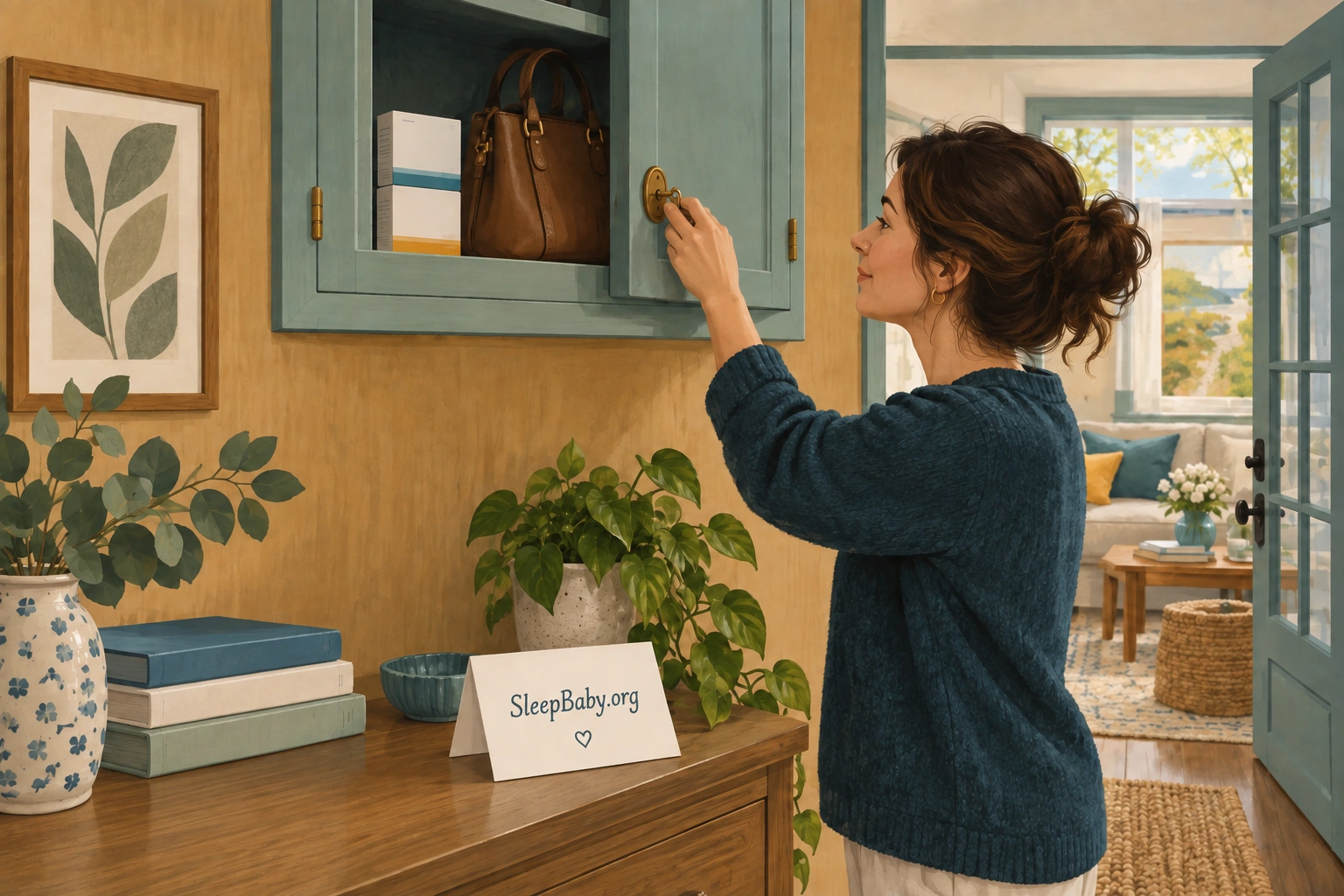
After care is arranged, look at the exact route your toddler used. Was the medicine in a low drawer, a visitor’s bag, a nightstand, or a blister pack left beside an adult’s water glass? Fixing that route gives this incident a practical follow-up.
- Put medicines out of sight and reach every time. Include vitamins and supplements, even those that look like treats.
- Keep the original labeled container. A loose pill or unmarked travel pouch makes identification much harder later.
- Include bags and pockets. Choose a secure place for visitors’ purses and overnight bags before your toddler investigates them.
- Finish the storage step immediately. Don’t leave the next dose on a counter “just for a minute.”
The CDC’s Up and Away campaign addresses that everyday storage habit. Its research on childhood medicine exposures also highlights pills removed from original packaging and medicines kept in bags or pockets. A familiar package is still medicine; a closed package is not a reason to leave it within reach.
I would make the storage location easy for the adults to use consistently. If putting the medicine away requires clearing a shelf every time, clear that shelf now. The plan should work during a busy morning as well as after a scare.
Watch later: the CDC’s medicine-storage reminder
This short prevention video is for after you’ve obtained advice about the ingestion. It does not assess Gas-X, give doses, or replace the call.
Written takeaway: Medicines left near an adult can still be reachable by a child. Return them to a place young children cannot see or reach, including during a family illness. For a possible ingestion, get Poison Help right away.
View the CDC video on YouTube if the player does not load.
An optional storage tool, after the immediate problem is handled
If small medicine packages keep migrating into a travel bag, the Master Lock 5900D portable combination safe is one practical option to consider as an extra storage barrier. The manufacturer describes a customizable combination and an attachment cable. Check that your original labeled packages fit before choosing it.
I would choose a locked existing cupboard first if that solves the access problem. I would skip this small box for large bottles, medicines with storage needs it cannot meet, or any situation where the adults would leave it unlocked. It is not a verified childproof medicine container, and it does not make a reachable medicine area safe by itself. Keep the box and cable out of children’s reach and follow each medicine’s storage directions.
Free alternative: Clear space in an existing locked cupboard, keep medicines in their original containers, and give visiting adults the same storage spot. You do not need a purchase to make that change today.
As an Amazon Associate, SleepBaby may earn from qualifying purchases.
Three questions parents often ask
My toddler ate only one. Do I still call?
Yes. “One” still needs the product name, ingredients, strength, and your child’s details. The call lets a specialist interpret those together. Do not borrow the outcome of another family’s exposure as a dose limit for yours.
Are baby gas drops and adult Gas-X interchangeable?
No. Some share simethicone as an ingredient, but formulation and concentration matter, and combination products add another issue. The fact that an ingredient appears in an infant product does not establish the amount or form appropriate for a toddler. Ask your child’s clinician about intended treatment separately from this accidental exposure.
Will Poison Control automatically send us to the emergency room?
No. Poison Control assesses the circumstances and may recommend home care, further discussion, or emergency evaluation. Give accurate details and follow the recommendation you receive. Asking is how you get a plan; it is not a commitment to any one outcome.

The useful move is small and immediate: keep your child with you, get the actual label, and call. After that, follow the plan you were given and make the medicine’s storage place part of the next adult handoff.
Sources
- Gas-X: current U.S. product range
- DailyMed: Gas-X Total Relief label
- DailyMed: Gas-X Ultimate Strength label
- Missouri Poison Center: gas drops
- Missouri Poison Center: calcium-carbonate antacids
- Poison Control: getting help and information to provide
- Poison Control: first aid for poisonings
- CDC: Up and Away campaign
- Master Lock: model 5900D specifications
- CDC: how young children gain access to pills
ONE ORDINARY STEP, WHEN YOU'RE READY
A plan you can return to after the urgent questions are answered
For tonight's ingestion questions, keep following professional advice. For a later, ordinary bedtime, SleepBaby.org's free planning preview can help you choose one starting step without a sign-up or card.
Keep the care notes where the next adult can find them, and put the medicine where your toddler cannot.





What viewers said10 comments · 4 replies+
Archived comments from the original Baby Sleep Miracle presentation. Not independently verified by SleepBaby.org; individual experiences vary.
Thank you so much for this video! I had no idea about the dangers of baby swings :O
Hi Mary-Ann. I have a question: Is method in any way similar to the ones recommended by Dr Bucknam, Dr. Weissbluth or Dr. Karp? We tried those but none of them help.
Hi Regina, thank you for your question. The short answer is no. The techniques I share in my guide are based on newest scientific research and this is why I have never seen any approach similar to the one I recommend.
This method really works! I tried it on my son Jesus and after just one week he went from waking up more than 5 times a night to waking up just once or twice. You are a lifesaver, Mary-Ann!
I'm truly impressed with how much information you share in your video. And all for free! I can feel that you truly care about mothers like myself, and that's hard to find these days. I have recommended your site to several of my friends already.
Mary-Ann, our child suffers from autism. Is your approach still suited?
Chloe, I made sure my method can be used with any child, even babies who are special like yours. Please note that I'm not a doctor and that I always advice to consult with your physician because nothing is more important than the safety and well-being of your love.
Hallo Mary-Ann, I'm from Germany. Do you have your guide in German?
Hello Heide, we do! Normally you should already see our video in German. If not, please contact our support so they can guide you
Thenk you for your answer, Mary-Ann!
I just completed your approach and I have to say, it worked almost too well. Yes, it took a bit of getting used to with your bedtime routine but the difference is huge. My son George used to take 1 hours to go down and now he's firmly asleep in no more than 10 minutes! You're the best!
It seems I'm the only man watching this video, lol! What you shared about the 'emotional backpack' made immediate sense to me and I can't wait to help my little girl Mila to unpack it!
Hey there, just discovered your site and this really sounds different. Just wanted to say thanks for sharing :)
For everyone who's still thinking about getting Mary-Ann's guide I want to advise you to go ahead. I wasn't sure myself but now I'm so thankful I invested in this program. It made a huge difference in our life as a family and yes, my baby girl does sleep through the night now.