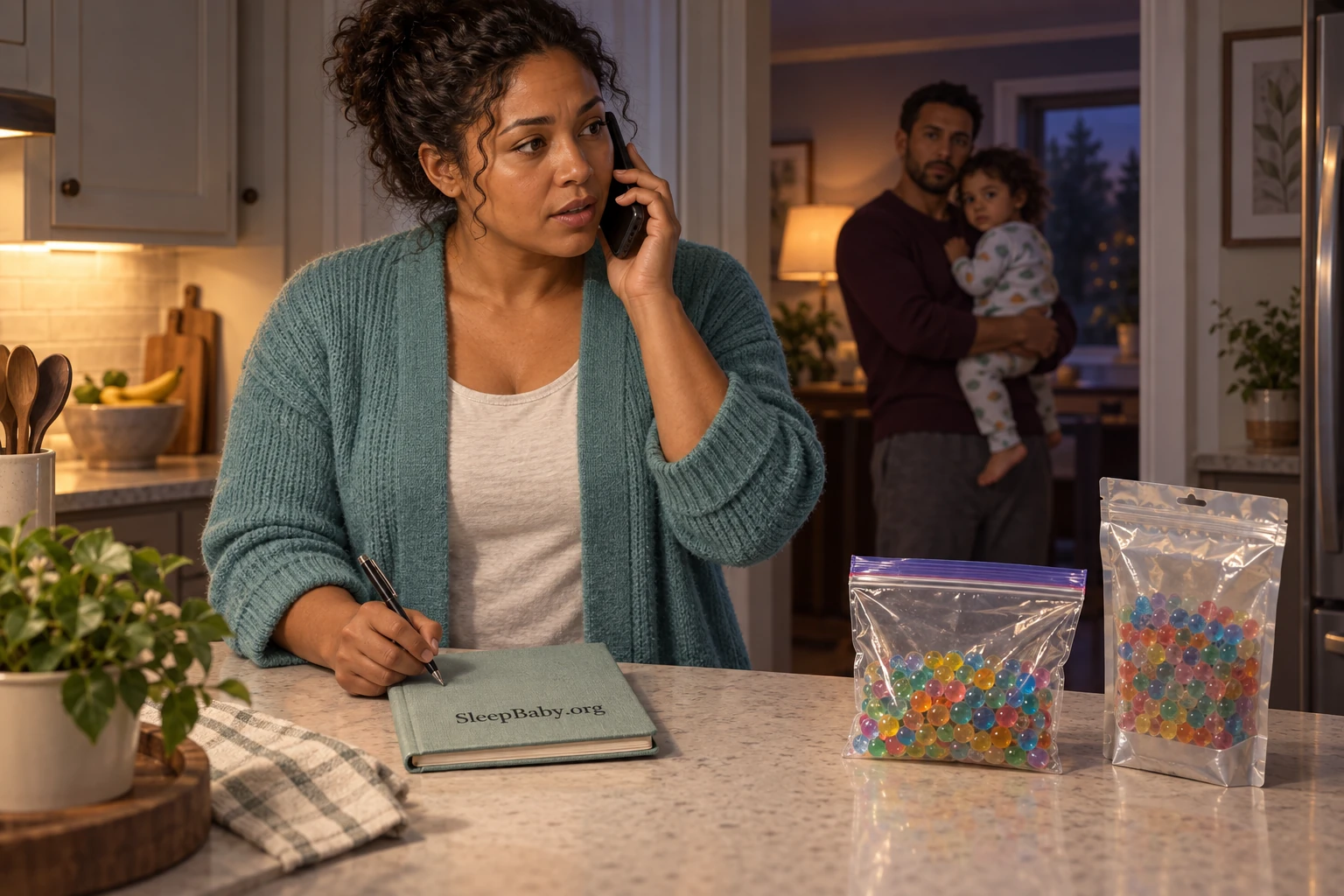
If your child swallowed Orbeez or another water bead, or you think they might have, call U.S. Poison Control now at 1-800-222-1222 and seek prompt medical guidance. Don’t wait for symptoms. If your child is choking, struggling to breathe, has collapsed, is having a seizure, or cannot be awakened, call 911 immediately. Outside the U.S., use your local poison service and emergency number. Poison Control first aid [1] and Washington Poison Center [2]
I would put the phone call ahead of counting beads or reading more stories online. Keep your child with you, prevent further access, and have the packaging nearby if you can reach it without delaying help. Water beads can cause a blockage; “non-toxic” does not mean safe to swallow. Poison Control’s water-bead guidance [3]
Get help before continuing this guide
Emergency symptoms: call 911 now. Do not wait for a poison-center call to deal with breathing trouble or unresponsiveness.
Possible swallowing, even without symptoms: call 1-800-222-1222 now for case-specific guidance. Follow the advice about medical evaluation.
This page explains the next questions. It cannot assess your child.
Start with your child, then the phone
Look at breathing and responsiveness first. A child who cannot cough effectively, cry, or breathe needs immediate choking help. Call emergency services and follow the dispatcher while giving age-appropriate first aid if you know how. Infant and older-child choking techniques differ. Don’t do a blind finger sweep into the mouth. The American Red Cross explains these differences [4].
If your child is breathing normally, that is useful information to tell the poison specialist. It isn’t a reason to postpone the call. HealthyChildren’s swallowed-object guidance specifically puts a water bead that grows when wet in the call Poison Center now category even when there are no other symptoms. AAP swallowed-object guidance [5]
Don’t make your child vomit. Don’t try a laxative, salt water, oil, or a food-and-drink experiment to move the beads along. Ask the professional handling the exposure what your child may eat or drink and whether anything should be withheld before assessment. General poisoning advice about drinking water for an irritating chemical is not a water-bead treatment plan. Poison Control first aid [1]
If another adult is there, give them one clear job: keep other children away from the spill, find the product package, or arrange transport as directed. If you’re alone, make the call first. A perfectly cleaned floor can wait until your child has the right help.
You don’t need every detail before you call
Poison specialists use the child’s age, symptoms, product, timing, and amount involved to decide what comes next. Keep the original container or a photograph of its label if available. Tell them about health conditions or medicines too. The service is free, confidential, and available around the clock. What Poison Control asks [6]
You can say that the amount is unknown. You can say you saw something in their mouth but didn’t see a swallow. You can say the beads came from a split toy and you don’t know the brand. An honest gap is more useful than turning “I think” into a precise number because you feel you should have one.
KEEP BESIDE THE PHONE
Four things to tell the poison specialist
Call first. Fill in what you know during the conversation; an unknown answer is allowed.
-
1. What I saw
A bead in the mouth, a possible swallow, a torn toy, or an unexplained spill. State what is uncertain.
-
2. Which product
Read the label if available. Say whether beads were dry, already wet, or inside another toy.
-
3. When it happened
Give the known time or explain the possible time window. Do not invent an exact minute.
-
4. How my child is now
Describe breathing, alertness, vomiting, swallowing, or pain. Give age and known weight when asked.
Before you hang up: ask what to do next, what changes need urgent help, and how tonight’s sleep should be handled.
SleepBaby.org · A conversation aid, not a medical assessment.
If the incident happened at daycare or someone else’s house, ask that adult to send the packaging and their account of what they saw. Keep observations separate: “There were beads on the floor” is different from “I saw a bead go into her mouth.” Both can matter. Neither needs to become a confident reconstruction of a moment nobody witnessed.
I would also write down the instructions as you receive them. Under stress, “call back if anything changes” can blur into “everything is fine.” Ask for the actual changes to watch for, the next contact, and any follow-up time. Read the plan back in your own words before ending the call.
Why a tiny bead deserves a real assessment
Orbeez is a familiar brand name, but parents also use that word for other water beads. These products contain superabsorbent material. Some start as tiny dry beads, take up liquid, and enlarge. When swallowed, an expanding bead can obstruct the digestive tract. A bead can also block the airway. Serious harm has occurred after a single bead, so there is no reliable “only one” reassurance to use at home. Poison Control on water-bead hazards [3]
That doesn’t mean every child who swallows a bead needs surgery. It means the right outcome cannot be predicted from the word “Orbeez” or the size of the spill. In an April 2026 report, Nationwide Children’s researchers described poison-center cases in which most children were managed without treatment at a health care facility, while some needed evaluation or admission. Those population results are context, not permission to choose home observation for an individual child. Nationwide Children’s research [7]
The useful distinction is between getting a plan for this child and borrowing another family’s outcome. A story about a three-year-old who passed a particular bead doesn’t tell you what happened in your baby’s body. Nor does a frightening account tell you that the same complication is inevitable. Give the care team the details they can actually use.
Does “non-toxic” on the package change anything?
It does not rule out a physical blockage. There have also been product-specific concerns about acrylamide in some water beads. I wouldn’t try to decide the medical risk by decoding a reassuring package label while your child waits. Tell the specialist exactly which product was involved; don’t assume every colorful bead has the same composition or expansion behavior. CPSC water-bead information [8]
What if the bead was already big and wet?
Say that when you call. Dry versus hydrated is a meaningful detail. Maryland Poison Center explains that a dry bead may travel onward and expand in the small intestine, while a fully hydrated bead can behave differently. That distinction belongs in the assessment; it isn’t a blanket guarantee that wet beads, crushed pieces, or beads from a squishy toy are harmless. Maryland Poison Center [9]
Don’t soak another bead and wait for your kitchen experiment to finish before seeking advice. If you have an unused sample, keep it securely away from children and ask whether the clinician wants it brought along. A home demonstration cannot recreate the conditions inside your child or establish an all-clear time.
Symptoms that need urgent attention
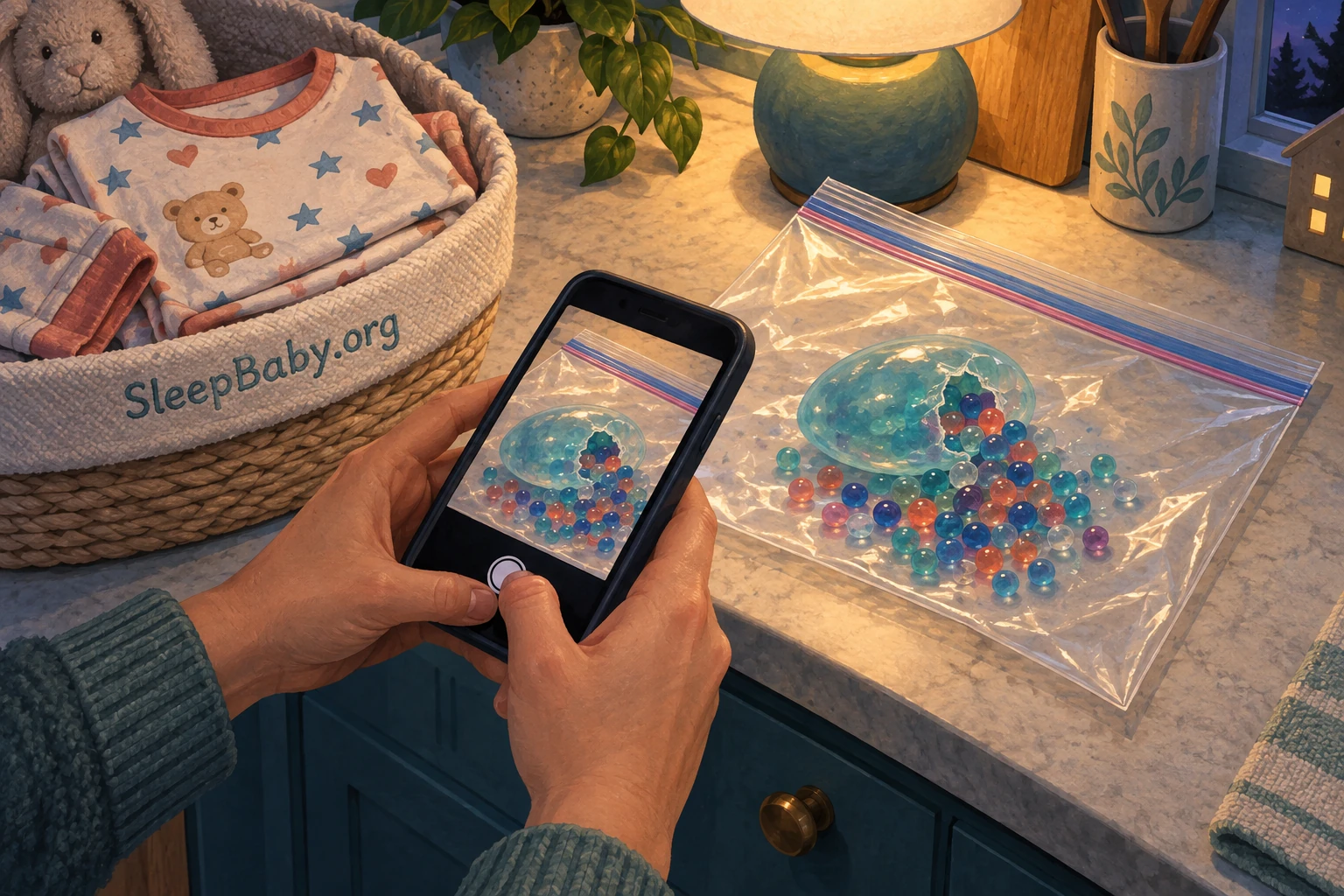
After a known or possible water-bead exposure, take new vomiting, abdominal pain or swelling, refusal to eat, unusual lethargy, drooling, or trouble swallowing seriously. Constipation can occur too. Wheezing or other breathing difficulty requires emergency help. These symptoms are not a home test for identifying a bead; they are reasons to get appropriate care. AAP water-bead warning signs [10]
Describe the change; don’t wait for a pattern
- Breathing or responsiveness
- Trouble breathing, collapse, seizures, or inability to wake: emergency services now.
- Swallowing or vomiting
- New drooling, difficulty swallowing, refusing food, or vomiting: seek urgent medical advice or assessment.
- Belly or behavior
- Pain, swelling, constipation, or unusual lethargy after a possible exposure: tell the care team promptly.
Severe symptoms, a very unwell child, or a suspected emergency need immediate emergency care. Do not wait for an online reply.
You don’t have to wait for the entire list. A child with repeated vomiting does not need to develop a visibly swollen belly before you seek help. And a child who seems comfortable should still have the exposure assessed now, rather than waiting to see whether the warning signs arrive.
Timing can be misleading. Maryland Poison Center’s review described obstruction symptoms often starting about a day after ingestion. That is not a 24-hour countdown, a safe observation period, or a deadline after which nothing can happen. Ask the clinician what follow-up your child needs and for how long. Maryland Poison Center’s review [9]
If symptoms develop after an earlier phone call or visit, contact the care team again promptly and repeat the water-bead history. Say when the possible exposure happened and what has changed. An earlier assessment describes the situation at that time; new symptoms are new information.
Can my child go to sleep after eating Orbeez?
Get the exposure assessed before treating bedtime as routine. I would not use a normal-looking bedtime, a settled child, or a familiar nap time as proof that everything is okay. If your child is difficult to awaken, that belongs in the emergency pathway, not in a sleep-schedule discussion. Poison Control emergency guidance [1]
If a poison specialist or clinician recommends care at home, ask directly about sleep: “Can they sleep normally? Do I need to check on them? What should make me call you or go in?” Follow their child-specific instructions. This article can’t set an overnight checking schedule or decide that waking is unnecessary.
Ask for a specific overnight plan
- Whether normal sleep is appropriate after this assessment.
- Whether any checks are needed, and exactly how to do them.
- What eating or drinking instructions to follow.
- Which symptoms mean calling back or going straight for care.
- Who to contact overnight and when follow-up is due.
Write the answers from your child’s care team. These questions do not create a home-monitoring plan by themselves.
A written handoff helps if another adult takes over. Give them the exposure time, the product information, whom you spoke with, and the exact plan. Put the contact number beside those notes. “Just keep an eye on him” leaves too much room for two adults to mean different things.
If your child needs a hospital assessment, let the usual bedtime go. Bring the information the team requested and follow their instructions about food and drink. There is no nap to rescue ahead of medical care. Later, when the concern has been addressed, there will be room to think about the ordinary sleep routine again.
OPTIONAL SLEEP SUPPORT, AFTER THE MEDICAL CONCERN
When ordinary bedtime is the next question
Once your child’s care team has addressed the exposure, you may still want help thinking about everyday sleep. The free Baby Sleep Miracle presentation on SleepBaby.org lets you explore the approach before deciding about a purchase.

The SleepBaby.org Workshop is an optional digital sleep guide. It does not treat swallowed beads, determine whether your child can sleep safely after an exposure, or replace Poison Control or your clinician’s instructions.
$20 USD
One-time payment · Digital guide
Opens the SleepBaby.org Workshop’s Shopify checkout.
What the medical team may need to work out
Tell the first clinician you speak with that the possible object is an expanding water bead. Don’t assume “small toy” conveys the same information. Bring the package or its photograph if you have it, including the product name and any size description. If the source was a torn toy, say so; not all fillings are the same.
Water beads may be difficult to see on an X-ray. That means an image needs to be interpreted alongside the exposure history, symptoms, examination, and the clinician’s judgment. Ask what the result can and cannot tell you and what should happen if symptoms continue or return. AAP water-bead guidance [10]
I wouldn’t take this as a reason to argue for one particular scan or procedure. A parent can give a clear history and ask a direct question without having to choose the medical workup. “Could this still be related to a water bead, and what is our next step if the vomiting continues?” is a useful question.
Some reported obstructions have required removal with an endoscope or surgery. Those are medical decisions, not things you can predict from the number of beads missing from a packet. The purpose of calling promptly is to get the appropriate assessment, not to assume either that a procedure is certain or that one will never be needed. Maryland Poison Center [9]
What if I find a bead in the diaper?
Tell the clinician or poison specialist. Record what you found and when, and ask whether that changes the existing plan. I would not cancel follow-up on my own because one bead appeared, especially if the swallowed amount was uncertain. Equally, don’t turn repeated diaper searches into a substitute for noticing how your child is doing or following instructions.
Keep a photograph if the team asks for one, but don’t delay care to produce proof. Your job is to pass along observations. The clinician’s job is to interpret them with the rest of the case.
What if it came from a stress ball or squishy animal?
Save the damaged toy away from children and tell the specialist what the filling looked like. Squishy products can contain different gels and other materials; some contain water beads. A generic answer about a foam stress ball doesn’t necessarily apply to a water-bead-filled toy. Poison Control advises prompt help when water beads may have been swallowed. Poison Control on stress balls [11]
Don’t keep squeezing the toy to work out how much is left while a child can reach the escaping pieces. A clear product photograph and an honest description are more helpful than another spill.
A bead in the ear or nose also needs care
Water beads don’t have to be swallowed to cause harm. If you suspect one is in an ear or nostril, seek medical care promptly. Washington Poison Center advises against trying to remove it at home. Tell the clinician it may be a water bead, even if it looks clear or is hard to spot. Washington Poison Center’s guidance [2]
I would leave the tweezers and improvised flushing attempts alone and focus on getting the right help. Breathing difficulty still means emergency services. The smallness of the object doesn’t make a delicate body opening a good place for trial and error.
Once care is arranged, stop the next exposure
CPSC urges families to remove water beads from environments with children and advises childcare centers, schools, and camps to avoid them. Tiny dry beads can roll away and be difficult to find. Keeping the main container on a high shelf doesn’t deal with the pieces already under the furniture. CPSC prevention guidance [8]
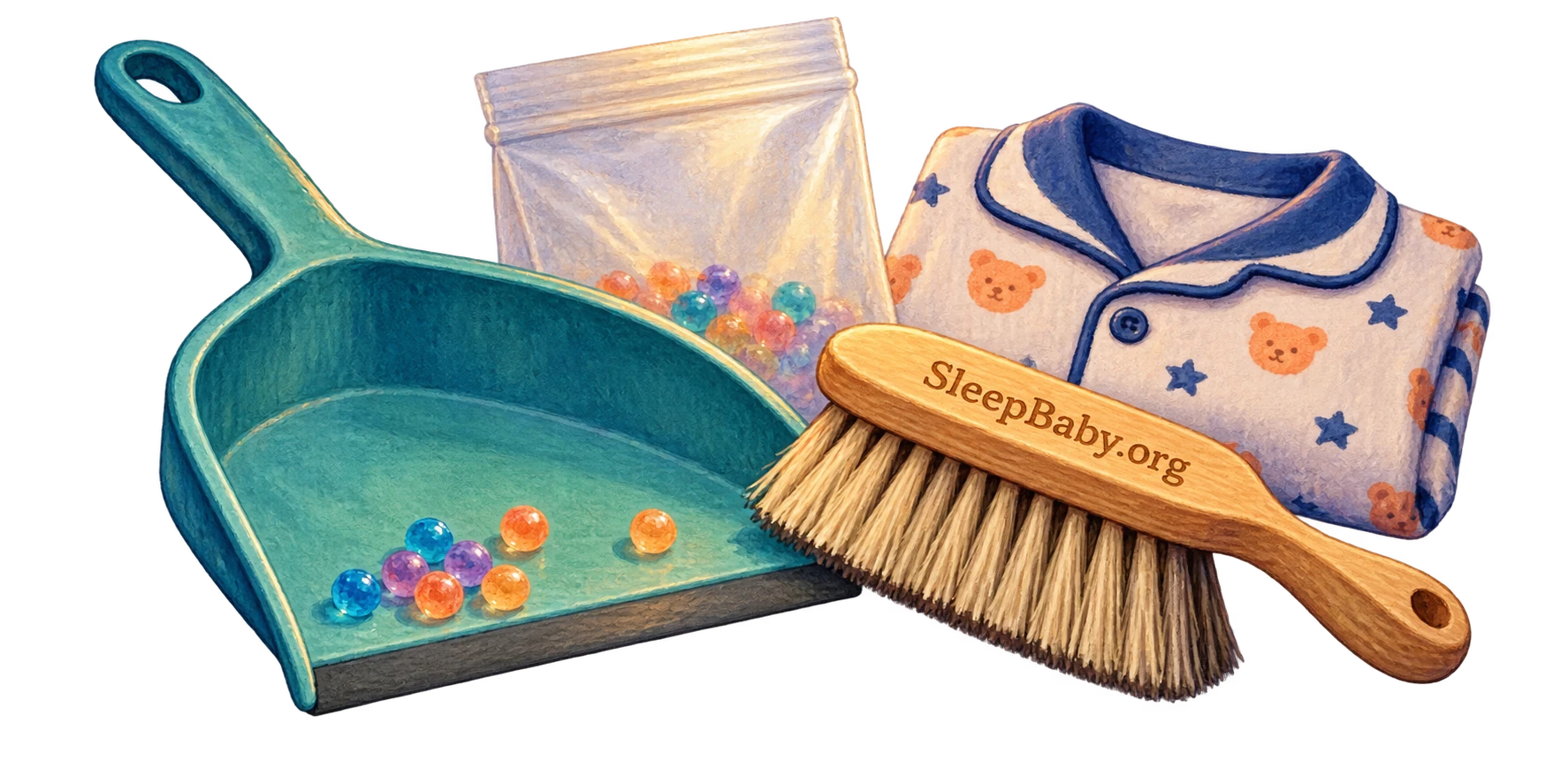
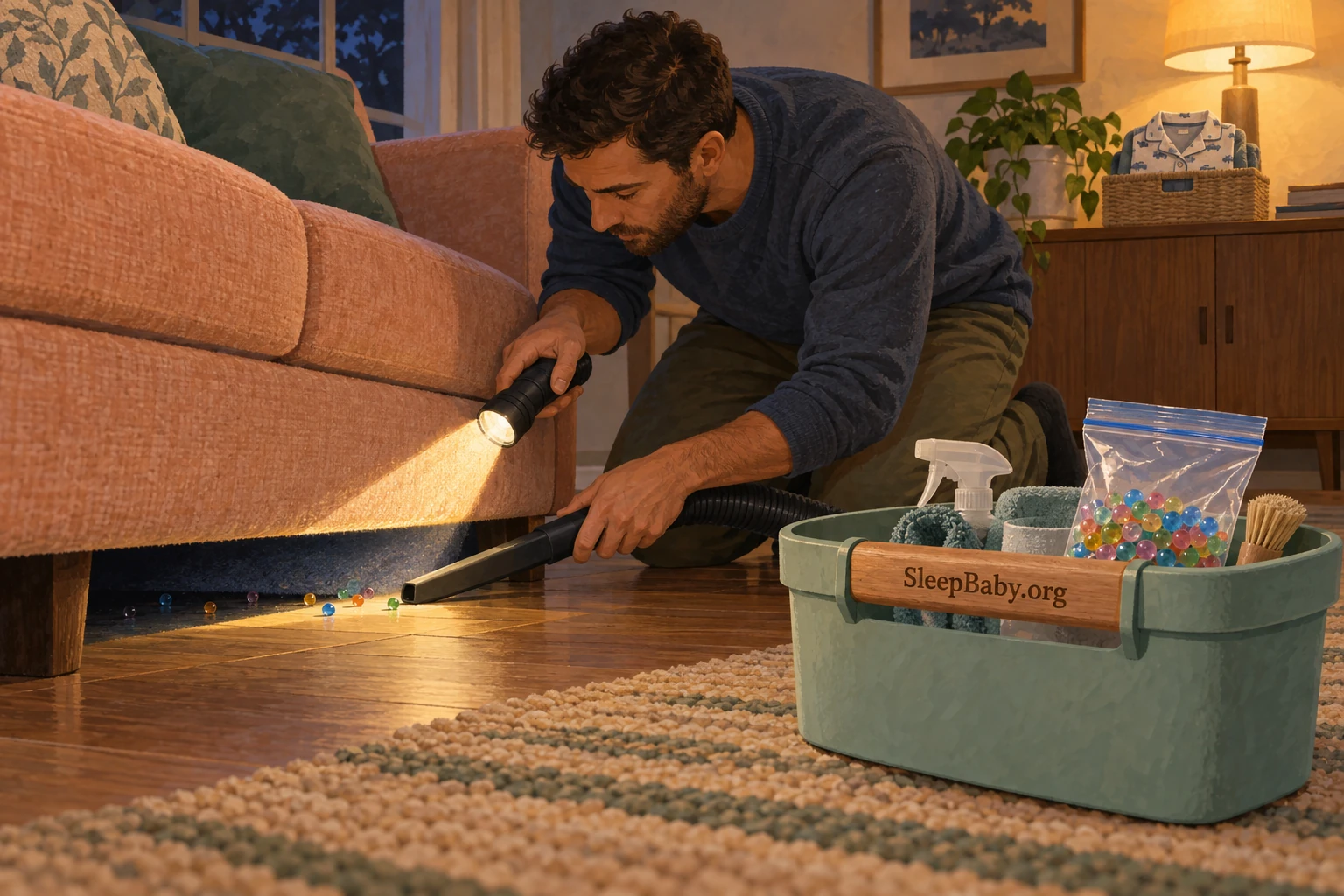
I would split the job into two parts: keep children out of the affected space, then remove the source and search the places a spill could have reached. Start where the beads were used, and work outward. Check beneath the table, furniture edges, rug edges, the storage container, and anything used to carry the activity. These are practical places to look, not a guarantee that a quick sweep finds every bead.
Arrange another adult’s supervision if available so you aren’t dividing attention between a floor search and a toddler. Contain the material securely as you collect it and follow any product recall disposal instructions. Don’t leave a dustpan, open rubbish bag, or vacuum contents where children can reach them.
Look beyond the sensory bin. Ask about craft supplies, plant or vase fillers, gel-blaster ammunition, and damaged bead-filled toys. Different packaging can hide the same practical problem: a small piece that escapes into a shared room. If you aren’t sure what a product contains, keep it away from children while you check its identity.
An older sibling’s age recommendation doesn’t protect a younger child who finds one dropped bead. Nationwide Children’s researchers recommend keeping water beads out of homes that children under six or children with developmental delays live in or visit. They also encourage conversations with childcare staff, preschool teachers, and therapists who may use them. Nationwide Children’s prevention advice [7]
For a childcare conversation, be specific: ask whether water beads are used anywhere in the building, how shared rooms and materials are handled, and what information would reach you after a possible exposure. You can share the CPSC guidance without asking staff to rely on a social-media story. If an incident occurred, request the product name and a factual account promptly so they can be passed to your child’s care team.
Did the new water-bead rules make them safe to swallow?
No. The CPSC’s new U.S. standard took effect in March 2026 and applies to water beads manufactured after March 12, 2026. It adds expansion, chemical, testing, and warning-label requirements. It does not turn water beads into food, establish what your child swallowed, or certify the old package in your cupboard. CPSC’s March 2026 announcement [12]
I would keep the regulatory question separate from the immediate care question. A new label isn’t a reason to cancel the call, and a recalled product is information to give the specialist, not something you need to research exhaustively before dialing. Check the CPSC water-bead information page for current warnings and recalls when the urgent concern is already being handled.
A REGULATOR’S EXPLANATION
What the 2026 water-bead standard changes
The U.S. Consumer Product Safety Commission explains its new expansion limits, chemical restrictions, and warnings in this short official video. It provides product-safety context after the immediate care questions have been handled.
The practical takeaway: a manufacturing rule is not an all-clear for a possible ingestion. Keep following the professional advice for your child.
Watch the CPSC video on YouTube · Published March 11, 2026
Choose a different kind of play when your child is ready
After the care team says your child can return to normal activities, you don’t need to recreate the exact water-bead experience. A suitable large nesting toy, a sturdy picture book, or a simple game with you can be enough. I’d start with something already in the house, rather than feeling you have to buy a replacement activity immediately.
Choose age-appropriate objects without small removable parts, and check them for damage. Adult supervision still matters. Avoid replacing one tiny loose material with another simply because a recipe calls it “taste-safe.” The AAP’s toy-selection advice [13] is a better starting point than an appealing sensory-bin photograph.
For a baby, you can offer a few moments of shared attention without a bin at all. Notice a look, answer a sound, or turn a page together. If you need ordinary play ideas later, our guide to a baby who seems bored helps you choose a small invitation instead of more and more equipment.
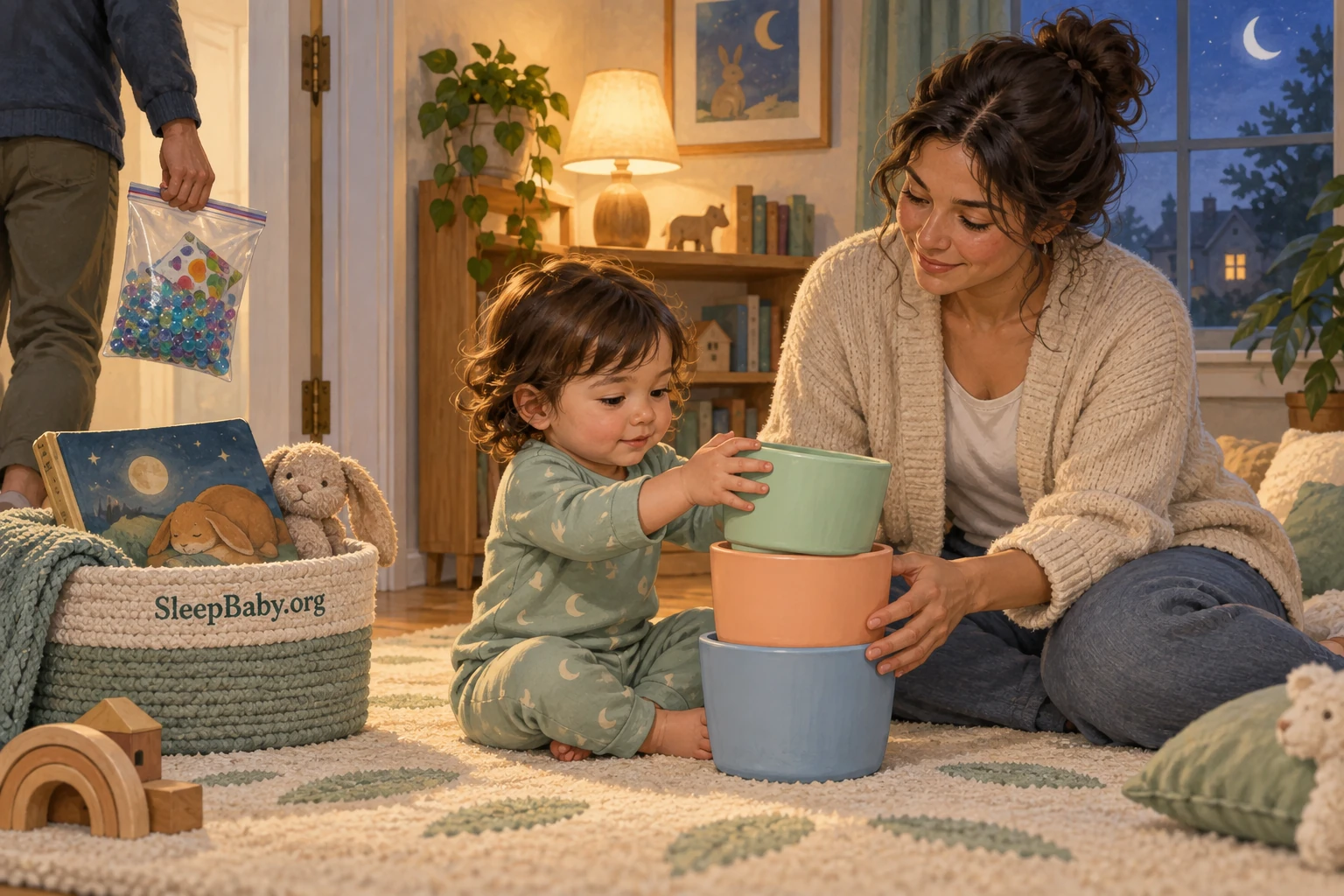
If an infant dozes during ordinary play after their medical concern has been addressed, move them to a firm, flat, approved sleep surface, on their back, with only a fitted sheet. Keep play objects out of the sleep space. NICHD safe-sleep guidance [14] Our page about falling asleep during tummy time explains that everyday transition; it cannot determine whether sleep is appropriate after an ingestion.
FOR ORDINARY PLAY AFTER CARE
An Amazon option for bead-free stacking
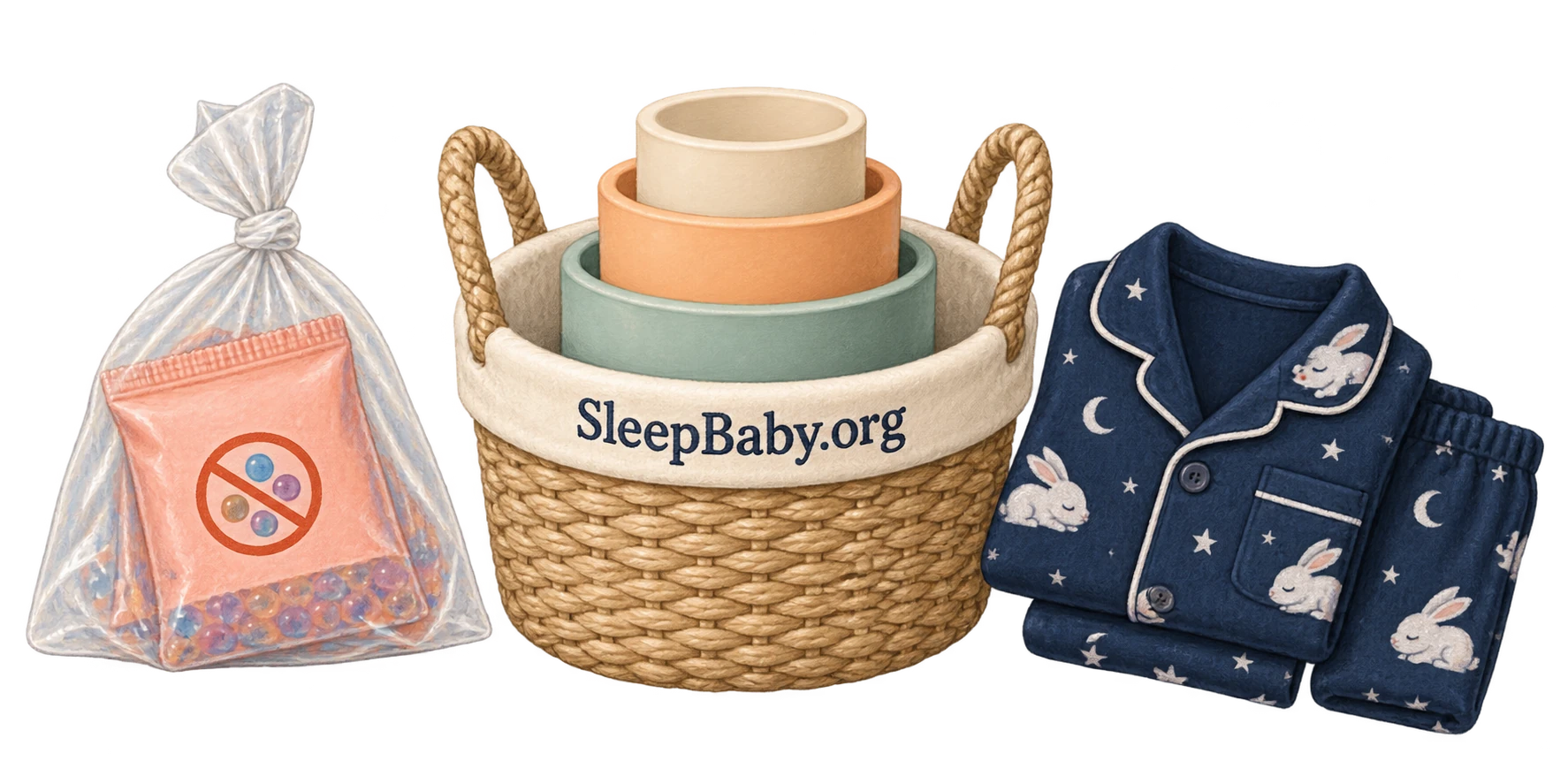
Lamaze Pile & Play Cups, eight-cup set offers a different activity: nesting and stacking large toy cups instead of handling loose water beads. TOMY lists this set for ages six months and up. I would consider it only if you need an age-appropriate replacement play object.
Why it fits: it moves the activity away from bead-filled sensory bins. It is a play choice, not a treatment or a way to prevent every choking hazard.
Check: the Lamaze eight-cup model, the current age guidance, condition, seller, and price. Inspect for damage and supervise play; keep every toy out of an infant sleep space.
Skip buying if: you already have suitable nesting cups, a sturdy book, or another safe activity your child enjoys. A new purchase is not part of managing this exposure.
The illustrations show imagined objects, not this product. TOMY’s product details.
As an Amazon Associate, SleepBaby may earn from qualifying purchases.
Leave the next caregiver a clear plan
The hardest detail to hand over may be the uncertainty: nobody knows exactly how many beads were there, the package was thrown away, or the first person who saw the spill has gone home. Write those gaps down alongside what is known. A tidy account that quietly fills in missing details is less useful than an honest one.
Save the medical instructions where both caregivers can find them. Agree who is responsible for any scheduled call or follow-up. If a new symptom appears, pass along the original exposure history as well as the new observation. You shouldn’t have to reconstruct the whole evening from memory while asking for help again.
Once the medical issue is resolved and your child’s clinician has no special instructions, you can return to ordinary feeding, comfort, and bedtime decisions. If an unusually late evening leaves you wondering about tomorrow’s routine, our guide to whether an earlier bedtime helps is a separate sleep discussion. It doesn’t replace the plan you were given tonight.
For now, you don’t need to decide whether you were sufficiently worried. You need someone qualified to assess this exposure and tell you what happens next. Make the call, describe what you actually know, and keep the instructions close enough that the next adult can follow them too.
Sources and references
Water-bead safety, poisoning guidance, safe sleep, and product facts checked September 20, 2026. Ask your child’s clinician about a specific concern.
- Poison Control: First aid for poisonings
- Washington Poison Center: Water beads
- National Capital Poison Center: Are water beads toxic?
- American Red Cross: Infant choking first aid
- American Academy of Pediatrics: Swallowed foreign object
- Poison Control: How to get help
- Nationwide Children's Hospital: April 2026 water-bead study
- CPSC: Water Beads Information Center
- Maryland Poison Center: Water beads clinical review (PDF)
- American Academy of Pediatrics: Water beads can be harmful
- Poison Control: Stress balls and foreign-body ingestion
- CPSC: New federal water-bead standard, March 2026
- American Academy of Pediatrics: Choosing toys for babies
- NICHD: A safe sleep environment
- TOMY: Lamaze Pile & Play Cups product details
WHEN CARE IS SETTLED AND ROUTINE CAN RETURN
Give the everyday sleep question its own space
An ingestion needs a medical plan. Later, when you are ready to think about ordinary nights again, the free Baby Sleep Miracle presentation introduces the SleepBaby approach. You can explore it without treating tonight’s uncertainty as a reason to buy.






What viewers said10 comments · 4 replies+
Archived comments from the original Baby Sleep Miracle presentation. Not independently verified by SleepBaby.org; individual experiences vary.
Thank you so much for this video! I had no idea about the dangers of baby swings :O
Hi Mary-Ann. I have a question: Is method in any way similar to the ones recommended by Dr Bucknam, Dr. Weissbluth or Dr. Karp? We tried those but none of them help.
Hi Regina, thank you for your question. The short answer is no. The techniques I share in my guide are based on newest scientific research and this is why I have never seen any approach similar to the one I recommend.
This method really works! I tried it on my son Jesus and after just one week he went from waking up more than 5 times a night to waking up just once or twice. You are a lifesaver, Mary-Ann!
I'm truly impressed with how much information you share in your video. And all for free! I can feel that you truly care about mothers like myself, and that's hard to find these days. I have recommended your site to several of my friends already.
Mary-Ann, our child suffers from autism. Is your approach still suited?
Chloe, I made sure my method can be used with any child, even babies who are special like yours. Please note that I'm not a doctor and that I always advice to consult with your physician because nothing is more important than the safety and well-being of your love.
Hallo Mary-Ann, I'm from Germany. Do you have your guide in German?
Hello Heide, we do! Normally you should already see our video in German. If not, please contact our support so they can guide you
Thenk you for your answer, Mary-Ann!
I just completed your approach and I have to say, it worked almost too well. Yes, it took a bit of getting used to with your bedtime routine but the difference is huge. My son George used to take 1 hours to go down and now he's firmly asleep in no more than 10 minutes! You're the best!
It seems I'm the only man watching this video, lol! What you shared about the 'emotional backpack' made immediate sense to me and I can't wait to help my little girl Mila to unpack it!
Hey there, just discovered your site and this really sounds different. Just wanted to say thanks for sharing :)
For everyone who's still thinking about getting Mary-Ann's guide I want to advise you to go ahead. I wasn't sure myself but now I'm so thankful I invested in this program. It made a huge difference in our life as a family and yes, my baby girl does sleep through the night now.