
The answer I want you to have before your eyes get any heavier
Your chest can be a lovely place to cuddle. It is not a safe place for you and your baby to sleep together.
A baby may doze against an awake, actively attentive caregiver whose arms support them and whose face and airway stay fully visible. But if you might drift off—even for a minute—move your baby to a separate crib, bassinet, portable crib, or play yard that is firm, flat, level, and empty except for its fitted sheet. Place your baby on their back. Never plan a chest nap on a sofa, recliner, or armchair; those are especially dangerous places for an adult to fall asleep while holding a baby.12
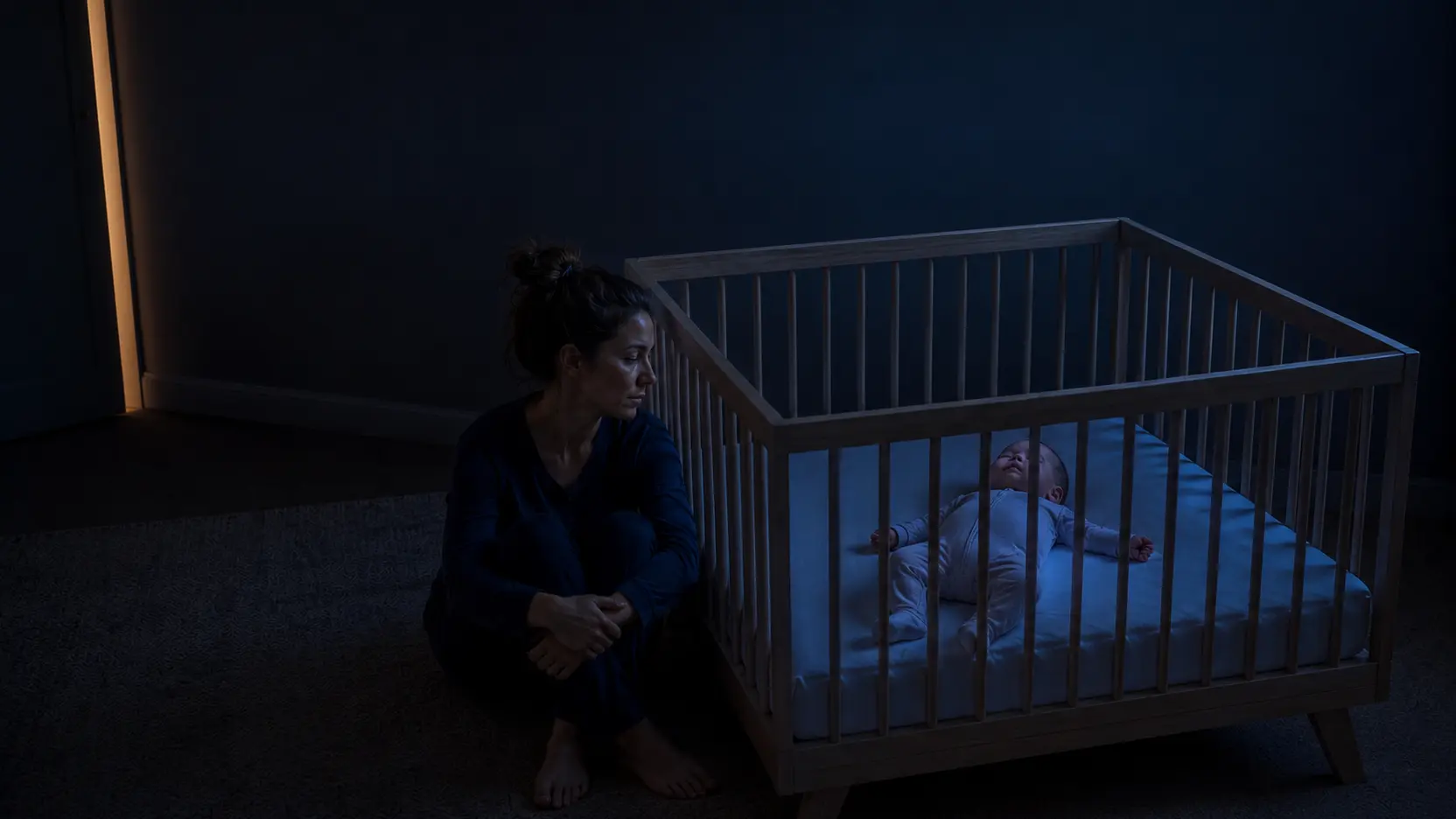
There is a particular moment that makes parents search my baby only sleeps on my chest: the baby’s cheek is warm against your shirt, one small hand has gone completely loose, and you realize your own blinking has become suspiciously slow. You are not asking whether cuddling is good. You are asking how to keep this closeness without accidentally crossing from an awake contact nap into shared sleep.
I would separate those two things immediately. Contact is not the problem. Adult sleep is the boundary. You have not spoiled your baby by being the place where their body settles fastest. You also do not need to prove anything by holding on until your own nervous system shuts the lights off. The useful question is not, “How do I make my baby stop needing me?” It is, “What is my plan for the minute I stop being reliably awake?”

Use your eyelids as the decision point, not the clock
You are fully awake
You are sitting securely, watching your baby’s face and breathing, supporting their body, and able to respond without fighting sleep. Enjoy the cuddle. Keep checking your own alertness.
You are becoming drowsy
Your head dips, your thoughts skip, your phone slides, or you keep “coming back” to the room. Transfer the baby now. Do not wait for a cleaner ending to the nap.
You are already nodding off
Wake another alert adult if one is available and move the baby to their own safe surface. If you are on a sofa, recliner, or armchair, the move is urgent—not something to attempt after “one more minute.”
Why does my baby sleep on my chest but wake in the bassinet?
Your chest offers a bundle of sensations that a bassinet intentionally does not: warmth, movement, your breathing, your smell, pressure across the baby’s body, and immediate help when they stir. Then the transfer changes several of those sensations at once. The baby’s position shifts. The temperature changes. The support under their body becomes still. Their startle response may join the meeting without being invited.
That contrast explains a lot without diagnosing anything. A baby who settles on you is not necessarily proving that they have reflux, pain, an allergy, or a “bad habit.” Age, feeding, wakefulness, startle responses, ordinary preference for contact, and the timing of the transfer can all shape what happens. I would watch the whole picture: how your baby feeds, breathes, gains weight, behaves while awake, and sleeps on an approved surface—not just the fact that your chest wins the first round.
The bassinet is also doing exactly what a safe sleep surface is designed to do: staying firm, flat, level, and free of the soft contours that make an adult body feel so comfortable. Safe can feel less immediately cozy. That is frustrating, but it is not a design flaw to fix with pillows, nests, wedges, rolled blankets, positioners, or an inclined surface. Those additions change the safety of the space rather than teaching the baby to accept it.34

A clearly labeled hypothetical Kacey-and-Benjamin scene
The moment I would stop negotiating with myself
Imagine Benjamin asleep on my chest at 1:38 a.m., his ear over my heartbeat, while I sit beside the bassinet and tell myself I am still perfectly awake. Then the hand holding my phone drops half an inch. I read the same sentence twice. The lamp seems to blink, although the lamp has done nothing wrong.
That is the moment I would move him—not because the cuddle became bad, and not because I had failed to transfer him earlier. I would move him because my body had just supplied better information than my optimism. The safe decision arrives before the dramatic head-bob. It arrives when staying awake starts to require effort.
This hypothetical scene is not medical evidence or a claim about a real event in Kacey or Benjamin’s life. It is a practical way to recognize the drowsiness boundary before an exhausted parent accidentally falls asleep.

Make the safe option easier before the contact nap begins
Safety plans work better when they do not depend on an exhausted person making six excellent decisions in a row. Before you settle with your baby, put the approved sleep space within practical reach. Clear the path. Turn on whatever dim light lets you see where your hands and the baby’s face are. Set your water nearby. If another adult is taking the next shift, agree on the handoff before both of you are too tired to form complete nouns.
If you are feeding or comforting in bed and there is any possibility you may fall asleep, NIH guidance advises clearing pillows, sheets, blankets, and other soft items away from the baby, then returning the baby to a separate sleep area as soon as you wake.1 That is harm-reduction guidance for an unplanned event, not an endorsement of bed sharing. A couch or armchair is not the backup plan. Those surfaces are particularly dangerous when an adult falls asleep with a baby.
Try one calm transfer, not a midnight laboratory
I would make the transfer small enough to repeat. You are not trying to produce a flawless independent nap on command. You are trying to give the baby one safe landing while preserving your ability to function.
- Prepare the destination first. Use the baby’s own approved crib, bassinet, portable crib, or play yard. Confirm it is empty except for the fitted sheet.
- Check the basics. Consider whether a feed is incomplete, a diaper needs changing, the baby is uncomfortably hot or cold, or something about their behavior feels newly different.
- Support the whole body. Keep one hand supporting the head and shoulders and the other supporting the hips and trunk. Keep the baby’s face visible.
- Lower slowly and place on the back. Bring your body close to the mattress so the baby does not experience a long drop through cool air.
- Pause with your hands present. Let the surface take the baby’s weight before gradually reducing your touch. Do not hold the baby in a side or stomach position to make the transfer “stick.”
- If it fails, reset safely. Soothe while awake, ask another alert adult to take over if available, or try again later. Do not escalate into unsafe bedding or a sofa nap.
If the transfer itself is the recurring problem, my next stop would be SleepBaby’s guide to a calm bassinet transfer when your newborn wakes on landing. It walks through Feed, Feel, Fit, then Land without pretending that “just put the baby down” is a complete set of instructions.


What if every transfer fails?
A failed transfer is information, but it is not an instruction to remain awake indefinitely. If another alert adult is available, trade shifts. One person can hold and soothe while fully awake; the other can get a protected block of sleep. Decide when the handoff happens before the awake adult reaches the edge. “Wake me if you need me” is less useful than “I take over at 2:00, even if the baby is asleep.”
If you are alone, simplify the night. Keep the safe sleep space close. Reduce optional tasks. Put the baby down safely when your body needs sleep, even if they protest. A crying baby on their back in an empty approved sleep space while you regroup is safer than a quiet baby on the chest of an adult who has fallen asleep on a sofa or chair. If the crying is intense or unusual, check feeding, temperature, diaper, illness signs, and anything that has changed, then contact your pediatric clinician when the pattern or your concern warrants it.
You may also need support for your fatigue. Tell a partner, relative, friend, postpartum clinician, pediatric office, or another trusted person plainly: “I am falling asleep while holding the baby and need a safer overnight plan.” That sentence is not an admission of bad parenting. It is useful safety information.
Look for the pattern that changes the next step
- Baby settles on you and is otherwise feeding, breathing, waking, and behaving as usual
- Focus on the awake-contact boundary, a nearby safe surface, a repeatable transfer, and caregiver shifts.
- Baby wakes flat after feeds with frequent discomfort, coughing, choking, poor intake, or poor growth
- Do not diagnose reflux from sleep position alone. Write down what happens and discuss the complete pattern with the pediatric clinician.
- Baby seems unusually sleepy, difficult to wake, limp, blue or gray, struggles to breathe, feeds poorly, has repeated forceful vomiting, or has a fever that concerns you
- Stop troubleshooting sleep and seek prompt medical guidance. Call emergency services for severe breathing trouble, unresponsiveness, or abnormal color.
Could reflux be why my baby sleeps only upright on my chest?
Possibly—but the sleep preference alone cannot tell you that. Many babies relax upright against a caregiver because the contact is warm, contained, moving, and familiar. Reflux, feeding difficulty, respiratory symptoms, or pain require a broader history. I would notice whether discomfort clusters around feeds, whether the baby arches or coughs, how much and how forcefully they spit up, whether feeding is comfortable, and whether growth and wet diapers are on track. Then I would take those observations to the clinician rather than using an unsafe sleep position as a treatment.
Even when a baby has reflux, safe-sleep guidance still calls for back sleep on a firm, flat surface unless the baby’s own clinician gives a specific medically supervised plan. Do not incline the mattress or use a positioner. Upright awake holding after a feed and safe flat sleep are two different parts of care.
Can my baby nap in a carrier on my chest?
A carrier can be useful for awake caregiving, but it does not become an approved routine sleep surface because the adult is moving around. If your baby dozes in a carrier, keep their face visible, keep their chin away from their chest, follow the carrier’s age, weight, fit, and positioning instructions, and remain actively attentive. Move the baby to a firm, flat, separate sleep surface as soon as practical. Never loosen the carrier and lie down, recline, or sleep with the baby attached to you.
I would be especially conservative with premature babies, low-birth-weight babies, very young newborns, or any baby with breathing, tone, feeding, or airway concerns. Ask the baby’s clinician for individualized positioning guidance rather than relying on social-media demonstrations.
Watch the safe-surface rule in one clear pass
Safe Sleep for Your Baby: Every Nap & Every Night
The American Academy of Pediatrics reinforces the same boundary this article uses: back placement and a separate safe surface apply to naps as well as nighttime sleep.
Takeaway: A contact cuddle can be part of the soothing. The baby’s actual sleep destination remains a separate, firm, flat, level space.
A product that solves the distance problem—not the baby’s feelings
My practical pick: Newton Baby Bassinet & Bedside Sleeper
The useful purchase for this exact problem is not a lounger that imitates your chest. It is a legitimate separate sleep surface that can sit close enough to use before your eyelids become the emergency. The Newton Baby Bassinet & Bedside Sleeper on Amazon gives a parent a nearby landing place, which addresses the physical friction of a chest-to-bassinet transfer better than another soothing gadget or a monitor.
I am recommending it as a bedside bassinet used within the manufacturer’s current limits—not because “breathable” wording prevents SIDS, not because it guarantees your baby will accept the transfer, and not because any product replaces back sleep on a firm, flat, level, empty surface. Compare its dimensions and limits with your room and your baby’s stage before buying.
Disclosure: As an Amazon Associate, SleepBaby may earn from qualifying purchases.

Your plan for tonight can fit on one hand
- Choose the separate surface. Set up the crib, bassinet, portable crib, or play yard before holding begins.
- Name the drowsiness cue. Decide what means “transfer now”: rereading, head dipping, dropping the phone, or fighting to keep your eyes open.
- Choose the handoff. If another alert adult is available, set an actual time rather than waiting for a crisis.
- Try one supported transfer. Place baby on their back and keep the space empty.
- Escalate the right problem. Call for help with overwhelming fatigue; call the clinician for concerning feeding, breathing, fever, pain, color, or alertness changes.
This plan does not require your baby to enjoy the bassinet immediately. It requires the adults to know what happens next. That is a meaningful difference on a night when comfort and safety seem to be pulling in opposite directions.
Practice the change when the household has more capacity
The middle of the hardest night is rarely the best time to redesign every sleep association. If your baby reliably accepts contact and rejects the bassinet, choose one daytime attempt when an adult is genuinely awake and there is enough margin for the landing to fail. Keep the setup the same for several attempts: the same approved surface, the same basic settling sequence, and the same safe back placement. Changing the room, swaddle status, sound, feeding timing, transfer technique, and caregiver all at once may produce a different nap, but it will not tell you which difference mattered.
I would keep the experiment modest. One bassinet attempt can be practice. The rest of the day can still contain awake contact naps when the caregiver can stay attentive. If the transfer fails and you are alert, soothe again. If the transfer fails and you are depleted, the safety plan outranks the training plan. Put the baby safely down, trade with another adult, or pause the experiment. A parent who is dangerously tired does not need a more ambitious method; they need fewer steps between the baby and a safe surface.
Notice what happens immediately before the wake-up. Does the baby startle as their shoulders touch? Do they wake after a temperature change? Are they already stirring before you move? Does the first stretch of the night go differently from the fifth nap of the day? These observations can guide small adjustments without turning your baby into a research project. They can also help a clinician understand the pattern when feeding, breathing, pain, or growth concerns are part of the picture.
Contact sleep can change without becoming a battle
Some babies accept the separate surface gradually. A transfer lasts eight minutes, then twenty. Another works only for the first stretch of night. Progress may look less like a dramatic breakthrough and more like the bassinet becoming one place the baby sometimes sleeps. I would count that honestly. The point is not to pretend every short stretch is a triumph; it is to recognize that repeated safe landings can build familiarity without asking an exhausted caregiver to force a long separation.
As babies grow, their sleep patterns, startle responses, feeding needs, and tolerance for separation change. Follow the current limits of the bassinet or crib and stop using a product when the manufacturer says your baby’s size or developmental stage has reached its limit. Do not respond to rolling, pulling up, or increased movement by adding restraints or positioners. Move to the next appropriate safe sleep space instead.
The emotional part can change too. A parent may love the weight of a sleeping baby and still want their arms back. Those statements can coexist. You do not have to turn every contact nap into a lesson, and you do not have to preserve every contact nap to prove you value closeness. The clean boundary remains useful: hold while awake, transfer before sleep takes you, and let the baby’s separate surface carry the part of the night your body cannot safely carry.
Questions parents ask after the third failed landing
Am I creating a bad habit by letting my baby sleep on my chest while I am awake?
Responsive awake holding is not a moral failure or proof that you have ruined sleep. The immediate safety issue is whether the adult remains fully awake and whether the baby’s face and airway stay clear. You can enjoy contact and still practice one safe-surface transfer when it is realistic.
Should I wait until my baby is deeply asleep before transferring?
There is no magic minute that makes every transfer work, and waiting longer becomes the wrong bargain if you are getting drowsy. Use your alertness as the upper limit. A safe transfer attempted earlier is better than a theoretically perfect transfer that begins after you have started nodding off.
What if my baby cries every time I put them down?
Check feeding, diaper, temperature, illness signs, and whether the timing makes sense. Soothe while awake and try again if you can do so safely. If you need a minute, place the baby on their back in the empty safe space while you breathe, drink water, or call another adult. Persistent or unusual crying with feeding trouble, fever, vomiting, breathing changes, or a marked behavior change deserves clinical guidance.
Is supervised chest sleeping safe if I set an alarm?
An alarm does not keep you awake during the minutes before it rings. If you need an alarm to stop yourself sleeping, your body has already answered the question: move the baby to their own safe surface or hand them to another alert adult.
Will a smart monitor make chest sleep safe?
No monitor changes the underlying surface or prevents an adult from shifting, trapping, or covering a baby. Use monitors only for their intended purpose. Do not treat them as permission to sleep with a baby on your chest, bed, sofa, recliner, or chair.
The memorable boundary is simple: warm, awake contact belongs beside a prepared, separate landing place.
When I would stop troubleshooting sleep
Seek prompt medical advice when the preference for upright contact arrives with poor feeding, fewer wet diapers, repeated forceful vomiting, breathing difficulty, persistent coughing or choking with feeds, fever in a young infant, unusual sleepiness, limpness, a blue or gray color, or difficulty waking. Call emergency services for severe breathing trouble, unresponsiveness, or abnormal color. A story about where a baby sleeps should never bury the detail that changes this into a medical question.
And seek practical help when you are too exhausted to remain awake safely. That may mean waking a partner, calling someone trusted, telling a clinician exactly what is happening, or placing the baby safely in the bassinet while you step away for a few minutes. Exhaustion is not evidence that you love your baby less. It is a condition the nighttime plan must account for.
Sources
The cuddle does not need to disappear
Give the sleepy weight on your chest a safe place to land
That warm cheek from the opening can still belong in your night. The change is that you now know the boundary: enjoy contact while you are truly awake, then move before drowsiness makes the decision for you. SleepBaby.org is built for these exact in-between moments—the ones where love is obvious and the next practical step is not.