When sleep arrives before you planned for it
My baby fell asleep too early. Should I wake them?
First, make the sleep safe. Then decide whether to wake your baby by checking four things: where they fell asleep, whether they are due to feed, how close this is to their usual bedtime, and what the whole day looked like. A newborn who needs to feed may need waking. A healthy, growing older baby who falls asleep close to bedtime can often simply begin the night early. If sleep starts much earlier after a difficult nap day, you can choose between a short rescue nap and an early bedtime without treating either choice as a permanent schedule decision.
I know the clock can feel alarmingly powerful in this moment. Your baby is finally peaceful, you are standing there with one sock in your hand, and the evening you expected has quietly left the building. Waking them feels unkind. Leaving them asleep feels like signing paperwork for a 3 a.m. family meeting. I would not let that wall clock make the entire decision by itself.
The useful question is not, “What is the universal cutoff?” There is no single cutoff that fits a two-week-old, a six-month-old, and an eleven-month-old. The useful question is, “Which clock matters most tonight?” Once you answer that, the next move gets much smaller.
The four clocks that decide what to do next
- The safe-place clock: Is your baby in a crib, bassinet, portable crib, or play yard that is approved for infant sleep, on a firm flat surface, on their back, with no loose bedding or soft objects?
- The feeding clock: Is this a newborn who is due to eat, a baby following a clinician-directed feeding plan, or a baby whose growth, feeding, hydration, prematurity, or illness changes the usual advice?
- The bedtime-distance clock: Is this twenty or forty minutes before the usual bedtime, or did your baby collapse while the rest of the neighborhood was still collecting mail?
- The whole-day clock: Were naps short, skipped, unusually long, or shifted? Was the morning early? Was there travel, stimulation, discomfort, or illness?
This is a qualitative decision tool, not a diagnostic chart. It is designed to help you identify the next reasonable action without pretending that one evening reveals everything about your baby’s sleep biology.
If your baby fell asleep somewhere else, move them before solving the schedule
If your baby nodded off in a car seat, stroller, swing, carrier, sling, on a couch, or on an adult bed, the immediate job is not to protect the nap. The American Academy of Pediatrics advises moving a sleeping baby from a sitting or carrying device to a firm, flat sleep surface on their back as soon as possible. The CDC likewise recommends back sleeping for every sleep, including naps, on a firm flat surface with soft bedding kept out.
Yes, the transfer may wake them. I understand why that possibility can feel like a tiny personal tragedy after you have spent forty minutes engineering silence. But a preserved nap is never more important than a safe sleep location. Keep the move calm and boring: support your baby, lower them into the approved sleep space, and let the room stay dim. If they wake fully, you can make the schedule decision then. If they resettle, the sleep continues in the right place.
This also applies when “too early” means you accidentally fell asleep while feeding. As soon as you wake, return your baby to their separate safe sleep space. Avoid trying to finish the stretch on a couch or soft chair. The timing question can wait until both of you are safe enough to think clearly.
A safe place for an unplanned sleep
Watch the AAP safe-sleep setup before tonight’s timing experiment
An early nap and an early bedtime use the same safe sleep space. This American Academy of Pediatrics video gives the non-negotiable foundation; the rest of this article helps with the clock decision.
Tonight’s takeaway: Do not keep a baby in a swing, stroller, carrier, or car seat merely to avoid waking them. Transfer first; troubleshoot timing second.
The newborn exception: sometimes you should wake a sleeping baby
“Never wake a sleeping baby” is the kind of sentence that sounds wise until a real newborn arrives. The CDC notes that newborns generally need to eat every two to four hours and that some sleepy newborns may need to be awakened to feed. A baby born early, a baby working on weight gain, or a baby with a feeding plan may have more specific instructions. Those instructions matter more than preserving an evening sleep stretch.
If your baby’s clinician has told you when to wake for feeds, follow that plan. If you are unsure because your baby is very young, unusually sleepy, feeding poorly, producing fewer wet diapers, or not gaining as expected, contact the baby’s doctor or nurse. The question has moved out of schedule territory and into feeding adequacy.
For a healthy, steadily growing older baby who feeds well and has normal output, the AAP notes that waking solely to offer a breast or bottle is often unnecessary. That is not a license to ignore hunger cues or a dramatic change in behavior. It is a reminder that age, growth, and the individual feeding plan change the answer.
I would keep this boundary almost annoyingly clear: a nap experiment can be flexible; a necessary feed is not an experiment. Do not use an online bedtime rule to overrule the person caring for your baby’s growth.
Clearly labeled composite Kacey-and-Benjamin scene
The evening I imagine whenever a parent asks this question
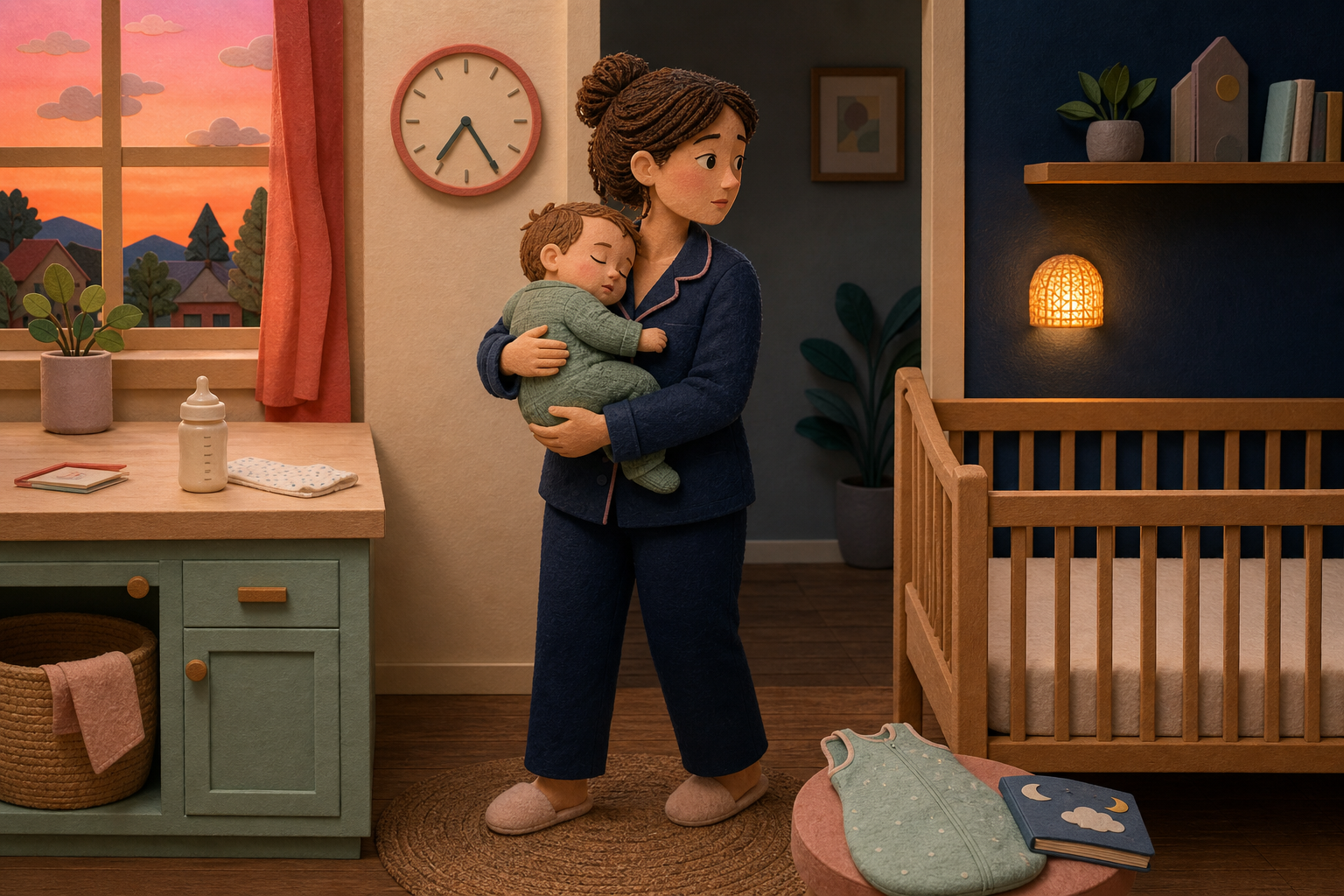
This is a composite scene, not a claim about a documented event in my family. In it, I am Kacey, standing over Benjamin after he has fallen asleep in his daytime clothes before the bedtime routine has even started. One small hand is still holding the corner of a burp cloth. The kitchen light is on. Dinner is only half assembled. He looks so completely committed to sleep that waking him feels like interrupting a treaty negotiation.
My first thought is not especially scientific: Please do not make me regret this at two in the morning. My second thought is that Benjamin’s peaceful face cannot tell me which problem I am solving. Is he due to eat? Is he safely placed? Is this thirty minutes before bedtime or two hours? Did he take two solid naps, or has he been running on twelve-minute samples all day?
That is why I use the four clocks. The scene helps me name the fear, but it does not count as evidence. The evidence comes from safe-sleep guidance, feeding guidance, age-appropriate sleep ranges, and the pattern I can observe. The composite Kacey gets to feel tender and indecisive. The parent reading gets a decision they can actually use.
Choose one of three paths for tonight
Path 1: Treat it as bedtime
This is often the least disruptive choice when your baby falls asleep close to the usual bedtime, is safely placed, is not due for a necessary feed, and had a day that plausibly created extra sleep pressure. Complete only the parts of the routine that still matter—perhaps a diaper check, sleep clothing, feeding if appropriate, and the familiar phrase—and let the night begin.
An early bedtime does not guarantee an early morning. Nor does it guarantee a normal morning. One night cannot offer that contract. What it can do is give an overtired baby the sleep they are already asking for without turning the evening into a campaign to keep their eyes open.
Path 2: Use a bounded rescue nap
This path may fit when sleep begins substantially earlier than bedtime, the baby is old enough that feeding is not the immediate issue, and a full early bedtime would make the family’s night impractical. Let the baby sleep briefly, then wake gently and keep the next wake period quiet. The purpose is to take the sharp edge off overtiredness, not to restart the entire day under stadium lighting.
I would choose the nap length from your baby’s recent pattern rather than borrowing a stranger’s exact number. Some babies wake cheerful after a short doze; others treat a short nap as an insult delivered by management. Start conservatively, notice what happens, and avoid claiming that a particular minute is biologically correct for every age.
Path 3: Wake for feeding or concern
Wake when a feeding plan says to wake, when a newborn is due to eat, or when the sleepiness itself is unusual or concerning. Difficulty waking, poor feeding, fewer wet diapers, breathing changes, fever in a young infant, or behavior that feels distinctly unlike your baby’s normal sleepiness deserves clinical guidance rather than schedule troubleshooting.
This path is not about preventing an inconvenient wake-up. It is about meeting a need that outranks the bedtime plan.
Will an early bedtime make my baby wake earlier?
It might, but it might not—and anyone who promises certainty has not met enough babies. Morning wake time is influenced by circadian timing, light, sleep pressure, feeding, environment, development, and individual variation. An early bedtime after a short-nap day can sometimes help a baby recover. On another night, the same baby may complete a shorter night and wake ready to discuss sunrise.
The American Academy of Sleep Medicine recommends that infants four to twelve months receive twelve to sixteen hours of sleep per twenty-four hours, including naps. The recommendation is a broad daily range, not a prescribed bedtime. It also recognizes individual variation. This is why I would rather count the whole day than panic over one clock time.
If your baby goes down early and wakes early once, resist changing every nap, wake window, light cue, and bedtime the following day. Keep the morning reasonably recognizable. Get normal daytime light and activity. Offer naps according to the cues and pattern you usually trust. Then see whether the next evening drifts back toward normal.
One early night is information. Three or four repeated early collapses are a pattern worth investigating. The distinction matters because exhausted parents are especially vulnerable to making seven changes after one weird Tuesday.
Read the whole day before blaming bedtime
- Did the day begin unusually early?
- An early morning can pull naps and bedtime forward. Decide whether you are seeing one shifted day or a repeated rhythm.
- Were naps shorter or fewer than usual?
- An early collapse may be accumulated sleep pressure, not a new bedtime preference.
- Was the last nap late or unexpectedly long?
- What looks like “bedtime sleep” may be a delayed nap. A gentle wake and quiet bridge to bedtime may fit better.
- Was there travel, extra stimulation, or a developmental day?
- Busy days can change sleep pressure. Treat the observation as context, not a diagnosis.
- Does your baby seem uncomfortable or unwell?
- Feeding trouble, breathing changes, pain, fever, dehydration, or unusual difficulty waking change the question. Seek appropriate medical guidance.
Use this as a pattern decoder, not a scorecard. You are looking for the most plausible explanation that supports one small next step.

The same early sleep means something different at different ages
A parent asking this question at three weeks is not solving the same problem as a parent asking it at nine months. The clock time may look identical, but the obligations around that sleep are different. I start with age, growth, feeding guidance, and the place where sleep happened; only then do I think about preserving tomorrow’s schedule.
In the newborn weeks
Feeding guidance has priority. A newborn may need to be woken because the clinician has set a maximum interval between feeds, because weight gain is still being established, or because the baby is not yet reliably showing hunger cues. If your baby was born early, has jaundice, has had feeding difficulty, or has a specific medical plan, use that plan rather than a generic bedtime rule. An unusually sleepy newborn who is hard to wake or cannot feed effectively needs medical attention, not a schedule adjustment.
When feeding and growth are established
For a healthy baby who is growing well and no longer has instructions to be woken for feeds, the decision can lean more heavily on bedtime distance and the whole day. Sleep beginning twenty minutes before the usual bedtime is often easiest to accept as bedtime. Sleep beginning two hours early after an accidental car nap may be more useful as a short rescue nap, provided the baby can be moved safely and wakes normally.
For an older baby with a recognizable rhythm
The pattern around the sleep becomes more informative. Was the final nap skipped? Did daycare naps run short? Did the morning start before dawn? Is your baby learning a new motor skill and arriving at evening worn out? Those clues do not create an exact formula, but they can explain why sleep pressure arrived early. If the same shift repeats for several days and mornings remain workable, you may be watching the schedule change rather than watching it fail.
I would not force an exhausted baby awake merely to defend a preferred number on the clock. I would also not assume every doze is the new bedtime. The useful middle ground is a bounded choice: decide whether this is bedtime or a short nap, set one clear endpoint, keep any awake bridge calm, and reassess in the morning. That protects the baby from an improvised late-night reset and protects you from changing five variables at once.
If two caregivers are making the decision together, say the plan out loud: “We are treating this as bedtime,” or, “We are waking after twenty minutes for a quiet feed and routine.” A named plan is easier to carry out consistently than a tense series of five-minute extensions. It also gives you a clean observation tomorrow: what you chose, how the night unfolded, and whether the same situation deserves the same response next time.
How to wake a baby gently after a rescue nap
If you decide to wake, change the environment gradually. Open the curtain a little rather than flooding the room with light. Speak softly. Pick your baby up, change the diaper if needed, and offer a feed based on the normal plan. Give them a minute to become a person again before expecting cheerful floor play.
Then keep the bridge to bedtime modest. You do not need a full afternoon of stimulation compressed into ninety minutes. A quiet feed, a little movement, a book, and the familiar bedtime ending may be enough. Watch your baby rather than the entertainment schedule. If they are clearly falling apart, the experiment has answered you: bedtime needs to come sooner tonight.
I would also protect myself from the “we already ruined it” spiral. Waking a baby from one rescue nap does not create a permanent habit. Letting one early sleep become bedtime does not create a permanent habit either. Repetition shapes patterns; one thoughtful exception is simply caregiving.
A useful tool for an unexpectedly early night
A repeatable light-and-sound cue when bedtime shifts
The Hatch Rest can help a caregiver repeat the same dim-light and sound sequence when an early sleep becomes bedtime, then use a separate caregiver-controlled morning cue after a disrupted night. I prefer this fit to a passive white-noise-only machine for this particular problem because one device can hold the whole cue sequence; it does not require you to rebuild the room mood manually while deciding whether tonight began early.
This is not a treatment, a sleep guarantee, or a claim that a baby understands a color clock. The useful reason to buy it is practical consistency for the adult: fewer switches, lamps, and separate sound controls when the schedule moves unexpectedly.
As an Amazon Associate, SleepBaby may earn from qualifying purchases.
What tomorrow morning can tell you
- If your baby wakes near the usual time and seems rested: the early bedtime may have met extra sleep pressure. Return to the normal day without trying to “pay back” the schedule.
- If your baby wakes much earlier but content: keep morning cues consistent and look at the total night and nap pattern before moving bedtime.
- If your baby wakes repeatedly or seems uncomfortable: reconsider feeding, illness, teething, environment, and other needs rather than assuming bedtime timing caused every wake.
- If early sleep repeats for several days: examine whether the morning and naps have drifted, whether the final wake period is realistic, or whether your baby is showing a genuine schedule transition.
The morning readback prevents hindsight from becoming blame. You made the best bounded decision with the information available. Now you have one more observation.
When “fell asleep early” is not just a schedule question
Normal tiredness usually fits the day and your baby’s familiar behavior. Concerning sleepiness feels different: your baby may be unusually hard to wake, feed poorly, have fewer wet diapers, breathe differently, seem floppy or weak, have a fever or other illness signs, or simply be acting unlike themselves. Trust the change you can see. Contact your pediatrician or appropriate urgent service based on your baby’s age and symptoms.
For a very young infant, feeding and fever concerns deserve especially prompt guidance. Do not keep a sick or unusually sleepy baby awake just to preserve bedtime, and do not leave them asleep through a required feed because an article promised that early bedtime is harmless. The schedule is the least important clock when health or feeding is in question.
I want this section to feel calm, not frightening. Most early sleeps are ordinary timing puzzles. The point is to recognize when the puzzle has changed categories.
Your five-minute plan for tonight
- Move your baby to a safe sleep surface if needed.
- Check whether a feed or medical concern outranks the schedule.
- Measure the distance to the usual bedtime without treating it as a universal cutoff.
- Choose bedtime, a bounded rescue nap, or waking for a need.
- Tomorrow, record only the wake time and how your baby seemed. Do not redesign the week before breakfast.
The peaceful baby in front of you does not need a perfect spreadsheet. They need a safe place, a fed body, and a caregiver who can choose one reasonable next step. The wall clock can offer information. It does not get the final vote.

For the parent whispering, “Is this bedtime now?”
Let one clock become one manageable next step
An early sleep can make the whole night feel decided before you have even cleared dinner. It is not. Start with safety, feeding, and the pattern you can actually see. SleepBaby.org helps you connect tonight’s odd timing to the rest of your baby’s sleep without opening twenty more tabs.
Sources
- American Academy of Pediatrics: How to Keep Your Sleeping Baby Safe
- CDC: Providing Care for Babies to Sleep Safely
- CDC: How Much and How Often to Breastfeed
- American Academy of Pediatrics: Sleeping Through the Night
- American Academy of Sleep Medicine: Recommended Amount of Sleep for Pediatric Populations
- CDC: About Sleep
- American Academy of Pediatrics: Safe Sleep Tips for Sleep-Deprived Parents






What viewers said10 comments · 4 replies+
Archived comments from the original Baby Sleep Miracle presentation. Not independently verified by SleepBaby.org; individual experiences vary.
Thank you so much for this video! I had no idea about the dangers of baby swings :O
Hi Mary-Ann. I have a question: Is method in any way similar to the ones recommended by Dr Bucknam, Dr. Weissbluth or Dr. Karp? We tried those but none of them help.
Hi Regina, thank you for your question. The short answer is no. The techniques I share in my guide are based on newest scientific research and this is why I have never seen any approach similar to the one I recommend.
This method really works! I tried it on my son Jesus and after just one week he went from waking up more than 5 times a night to waking up just once or twice. You are a lifesaver, Mary-Ann!
I'm truly impressed with how much information you share in your video. And all for free! I can feel that you truly care about mothers like myself, and that's hard to find these days. I have recommended your site to several of my friends already.
Mary-Ann, our child suffers from autism. Is your approach still suited?
Chloe, I made sure my method can be used with any child, even babies who are special like yours. Please note that I'm not a doctor and that I always advice to consult with your physician because nothing is more important than the safety and well-being of your love.
Hallo Mary-Ann, I'm from Germany. Do you have your guide in German?
Hello Heide, we do! Normally you should already see our video in German. If not, please contact our support so they can guide you
Thenk you for your answer, Mary-Ann!
I just completed your approach and I have to say, it worked almost too well. Yes, it took a bit of getting used to with your bedtime routine but the difference is huge. My son George used to take 1 hours to go down and now he's firmly asleep in no more than 10 minutes! You're the best!
It seems I'm the only man watching this video, lol! What you shared about the 'emotional backpack' made immediate sense to me and I can't wait to help my little girl Mila to unpack it!
Hey there, just discovered your site and this really sounds different. Just wanted to say thanks for sharing :)
For everyone who's still thinking about getting Mary-Ann's guide I want to advise you to go ahead. I wasn't sure myself but now I'm so thankful I invested in this program. It made a huge difference in our life as a family and yes, my baby girl does sleep through the night now.