The short answer
Pregnant and itchy all over? Make the maternity call before you chase relief
If you are pregnant and the itching is intense, keeps you awake, is strongest on your palms or soles, is worse at night, or has no obvious rash, contact your maternity unit, obstetric clinician, or midwife promptly and ask whether you need bile-acid and liver blood tests. That pattern can occur with intrahepatic cholestasis of pregnancy (ICP), a pregnancy-related liver condition that needs clinical assessment. Itching alone cannot diagnose ICP, but moisturizer, an antihistamine, or a normal-looking skin surface cannot safely rule it out.[1][2]
Tell the maternity team right away if your baby’s movement has slowed or changed from the pattern you normally feel, or if you also have yellow skin or eyes, very dark urine, unusually pale stool, significant nausea, or you feel unwell. Use emergency services for trouble breathing, swelling of the lips, tongue, or throat, fainting, a rapidly blistering or peeling rash with illness, or any emergency sign named by your local maternity team.
If the itch is mild, limited to stretching or dry skin, has an obvious small-area trigger, and is not persistent, ordinary pregnancy skin change is possible. Still mention a new rash or recurring itch to your prenatal clinician. Do not scratch for certainty; test for it.
Choose the care speed
The Three-Door Itch Plan
Emergency help: now
Breathing, consciousness, or severe skin danger
- Trouble breathing, throat tightness, or swelling of the face, lips, or tongue.
- Fainting, confusion, severe weakness, or a rapidly worsening reaction after a medicine, food, or sting.
- Widespread blisters, skin peeling, a painful rash with fever, or a purple rash that does not fade when pressed.
Use emergency services. Do not drive yourself if you are faint, short of breath, or having a severe allergic reaction.
Maternity contact: promptly
The pattern could need bile-acid testing
- Very itchy skin, especially when it is keeping you awake.
- Itchy palms or soles, itching without a primary rash, or itching that is worse at night.
- Persistent generalized itch, even if a first blood test was normal.
- Reduced fetal movement, jaundice, dark urine, pale stool, or feeling significantly unwell.
Call your maternity unit, obstetric clinician, or midwife. The NHS specifically treats severe nighttime, palm, or sole itching as a reason for urgent medical contact because it can be an ICP pattern.[2]
Skin care plus prenatal advice
A mild, visible skin cause seems more likely
- Itch is mild and localized to dry or stretching skin.
- A small contact area became itchy after a new product, fabric, bandage, or detergent.
- A visible rash is present but there are no emergency features.
Stop the suspected irritant, use gentle cooling skin care, and ask a prenatal clinician or pharmacist what is pregnancy-appropriate. Move to the maternity door if the itch becomes severe, generalized, nocturnal, or concentrated on palms or soles.
The doors sort urgency; they do not diagnose the cause. A visible rash and ICP can also coexist, so the full pattern matters.

Why whole-body itching in pregnancy deserves a pattern check
Pregnancy can make skin drier, warmer, more sensitive, and more stretched. Those ordinary changes explain a great deal of itching. They do not explain every case. The useful first question is not simply, “How itchy am I?” It is, “What pattern is the itch making?”
ICP classically causes severe itching without a primary rash. It often involves the palms and soles, can spread across the trunk or the whole body, and tends to be worse at night. It most often begins later in pregnancy, but it can begin earlier. Scratching may leave red lines, scabs, or broken skin, so “I see marks” does not necessarily mean the marks were the original problem.[1][3]
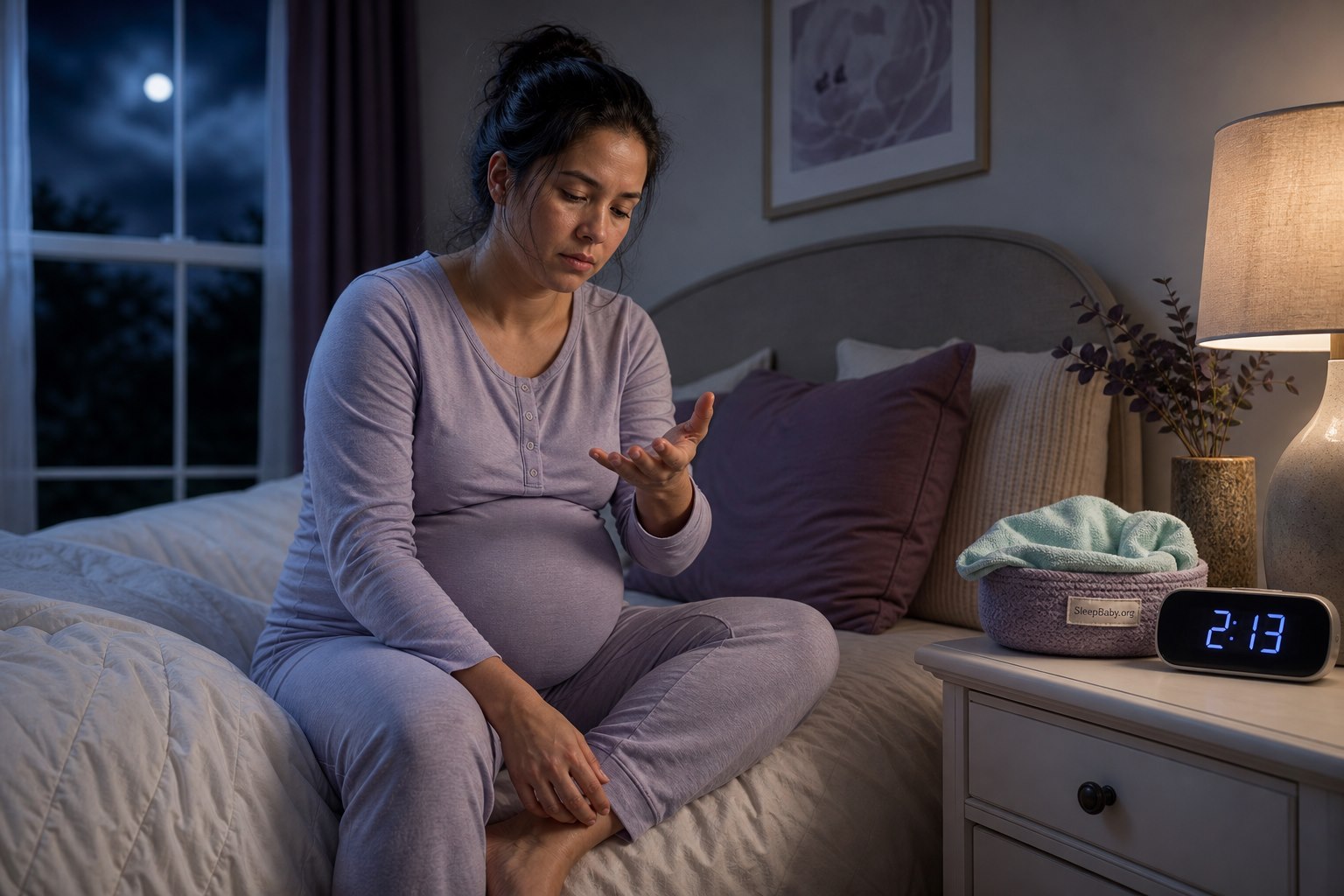
A disclosed composite scene captures the search better than a list of symptoms: it is 2:13 a.m.; a pregnant parent is sitting on the edge of the bed with one foot pressed against the cool floor. The soles feel electrically itchy, the belly has scratch marks, and every search result seems to alternate between “totally normal” and “medical emergency.” The compassionate middle is more useful. This is not a diagnosis to make in the dark. It is a pattern to report while the care team is reachable.
Location is a clue, not a verdict. Plenty of people with dry skin can have itchy hands. Not everyone with ICP begins with dramatic palm or sole itching. A rash can point toward a skin condition, yet it does not mathematically exclude ICP. Timing, severity, distribution, a primary rash, pregnancy week, associated symptoms, and blood results belong in the same conversation.
I would not ask a pregnant person to wait until both palms and both soles are screaming before making that call. A symptom does not have to become cinematic to deserve a blood-test question.

The Itch Signal Map
Four clues make the call more useful
Use this map to describe the symptom. Do not use it as a score that clears or diagnoses you.
- Surface
- No primary rash: think about ICP among the possibilities. Raised bumps, plaques, blisters, burrows, or a contact-shaped patch: describe or photograph what appeared before scratching.
- Location
- Palms or soles: name them explicitly. Abdominal stretch marks: say whether the navel is involved. Everywhere: list where it began and where it spread.
- Clock
- Worse at night or sleep-disrupting: report that. Note the first day, whether it is constant or in waves, and whether cooling or a product changes it.
- Whole-pregnancy context
- Give your pregnancy week, fetal-movement pattern, urine/stool color changes, jaundice, new medicines or products, prior liver disease, multiple pregnancy, and any previous ICP.
The screenshot-worthy takeaway: surface, location, clock, and whole-pregnancy context turn “I am itchy” into a clinical handoff. They still do not replace bile-acid testing when ICP is suspected.
What cholestasis of pregnancy is – and what the itch is telling you
Intrahepatic cholestasis of pregnancy is a liver condition in which bile acids build up in the blood during pregnancy. The pregnant person usually experiences itching; the pregnancy team cares about both symptom relief and the relationship between bile-acid levels and fetal risk. The condition is sometimes called obstetric cholestasis.
ICP does not usually create a distinctive primary rash. That distinction matters because the old page treated “itching” as one generic skin symptom. With ICP, the visible changes may be secondary to rubbing and scratching. A person can have excoriations, bruised-looking scratch marks, or irritated skin and still need the blood-test pathway.
Palms and soles are memorable warning locations, but they are not mandatory entry tickets. The itch can be generalized. It can be severe enough to erase sleep. Some people notice darker urine, pale stool, or yellowing of skin or eyes, but the absence of those features does not clear ICP. ACOG describes the usual pattern as severe itch without rash, commonly involving palms and soles and often worsening at night.[1]
The practical rule is deliberately simple: if the pattern sounds concerning, call. You do not need to wait until the itch is unbearable, wait for a routine appointment, or prove that both palms and both soles are involved.
The blood-test pathway: bile acids, liver tests, and the important repeat
When ICP is suspected, SMFM recommends measuring serum bile acids and liver transaminases.[4] The exact panel, fasting instructions, lab range, and follow-up interval can differ by health system, so call the team who will interpret the result rather than ordering meaning from a single number online.
- Call with the pattern. Say how many weeks pregnant you are, where the itch is, whether there was a rash before scratching, whether it is worse at night, and whether palms or soles are involved.
- Have the ordered blood tests. These commonly include total bile acids and liver-function or transaminase tests. Bile acids can be abnormal even when other liver tests are normal.[3]
- Ask who will contact you and when. Do not assume “no news” means normal. Know the callback route for worsening symptoms or reduced movement.
- Repeat if the clinical question remains open. RCOG notes that itching can precede abnormal blood results by days or weeks. If persistent unexplained itch continues, bile acids and liver tests should be repeated under the care team’s plan.[3]
- Keep the trend with the pregnancy context. The highest level, gestational age, symptoms, multiple pregnancy, and other complications can affect management. One screenshot of one result is not the whole plan.
A normal first test can be genuinely reassuring for that moment and still not be the final word if the symptom persists. This is not because the laboratory “missed” an obvious diagnosis. The blood changes may develop after the itch begins. The useful question is: “If I am still itching, when and how do you want these tests repeated?”

The six-line maternity handoff
What to say when you call about itching
- Pregnancy: “I am ___ weeks pregnant, with a single/multiple pregnancy, and I have/have not had ICP before.”
- Start: “The itching began ___ and is getting better/staying the same/getting worse.”
- Pattern: “It is on ___, includes/does not include my palms or soles, and is/is not worse at night.”
- Skin: “There was/was not a rash before I scratched. It looks like ___.”
- Pregnancy signs: “Movement is usual/reduced/not yet regularly felt. I do/do not have dark urine, pale stool, yellowing, or feel unwell.”
- Question: “Do you want bile-acid and liver tests now, and what is the repeat plan if the first results are normal but the itch continues?”
“I am 31 weeks pregnant. For three nights I have been very itchy all over, especially on my palms and soles, and there was no rash before I scratched. It is waking me from sleep. The baby’s movement is usual and I do not see yellowing, but I want to know where you want me assessed and whether I need bile-acid and liver tests.”
If fetal movement is reduced or another urgent symptom is present, lead with that fact. Do not bury it at line five.

What ICP can mean for the baby – without turning one number into a prophecy
ICP is taken seriously because it is associated with preterm birth, meconium in the amniotic fluid, and, in some circumstances, stillbirth. The risk is not identical for every diagnosis. It changes with bile-acid concentration, gestational age, and other pregnancy factors.
RCOG explains that, in a pregnancy without other risk factors, bile acids between 19 and 39 micromol/L are not associated with a higher stillbirth chance than a pregnancy without ICP; levels between 40 and 99 micromol/L have a similar chance until 38 to 39 weeks; and levels of 100 micromol/L or higher carry a higher chance, with around 3 in 100 severe-ICP pregnancies described as having a stillbirth after 36 weeks.[3] Those figures are population guidance, not an individual prediction.
SMFM’s ACOG-endorsed guidance uses laboratory confirmation and bile-acid level to shape surveillance and delivery timing. It recommends offering delivery at 36 weeks for total bile acids of 100 micromol/L or higher and a range from 36 to 39 weeks below that threshold, individualized by the clinical team.[4] Other countries and health systems may use related but not identical thresholds and timing language.
I would not hand a sleepless reader a threshold chart and call it a personal prediction. Numbers guide a clinical plan; they do not know your pregnancy week, other complications, laboratory trend, or baby’s current movement.
This is why the article will not hand you a delivery date. Your team needs the result, its trend, your gestational age, other complications, local protocol, and a conversation about benefits and risks. The correct emotional translation is not “any itch means my baby is in danger.” It is “this pattern has a testable pathway, and the result can change the plan.”
Contact maternity care for reduced movement rather than waiting for the next test or trying to reassure yourself with a home doppler. Fetal movement is a live symptom. A home heartbeat sound does not assess the full situation and should not delay professional triage.

Other reasons pregnancy can make you itchy all over
Not every pregnancy itch is ICP. Skin stretching, dryness, eczema, heat, contact irritation, hives, medication reactions, scabies, and pregnancy-specific eruptions can all itch. The goal is not to memorize a dermatology atlas. It is to notice whether there is a primary rash and where it began, then let a clinician examine it.
Dry, stretching, or sensitive skin
Dryness and stretching commonly affect the abdomen and breasts, while heat, sweat, fragranced products, or frequent hot showers can make many areas itch. The skin may look dry or mildly irritated rather than showing a new organized rash. Gentle cooling care and an unperfumed emollient may help, but severe nighttime or palm/sole itch still deserves the ICP conversation.
Atopic eruption or eczema
Pregnancy can worsen eczema in some people and improve it in others. Atopic patterns may involve dry, inflamed, scaly, or scratched areas, often in familiar eczema locations. New widespread eczema-like symptoms should be assessed because infection, treatment selection, and pregnancy context matter.
PUPPP or polymorphic eruption of pregnancy
Pruritic urticarial papules and plaques of pregnancy (PUPPP), also called polymorphic eruption of pregnancy (PEP), usually appears late in pregnancy as itchy red bumps or plaques beginning in abdominal stretch marks. It often spreads to the thighs and buttocks and may extend further, while the navel is typically spared.[1][5] It can be miserable but is not generally considered a direct danger to the baby. A clinician can distinguish it from other eruptions and recommend treatment.
Prurigo of pregnancy
Prurigo can look like small itchy bumps, sometimes compared with insect bites, on the trunk or limbs. Scratching can crust or break them. A photograph before heavy scratching can help, but diagnosis still belongs to an examining clinician.
Pemphigoid gestationis
This rare autoimmune eruption may begin with intensely itchy red or hive-like lesions around the navel and later form tense blisters. It needs prompt medical assessment and often specialist management.[6] Do not puncture blisters or treat a widespread blistering eruption as ordinary PUPPP.
Contact reaction, hives, medicines, or infection
A new detergent, lotion, adhesive, supplement, antibiotic, or other medicine can be relevant. Scabies often causes intense nighttime itch and may affect household contacts; burrows can appear between fingers or at wrists, but self-diagnosis is unreliable. Hives with lip, tongue, throat, or breathing symptoms are an emergency. Bring a full medicine and product list to care rather than stopping an important prescription without advice.
A visual distinction, not a home diagnosis
What appeared before the scratching?
- No primary rash
- ICP belongs on the differential, especially with palm/sole, generalized, nighttime, or severe itch. Scratch marks do not count as the original rash.
- Stretch-mark plaques
- PUPPP/PEP is possible, particularly late in pregnancy when red itchy plaques begin in abdominal stretch marks and spare the navel.
- Dry inflamed patches
- Eczema or atopic eruption may be possible. The distribution, prior history, infection signs, and treatment history matter.
- Around-navel blisters
- Pemphigoid gestationis is uncommon but important. Prompt examination is more useful than another image search.
- Burrows or household itch
- An infestation such as scabies may need consideration and household treatment under professional guidance.
- Hives plus swelling
- Facial, lip, tongue, throat, breathing, or fainting symptoms use the emergency lane.
If the itch pattern still sounds like ICP, a visible skin condition does not cancel the blood-test question.

How to get through tonight without hiding the clue
Comfort measures are worthwhile. They simply run beside the care plan, not in place of it. The NHS suggests cool or warm rather than hot bathing, regular use of an unperfumed moisturizer or emollient, short nails, and loose natural-fiber clothing.[2]
- Cool the environment. Lower the room temperature if you can, use a fan safely, and try a cool damp cloth on the most irritated area. Avoid ice directly on skin.
- Keep bathing brief and lukewarm. Hot water may intensify itch and dryness. Pat dry instead of rubbing.
- Use a plain emollient. Choose a fragrance-free product you already tolerate or ask a pharmacist for a pregnancy-appropriate option. Apply gently after bathing.
- Reduce scratching damage. Trim and smooth nails. Press, pat, or cool the area instead of digging at it. Cover broken skin with guidance appropriate to the wound.
- Choose loose cotton layers. Tight waistbands, synthetic heat, seams, and rough fabric can amplify the sensation.
- Write the call note once. Record pattern and symptoms, then stop repeatedly inspecting every inch of skin under a phone light.
Ask a clinician or pharmacist before using an oral antihistamine, medicated cream, herbal product, essential oil, or sleep aid. Some treatments may be appropriate for a diagnosed skin condition or to support sleep; none should be used as proof that ICP is absent. A sedating medicine can make you drowsy while the underlying question remains.
If itching is destroying sleep, say that plainly. Sleep disruption is part of severity and is one reason the NHS places very itchy nighttime symptoms in the urgent-contact pathway.[2] Our separate guide for being pregnant and unable to sleep can help with the environment after the maternity call, while the guide to whole-body aches in pregnancy addresses pain rather than itch.

What not to do when pregnancy itching is frightening you
Do not wait for a rash. ICP commonly causes itch without a primary rash. Scratch marks are not the same thing as an explanatory eruption.
Do not let one normal test end an unchanged symptom. If severe or unexplained itch persists, ask for the team’s repeat-testing plan. Symptoms can appear before bile acids become abnormal.[3]
Do not use relief as a diagnostic test. Cooling, lotion, or an antihistamine may reduce how itch feels and still tell you nothing conclusive about the cause.
Do not choose a delivery date from a chart. Bile-acid level, trend, gestational age, laboratory confirmation, other complications, and local guidance belong together. Your care team must make that decision with you.[3][4]
Do not rely on a home doppler for reduced movement. A sound from a device cannot replace maternity assessment. Follow your local movement instructions promptly.
Do not assume every swollen or numb hand is the same symptom. Carpal tunnel and fluid changes can cause nighttime hand symptoms. The guide to numb hands or arms during pregnancy explains that pattern, and the guide to swollen feet in pregnancy covers edema warning signs. Itch on palms or soles still deserves its own description.
If the tests confirm ICP, what happens next?
A diagnosis usually shifts the care plan from “What is this?” to symptom treatment, repeat laboratory assessment, fetal surveillance decisions, and birth timing. The details are individualized.
SMFM recommends ursodeoxycholic acid as first-line treatment for maternal symptoms of ICP.[4] That is a prescription decision. It is reasonable to ask what the medicine is intended to improve, how the team will assess response, and what it does and does not change about fetal monitoring or birth planning.
Your team may repeat bile acids and liver tests, discuss fetal surveillance, and recommend delivery within a gestational window based on the highest bile-acid level and the rest of the pregnancy. Ask the clinician to translate the plan into four concrete items:
- Which symptoms should trigger an immediate call?
- When will labs be repeated, and who reviews the result?
- What fetal-movement and surveillance instructions apply to you?
- What birth window is being considered, and what could move it earlier or later?
Monitoring is not permission to ignore symptoms between appointments. If movement changes or you feel acutely unwell, contact maternity care using the instructions they gave you.
A clinician explains the pathway
Watch a brief hospital overview of cholestasis in pregnancy
In this 3-minute, 22-second SLUCare OB/GYN video, a maternal-fetal medicine clinician explains why itchy hands can prompt testing and why bile-acid results matter. Use it to reinforce the written pathway, not to interpret your own result or delay a call.
Watch “Cholestasis of Pregnancy: Treating Itchy Hands & Preventing Still Birth” on YouTube. If the video does not play, the full care and testing plan is already written above.
After birth: the itch should close, and the lab story should close too
ICP symptoms usually improve after birth, though blood tests can take several weeks to return to normal. RCOG advises checking at the six-week postnatal visit that the itching has resolved and arranging liver-function and bile-acid tests to confirm normalization.[3]
If the itch continues, begins unusually early, or blood tests stay abnormal after pregnancy, further evaluation may be needed to look for another liver or skin condition. Do not let the pregnancy label follow you indefinitely without that closing check.
ICP has a meaningful chance of returning in a future pregnancy. Tell the prenatal team about the history early, even if you are not itching yet. RCOG advises checking liver tests and bile acids at the start of future pregnancies and repeating the clinical pathway if symptoms return.[3]
Also ask about medicines and contraception in the context of your liver-test history. The right option is individualized; a generic article should not tell you to start or avoid a method without the clinician who can see your results.
The tender part of the ending is not pretending the night was easy. It is closing the loop: the itch is gone, the labs are back where they should be, and the note that once lived beside the 2:13 clock can finally leave the nightstand.
Quick answers about itching in pregnancy
Are itchy palms and soles always cholestasis?
No. Dry skin, eczema, contact reactions, and other causes can affect hands and feet. But palm or sole itching in pregnancy is a recognized ICP pattern, especially when severe or worse at night, so it should be reported promptly rather than self-cleared.[1][2]
Can I have cholestasis if I also have a rash?
ICP usually has no primary rash, but scratching can create marks and a separate skin condition can coexist. Tell the clinician what appeared before you scratched and still describe the location and nighttime pattern. The team can examine the skin and decide whether bile-acid testing is needed.
Can bile acids be normal and then become high?
Yes. RCOG notes that some people itch for days or weeks before blood tests become abnormal. If persistent unexplained itch continues, ask when bile acids and liver tests should be repeated.[3]
Does PUPPP hurt the baby?
PUPPP/PEP can be intensely uncomfortable but is not generally considered directly harmful to the baby. It usually begins in abdominal stretch marks late in pregnancy and tends to spare the navel.[5] It still deserves examination because other eruptions can look similar.
Is itching a symptom of preeclampsia?
Generalized itch is not the classic defining symptom of preeclampsia. Severe headache, vision changes, significant upper abdominal pain, breathing trouble, or sudden concerning swelling need urgent maternity guidance whether or not you are itchy. Do not use the absence or presence of itch to screen yourself for preeclampsia.
What lotion is safe for pregnancy itching?
A plain fragrance-free moisturizer or emollient is a reasonable general comfort measure, and a pharmacist can help select a pregnancy-appropriate product.[2] A medicated cream depends on the diagnosis and body area. Lotion does not replace ICP testing when the symptom pattern is concerning.
Can an antihistamine treat cholestasis?
An antihistamine may sometimes be recommended for sleep or a separate allergic/skin condition, but it does not diagnose ICP and is not the SMFM first-line prescription for maternal ICP symptoms. Ask the prenatal team or pharmacist before taking one, and do not let temporary relief cancel repeat testing.[4]
Should I go to labor and delivery for itching?
Follow your local maternity instructions. Severe sleep-disrupting itch, palm/sole itch, or nighttime worsening warrants prompt contact; the team can tell you whether to come to triage, arrange same-day testing, or use another pathway.[2] Reduced movement or another urgent pregnancy symptom should lead the call.

The bedside card
Five things worth remembering tonight
- Severe, nighttime, palm/sole, or no-rash itching deserves a prompt maternity call.
- ICP needs bile-acid and liver blood tests; symptoms alone cannot diagnose it.
- A normal first result may need repeating if unexplained itch persists.
- Cooling, emollient, cotton, and short nails can protect comfort and skin while care proceeds.
- Reduced fetal movement or emergency allergic/skin symptoms use the faster door.
Save the pattern, not the panic: surface, location, clock, pregnancy context.
When the bedroom feels louder than the scratching
Make the medical call, then make the night gentler
SleepBaby cannot test bile acids, but it can help you hold the practical pieces: a cooler room, a written symptom pattern, one clear care question, and a bedtime plan that does not pretend the itch is “just anxiety.”
Sources
- American College of Obstetricians and Gynecologists: Skin Conditions During Pregnancy
- NHS: Itching and Intrahepatic Cholestasis of Pregnancy
- Royal College of Obstetricians and Gynaecologists: Intrahepatic Cholestasis of Pregnancy
- Society for Maternal-Fetal Medicine Consult Series #53: Intrahepatic Cholestasis of Pregnancy
- DermNet: Polymorphic Eruption of Pregnancy
- DermNet: Pemphigoid Gestationis