If you need help sleep training your baby, begin with one bedtime problem—not a famous method. First confirm that your baby is well, feeding appropriately, sleeping in a safe space, and developmentally ready for the kind of change you are considering. Then choose one repeatable bedtime routine, one response you can offer calmly, and one reason to pause. Sleep training does not have to mean ignoring your baby, and it is not the same as night-weaning.
For a newborn or a baby whose growth, feeding, breathing, reflux, pain, prematurity, or health is uncertain, start with your pediatric clinician rather than a formal training plan. The American Academy of Pediatrics notes that regular sleep cycles usually do not emerge until around four months; that is context, not a deadline or a promise.

The search usually starts before the baby is the problem
It is 7:46 p.m. The clean sleep sack is waiting on the chair, the bottle parts are drying beside the sink, and your phone contains three mutually offended experts. One says never pick up. One says always pick up. One has turned a wake window into a moral philosophy. You are not really asking which expert wins. You are asking, What can I do tonight that will not make this worse?
Composite Kacey-and-Benjamin scene: Imagine me beside Benjamin’s crib with one hand on the rail and the other holding a note that says “feed, book, phrase, down.” He begins to complain, and I can feel my plan trying to grow seventeen new branches. In this composite—not a biographical memory or evidence—I tell myself, “I only need to answer the next true question.” Is he hungry? Is he ill? Is he safe? If those answers are settled, what response did I decide to practice?
That moment is the whole article in miniature. A sleep plan becomes usable when it is smaller than your panic.
I do not want you to prove that you can tolerate crying. I want you to understand the problem well enough that crying is not the only information you have.
Name the one sleep problem you are solving first
“My baby will not sleep” is emotionally accurate and operationally enormous. It can contain a dozen different jobs: falling asleep, frequent waking, early rising, short naps, contact-only naps, feeding, discomfort, schedule mismatch, or a caregiver who cannot keep improvising at 2 a.m. If you aim at all of them, every wake becomes a referendum on the whole plan.
Route the night before choosing a method
| What you see | What to examine first | A useful first target |
|---|---|---|
| Bedtime takes an hour | Timing, last nap, stimulation, routine length | A shorter runway and a realistic lights-out time |
| Baby wakes every cycle | Feeds, health, discomfort, environment, sleep-onset help | Bedtime settling before every overnight wake |
| Crying escalates immediately | Readiness, response style, caregiver tension, real needs | A more responsive method or a pause |
| Naps are chaotic | Age, awake time, nap environment, contact or motion pattern | One nap, not every nap plus nighttime |
| The plan worked, then stopped | Illness, travel, teething, development, schedule shift | Restore the baseline before inventing a new system |
Write your target as an observable sentence. “Fall asleep in the crib with less rocking” can be observed. “Become a good sleeper” cannot. “Settle the first waking without feeding when our clinician agrees that feed is no longer needed” is clearer than “sleep through the night.” Specific targets protect you from moving the goalposts at dawn.
The private question underneath this is often, “Did I create a bad habit?” A habit is simply a pattern that currently helps sleep happen. You are allowed to keep it. You are also allowed to change it. Neither choice is a verdict on your bond.
Pass the readiness gate before you change the response
Age matters, but age is not the only gate. A healthy six-month-old who is growing well and has clear feeding guidance presents a different question from a four-month-old born prematurely, a baby struggling with weight gain, or a baby who suddenly sounds congested and wakes screaming. A calendar cannot sort those differences for you.
Six green lights to look for
- Health: no new illness, pain, fever, breathing difficulty, unusual lethargy, or other concerning change.
- Feeding and growth: you know which overnight feeds remain needed and are not using sleep training as automatic night-weaning.
- Developmental context: the plan fits your baby’s age and individual history, including prematurity or medical needs.
- Safe sleep: back for every sleep, firm flat noninclined surface, fitted sheet only, and no pillows, blankets, toys, bumpers, nests, or positioners.
- A realistic bedtime: close to when your baby can actually fall asleep, not an app’s idealized schedule.
- Caregiver capacity: every adult knows the response, the stop signal, and how to hand off before becoming overwhelmed.
If any light is red or uncertain, pausing is not inconsistency. It is good observation. Ask your pediatrician about feeding, growth, breathing, reflux, medication, illness, prematurity, or anything else that changes the ordinary sleep question.
And please keep sleep training separate from safe-sleep rules. No method makes a weighted product, inclined sleeper, lounger, loose blanket, positioner, sofa, or adult bed safer for an infant. A desperate night does not need an impressive setup; it needs a boring, firm, flat, empty sleep space.

Build a bedtime runway the tired version of you can repeat
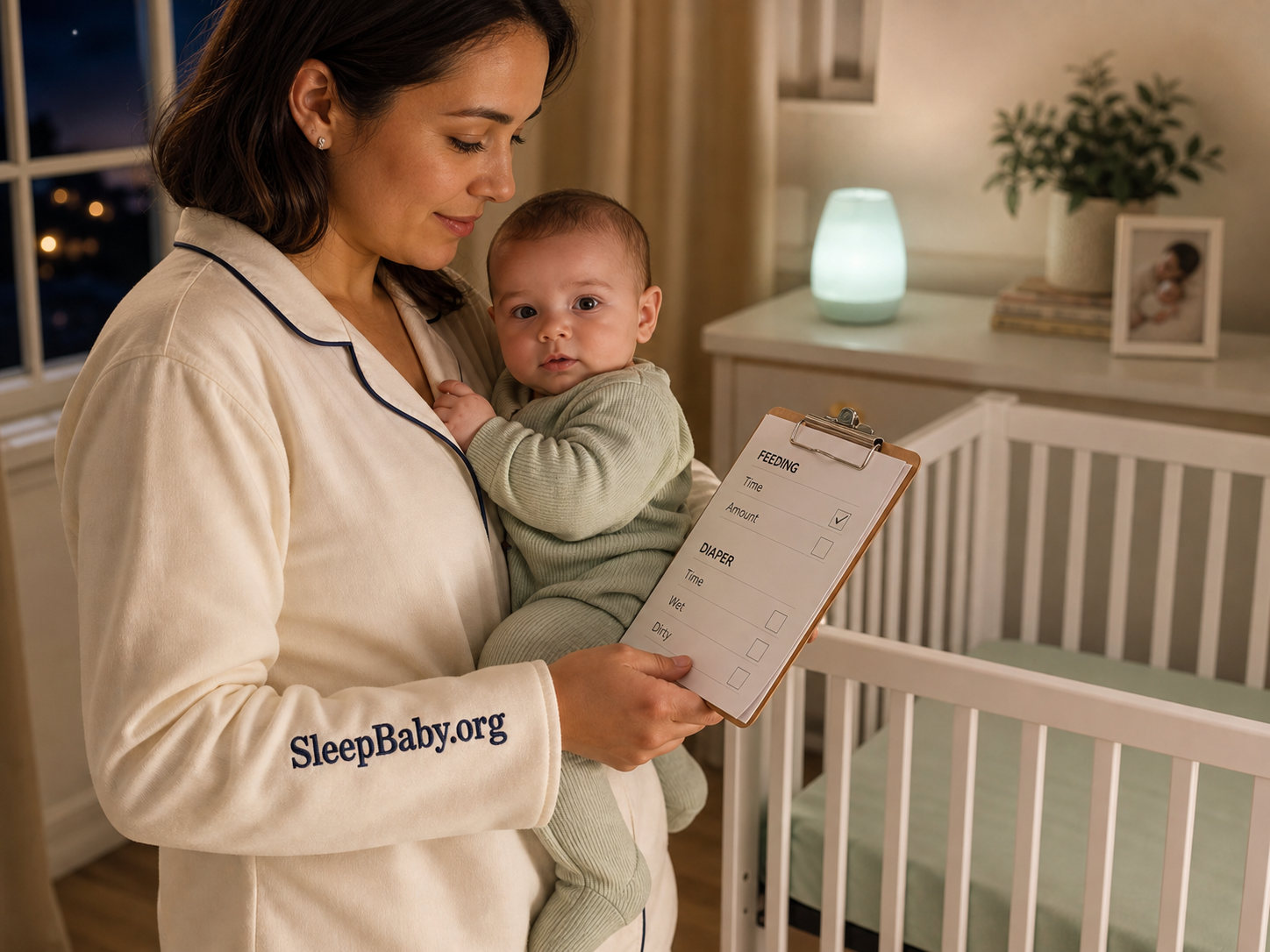
A routine is a sequence of cues, not a performance. Choose three or four calm steps: feed when appropriate, diaper and pajamas, one short book or song, lights down, the same closing phrase, then the sleep space. The sequence can be ten or twenty minutes. It does not need a bath, essential oils, blackout tape worthy of a lunar mission, or an adult with flawless emotional regulation.
Place feeding early enough in the routine that you can observe whether your baby is falling asleep while eating, if changing that association is part of your target. If feeding to sleep works for your family and is not the target, it does not have to be removed merely because a chart said so. Change the lever connected to the problem.
For babies old enough for a formal settling plan, the routine’s job is to make the transition predictable. It cannot force sleep on a baby whose timing is wrong. If your baby lies awake contentedly for a long time, bedtime may be earlier than their current sleep pressure supports. If the whole routine is frantic and your baby is unraveling before pajamas, overtiredness or excessive stimulation may be involved. Move timing modestly and observe; do not redesign the entire day after one difficult night.
Choose a response style by fit, not by toughness
Sleep training is an umbrella term. It can describe gradual changes with substantial parental presence, scheduled check-ins, bedtime fading, responsive pick-up and put-down, or approaches that limit nonessential responses after needs are met. Those are meaningfully different experiences. “Sleep training” does not automatically mean leaving a baby alone to cry for the entire night.
Bedtime fading temporarily places bedtime closer to when sleep actually arrives, then moves it earlier in small steps. It can be useful when a baby spends a long time awake at the proposed bedtime. Parental-presence approaches keep a caregiver nearby and gradually reduce help. Responsive settling may use voice, touch, picking up to calm, and returning to the sleep space. Graduated responses create planned pauses or check-ins. Extinction-style approaches limit nonessential responses while still requiring caregivers to respond to feeding, illness, safety, and other genuine needs.
A small randomized trial involving infants six to sixteen months found that graduated extinction and bedtime fading improved measured sleep outcomes compared with sleep education alone, without detected adverse attachment or emotional-behavioral effects at follow-up. A separate longer-term follow-up of a behavioral program did not find measured differences in the studied child, parent-child, or maternal outcomes years later. That evidence is useful, but it does not prove that every method works for every baby or that a family must choose one particular approach.
I would choose the least complicated response you can carry out calmly while remaining attentive to your baby. If check-ins intensify the protest, their frequency may be part of the problem. If leaving the room makes you panic or become inconsistent, a more present approach may fit better. If repeated picking up wakes your baby further, you may need a quieter ladder. Method fit is not a contest in parental bravery.


Use a seven-night learning plan, not a seven-night promise
No ethical plan can promise that your baby will sleep through the night in a fixed number of days. Seven nights is simply long enough to observe patterns without declaring success or failure after each cry. Illness, feeding changes, travel, development, and ordinary baby variability may interrupt the experiment.
Your one-page plan
- Target: name one observable change.
- Runway: list the same three or four bedtime cues.
- Response: write exactly what you will do first, next, and when you will pick up or feed.
- Stop signals: list illness, breathing or feeding concern, unusual distress, unsafe conditions, and caregiver overload.
- Three notes each morning: routine start, response used, what happened next.
On nights one and two, you are mostly learning whether the plan is understandable. On nights three and four, look for direction rather than perfection: a shorter routine, less help at sleep onset, a calmer first waking, or caregivers making fewer panicked rule changes. By nights five through seven, ask whether the target is improving, flat, or worsening and whether the method remains emotionally and practically sustainable.
Do not grade the plan by whether there was any crying. Crying is communication, and some babies protest change. Grade it by the whole pattern: intensity, duration, recovery, daytime behavior, feeds, caregiver steadiness, and whether the target is moving. Escalating or unusual distress deserves a response, not a lecture about consistency.
Progress can be modest. Five fewer minutes of rocking is data. A routine that ends without both adults renegotiating the constitution is data. One waking that is clearly hunger and another that settles with a hand on the chest is data. The night becomes less mysterious before it becomes easy.
What to do when crying makes the plan feel impossible
Decide your response ladder in daylight. You might pause briefly, use your voice, offer steady touch, pick up to calm, then return your baby to the sleep space. Another family may use timed checks. The exact ladder is less important than knowing what each step is for and remaining free to respond when something is wrong.
Do not turn a timer into a superior authority. If the cry changes sharply, your baby vomits, seems ill, has trouble breathing, feeds poorly, is unusually hard to wake, appears to be in pain, or your instincts tell you this is not the ordinary protest you planned for, check your baby. A method cannot diagnose the sound from another room.
If you feel yourself approaching rage or losing physical control, place your baby on their back in the safe empty crib and step away. Call another safe adult. If you think you might shake, hit, or otherwise harm the baby—or anyone is in immediate danger—contact emergency services. That is not a failed sleep-training night. That is the correct safety response.
The gentlest plan on paper can become harsh if a caregiver is beyond capacity. The reverse is also true: a structured approach can remain responsive when adults check needs, protect safety, and stay emotionally regulated. Labels do not parent the baby. People do.
Keep feeds, naps, and every overnight wake from becoming one project
Night-weaning is a feeding decision, not a complimentary feature inside a sleep plan. Babies may continue to need overnight feeds based on age, growth, feeding history, prematurity, health, and clinician guidance. Decide which feeds you expect to keep before bedtime. Then you are less likely to spend every waking arguing with yourself about whether hunger “counts.”
Naps also deserve their own plan. Daytime sleep pressure is different, the environment is brighter, and short naps can be developmentally common. If bedtime is beginning to improve, you do not have to train every nap immediately. Protect the progress you can understand. Work on one nap later if that is the next useful target.
Normal brief wakings happen across the night. The practical question is not whether your baby ever surfaces between cycles; it is what help they need, whether a real need is present, and whether the pattern is workable for the family. “Twelve hours without a sound” is not the only acceptable definition of sleep.


If the plan is not working, troubleshoot the lever instead of blaming yourself
The target may be too large. Separate falling asleep from night feeds, early waking, and naps. The timing may be wrong. A baby who is not sleepy enough can protest a beautiful routine; a baby who is far beyond comfortable wakefulness can struggle to settle. The response may be activating. Some babies become angrier when a parent repeatedly enters and leaves. Others need more presence. A real need may be hiding. Illness, pain, breathing changes, hunger, temperature, a dirty diaper, or another discomfort is not behavioral defiance.
The adults may not share the same plan. One caregiver waits, another rocks, and both believe the other is undoing the night. Use a handoff sentence: “Our target is bedtime settling. We will use voice, then touch, then pick up to calm. We will feed at the agreed feed, and we stop for illness, unusual distress, or either adult losing control.” It is not romantic, but neither is conducting a whispered policy summit beside the crib at 1:12 a.m.
The plan may conflict with your values. Evidence can describe average outcomes; it cannot decide what level of protest your family is willing to accept. You can choose a slower approach, pause, or decide not to use formal sleep training. Babies can develop sleep skills with many kinds of parental support.
You may be measuring the wrong result. Look for a shorter routine, a calmer transfer, slightly less assistance, a predictable feed, or a parent who knows what to do next. Those changes can precede longer sleep.
When sleep training needs a clinician, not another tweak
Contact your pediatric clinician when sleep changes arrive with feeding difficulty, poor growth, persistent vomiting, significant reflux concerns, pain, fever, unusual irritability, unusual sleepiness, snoring with breathing pauses, labored breathing, color change, or anything else that concerns you. Seek urgent or emergency care for breathing difficulty, blue or gray color, unresponsiveness, a seizure, or another emergency symptom.
Ask before reducing feeds when you are unsure about growth or nutritional needs. Ask for individualized guidance when your baby was born prematurely, has a medical condition, takes medication, or has developmental or airway concerns. Sleep education cannot replace medical assessment.
Also ask for help when caregiver exhaustion is creating safety risk. A partner, trusted adult, pediatric clinician, mental-health professional, or community resource can be part of the sleep plan. You do not have to earn help by becoming more depleted.
Age changes the job, even when the search words are the same
During the newborn months, the job is regulation, feeding, attachment, and safe sleep. Newborns wake frequently because their bodies require it. Day and night may still be organizing, and feeding needs can be substantial. Use light and ordinary household interaction during the day, keep overnight care calm and dim, build a tiny repeatable wind-down, and practice the safe sleep space when it works. Do not turn normal newborn waking into a test of independence.
Around four to six months, sleep rhythms may be becoming more organized, but readiness remains individual. This is the age when many parents begin discussing settling changes with their pediatrician. Keep feeding and growth guidance explicit. A baby who is newly rolling also changes the practical setup: always place the baby on their back, stop swaddling when rolling begins or your clinician advises, and use an empty sleep space. If your baby rolls independently after being placed on their back, follow current AAP safe-sleep guidance rather than adding a positioner.
From roughly six months onward, a wider range of behavioral methods has been studied, but the same gates still matter. Separation awareness, teething, illness, new mobility, travel, and schedule transitions can make a previously workable plan feel brand-new. Do not interpret every protest as manipulation. Ask what changed in the child’s body, day, and understanding before increasing the intensity of your response plan.
For an older baby approaching toddlerhood, routines and boundaries can become more visible. Use the same short sequence and the same closing phrase. Offer limited choices earlier in the routine—two pajamas, one of two books—rather than negotiating whether bedtime exists. The sleep space and safety rules remain nonnegotiable, while your presence and response style can still reflect your family’s values.
These age bands are not prescriptions. They explain why advice that worked beautifully for someone else’s eight-month-old may be irrelevant to your twelve-week-old, and why a plan that fit last month can need adjustment without being “ruined.”
Rehearse the response before the room goes dark
A plan is easier to follow when the adults say it aloud once. Try this: “After the closing phrase, we place the baby down on their back. If they fuss, we pause long enough to observe. Then we use our voice. Then steady touch. If distress escalates, we pick up to calm and return to the crib. At the agreed feeding time, we feed. We stop for any health or safety concern.” Change those steps to match your chosen method, but keep the verbs concrete.
Now decide the handoff. Who starts bedtime? When does the second adult take over? What sentence means “I am no longer calm enough to continue”? A handoff should not require a debate. “I need you now” is enough. If you are parenting alone, identify the safe crib pause, the person you can call, and what you will do to lower the temperature before returning.
Finally, decide what you will not judge at 2 a.m. You will not redesign wake windows, compare your baby with a stranger’s screenshot, or decide that one feed destroyed the plan. Overnight, protect safety and follow the simple response. In daylight, review the three notes and make one deliberate change if the pattern supports it.
I like this rehearsal because it reveals vague language. “Comfort as needed” sounds lovely until two adults disagree about what needed means. “Use voice for one calm interval, then touch, then pick up if crying escalates” gives both adults something they can recognize. Precision can be gentle.
Return to the next true question
Back at the crib rail, the note is still small: target, runway, response, stop. In the composite scene, Benjamin has not transformed into a tiny employee who respects project deadlines. But the room has changed because I am no longer trying to answer every sleep question at once.
Your next true question may be: Is my baby ready? Is bedtime timed well? Which feed stays? What response can I repeat calmly? What would make me pause? Answer that one, then let the night give you information.
You do not need the toughest method or the prettiest schedule. You need a safe plan that fits your baby, protects real needs, and remains kind when the clock says something unreasonable.
When the whole night feels tangled
Build the plan around the problem you actually have
Bring the bedtime timing, feeds, wakings, and response questions into one calmer map. Start with the next true question instead of another contradictory rule.
Sources
- American Academy of Pediatrics / HealthyChildren.org, “Getting Your Baby to Sleep” (updated June 4, 2024; accessed August 22, 2026).
- American Academy of Pediatrics / HealthyChildren.org, “Self-Soothing: Help Your Baby Learn This Life Skill” (accessed August 22, 2026).
- American Academy of Pediatrics / HealthyChildren.org, “Safe Sleep Tips for Sleep-Deprived Parents” (accessed August 22, 2026).
- Gradisar et al., “Behavioral Interventions for Infant Sleep Problems: A Randomized Controlled Trial,” Pediatrics (2016).
- Price et al., “Five-Year Follow-up of Harms and Benefits of Behavioral Infant Sleep Intervention: Randomized Trial,” Pediatrics (2012).
- American Academy of Sleep Medicine, “Recommended Amount of Sleep for Pediatric Populations: A Consensus Statement” (2016).






What viewers said10 comments · 4 replies+
Archived comments from the original Baby Sleep Miracle presentation. Not independently verified by SleepBaby.org; individual experiences vary.
Thank you so much for this video! I had no idea about the dangers of baby swings :O
Hi Mary-Ann. I have a question: Is method in any way similar to the ones recommended by Dr Bucknam, Dr. Weissbluth or Dr. Karp? We tried those but none of them help.
Hi Regina, thank you for your question. The short answer is no. The techniques I share in my guide are based on newest scientific research and this is why I have never seen any approach similar to the one I recommend.
This method really works! I tried it on my son Jesus and after just one week he went from waking up more than 5 times a night to waking up just once or twice. You are a lifesaver, Mary-Ann!
I'm truly impressed with how much information you share in your video. And all for free! I can feel that you truly care about mothers like myself, and that's hard to find these days. I have recommended your site to several of my friends already.
Mary-Ann, our child suffers from autism. Is your approach still suited?
Chloe, I made sure my method can be used with any child, even babies who are special like yours. Please note that I'm not a doctor and that I always advice to consult with your physician because nothing is more important than the safety and well-being of your love.
Hallo Mary-Ann, I'm from Germany. Do you have your guide in German?
Hello Heide, we do! Normally you should already see our video in German. If not, please contact our support so they can guide you
Thenk you for your answer, Mary-Ann!
I just completed your approach and I have to say, it worked almost too well. Yes, it took a bit of getting used to with your bedtime routine but the difference is huge. My son George used to take 1 hours to go down and now he's firmly asleep in no more than 10 minutes! You're the best!
It seems I'm the only man watching this video, lol! What you shared about the 'emotional backpack' made immediate sense to me and I can't wait to help my little girl Mila to unpack it!
Hey there, just discovered your site and this really sounds different. Just wanted to say thanks for sharing :)
For everyone who's still thinking about getting Mary-Ann's guide I want to advise you to go ahead. I wasn't sure myself but now I'm so thankful I invested in this program. It made a huge difference in our life as a family and yes, my baby girl does sleep through the night now.