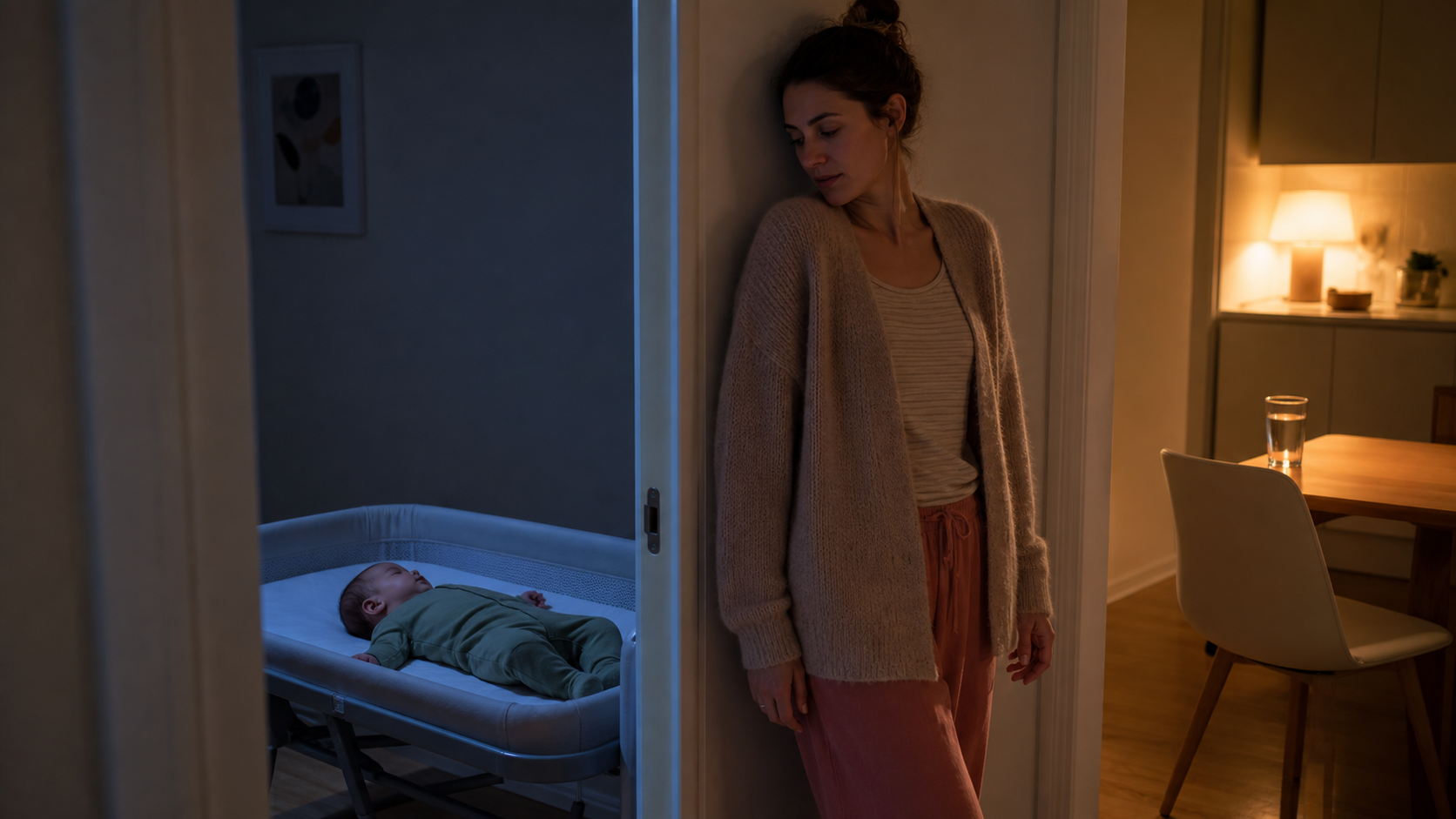
The quiet can feel bigger than the distance
Missing your baby while they sleep can be tender and ordinary—and you do not have to interrupt safe sleep to prove your bond
If you miss your baby when they sleep, I do not hear something silly or ungrateful. I hear a parent whose day has been built around a small person’s breath, weight, sounds, and needs—and then, suddenly, the room goes quiet. Relief and longing can arrive together. You can want the break and still miss the baby. You can adore them and still use the nap to eat, shower, work, talk, stare at a wall, or sleep.
The feeling is real, but it is not a command. You do not need to wake a sleeping baby, keep touching them, bring them into an adult bed, or watch a monitor without blinking. If your baby is on the back in a separate, firm, flat, level, bare sleep space, love can look like leaving that safe sleep alone. Your next connection is still coming.
The private question beneath “I miss my baby when he sleeps” is often, “If I stop watching for a moment, will I miss this whole season?” I want to help you answer that question without making sleep the enemy. We will sort ordinary longing from anxiety that is taking over, build one small response for the nursery doorway, and find ways to hold onto this season during awake time—when your baby can actually receive you.
The small routines
Feeds, changes,
and a little time for rest.
The feeds and changes keep coming, and you’re figuring out where sleep fits between them. Watch our video below for practical ideas for settling your baby.
Prefer to read?Press play for a little help with your baby’s next bedtime.
Kind words about the original video
“Thank you so much for this video!”
“I'm truly impressed with how much information you share in your video.”
The SleepBaby Workshop
Get the Workshop.
Get the Workshop, including Our Night Handoff and the Caregiver Shift & Fatigue Plan. 15 guides and five audio tracks in a simple browser hub. Read, listen, and return to the part you need.
A conversation, if you want one.Night Owls is the SleepBaby chat room. Read what is there or join in.
Why the quiet can feel like absence when your baby is only a room away
Caregiving trains attention quickly. You learn the difference between a hungry sound and a settling sound. You notice the angle of a head, the warmth of pajamas, the time since the last feed, and whether that silence is ordinary. During awake hours, your senses keep finding the baby. Sleep removes most of those cues at once. The body can stay in “listen” mode even when the task has changed from active care to protecting rest.
I think that is why the emotion can surprise people. Distance is not measured only in feet. A baby who has finally fallen asleep is temporarily unavailable for eye contact, feeding, rocking, play, and those tiny negotiations that fill the day. The relationship has not disappeared, but the stream of feedback has paused. For a tired, newly vigilant mind, that pause can feel much larger than it is.
There is also time inside the feeling. A nap is proof that the afternoon is moving. A longer first stretch at night may be welcome and strangely bittersweet. A baby who no longer needs every contact nap can make a caregiver proud and leave an empty patch on the chest at the same time. Missing the baby may partly mean missing the version of this season that existed last week.
None of that creates a rule about how a “good” parent should feel. Some parents exhale the second the baby sleeps. Some feel lonely. Some feel numb. Some do not feel instantly bonded and build closeness gradually. HealthyChildren describes bonding as a process supported by repeated responsive interactions, not a single emotional test. I would never use one nap-time feeling to grade a whole relationship.
It may be attachment
“I enjoy being near this person”
The simplest meaning may be the truest: you like your baby’s company, and the sudden lack of contact is noticeable.
It may be transition
“The day changed faster than my body did”
Your baby settled, but your attention has not downshifted yet. The feeling may soften after food, movement, conversation, or a few quiet minutes.
It may be time
“This stage is already passing”
The ache may belong to growth: fewer contact naps, a first crib stretch, a return to work, or simply another day completed.
It may need support
“I cannot stop checking or settle myself”
When fear, repeated checking, or inability to sleep is persistent and disruptive, the next kind act is not tougher self-talk. It is support.

A clearly hypothetical Kacey-and-Benjamin scene—not a memory or evidence
At the doorway, I let the feeling be true without making it Benjamin’s job
This is an imagined teaching scene. Picture me, Kacey, pausing at a nursery doorway after Benjamin has gone to sleep. The transfer is over. His approved sleep space is bare, firm, flat, and level. He is on his back. The room has that almost theatrical stillness that can make a parent want to walk right back in and begin the whole closeness ritual again.
I miss him immediately. I feel the impulse to lean over, touch his chest, adjust something that does not need adjusting, and stay until I have collected enough proof that I am still connected. Nothing is wrong with the tenderness. But Benjamin does not need to be awakened so I can resolve a feeling that belongs to me.
I look once at the setup, because safety deserves attention. Then I name the plan: I know how I will hear or respond when he needs me, and I know the next care step. Finally, I ask what I need right now. Maybe it is water. Maybe it is ten minutes beside another adult. Maybe I want to choose one photo from an awake moment and leave the rest of the camera roll alone. Maybe I need sleep.
The scene changes when I stop treating longing as an emergency. I do not have to argue with it. I can say, “Of course I miss Benjamin; I have been close to him all day.” Then I can protect the very sleep I worked to make possible. The bond is not waiting inside the crib for constant maintenance. It continues across the next feed, the next look, the next ordinary morning.

My doorway reset: one look, one plan, one need
When the pull is mild but sticky, I use a short sequence rather than a debate. It is not a treatment or a diagnostic test. It is a way to keep a tender feeling from recruiting the baby into repeated checks.
-
One look: verify the environment, not perfection
Confirm the baby is on the back in the separate approved sleep space with a firm, flat, level surface and only a fitted sheet. Make sure cords, blankets, pillows, toys, positioners, devices, and loose objects are outside the sleep space. If something is unsafe, fix the actual hazard. If the setup is already right, resist inventing one more adjustment.
-
One plan: know how the next need will reach you
Decide what you are listening for and who responds. In the same room, that may simply mean you are going to bed. During a nap, it may mean the door is open or an ordinary audio/video monitor is placed according to its instructions with the cord far from reach. A monitor can carry a cry across rooms; it cannot make sleep safer or prevent SIDS.
-
One need: turn toward the caregiver for sixty seconds
Ask, “What does my body need now that the baby does not need my hands?” Choose one answer small enough to do: use the bathroom, drink water, eat, sit, stretch, text a trusted person, or lie down. If the answer is “I need to check again,” ask whether new information appeared. Without a new sound, alert, symptom, or safety concern, the urge itself is not new information.
The reset is intentionally modest. I am not asking a newly postpartum parent to become serene on command. I am separating three jobs that anxiety can blur: keeping the baby’s environment safe, having a response plan, and caring for the person who is still awake.
If a real cue appears, respond. If the baby cries, has unusual breathing, seems ill, or your monitor shows something you need to assess, go assess. The point is not to ignore a baby. The point is to stop making every wave of missing them into evidence that the baby needs intervention.


How to feel close without disturbing sleep
I do not think the only choices are “hover” or “detach.” There is a wide middle where a parent can honor connection and keep the sleep boundary intact.
Name the next reunion
Replace “this moment is gone” with something concrete: “When my baby wakes, I will feed them by the window,” or “Tomorrow I want five floor minutes with no phone.” Anticipating one ordinary awake moment gives the attachment somewhere safe to go.
Choose one awake-time photo
If the camera roll comforts you, choose a single photo from an awake, supervised moment. Give it a destination—a favorites album, a printed frame, or a message to family—then close the app. The goal is remembrance, not an hour of scrolling that keeps your nervous system on duty.
Keep a caregiver cue outside the crib
A mug, a soft adult blanket on your chair, a familiar song through your own headphones, or a note on the kitchen counter can mark the transition. Never place a sentimental object, clothing item, photo frame, phone, cord, or keepsake inside or over the baby’s sleep space.
Let yourself leave the room
Room sharing describes where the baby normally sleeps while the caregiver sleeps; it does not require an adult to sit beside every nap. Our guide to room sharing and moving baby to their own room explains that you can shower, eat, or sit elsewhere while a baby sleeps safely.
One boundary matters especially when you are exhausted: do not turn longing into an adult-bed, sofa, or armchair cuddle that becomes sleep. If you bring the baby into bed to feed or comfort, return them to the separate approved sleep space before you go to sleep. Sofas and soft armchairs are particularly dangerous if an adult dozes with an infant. Missing the baby cannot make those surfaces safe.
Safe sleep is not emotional distance. It is a physical arrangement that protects a baby who cannot protect their airway. You can be warm, responsive, and deeply attached while the mattress stays firm, flat, level, and empty.
Move the closeness into awake time, where your baby can answer
When parents are afraid of missing the season, the internet often hands them an ambitious activity list. I prefer a tiny menu. Bonding is not a performance, and a baby does not need every waking minute optimized. Pick one interaction that fits the baby in front of you and the energy you actually have.
I want to underline the last point because guilt likes to disguise itself as devotion. Rest is not time taken from the bond. The relationship is built over thousands of returns. No single nap decides it.

When “I miss him” really means “he is changing”
A baby who once slept only against you may begin accepting the bassinet. A contact nap may shrink. A child may turn away, settle with another caregiver, or sleep a longer stretch. These changes can be developmentally welcome without feeling emotionally neat.
I would not rush to convert every ache into gratitude. You can be grateful and grieve a stage. Try naming the precise thing you miss: the weight on your chest, the milk-drunk face, the hour when the house belonged only to two people, the feeling of being the only person who could settle them. Precision turns a foggy sadness into something you can honor.
Then ask whether the old form of closeness has a new address. The chest nap may become a cuddle after waking. The long rocking session may become one song. Being the only person who can settle the baby may become the relief of seeing another caregiver succeed. Growth does not replace connection; it changes its shape.
Sometimes the ache is also about identity. A parent can spend weeks being needed every few minutes and then feel strangely unmoored by a longer nap. Use part of the quiet to meet one piece of yourself that did not disappear when the baby arrived. That may be music, prayer, work, a friend, a meal eaten warm, or simply your own unmonitored thoughts. The baby’s sleep and your personhood do not compete.
If someone else is available, share the listening—not just the chores
A handoff fails when one person leaves the room but remains the invisible control tower. They still watch the monitor, issue instructions, anticipate every cry, and correct every response. Their hands are technically free; their attention is not.
I would make the handoff explicit. Say what the baby last ate, the safe-sleep setup, what cues matter, and when you want to be awakened. Then let the other capable caregiver own the interval. If you need one check-in, agree on one. Do not make them prove competence every sixty seconds.
The longing may spike when you hear someone else soothe the baby. That feeling does not mean the handoff is wrong. It may mean you are watching your family’s capacity grow. A baby learning that care can come from more than one safe person does not erase the primary bond.
If you are alone, the “other caregiver” may be a plan rather than a person: the approved sleep space, a charged phone kept outside reach, water already beside your chair, and one person you can call. Reducing decisions can help the quiet feel less exposed.
When the monitor stops informing you and starts holding you
A monitor is useful when it carries information you could not otherwise receive: the baby is awake, crying, moving in a way you need to assess, or needs a response from another room. It becomes less useful when the same unchanged image is used to answer an emotional question it cannot answer: “Am I still close enough?”
I use a simple test. After a check, did I learn something that changes what I will do? If the baby is sleeping in the same safe position and no cue appeared, another immediate check is unlikely to add information. Close the screen for a defined interval and let sound or the agreed alert bring you back.
Do not use heart-rate, oxygen, movement, or “AI” alerts as permission to relax safe-sleep rules. Consumer monitors do not prevent SIDS, and an alarm cannot make a pillow, blanket, inclined sleeper, adult bed, sofa, or prone placement safe. Our guide to what AI baby-monitor alerts can and cannot tell you can help separate a device notification from a clinical judgment.
If you repeatedly reopen the feed despite trying to stop, lose large parts of every nap to checking, or cannot sleep even when the baby is safely asleep and another capable adult is responsible, tell a health professional. The important fact is not the number of checks. It is the distress, loss of rest, and narrowing of your life.

A sixty-second environment reset
Let the safe setup carry the moment when you want to look again
This official NICHD Safe to Sleep video is brief enough to use as a practical reset. Watch the sleep space, not for a promise that nothing bad can happen, but for the physical choices you can control before stepping away.
Watch “Safe Sleep For Your Baby — 60 Seconds” on YouTube if the privacy-enhanced player is unavailable.
Takeaway for this article: closeness is emotional; safe sleep is physical. You can feel the first deeply while keeping the second simple—back, separate surface, firm, flat, level, and bare.
When missing the baby deserves more support
I would not make ordinary tenderness sound clinical. I would also not hide a struggling parent inside the word “normal.” The question is not whether you ever miss the baby. Ask what the pattern is doing to your sleep, attention, safety, and ability to function.
Often ordinary
- The feeling arrives when the room becomes quiet and passes as you settle into another activity.
- You can leave the room, accept a handoff, or sleep even if you feel a little ache.
- You enjoy the reunion but do not need to wake the baby or check repeatedly to feel safe.
- Relief, love, boredom, grief, and gratitude can coexist without taking over the day.
Bring it up promptly
- You cannot sleep during real opportunities because you feel driven to watch or check.
- Fear, sadness, irritability, numbness, or guilt is persistent, intense, or interfering with daily care.
- Intrusive thoughts frighten you, checking rituals keep expanding, or you avoid ordinary separations you want to tolerate.
- You feel disconnected from the baby, doubt you can care for them, or the emotional pattern is getting worse rather than easing.
Contact your obstetric, primary-care, or mental-health clinician. In the U.S., the National Maternal Mental Health Hotline is available 24/7 by call or text at 1-833-TLC-MAMA (1-833-852-6262). It is free and confidential. Our guide to baby blues and when to get more help can add context when you are stable enough to read.
Emergency help now
Get immediate help if you may harm yourself or the baby, cannot keep either of you safe, or have severe confusion, paranoia, hallucinations, delusions, or manic behavior after birth. In the U.S., call 911 or your local emergency number for immediate danger. Call or text 988 for the Suicide & Crisis Lifeline. Postpartum psychosis is a psychiatric emergency; do not stay alone and wait for an ordinary appointment.
Intrusive thoughts can be deeply upsetting, and having a thought is not the same as wanting to act. A clinician can help you sort what is happening without shame. If there is intent, a plan, loss of control, severe confusion, or an inability to maintain safety, use the emergency lane now.
Partners and family members: do not reduce this to “just sleep when the baby sleeps.” Offer a specific block of care, food, transportation, help making the call, or company during the appointment. If the parent seems detached from reality, severely confused, unusually energized without sleep, paranoid, or unsafe, treat it as urgent rather than debating whether they mean it.
Questions parents ask in the quiet
Is it normal to miss my baby as soon as he falls asleep?
It can be. The sudden shift from continuous caregiving cues to silence can make attachment feel like absence for a moment. Look at the whole pattern: can you let the baby sleep, turn toward another need, and function? If the feeling is persistent, frightening, or keeps you from sleeping and living, mention it to a clinician rather than relying on an internet definition of normal.
Should I wake my baby because I miss him?
Usually, no. If your baby is sleeping safely and there is no medical or feeding instruction to wake them, let the sleep continue. Young newborns and some babies with feeding, growth, or medical needs may need scheduled waking; follow the plan from your baby’s clinician. Missing the baby alone is not a reason to interrupt needed sleep.
Can I hold my baby for every nap?
Awake contact and supervised cuddles can be wonderful, but an adult who might fall asleep should transfer the baby to the separate approved sleep surface. Do not sleep with a baby on a sofa, armchair, adult bed, or chest. If contact naps are the only sleep your baby accepts, work on safe transfer and support rather than treating caregiver wakefulness as limitless.
Does enjoying the break mean I am not bonded?
No. Relief is information about workload, not a verdict on love. Eating, resting, working, or enjoying adult quiet can help you return with more capacity. Bonding develops through repeated responsive care and shared awake moments; it is not measured by whether you miss every minute.
Why do I keep looking at photos while my baby sleeps?
Photos may offer a quick dose of connection or help you hold onto a fast-moving stage. Notice whether the habit comforts you and ends, or whether it becomes another loop that delays sleep. Try choosing one favorite from an awake moment and giving it a destination, then close the camera roll.
What if my partner does not miss the baby in the same way?
Different nervous systems and caregiving roles produce different reactions to quiet. One parent may listen for every breath; another may downshift quickly. Neither response proves more love. Compare practical responsibilities and support needs instead of demanding identical feelings.
When does checking become too much?
There is no universal number. Pay attention when checking adds no new information, repeatedly prevents sleep, expands despite attempts to stop, or interferes with work, eating, relationships, or accepting help. That functional impact is a useful reason to talk with a perinatal mental-health or primary-care professional.
Can a baby monitor reassure me that my baby is safe?
A monitor can help you hear or see that the baby needs a response. It cannot guarantee safety, prevent SIDS, or replace back sleeping on a firm, flat, level, bare approved surface. If a medical monitor was prescribed, use it exactly as the clinical team instructs; do not generalize from consumer devices.
What if I do not miss my baby when they sleep?
You are allowed to welcome the quiet. A nap may be the first moment your body has not been touched or needed all day. Use it. If you feel persistently numb, detached, hopeless, or unable to connect during awake care, bring that broader pattern to a clinician. The absence of nap-time longing by itself is not a parenting failure.
Will this feeling go away?
It often changes as sleep, confidence, hormones, support, and the baby’s development change. The goal is not to become a parent who never misses the baby. It is to let the feeling fit inside a life where the baby can sleep safely and the caregiver can also rest, function, and receive care.
Sources
- National Institute of Mental Health: Perinatal Depression — symptoms, treatment context, and the postpartum-psychosis emergency boundary.
- American College of Obstetricians and Gynecologists: Summary of Perinatal Mental Health Conditions — perinatal anxiety, intrusive thoughts, checking, and sleep disturbance.
- Health Resources and Services Administration: National Maternal Mental Health Hotline — current U.S. 24/7 call and text support.
- 988 Suicide & Crisis Lifeline — U.S. 24/7 call, text, and chat crisis support.
- NICHD Safe to Sleep: Ways to Reduce Baby’s Risk — back sleeping, separate firm flat level surface, fitted sheet only, and a clear sleep space.
- HealthyChildren.org: Safe Sleep—Back is Best — AAP-backed guidance on back sleeping, soft bedding, inclined surfaces, and bed-sharing.
- HealthyChildren.org: 3 Ways You Can Bond With Your Baby — bonding as a gradual process supported by responsive awake interaction and caregiver support.
- NICHDVideos: Safe Sleep For Your Baby — 60 Seconds — the official video embedded in the privacy-enhanced video card.
Let this sleep finish; meet the next question with steadier hands
You are not losing the bond in the quiet
I want the doorway to mean something different now. Missing your baby can be true. The safe setup can also be true. You can look once, trust the response plan, care for one need of your own, and let the next reunion arrive without forcing it early.
When the baby wakes, connection returns in a form they can receive: your face, voice, milk, touch, play, or simple response. If another sleep question is waiting—crib transfers, room sharing, short naps, bedtime timing, or repeated wakes—start from SleepBaby.org and choose the next problem that actually belongs to the baby in front of you.
Find the next baby-sleep answer on SleepBaby.org
The quiet is not the bond disappearing. It is one protected pause inside a relationship made of returns.
The SleepBaby.org Workshop
Make a plan for
the next bedtime.
Practical help for wake-ups, short naps, and sharing the night shift. Watch the original video, then get 15 guides and five audio tracks for $9.
$9 USD, paid once. No subscription. Digital access.
Watch the original Baby Sleep Miracle presentation
Press play for a little help with your baby’s next bedtime.
Original presentation. Watch before you decide.
15practical guides
5audio tracks
1one-time payment
Kind words about the original video
“Thank you so much for this video!”
“I'm truly impressed with how much information you share in your video.”
Inside the Workshop
Start with the night
you're having.
You don't need to read all 15 guides before bedtime. Choose the one that answers the question in front of you, then come back for the next part.
Before you buy
A few things
made clear.
A straightforward purchase, with space to decide what fits your family.
What am I buying?
The SleepBaby.org Workshop includes 15 digital guides, five audio tracks, and the original Baby Sleep Workshop PDF as an additional download. It costs $9 USD, paid once, with no subscription. Nothing is shipped.
Where should I start?
Try Tonight Rescue when you need a starting point. If your question is more specific, go straight to the guide on naps, a caregiver handoff, the sleep space, or another topic. You can read at your own pace.
Is this personal sleep coaching?
No. This is an educational collection for parents of babies and young children. Use the age-specific guidance, and bring feeding, breathing, growth, illness, or other health concerns to your child's clinician. It does not diagnose a problem or promise a sleep result.
Is the video the paid Workshop?
You can watch the original Baby Sleep Miracle presentation on this page. Your purchase is the SleepBaby.org Workshop collection of guides, audio tracks, and the original PDF described here.
How do I find it after checkout?
On your thank-you or order-status page, look for Open Workshop access, then Open your SleepBaby Workshop. Keep your order confirmation so you can return. If you need help finding your access, use our Workshop download help.
The SleepBaby.org Workshop
Have somewhere to start
at the next bedtime.
15 practical guides. Five audio tracks. One $9 purchase.


What part of “I Miss My Baby When He Sleeps: What the Feeling Can Mean” feels most painfully specific in your house right now?
Sometimes the smallest detail—what time it happens, what changed recently, or what finally helps—reveals the pattern. Share the exact version below, and the SleepBaby Team can help you think through it.