

Do not try to keep a healthy baby perfectly still while sleeping. Babies twitch, startle, stretch, thump their legs, turn their heads, make odd little noises, and eventually roll. The safe goal is to control the sleep environment, not restrain the sleeper: put your baby on their back for every sleep, use a firm and level bare sleep space, stop swaddling at the first signs of trying to roll, and keep wedges, positioners, weights, straps, and improvised barriers out of the crib. If the movement is brief and happens only during sleep, it is often normal. If it comes with breathing trouble, color change, unresponsiveness, or awake or prolonged jerking, that is a medical question—not a sleep-positioning project.
I understand why “keep baby still” feels like the obvious assignment. You finally lower a sleeping baby onto a safe surface, ease your hands away, and then one knee lifts, both arms fling out, or the whole small body begins a slow migration toward the crib rail. The private question underneath the search is usually: If my baby moves after I put them down safely, have I failed to keep them safe?
No. A safe put-down does not require a motionless result. Your job is to build a sleep space where normal movement has nowhere dangerous to go. That distinction matters because the products that promise to hold a baby in one “right” position—wedges, bolsters, positioners, rolled blankets, weighted items, and homemade restraints—can add the very hazards a bare crib is designed to remove.

The four jobs that replace “keep baby still”
I use four verbs because they are easier to remember at 2 a.m. than a page of rules. They also separate what you can control from what you cannot.
First, name the movement you are actually seeing
“Moving in sleep” can describe several different things, and they do not all need the same response. A newborn may startle and fling both arms. A sleeping baby may briefly twitch a hand or foot, bicycle their legs, groan, whimper, stretch, or turn their head. An older baby may use the mattress like a slow dance floor and wake up facing a completely different direction. Another baby may be practicing the first half of a roll. Those patterns are frustrating when they interrupt sleep, but frustration is not the same as danger.
The American Academy of Pediatrics’ symptom guidance describes brief jerks or twitches that occur only during sleep as most likely normal. The important qualifiers are brief and sleep-only. If you are trying to decide whether the movement looks like an ordinary sleep start, our guides to Moro reflex, sleep starts, and leg-kicking patterns and how to read stretching and squirming during sleep can help you observe more specifically.
I would not judge a single motion in isolation. I would look at the whole baby: Are they breathing comfortably? Is their color usual? Do they settle again? Does the motion stop on its own? Does it occur only while asleep? A soft grunt plus a leg lift in a pink, comfortably breathing baby is a different picture from rhythmic jerking paired with altered responsiveness or a gray-blue color. The whole picture tells you whether you are watching active sleep or an urgent problem.
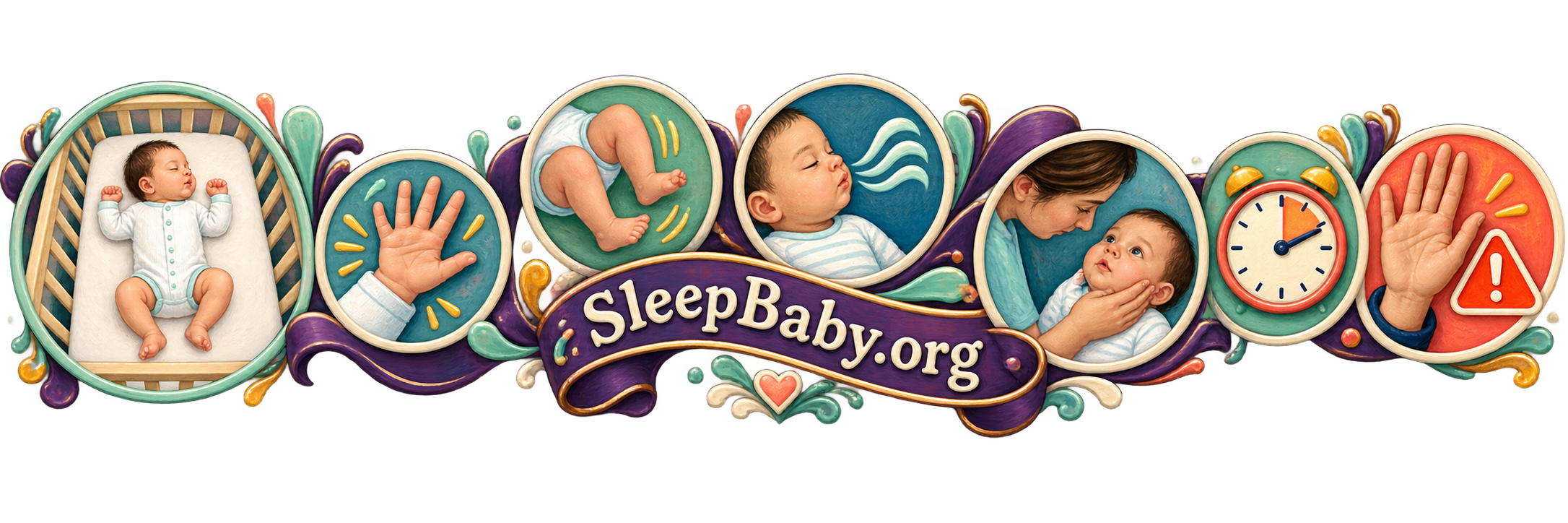
A movement sorter for the middle of the night
| What you notice | What to check next | A reasonable response |
|---|---|---|
| Brief twitch, startle, stretch, grunt, or leg thump only during sleep | Comfortable breathing, usual color, motion stops, baby settles | Pause and observe. Avoid adding gear or repeatedly waking a baby who is otherwise well. |
| Baby rotates or rolls in a bare crib | Was baby placed on the back? Can they roll one way or both ways independently? | Use the rolling guidance below; never fence the body in with objects. |
| Jerking while awake, a spell lasting more than 10 seconds, or a suspected seizure | Responsiveness, breathing, color, recurrence, and your clinician’s instructions | Contact the baby’s clinician promptly; use emergency services for breathing trouble, color change, or unresponsiveness. |
The moment I would stop trying to “fix” every wiggle
Picture Kacey—that is me—beside a crib with Benjamin sleeping on his back. He lifts both legs, thumps them onto the mattress, turns his head, and begins a slow quarter-turn that makes my hand hover over him. In this composite scene, nothing is wrong with his breathing or color. The crib is firm, flat, and bare. Still, my mind supplies an entire nighttime job description: straighten him, center him, smooth him, make sure he stays exactly as placed.
That is the moment I would remind myself that my careful back put-down was a starting action, not a contract requiring his body to remain frozen. I can check the space without controlling Benjamin’s limbs. Fitted sheet? Yes. No blanket, pillow, toy, bumper, wedge, or positioner? Yes. No swaddle now that rolling attempts are appearing? Yes. Comfortable breathing and usual color? Yes. Then my safest next action may be to step back.
I am using a composite because many parents know this exact hovering feeling, not because it proves a medical point. The evidence comes from the safe-sleep guidance in the Sources section. The scene simply names the emotional turn: when the environment is right and the baby looks well, constant correction can be anxiety asking for a task—not safety asking for one.
Back is the starting position, not a promise your baby will stay there
Place your baby on their back for every nap and every night sleep through the first birthday. That includes babies with reflux and babies born preterm unless the baby’s own clinician has given a specific medical plan. Side placement is not the halfway option; it is unstable and can make it easier for a baby to roll onto the stomach.
Then rolling changes what happens after the put-down. The NIH’s Safe to Sleep guidance separates babies who can roll one way from babies who can roll both ways independently. If your baby can roll from back to stomach and stomach to back on their own, you do not need to spend the night repeatedly flipping them after you have started them on the back. You can leave them in the position they choose. Keep the sleep space bare so there is no soft bedding or object to meet their face.
If your baby can currently roll only one way and ends up on the stomach, you can reposition them onto the back. You may need to do that more than once during the learning phase; you do not need to build a barrier around them. Rolling is a developmental skill, not a behavior that a crib accessory should suppress. Age alone is also a poor switch because early rolling attempts can appear sooner than a parent expects.
If the back position brings strong protest, use soothing that does not change the sleep-surface rules: hold and calm your baby while awake, offer feeding if it is appropriate, check the diaper and clothing, dim the room, and try the back put-down again. Our guide on how to comfort a baby who protests the back-sleep position keeps comfort separate from unsafe positioning.

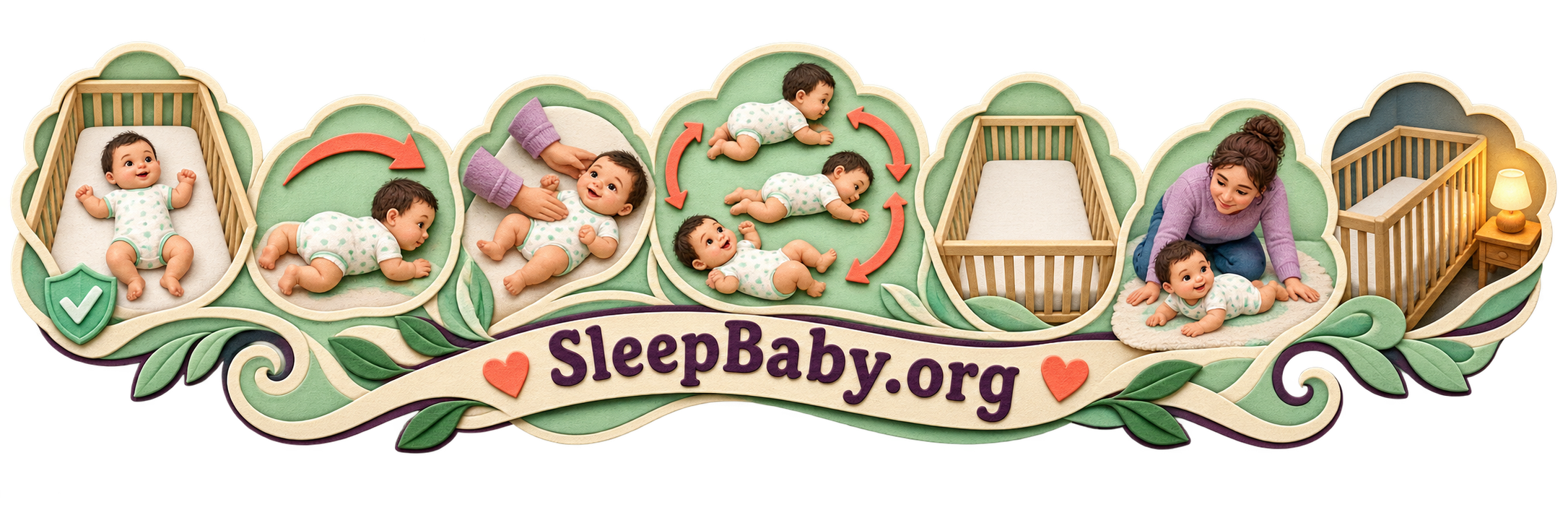
A rolling decision path you can use tonight
- At every put-down: place baby on the back in the regular bare sleep space.
- No independent roll yet: keep using back placement; do not prop the body on either side.
- Rolls one way: you can reposition to the back when you find baby on the stomach; keep practicing rolling during supervised awake floor time.
- Rolls both ways independently: after the back put-down, leave the position baby chooses and keep the crib bare.
Make the sleep space do the safety work
A safe sleep space is intentionally boring. Use a CPSC-compliant crib, bassinet, portable crib, or play yard with a firm, flat, level, noninclined surface and a fitted sheet. Keep pillows, loose blankets, quilts, toys, stuffed animals, bumpers, positioners, nursing pillows, and other objects out. A baby’s arms and legs may travel; the environment should not introduce something soft, loose, angled, or confining for the baby to meet.
This is where the phrase “keep baby still” can pull a loving parent toward the wrong solution. Rolled towels beside the hips, a blanket tucked as a side barrier, anti-roll cushions, bolster mats, and commercial wedges all look like ways to stabilize a tiny body. The FDA warns against infant sleep positioners because babies have suffocated after rolling, scooting, or becoming trapped against the device or the side of the sleep space. A homemade version does not become safer because it did not arrive in a box.
Do not strap, tether, or otherwise fasten a baby to a crib or bassinet. That statement is about sleep spaces; it is not advice to unbuckle a properly installed car-seat harness during vehicle travel. When the trip is over, or when a baby falls asleep in a swing, stroller, carrier, sling, or car seat outside active travel, move the baby to the regular firm, flat sleep surface as soon as practical.
Do not incline the crib mattress or use a wedge for reflux unless a qualified clinician is directing care in a medical setting. Reflux alone does not change the recommendation to place a baby flat on the back for sleep. If coughing, choking, feeding problems, poor growth, or breathing concerns are driving the urge to elevate or restrain, bring that exact problem to the baby’s clinician rather than experimenting with the sleep surface.

Stop swaddling before rolling turns it into a trap
A swaddle limits arm movement, which is exactly why it becomes a problem once a baby is trying to roll. Stop swaddling at the first signs of attempting to roll. Do not wait for a completed roll, a particular age, or one more “good night.” Babies do not consult our transition calendar before trying a new skill.
A swaddled baby must always start on the back, and swaddling itself does not reduce SIDS risk. Once rolling attempts begin, move to sleep clothing that leaves the arms free and allows the legs and hips to move. Do not use a weighted swaddle, weighted sleep sack, weighted blanket, or another weighted product as a substitute. NIH and AAP guidance warn against added weight in infant sleep because it may affect chest expansion, make repositioning harder, and contribute to overheating; the claimed benefits and home-use safety are not established.
The transition may produce a few untidy nights. Your baby may startle more visibly or take longer to settle without the snug wrap. That does not mean the answer is to pin the arms down again. It means the bedtime routine may need more help outside the crib—feeding, holding, rocking, a calm song, or a little extra time—while the actual sleep space remains clear.

A safe swaddle-off reset
- Stop at signs of trying to roll, even if rolling has not happened in the crib.
- Use ordinary sleep clothing or a correctly sized, nonweighted wearable blanket with the arms free.
- Keep the same calming routine, but do the soothing while baby is awake and the crib stays bare.
- Give supervised awake floor time for rolling practice; do not practice with positioning gear in the sleep space.
Dress for movement instead of trying to stop it
Sometimes “my baby will not stay still” is really “my baby kicks off every blanket and I am worried they will be cold.” Loose blankets still do not belong in the infant sleep space. Dress the baby for the room instead. A correctly sized, nonweighted wearable blanket can add a layer while leaving the arms free and the lower body able to kick and stretch.
Choose size by the baby’s current height and weight, not by the age range alone. The neck and arm openings should not be so large that the fabric can ride over the face, and the garment should not bind the hips or legs. Keep the room at a temperature that feels comfortable to a lightly clothed adult, generally use no more than one extra clothing layer beyond what an adult would wear, and check the baby’s chest or back rather than cool hands. Sweating, flushed skin, or a hot chest can signal overheating. Keep the head uncovered indoors during sleep.
I like this framing because it solves a real problem without inventing a motion-control problem. Warmth comes from appropriate clothing. Safety comes from the bare surface. The baby’s legs are still allowed to be legs.
Watch the back-sleeping and rolling guidance with another caregiver
If a grandparent, sitter, or partner still believes a baby should be propped in place, this official NICHD video gives everyone the same starting point. Watch it together before the next handoff so the crib rules do not have to be renegotiated at bedtime.
Takeaway: every caregiver starts the baby on the back in a clear, separate sleep space; normal movement is managed by keeping that space safe, not by adding a device that holds the baby still.
Read the official NICHD back-sleeping and rolling guidance if video is not convenient or you want the text alternative.
A calm way to watch without policing every wiggle
When a baby moves, parents often respond by touching, straightening, or checking over and over. That can wake the baby, sharpen your own attention, and turn ordinary active sleep into a nightly alarm. I would rather use a short observation sequence that has a clear stopping point.
Pause, look, listen, then choose
- Pause for a moment. A brief startle, grunt, or leg lift may end without intervention.
- Look at the whole baby. Check breathing effort, color, position, and whether the space is still clear.
- Listen for the pattern. Ordinary sleep noise is different from choking, persistent gasping, or a cry that signals a fully awake need.
- Choose one response. Observe, soothe after waking, reposition a one-way roller, or act on a red flag. Do not default to adding equipment.
If movement repeatedly ends the nap, the next useful question is what happens immediately before the wake. Is the baby startling as they enter lighter sleep? Bumping the side of a too-small bassinet? Rolling one way and getting frustrated? Waking hungry? Over- or undertired? Our guide to what the movement before a wake can mean helps you work backward from the pattern instead of trying to eliminate every motion.
You do not need to stare all night to make this method work. Once you have verified the safe space and the baby looks well, it is reasonable to stop treating every rustle as an assignment. A monitor can help you check from another room when needed, but no consumer monitor can make an unsafe sleep environment safe or prove that a baby is protected from SIDS.
When movement is not “just active sleep”
This is the boundary where reassurance must stay precise. Call emergency services if your baby has trouble breathing, becomes blue, purple, or gray around the lips or skin, is unresponsive or increasingly difficult to wake, or has rhythmic jerking with loss of responsiveness. Follow any emergency plan already given by your baby’s clinician.
Contact the baby’s clinician promptly about a suspected seizure; jerking that happens while awake or lasts more than 10 seconds; a breathing pause longer than 10 seconds even if breathing resumes; hard or labored breathing; a baby who looks or acts very ill; or developmental skills that are missing or have been lost. If you are unsure whether the baby is responsive or breathing normally, do not spend time arranging the crib or filming a perfect example before seeking help.
A short video can sometimes help a clinician understand a recurring movement, but only if the baby is otherwise stable and recording does not delay urgent care. Note whether the baby was asleep or awake, how long the spell lasted, what the eyes and limbs did, whether both sides moved the same way, how breathing and color looked, and how the baby acted afterward. Those observations are more useful than the label “restless.”
Questions parents ask when the baby will not stay where they were placed
Should I keep moving my baby back to the center of the crib?
Not simply because the baby has scooted toward one side. A compliant crib is designed as a sleep space, and the bare rails are not a reason to add padding. Check that the mattress fits correctly, the fitted sheet is secure, and there are no objects or cords within reach. If the baby is comfortable, breathing normally, and not trapped, centering is not a safety ritual you must repeat all night.
What if my baby’s face is against the mattress after rolling?
First, every sleep still begins on the back. If your baby rolls only one way, you can turn them back. If they roll both directions independently, NIH guidance says you can leave the position they choose after the back put-down. The mattress must be firm, flat, level, and covered only by a fitted sheet. Do not add a “breathable” pad, bumper, positioner, or soft layer. For a more detailed rolling-stage explanation, read what to do if your baby rolls onto their tummy.
Can I use a towel under one side of the mattress?
No. Do not tilt the sleep surface or place objects under or on top of the mattress to create an incline. The safe surface is firm, flat, level, and noninclined. If congestion, reflux, or noisy breathing makes flat sleep feel impossible, ask the baby’s clinician about the underlying symptom rather than changing the crib geometry.
Can I hold my baby so they do not startle?
You can cuddle and soothe an awake baby. The risk is the caregiver falling asleep with the baby on a sofa, armchair, or adult bed. If you feel yourself getting drowsy, place the baby on the back in the separate safe sleep space. If another alert adult is available, trade off. The goal is not independent sleep performance; it is a safe location when the caregiver may sleep.
Will more tummy time make sleep safer?
Supervised, awake tummy time supports development and gives a baby practice lifting the head and moving the body. It does not replace back placement for sleep, and it does not justify stomach placement before the baby rolls there independently. Think of floor practice and sleep rules as two different lanes: movement practice while awake and supervised, back-first bare-space sleep when it is time to rest.
What if the movement is ruining everyone’s sleep?
Then treat the waking pattern, not movement as a defect. Look at feeding needs, discomfort, illness, sleep timing, the move from bassinet to crib, rolling frustration, and how much help the baby needs between sleep cycles. If bedtime itself has become a long protest, it may help to match bedtime resistance to the cause. Keep the safe-sleep foundation fixed while you experiment with timing and soothing.
What I would do tonight
I would begin before the baby is asleep, when my brain still has access to complete sentences. I would remove everything from the crib except the fitted sheet. I would check that the mattress is firm, flat, and level. I would move cords, monitor cables, and nearby objects out of reach. If there are signs of trying to roll, I would retire the swaddle now and choose ordinary sleepwear or a correctly sized, nonweighted wearable blanket.
At the put-down, I would place the baby on the back. If there is a brief startle or stretch, I would pause before touching. I would look at breathing, color, and whether the movement stops. If the baby rolls, I would respond according to actual ability—one-way rollers can be repositioned; confident two-way rollers can choose their position after the back put-down. I would not add anything to keep either baby in place.
I would write the red flags somewhere every caregiver can find them: breathing trouble, blue/purple/gray color, unresponsiveness, or rhythmic jerking with altered responsiveness means emergency help. Awake or prolonged jerking, a suspected seizure, a breathing pause over 10 seconds, labored breathing, a very ill-looking baby, or lost skills deserves prompt clinician guidance. Then I would let the ordinary grunts, stretches, leg thumps, and position changes be ordinary unless the whole picture tells me otherwise.
Your five-minute sleep-space reset
- Empty the sleep space down to the fitted sheet.
- Confirm a firm, flat, level mattress in a compliant crib, bassinet, portable crib, or play yard.
- Stop swaddling if rolling attempts have begun; use nonweighted, arms-free sleep clothing.
- Place baby on the back and use actual rolling ability—not age alone—to guide later repositioning.
- Share the same red-flag and emergency plan with every caregiver.
The safer answer is less control, not less care
You came looking for a way to keep a baby still because stillness can look like proof that everything is under control. But a baby’s normal movement is not a verdict on your care. You cannot—and should not—design sleep around pinning a growing body in one position.
You can control the parts that matter: back at every put-down, a firm and level bare space, no swaddle once rolling attempts appear, no weighted or positioning products, clothing that permits free movement, and a clear plan for medical red flags. Once those pieces are in place and the baby looks well, the next safe step may be the one that feels hardest: let the baby stretch, twitch, turn, and sleep.

Sources
- American Academy of Pediatrics. Sleep-Related Infant Deaths: Updated 2022 Recommendations.
- HealthyChildren.org. How to Keep Your Sleeping Baby Safe: AAP Policy Explained.
- NIH Safe to Sleep. Back Sleeping, Ways to Reduce Baby’s Risk, and Frequently Asked Questions.
- U.S. Food and Drug Administration. Recommendations About Baby Products.
- U.S. Consumer Product Safety Commission. Safe Sleep.
- HealthyChildren.org. Newborn Reflexes and Behavior and When to Call Emergency Medical Services.
- Centers for Disease Control and Prevention. Important Milestones: Your Baby By Two Months.
- Burt’s Bees Baby. Solid Organic Lightweight Beekeeper Wearable Baby Blanket.
SleepBaby next step
Build a sleep plan that does not depend on perfect stillness
Bring the question underneath tonight’s question—rolling, waking, timing, soothing, or your own need for a plan—and keep working from a safe foundation.














Join the conversation
What would you add?
Share one useful detail or question about Baby Sleep. No name or email is needed.
Start the conversation. Share the detail you wish you had seen.