A calm plan for a painful night
Hand, foot and mouth disease can make a baby wake repeatedly because fever, a sore throat, painful mouth ulcers, and tender blisters make swallowing and settling hurt. Tonight, put hydration and comfort ahead of the usual sleep schedule. First check that your baby is breathing normally, wakes and responds normally, and is still taking fluids and making wet diapers. A baby 3 months or younger with a rectal temperature of 100.4°F (38°C) or higher needs immediate pediatric contact. Get urgent help for breathing trouble, blue or gray color, a seizure, or a baby who is unusually hard to wake. If those warning signs are absent, use clinician-approved, age- and weight-appropriate pain relief, offer frequent appropriate fluids, and keep every sleep on the back in a firm, flat, clear crib or bassinet.
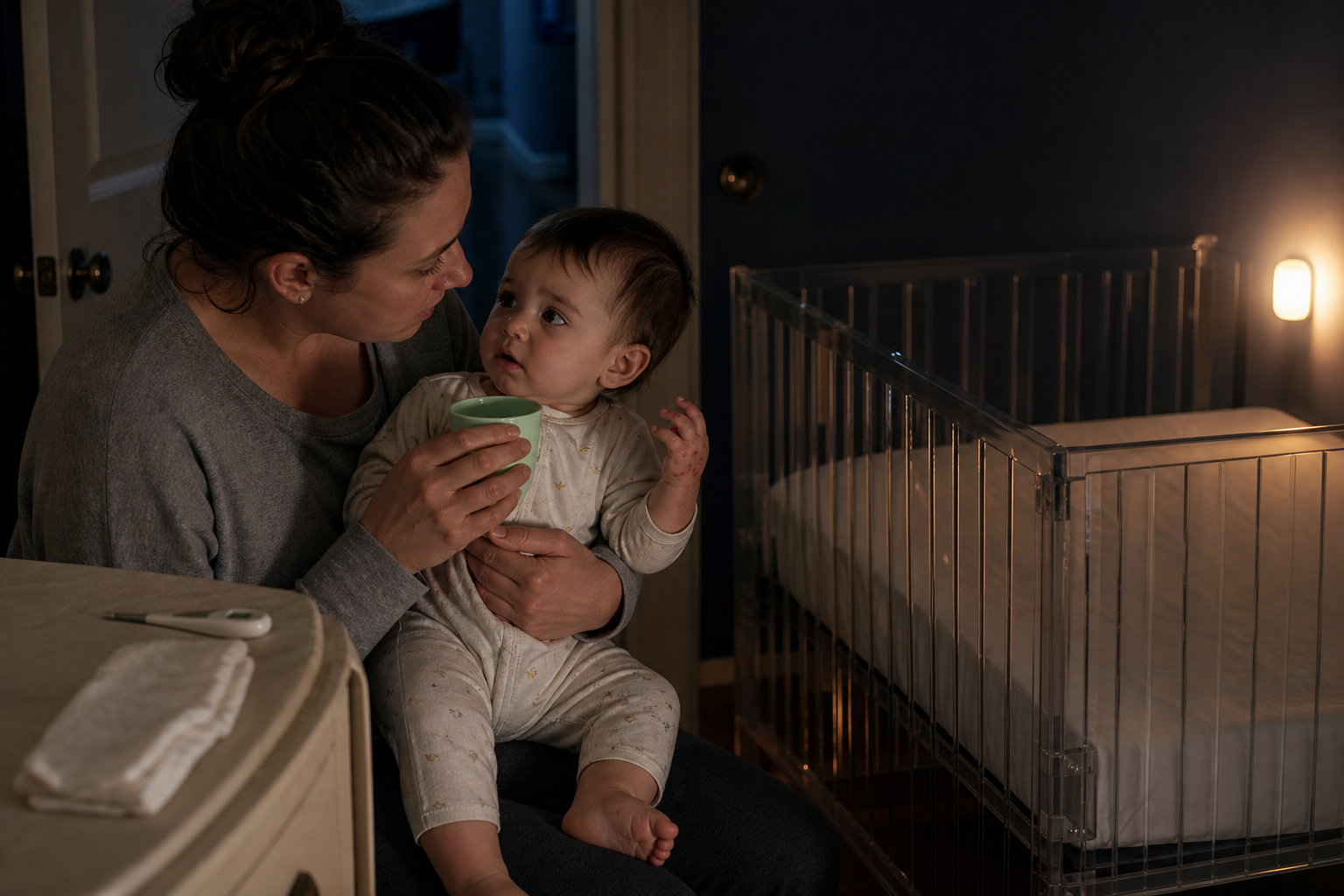
The search usually happens beside something small: a bottle or cup that is still too full, a damp washcloth, the thermometer on the dresser, the fitted sheet you have already changed once. You are listening to a cry that sounds different because swallowing hurts, and you are trying to decide whether your baby needs another cuddle, another drink, or a doctor.
I would not begin by calculating how much sleep has been lost. I would begin with the body in front of me. Is breathing easy? Does my baby look at me, protest, reach, or settle in a recognizable way when awakened? Can they swallow enough to keep fluids going? Are the wet diapers still arriving? Those answers tell us much more tonight than the length of the last nap.
Why hand, foot and mouth disease can wreck sleep
HFMD is usually a mild viral illness, but “mild” describes the expected medical course, not the quality of the night. Mouth sores can begin as red spots on the tongue or inside the mouth, then blister and become painful. A baby may drool more, pull away from a feed, accept only a little at a time, or cry just as sucking and swallowing begin. Fever, sore throat, and the general heavy feeling of being ill can shorten sleep and make every resettle harder.
The rash on the hands, feet, legs, arms, or diaper area may also be tender. CDC notes that the rash is not usually itchy, so a baby who cannot settle is often reacting to pain, fever, thirst, or malaise rather than an itch that needs a home remedy. None of those possibilities can be diagnosed from one wake-up, which is why the pattern around sleep matters.
A tired, uncomfortable baby
- Wakes with touch or ordinary prompting.
- Looks at you, cries, reaches, or resists in a familiar way.
- Takes at least some breast milk, formula, or age-appropriate fluid.
- Continues to urinate, even if the night is messy.
A baby who needs prompt assessment
- Is unusually difficult to wake or excessively sleepy.
- Cannot drink well or repeatedly refuses feeds because swallowing hurts.
- Has substantially fewer wet diapers, dry mouth, fewer tears, or a sunken soft spot.
- Looks increasingly ill, weak, poorly colored, or unlike themselves.
SleepBaby.org bedside distinction: ordinary tiredness still produces a recognizable response; abnormal responsiveness or poor hydration changes the plan.
When the pattern changes
Different nights.
Work through bedtime again.
A bedtime that worked last week can feel completely different tonight. Press play below for ideas to help you work through settling and the nights ahead.
Prefer to read?Press play for a little help with your baby’s next bedtime.
Kind words about the original video
“Thank you so much for this video!”
“I'm truly impressed with how much information you share in your video.”
The SleepBaby Workshop
Get the Workshop.
Get the Workshop, including Nap Rescue & Transition and the 14-Night Progress Review. 15 guides and five audio tracks in a simple browser hub. Read, listen, and return to the part you need.
Current price shown in the cart.
Digital Workshop. Nothing ships.
A conversation, if you want one.Night Owls is the SleepBaby chat room. Read what is there or join in.
Use the same seven checks at each difficult waking
-
1. Watch one quiet minute of breathing
Look at the chest and belly. Listen for a cry or sound that is normal for your baby. Struggling for each breath, blue or gray color, or a baby who can barely cry is emergency territory. HFMD is not an explanation to place over a breathing problem.
-
2. Check how your baby wakes and responds
A sleeping baby does not need to be kept awake merely because they are sick, but they should respond in a recognizable way when you need to assess them. Notice eye contact, movement, tone, crying, and whether they can be comforted. Unusual limpness or difficulty waking is not a sleep-training question.
-
3. Measure temperature when fever matters
Use a thermometer rather than judging by the forehead. For a baby 3 months or younger, a rectal temperature of 100.4°F (38°C) or higher means immediate pediatric contact even if the baby otherwise looks well. For older babies, follow your clinician’s fever instructions and call sooner when the child looks significantly unwell.
-
4. Offer the right fluid
Continue breast milk or formula for young infants. Do not replace feeds with plain water in a baby under 6 months. Older babies can have the fluids already appropriate for their feeding stage. Smaller, more frequent offers may be easier than insisting on one normal-sized feed when the mouth is sore.
-
5. Count urine, not hopeful sips
A few swallows are encouraging, but wet diapers show whether enough fluid is making it through. Compare with your baby’s usual pattern. Reduced urination, dry mouth, fewer tears, a sunken soft spot, or increasing sleepiness deserves prompt clinical guidance.
-
6. Ease pain without improvising
Use only a single-ingredient pain or fever medicine appropriate for your baby’s age and weight, exactly as the label and clinician direct. Never give aspirin to a child. Do not use adult mouthwash, homemade numbing mixtures, or oral benzocaine products; FDA says benzocaine should not be used in children younger than 2 because of a rare but potentially fatal blood disorder.
-
7. Return to the safe sleep space
After awake comfort and fluids, place your baby on the back on a firm, flat, noninclined mattress in a safety-approved crib, bassinet, or play yard with only a fitted sheet. Illness does not make pillows, wedges, positioners, loose blankets, or an inclined mattress safe.
SleepBaby.org night check: breathe ? respond ? temperature ? drink ? urine ? comfort ? flat safe sleep.
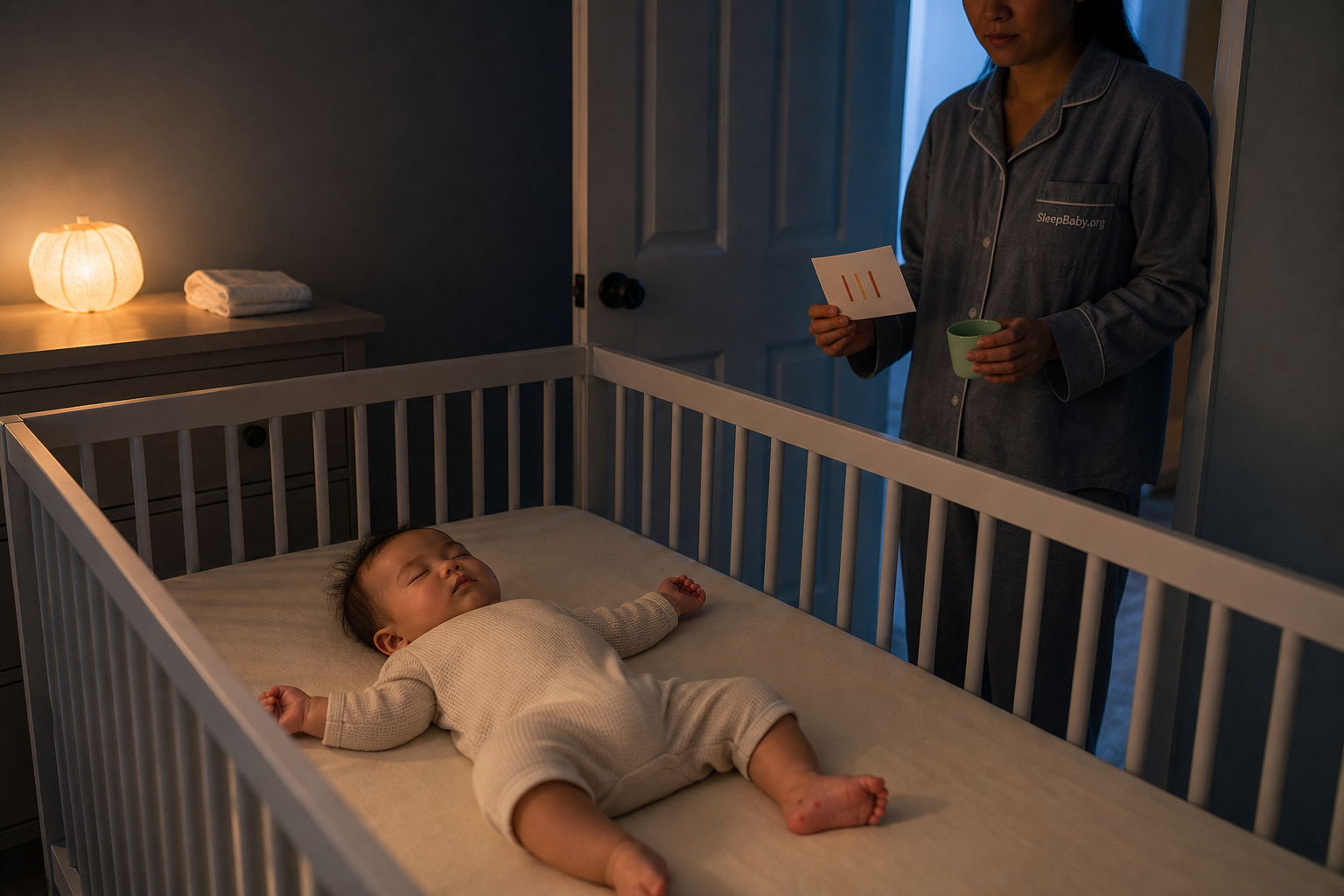
The bottle, breast, cup, and diaper tell one hydration story
Mouth ulcers create an especially frustrating loop. Swallowing hurts, so the baby drinks less. Drinking less makes the mouth feel drier and the child feel worse. Discomfort then interrupts sleep, and a very tired baby may have less patience for the next feed. The practical way through is often frequency rather than pressure.
Offer breast milk or formula more often to a young infant. If an older baby already drinks from a cup and their clinician has no reason to restrict fluids, cool age-appropriate drinks may be soothing. For babies eating solids, cool soft foods may be easier than hot, salty, spicy, or acidic foods. Food can wait more easily than fluid during a short illness; a parent should not turn bedtime into a contest over finishing dinner.
I would write down the time of feeds and wet diapers only if exhaustion is making the night blur. This is not a new permanent tracker and it does not need to be beautiful. A note that says “11:20 feed, 12:05 wet diaper, 1:40 small feed” can keep two caregivers from relying on the same uncertain memory. The note is useful because it answers a clinical question, not because parenthood needs another spreadsheet.
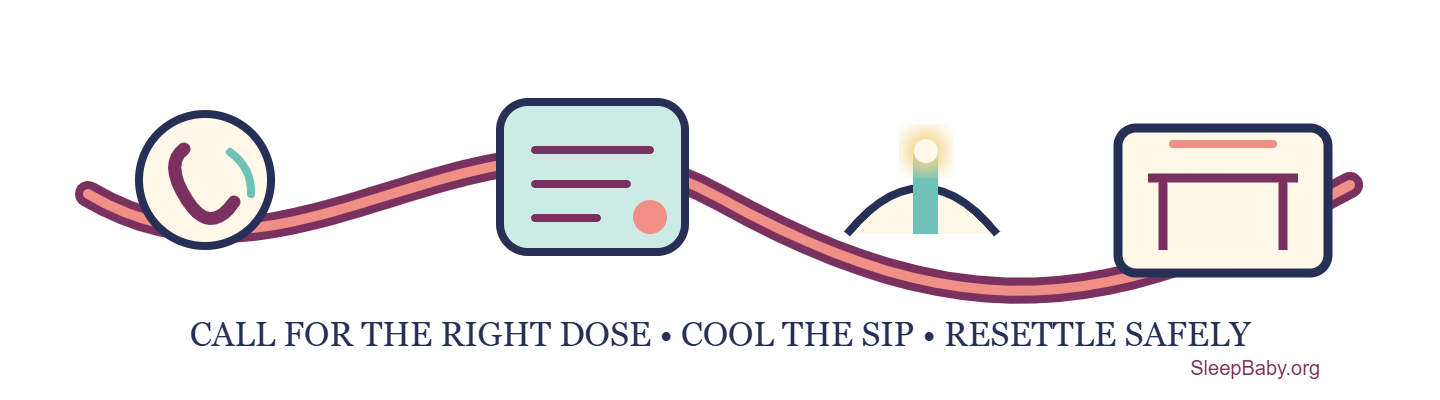
Pain relief can help sleep, but the medicine boundary is narrow
There is no routine medicine that cures HFMD. Pain relief matters because a baby who can swallow more comfortably may drink and rest more easily while the immune system clears the illness. It should be treated as symptom support, not as a sedative or a way to force the old schedule back into place.
| Situation | Safer next step | Avoid |
|---|---|---|
| Fever or mouth pain | Ask the pediatric clinician or pharmacist which single-ingredient medicine fits the baby’s age and weight; follow the label exactly. | Guessing a dose, using a kitchen spoon, combining products with the same ingredient, or medicating a very young infant before calling. |
| Painful mouth sores | Offer appropriate cool fluids frequently; ask before using any oral product in a baby. | Benzocaine under age 2, adult mouthwash, viscous lidocaine unless specifically prescribed and directed, or improvised numbing mixtures. |
| A miserable bedtime | Comfort while awake, hold, feed, and resettle as needed, then return baby to the safe sleep space. | Sedating antihistamines, cough-and-cold products, or medicine given primarily to make a baby sleep. |
| Persistent or worsening symptoms | Call the child’s clinician, especially for fever beyond 3 days, severe illness, poor drinking, or no improvement by day 10. | Increasing doses or adding remedies because sleep remains broken. |
Ibuprofen is generally not recommended for babies under 6 months unless a clinician specifically directs it. Acetaminophen also requires age- and weight-appropriate dosing, and a baby under 2 months should not receive fever medicine before pediatric advice. The correct dose cannot be supplied safely by an article because formulations, weights, histories, and local labels differ.
Never give aspirin to a child. Do not assume a product is infant-safe because it is sold beside teething supplies or says “oral pain” on the box. The painful spot is in the mouth, but the medicine still reaches the whole child.
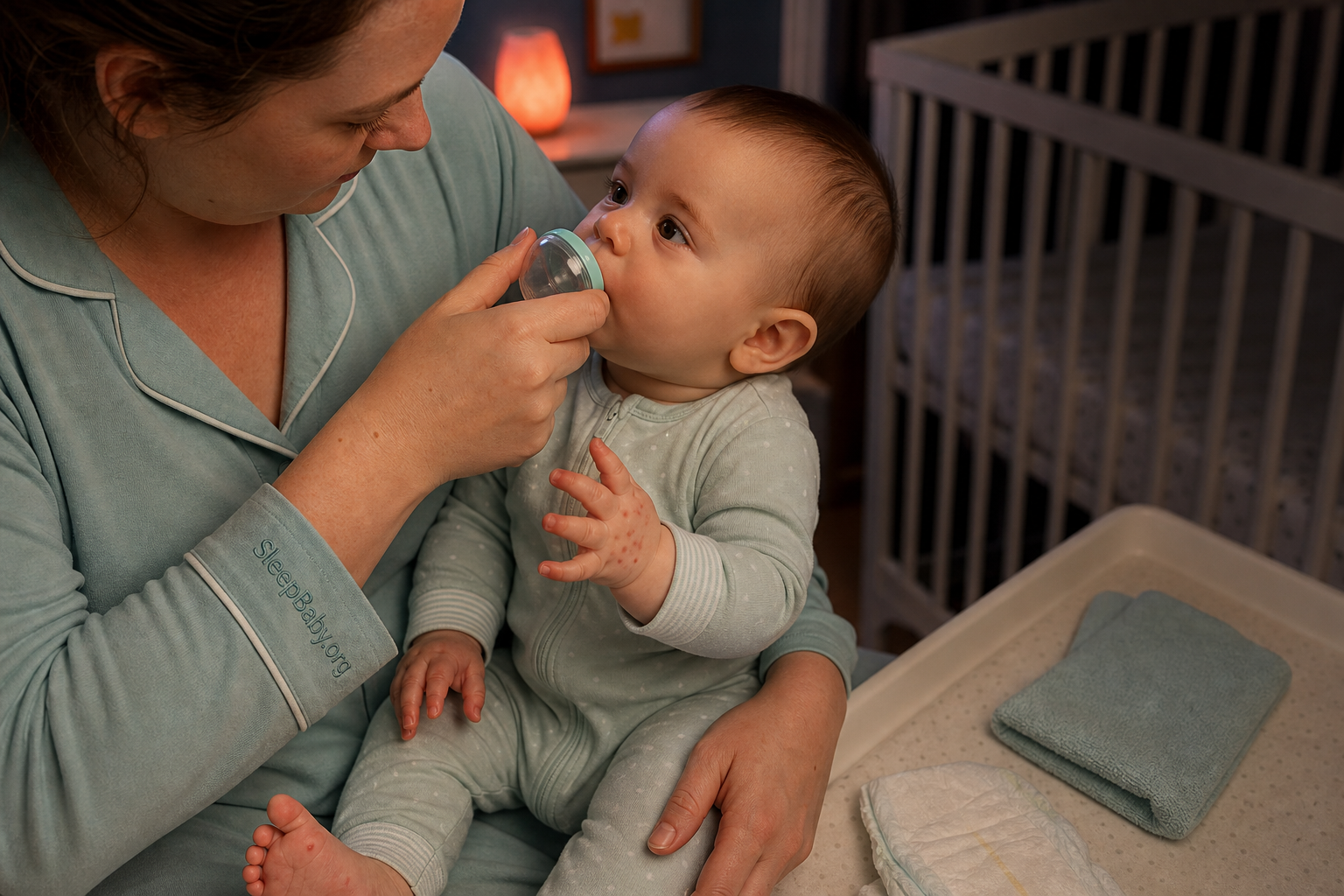
A Kacey-and-Benjamin composite: the bottle that stayed too full
This is a clearly labeled composite scene based on common parent concerns. It is not a documented event in our family and is not medical evidence.
In the scene I picture, the room is dim except for the small mint nightlight near the dresser. Benjamin has woken again, and the bottle in my hand is still much heavier than I want it to be. He latches for two swallows, pulls away crying, then reaches back because he is thirsty. The contradiction is the whole night: he wants what hurts.
I feel the temptation to call any sleep a victory. If he finally closes his eyes against my shoulder, part of me wants to leave every check until morning. But the question I need to answer is not merely “Can he fall asleep?” It is “Is he taking enough fluid, responding normally, and still making urine?” A sick baby can sleep because they are tired. A dehydrated or unusually difficult-to-wake baby needs a different response.
So composite Kacey turns on one quiet lamp, checks his breathing and color, wakes him enough to see the familiar protest, offers another small feed, and notes the wet diaper. Then she holds him until his body softens and places him on his back in the empty crib. No pillow under the mattress. No towel roll. No soft nest added because the night feels exceptional.
That scene helps me name the private fear beneath this search: if I let my baby sleep, will I miss something? The answer is not to keep an improving, hydrated baby awake all night. It is to know which observations matter, make them deliberately, and call when they stop reassuring you.
A sick baby still needs a flat, clear sleep space
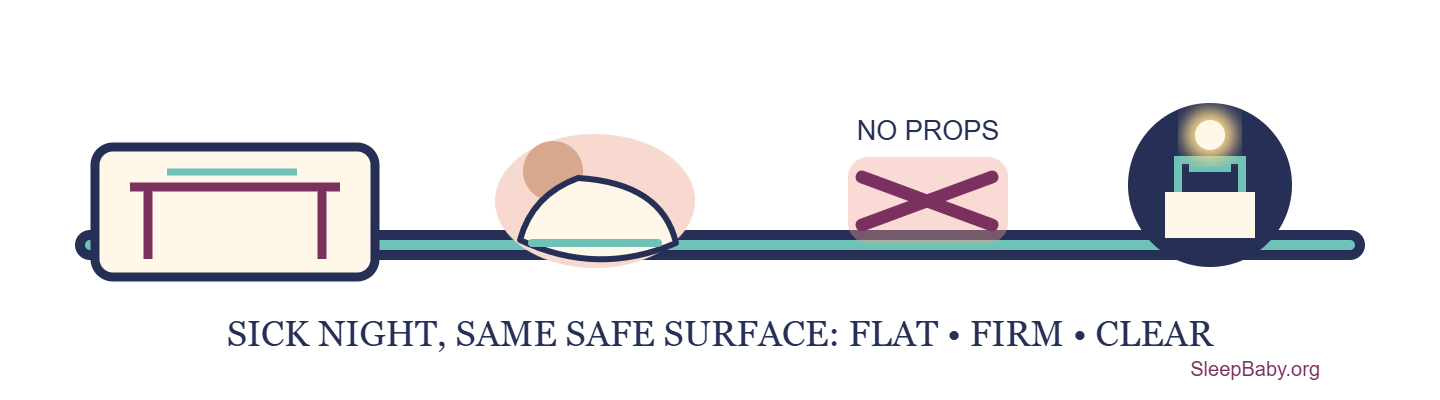
When a baby is uncomfortable, unsafe additions can look like care. A pillow seems softer for tender skin. An inclined mattress seems easier for swallowing. A blanket nest seems more secure after an hour of holding. But none of those changes treats HFMD, and each can add suffocation or entrapment risk.
Place your baby on the back for every nap and nighttime sleep. Use a firm, flat, noninclined surface approved for infant sleep, covered only by a fitted sheet. Keep pillows, quilts, loose blankets, stuffed toys, bumpers, wedges, positioners, and weighted products out. Dress the baby in fitted sleep clothing appropriate for the room and avoid overheating, especially when fever is present.
Comfort can be generous while your baby is awake. You can hold, rock, feed, sing, or sit beside the crib. The boundary arrives when the caregiver may fall asleep: move the baby back to their own safe sleep space. Sofas and armchairs are particularly hazardous places to accidentally sleep with an infant. If another safe adult can take a shift, ask before exhaustion makes the decision for you.
Awake comfort
Hold upright if that is soothing, offer an appropriate feed, wipe drool gently, cuddle, and observe. Stay awake and attentive.
Sleep
Back in the crib or bassinet, firm and flat, fitted sheet only. The safe setup stays ordinary even when the night is not.
What happens to the schedule for the next few days?
Let it loosen. A baby with fever or painful mouth ulcers may nap at odd times, wake after short stretches, feed in smaller portions, and need more help settling. This is not the moment to protect wake windows more fiercely than hydration. It is also not good evidence that your baby has permanently forgotten how to sleep.
Keep only the cues that still help: dim lights, a short song, familiar sleep clothing, white noise at a conservative volume and distance if your family already uses it, and the same safe sleep space. Skip the parts that create friction. A bath may sting irritated skin or simply cost energy. A long story may be too much. “Routine” can shrink to medicine if due and clinician-approved, feed, diaper, pajamas, cuddle, crib.
Respond to discomfort. If your baby needs to be picked up, pick them up. If they are hungry or thirsty, feed them. If you need to check temperature or urine output, do it. Supporting an ill child is not a sleep association emergency. Once fever and mouth pain improve and drinking looks normal, return gradually to the ordinary order of the day rather than trying to repair every sick-night wake at once.
Most HFMD symptoms improve within 7–10 days, often with the first days feeling worst. Recovery is not always perfectly linear. Appetite may lag behind energy, and sleep may take another night or two to feel recognizable. What matters is the broader direction: easier drinking, normalizing wet diapers, improving comfort, and a child who is more like themselves.
Make the overnight handoff useful, not elaborate
If two caregivers are trading shifts, pass along only the facts that change care: last measured temperature, last medicine and exact time if one was given, what fluid was offered and roughly how much was taken, the most recent wet diaper, and any change in breathing or responsiveness. Do not rely on “I think it was around midnight” when another dose may be considered. Use the medicine log on the package or a plain note, keep every product in its original container, and let one adult confirm the label before anything is given.
HFMD spreads through respiratory secretions, saliva, blister fluid, and stool. Wash hands with soap and water after diaper changes and before preparing feeds or medicine. Do not share cups, utensils, towels, or toothbrushes. Clean frequently touched surfaces and keep blisters clean rather than opening them. These steps will not make tonight quiet, but they can reduce the chance that the next exhausted person in the house becomes sick too.
A handoff is also the moment to say the concern out loud. “She drank less but had a wet diaper and woke normally” is different from “I could barely wake her and the diaper is still dry.” The second sentence should trigger a call, not another attempt at the bedtime routine.
Questions worth taking to the pediatrician
- My baby is taking less than usual. What intake or wet-diaper change should trigger same-day assessment for this age?
- Which pain medicine, formulation, and dose are appropriate for my baby’s current weight and medical history?
- My baby is under 6 months. Do you want to examine them even if symptoms appear mild?
- The fever has lasted more than 3 days, returned, or is accompanied by worsening behavior. What should we do next?
- The mouth pain is preventing feeds. Is there any child-safe oral treatment you specifically recommend, or should we avoid topical products?
- How should I adjust fluids if my baby has another medical condition or an individualized feeding plan?
Call sooner if your instinct is that the illness no longer resembles the mild course you were told to expect. A general list cannot capture every premature infant, immune condition, feeding disorder, kidney issue, medication interaction, or rapidly changing baby. Your clinician can apply the history this article does not have.
Watch: recognizing dehydration in a sick child
St. Louis Children’s Hospital explains the signs that turn poor drinking into a medical concern. Watch for the bedside observations that matter overnight, then return to the checklist above for your baby’s age and history.
Takeaway: fewer wet diapers, dry mouth, fewer tears, sunken eyes or soft spot, and unusual sleepiness are reasons to contact a clinician rather than simply keep trying bedtime.
Your plan for the next waking
- Look and listen to breathing before assuming this is ordinary restlessness.
- Wake enough to confirm a familiar response when assessment is needed.
- Measure temperature, applying the immediate under-3-month fever rule.
- Offer breast milk, formula, or another developmentally appropriate fluid.
- Check the wet-diaper pattern and other dehydration signs.
- Use only clinician- and label-directed pain relief; never aspirin or benzocaine for a baby.
- Comfort freely while awake, then return baby to a flat, clear, separate safe sleep space.
The bottle or cup beside you may still be too full. The thermometer may stay on the dresser for another night. But the objects are no longer asking one enormous question—“Is my baby okay?”—without giving you a way to answer. They are part of a smaller set of observations: normal breathing, a recognizable response, measured temperature, fluid taken, urine made, pain eased safely, back into the crib.
I would let an improving, hydrated baby sleep. I would also keep the threshold for calling low when drinking falls, urine drops, fever persists, or the baby becomes unusually sleepy or difficult to wake. A perfect night is not the assignment. The assignment is a safely sleeping baby whose body is still giving you reassuring answers.
When illness has taken over bedtime
Keep the sleep plan simple enough to carry
Tonight may belong to fluids, comfort, and repeated checks. When your baby’s symptoms ease, SleepBaby.org can help you find the calm, age-appropriate bedtime rhythm underneath the temporary disruption—without pretending an illness night should behave like an ordinary one.
Sources
- CDC: HFMD Symptoms and Complications
- CDC: About Hand, Foot, and Mouth Disease
- American Academy of Pediatrics: Hand, Foot & Mouth Disease
- American Academy of Pediatrics: Signs of Dehydration in Infants & Children
- American Academy of Pediatrics: Fever and Your Baby
- FDA: Risk of serious blood disorder from oral benzocaine products
- CDC: Helping Babies Sleep Safely
- NHS: Hand, foot and mouth disease
The SleepBaby.org Workshop
Make a plan for
the next bedtime.
Practical help for wake-ups, short naps, and sharing the night shift. Watch the original video, then get 15 guides and five audio tracks for $9.
$9 USD, paid once. No subscription. Digital access.
Watch the original Baby Sleep Miracle presentation
Press play for a little help with your baby’s next bedtime.
Original presentation. Watch before you decide.
15practical guides
5audio tracks
1one-time payment
Kind words about the original video
“Thank you so much for this video!”
“I'm truly impressed with how much information you share in your video.”
Inside the Workshop
Start with the night
you're having.
You don't need to read all 15 guides before bedtime. Choose the one that answers the question in front of you, then come back for the next part.
Before you buy
A few things
made clear.
A straightforward purchase, with space to decide what fits your family.
What am I buying?
The SleepBaby.org Workshop includes 15 digital guides, five audio tracks, and the original Baby Sleep Workshop PDF as an additional download. It costs $9 USD, paid once, with no subscription. Nothing is shipped.
Where should I start?
Try Tonight Rescue when you need a starting point. If your question is more specific, go straight to the guide on naps, a caregiver handoff, the sleep space, or another topic. You can read at your own pace.
Is this personal sleep coaching?
No. This is an educational collection for parents of babies and young children. Use the age-specific guidance, and bring feeding, breathing, growth, illness, or other health concerns to your child's clinician. It does not diagnose a problem or promise a sleep result.
Is the video the paid Workshop?
You can watch the original Baby Sleep Miracle presentation on this page. Your purchase is the SleepBaby.org Workshop collection of guides, audio tracks, and the original PDF described here.
How do I find it after checkout?
On your thank-you or order-status page, look for Open Workshop access, then Open your SleepBaby Workshop. Keep your order confirmation so you can return. If you need help finding your access, use our Workshop download help.
The SleepBaby.org Workshop
Have somewhere to start
at the next bedtime.
15 practical guides. Five audio tracks. One $9 purchase.




Leave a comment