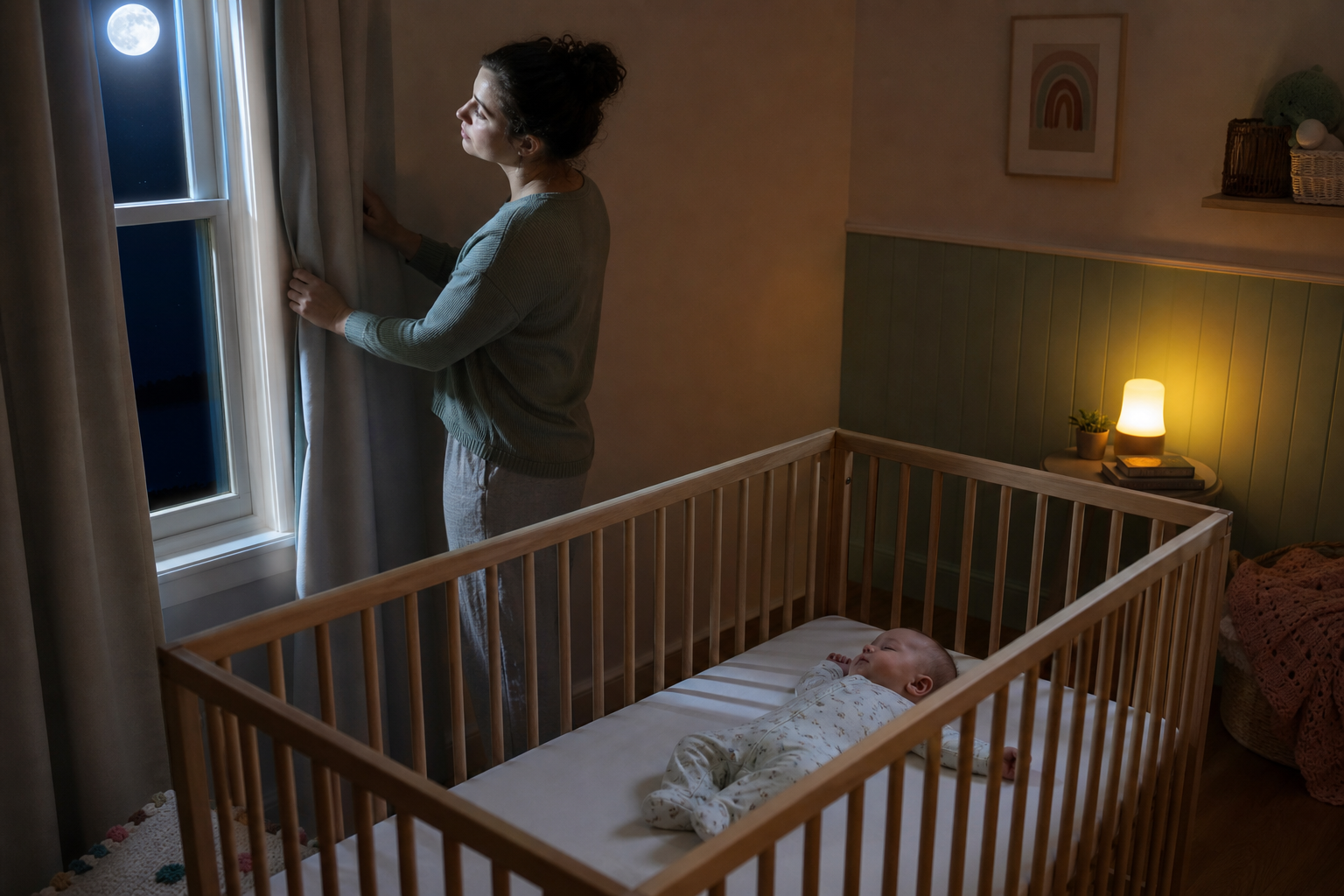
The nursery is finally dark—except for one silver stripe crossing the floor—and your baby is awake again. You pull the curtain tighter, glance at the bright circle outside, and suddenly the moon has a performance review.
A full moon probably is not the reason your baby is not sleeping, at least not in any way one rough night can prove. Researchers have found a few small lunar associations in older children and adults, but the results conflict, the effects are modest, and none of the studies in this research pass tested babies. Literal moonlight entering the room is worth checking. So are feeds, illness or discomfort, nap timing, bedtime, developmental change, and plain night-to-night variation. I would keep the moon on the calendar and put the baby’s actual clues back in charge.
What the full-moon sleep studies actually found
The honest answer is more interesting than “yes” or “no,” but it is also less dramatic than the internet tends to make it. Some studies have detected changes near the full moon. Others have not. The populations, measurements, and definitions of “near the full moon” differ, and a statistically detectable difference is not automatically large enough for a family to notice.
The largest child study in this evidence set followed 5,812 children ages 9 to 11 across 12 countries. The researchers analyzed 33,710 days of accelerometer data. Children slept an average of 4.9 minutes less during the study’s broad full-moon window than during its new-moon window. That was about a 1% difference. Physical activity and sedentary time did not meaningfully differ.1
Five minutes is a real number. It is not a convincing explanation for a baby who was awake for two hours, refused three transfers, or suddenly started feeding more often. The children were also school-aged, not infants, and the study was observational. It found an association; it could not show that the moon caused it.
A 2022 study gives the question another wrinkle. Researchers reanalyzed data from 46 healthy children ages 3 to 5.9 who completed carefully controlled dim-light assessments. Evening melatonin concentrations were lower in the group assessed near the full moon than in the group assessed near the new moon.4 That is biologically interesting. It still does not tell us that a full moon makes babies wake, because the sample was small, the analysis was post hoc, the children were preschoolers, and the study did not test whether they slept worse.
Adult research is conflicted too. One field study found later sleep onset and shorter sleep before the full moon in communities with very different access to electric light.2 But a separate analysis of three large sleep-laboratory datasets failed to reproduce a lunar effect and warned that unpublished null findings can make a phenomenon look more consistent than it is.3
The lunar evidence scale
Signal detected
Small changes appeared in some older-child and adult studies.
Signal disputed
Other large datasets found no reliable lunar sleep effect.
Infant answer missing
None of these results proves that lunar phase disrupts a baby’s sleep.
SleepBaby.org interpretation: interesting enough to study, too uncertain to use as a diagnosis or a bedtime rule.

I would not tell a tired parent that nothing was noticed. If the night felt different, it felt different. The useful correction is narrower: you noticed a difficult night during a full moon is evidence about your night. It is not yet evidence that the moon caused it.
Why the pattern can feel so convincing
A full moon is memorable. Ordinary nights are not. If your baby wakes on a random Tuesday, you think about the nap, the last feed, the stuffy nose, or the fact that bedtime quietly wandered forty minutes later. If the same wake happens beneath a bright moon, the night arrives with its own label.
That label changes what adults notice. We remember the moonlit disaster and rarely make a matching note on the perfectly ordinary quarter-moon night when the baby also woke twice. This is not foolishness; it is what exhausted brains do when they are trying to make a pattern out of incomplete information. At 2:08 a.m., the moon is also the only suspect visible from the window.
There is another possibility that does not require a mysterious biological force: actual light. A full moon can make the outdoors noticeably brighter, and a stripe of light may reach a crib when curtains gap or a window faces the moon’s path. The child study estimated full-moon illumination outdoors at roughly 0.25 lux—bright for moonlight, but still very dim compared with typical indoor lighting.1 The preschool melatonin study controlled bedroom light and still found an association, which is one reason researchers continue asking whether something beyond visible moonlight could be involved.4
For your baby tonight, you do not need to solve the mechanism. If light is visibly hitting the sleep space or making the room brighter than usual, you can test the environment. If the room is already consistently dark, another blackout layer is unlikely to explain a dramatic change. That distinction keeps a practical idea from becoming a promise.
Use the Moon-or-Pattern Check before changing bedtime
I like a decision tool that can survive an interrupted night. This one has four lanes. Start with the baby, then the room, then the timing. The moon gets considered last, because it cannot tell you whether your baby is hungry, uncomfortable, overtired, undertired, ill, or simply between sleep cycles.
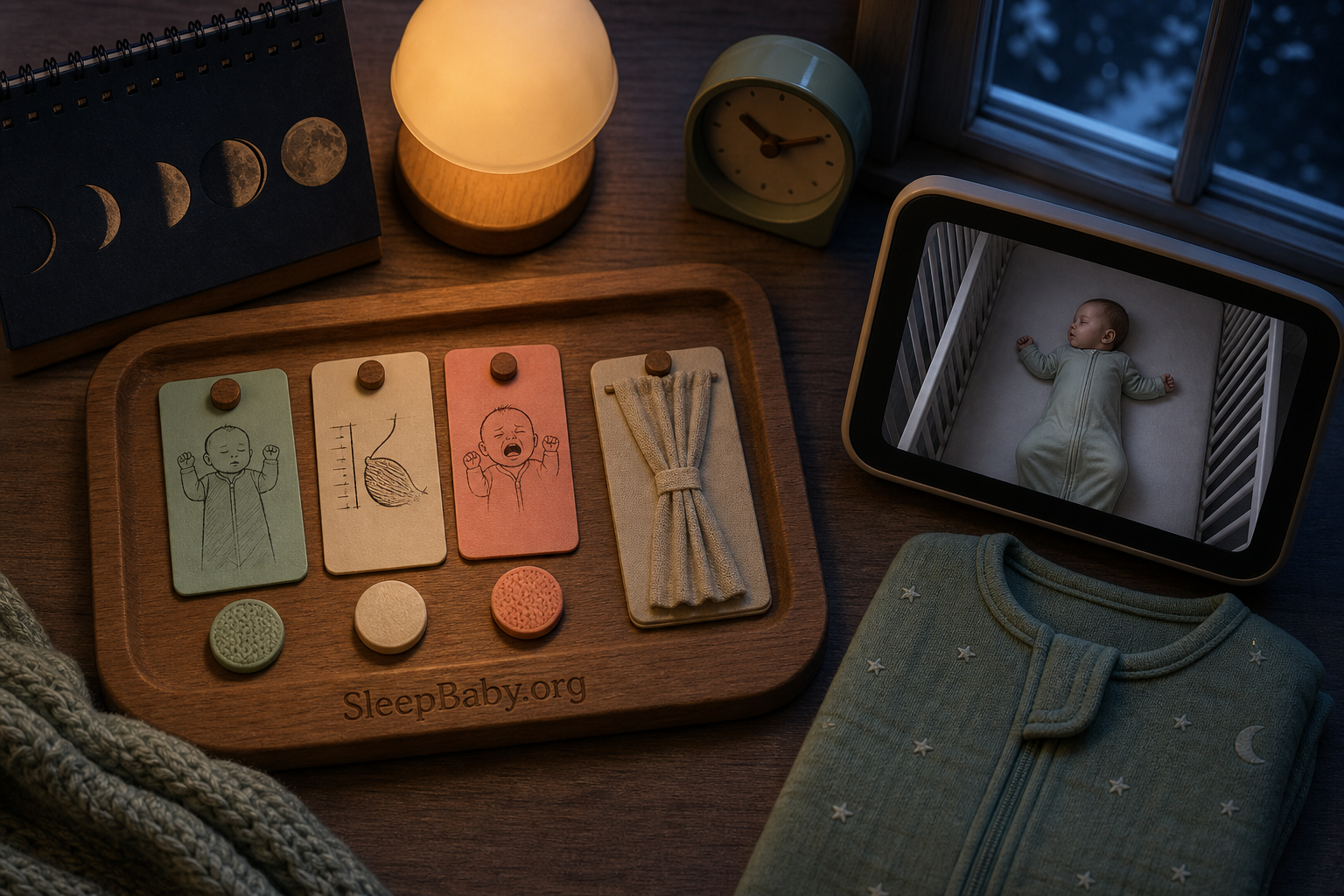
Moon or pattern? Follow the orbit inward
- Baby/body: feeding, wet diapers, breathing, temperature, pain, congestion, unusual crying, alertness, and any clinician-directed plan.
- Room: visible light, temperature, a new sound, HVAC cycle, screen glow, door movement, or another timed household event.
- Day: actual nap lengths, final nap end, last feed, bedtime, new skill, travel, teething, or a disrupted routine.
- Calendar: moon phase only after the first three lanes are recorded across comparable nights.
Stop the experiment when illness, feeding trouble, breathing changes, pain, or a marked behavior change becomes the real question.
SleepBaby.org original decision path. It organizes observation; it does not diagnose a sleep or medical problem.
If your baby wakes at nearly the same clock time across many nights—not only on the full moon—our guide to testing a repeatable same-time wake without blaming the clock takes this pattern method further.

What I would do tonight, in order
1. Meet the need in front of you
Respond to hunger, discomfort, a dirty diaper, illness, or the level of support your baby currently needs. Do not delay a feed or leave a distressed baby waiting because you are trying to collect cleaner lunar data. A sleep experiment never outranks care.
2. Keep the sleep space safe
For every infant sleep, place your baby on the back on a firm, flat, level, noninclined surface intended for infant sleep. Use a fitted sheet and keep the space clear of pillows, loose blankets, bumpers, positioners, toys, and weighted products. Room sharing without bed sharing is recommended. Those rules do not change when the moon is full.7
3. Look for literal light
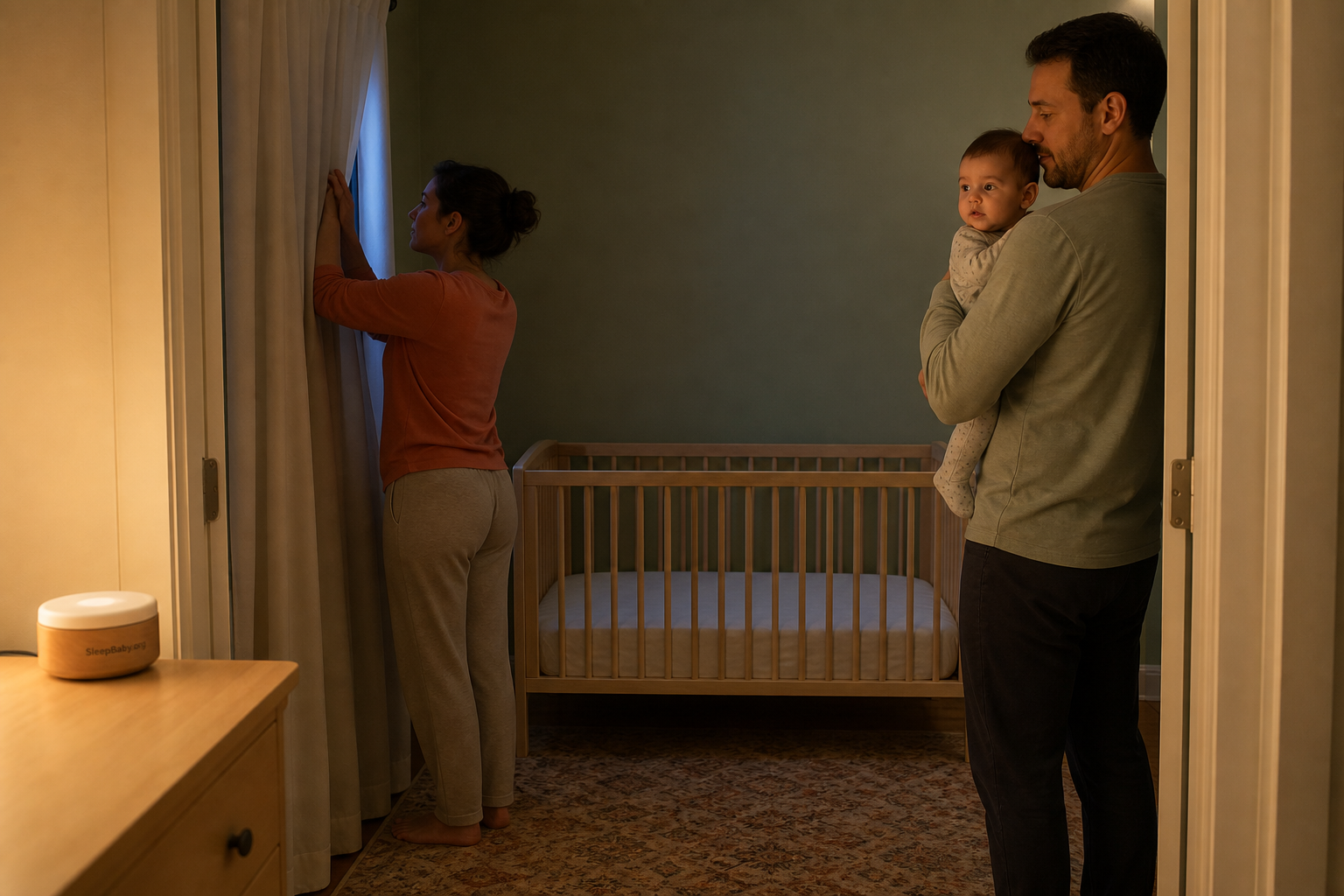
Stand where your baby sleeps and let your eyes adjust. Is there a bright stripe on the mattress or wall? Does the curtain gap change as the moon moves? Is an outdoor security light, hallway lamp, monitor screen, or phone contributing more light than the moon? If the room is visibly brighter, close the existing shade or curtain fully. Keep coverings and cords secured at the window and completely outside the sleep space and the baby’s reach.
4. Repeat the normal wind-down
Do the ordinary sequence your family can repeat: feed as appropriate, diaper, pajamas or sleep sack, a short book or song, dim interaction, and safe placement. In a randomized study of children ages 7 to 36 months, a consistent nightly routine improved several parent-reported sleep outcomes.5 That supports steadiness for the ages studied; it does not mean a routine will override hunger, illness, development, or every night waking. Newborn care stays responsive and feeding-led.
5. Change one plausible variable, not the whole nursery
If visible window light is the only new clue, test better light blocking while leaving the rest of the routine alone. If light is not different, do not add blackout fabric, white noise, a later bedtime, an earlier bedtime, a new settling method, and a new feeding pattern all at once. Five simultaneous fixes can produce one improved night and no idea why.
6. Give the night a fair label
“Rough full-moon night” is less useful than “bedtime 7:25, final nap ended 4:50, last feed 6:55, room dark, wakes at 10:40 and 2:05, congested, resettled after feeding.” The second description may not be prettier, but it gives tomorrow something to work with.
A three-night comparison that does not take over your life
You do not need to track an entire lunar month unless you genuinely enjoy spreadsheets. Three comparable nights can answer the first practical question: is there a repeatable environmental or timing clue worth testing?
| Record | Night 1 | Night 2 | Night 3 | What it may reveal |
|---|---|---|---|---|
| Final nap + bedtime | Timing changed before sleep changed. | |||
| Feeds | Waking aligns with hunger or a feeding change. | |||
| Visible room light | A window or household source is testable. | |||
| Wakes + help needed | A brief stir differs from a fully supported wake. | |||
| Body clues | Congestion, pain, fever, diapers, or alertness changes the lane. | |||
| One change tested | A result can be connected to one plausible input. |
Do not score the night only as “slept through” or “did not.” A later first wake, a shorter awake period, easier resettling, a clear hunger pattern, or proof that the room light made no difference can all be useful. The goal is not to win against the moon. It is to leave the third night knowing more than you knew on the first.
How to read those three nights without making the moon fit
I use three nights to help choose a sensible next step, but I do not treat them as proof that a lunar phase caused a baby’s sleep. I would read the notes by asking which explanation needed the fewest assumptions:
- The room-light pattern
- The cot area was visibly brighter, the rest of the routine stayed familiar, and sleep was easier after the light path was blocked. That supports a practical conclusion: visible light was worth managing. It still does not show that moon phase itself changed your baby’s biology.
- The timing or feeding pattern
- The difficult night followed a shifted last nap, later bedtime, missed feed, unusual outing, or different morning start. Work with that concrete timing or need first. A calendar label adds no useful treatment plan.
- The body or development pattern
- Waking arrived with congestion, fever, discomfort, hunger, a new motor skill, separation distress, or another change you could observe. Respond to the child in front of you and use the health boundaries below. The moon does not explain away symptoms.
- The no-repeat pattern
- One rough night sat between two ordinary ones, or the second and third nights behaved differently even though the moon looked much the same. That is useful evidence too: normal night-to-night variation is a stronger working explanation than a dependable lunar effect.
If you still see the same pattern next month, I would compare like with like: similar age-appropriate nap timing, health, feeds, bedtime routine, and room conditions. Write the moon phase down only after you record the night, so it does not steer what you notice. A pattern that repeats may justify a closer look at recurring light, household timing, or another monthly change, but a home log still cannot establish cause. Stop tracking when it makes you more watchful than rested. The useful endpoint is a calmer decision, not a perfect explanation.
Age changes what counts as a surprising night
Newborns and young infants
Newborn sleep is distributed across day and night, and waking for feeds is expected. Regular circadian patterns develop gradually. The AASM does not publish a sleep-duration recommendation for infants younger than 4 months because normal variation is wide and evidence is limited.6 A one-month-old observational study found relationships between sleep and broader natural/artificial light–dark patterns, but it did not test the full moon as a cause of waking.8
For this age, feeding, weight gain, wet diapers, temperature, breathing, and responsiveness matter more than moon phase. Do not stretch feeds, force a schedule, or try to keep a newborn awake so the next night looks more organized.
About 4 to 12 months
The AASM recommends 12 to 16 total hours of sleep per 24 hours, including naps, for infants 4 to 12 months.6 That range is a population recommendation, not a nightly test. An older infant can have one fragmented night and still land within their normal 24-hour pattern. New skills, changing nap needs, feeding, separation, illness, travel, and familiar settling conditions can all become more plausible explanations than a lunar phase.
Toddlers and preschoolers
Older children may be more aware of a bright window, a changed evening, or adult excitement about the moon. The small preschool melatonin study is relevant to scientists, but it cannot tell a parent to move bedtime or expect a bad night. Keep the routine recognizable, make the room appropriately dark, and judge the pattern by sleep and daytime function—not by the moon icon on a phone.

What I would not do because the moon is full
- I would not move bedtime dramatically based on one moon phase.
- I would not add melatonin or another sleep aid without the child’s clinician. A preschool melatonin finding is not a supplement recommendation.
- I would not skip or delay feeding to protect a sleep experiment.
- I would not add loose fabric, a canopy, a cover, or any object to the crib to block light.
- I would not use weighted sleep products or an inclined surface.
- I would not assume crankiness, anxiety, autism, ADHD, seizures, or another diagnosis is explained by lunar phase.
- I would not let a moon app become the narrator of every difficult night. It can label a date; it cannot examine your baby.
That last one is the trap I understand most. Once the calendar offers a story, every wake starts auditioning for it. I prefer the less glamorous explanation that can be checked: a gap in the curtain, a feed that shifted, a nap that ended late, a cold beginning, or a baby who had one noisy night because babies do not submit their sleep plans for astronomical approval.
When the moon question should become a health question
A sudden sleep change deserves medical attention when it arrives with body clues. Contact your child’s clinician for feeding difficulty, markedly fewer wet diapers, repeated vomiting, persistent pain, unusual lethargy or difficulty waking, a new concerning cry, poor growth concerns, regular loud snoring, gasping, breathing pauses, or a marked change that persists or feels unlike your baby.
For a baby younger than 3 months, a rectal temperature of 100.4°F (38°C) or higher needs prompt medical guidance. Get emergency help for severe trouble breathing, blue or gray color, a seizure, unusual limpness or unresponsiveness, or a baby who will not wake. Do not finish a moon log first.
Even without an urgent sign, call if you are worried. A clinician can consider age, feeding, growth, illness, medication, breathing, and development—information a lunar calendar does not have.
Watch: keep the foundation safe and simple
AAP pediatrician Dr. Jennifer Shu on getting a baby ready for sleep
When a strange night makes you want to rebuild everything, return to the setup that does not depend on a moon phase: a clear, firm, flat sleep space and back placement.
Takeaway: use a clear, firm, flat sleep space; place baby on the back; and treat independent settling as an optional practice rather than a requirement. Feeding, comfort, and illness care still come first.
Watch on YouTube if the privacy-enhanced player does not load
A practical buy only when the window is the clue
Tommee Tippee Portable Blackout Blind
If you can see moonlight, a security light, or early dawn spilling through the problem window, this portable blind gives you a clean one-variable test. The manufacturer describes it as lightweight, adjustable to the window, attached with suction cups, able to block daylight, and foldable for travel. That makes it a more exact fit here than a white-noise machine, which cannot change light, or a lunar app, which cannot change the room.
I like the purchase for this situation because it can solve a visible environmental job without asking you to redesign bedtime. Use it only on a compatible intact window, follow the manufacturer’s installation and removal instructions, check that the suction cups remain secure, and keep the window area completely outside your baby’s reach. It is not a sleep treatment, a guarantee, or evidence that the moon caused the waking.
See the portable blackout blind on Amazon
As an Amazon Associate, SleepBaby may earn from qualifying purchases.
What the next morning can tell you
In daylight, the silver stripe that looked like the answer may turn out to be one clue among six. Maybe the curtain solved it. Maybe the same waking happened in a fully dark room. Maybe the late nap explains more. Maybe your baby developed a runny nose by breakfast and the whole astronomical theory can be excused from the meeting.
That is progress. A useful sleep explanation does not have to be magical or complete; it has to improve the next decision. If the room-light test helped, keep it. If it did not, undo the unnecessary change and move to the next plausible lane. If the pattern persists or body clues appear, involve your child’s clinician.
I would let the moon remain beautiful. I just would not appoint it manager of the nursery. Tonight, close the curtain if actual light is getting through, keep the routine recognizable, respond to the baby in front of you, and write down only enough to make tomorrow less mysterious.
Sources
- Chaput J-P, et al. Are Children Like Werewolves? Full Moon and Its Association with Sleep and Activity Behaviors in an International Sample of Children. Frontiers in Pediatrics. 2016.
- Casiraghi L, et al. Moonstruck sleep: Synchronization of human sleep with the moon cycle under field conditions. Science Advances. 2021.
- Cordi M, et al. Lunar cycle effects on sleep and the file drawer problem. Current Biology. 2014.
- Hartstein LE, et al. Evidence of circalunar rhythmicity in young children’s evening melatonin levels. Journal of Sleep Research. 2022.
- Mindell JA, et al. A nightly bedtime routine: impact on sleep in young children and maternal mood. Sleep. 2009.
- Paruthi S, et al. Recommended Amount of Sleep for Pediatric Populations: A Consensus Statement of the American Academy of Sleep Medicine. Journal of Clinical Sleep Medicine. 2016.
- Moon RY, Carlin RF, Hand I, et al. Evidence Base for 2022 Updated Recommendations for a Safe Infant Sleeping Environment to Reduce the Risk of Sleep-Related Infant Deaths. Pediatrics. 2022.
- Yoshida M, et al. Dependence of nighttime sleep duration in one-month-old infants on alterations in natural and artificial photoperiod. 2017.
- American Academy of Pediatrics. Dr. Jennifer Shu offers tips on getting baby to sleep. Video.
When the moon stops being the suspect
Build a bedtime plan from the clues inside your house
The curtain is closed, the moon is still outside, and you have a better question: what can this family repeat when sleep goes sideways? SleepBaby helps you connect naps, feeds, bedtime, wakes, and the support your baby needs without letting one dramatic night rewrite the whole plan.