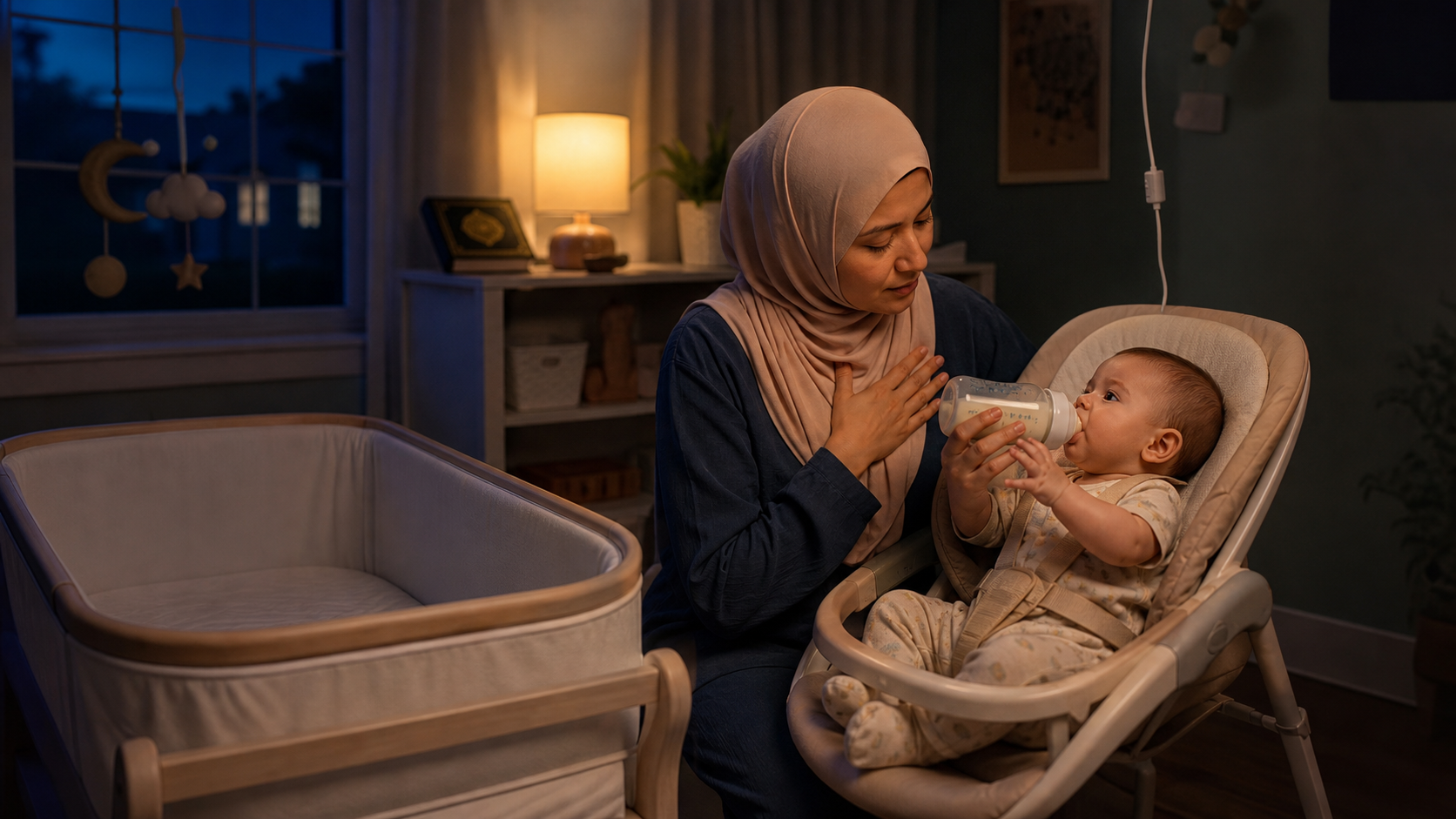
The answer I would want in the quietest, hardest hour
You can make dua while you care for your waking baby, but no dua guarantees sleep
There is an authentic protection dua connected to children, and there are authentic bedtime remembrances a caregiver can recite. I would use them as worship, comfort, and a steady rhythm for my own hands—not as a formula that must make a baby sleep. A waking baby may need milk, a diaper, help with temperature, relief from pain, a medical check, or simply time inside an immature sleep pattern. Recitation and responsive care belong together.
If your baby cannot be awakened, is limp or very weak, has blue or gray lips, tongue, or face, is struggling or grunting with each breath, has a seizure, or vomits green fluid, use emergency help now. Call your baby’s clinician promptly for a fever of 100.4°F (38°C) or higher in a baby under three months, weak or sharply reduced feeding, repeated vomiting, materially fewer wet diapers, unusual sleepiness, or any newborn who looks or acts abnormal. Keep praying if prayer steadies you—but do not delay the call.
The private question beneath “dua for baby not sleeping at night” is often, “Am I missing the one thing that would let both of us rest?” I do not want a tired parent carrying that spiritual burden. Your baby’s waking is not proof that your faith is weak, your words are wrong, or you have failed. The most faithful next step may be a soft recitation. It may also be a feed, a temperature check, a safe handoff, or medical help. This guide gives you a way to tell those steps apart without turning dua into a sleep product.
The authentic protection dua connected to children
The clearest child-connected source I found is Sahih al-Bukhari 3371. It reports that the Prophet sought refuge for al-Hasan and al-Husayn with these words:
Aʿūdhu bi-kalimāti-llāhi t-tāmmati min kulli shayṭānin wa hāmmah, wa min kulli ʿaynin lāmmah.
Meaning: I seek refuge in Allah’s perfect words from every devil, every harmful creature, and every harmful or envious eye.
I would recite that calmly over a baby as a prayer for protection. I would not append a promise the source does not make. The hadith does not say that these words sedate a baby, end every waking, diagnose the cause of crying, or replace medical care. Protection and sleep are not interchangeable claims. Keeping that distinction does not weaken the dua; it keeps our description honest.
You may see alternate spellings because Arabic sounds are represented differently in English letters. That does not mean the prayer only “works” with one internet spelling. If Arabic pronunciation is new to you, listen to a trusted teacher, move slowly, and say what you can with sincerity. I would rather give a parent a faithful source and room to learn than create fear about an accent in the middle of the night.
I also refuse the cruel implication that persistent waking proves an evil eye, jinn, sin, or an inadequate recitation. A baby can be protected and still wake hungry. A loved and well-cared-for baby can have an illness. A parent can pray with a full heart and still need help. Faith gives the night meaning; it does not erase the body.
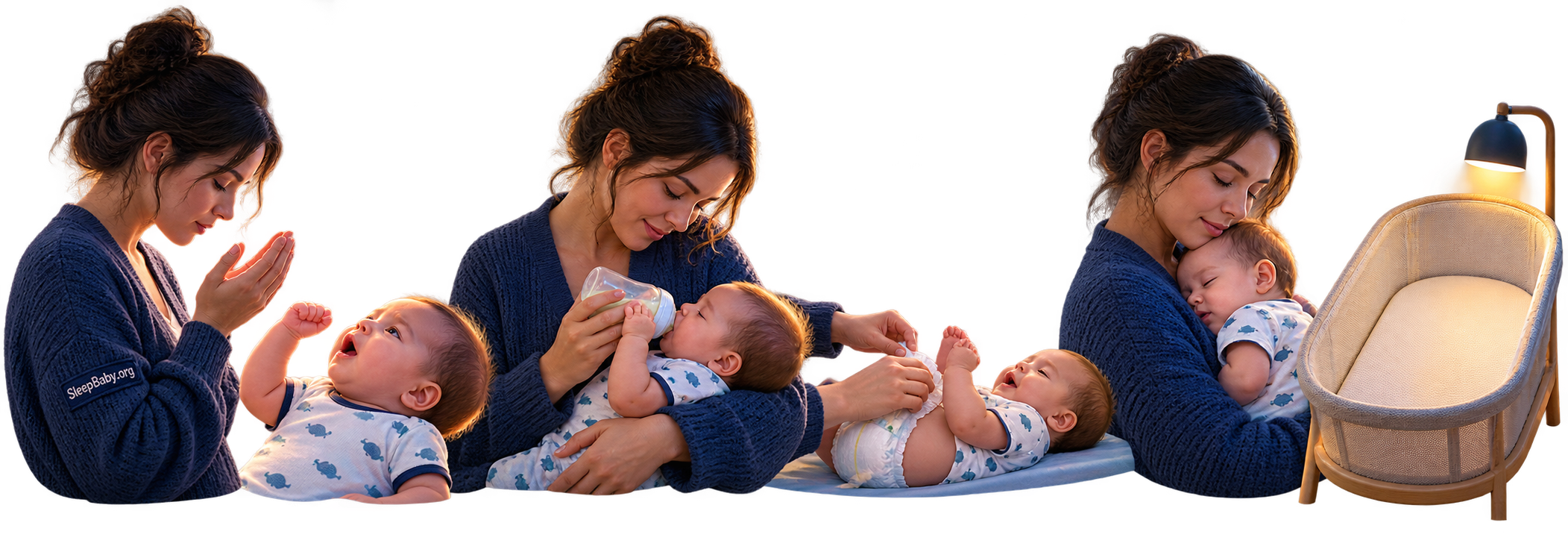
Four faith lanes—so an authentic source never becomes an invented promise
At 2 a.m., a list of Arabic phrases can blur together. I find it more useful to sort each practice by what its source actually supports. That gives a parent freedom to pray without feeling manipulated by a viral label such as “the one dua that makes any baby sleep.”
Lane one · Child-connected protection
The Bukhari 3371 protection wording
This is the most directly child-connected recitation in this guide. Use it as a prayer for protection. Do not rename it a guaranteed baby-sleep dua or treat a wake after recitation as spiritual failure.
Lane two · General bedtime remembrance
Bismika Allāhumma amūtu wa aḥyā
Sahih al-Bukhari 6324 records this before-sleep dua: “In Your name, O Allah, I die and I live.” It is an authentic general bedtime remembrance. I can say it as I prepare for sleep or as part of the home’s quiet rhythm, but I would not call it an infant treatment.
Lane three · Bedtime Quran recitation
The three Quls and Ayat al-Kursi
Bukhari 5017 describes the Prophet reciting Al-Ikhlas, Al-Falaq, and An-Nas into his cupped hands, blowing lightly, and wiping his own body, repeating the sequence three times. Bukhari 2311 reports Ayat al-Kursi in a bedtime-protection account. Both are authentic bedtime practices in their reported settings; neither report promises an infant will sleep through the night.
Lane four · Your own request
Personal dua in ordinary words
Quran 2:186 reminds us that Allah is near and responds to the caller. Quran 25:74 includes a broad prayer for spouses and children to be a joy to the heart. A parent can also ask plainly for ease, health, patience, guidance, and rest. Original wording must stay labeled as personal; it is not a verse or a transmitted hadith.
One common online mix-up deserves a gentle correction. Quran 17:24 is a beautiful prayer for parents, spoken from the child’s side of the relationship. It should not be relabeled as a transmitted prayer from a parent to make a baby sleep. We do not need to force every beloved verse into this job. The sources already give us enough.
A clearly labeled hypothetical Kacey-and-Benjamin night—not a memory or evidence
The moment I stop asking the prayer to do the baby’s job
This is an imagined teaching scene. Picture me, Kacey, standing beside Benjamin’s bassinet with the room dim enough that the corners have disappeared. In the hypothetical, I have recited the child-connected protection dua once. Benjamin is still awake. The tired story in my head begins immediately: perhaps I pronounced something poorly; perhaps I should repeat it until he sleeps; perhaps a better mother would know the exact number.
Then I notice his rooting mouth. The question changes. I do not need a more powerful phrase; I need to attend to the baby. I feed him, keep the interaction quiet, and recite again because the words are worship—not because I am testing them against the clock. When he pauses, I check the diaper and feel his chest rise without effort. Nothing about that care competes with the dua. The prayer steadies the hands doing it.
In another version of the same hypothetical, Benjamin feels unusually hot, barely feeds, and is hard to rouse. That scene does not call for more rounds of recitation before seeking help. I make the urgent call. I may keep praying while help is on the way, but the call is now part of protecting him.
The lesson is not that I found the perfect routine. It is that I stopped grading faith by sleep duration. A child may wake after beautiful recitation. A caregiver may feel exhausted after sincere dua. The next faithful act is still the next truthful one: observe, respond, and arrange the safest possible return to sleep.
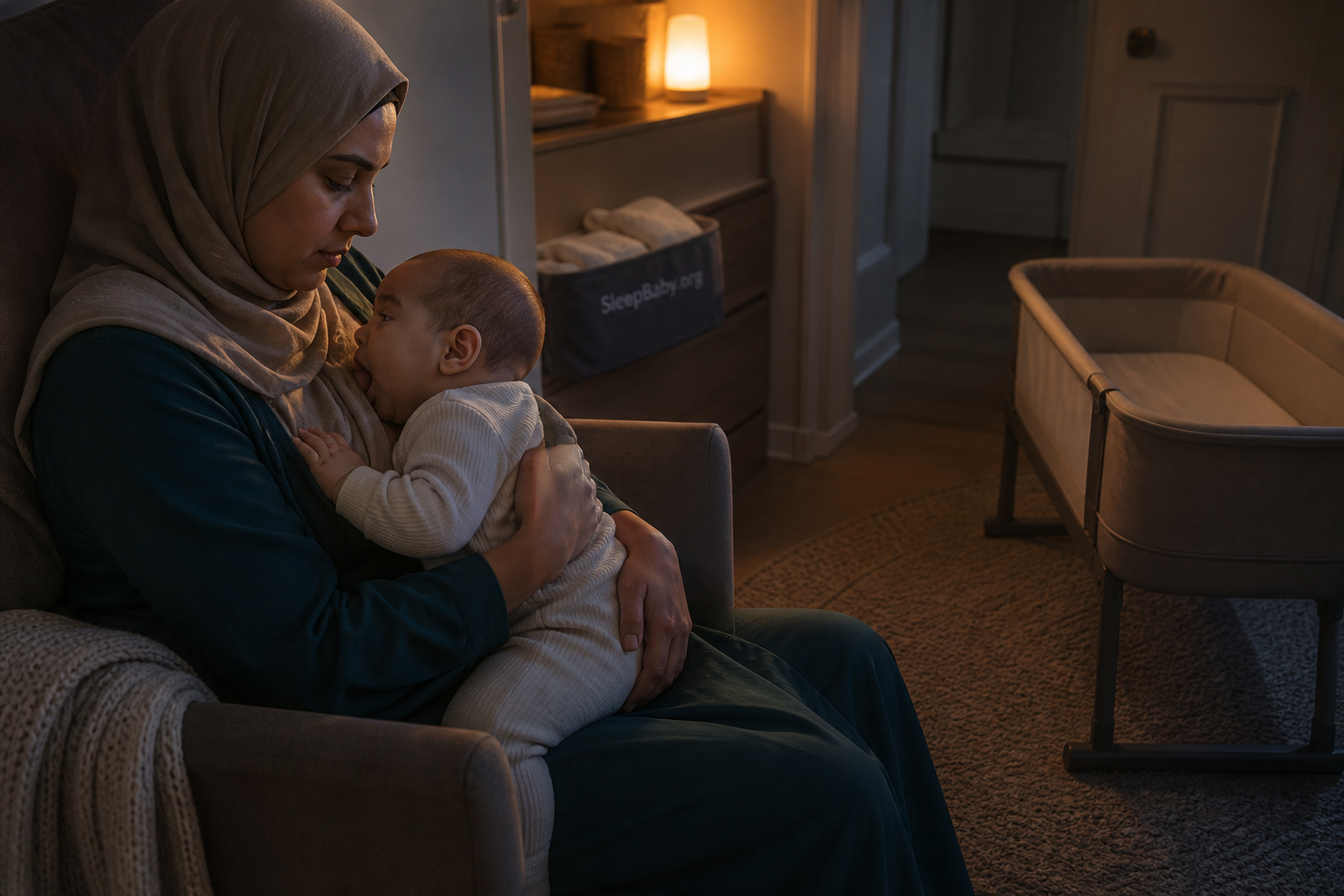
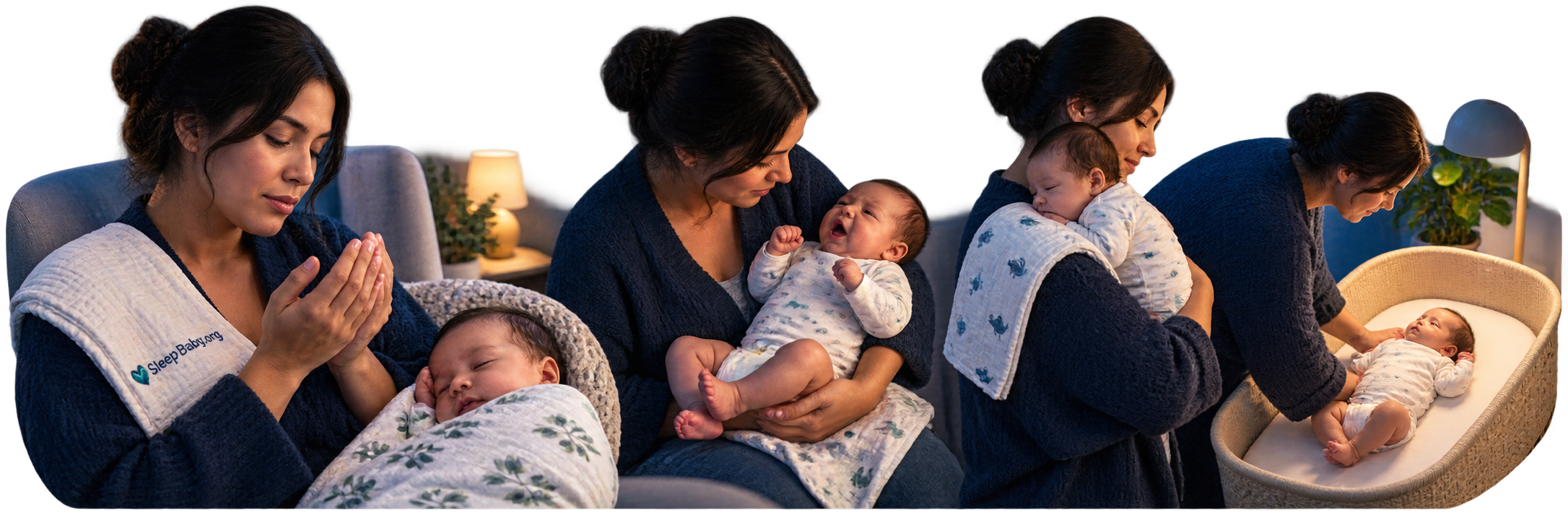
Before you search for another dua, read the waking by age and pattern
Newborn sleep is fragmented. Their sleep cycles are not yet regular, and frequent waking—especially for feeds—can be normal. That truth is not comforting because it promises an easy night. It is comforting because it removes the accusation. A two-week-old who wakes every few hours has not defeated your bedtime worship. A baby who needs feeding has not refused your prayer.
Newborn and early weeks
Expect short stretches and prioritize feeding, safe sleep, diaper output, temperature, color, breathing, and alertness. Follow the feeding plan from your baby’s clinician. Do not stretch feeds to protect a routine or keep reciting while a hungry newborn’s cues intensify. If a newborn is unusually sleepy, difficult to feed, hard to wake, feverish, vomiting repeatedly, breathing abnormally, or making materially fewer wet diapers, call promptly.
Young infant building day-night rhythm
Keep daylight and normal household life available in the day, then make night care calm, dim, and brief. A consistent sequence can become recognizable even before long sleep appears. I would watch whether wakes are driven by clear hunger, discomfort, a transfer protest, or a timing pattern rather than declaring every wake a spiritual or behavioral problem.
Older baby with a changing pattern
Development, illness, schedule shifts, overtiredness, environmental cues, and learned ways of returning to sleep can all shape the night. If bedtime has been drifting late, the guide to recognizing an earlier-bedtime need can help you assess timing without blaming dua. If the baby sleeps only in arms and protests the crib, use the crib-transfer troubleshooting guide outside any urgent medical question.
I would ask four pattern questions: Is this waking new? Is it getting rapidly worse? Does the baby look and feed normally between wakes? Does the waking happen at a predictable time or only after a specific transfer? A predictable repeated waking may be easier to address when you map the surrounding cues; the guide to same-time night waking is a useful next step once illness and feeding concerns are off the table.
None of this asks you to become detached. Responding is not the enemy. I want the response to be proportionate: urgent when the baby looks ill, practical when the baby needs care, quiet when the baby simply needs help through a normal wake, and supported when the caregiver is too exhausted to stay safe.
My three-part night tool: Ask, Attend, Arrange
When I am tired, I cannot use a twelve-step checklist with grace. I need a short tool that respects both worship and the body. Ask · Attend · Arrange is that tool. It does not promise an instant sleep outcome. It gives the night a safe order.
-
Ask
Make the dua without bargaining with the clock
Use the child-connected protection wording, a general bedtime remembrance, Quran recitation, or your own clearly personal dua. Choose one practice you can say calmly. I do not require a distressed parent to complete every optional recitation before responding. The goal is presence, not a recital score.
-
Attend
Check what the baby’s body is asking for
Look at breathing and color. Notice alertness, temperature when relevant, feeding cues, the last feed, the diaper, clothing, obvious pain, vomiting, congestion, and whether this is a sharp change. Feed and change the baby as needed. If urgent signs are present, move directly to care. Prayer does not create a waiting period.
-
Arrange
Set up the safest next sleep for baby and caregiver
Dim the environment, reduce stimulation, ask another capable adult to take a turn when available, and place the baby on the back in the firm, flat, empty approved sleep space. Put prayer beads, books, phones, lights, chargers, and cords in the adult zone. If you feel yourself drifting while holding or feeding, the arrangement must change before sleep wins.

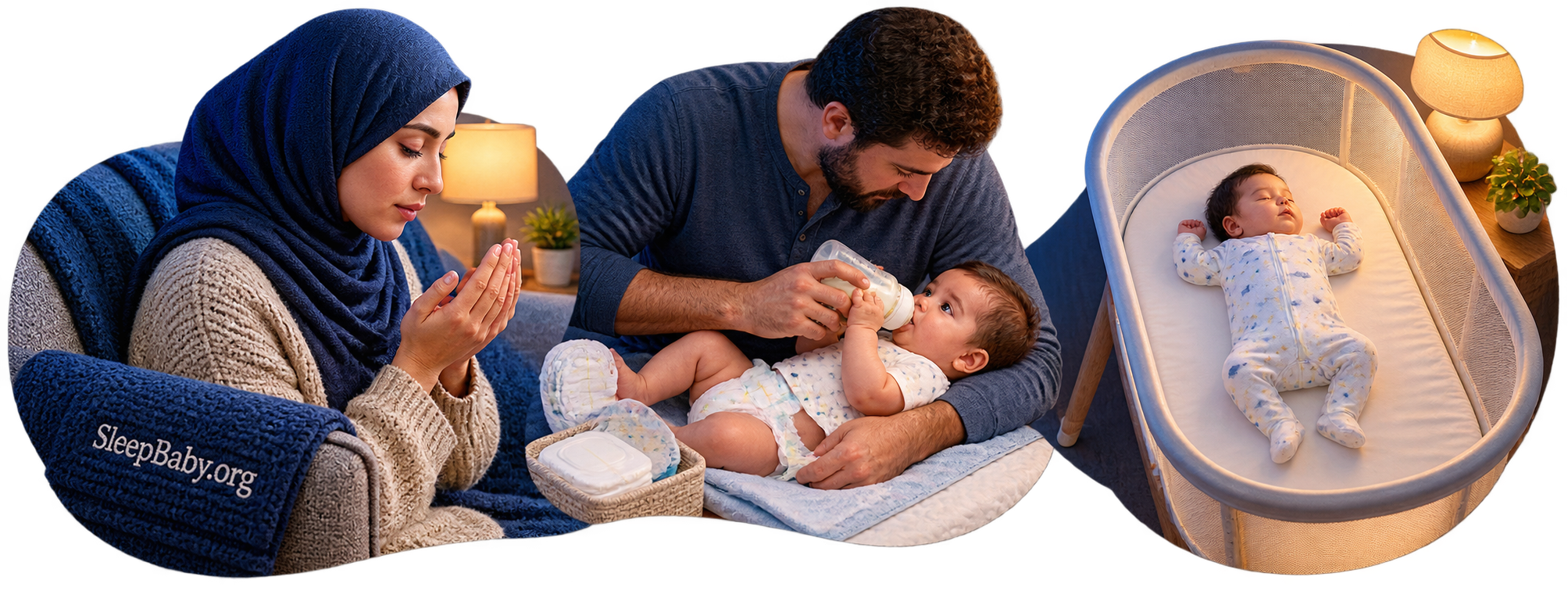
A gentle dua-and-care routine that does not depend on perfect timing
I would keep the routine short enough to survive a real family night. The power of repetition here is recognition, not control. The baby may begin to associate the same soft voice and dim room with winding down, while the caregiver receives a familiar sequence when decision-making feels thin.
1. Prepare the adult zone
Place the diaper supplies, feeding items, water, and any book or phone where the adult can reach them without putting anything in the crib. Lower the overhead light. Secure cords. Clear the safe sleep surface completely.
2. Meet the care need
Feed, burp, change, or comfort according to your baby’s cues and care plan. Keep nights quiet, but do not make “boring” mean unresponsive. A baby who needs help receives help.
3. Recite one authentic practice
Choose the protection dua, the general bedtime dua, the three Quls, or Ayat al-Kursi according to what you know and can sustain. Do not add a countdown that makes you panic when sleep has not arrived by the final word.
4. Ask personally
Use your own language to ask for ease, protection, health, patience, and wise action. Label those words honestly when sharing them; personal dua does not need a false attribution to matter.
5. Make the safe handoff
Place the baby on the back on the firm, flat, noninclined approved sleep surface. If the transfer fails, comfort and try again without introducing a wedge, pillow, loose blanket, weighted item, or sitting-device sleep.
If the routine becomes an hour-long attempt to “complete everything,” shrink it. One authentic recitation and one personal sentence can be enough for that night. If another caregiver’s pronunciation or preferred sequence differs, agree on the nonnegotiables—responsive care and safe sleep—rather than turning the nursery into a debate. The child does not need two exhausted adults proving a point.
If the baby wakes again ten minutes later, repeat only what helps you stay gentle and observant. You are not required to restart a spiritual stopwatch. Check the baby, respond, and preserve the safe setup. That is consistency with room for reality.
A useful tool for the caregiver—not a baby sleep aid
My article-specific pick: a dimmable touch night light for recitation and care
The JolyWell rechargeable touch night light fits this exact night because it gives a caregiver low, adjustable light for reading or reciting, checking a diaper, and finishing a feed without switching on a bright ceiling light or unlocking a notification-heavy phone. A sound machine cannot help you see, and continuous phone audio can add alerts and screen light. Here, touch control and stepless dimming solve the more specific job: use only the light your hands need while keeping one hand available for care.
This light does not make a baby sleep, treat waking, or make an unsafe setup safe. Keep it on an adult-controlled surface outside the crib and baby’s reach, and secure the charging cord. If that practical job matches your nights, view the JolyWell dimmable touch night light on Amazon.
As an Amazon Associate, SleepBaby may earn from qualifying purchases.
Dua can soften the room; it cannot change the safe-sleep floor
For every sleep, place your baby on the back on a firm, flat, noninclined approved sleep surface with only a fitted sheet. Keep pillows, loose blankets, toys, wedges, positioners, and weighted sleep products out. Room-sharing without bed-sharing can keep the baby close while preserving a separate sleep space.
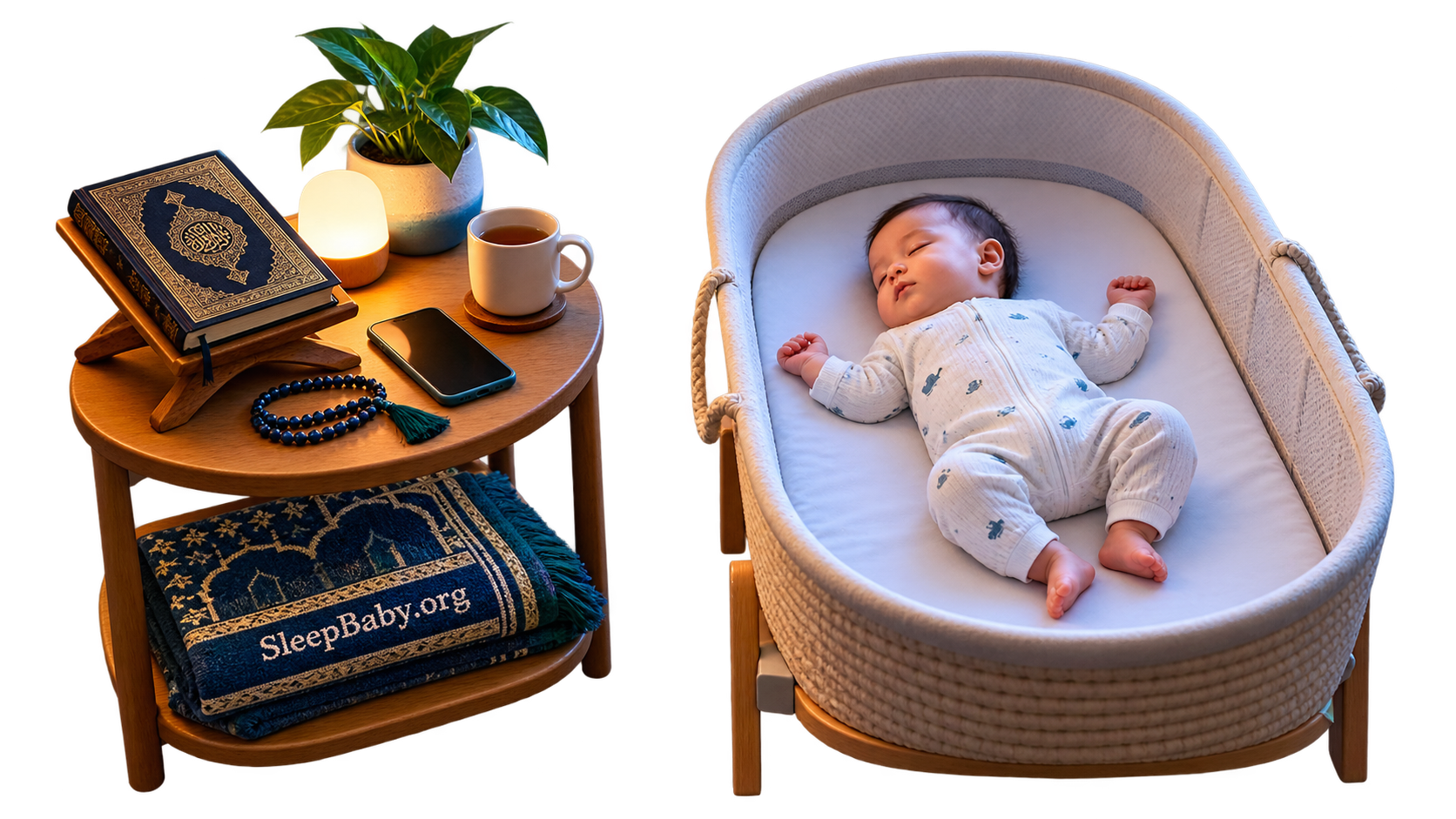
The same boundary applies to worship objects and routine tools. Prayer beads, a Quran, dua cards, phones, earphones, the night light, and every charging cord remain in the adult zone. A beautiful object placed beside a baby’s face is still an object in the sleep space. Meaning does not cancel entrapment, suffocation, strangulation, or overheating risk.
If your baby falls asleep in a swing, car seat, stroller, carrier, sling, or your arms, transfer them to the approved surface as soon as practical. Never use a wedge or raise the mattress because you think sleep trouble is reflux. Do not switch to stomach or side placement to make recitation feel more effective. Safe sleep is not the variable in the experiment.
I am especially direct about sofas and armchairs because exhaustion changes judgment quickly. If you are nodding off, place the baby in the bassinet or crib. If your baby protests that transfer, the guide to helping a baby who will not sleep in the crib offers next steps once you are alert; it should never keep you reading while sleep is overtaking you.
A baby who cries in a clear, approved sleep space while you take a brief reset is safer than a baby asleep on an unconscious adult. Make wudu, pray, or call someone if those actions help you regulate—but set the baby down safely first. The sequence matters when your eyes are closing.
For the caregiver’s own bedtime practice
Yaqeen Institute’s “Sleep Well” episode gives the adult ritual more context
This short Yaqeen Institute lesson discusses wudu, remembrance, and Ayat al-Kursi in the caregiver’s bedtime practice. I place it here—not in the emergency or infant-care steps—because it can deepen the adult’s understanding without pretending to diagnose a baby’s waking. Watch when you are safely able to learn, not while you need both eyes on a distressed infant.
Watch “Sleep Well” on YouTube if the privacy-enhanced player is unavailable.
Takeaway for this article: a meaningful adult remembrance can make the caregiving rhythm gentler. It is not evidence that the infant’s medical, feeding, or sleep need has been solved.
When a “sleep problem” needs medical help instead of another routine
I do not want a frightened parent decoding a long diagnosis list. I use two doors: emergency help now, or prompt pediatric advice. If your instinct says your baby is seriously unwell, use the faster door.
Emergency help now
- Your baby cannot be awakened, is not moving normally, is very weak, or becomes markedly floppy.
- Lips, tongue, or face look blue or gray; breathing is severely difficult; the chest pulls in; or the baby grunts with each breath.
- Your baby has a seizure, stops breathing, or vomits green or bilious fluid.
- You believe the situation is life-threatening.
Call the pediatric route promptly
- A baby under three months has a rectal temperature of 100.4°F (38°C) or higher.
- A newborn under one month looks or acts abnormal in any way.
- Your baby has a weak suck, cannot finish feeds, suddenly feeds much less, vomits repeatedly, or has materially fewer wet diapers.
- Your baby is much sleepier than usual, difficult to rouse for feeding, has an unusual weak or high-pitched cry, or simply does not seem like themselves.
- The waking is a sharp change accompanied by pain, breathing changes, fever, rash, injury concern, or your strong sense that something is wrong.
Use your local emergency number and your baby’s local urgent-care route. I intentionally keep this section free of products, optional reading, and spiritual tests. If you are unsure whether the pattern is worrying, the guide to when baby sleep needs medical attention can help only when your baby is currently stable enough for you to read. Urgent signs always outrank the article.
Questions parents ask after the recitation ends
What is the best dua for a baby who will not sleep?
If you want a source directly connected to children, use the protection wording reported in Bukhari 3371. If you want a general bedtime remembrance, “Bismika Allāhumma amūtu wa aḥyā” is authentic. The “best” choice is not the one an influencer promises will work fastest; it is one whose source and scope you understand and can recite sincerely while still responding to your baby’s needs.
How many times should I repeat the child-protection dua?
The Bukhari 3371 report gives the wording and child connection but does not turn it into a sleep countdown. I would not invent a required repetition number. Bukhari 5017 does report three repetitions for the Prophet’s own practice with the three Quls, which is a separate source and practice. Keep those details in their own lanes.
Can I play Quran audio all night for my baby?
That is a family worship choice, not a proven infant sleep treatment. Keep any phone, speaker, charger, and cord outside the crib and baby’s reach, use a volume that does not overwhelm the room, and make sure audio does not mask feeding cues or unusual breathing. If alerts and screen light pull you back to the phone, a brief live recitation may serve the moment better.
What if my baby cries while I recite?
Crying is communication, not a verdict on the prayer. Pause long enough to assess hunger, diaper, temperature, pain, illness, breathing, and whether your baby needs closeness. You can continue softly while feeding or comforting if doing so keeps you present. Do not use the recitation to delay a needed response.
Does waking after dua mean I pronounced it incorrectly?
No sleep outcome can grade your pronunciation or faith. Learn the wording from a trusted source and improve over time, but do not attach a spiritual accusation to normal infant waking. A wake may be developmentally ordinary or may signal a concrete care need. Read the baby, not the imagined score.
Is there a Quran verse guaranteed to make a baby sleep through the night?
I found no sound basis for that guarantee. Quran recitation is worship and can be part of a peaceful home rhythm, but a guarantee of uninterrupted infant sleep is a different claim. Avoid graphics that attribute an unsourced phrase to the Quran or rename a general verse as a baby-sleep prescription.
Can I recite while feeding?
Yes, if it helps you stay calm and you remain attentive to latch, swallowing, breathing, comfort, and your own alertness. The feed is not an interruption of the ritual; caring for the baby is the work in front of you. If you are becoming sleepy, put the baby back on the safe sleep surface before you lose awareness.
Should I wake a sleeping newborn for feeds?
Follow the feeding and weight plan given by your baby’s clinician. Young newborns often need frequent feeds, and some sleepy newborns must be awakened according to an individualized plan. An article about dua should never tell you to stretch those intervals. If the baby is hard to wake or too weak to feed, seek urgent advice rather than assuming the sleep is a blessing.
What if my baby wakes at exactly the same time every night?
A repeated time can point toward a schedule cue, habitual response, feeding pattern, noise, temperature shift, or ordinary sleep-cycle transition. Continue the worship practice if it matters to your family, but map the surrounding pattern separately. That keeps you from escalating recitation as if timing proved a spiritual cause.
Can dua replace sleep training?
They answer different questions. Dua is worship and supplication. A sleep approach is a set of caregiving choices shaped by age, feeding, temperament, family values, and health. You do not have to choose between faith and a practical plan, but any plan must remain responsive to illness and feeding needs and keep the baby’s sleep environment safe.
What should I do if I feel angry or desperate?
Place the baby on the back in the empty approved sleep space and step away briefly. Breathe, make a short dua, wash your face, or call a trusted adult. Never shake a baby. If you fear you may lose control, get immediate support. A brief period of crying in a safe crib is safer than holding the baby while your control is breaking.
Sources
- Sahih al-Bukhari 3371 — the protection wording reported in connection with al-Hasan and al-Husayn.
- Sahih al-Bukhari 6324 — the general before-sleep dua.
- Sahih al-Bukhari 5017 — Al-Ikhlas, Al-Falaq, and An-Nas in the Prophet’s own bedtime practice.
- Sahih al-Bukhari 2311 — the Ayat al-Kursi bedtime-protection account.
- Quran 2:186 — Allah’s nearness and response to prayer.
- Quran 25:74 — a general prayer concerning spouses and offspring.
- Quran 17:24 — the prayer for parents referenced in the scope correction.
- HealthyChildren.org: Getting Your Baby to Sleep.
- HealthyChildren.org: Safe Sleep—9 Ways to Reduce Your Baby’s Risk of SIDS.
- HealthyChildren.org: Safe Sleep Tips for Sleep-Deprived Parents.
- HealthyChildren.org: Newborn Illness—How to Recognize.
- NICHD Safe to Sleep: Safe Sleep Environment.
- NHS: When to get urgent medical help for babies and children under 5.
- Yaqeen Institute: Sleep Well—Angels in Your Presence.
When the prayer is said and the room is still awake
Keep the steady hands; choose the next baby-sleep question
I want you to leave with less pressure, not a longer list of spiritual tasks. Ask sincerely. Attend to the real baby. Arrange the safe sleep handoff. If the urgent signs are absent and the waking pattern still needs work, the SleepBaby.org Workshop can help you choose the next practical question—bedtime timing, crib transfers, repeated wakes, or a routine that your actual family can sustain.
Continue in the SleepBaby.org Workshop with your next baby-sleep question
May your dua make room for steadiness, and may that steadiness help you see the next right act of care.
General parent education only. SleepBaby.org cannot diagnose a condition, replace individualized medical or faith guidance, or promise a sleep outcome.






What viewers said10 comments · 4 replies+
Archived comments from the original Baby Sleep Miracle presentation. Not independently verified by SleepBaby.org; individual experiences vary.
Thank you so much for this video! I had no idea about the dangers of baby swings :O
Hi Mary-Ann. I have a question: Is method in any way similar to the ones recommended by Dr Bucknam, Dr. Weissbluth or Dr. Karp? We tried those but none of them help.
Hi Regina, thank you for your question. The short answer is no. The techniques I share in my guide are based on newest scientific research and this is why I have never seen any approach similar to the one I recommend.
This method really works! I tried it on my son Jesus and after just one week he went from waking up more than 5 times a night to waking up just once or twice. You are a lifesaver, Mary-Ann!
I'm truly impressed with how much information you share in your video. And all for free! I can feel that you truly care about mothers like myself, and that's hard to find these days. I have recommended your site to several of my friends already.
Mary-Ann, our child suffers from autism. Is your approach still suited?
Chloe, I made sure my method can be used with any child, even babies who are special like yours. Please note that I'm not a doctor and that I always advice to consult with your physician because nothing is more important than the safety and well-being of your love.
Hallo Mary-Ann, I'm from Germany. Do you have your guide in German?
Hello Heide, we do! Normally you should already see our video in German. If not, please contact our support so they can guide you
Thenk you for your answer, Mary-Ann!
I just completed your approach and I have to say, it worked almost too well. Yes, it took a bit of getting used to with your bedtime routine but the difference is huge. My son George used to take 1 hours to go down and now he's firmly asleep in no more than 10 minutes! You're the best!
It seems I'm the only man watching this video, lol! What you shared about the 'emotional backpack' made immediate sense to me and I can't wait to help my little girl Mila to unpack it!
Hey there, just discovered your site and this really sounds different. Just wanted to say thanks for sharing :)
For everyone who's still thinking about getting Mary-Ann's guide I want to advise you to go ahead. I wasn't sure myself but now I'm so thankful I invested in this program. It made a huge difference in our life as a family and yes, my baby girl does sleep through the night now.