
Yes, babies sleep in the womb. Especially later in pregnancy, researchers can identify quiet and active sleep-like states from patterns of movement, eye activity and fetal heart rate. But here is the part I want beside the fascinating science: you cannot safely explain away a meaningful change in your baby’s usual movement pattern by deciding the baby must be asleep.
If you arrived here because the womb suddenly feels quieter than usual, skip the sleep detective work. Contact your midwife, obstetric clinician or maternity unit now and follow their instructions. Do not wait until tomorrow, rely on a home Doppler, or try to earn reassurance with a cold drink. A quiet spell can be ordinary; a changed pattern deserves a real clinical answer.

What does “sleep” mean before birth?
We cannot ask a fetus whether they were dreaming about amniotic fluid upgrades. Researchers instead watch several signals together. In later pregnancy, combinations of body movement, eye movement and fetal heart-rate patterns organize into recognizable behavioral states. Quiet sleep is marked by relatively little body movement and a steadier heart-rate pattern. Active sleep includes more movement, eye activity and greater heart-rate variability. These are often described as NREM-like and REM-like because they resemble important features of sleep after birth.
The word like matters. Sleep before birth is not simply adult sleep in a smaller bedroom. The nervous system is still organizing. Transitions can be hard to classify, especially earlier in gestation, and whether every active-looking interval counts as true wakefulness remains debated. A 2026 cross-species review emphasizes both the evidence for fetal sleep states and the measurement limits. I would rather give you that honest edge than turn a developing science into a tidy animation with three labeled buttons.
What clinicians and researchers can observe—and what they cannot
- Quiet sleep / NREM-like
- Few body movements, absent eye movements and a relatively stable fetal heart-rate pattern. Quiet does not independently prove wellbeing.
- Active sleep / REM-like
- More frequent movement, eye activity and a more variable heart-rate pattern. Much late-gestation sleep is active sleep-like.
- Transition or indeterminate state
- Signals do not line up neatly. This is a reminder that fetal state organization matures gradually and does not always fit a clean label.
SleepBaby.org fetal-state decoder: patterns are inferred from several signals together; movement alone is not a sleep monitor.
Fetal sleep also includes shorter repeating cycles rather than one consolidated overnight block. Near term, research describes organized cycles on the scale of roughly an hour to an hour and a half, while maternity movement guidance often describes outwardly quiet sleep periods of about 20 to 40 minutes and rarely longer than 90 minutes. Those figures answer different measurement questions, so I would not use either as a kitchen timer. They tell us that alternating quiet and activity is expected—not that ninety minutes of concern should be spent watching a clock.

When do babies start sleeping in the womb?
There is no single first nap that science can circle on a pregnancy calendar. Early in gestation, movement and nervous-system activity are developing, but mature behavioral states are not yet neatly synchronized. During the third trimester, recognizable quiet and active sleep-like organization becomes easier to detect. Reviews place emerging functional organization around 28 to 30 weeks, with patterns becoming more consolidated toward 36 weeks and term.
That does not mean a fetus was continuously awake before the third trimester. It means the signals researchers use become coordinated enough to classify with more confidence. Development is a dimmer switch, not a nursery lamp snapped on at 28 weeks exactly.
Sleep organization grows in layers
- Earlier gestation: movement and physiologic rhythms are present, but the signals are less synchronized and harder to classify as stable states.
- Third trimester: quiet and active sleep-like patterns become increasingly organized.
- Near term: state cycles are clearer, with active sleep-like behavior still prominent.
- After birth: the newborn still lacks a mature day-night rhythm and sleeps in many short stretches around feeding and care.
This is why the answer to “Does my baby know night from day?” is more interesting than yes or no. Maternal signals—including rhythms of hormones, activity, meals and light exposure—help provide prenatal timing information. Yet the newborn’s own circadian system remains immature. Birth changes the environment dramatically: light becomes direct, feeding is no longer continuous through the placenta, temperature varies, and caregiving arrives in cuddly but unpredictable shifts.
I would not treat a lively 11 p.m. womb as a forecast of a child who will host parties at bedtime. Nor would I treat daytime quiet as evidence of a future champion sleeper. The fetus is practicing state transitions in one environment; the newborn will learn day and night in another.
Why does my baby move when I lie down?
Many pregnant parents notice more movement when they sit or lie down. Several ordinary things can contribute. You are less distracted and better able to feel small motions. Position can change which movements press against the abdominal wall. The baby’s own activity period may happen to overlap with your evening rest. Placenta position can also change how strongly movement is perceived.
You will often hear that walking “rocks the baby to sleep” and stopping wakes them. It is a charming explanation and may fit some experiences, but it is too certain as a universal rule. Maternal movement, attention and fetal timing are tangled together in everyday perception. I can honor the familiar experience without pretending we can identify the mechanism from the sofa.

What you feel is the baby’s movement filtered through context
- Your attention and activity
- Your position
- Placenta location
- Gestational age
- The baby’s individual pattern
- A genuine change requiring assessment
The last possibility is why pattern change outranks a clever explanation.

The quiet spell that makes the science personal
Clearly labeled composite Kacey-and-Benjamin scene:
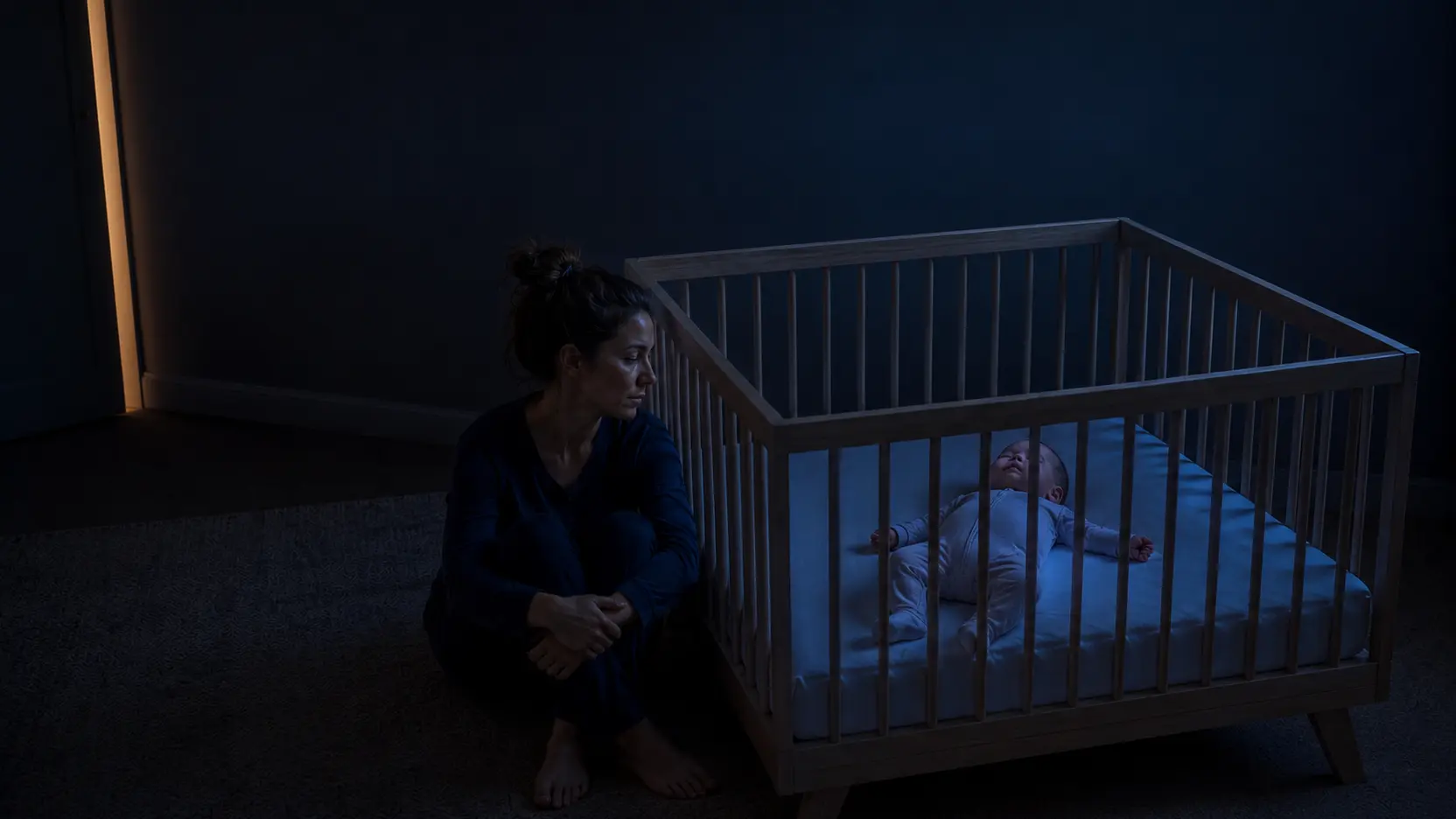
Imagine I am pregnant with Benjamin, finally sitting down after an evening of moving laundry from one flat surface to another, and the belly that had been performing a full percussion set feels quiet. My brain offers two competing narrators. One says, “He is probably asleep.” The other has already opened twelve browser tabs and promoted itself to Chief of Catastrophic Possibilities.
The useful move is not to decide which narrator has the better costume. I ask the real question: Is this within Benjamin’s familiar pattern, or is it a meaningful change? If it feels changed, I call the maternity team. I do not make fetal sleep science carry a safety decision it cannot carry.
That distinction is the reason I answer this article in two layers. Yes, fetal sleep is real and astonishing. No, “probably asleep” is not a substitute for assessment when your own pattern-recognition alarm is ringing.
This is a composite scene, not Kacey or Benjamin’s documented family history and not medical evidence. It demonstrates the decision boundary supported by maternity guidance.
I know “call now” can feel dramatic when you are hoping for a calm explanation. It is not an accusation that something is wrong, and it is not a test you pass by waiting. Most people assessed for a movement concern receive reassuring news. The reason to call promptly is that the maternity team has tools you do not have at home, and timing matters when a baby does need help.
How long do fetal sleep periods last?
Maternity guidance commonly says babies have sleep periods during day and night that usually last 20 to 40 minutes and rarely longer than 90 minutes. Research that classifies complete behavioral-state cycles near term may describe cycles of roughly 70 to 90 minutes. These are not contradictory stopwatch settings. One refers to practical periods of absent or reduced movement noticed in pregnancy care; the other reflects physiologic state cycling defined with multiple signals.
The safest use of these numbers is educational: fetuses alternate between quieter and more active periods. The unsafe use is bargaining with yourself—“I will wait until minute 91.” If movement is reduced, stopped or different from what is normal for your baby, contact your maternity team immediately regardless of where you think the baby may be in a cycle.
Use timing to understand normal cycling—not to delay a call
Helpful: “Quiet and active periods alternate, and brief quiet spells can be normal.”
Not helpful: “The baby might be asleep, so I must wait a specific number of minutes before asking for help.”
Do babies dream in the womb?
Active sleep-like states include rapid eye movements, which naturally makes people wonder about dreams. But rapid eye movement does not let us read subjective experience. We cannot know whether a fetus dreams in the narrative sense an older child or adult does, and we should not turn eye movements into proof of tiny cinematic adventures.
What scientists can say is more grounded and still remarkable: active sleep is prominent in early development, and sleep-state maturation occurs during a period of intense brain organization. Reviews discuss possible roles for sleep and spontaneous neural activity in developing circuits. That is a population-level developmental framework, not a way to promise that a particular sound, routine or product will improve an individual baby’s brain or sleep.
I find the honest answer more moving than the invented one. A developing nervous system is practicing rhythms before anyone has dimmed a nursery lamp. We do not need to add a dream plot to make that extraordinary.
How do we know a fetus is sleeping?
No single routine prenatal tool prints “asleep” on the screen. Researchers classify fetal behavioral states by combining signals over time. Ultrasound can show body and eye movements. Cardiotocography can record fetal heart-rate patterns and their variability. Specialized research methods add other physiologic measures. A state becomes recognizable when those signals cluster in a consistent way—not because one still ultrasound frame catches the baby looking peaceful.
This explains a common appointment experience. A clinician may say the baby seems to be in a quiet period when a particular movement or response is not immediately visible, then wait, reposition the parent or continue observing. That clinical context is different from deciding at home that reduced movement must be sleep. The clinician can assess gestational age, the reason for the test, heart-rate behavior and other findings together. At home, the actionable signal is your baby’s usual movement pattern and whether it changed.
One clue suggests; several synchronized clues classify
- Body movement: quiet states have less; active states have more—but movement alone is insufficient.
- Eye movement: absent versus frequent eye activity helps distinguish quiet and active sleep-like states.
- Heart-rate pattern: stability and variability add a physiologic layer.
- Time and synchronization: signals must remain coordinated long enough to represent a state rather than one moment.
Routine ultrasound also is not a dream camera or a long-term sleep study. A scan samples a limited window. If the fetus is quiet during that window, the observation belongs beside the rest of the clinical assessment. This is another reason online videos of one yawning or still fetus cannot tell us how all babies sleep, what a particular baby experiences, or whether that baby’s current movement pattern is reassuring.
How much do babies sleep in the womb?
You may see confident claims that a fetus sleeps 90 or 95 percent of the day. I would treat exact all-pregnancy percentages cautiously. Estimates depend on gestational age, how states are defined, which signals were measured and whether unclassified or wake-like intervals were included. Near term, studies often find that quiet and active sleep-like states occupy most observed time, with active sleep-like behavior taking a large share. Earlier in pregnancy, classification is less stable.
The useful conclusion is qualitative: late-gestation fetuses spend much of their time in developing sleep-like states and move among those states repeatedly. The less useful conclusion is a universal daily total that a parent could compare with kicks. There is no consumer sleep score for the womb, and there should not be one masquerading as prenatal reassurance.
I also would not assume that more fetal sleep is automatically better or that more activity is automatically better. Clinical interpretation depends on the whole pattern and the pregnancy context. Growth restriction, hypoxia and some other complications can alter behavioral-state organization, but those research associations are not tools for self-diagnosis. If your care team recommends monitoring, their interpretation belongs to your actual pregnancy—not to a percentage copied from a general article.

Five fetal-sleep ideas worth untangling
| Idea | What is more accurate | What to do with it |
|---|---|---|
| “The baby is quiet, so the baby is asleep.” | Sleep can be quiet, but movement alone cannot establish sleep or wellbeing. | Act on a changed movement pattern. |
| “My movement rocks the baby to sleep.” | Attention, position, fetal timing and maternal movement may all affect what you notice. | Treat it as an observation, not a universal mechanism. |
| “Night kicks predict a bad sleeper.” | Prenatal rhythms are not a reliable forecast of mature newborn or infant sleep. | Expect newborn sleep to remain immature. |
| “A home Doppler can reassure me.” | Finding a sound does not assess the full clinical picture and may delay care. | Call the maternity team for movement concerns. |
| “I can train fetal sleep with sound or timing.” | There is no basis for promising a prenatal routine will produce later sleep outcomes. | Protect your own rest; skip fetal sleep‑training claims. |
Are fetal breathing movements the same as breathing?
No. Before birth, oxygen exchange happens through the placenta. Fetal breathing movements are episodic motions involving the diaphragm and chest that help prepare developing systems, but the fetus is not breathing air. These movements also vary with behavioral state and are observed clinically or in research; they are not something a parent should try to count as proof of health at home.
This distinction matters because pregnancy language can make several different things sound interchangeable: body movement you feel, fetal breathing movements seen on ultrasound, heart-rate patterns measured in care, and breathing safety after birth. They are related pieces of physiology, not one home-monitoring signal.

A pregnancy reference worth owning
I deliberately did not recommend a home Doppler, fetal-listening device or movement-monitoring gadget. Those products can turn a question about development into false reassurance. A broad, evidence-based pregnancy reference has a safer and more durable job: helping you understand context and formulate questions while leaving clinical assessment with clinicians.

What does fetal sleep mean for newborn sleep?
It means your baby arrives with developing state regulation—not with a finished household schedule. Newborns still sleep in short stretches across day and night. Feeding needs, immature circadian timing and rapid development keep sleep distributed. The transition from womb to world adds light, sound, temperature change, gravity, touch and separate feeding events. That is an enormous rewrite of the sensory environment.
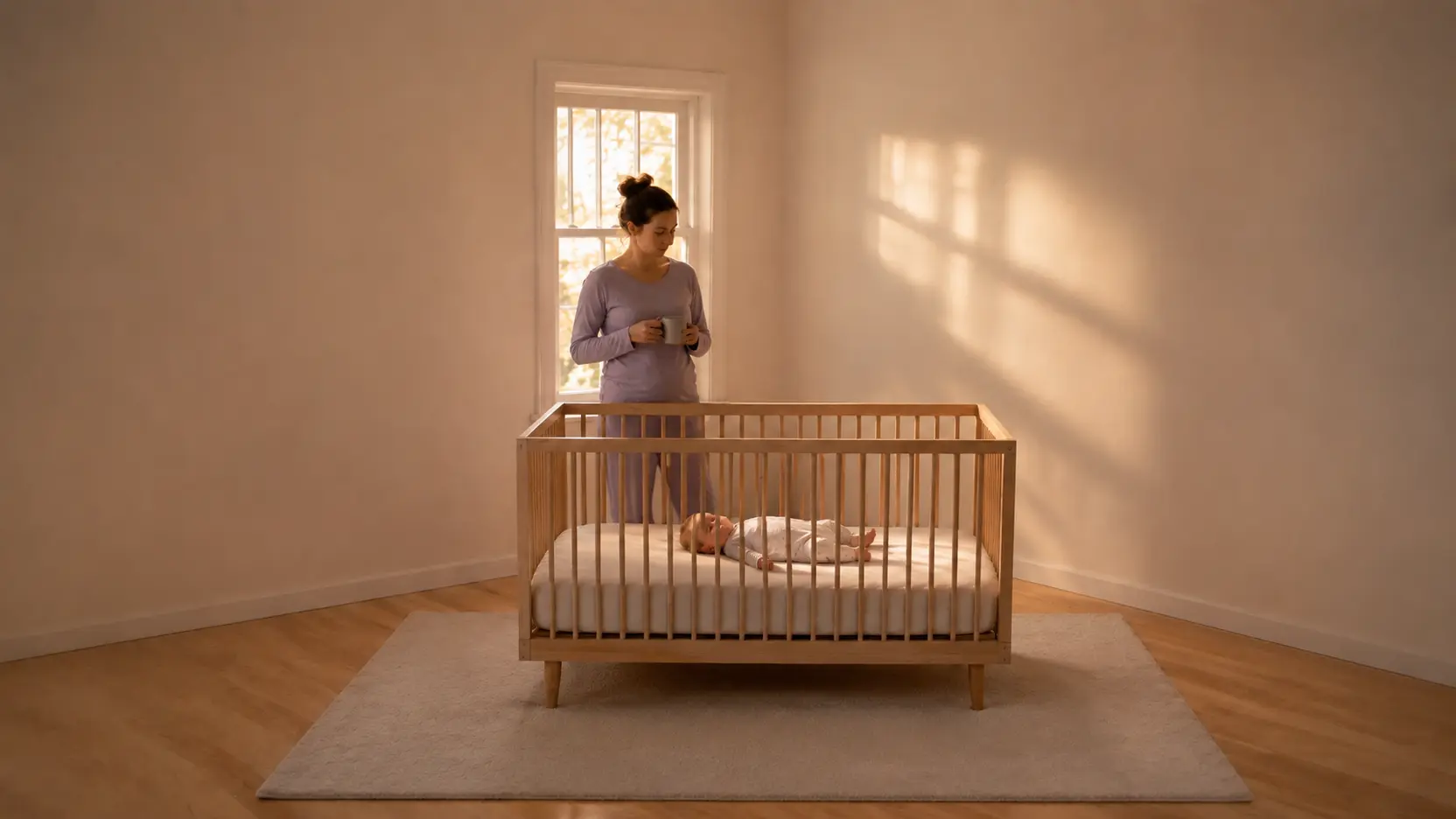
You do not need to train the fetus to prepare for that transition. During pregnancy, protect your own sleep as well as you reasonably can, attend prenatal care and respond to movement concerns. After birth, follow current safe-sleep guidance: place the baby on their back for every sleep on a firm, flat sleep surface in an approved crib, bassinet or play yard, with the sleep space free of soft objects and loose bedding.
I also would not use womb-night activity to set expectations. A baby vigorous during your evening quiet may still sleep in perfectly ordinary newborn fragments. A fetus with long-feeling quiet stretches may still wake frequently to feed. The kindest prenatal promise is not “this baby will sleep well.” It is “we will learn the baby in front of us, in the environment they are actually in.”
Development continues across the doorway
A developing nervous system, active and quiet sleep organization, and sensitivity to rhythmic signals.
Direct light-dark exposure, separate feeds, safe sleep in a firm flat space, and gradual postnatal circadian maturation.
The answer to carry with you
Yes, your baby sleeps in the womb. The sleep is developmentally real, increasingly organized late in pregnancy and often divided into active, quiet and transitional states. It is also measured more carefully than “moving equals awake” and “still equals asleep.”
The private question may have been less scientific: Is this quiet safe? I cannot answer that from a webpage, and neither can a product. What I can give you is the clean boundary. Familiar quiet can belong to the baby’s ordinary rhythm. Reduced, stopped or meaningfully changed movement belongs to your maternity team now.
That is not fear taking over the wonder. It is how we protect the wonder. The womb is already hosting a developing sleep world; your job is not to decode every minute of it alone.
Sources
- Fetal sleep: a cross-species review of physiology, measurement, and classification.
- The Ontogenesis of Mammalian Sleep: Form and Function.
- Current ideas about REM and NREM sleep in brain development.
- A review of autonomic nervous-system development and fetal sleep states.
- ACOG: Indications for Outpatient Antenatal Fetal Surveillance.
- RCOG Green-top Guideline 57: Reduced Fetal Movements.
- University College London Hospitals: Your baby’s movements.
- Oxford University Hospitals: Your baby’s movements.
- University Hospitals Dorset: Your baby’s movements in pregnancy.
- Computerized Analysis of Antepartum Cardiotocography: A Review.