For an infant crib, the safest canopy is no canopy at all
Crib canopy safety has one clear rule. Remove decorative fabric, hoops, ties, cords, and canopy hardware from above, beside, or attached to a baby’s crib. Loose fabric can cover the face or wrap around the neck or body. Cords and loops can tighten. A hook, hoop, rail clip, or ceiling anchor can loosen and fall. The setup also changes as a baby learns to roll, sit, pull up, stand, and reach.
Keep the sleep space simple: a safety-approved crib, a firm flat mattress, and a fitted sheet, with no pillows, blankets, bumpers, toys, positioners, or drapery. If a canopy is already installed, move the baby to a safe awake place with another adult, remove the entire system, and inspect the crib, wall, ceiling, rails, mattress edge, and floor before the next sleep.[1][2]
You do not need to make the nursery less beautiful. You need to move the beauty out of the crib’s reach and fall zones. Paint, distant fixed light, a familiar song, a bedtime book, and your voice can create softness without asking a sleeping child to share space with hanging fabric.
Why the dreamy nursery picture is so persuasive
A crib canopy photographs like a little moonlit room inside the room. It softens hard corners, promises hush, and makes a plain crib look finished. When the rest of early parenthood feels like an open drawer of unmatched socks, that one floaty detail can seem almost medicinal.
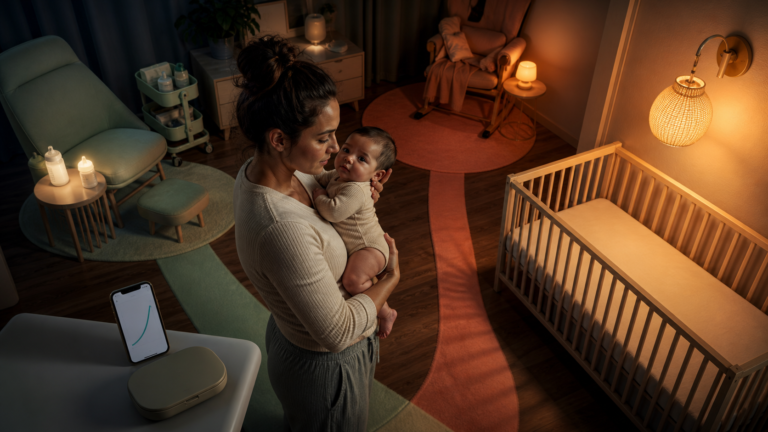
In a clearly labeled editorial composite, I can imagine standing in the nursery at dusk with a baby on my shoulder, wanting the gauzy fabric to mean that the day is finally under control. The feeling is real. The fabric still does not belong where it can sag, swing, loosen, or become reachable.
Nursery decor has a remarkable talent for arriving with seventeen tiny hooks and the confidence of a chandelier. You are allowed to love the look and reject the setup. Safety does not require an undecorated room. It asks us to put the magic somewhere that cannot land on the child.
The useful question is not whether the canopy looks secure in one photograph. It is whether every part will stay outside the crib after ordinary life touches it: washing, dusting, a ceiling fan, an older sibling, a curious hand, a shifted crib, a loose adhesive strip, or the baby’s next growth spurt.


Check three zones, not only the mattress
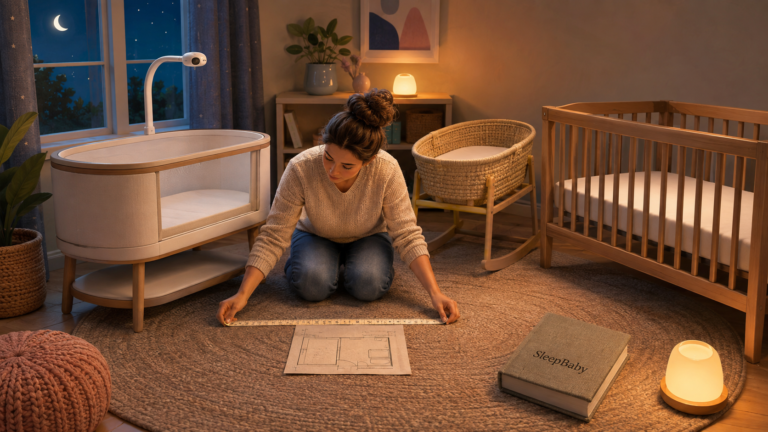
The Clear-Circle Map makes the decision easier: clear the inside zone, the reach zone, and the fall zone. A canopy can fail the check even when no fabric is touching the mattress right now.
Inside the crib stays bare
Only the fitted sheet belongs on the firm flat mattress. No canopy panel, tie, cord, tassel, hoop, toy, bumper, pillow, blanket, or monitor enters the sleep space.
The reach zone plans ahead
Do not measure only today’s arm. A child who is rolling now may sit, pull up, stand, or use the rail for leverage sooner than the nursery plan expects.
The fall zone includes overhead space
Fabric and hardware that could detach, swing, sag, or drop into the crib do not get a pass merely because they begin beyond the rails.
SleepBaby.org Clear-Circle Map: clear the crib, the growing reach zone, and every path an overhead object could take into the sleep space.
Stand where the child will stand, not where the newborn lies. Look from rail height. Tug nothing, but imagine what a determined hand could pull. Then look up: if a fastener failed, where would the hoop, fabric, screw, or decorative crown land? The safest answer is a setup that does not depend on daily tucking, knotting, measuring, or hoping.
How far from the crib is far enough?
There is no honest universal number that makes every canopy, wall, crib, and growing child safe. A fixed distance can become misleading when the fabric is longer, the crib moves, the mattress is lowered, the child stands, a tie stretches, or a hook can fall diagonally. Use the crib and decor manufacturers’ instructions, then apply the stricter Clear-Circle test.
A decoration is outside the reach zone only when the child cannot touch it from any normal position in the crib, including standing at the closest rail. It is outside the fall zone only when no loose piece or failed fastener could land in the crib. A cord also needs its own route completely beyond reach, with no loop that can migrate toward the rails.
Recheck after lowering the mattress, moving the crib, changing window treatments, installing a monitor, or watching the child gain a new skill. If the answer depends on a perfectly arranged fold staying exactly where you put it, the setup is not far enough. For loose canopy fabric, the cleanest distance is out of the crib area altogether.
What safe-sleep guidance says about the crib environment
The American Academy of Pediatrics recommends a firm, flat infant sleep surface with no soft objects or loose bedding. The Eunice Kennedy Shriver National Institute of Child Health and Human Development gives the same practical message through the Safe to Sleep campaign: keep the baby’s sleep area clear and use only a fitted sheet on the mattress.[1][2]
A decorative canopy is not part of a safety-approved crib. It does not improve sleep safety, and it creates new routes for material or hardware to enter the space. The concern is broader than a panel already lying on the mattress. Air movement, a loosened ceiling hook, a tired tie-back, washing, furniture movement, another child, or normal development can change where the canopy is by morning.
Consumer-product history gives caregivers another reason to take fabric structures around cribs seriously. The U.S. Consumer Product Safety Commission has warned about crib safety and recalled certain crib-tent products after entrapment and strangulation incidents.[3][4] A decorative canopy is not the same product as a crib tent, and that recall does not prove every canopy will fail. It does show why a fabric structure around a crib should not be treated as harmless simply because it looked taut when installed.
HealthyChildren.org also frames the safe-sleep environment around a firm, flat surface and a clear crib.[5] None of these sources needs to name every nursery decoration one by one. The design principle is the useful part: keep loose, soft, dangling, and falling objects out of the infant sleep environment.
The forward question is not, “Is the canopy touching the baby this second?” It is: Can any part be reached, pulled, loosened, or dropped into the sleep space before I inspect it again?

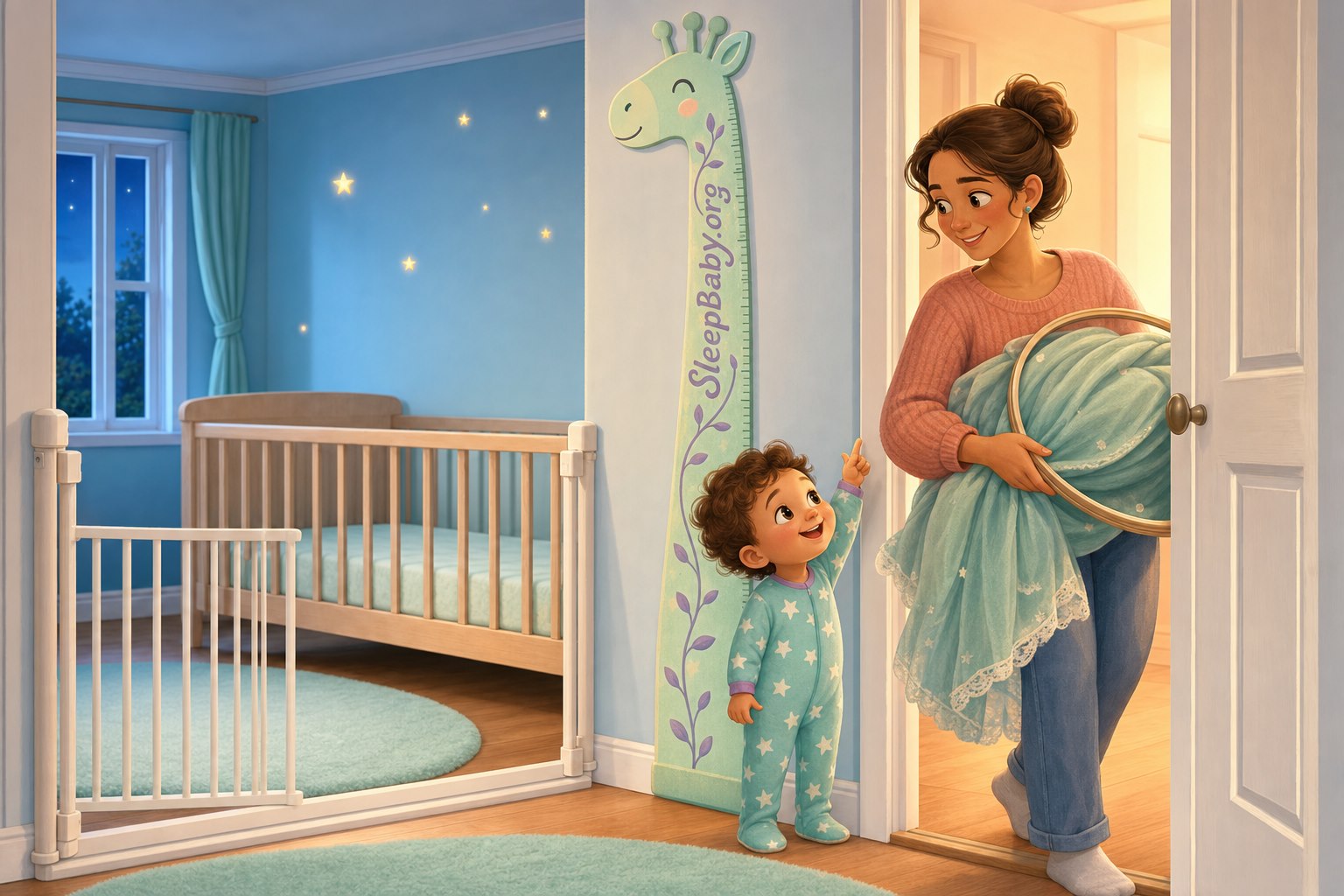
Canopy, mosquito net, and crib tent are not interchangeable names
A decorative canopy is usually loose fabric suspended for appearance. A crib tent is a fitted enclosure marketed for a particular crib or behavior. Mosquito netting is intended as an insect barrier. Different names do not erase the need for a clear airway, intact materials, correct product use, secure fit, and a child who cannot pull fabric into the sleep space.
Do not improvise mosquito protection with a decorative canopy, curtain panel, tulle, fishing line, ribbon, or a net meant for another product. If mosquito-borne illness is a concern where you live or travel, ask the pediatrician or local public-health authority about an age-appropriate prevention plan. Screens, clothing, approved repellents used as directed, and a purpose-built barrier can play different roles. Loose nursery drapery is not a substitute.
Do not use a tent or canopy to stop climbing. A child trying to climb out may be telling you that the crib setup or sleep-surface stage needs to change. Check the crib manufacturer’s height and developmental limits and ask the pediatrician when the next sleep space is uncertain.
A product marketed for supervised play does not become sleep equipment because it fits over a bed. A photo prop does not become safe by staying installed after the camera is gone. A vintage canopy frame does not inherit modern safety approval from the new crib below it. Treat each object according to its own instructions and keep unapproved fabric structures away from infant sleep.
Four popular fixes that do not solve the crib-canopy problem
The same answer applies to magnets, adhesive hooks, tension rods, decorative crowns, rail clips, zip ties, and hidden fishing line. A clever fastener may change how the canopy looks. It does not remove the fabric, loop, reach, or fall path that matters.
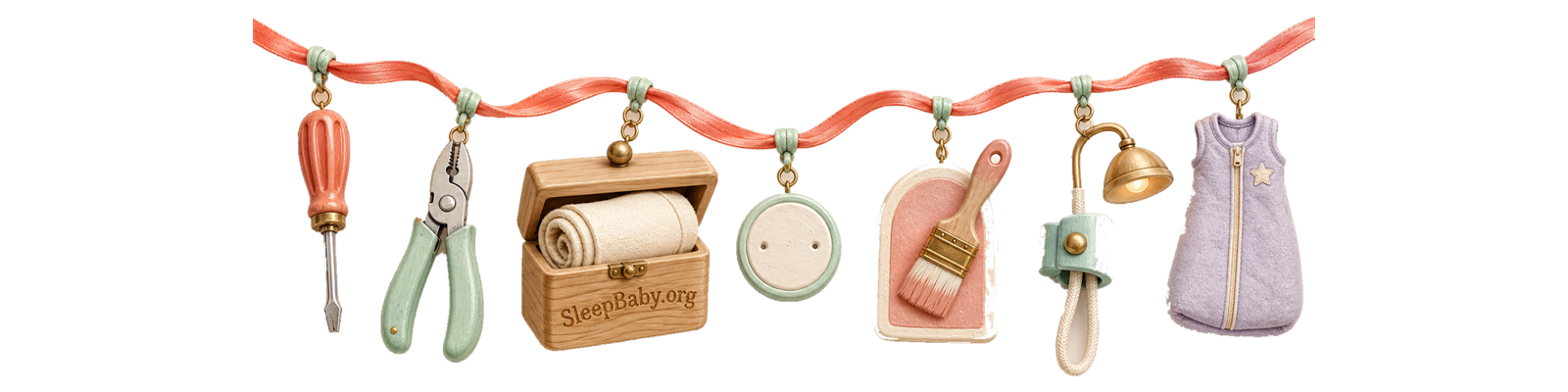
Use the Reach-Pull-Fall Test to remove the whole system
The job is complete only when the fabric, support, fasteners, debris, reach path, and fall path have all been checked. Do the work while the child is awake and safely away from the crib.
-
Move the baby first
Put the awake baby with another adult or in an age-appropriate clear play space outside the work area. Never remove overhead hardware with a child beneath it.
-
Take down every layer
Remove the fabric, hoop, crown, ties, cord, adhesive hook, ceiling anchor, rail clip, and decorative fastener. “I tucked the panel higher” is not the same as removal.
-
Search at hand level
Inspect the outside rails, wall, mattress edge, and floor for thread, staples, broken plastic, wire, adhesive pieces, loose paint, or a hidden loop.
-
Look up and imagine a failure
If a remaining shelf, mobile, frame, light, camera, or wall object loosened, could it enter the crib? Move the crib or object until the fall path is clear.
-
Recheck from the child’s future height
Lower the mattress when the crib instructions require it, but do not use mattress height to justify nearby fabric. A baby who cannot reach the wall today may be standing sooner than the mood board expects.
If my baby’s fingers could find one fold of that canopy, I would treat the entire installation as reachable. I would rather patch two tiny anchor holes than ask a sleepy child to solve a loop of fabric in the dark.
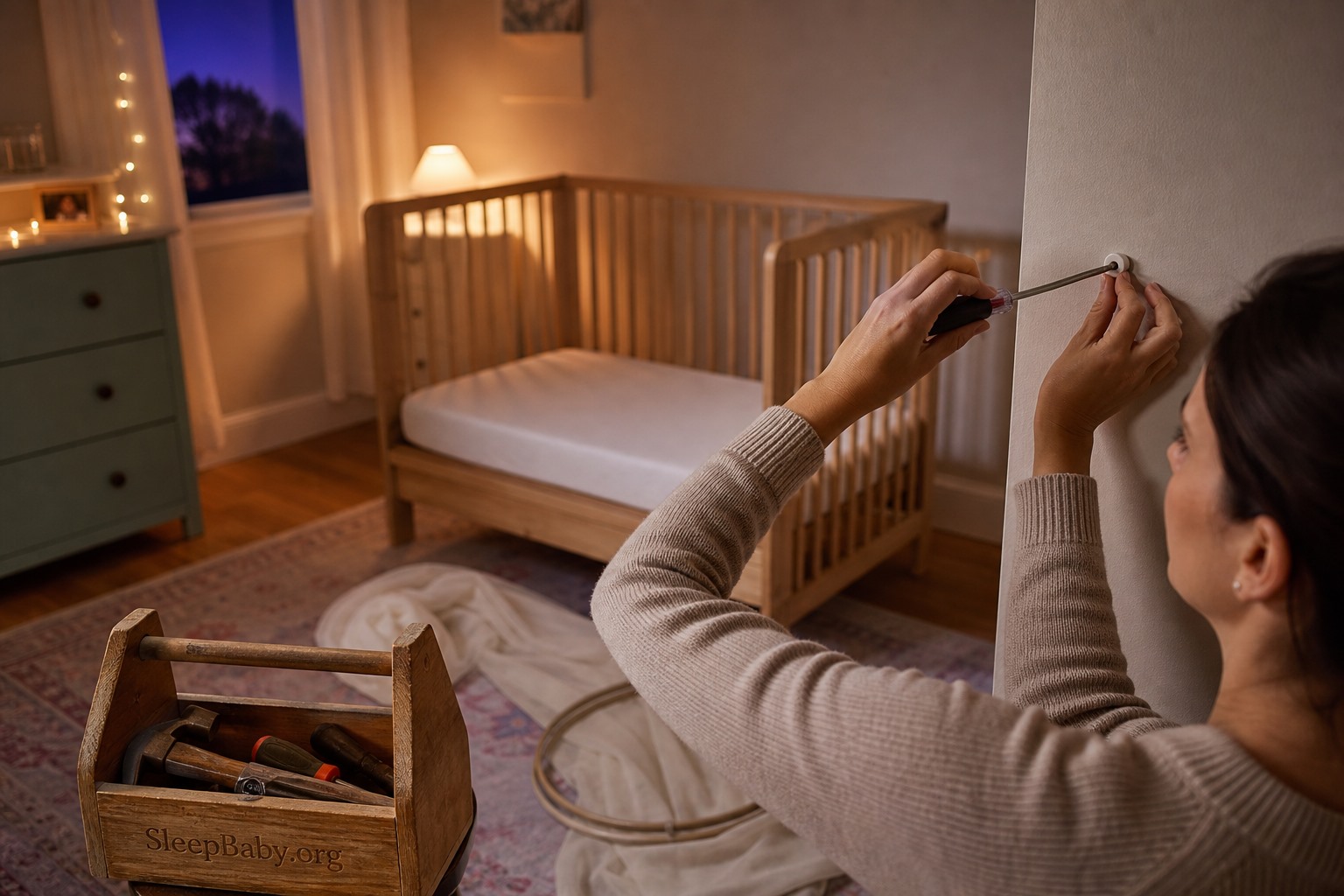
After removal, shake out nothing over the crib. Bag or contain the fabric elsewhere, count the major hardware pieces, vacuum or wipe the floor, and run a clean hand along the outer rails and nearby wall. If an anchor leaves a rough hole, repair it according to the wall material and keep dust, chips, filler, and tools away from the mattress.
SleepBaby.org Reach-Pull-Fall Test: remove, inspect, imagine the failure path, and plan for the child’s next reach.
Tonight’s sleep connection: the room is ready when the crib stays clear without daily tucking, knotting, or wishful measuring.
Keep the softness; change the material
The canopy may have been doing an emotional job: making the nursery feel enclosed, special, dim, or separate from the rest of the house. Replace that job without putting anything over the crib. Try a warm wall color, a painted arch, a distant mural, or a softly glowing fixed light installed according to its instructions with every cord completely out of reach.
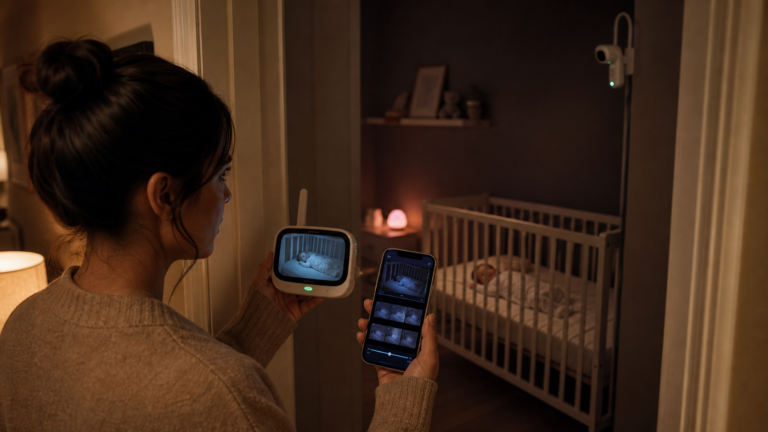
Keep pictures, shelves, lamps, cameras, and monitors away from the crib’s reach and fall zones. A monitor cord can become dangerous when it is close enough to grab, even if the device itself sits outside the crib. Follow the manufacturer’s placement instructions and revisit the setup whenever furniture moves or the child reaches a new milestone.
For awake time, a fabric reading nook can look lovely in another part of the room, but it should not quietly become a sleep space. Supervise its use, anchor products according to their instructions, keep cords and loops inaccessible, and close the nook when play is finished. The crib remains the plain, predictable place.
If removing the canopy makes the room feel visually unfinished, wait one evening before buying a replacement object. Notice which feeling is actually missing: warmth, darkness, a focal point, enclosure, or a bedtime cue. The answer may be a dimmer bulb, a painted shape, one framed print outside the fall zone, or the same two-line lullaby every night. The right replacement has no route into the crib.
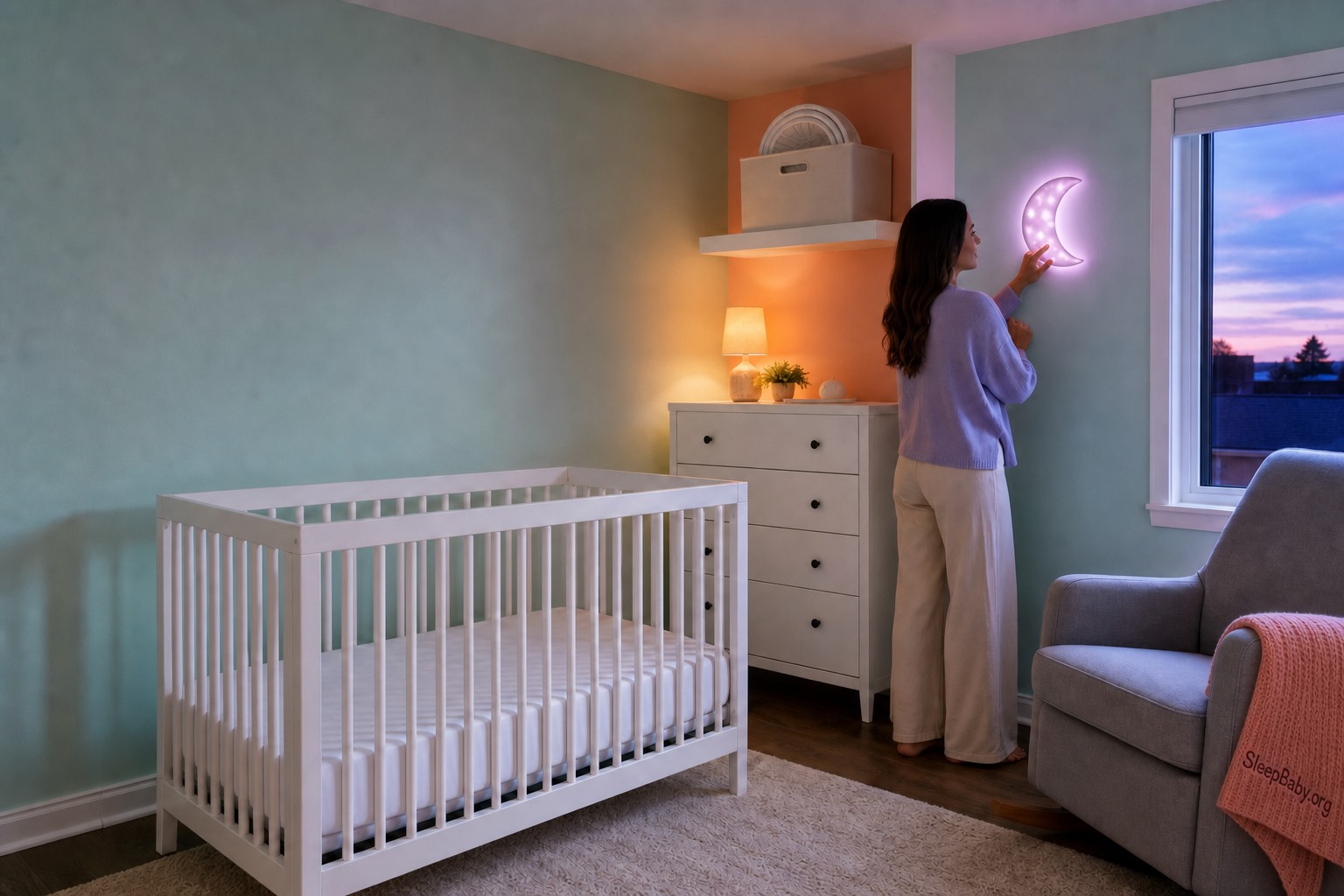
Use the Nursery Mood Swap to rebuild the wonder safely
If you wanted a cocoon
Use a painted color block or arch on a wall outside the crib’s reach and fall zones. The feeling stays; nothing can drape over the baby.
If you wanted softer light
Use a fixed dimmable light placed and wired completely out of reach. Keep the crib away from cords, plugs, hot bulbs, and objects that could detach.
If you wanted a bedtime cue
Choose a short repeated phrase, song, or book. A cue the family carries is more reliable than fabric attached to one room.
If you wanted a photo moment
Make the awake chair, doorway, or supervised play corner the decorated scene. Keep the actual sleep space camera-ready by keeping it clear.
SleepBaby.org Nursery Mood Swap: preserve the feeling while removing the reach, pull, and fall paths.

What if the nursery is tiny, rented, or shared?
A small room can make every wall feel like crib territory. Start with the crib, not the decor. Position it according to the manufacturer and keep windows, blind cords, shelves, lamps, heaters, frames, monitors, and hanging fabric outside the child’s reach and the object’s fall path. If the room cannot support a safe arrangement, remove the decoration rather than squeezing the safety margin.
In a rental, take photographs before removal, save reusable hardware in a labeled container away from the child, and ask the property manager how to patch anchors when the lease requires it. A small cosmetic repair is a household task. It is not a reason to leave fabric above a crib.
In a shared bedroom, place the visual focal point on the adult side of the room or use something flat and secured outside the crib zone. An older sibling’s fort, string lights, curtain, costume, or craft garland also needs a boundary. “It belongs to the big kid” does not keep it out of a baby’s hands.
Travel changes the room but not the clear-space principle. Inspect borrowed cribs and play yards before use, remove add-on drapes or nets that are not part of the approved product setup, and follow the product instructions. If insects are the concern, use local public-health guidance rather than improvising with loose fabric.
Does a canopy become safe when the baby becomes a toddler?
Age changes the sleep space, but it does not make dangling fabric, cords, loops, or loose hardware harmless. A standing toddler has a longer reach, a stronger pull, and more ambitious climbing plans than an infant. If fabric is above a crib or toddler bed, the child may be more able to grab it, not less.
When a child moves to a bed, keep the path in and out clear. Do not place a hanging canopy where it can wrap around the neck, block an exit, catch on clothing, cover the face, or detach onto the sleeper. Check fire-safety guidance, anchors, ceiling fans, heaters, outlets, window-blind cords, and the product’s exact age and use limits.
A family may decide that a properly installed decorative feature belongs in a supervised play area for an older child. That is a different decision from putting fabric over a sleep surface. Separate play from sleep, supervise the play setup, and put any cord or loop fully out of reach. “Not over the bed” is the boundary that survives every room redesign.
Our guide to what babies can safely sleep with explains why the clear-space rule extends beyond canopies. If soft objects are the next question, see when a stuffed animal can enter the conversation. For broader bedtime planning, this three-way test for sleep close to bedtime can help separate a room-design worry from a schedule problem.
What to do if fabric is already in the crib
Remove the fabric and inspect the child. If the baby is breathing normally, has normal color, is alert for the time of day, and appears uninjured, restore the clear sleep setup and contact the pediatrician if you are worried about what happened. Do not reinstall the canopy while deciding.
Call emergency services for severe trouble breathing, blue or gray lips or skin, choking that does not clear, loss of consciousness, a seizure, significant neck injury, or a child who is difficult to wake. If fabric is tightly wrapped around the neck or body, free the airway and follow emergency-dispatch instructions. Do not delay urgent care to photograph the setup or search for a product manual.
After the child is safe, preserve the product name, instructions, hardware, and photographs of the installation if a failure occurred. Report a suspected defective product to the manufacturer and the appropriate consumer-safety authority. The nursery can wait; the child cannot.
If nothing happened and you simply discovered a loose panel in the crib, treat the near miss as useful information. Remove the complete setup, inspect for missing hardware, and reset the sleep space. You do not need to prove that the fabric caused harm before taking away the path that allowed it to enter.

Watch the clear-crib setup in under a minute
Creator: Safe to Sleep campaign, Eunice Kennedy Shriver National Institute of Child Health and Human Development. Watch “Clear the Crib to Reduce the Risk of Sleep-Related Infant Death” on YouTube.
Why it is here: the short public-health video makes the clear-sleep-space principle visible. It does not review decorative canopy brands or replace the crib manufacturer’s instructions.
Takeaway if you cannot watch: A baby’s sleep area should contain a firm flat mattress and fitted sheet, without soft objects or loose material. Decoration belongs outside the crib’s reach and fall zones.[6]
Give the crib a clear sky
Removing a canopy can feel like erasing the prettiest part of the room. You are really redrawing the border between atmosphere and sleep equipment. Let paint, light, music, and your familiar voice make the nursery gentle. Let the crib do one plain job very well.
The good design is the one that still works after the baby rolls, stands, moves furniture, visits Grandma, or outgrows the room’s first layout. A bedtime song travels. A painted wall stays put. Your voice does not need a ceiling hook.
The most reassuring nursery detail is not fabric floating over the mattress. It is the clear space that will still be clear when the baby reaches farther than anyone expected.
When the prettiest nursery detail needs to come down
Keep the wonder; give the crib a clear sky
The empty space above the mattress may look unfinished for one evening. It is also space your baby cannot pull around their face, wrap around a wrist, or wake beneath. SleepBaby can help you turn that protective edit into a calmer bedtime plan built from light, rhythm, and cues your family can carry anywhere.