
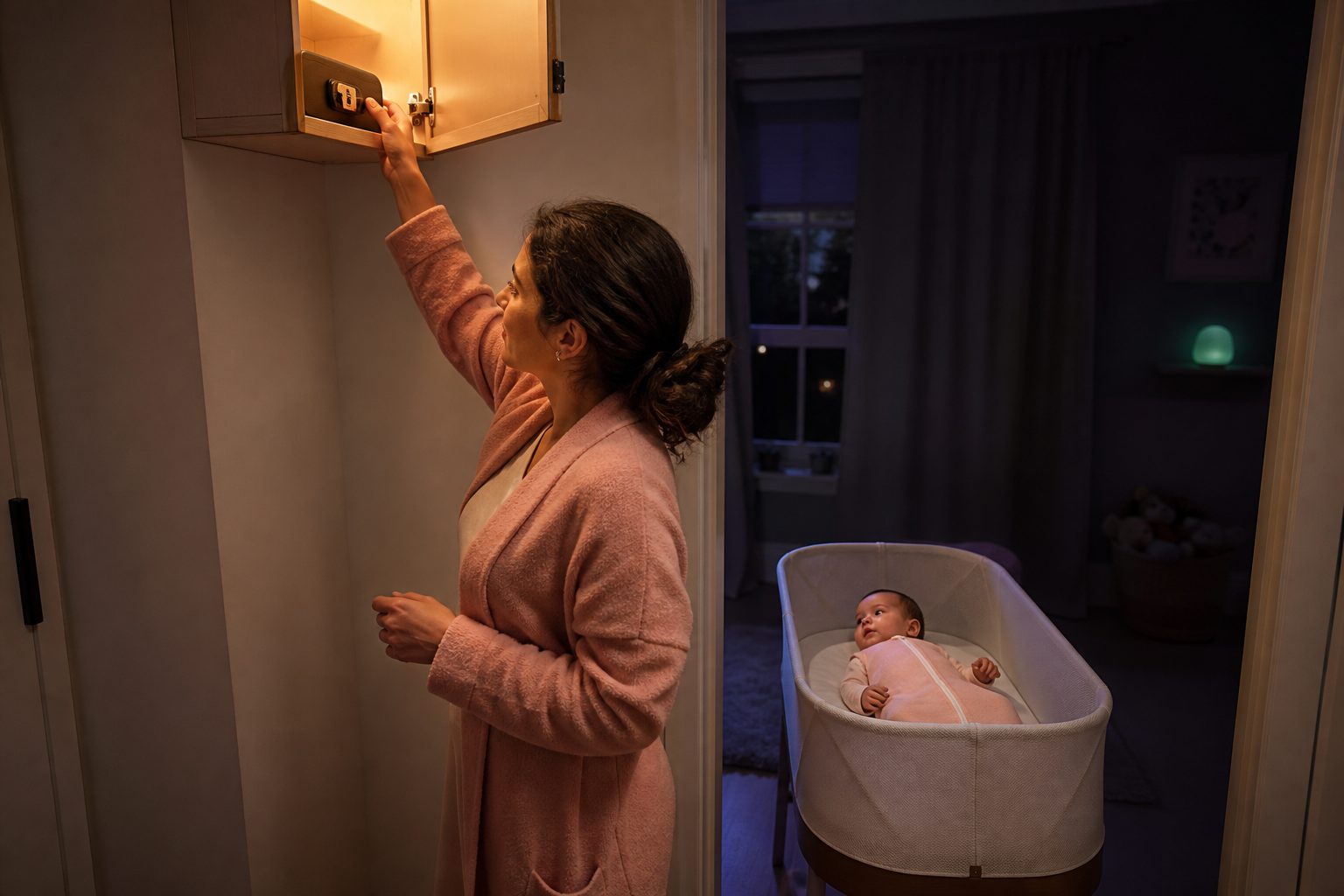
If your baby may already have swallowed a medicine
Do not wait for symptoms. In the United States, call Poison Control now at 1-800-222-1222 or use webPOISONCONTROL. Call 911 immediately if your baby collapses, has a seizure, has trouble breathing, turns blue or gray, or cannot be awakened. Outside the United States, call your local poison service or emergency number.
Keep the package with you. Do not make your baby vomit and do not give another medicine, food, or drink as an antidote unless Poison Control or a clinician tells you to.
The bottle marked PM on the nightstand can look like a shortcut when the room is dark and your baby is still awake. Put it down. Do not give a baby sleeping pills, an adult nighttime product, diphenhydramine, melatonin, herbal sleep drops, or any medicine for the purpose of making the baby sleep. A medicine prescribed for your baby’s diagnosed condition is different, but it must be given only for that condition and exactly as the baby’s clinician directed.
No over-the-counter or borrowed “sleep aid” belongs in a baby’s bedtime routine. Sleepiness is a drug effect, not proof that a product is safe or that the baby is getting healthy sleep. If the problem is that your baby will not sleep, the useful next question is not Which pill? It is What is keeping this baby awake, and does anything about it need medical attention tonight?
The pause I want between the thought and the bottle
Imagine me—Kacey—in a composite 2:17 a.m. moment with Benjamin awake against my shoulder, one hand on the kitchen drawer and the other trying to keep his head from finding the exact least comfortable angle. An adult nighttime medicine is sitting there. The thought is not dramatic: Could a tiny amount help? That ordinary thought is precisely where I want a hard pause.
In this composite scene, I close the drawer, move the medicine out of reach, and stop trying to solve wakefulness with sedation. Benjamin’s crying still needs an answer, but the answer has changed shape: check his breathing and temperature, think about feeding and pain, keep his sleep space safe, and call someone qualified when the picture does not make sense. The scene is hypothetical. The safety boundary is not.

Why “sleepy” and “safe sleep” are not the same thing
I understand the logic that gets a tired parent here. Adults buy products labeled “nighttime,” “PM,” or “sleep aid.” Some allergy medicines make people drowsy. Melatonin is sold beside vitamins. A parent can look at an alert baby and make one dangerous leap: if a substance causes drowsiness, perhaps a smaller amount will cause a smaller, useful effect.
Babies are not scaled-down adults, and a kitchen guess is not a pediatric dose. Age, weight, concentration, ingredients, metabolism, the reason for treatment, and other medicines all matter. Liquid products that look similar can contain different amounts. Combination cold and nighttime products may contain more than one active ingredient. A measuring teaspoon from the drawer is not a dosing syringe. Even a medicine that is appropriate for one symptom can become inappropriate when the purpose changes from treating that symptom to producing sleep.
Diphenhydramine is the clearest example. It is an antihistamine used for allergy symptoms in some circumstances, but Poison Control specifically warns against giving it to children to make them sleep. It can cause marked drowsiness, but some children become agitated instead. Too much can cause dangerous heart effects, seizures, coma, or death. The FDA’s over-the-counter nighttime sleep-aid labeling for diphenhydramine says not to give it to children under 12. That is not a baby-dose puzzle to solve; it is a boundary.
The same purpose test applies to acetaminophen, ibuprofen, prescription medicines, and anything described as “calming.” A pain or fever medicine may be appropriate for a real symptom when the baby’s clinician has given age-, weight-, and product-specific instructions. It is not a sleep aid. If the baby happens to sleep after pain improves, the medicine treated pain; it did not become a bedtime tool.

A medicine-purpose sorter for the middle of the night
When sleep deprivation makes every bottle in the cabinet feel vaguely relevant, I use a blunt sorting question: What diagnosed problem is this exact product supposed to treat for this exact baby? If the honest answer is “being awake,” stop.
| What is in your hand? | What it does not mean | The safer decision |
|---|---|---|
| Adult sleeping pill or “PM” product | A smaller body does not make an improvised fraction appropriate. | Do not give it. Lock it away. If any may have been swallowed, call Poison Control. |
| Diphenhydramine or another antihistamine | Drowsiness on the label is not a pediatric sleep indication. | Do not use it to make a baby sleep. Ask the pediatrician about the actual symptom. |
| Melatonin, gummy, herbal drop, or supplement | “Natural,” “children’s,” or supplement placement does not establish infant safety or dose. | Do not give it without the baby’s clinician directing the exact product and plan. |
| Pain or fever medicine | Treating discomfort is not the same as sedating a baby. | Use only for the stated symptom and only with correct product‑specific clinician guidance. |
| A prescription bearing your baby’s name | A prescription is not a flexible bedtime tool and should not be borrowed, repeated, or repurposed. | Follow its exact indication, timing, dose, and stop instructions. Call the prescriber or pharmacist if anything is unclear. |
What about melatonin for a baby?
Melatonin deserves its own answer because it is often discussed as if it sits halfway between a vitamin and a sleep medicine. The American Academy of Pediatrics describes melatonin as a hormone and says it should be considered only after a conversation with a pediatrician and after healthy sleep habits are in place. The American Academy of Sleep Medicine likewise advises parents to talk with a pediatric health professional before giving melatonin or any supplement to a child.
Those statements are not a recommendation for babies. They are a warning against self-starting it. Evidence in children is limited in important ways, long-term effects remain uncertain, and supplement contents may not precisely match the label. A gummy can also look like candy to another child. The CDC documented a steep rise in pediatric melatonin ingestions from 2012 through 2021, driven largely by unintentional exposures in young children.
If an older child’s specialist uses melatonin for a specific reason, that individualized plan does not transfer to a baby, a sibling, or a different product. I would not use a friend’s dose, a social-media schedule, or the front of a “kids” bottle as dosing authority. For a baby who is awake, melatonin is not the first question. Feeding, discomfort, illness, breathing, sleep timing, development, and the sleep environment all come before a supplement experiment.

If you already gave something, use this action rail
This is not the moment to search five dosing charts and average the answers. Product names can hide multiple ingredients, concentrations vary, and an amount that sounds small may not be small for a baby. Bring the uncertainty to Poison Control or emergency services instead of trying to calculate your way out of it.
Look at your baby first
If the baby collapses, has a seizure, struggles to breathe, looks blue or gray, or cannot be awakened, call 911 now. Do not drive while trying to manage an unstable baby if emergency help can come to you.
Call before symptoms appear
In the United States, call Poison Control at 1-800-222-1222. The service is free and confidential. The web tool can help in appropriate cases, but call if the child is very young, symptoms are present, the product or amount is uncertain, or the web tool directs you to call.
Put facts beside the phone
Have the package, ingredient list, concentration, possible amount, time of exposure, and your baby’s age and weight ready. Say whether the product was swallowed, spilled, inhaled, or placed in the mouth. If you do not know an answer, say that plainly.
Follow the instruction you receive
Do not induce vomiting. Do not add another medicine to “cancel it out.” Poison Control or the emergency clinician will tell you whether home observation, an emergency department, or another step is appropriate for the exact exposure.
If no medicine was given, what is keeping your baby awake?
The private question beneath “Can I give my baby sleeping pills?” is often not really about pills. It is: How do I get through a night that no longer feels manageable? I do not want to answer that with a lecture or a list of twenty-seven bedtime habits. I want to help you separate an ordinary hard night from a baby who needs medical attention.
Start with what is happening alongside the wakefulness. A newborn who wakes frequently to feed is not failing at sleep. Newborn sleep cycles are irregular, and day-night patterns take time to develop. A baby who suddenly cannot settle because breathing sounds different, feeding has changed, pain seems likely, vomiting is persistent, or the child is unusually hard to wake has a different problem from a healthy baby who is alert and protesting bedtime.
Feeding and growth
Young babies may need frequent feeds around the clock. Notice whether your baby is feeding effectively, waking for feeds, producing the expected wet diapers, and following the feeding plan your clinician gave you. Do not stretch feeds or sedate a baby in order to protect a sleep schedule.
Illness, pain, or discomfort
Look for fever, congestion that affects feeding or breathing, repeated vomiting, a new rash, ear-pain clues, an injury, or crying that sounds unlike your baby. Medicine should not be used to hide a symptom whose cause is unknown. Call the pediatrician when the pattern worries you.
Breathing during sleep
Loud snoring, gasping, pauses, pulling in around the ribs, color change, or obvious work to breathe deserves medical attention. A sedating product can make observation harder; it does not fix an airway problem.
Timing and development
An older baby may be undertired, overtired, practicing a new skill, shifting naps, or relying on a settling pattern that no longer works smoothly. Those are sleep-plan questions, not reasons to reach for medicine.
Environment
Check light, temperature, household noise, clothing, and whether a diaper or feed needs attention. Keep the sleep space firm, flat, level, and empty; do not add pillows, positioners, weighted items, or loose bedding in an attempt to improve sleep.
A pattern you cannot explain
A short factual log of feeds, naps, symptoms, breathing, and when the crying begins can help a clinician see the pattern. The log is for communication, not for delaying care when your baby looks unwell.
If your problem is a very young baby who seems to have day and night reversed, my next stop would be SleepBaby’s guide to a newborn who will not sleep at night. If congestion is the obvious change, use the separate guide for a congested baby who cannot settle—while treating breathing difficulty or poor feeding as a reason for prompt medical advice, not as a routine sleep problem.

What I would do tonight instead of giving a sleep aid
When the baby appears well and no exposure occurred, the safest plan is intentionally boring. Boring is useful at night. It lowers stimulation, makes changes easier to observe, and prevents a desperate experiment from becoming the new variable you cannot interpret.
1. Make one fast health check
Look at breathing, color, responsiveness, temperature if illness is possible, feeding, wet diapers, and whether the cry sounds familiar. If something is off, call the pediatrician’s after-hours line or urgent service. If the baby is having trouble breathing, turns blue or gray, has a seizure, collapses, or cannot be awakened, call 911. A bedtime routine does not belong in front of emergency care.
2. Meet the age-appropriate need
Feed a young baby according to the feeding plan. Change a soiled diaper. Use the comfort method that is safe for your baby’s age and current development. Keep lights low and your response calm, but do not withhold necessary feeding or care in pursuit of a longer stretch.
3. Return to a safe sleep surface
Place your baby on their back on a firm, flat, level sleep surface in a safety-approved crib, bassinet, or play yard. Keep the space empty. Room sharing without bed sharing is recommended for infants. If the baby falls asleep in a car seat, swing, carrier, or another sitting device, move them to the appropriate flat sleep surface as soon as practical.
4. Keep the night small
Use the same short sequence—feed or comfort, dim light, quiet words, safe sleep space—rather than changing six variables. For an older baby, you can observe whether the last nap, time awake, or level of bedtime help is part of the pattern. For a newborn, frequent waking may be developmentally expected and connected to feeding. Age changes the interpretation.
5. Decide what tomorrow needs
If this was one hard night and the baby is otherwise well, keep notes only if they help. If wakefulness is persistent, suddenly worse, tied to pain or feeding, accompanied by snoring or gasping, or pushing your family toward unsafe decisions, call the pediatrician. Say the honest sentence: “We are exhausted enough that we considered giving medicine for sleep.” That is clinically useful information, not a confession.
When to call the pediatrician about sleep
I would call sooner when the sleep change arrives with a body clue: difficulty breathing, repeated vomiting, fever, poor feeding, fewer wet diapers, pain, unusual limpness, extreme irritability, a new rash, or a baby who is unusually difficult to wake. The clinician may want to examine the baby rather than troubleshoot sleep remotely.
For a baby who looks well but persistently cannot settle, a useful appointment is still possible. Bring a concise pattern, not a theory. Record when sleep begins, how long it lasts, feeding times, naps, breathing or snoring, and what you do to settle the baby. Note every medicine, vitamin, and supplement in the home or already given. A pediatrician can help determine whether the problem is developmental, behavioral, environmental, feeding-related, or connected to a medical condition.
These are the questions I would ask:
- Is this waking pattern expected for my baby’s age and feeding needs?
- Do the breathing sounds, feeding changes, reflux concerns, skin symptoms, or pain clues need evaluation?
- Could any prescribed medicine already being used affect alertness or sleep?
- What exact comfort or schedule adjustment is appropriate for this baby?
- If you recommend a medicine for a diagnosed condition, what is its purpose, exact product, concentration, dose, timing, and stop rule?
A recommendation must be exact enough that you are not left converting household spoons, guessing between formulations, or using an older sibling’s instructions. Your pharmacist is also a strong resource for checking active ingredients, concentrations, measuring devices, interactions, and duplicate ingredients in combination products.
Locking medicine away is part of the sleep plan
Adult sleep products often live in the least safe place for a growing child: a nightstand, handbag, bathroom counter, or suitcase pocket. The location makes sense for an adult who takes the medicine at bedtime. It also places the product near the nursery routine, visiting children, and the future toddler who can climb far earlier than anyone expects.
Keep every medicine in its original labeled package. Close the child-resistant cap every time, but remember that child-resistant does not mean childproof. Put medicines up, away, out of sight, and behind a lock. Return them immediately after each use. Check purses, diaper bags, grandparents’ bags, weekly pill containers, gummies, and products left by overnight guests. Do not call medicine candy, even when you are trying to persuade a child to take a needed dose.
The crib stays empty and the medicine stays locked. I like that division because it removes two kinds of improvisation from the same exhausted night: nothing gets added to the sleep space, and nothing gets borrowed from the medicine cabinet to force sleep.
Watch where medicine goes after the cap clicks
The U.S. Consumer Product Safety Commission’s medication-storage video is useful because it focuses on the ordinary moment when risk is created: a product is used, set down, and not locked away. Watch it once, then inspect the nightstand and every bag that enters your home.
Takeaway: “Up and away” is stronger when it also means locked, promptly returned, and still in the original container. If the player does not load, view the CPSC medication-storage video on YouTube.
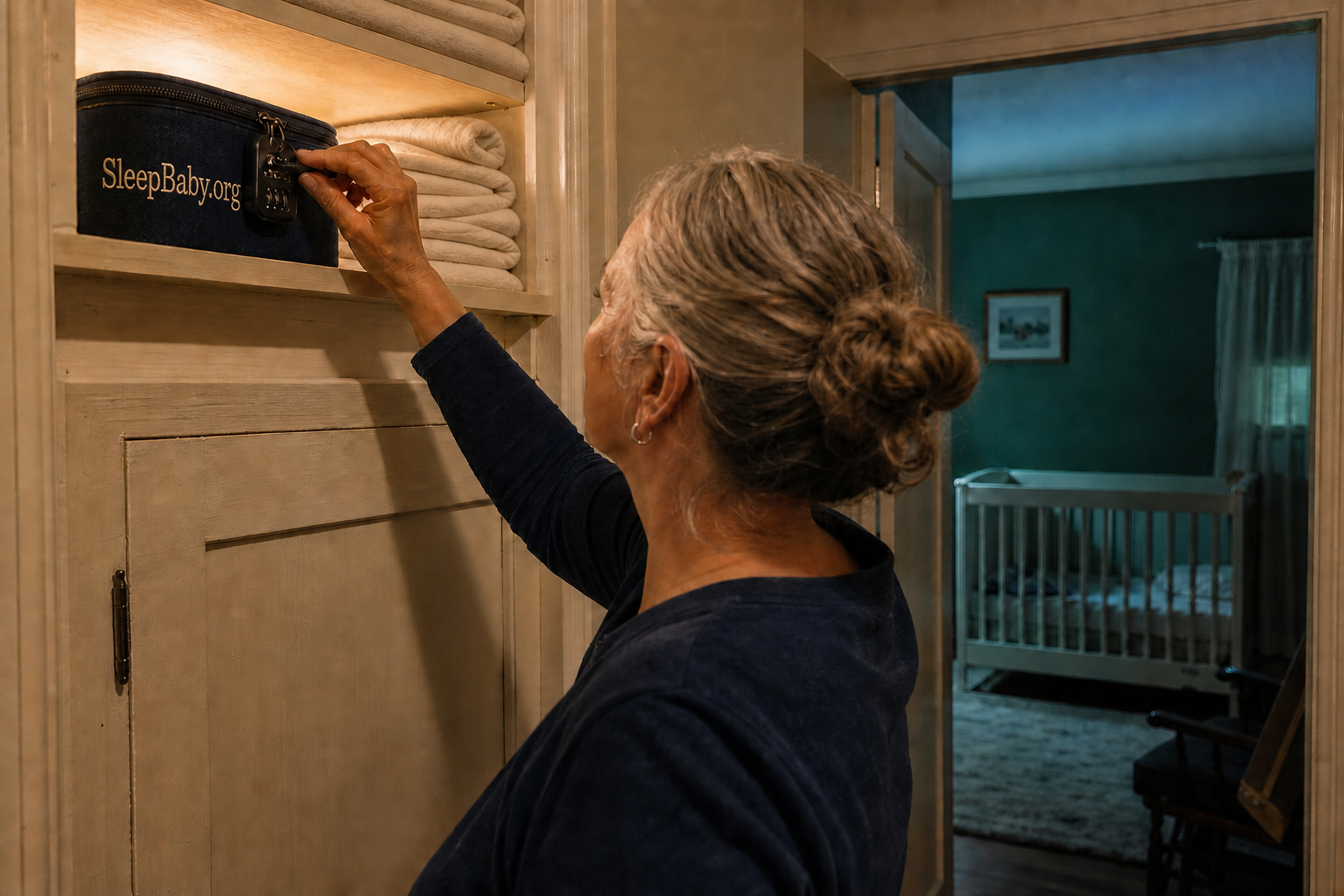
A lockable barrier for the adult “PM” products that live near bedtime
If adult sleep medicine currently sits in a nightstand, toiletry bag, or open bathroom bin, my practical pick is the Vaultz Locking Medicine Case. Its useful job here is narrow: it adds a combination lock between a child and the adult nighttime products that are otherwise easy to leave near the bed. That makes it a better fit for this exact problem than an unlocked organizer or passive pill box.
A movable case is not childproof and does not replace high, out-of-sight storage. Keep every product in its original child-resistant container, lock the case, store the whole case high, and return it immediately after use. A fixed locked cabinet may be the stronger choice if a portable case could be carried away.
See the Vaultz Locking Medicine Case on Amazon
As an Amazon Associate, SleepBaby may earn from qualifying purchases.
OPTIONAL SHOPPING IDEAS
Helpful Amazon finds for this topic
These optional shopping links are separate from the guidance above and are not medical advice or a substitute for professional care.
As an Amazon Associate, SleepBaby.org may earn from qualifying purchases.
Questions parents ask after the first “no”
Can I give a tiny piece of my own sleeping pill?
No. Cutting an adult tablet does not create a pediatric product or a reliable infant dose. Some tablets should not be split or crushed, and a fragment may not contain an even share of the active ingredient. If a piece may already be missing or touched your baby’s mouth, call Poison Control rather than estimating what happened.
Can I give Benadryl if my baby also has allergies?
Do not decide this from the bedtime problem. Diphenhydramine should not be used to make a child sleep. If your baby has allergy symptoms, contact the pediatrician for an age-appropriate diagnosis and treatment plan. The presence of a symptom does not make sedation an acceptable secondary goal, and products sold for adults or older children may not be appropriate for a baby.
What if the label says “children’s”?
“Children’s” covers an enormous developmental range and does not mean “for infants.” Read the active ingredient, concentration, age limits, and purpose. When a label tells you to ask a doctor for a young child, that means ask the child’s own clinician; it does not mean calculate a fraction from an older child’s dose.
Is melatonin safer because the body makes it naturally?
No product becomes automatically safe for a baby because the body also produces a related substance. Dose, timing, formulation, label accuracy, other ingredients, and developmental context matter. Pediatric organizations advise clinician involvement, and child-safety organizations emphasize locked storage because accidental ingestions have risen sharply.
Could a doctor ever prescribe something that makes a baby sleepy?
A clinician may prescribe medicine for a diagnosed condition, and drowsiness may be a known effect. That is different from prescribing a general sleeping pill for an otherwise unexplained bedtime problem. Give only the exact medicine for its stated purpose. If the baby seems excessively sleepy, difficult to wake, feeds poorly, or behaves differently after a prescribed medicine, contact the prescriber promptly; call emergency services for severe symptoms.
What if I only need one night of sleep?
Your need for sleep is real. The solution has to protect both of you. Ask another alert adult for a shift, place the baby in a separate safe sleep space when you need a break, and call the pediatrician’s after-hours line if the crying or wakefulness is unexplained. If you feel you might hurt yourself or your baby, put the baby safely in the crib and call emergency services or a crisis resource now. A crying baby in a safe crib while you get immediate help is safer than a sedating experiment.
Will sleep training fix a medication-level sleep problem?
“Medication-level sleep problem” is not a useful home diagnosis. Sleep training is not a substitute for evaluating illness, pain, feeding, growth, breathing, or a caregiver safety crisis. Once medical and feeding concerns are addressed, an age-appropriate sleep plan may help an older baby learn a different settling pattern. Newborns need responsive feeding and care; they are not candidates for being medicated or pushed into an older-baby schedule.
The answer I want beside the closed drawer
Return to that bottle on the nightstand. The safest move is still the plain one: close it, lock it away, and look at the baby rather than the promise on the front of the package. If a medicine may already have been given, call Poison Control before symptoms. If the baby looks ill, has breathing trouble, or cannot be awakened, use emergency care. If the baby is simply awake, meet the age-appropriate need and return to a firm, flat, empty sleep space.
I would rather help a parent make one clear call than give them twelve “natural” alternatives that leave the real question untouched. Your baby’s wakefulness may be exhausting, but it is information—not an invitation to improvise a sedative. The next safe step is to identify what the night is telling you.
Sources
- American Academy of Pediatrics, HealthyChildren.org. Melatonin for Kids: What Parents Should Know About This Sleep Aid.
- American Academy of Sleep Medicine. Health advisory on melatonin use in children and adolescents.
- National Capital Poison Center. Benadryl (diphenhydramine): dosing, safety, and poisoning.
- National Capital Poison Center. How to get help from Poison Control.
- U.S. Food and Drug Administration. OTC Monograph M010: Nighttime Sleep-Aid Drug Products for Over-the-Counter Human Use.
- U.S. Food and Drug Administration. FDA warns about serious problems with high doses of diphenhydramine.
- Centers for Disease Control and Prevention. Pediatric melatonin ingestions — United States, 2012–2021.
- National Center for Complementary and Integrative Health. Melatonin: What You Need To Know.
- American Academy of Pediatrics, HealthyChildren.org. Medication Safety Tips for Families.
- U.S. National Library of Medicine, MedlinePlus. Diphenhydramine drug information.
- Centers for Disease Control and Prevention. Helping Babies Sleep Safely.
- American Academy of Pediatrics, HealthyChildren.org. Getting Your Baby to Sleep.
- American Academy of Pediatrics, HealthyChildren.org. Healthy Sleep Habits: How Many Hours Does Your Child Need?.
- U.S. Consumer Product Safety Commission. Medication & Cleaner Storage Safety: Protect Children at Home.
Build the bedtime plan after medicine is off the table
If your baby is well and this has become a repeating sleep pattern, SleepBaby can help you sort the schedule, settling, naps, and nighttime response without turning a medicine cabinet into a sleep strategy.
Start with SleepBaby’s practical sleep support
SleepBaby’s sleep support does not replace Poison Control, emergency care, or advice from your baby’s clinician.













Join the conversation
What would you add?
Share one useful detail or question about Feeding & Nutrition. No name or email is needed.
Start the conversation. Share the detail you wish you had seen.