
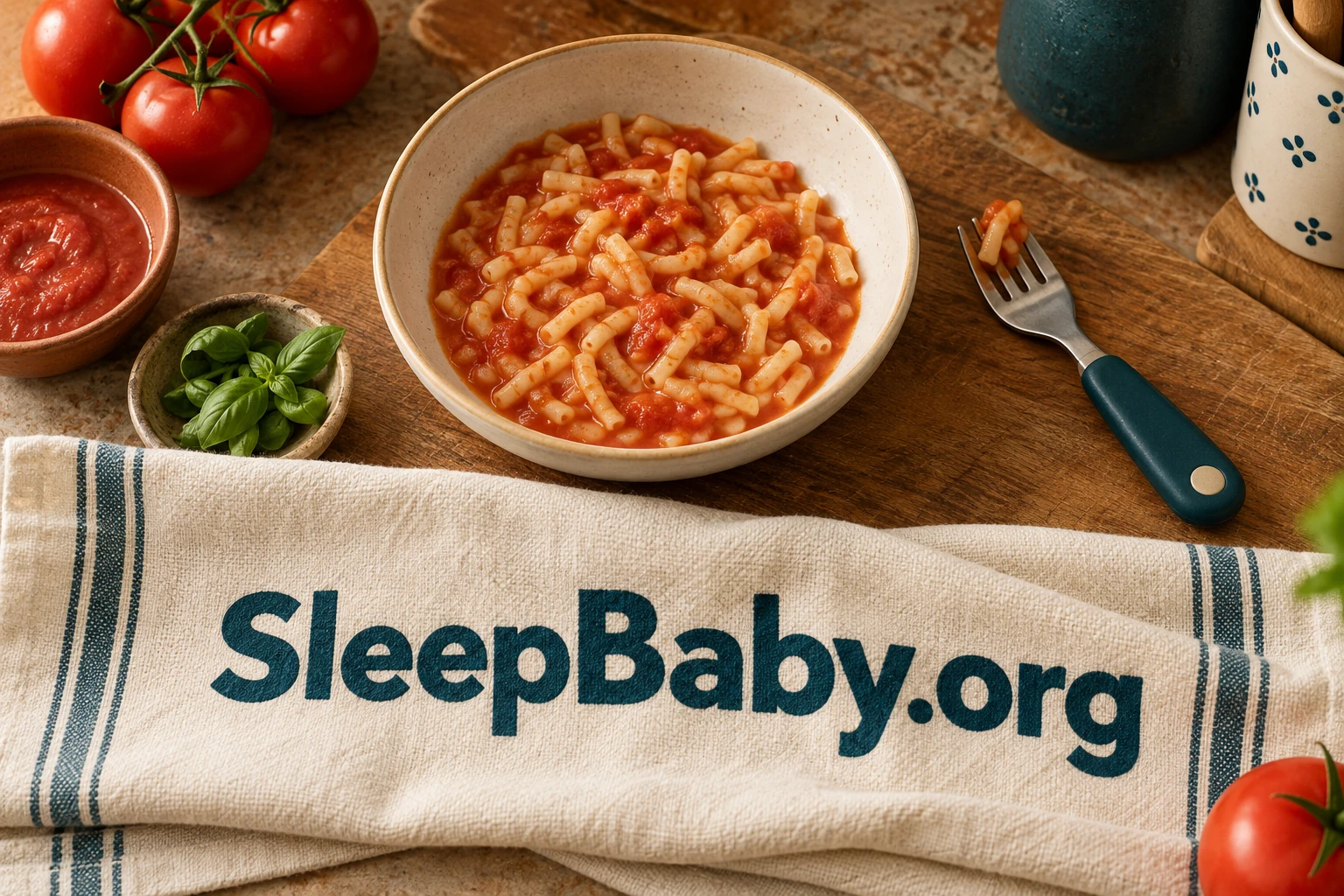
Yes. Babies can have suitably prepared noodles from around six months, when they’re ready for solid foods. Cook them until very soft, shorten long strands and adapt the texture to what your baby can manage. Check the ingredients, leave out added salt, and stay with your baby while they eat upright.
I would start with a small spoonful of soft, finely chopped or mashed noodles with a familiar sauce. Press a cooled piece with a fork before serving: it should squash easily, not spring back with a chewy center. That kitchen check helps you judge texture; it doesn’t make any food choke-proof.
Readiness matters more than a noodle birthday
You don’t have to wait until eight or ten months just because a baby hasn’t developed a precise finger-and-thumb grasp. Noodles can be adapted for spoon feeding. The starting question is whether your baby is ready for solids, not whether they can pick up a tiny piece of pasta.
Look for the readiness signs together around six months: your baby can stay sitting with a steady head, coordinate looking at food and bringing it to their mouth, and swallow food rather than consistently pushing it out. If your baby was premature, ask your clinician about timing.
More night waking or an interest in your bowl isn’t enough to establish readiness. And a noodle meal is not a way to replace needed milk feeds. Breast milk or first infant formula remains central while your baby is learning to eat.
If your baby has swallowing difficulties, a feeding tube, poor growth or an existing texture plan, use their feeding team’s instructions. A photograph of another baby eating spaghetti cannot tell you what is appropriate for yours.
The fork check: cook, shorten, then check again
The packet tells you how to cook the product. Your baby’s serving needs an additional look. Pasta cooked to an adult’s preferred firm bite may still be too chewy for this meal. A noodle can also be soft and much too long for the way you intend to serve it.
Check the food that will actually reach the tray
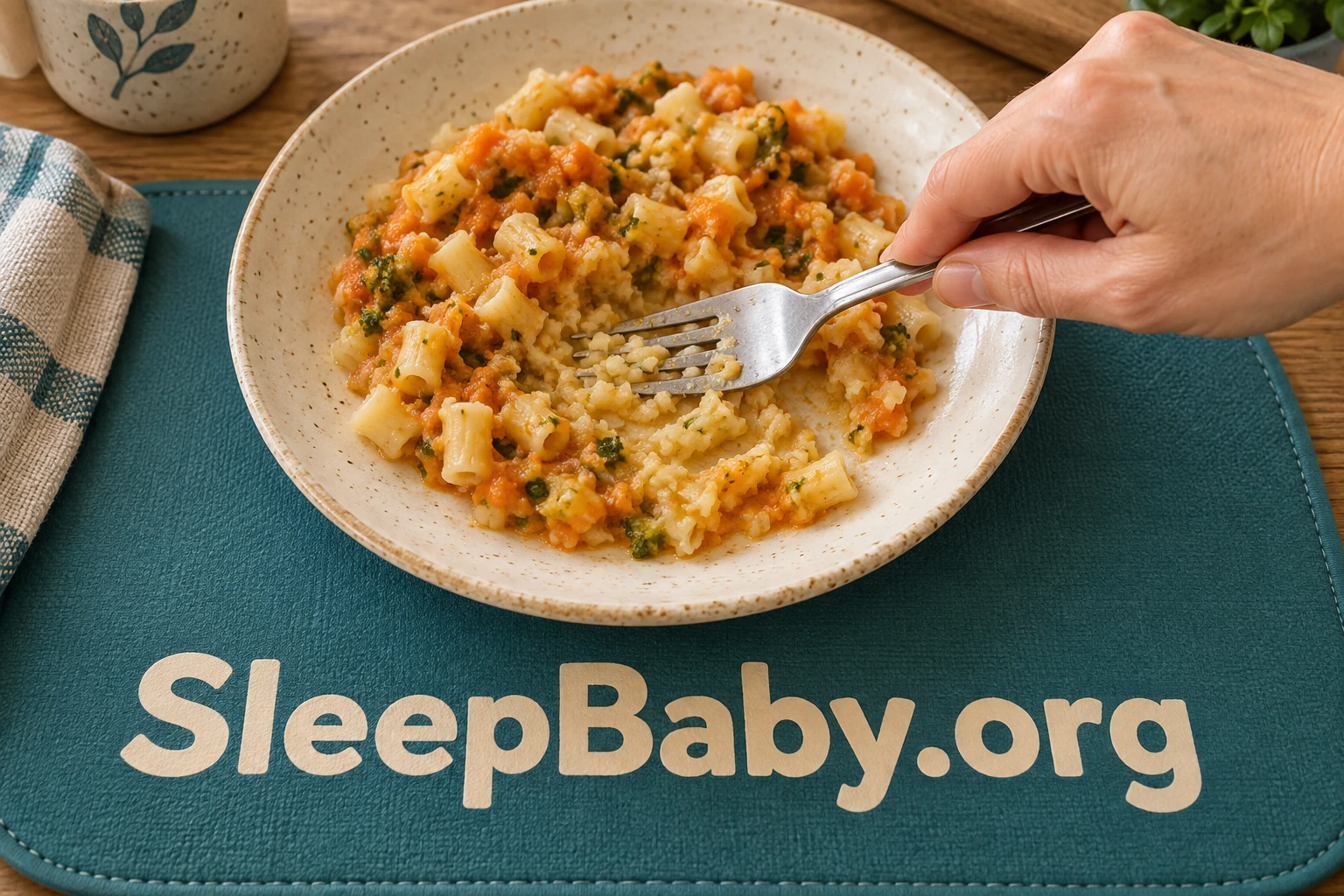
- Cook it soft. After cooling a sample, press it with the back of a fork. If it resists or has a firm middle, cook it longer and check another piece.
- Break up the length. Cut long strands into small, manageable pieces. For an early spoon-fed meal, finely chop or mash them into a suitable texture.
- Look for a clump. Separate sticky bundles and loosen the serving with a suitable familiar sauce. Don’t hand over a dense knot of noodles.
- Check after cooling. The serving should still be soft and manageable, and cool enough to eat. The hot noodle you tested over the stove is not the final serving.
This is a preparation reminder, not a validated swallowing test. Your baby’s skills and any individual feeding advice still matter.
How small should the pieces be?
For chopped bites, the American Academy of Pediatrics gives a general choking-prevention guide of pieces no larger than half an inch. I would treat that as an upper limit to think about, not a target every beginner must manage. A thick, rubbery half-inch piece still fails the texture check.
For a baby just starting with a spoon, mash or finely chop the cooked noodles further. The NHS chicken-noodle recipe for seven- to nine-month-olds specifically adapts the cooked meal by mashing or blending. It doesn’t ask the baby to work through an adult bowl of strands.
If you’re offering finger foods, choose a soft form your baby can grasp and manage, following their feeding guidance. You can combine self-feeding with spoon feeding; you don’t need to make a slippery tiny noodle the test of whether baby-led feeding is working.
Check the noodle and the sauce for allergens
Wheat and egg are the first ingredients I would look for on a noodle packet. Then I would read the sauce label too: milk, soy, sesame, peanut or other allergens may be part of the meal even when the noodles seem plain. The name on the front isn’t the ingredient list.
Introduce foods that can cause allergy one at a time, in small amounts, from around six months. For a first wheat exposure, a meal containing several other new allergens makes a reaction harder to interpret. Use familiar ingredients around the new one. If tolerated, include the food in the usual diet rather than treating that first taste as the only exposure needed.
If your baby already has a diagnosed allergy or eczema, or there is a family allergy history, speak with your clinician before introducing relevant foods. Follow an existing allergy plan rather than using this article to test a food again.
Stop the food and seek medical advice if you suspect an allergic reaction. A rash, vomiting or swelling after eating needs attention; don’t offer another bite to see what happens. Trouble breathing, sudden tongue or throat swelling, or a baby becoming limp or unresponsive is an emergency. Call your local emergency number and use prescribed emergency medicine according to your baby’s plan.
Make the first noodle meal an ordinary small meal
Choose a time when your baby is awake and you can sit with them. Put them safely upright in their high chair with its harness fitted. Finish chopping and checking the temperature before bringing the bowl to the tray, so your attention can stay on eating.
Offer a small amount. Wait for your baby to open their mouth if you are using a spoon, and let them set the pace. Closing their mouth or turning away is a reason to pause or finish, not to distract them into another mouthful.
I would rather offer a little and add more than face a heap of cooling, sticky noodles. Watch the actual meal: is your baby managing the texture, swallowing comfortably and remaining interested? Stop and get advice if coughing, choking or difficulty managing food keeps happening. Don’t keep increasing the challenge to help them “practice.”
AFTER THE BOWL IS PUT AWAY
Let dinner be dinner. Give bedtime its own small plan.

For an ordinary evening, the free planning preview at SleepBaby.org offers three choices and one suggested starting step. It works in your browser without a sign-up or card.
A noodle taste does not need to become a test of whether your baby sleeps longer. I would handle food preparation and needed feeds first, then decide separately what the familiar evening routine needs.
The optional paid SleepBaby.org Workshop offers short lessons you can revisit and a seven-night tracker. It is sleep-planning support, not choking prevention, allergy advice or permission to change a feeding plan. It does not promise a particular sleep result.

Which noodles are a reasonable choice?
There isn’t one special baby noodle that solves preparation. I would compare texture after cooking, ingredients and salt before worrying about the shape on the package. Ordinary pasta can work; a product marketed as healthy may still be chewy, salty or unsuitable for a particular allergy.
- Wheat pasta, spaghetti and macaroni
- Cook thoroughly and adapt the serving. Short pasta still needs a texture check; long spaghetti needs cutting for a chopped meal. Small tubes aren’t automatically ready to serve simply because they look bite-sized.
- Egg noodles
- Check both wheat and egg ingredients. Cook until soft, then shorten and mash or chop as needed. The NHS uses egg noodles in its adapted baby recipe, so they aren’t automatically off-limits.
- Rice noodles and vermicelli
- Don’t assume a thin noodle needs no preparation. Cook it fully, shorten it and separate tangles. If avoiding an allergen, check the actual package rather than assuming a rice-based name guarantees suitability.
- Udon, soba and other thicker noodles
- Read the ingredients and assess the cooked texture. A thick noodle that stays springy may need more cooking or a different preparation. “Buckwheat” on the front is not a reason to skip checking for wheat.
- Wholegrain or pulse-based pasta
- These can add variety, but I wouldn’t rank every version above ordinary white pasta. Choose a product your baby can manage and consider the rest of the meal. Check pulse ingredients too if your baby has a relevant allergy.
A lack of teeth isn’t the only deciding factor. Early foods should be soft enough for a baby learning to handle solids; don’t use the appearance of a tooth as permission to serve firm noodles. When you’re uncertain about oral skills, an individual feeding assessment is more useful than a product list.
What about instant ramen or cup noodles?
I wouldn’t make a seasoned instant-noodle cup the default baby meal. The concern is the complete product, particularly salt, ingredients, texture and serving temperature. “Instant” doesn’t describe all of those things, and vague worries about preservatives aren’t a useful substitute for reading the label.
The NHS advises against adding salt to babies’ food or cooking water and warns that stock cubes and gravy are often salty. For noodles, that makes plain cooking water and a suitable unsalted sauce a straightforward starting point. Soy sauce, seasoning sachets and ready-made broths deserve a separate label check.
Leaving out a sachet doesn’t automatically make an instant noodle suitable: the noodle itself may contain salt. Check it too. If the label is unclear or you can’t adapt the texture, choose a simpler option you can assess.
Don’t give a baby a cup of very hot broth or a dry noodle block to nibble. Transfer a suitable portion to their own dish and check its temperature and texture before serving. A bowl can feel comfortable while the food in the middle is still hot.
One family pan, two finishing steps
You don’t necessarily need to cook a separate baby dinner. Often the useful change is when you divide the meal. Cook the shared ingredients, set aside the baby’s portion, then finish the adults’ serving the way they like it.
Set aside, then adapt
Before adult seasoning: take out a suitable portion before adding salty stock, soy sauce or salty toppings.
Before the high chair: check every component. Shorten noodles, soften and mash vegetables as needed, and remove bones or other hard pieces from protein foods. Adjust the whole serving to your baby’s texture skills.
Before you call it dinner: think beyond noodles alone. Include a suitable iron-containing food and some variety across the day, while continuing your baby’s usual milk feeds.
A soft lentil-and-vegetable sauce is one possibility when those ingredients are suitable for your baby. Thoroughly cooked chicken with soft vegetables is another, with the meat and noodles prepared for the baby’s skills. These are meal-building ideas, not a requirement to put every food group in every bite.
Protein foods such as meat, beans and pulses provide nutrients including iron and zinc. The NHS includes these foods from around six months. Noodles can provide part of the meal without carrying the entire nutrition job.
Tomato sauce, cheese sauce and chicken noodle soup
A familiar smooth vegetable sauce can help you combine finely chopped noodles into a manageable spoonful. For cheese or creamy sauces, check milk ingredients and salt, and use appropriate pasteurised dairy ingredients. A restaurant’s Alfredo sauce may be much harder to assess than a simple home preparation.
With chicken noodle soup, look at the pieces as well as the broth. Soft noodles don’t fix firm carrot rounds, tough meat or bones elsewhere in the bowl. Adapt each ingredient, avoid salty stock and cool the serving. For a beginner, the NHS recipe’s mashed texture is a useful example of adapting a family dish.
If you don’t know the ingredients in a takeaway or someone else’s sauce, don’t guess for a baby with an allergy. Asking what went into the meal is part of serving it.
If noodles stick, get refused or trigger gagging
A sticky bundle
Stop and separate it before serving. Add a little suitable familiar sauce if needed, then check the final texture again. There is no benefit in making your baby work through a gummy knot because each strand was soft when it came out of the pan.
A turned head or closed mouth
End the attempt without making the next spoonful a contest. A first noodle meal is an opportunity to learn, not a portion to finish. You can offer an appropriate preparation again another day. Keep concerns about consistently poor intake or growth in a separate conversation with your clinician.
Gagging versus choking
Gagging can be noisy and involve retching or pushing food forward while a baby learns about texture. Choking can be quiet, especially when air cannot get through. Watch breathing and the ability to cough or cry rather than judging by noise alone.
If your baby is gagging but breathing, stay close and let them work the food forward; don’t reach blindly into the mouth. For ineffective coughing or trouble breathing, use the emergency guidance above. Repeated difficulty with meals needs professional advice even if each episode seems to settle.
Learn infant choking first aid before a meal
The American Red Cross infant-choking demonstration is useful preparation for caregivers. It is not a reason to delay an emergency call or to try a harder food texture.
Written takeaway: severe choking in a responsive baby under one year calls for infant back blows and chest thrusts, not abdominal thrusts. Get emergency help; begin CPR if the infant becomes unresponsive, following training and dispatcher guidance. Hands-on first-aid training can help you learn the technique.
Saving noodles for another meal
Keep an untouched portion separate from the baby’s bowl. Cool cooked food promptly, ideally within one to two hours, and refrigerate or freeze it. NHS baby-food guidance says to use refrigerated food within two days. Follow any shorter product-specific instructions.
Reheat an already-cooked portion only once, until steaming hot throughout, then cool it to a suitable serving temperature. Stir carefully, especially after microwaving, and check before offering it. Throw away the half-eaten portion from your baby’s dish.
I would label the untouched container when it goes away, rather than try to reconstruct which evening it came from. After reheating, repeat the texture check: stored noodles can stick together or change consistency. Food storage and a manageable texture are two separate checks.
An optional shortcut for the adult doing the chopping
If you often shorten cooked noodles, OXO Good Grips Kitchen and Herb Scissors are an optional preparation tool. OXO describes micro-serrated blades that separate for cleaning and cushioned handles. My reason for considering them here is the ordinary task of snipping cooked food, not any claim that a product prevents choking.
A suitable knife and stable cutting board you already own can do the job. Use clean food-preparation tools, keep sharp blades away from children, and finish cutting before serving. I haven’t personally tested these scissors. You still need to assess softness, size and your baby’s feeding skills.
Affiliate disclosure: As an Amazon Associate, SleepBaby.org earns from qualifying purchases. You don’t need to buy a special tool to offer noodles.
The last check happens at the table
Before offering the bowl, look at the meal you actually made: soft noodles, an appropriate texture, suitable ingredients and a comfortable serving temperature. Then sit with your baby. Good preparation does not replace watching them eat.
I would keep that first portion small and the evening expectations ordinary. A few tastes can be enough for one meal. Noodles aren’t a bedtime treatment, and starting solids doesn’t make a baby more likely to sleep through the night. Keep needed milk feeds and let dinner be dinner.
Sources
- NHS: first solid foods
- NHS: preparing food safely
- American Academy of Pediatrics: choking prevention
- NHS: chicken noodles recipe
- NHS: food allergies in babies and young children
- NHS: food allergy and emergency signs
- NHS: foods to avoid giving babies
- NHS: feeding from around six months
- NHS: choking and gagging
- American Red Cross: infant choking
- MedlinePlus: choking in infants under one year
- NHS: storing and reheating baby food
- OXO: Kitchen and Herb Scissors
FROM THE TABLE TO THE NEXT SMALL STEP
The meal can end without a whole new bedtime strategy.
If you want a starting point for an ordinary sleep routine, explore the free homepage planning preview or the optional SleepBaby.org Workshop. Feeding problems and health concerns still belong with your baby’s clinician.





What viewers said10 comments · 4 replies+
Archived comments from the original Baby Sleep Miracle presentation. Not independently verified by SleepBaby.org; individual experiences vary.
Thank you so much for this video! I had no idea about the dangers of baby swings :O
Hi Mary-Ann. I have a question: Is method in any way similar to the ones recommended by Dr Bucknam, Dr. Weissbluth or Dr. Karp? We tried those but none of them help.
Hi Regina, thank you for your question. The short answer is no. The techniques I share in my guide are based on newest scientific research and this is why I have never seen any approach similar to the one I recommend.
This method really works! I tried it on my son Jesus and after just one week he went from waking up more than 5 times a night to waking up just once or twice. You are a lifesaver, Mary-Ann!
I'm truly impressed with how much information you share in your video. And all for free! I can feel that you truly care about mothers like myself, and that's hard to find these days. I have recommended your site to several of my friends already.
Mary-Ann, our child suffers from autism. Is your approach still suited?
Chloe, I made sure my method can be used with any child, even babies who are special like yours. Please note that I'm not a doctor and that I always advice to consult with your physician because nothing is more important than the safety and well-being of your love.
Hallo Mary-Ann, I'm from Germany. Do you have your guide in German?
Hello Heide, we do! Normally you should already see our video in German. If not, please contact our support so they can guide you
Thenk you for your answer, Mary-Ann!
I just completed your approach and I have to say, it worked almost too well. Yes, it took a bit of getting used to with your bedtime routine but the difference is huge. My son George used to take 1 hours to go down and now he's firmly asleep in no more than 10 minutes! You're the best!
It seems I'm the only man watching this video, lol! What you shared about the 'emotional backpack' made immediate sense to me and I can't wait to help my little girl Mila to unpack it!
Hey there, just discovered your site and this really sounds different. Just wanted to say thanks for sharing :)
For everyone who's still thinking about getting Mary-Ann's guide I want to advise you to go ahead. I wasn't sure myself but now I'm so thankful I invested in this program. It made a huge difference in our life as a family and yes, my baby girl does sleep through the night now.