
Yes. Most babies can try mashed potatoes from around 6 months, once they are ready for solid food. Cook the potato until soft, mash it to a texture your baby can manage, and leave out added salt. I would set aside a plain portion before seasoning the family pot. Whether that mash contains milk, butter or another new ingredient matters more than whether it came from a special baby recipe.
Keep your baby upright and stay beside them while they eat. If they cannot breathe, cough or cry, get emergency help and begin infant choking first aid. Do not try to wash the food down with a drink.
SleepBaby.org · The original video
A little help
for the night ahead.
Take a moment to watch the original Baby Sleep Miracle presentation. Your article will be right here when you’re ready to keep reading.
What viewers said10 comments · 4 replies
Archived comments from the original Baby Sleep Miracle presentation. Not independently verified by SleepBaby.org; individual experiences vary.
Hi Mary-Ann. I have a question: Is method in any way similar to the ones recommended by Dr Bucknam, Dr. Weissbluth or Dr. Karp? We tried those but none of them help.
Hi Regina, thank you for your question. The short answer is no. The techniques I share in my guide are based on newest scientific research and this is why I have never seen any approach similar to the one I recommend.
This method really works! I tried it on my son Jesus and after just one week he went from waking up more than 5 times a night to waking up just once or twice. You are a lifesaver, Mary-Ann!
I'm truly impressed with how much information you share in your video. And all for free! I can feel that you truly care about mothers like myself, and that's hard to find these days. I have recommended your site to several of my friends already.
Mary-Ann, our child suffers from autism. Is your approach still suited?
Chloe, I made sure my method can be used with any child, even babies who are special like yours. Please note that I'm not a doctor and that I always advice to consult with your physician because nothing is more important than the safety and well-being of your love.
Hallo Mary-Ann, I'm from Germany. Do you have your guide in German?
Hello Heide, we do! Normally you should already see our video in German. If not, please contact our support so they can guide you
Thenk you for your answer, Mary-Ann!
I just completed your approach and I have to say, it worked almost too well. Yes, it took a bit of getting used to with your bedtime routine but the difference is huge. My son George used to take 1 hours to go down and now he's firmly asleep in no more than 10 minutes! You're the best!
It seems I'm the only man watching this video, lol! What you shared about the 'emotional backpack' made immediate sense to me and I can't wait to help my little girl Mila to unpack it!
Hey there, just discovered your site and this really sounds different. Just wanted to say thanks for sharing :)
For everyone who's still thinking about getting Mary-Ann's guide I want to advise you to go ahead. I wasn't sure myself but now I'm so thankful I invested in this program. It made a huge difference in our life as a family and yes, my baby girl does sleep through the night now.
Ready to get started?Take the next step with SleepBaby.
Pick your priceStart with your baby’s readiness, not the potato
Mashed potato belongs with first foods, alongside continued breast milk or infant formula. It is not a reason to start solids early. The CDC recommends beginning around 6 months and advises against introducing foods before 4 months.
Look at the skills that make a meal possible: your baby can hold their head and neck steady, sit upright with appropriate support, and move food back to swallow instead of repeatedly pushing it out. Reaching for food and coordinating hands, eyes and mouth are part of the picture. A birthday alone does not tell you how a baby will manage a spoonful.
For a 4- or 5-month-old, I would discuss readiness with their clinician rather than use a very smooth potato purée as a workaround. If your baby was premature, has trouble swallowing or follows an individual feeding plan, ask their healthcare team when and how to offer solids.
Chewing fists, wanting more milk or waking more often at night are not reliable signs that a baby needs mashed potatoes. Offer the milk they need. Starting solid food does not make a baby more likely to sleep through the night.
A simple way to make the first serving
You do not need a special recipe for one small bowl. Start with a plain potato and a clean fork. Keep the rest of the meal separate while you work out what your baby can manage.
- Wash your hands and equipment. Wash and peel the potato, then cut it into pieces for cooking. Keep the preparation surface clean.
- Cook in unsalted water or steam until soft. A fork should mash the cooked potato easily. A piece that is still firm in the middle needs more cooking.
- Remove your baby’s portion. Do this before adding salt, stock cubes, gravy or other family seasonings.
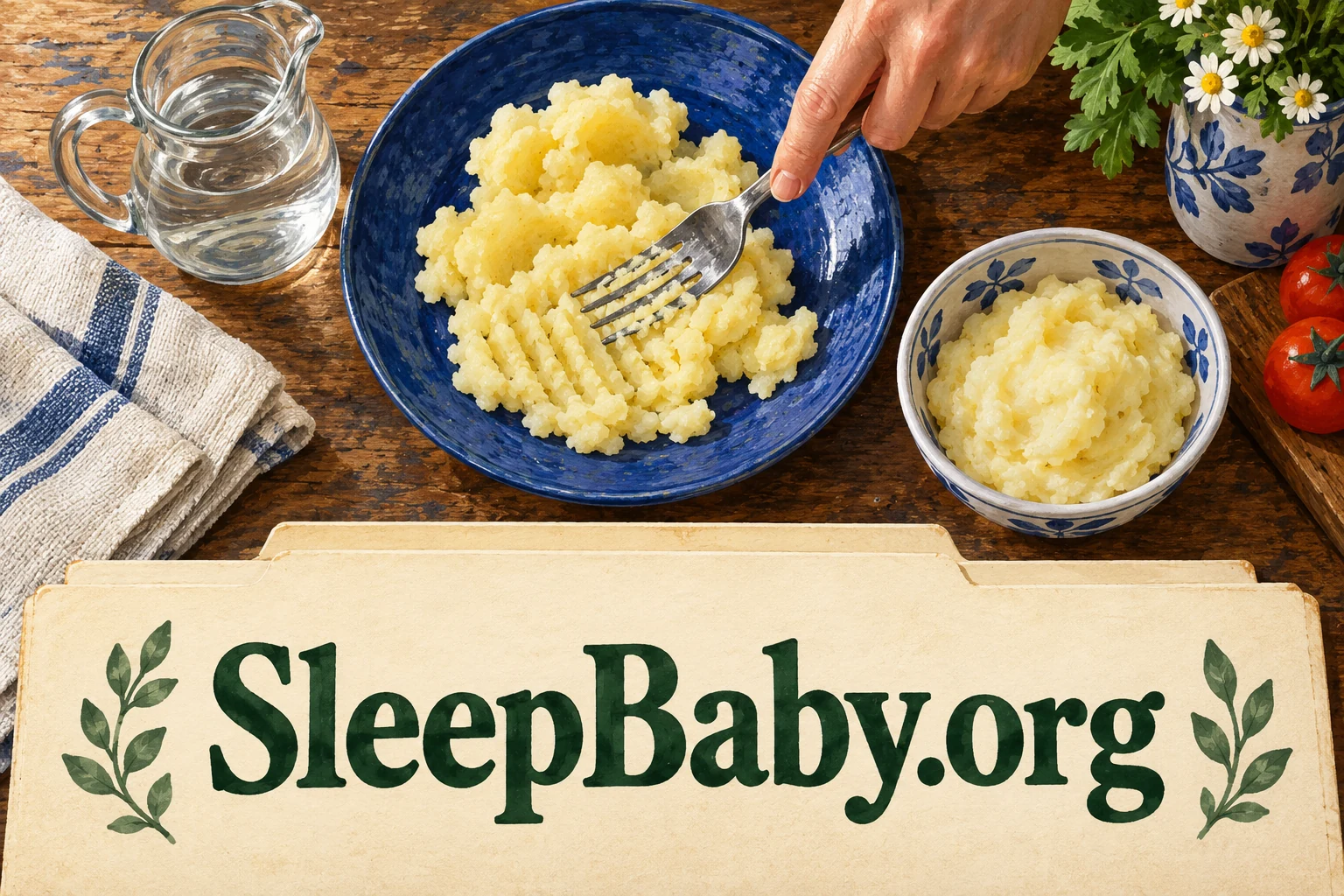
- Mash and adjust. Use a fork or masher. Add a little water at a time if needed to make a moist, manageable mash. Start smoother if that is what your baby can currently handle; soft lumps can follow as their skills develop.
- Cool, stir and check before serving. Test the temperature and inspect the texture again. Break up any firm pieces. Offer a little on a spoon rather than a large packed mouthful.
I would check the spoonful I am about to offer, not just the pan. Food that looked soft while being stirred can still contain a firmer piece. Add liquid gradually, then mix it through; the aim is a texture your baby can move and swallow, not a dense lump or an unnecessarily watery meal.
Can I loosen it with breast milk or formula?
Your baby’s usual milk can be used in appropriate foods. If you use infant formula, prepare it correctly according to its container before adding a little of the prepared liquid. Do not sprinkle formula powder straight into mashed potato or invent a stronger mixture.
A simple approach for batch cooking is to store the plain cooked potato separately and adjust only the portion you are serving. Adding milk does not extend either ingredient’s safe storage time. Follow the applicable milk-handling instructions as well as the food instructions, and discard a used feeding portion.
Milk and butter are different questions from milk as a drink
The rule about waiting until 12 months for cow’s milk as a main drink does not mean every food containing milk is off limits before then. NHS guidance allows pasteurised whole cow’s milk in cooking or mixed with food from around 6 months.
Milk is an allergen, however. Introduce foods that can cause allergy one at a time, in small amounts, so a reaction is easier to identify. If your baby has a diagnosed milk allergy or a prescribed dairy-free plan, use the substitute their clinician or dietitian recommends. Do not assume a little milk in potato is exempt from that plan.
Butter is optional. Potato does not need it to become a first food, and butter made from milk matters to a baby with milk allergy. I would begin with the uncomplicated version rather than add several unfamiliar ingredients to make the bowl more exciting. For a baby already tolerating dairy, a family recipe is a question of its full ingredients and salt content, not a blanket ban on all dairy before age one.
Read the whole bowl
- Plain potato and water
- A straightforward starting point when cooked and mashed appropriately.
- Milk, butter, cream or cheese
- Check dairy tolerance and any allergy plan. Cheese and salted butter can also add salt.
- Gravy, stock or seasoning mix
- Check for salt and allergens before offering the finished family dish.
- Restaurant or packet mash
- Ask for the ingredients or read the label. “Mashed potato” does not describe everything in it.
If someone else cooked dinner, ask when the salt and extras went in. A spoonful taken from a finished seasoned pot is not the same as a plain portion reserved earlier. That small kitchen detail is easier to settle before everyone sits down.

Serve the texture your baby can manage today
Some babies begin with smooth food on a spoon; others manage soft fork-mashed food from the start. The useful direction is gradual progress toward different textures as your baby develops, rather than keeping every meal perfectly smooth indefinitely.
Texture is not something a blender alone certifies. Check for hard pieces, keep portions small and watch your baby’s actual response. If a particular texture repeatedly causes difficulty, pause and discuss it with their healthcare team instead of making each bite a test.
Use a high chair with an appropriately fitted harness and keep your baby sitting upright. Stay close enough to see and respond throughout the meal. Avoid feeding them while reclined, moving around, riding in a car or sitting in a stroller.
Let your baby see the spoon. Wait for an open mouth, offer a small amount, then give them time. If they turn away or close their mouth firmly, stop. Scraping another spoonful into a closed mouth does not teach eating.
You can let a baby who is ready practise with a preloaded spoon while you supervise. A separate spoon to hold can make the exchange easier. The goal is participation, not a spotless bib or a bowl emptied on schedule.

AFTER THE SPOON GOES DOWN
Let dinner finish before the next part of the evening begins.
If the transition from dinner to bedtime feels scattered, the SleepBaby.org homepage describes the current SleepBaby.org Method, including information about bedtime routines and baby sleep schedules.
I would keep the food decision small: offer a suitable serving, follow fullness signals and clear the bowl when the meal is finished. Then choose an ordinary household cue, such as wiping the tray and putting out a clean bib for tomorrow, to mark the change of activity.
You can read the current offer on the homepage and decide whether it fits the routine question you want help with. Mashed potatoes are not a sleep treatment, and a larger dinner is not permission to drop needed milk feeds. Feeding, allergy or swallowing concerns belong with your baby’s healthcare team.
How much mashed potato should I offer?
At the beginning, a small amount is enough for trying the taste and practising the skill. Put a little in the feeding bowl and offer more if your baby is interested. There is no need to turn a serving suggestion into a target they must finish.
Watch the baby rather than the last spoonful. Opening their mouth and reaching toward food can show interest. Turning away, closing their mouth or losing interest can mean they have had enough. Let them stop, even when more is left.
Breast milk or infant formula remains important as solids increase, and it should remain the main drink throughout the first year. A bowl of potato does not replace the nutritional role of milk. Ask for feeding advice if solids are crowding out milk feeds, intake is consistently poor or you are worried about growth.
Potato can be part of a meal, not the entire menu
Potato is a starchy food. Babies also need variety, including foods containing iron once they start solids. Think about what goes beside the mash as skills and familiarity grow: soft mashed lentils, suitably prepared meat or another appropriate iron-containing food, plus a vegetable.
For example, a baby already comfortable with those ingredients might have soft mashed lentils alongside potato and well-cooked broccoli mashed to a manageable texture. A baby trying their first spoonful does not need all three unfamiliar foods at once.
Keep introducing different tastes instead of making every vegetable disappear into the same potato mixture. It is fine to combine foods, but tasting an ingredient on its own also gives your baby a chance to learn it. Familiarity can take repeated calm offers.
Gagging, choking and reactions need different responses
Gagging can happen while babies learn to move food in their mouths. You may hear retching, see watery eyes or notice the tongue push forward. Stay calm and watch closely. Do not add another spoonful while your baby is dealing with the one already there.
Choking can be quiet. A weak or absent cough, inability to cry or difficulty breathing needs immediate action. Do not wait for a change in skin colour before responding.
If your baby can cough strongly or cry, the Red Cross advises letting them keep coughing while you observe closely and remain ready to act. Do not put fingers into their mouth blindly. Learn infant first aid in advance; an article is harder to follow in the middle of an emergency.
A rash, vomiting or other possible reaction after a new food is a reason to stop that food and seek medical advice. Keep the ingredient list, including milk, butter or seasoning added to the potato. Do not assume the potato itself caused it or retry a suspected allergen simply to check.
Store the untouched portion, not the feeding bowl
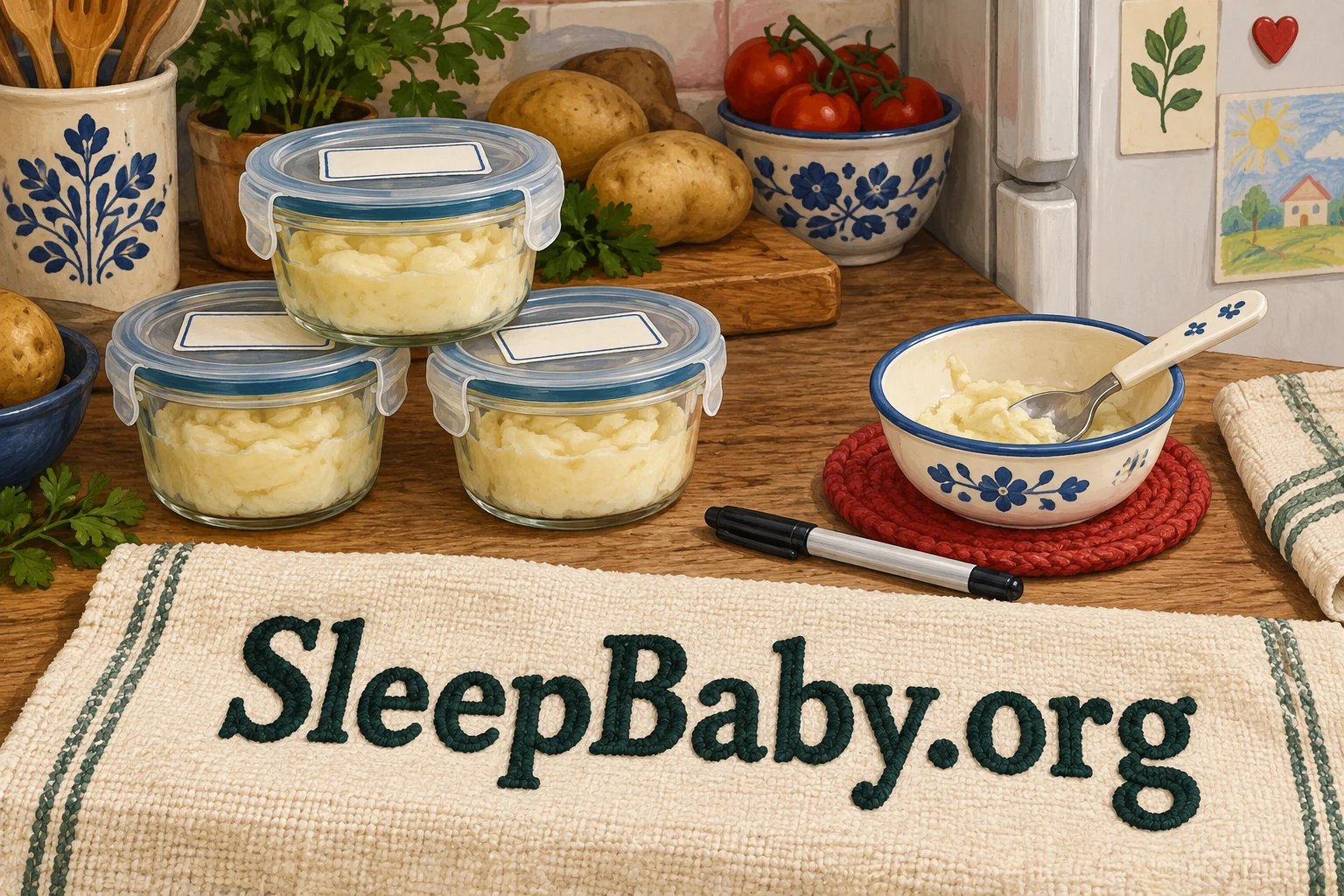
Small portions make this easier. Before feeding, use a clean utensil to move only what you need into the baby’s bowl. Keep the rest separate. Once a spoon has been in your baby’s mouth, do not use it to stir the stored batch.
For home-prepared baby food, NHS guidance says to cool it promptly, ideally within one to two hours, then refrigerate or freeze it. Use refrigerated food within two days. These are baby-food instructions; do not automatically apply a longer adult-leftover timetable.
Label the container with what it contains and when it was made. “Potato with milk” is a more useful note than “dinner” when another caregiver opens the fridge. If you are not sure how long it has been out or how it was stored, choose a fresh portion.
One portion, one reheat
- Defrost frozen food thoroughly in the fridge, or use the microwave’s defrost setting.
- Use defrosted food within 24 hours.
- Reheat cooked food only once, until steaming hot throughout.
- Stir well and let it cool to a safe feeding temperature before offering it.
- Discard the half-eaten portion. Do not refrigerate it for another meal.
With a microwave, stirring and checking matter because food can heat unevenly. Do not test only the edge of the bowl.
For a portion containing breast milk or prepared formula, its milk-handling limits still apply. Using water to adjust a plain potato batch and adding milk only to a serving can keep the decisions simpler. Do not keep extending a batch’s life by adding fresh ingredients.

Questions that come up at the dinner table
Are instant mashed potatoes always unsuitable?
No blanket rule can tell you what is in every packet. Read its ingredients, salt information and preparation directions. Plain potato flakes are a different proposition from a salted, flavoured mix containing milk or cheese. Make sure the prepared texture is appropriate and every ingredient fits your baby’s needs.
I would choose the simplest suitable option I can identify. “Homemade” does not make a salty recipe suitable, and “instant” alone does not establish a problem with every ingredient.
Can my baby eat restaurant mashed potatoes?
Ask what is in them. Restaurant mash may already contain salt, dairy or other ingredients before it reaches your plate. If staff cannot confirm ingredients relevant to an allergy, do not offer it. A separate familiar food is easier than guessing.
What if my baby already tasted salted mash?
For future servings, reserve an unsalted portion. One taste does not tell you that your baby has been harmed, and there is no need to invent a home “flush” or change their formula recipe. If you are concerned about the amount or your baby is unwell, contact their healthcare professional for advice.
Is sweet potato better than white potato?
Both appear among the starchy foods the NHS includes from around 6 months. They provide different tastes and can be part of a varied diet. The immediate checks are the same: appropriate readiness, thorough cooking, manageable texture and suitable additions.
Can I offer potato every day?
Potato can fit into ordinary meals, but I would look at the whole week. Is your baby also meeting different vegetables, proteins and other starchy foods? A food they accept is useful; it does not need to become the only food offered.
What if they spit it out or refuse?
Pause without making the spoon a contest. A new texture, tiredness or simply being finished can change the response. Offer it another time when your baby is alert and interested. Repeated difficulty swallowing, pain or consistently poor intake deserves professional advice rather than repeated persuasion.
Does potato cause constipation or gas?
You cannot identify the cause of a digestive problem from one bowl. Note the food, additions, stool pattern and any discomfort if you need to discuss it with your baby’s clinician. Get prompt medical advice for blood in the stool, vomiting with constipation or constant abdominal pain; discuss persistent symptoms and feeding problems too. Do not use potatoes as a treatment or remove a whole food group on the strength of one unsettled evening.
Should I offer a bigger portion before bed?
I would not use mashed potatoes as a sleep strategy. Starting solids does not reliably make babies sleep through the night, and pushing extra food past fullness is not responsive feeding. Keep meals calm, continue needed milk feeds and address routine questions separately.
Watch infant choking first aid before you need it
This American Red Cross demonstration is a preparation resource for caregivers of babies under one. Do not stop during an emergency to watch a video; call for help and follow emergency instructions.
Written fallback: If a responsive infant cannot cough or cry, get emergency help and use five back blows followed by five chest thrusts. Repeat until the obstruction clears or the infant becomes unresponsive. If unresponsive, begin CPR according to your training and the dispatcher’s instructions. A baby who can cough or cry needs close observation and space to keep coughing. Read the Red Cross written instructions and take an infant first-aid course.
A small masher is optional
For frequent small batches, the OXO Tot Food Masher is one practical option to compare. Its manufacturer describes matching ridges on the masher and bowl and a design that packs inside the lidded bowl. It is for mashing soft food; it does not cook potato or establish that a texture is safe for your baby.
Already-owned alternative: A clean fork and a small bowl are enough to mash thoroughly cooked potato. I would try those first. Buy another tool only if it solves a repeated preparation problem in your kitchen.
Sources
- CDC: When, what and how to introduce solid foods
- NHS: Your baby’s first solid foods
- NHS: Feeding from around six months
- NHS: Introducing foods that could trigger allergy
- NHS: Foods to avoid giving babies and young children
- CDC: Choking hazards
- CDC: Iron
- NHS: Choking and gagging on food
- American Red Cross: Infant choking first aid
- NHS: Food allergy
- NHS: Storing and reheating baby food
- NHS: Swallowing problems
- Berkshire Healthcare: Feeding difficulties in babies
- NIDDK: Constipation symptoms and when to seek help
- CDC: Infant formula preparation and storage
- OXO: Tot Food Masher product details
ONE MANAGEABLE MEAL AT A TIME
Set aside the serving. Leave room for your baby’s cues.
Once the food and safety questions are settled, you can visit the SleepBaby.org homepage to read about the current Method and its information on bedtime routines. Keep those routine decisions separate from feeding pressure or medical concerns.
SleepBaby.org · The original video
A next step for
the next bedtime.
Still thinking about sleep? Watch the presentation here, then explore the SleepBaby program whenever you’re ready.
What viewers said10 comments · 4 replies
Archived comments from the original Baby Sleep Miracle presentation. Not independently verified by SleepBaby.org; individual experiences vary.
Thank you so much for this video! I had no idea about the dangers of baby swings :O
Hi Mary-Ann. I have a question: Is method in any way similar to the ones recommended by Dr Bucknam, Dr. Weissbluth or Dr. Karp? We tried those but none of them help.
Hi Regina, thank you for your question. The short answer is no. The techniques I share in my guide are based on newest scientific research and this is why I have never seen any approach similar to the one I recommend.
This method really works! I tried it on my son Jesus and after just one week he went from waking up more than 5 times a night to waking up just once or twice. You are a lifesaver, Mary-Ann!
I'm truly impressed with how much information you share in your video. And all for free! I can feel that you truly care about mothers like myself, and that's hard to find these days. I have recommended your site to several of my friends already.
Mary-Ann, our child suffers from autism. Is your approach still suited?
Chloe, I made sure my method can be used with any child, even babies who are special like yours. Please note that I'm not a doctor and that I always advice to consult with your physician because nothing is more important than the safety and well-being of your love.
Hallo Mary-Ann, I'm from Germany. Do you have your guide in German?
Hello Heide, we do! Normally you should already see our video in German. If not, please contact our support so they can guide you
Thenk you for your answer, Mary-Ann!
I just completed your approach and I have to say, it worked almost too well. Yes, it took a bit of getting used to with your bedtime routine but the difference is huge. My son George used to take 1 hours to go down and now he's firmly asleep in no more than 10 minutes! You're the best!
It seems I'm the only man watching this video, lol! What you shared about the 'emotional backpack' made immediate sense to me and I can't wait to help my little girl Mila to unpack it!
Hey there, just discovered your site and this really sounds different. Just wanted to say thanks for sharing :)
For everyone who's still thinking about getting Mary-Ann's guide I want to advise you to go ahead. I wasn't sure myself but now I'm so thankful I invested in this program. It made a huge difference in our life as a family and yes, my baby girl does sleep through the night now.
Ready to get started?Take the next step with SleepBaby.
Pick your price



Thank you so much for this video! I had no idea about the dangers of baby swings :O