
Yes, you can offer ripe, soft banana from around 6 months, once your baby shows the signs of being ready for solid food. Mash it or prepare a soft finger food suited to their skills, seat them upright, and stay beside them while they eat. Breast milk or infant formula remains their main drink during the first year.
I would start with a little fork-mashed banana and an unhurried moment at the table. You don’t need a blender, a whole banana, or a baby who is determined to finish the bowl. Readiness and texture matter more than the amount.
If something is wrong right now
If your baby cannot breathe or cry, has a weak or ineffective cough, changes color, or becomes unresponsive, call your local emergency number and start appropriate infant first aid. Have someone call while you help, or use speakerphone and follow the dispatcher. A responsive choking infant under 1 year needs back blows and chest thrusts, not abdominal thrusts. If unresponsive, begin infant CPR as directed. Do not blindly sweep a finger inside the mouth.
Sudden breathing difficulty, tongue or throat swelling, collapse, or a floppy, unusually unresponsive baby after food can be a severe allergic reaction. Call emergency services immediately and follow any prescribed emergency allergy plan, including prescribed adrenaline/epinephrine. Do not wait to see whether sleep helps.
For a suspected reaction without those emergency signs, stop the food and seek medical advice before offering it again. You cannot tell from a rash alone whether banana or another ingredient caused it.
When is a baby ready for banana?
Banana follows the same readiness rules as other first solid foods. The NHS advises starting around 6 months, when three signs appear together: your baby can stay sitting with their head steady, coordinate their eyes, hands and mouth to reach for food, and swallow food instead of pushing it straight back out.
Being fascinated by your breakfast is not enough on its own. Neither is waking more often at night, chewing fists, or wanting extra milk. Those things can happen before a baby is ready for solids. Offering banana early is not a reliable answer to them.
A birthday does not automatically settle the question, either. If your baby was premature, has a swallowing difficulty, or already follows a feeding plan, ask their clinician how that plan applies to solids and texture. Don’t replace individual advice with an age chart from a food page.
My three checks: ready, soft, seated
This is a practical reminder, not a test that can certify a food as safe.
- Ready: Around 6 months, the readiness signs are present together, and any individual feeding advice has been followed.
- Soft: The peeled banana is ripe and easily mashed. Its texture and shape fit the skills your baby has now.
- Seated: Your baby is awake, upright and securely seated, with an attentive adult beside them throughout the meal.
If one part is missing, change the plan before offering food. A soft fruit does not make a reclined, sleepy or unsupervised feed appropriate.
How to prepare a first taste
Wash your hands, preparation surface and utensils. Wash fruit before preparing it, then peel the banana. Choose one with flesh that is soft enough to mash easily. A yellow skin is a clue, but the flesh tells you more than the color alone. A firm, underripe banana is not the starting point I would choose.
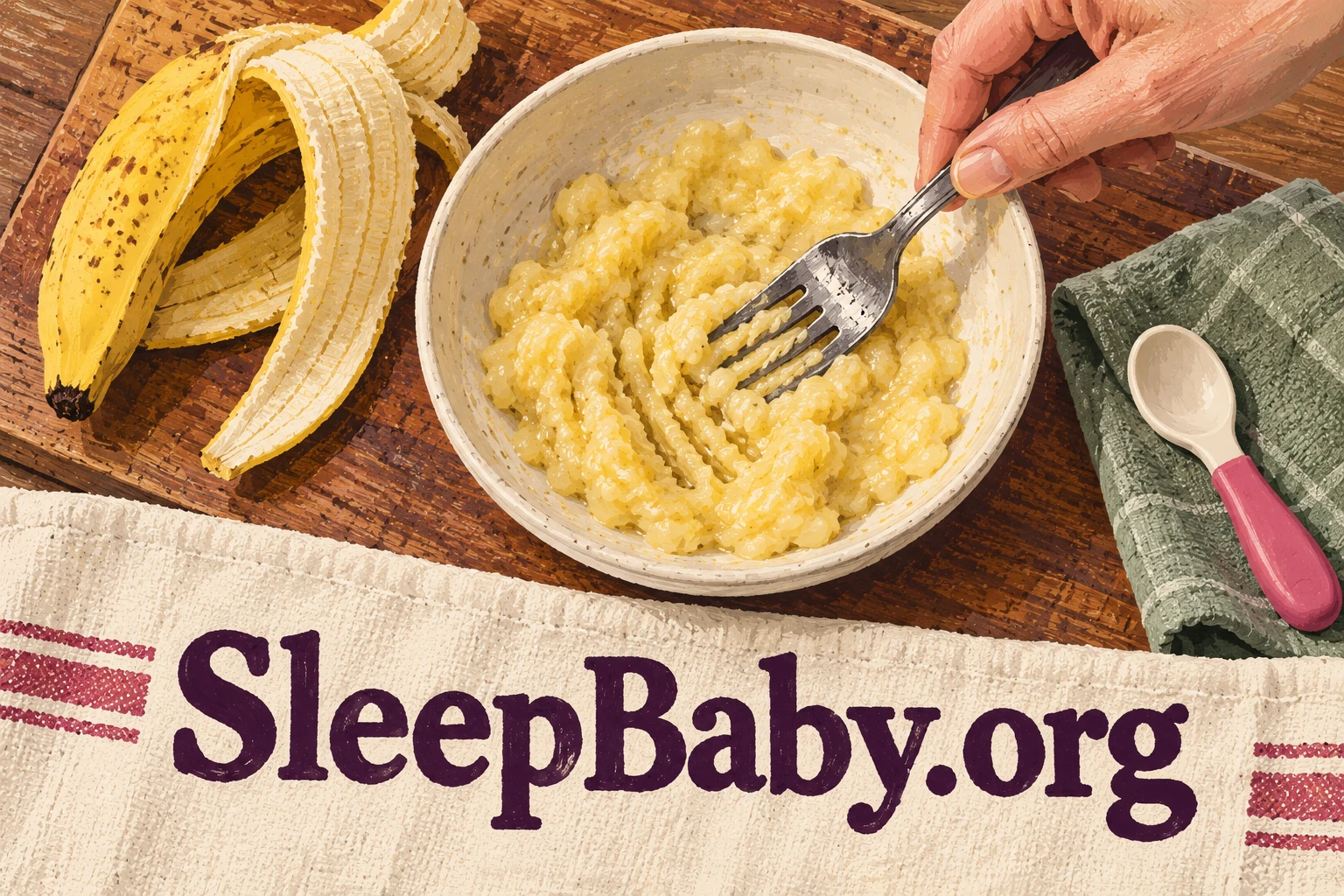
Put a small amount in a clean bowl and press it thoroughly with a fork. Adjust the texture to what your baby can manage; some babies begin with a smooth mash and progress to more texture. Ripe banana does not need cooking before it is mashed. The NHS includes uncooked mashed banana in its recipe for babies from 6 months.
Offer a little on a suitable baby spoon and let your baby respond. Wait for an open mouth rather than pushing the spoon through closed lips. You can also offer an appropriately prepared preloaded spoon for them to explore. Keep watching the baby, not the amount disappearing from the bowl.
You do not need to sweeten banana. Skip added sugar and salt, and do not add honey before 12 months. A drizzle can disappear into the mash while still being an unsuitable ingredient for a baby.
Choose the form your baby can manage
Fork-mashed banana: A straightforward option when you want control over softness and consistency. Break down firm lumps; do not assume a quick squash removes every choking risk.
Soft finger food: For a baby ready to self-feed, use a soft piece shaped so they can grasp it. NHS guidance describes finger foods in pieces big enough to hold in a fist with some sticking out. Preparation still needs to match the individual baby. Slipperiness, firmness and the pieces that break off matter.
Forms to leave out of an early banana meal: Hard frozen chunks, dried banana chips, and firm pieces your baby cannot manage. Do not treat round slices as automatically appropriate because they look small.
If banana keeps sliding out of their hand, that is not a reason to place a chunk directly into their mouth. Mash it or change the serving approach. I would keep this first attempt simple rather than introduce a new nut flour or other allergen just to make the fruit easier to grip.
How much banana should you offer?
There isn’t one fraction of a banana that every baby should finish at a particular age. Banana sizes vary, appetites vary, and a first taste is different from an established meal. Start small, then offer more if your baby remains interested.
Early solid feeding includes learning to move food, exploring it with hands, and sometimes sending most of it onto the bib. A tiny amount swallowed does not mean you need to press on until a serving target is reached. Continue the usual breast milk or formula feeds while solid-food skills develop.
Pause when your baby closes their mouth, turns away, or loses interest. Give them a moment. If they are done, put the spoon down. One distracted glance is not a precise fullness measurement, but you do not need certainty about fullness to respect a pause.
For example, if you mash part of a banana and your baby tries two tastes before turning away, the remaining mash is a storage question, not a reason to persuade them to eat. Serve a little at a time so there is less saliva-contaminated food to throw away.
If intake, weight gain, swallowing, or feeding stamina concerns you, ask your baby’s clinician about the whole feeding pattern. Repeatedly adding banana is not a way to assess or correct those concerns.
AFTER THE BOWL IS PUT AWAY
Let banana be food. Give bedtime its own plan.

If your next question is about an ordinary evening routine, the SleepBaby.org Method homepage discusses bedtime routines and baby sleep schedules.
A familiar food can fit into a family meal without becoming a strategy for making a baby sleep. I would finish the feed when the baby is done, continue their usual milk feeds, and consider the evening separately.
You can read the current offer on the homepage and decide whether that routine discussion fits your question. It does not assess feeding readiness, treat constipation or allergies, or replace advice about swallowing, intake or growth. A feeding or medical concern needs attention before a sleep plan.
Let banana be one food among many
Banana can be a convenient fruit in a varied diet. It does not need to carry the whole meal, and it should not crowd out milk feeds or the range of other foods your baby is learning to eat. Include suitable iron-containing foods as solids develop, such as meat, fish, beans, lentils or fortified infant cereals, prepared for your baby’s stage.
If banana is a familiar favorite, you can offer it alongside another suitable food without hiding everything in sweet mash. Babies also need chances to experience different tastes and textures. The NHS specifically recommends offering less sweet vegetables as part of early variety.
A daily taste is a different situation from banana becoming the only accepted solid food. I would look at what else the baby is offered and able to eat. If the range is narrowing, meals are distressing, or growth is a concern, get feeding support rather than turning the next meal into a contest.

Simple combinations, with ingredients you know
Mashed banana can be combined with a familiar soft food, such as cooked oats or plain full-fat pasteurized yogurt. Adjust the finished texture to your baby. Milk is an allergen, and cereals can contain wheat or other gluten-containing ingredients, so check what you are actually using.
Introduce foods that commonly trigger allergy one at a time, in small amounts, so a reaction is easier to recognize. Once an allergenic food has been introduced and tolerated, NHS guidance recommends keeping it in the usual diet. Follow individualized advice if your baby has eczema, a diagnosed allergy, or a previous reaction.
For a measured no-cook idea, the NHS smashed avocado and banana recipe is written for babies from 6 months. It uses ripe fruit mashed or blended to a suitable consistency. I have not personally tested the recipe; its value here is that you can follow the published preparation and storage instructions instead of guessing from a photograph.
Can banana cause constipation?
I would not label banana a constipation cure or blame it from one changed diaper. When solids begin, the wider diet and stool pattern matter. A baby who is straining is not automatically constipated; look at whether the stool is hard and difficult or painful to pass.
The NHS lists hard stools, small pellets, straining or pain, and sometimes a small amount of blood associated with hard stool among constipation signs. A change in how often your baby goes is useful information, but frequency alone does not tell the whole story.
If you think your baby is constipated, ask their clinician for advice, especially if it persists or your baby seems unwell. Keep offering their usual milk and a variety of suitable foods. Do not replace feeds, start a laxative, or make a juice or water plan from a banana article. Treatment and fluid advice depend on age and the individual situation.
It helps to note when solids started, what your baby has been eating, what the stool looks like, and whether passing it hurts. That gives a clinician something more useful than “banana did it.” A repeated pattern after a food is worth discussing, without treating the timing as proof.

Keep the clean portion separate from the used bowl
Banana is easy to mash fresh, so I would prepare only a little for the first meal. If you want to save some, set aside a clean, untouched portion before feeding begins. A spoon that has been in your baby’s mouth should not go back into that stored portion.
A small-batch plan for mashed banana
- Fresh is simple: Peel and mash a little shortly before the meal with clean hands and utensils.
- Save only an untouched portion: Cover it, refrigerate promptly and use it the same day. This is a conservative approach consistent with the NHS banana-and-avocado recipe’s same-day advice.
- Discard the partly eaten portion: Do not save your baby’s used bowl for the next meal.
- Follow the mixture’s instructions: Adding yogurt, milk or another food does not extend its storage life. Follow any shorter applicable storage guidance.
- Don’t judge by color alone: Mashed banana can brown quickly. Color cannot tell you whether handling and storage were safe.
An already-owned clean food container with a suitable cover can do this job. No special baby-food machine or storage set is needed. Label a saved portion so another caregiver knows what it contains and when you prepared it.
If you freeze prepared food, follow safe storage and defrosting guidance for the whole mixture. Thaw it thoroughly before serving; a frozen banana chunk is not an appropriate substitute for soft food. NHS weaning guidance advises using defrosted food within 24 hours. For an occasional spoonful of banana, making it fresh may be the easier choice.
Gagging, choking, and signs to discuss with a clinician
Gagging can occur while a baby learns to manage food. It is often noisy, with retching, watery eyes or a tongue pushing forward. Stay close and calm. Do not put fingers into the mouth to fish for food or rush another spoonful in.
Choking can be quiet. An ineffective cough, inability to cry or breathe, color change or fading responsiveness calls for immediate action. A strong cough or cry is different from a weak cough, but keep watching and be ready to act if the baby worsens. Use the emergency guidance near the top of this page; do not wait for a video.
Get medical help after a choking episode, even if the obstruction comes out. Arrange advice for recurring coughing during meals, repeated choking, trouble progressing through textures, or concerns about swallowing or growth. You do not need to keep offering the same piece to prove that the problem happens again.
For possible allergy symptoms, note the food and every added ingredient, how much was offered, and when symptoms began. Stop the suspected food and get advice before trying it again. Breathing problems, tongue or throat swelling, collapse or unusual floppiness belong in the emergency pathway above, regardless of whether a rash is visible.
Learn infant choking first aid before a meal becomes an emergency
This American Red Cross demonstration supports preparation alongside practical first-aid training. In an emergency, call for help and act instead of waiting for the player.
Written fallback: A responsive choking infant under 1 year who cannot cough effectively, cry or breathe needs back blows and chest thrusts. If unresponsive, begin infant CPR and follow emergency-dispatch instructions. No blind finger sweeps or abdominal thrusts for infants. Read the Red Cross infant choking instructions.
Banana before bed is still just food
You can include banana in a suitable meal without making it a bedtime requirement. I would not promise that it relaxes a baby’s muscles, prevents night waking, or makes a baby sleep longer. The feeding guidance does not establish those outcomes.
Don’t put mashed banana into a bottle or keep spooning it in after your baby is done in hopes of getting a longer stretch of sleep. Continue normal milk feeds and respond to the baby in front of you. If feeding difficulties or illness are disrupting the evening, address those with appropriate support.

The questions left at the kitchen counter
Can my 3- or 4-month-old have banana?
The general starting point is around 6 months with the readiness signs present together. A young baby watching you eat or waking more at night does not establish readiness. Discuss an individual concern with your clinician rather than starting banana early to solve it.
Does my baby need teeth?
Counting teeth is not the readiness check. Being developmentally ready and able to manage the prepared texture matters. Keep the banana soft and suitable for your baby’s current skills; teeth do not make a firm or slippery piece automatically manageable.
Must I puree banana until a certain month?
No single birthday tells you exactly when to change texture. Progress from smooth to mashed, lumpy and soft finger foods as your baby becomes able to manage them. If you are unsure or progress is difficult, ask for feeding advice rather than following a rigid banana-cutting chart.
What if my baby refuses it?
Put it away and offer suitable food again another time without pressure. There is no requirement to make banana a favorite. If refusal is part of a wider pattern of distress, difficulty swallowing or poor intake, bring that pattern to your baby’s clinician.
For the next attempt, I would put a small amount of soft mash in a bowl, sit beside an awake, upright baby, and see whether they want a taste. The unused part of the banana can stay your snack. The baby does not owe the fruit a finished serving.
Sources
- NHS: first solid foods, readiness and responsive feeding
- NHS: feeding from around 6 months
- NHS: preparing food safely for weaning
- NHS: choking and gagging on food
- American Red Cross: infant choking first aid
- MedlinePlus: choking first aid for infants under 1 year
- American Academy of Pediatrics: choking prevention
- NHS: food allergies in babies and young children
- NHS: introducing food allergens during weaning
- NHS: foods to avoid giving babies and young children
- NHS: storing and reheating food for weaning
- NHS: smashed avocado and banana, including same-day storage advice
- NHS: constipation in children
FOOD FIRST. THEN THE EVENING.
One soft food can stay a simple choice.
For a separate look at bedtime routines and baby sleep schedules, visit the SleepBaby.org Method homepage. Keep your baby’s feeding needs and any medical plan in place while deciding whether the current offer is relevant to your family.




What viewers said10 comments · 4 replies+
Archived comments from the original Baby Sleep Miracle presentation. Not independently verified by SleepBaby.org; individual experiences vary.
Thank you so much for this video! I had no idea about the dangers of baby swings :O
Hi Mary-Ann. I have a question: Is method in any way similar to the ones recommended by Dr Bucknam, Dr. Weissbluth or Dr. Karp? We tried those but none of them help.
Hi Regina, thank you for your question. The short answer is no. The techniques I share in my guide are based on newest scientific research and this is why I have never seen any approach similar to the one I recommend.
This method really works! I tried it on my son Jesus and after just one week he went from waking up more than 5 times a night to waking up just once or twice. You are a lifesaver, Mary-Ann!
I'm truly impressed with how much information you share in your video. And all for free! I can feel that you truly care about mothers like myself, and that's hard to find these days. I have recommended your site to several of my friends already.
Mary-Ann, our child suffers from autism. Is your approach still suited?
Chloe, I made sure my method can be used with any child, even babies who are special like yours. Please note that I'm not a doctor and that I always advice to consult with your physician because nothing is more important than the safety and well-being of your love.
Hallo Mary-Ann, I'm from Germany. Do you have your guide in German?
Hello Heide, we do! Normally you should already see our video in German. If not, please contact our support so they can guide you
Thenk you for your answer, Mary-Ann!
I just completed your approach and I have to say, it worked almost too well. Yes, it took a bit of getting used to with your bedtime routine but the difference is huge. My son George used to take 1 hours to go down and now he's firmly asleep in no more than 10 minutes! You're the best!
It seems I'm the only man watching this video, lol! What you shared about the 'emotional backpack' made immediate sense to me and I can't wait to help my little girl Mila to unpack it!
Hey there, just discovered your site and this really sounds different. Just wanted to say thanks for sharing :)
For everyone who's still thinking about getting Mary-Ann's guide I want to advise you to go ahead. I wasn't sure myself but now I'm so thankful I invested in this program. It made a huge difference in our life as a family and yes, my baby girl does sleep through the night now.