Yes—you can fall asleep before your baby does. If your baby’s immediate needs are met and they are lying on their back in their own firm, flat, empty, approved crib, bassinet, bedside sleeper, or play yard, you do not have to keep watch until their eyes close. The safe-sleep question is not who falls asleep first? It is where is the baby when the adult falls asleep?
I want to say that plainly because exhaustion turns ordinary quiet wakefulness into a moral test. You look over at a baby blinking in the bassinet and wonder whether closing your own eyes would be careless. It is not careless to sleep after you have completed a safe handoff. In fact, if you are nodding off while holding your baby, putting them down safely—even fully awake—is the safer choice.

Awake is a state, not a danger signal
A baby can be awake and safe at the same time. Quiet alertness may look like open eyes, small wiggles, soft grunts, coos, or a few minutes of looking around. Those behaviors do not create a requirement for an adult to stare continuously at the bassinet. Current safe-sleep guidance tells us how to set up the baby’s location: on the back, on a firm and flat surface, with only a fitted sheet, in a safety-approved infant sleep product. It does not say a parent must remain awake until the baby crosses an invisible sleep threshold.
This matters because “put baby down awake” is sometimes treated as shorthand for sleep training. I would separate those ideas. You are not promising that a newborn will self-settle, asking a distressed baby to cope alone, or following a rigid “drowsy but awake” program. You are completing a safety handoff. Your baby may drift off, fuss and need you again, or decide that 2:13 a.m. is an excellent time to inspect the ceiling. The safe location remains useful in all three outcomes.
If your baby is crying hard, rooting, showing feeding cues, unusually sleepy, hot or cold, struggling to breathe, changing color, repeatedly vomiting, or behaving in a way that worries you, that is no longer merely “awake.” Reassess the baby and seek appropriate care. Reassurance should sharpen your attention to the right signals, not make you ignore them.

Use the situation—not the eyelids—to decide what happens next
When I am tired, I do better with a decision I can see. This one has three lanes. None asks you to predict the exact minute your baby will fall asleep.
A three-lane decision for an exhausted night
Rest now, move baby first, or check and get help
Rest now
Baby is calm or quietly alert, on their back in a separate, firm, flat, empty approved sleep space. No feed, care need, symptom, or individualized plan requires action now. You may close your eyes.
Move baby first
Baby is in your arms, on your chest, in adult bedding, on a couch or recliner, or asleep in a swing, bouncer, car seat outside travel, or another sitting device. Put baby on the approved flat surface before you sleep.
Check or get help first
A feed is due, baby is distressed or seems unwell, a clinician’s plan calls for waking, or you feel close to losing control. Meet the need, call support, or get urgent care; use the empty crib as a safe pause when needed.
The middle lane deserves special emphasis. A couch, recliner, adult bed, or sleeping adult’s chest does not become safer because the baby finally fell asleep. Couches and armchairs are especially hazardous when an adult dozes while feeding or comforting. If your head is dropping, the goal is not a heroic extra twenty minutes of holding. The goal is to finish the transfer while you still can.
If your baby fell asleep in a bouncer or swing, move them to the flat infant sleep surface. Our guide to what to do when a baby sleeps in a bouncer gives that handoff its own simple sequence. Supervision does not turn sitting gear into a routine sleep space, and your own sleep removes even that supervision.
The Last Awake Check: four questions before you close your eyes
I call this the Last Awake Check because it belongs to the final minute before the parent rests. It is not a ritual your baby has to “pass.” It is a quick way to move attention from anxious watching to the few conditions that actually change the decision.
The practical tool
Four real questions—then permission to rest
- Where is baby? On their back in their own firm, flat, level, empty, approved sleep space—not in arms, adult bedding, sitting gear, or soft furniture.
- What does baby need now? Check feeding cues, the diaper if it is bothering them, comfortable clothing and room temperature, escalating distress, and anything unusual about breathing, color, alertness, or behavior.
- What plan overrides the default? Follow a waking-to-feed, weight-gain, prematurity, illness, medication, or other individualized plan from your baby’s clinician.
- Can I exit safely? Your hands are off the baby, the sleep area is clear, and an awake adult has taken over if the transfer or care task is not finished.
If all four answers are reassuring, you have completed the work that belongs to you in that moment. Your baby’s remaining job may be to blink, squirm, sigh, or fall asleep. I cannot promise how smoothly that part will go. I can tell you that watching harder does not make a correctly prepared bassinet more correct.
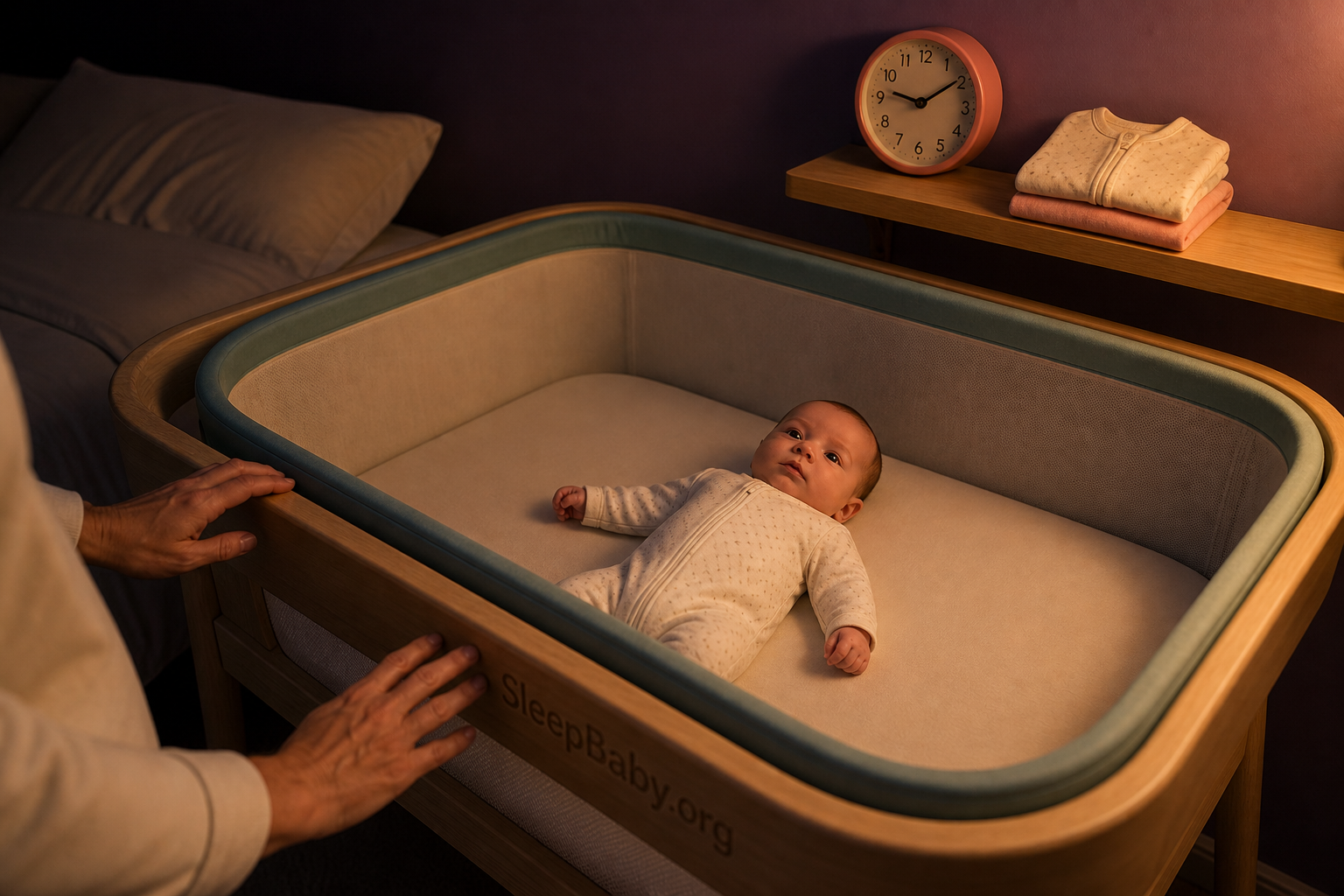

If the danger is falling asleep during a feed
This is the part I would plan in daylight, because midnight judgment is operating on fumes. NICHD and AAP guidance is blunt about couches and armchairs: do not choose them for a feed when you may fall asleep. Soft cushions, gaps, and trapped positions make an accidental doze especially dangerous.
Prepare the baby’s separate sleep space before the feed begins. Clear the bassinet, make sure the fitted sheet is secure, place anything you need for yourself within reach but outside the infant space, and decide who can take over if another awake adult is available. A timer or another person can help you stay alert, but neither changes where the baby belongs when the feed ends.
If you feed in bed and think you might doze, remove pillows, blankets, and other soft items from the area around the baby before the feed. This is harm reduction for an unplanned event, not a recommendation to bed-share. Return the baby to their nearby separate sleep space when the feed is over, or as soon as you wake if you accidentally fell asleep. The American Academy of Pediatrics does not recommend bed sharing.
A fatigue plan, not a willpower test
Ready the surface → feed → hand off → lie down
- Ready the surface first. Bare, flat, nearby, and usable now.
- Feed in the least hazardous place available. Avoid couches and recliners when sleepy.
- Hand baby off to the separate surface. Awake is acceptable; back placement and a clear space matter.
- Then let the adult sleep. If the handoff keeps failing, wake another adult or use a short reset rather than continuing to hold while nodding off.
When there is no second adult to take the handoff
A partner handoff is useful, but I do not want to write as though every parent has another awake adult in the house. If you are solo tonight, the safe sleep space becomes your handoff partner. Prepare it before you pick baby up for the last feed or soothing attempt. Put your water, phone, and feeding supplies where you can reach them without making the bassinet a storage shelf. Decide before you sit down that the first unmistakable head drop, dreamlike confusion, or inability to keep your eyes open ends the hold.
At that point, place baby on their back in the empty crib, bassinet, or play yard—even if the transfer wakes them and even if they protest. A crying baby in a safe sleep space while you stand, wash your face, breathe, or make a call is safer than a quiet baby on a sleeping adult. You can return after a brief reset and try feeding or soothing again if you are alert enough. If you are not, leave baby safely placed while you call someone who can come, stay on the phone, or help you decide what support is available.
Make the call before exhaustion becomes an emergency. A friend does not have to be an infant-sleep expert to provide an awake voice. A nearby relative may be able to hold the adult logistics while you feed. Your baby’s clinician can help if feeding difficulty, unusual crying, reflux symptoms, illness, or poor weight gain is driving the cycle. If you feel unsafe to care for the baby, say that clearly rather than softening it into “I’m a little tired.”
I would also lower the standard for everything that is not safety. The bottles can wait for daylight once the next feed is covered. The room does not need to look calm. A baby does not need a perfect wind-down performance before entering the bassinet. On a solo night, success may be wonderfully plain: baby is fed according to the plan, placed safely, and the adult is horizontal. That is not cutting a corner. That is choosing the corner that protects both of you.
For a newborn who keeps waking through every cycle, the next useful step may be a whole-night plan rather than another transfer trick. Our guide to a newborn who will not sleep at night helps you map feeds, care loops, and adult handoffs. If the bassinet itself is the sticking point, use the safer landing ideas in what to try when a newborn will not sleep in the bassinet. Neither problem is solved by an adult falling asleep while holding the baby.

Make the separate surface easier to use before you are exhausted
A safe surface only helps if it is ready at the moment you need it. Put the approved crib, bassinet, bedside sleeper, or play yard where you can use it without stepping over clutter. Keep the baby’s fitted sleep clothing ready. Leave the infant space empty. If you use a room monitor, set the volume once rather than turning the night into a surveillance shift.
For the first six months, current AAP and CDC guidance favors room sharing in a separate infant sleep space. That arrangement can make the final handoff shorter and feeding responses easier without putting the baby in the adult bed. If you are deciding where that surface belongs, our room-sharing guide separates the safety recommendation from the practical move to another room.
Notice what I am not promising: a closer bassinet does not guarantee a sleeping transfer. It can simply remove steps from the process that has to be repeated when you are tired. Sometimes reducing friction is the most honest win available.
The answer changes when a feeding or health plan says it does
A broad “yes, go to sleep” should never overrule the specific plan for a specific baby. Many newborns feed every two to four hours, and some need to be awakened. A baby born early, a baby who has not regained birth weight, a baby with poor weight gain, or a baby recovering from illness may have a different overnight plan. Follow the instructions from the clinician who knows your baby.
I would write the next feeding time down before the adult lies down if exhaustion is making time slippery. Use an alarm when your care plan calls for one. If your baby seems too sleepy to feed, has fewer wet diapers than expected, is difficult to wake, has a fever at an age when that requires urgent evaluation, or shows another concerning change, contact the baby’s clinician or seek urgent care. This article cannot decide whether a particular baby should be awakened or medically assessed.
Same safety foundation, different overnight details
What to check by stage and circumstance
| Situation | Before the parent sleeps | What does not change |
|---|---|---|
| Young newborn | Confirm the next feed and any waking or weight-gain plan; meet current needs. | Back placement in a separate firm, flat, empty approved surface. |
| Baby beginning to roll | Stop swaddling at signs of trying to roll; place baby on the back at the start of every sleep. | No positioner, wedge, loose bedding, or side-placement workaround. |
| Older mobile baby | Use the crib at the correct mattress height and keep climbable or loose items out. | Baby may be awake when placed down; the sleep space remains clear. |
| Prematurity, illness, or individualized plan | Follow the baby’s clinician for feeding, positioning, monitoring, medication, and when to seek care. | Do not improvise an incline or soft surface without specific medical direction. |
What about spit-up, rolling, and the fear that you will miss something?
“What if my baby spits up while I am asleep?”
Healthy babies should still be placed on their backs. The airway anatomy and gag reflex help protect them, and AAP safe-sleep guidance does not recommend side or stomach positioning for ordinary spit-up. Do not add a wedge, incline the mattress, or put a positioner around the baby. If vomiting is forceful, green, bloody, frequent with poor intake, paired with breathing trouble, or otherwise concerning, contact a clinician; that is a health question, not a sleep-position hack.
“What if my baby leans to the side?”
Always start the baby on the back. A newborn may curl or shift, and a baby who can roll independently may change position. Do not hold the baby in place with rolled towels, wedges, nests, or other objects. If back placement brings crying, troubleshoot feeding, comfort, timing, and transfer while preserving the safe starting position; our guide to a baby who cries when placed on the back walks through that distinction.
“Do I need a monitor before I am allowed to sleep?”
No consumer monitor grants permission to sleep, and no monitor repairs an unsafe surface. A monitor can be a convenience when your baby is in another room or when you want to hear waking. It has not been shown to prevent SIDS, and it cannot replace the back, bare, flat, separate sleep setup. If your baby’s clinician prescribes medical monitoring, follow that specific plan rather than treating a consumer product as equivalent.
Watch the safe-sleep setup once, then let yourself stop watching
AAP: Safe Sleep for Babies
This short American Academy of Pediatrics video is a useful visual reset for the sleep-space details that matter. It does not ask you to watch a baby until sleep begins; it helps you prepare the place where baby can safely be while you rest.
Takeaway: prepare the separate bare space before fatigue peaks; awake placement is compatible with that safe setup.
Watch the AAP video on YouTube if the embedded player is unavailable.
If baby is crying—and if you are reaching your limit
A crying baby may need another pass through feeding, diaper, temperature, comfort, and illness clues. Responding does not mean you must keep holding through dangerous exhaustion. If you are getting angry, panicked, dissociated, or afraid you might shake or hurt the baby, place the baby on their back in the empty crib or play yard and step away for a short reset. Call a trusted person. Call your baby’s clinician. The American Academy of Pediatrics and CDC both support using a safe infant space while an overwhelmed caregiver regains control.
If you think you might harm yourself or your baby, get help now. In the United States, call or text 988 for a suicidal or mental health crisis. Call 911 or go to the nearest emergency department for immediate danger or symptoms of postpartum psychosis. These instructions belong outside every shopping decision because the product is not the answer to a crisis; another human and appropriate care are.


You are not abandoning an awake baby; you are trusting the safe place you prepared
Let me return to the blinking baby in the bassinet. At the beginning, those open eyes can feel like an accusation: You are still needed. You are not allowed to sleep yet. After the Last Awake Check, the same open eyes mean something quieter. The baby is safely placed. Their current needs and tonight’s plan have been considered. The adult is no longer balancing a tiny body while losing alertness.
I would rather have Kacey put Benjamin down safely and lie beside the bassinet while he is awake than keep holding him until exhaustion wins. That sentence is editorial judgment, not a claim about a particular night in their real life. It is also the heart of the answer: responsible care includes knowing when the safest next action is for the adult to stop doing.
Your baby may call you back. You can respond when they do. You may discover that the feed was not quite finished, that the diaper is uncomfortable, or that they need another calm landing. None of those possibilities requires you to stay awake in advance as proof of love. Finish the handoff. Put your own body somewhere safe. Let sleep be allowed to arrive in either order.
Sources
- American Academy of Pediatrics: Safe Sleep Tips for Sleep-Deprived Parents
- Kingston and Richmond NHS Foundation Trust: Safe sleeping guide for babies under 1 year
- CDC: Providing Care for Babies to Sleep Safely
- U.S. Consumer Product Safety Commission: Safe Sleep—Cribs and Infant Products
- NICHD Safe to Sleep: Safe Sleep Environment for Baby
- NICHD Safe to Sleep: Breastfeeding & Safe Sleep
- American Academy of Pediatrics: How to Keep Your Sleeping Baby Safe
- AAP Pediatrics: Sleep-Related Infant Deaths—Updated 2022 Recommendations
- American Academy of Pediatrics: How to Calm a Fussy Baby
- CDC: About Abusive Head Trauma
- CDC: How Much and How Often to Breastfeed
- National Institute of Mental Health: Perinatal Depression






What viewers said10 comments · 4 replies+
Archived comments from the original Baby Sleep Miracle presentation. Not independently verified by SleepBaby.org; individual experiences vary.
Thank you so much for this video! I had no idea about the dangers of baby swings :O
Hi Mary-Ann. I have a question: Is method in any way similar to the ones recommended by Dr Bucknam, Dr. Weissbluth or Dr. Karp? We tried those but none of them help.
Hi Regina, thank you for your question. The short answer is no. The techniques I share in my guide are based on newest scientific research and this is why I have never seen any approach similar to the one I recommend.
This method really works! I tried it on my son Jesus and after just one week he went from waking up more than 5 times a night to waking up just once or twice. You are a lifesaver, Mary-Ann!
I'm truly impressed with how much information you share in your video. And all for free! I can feel that you truly care about mothers like myself, and that's hard to find these days. I have recommended your site to several of my friends already.
Mary-Ann, our child suffers from autism. Is your approach still suited?
Chloe, I made sure my method can be used with any child, even babies who are special like yours. Please note that I'm not a doctor and that I always advice to consult with your physician because nothing is more important than the safety and well-being of your love.
Hallo Mary-Ann, I'm from Germany. Do you have your guide in German?
Hello Heide, we do! Normally you should already see our video in German. If not, please contact our support so they can guide you
Thenk you for your answer, Mary-Ann!
I just completed your approach and I have to say, it worked almost too well. Yes, it took a bit of getting used to with your bedtime routine but the difference is huge. My son George used to take 1 hours to go down and now he's firmly asleep in no more than 10 minutes! You're the best!
It seems I'm the only man watching this video, lol! What you shared about the 'emotional backpack' made immediate sense to me and I can't wait to help my little girl Mila to unpack it!
Hey there, just discovered your site and this really sounds different. Just wanted to say thanks for sharing :)
For everyone who's still thinking about getting Mary-Ann's guide I want to advise you to go ahead. I wasn't sure myself but now I'm so thankful I invested in this program. It made a huge difference in our life as a family and yes, my baby girl does sleep through the night now.