When one tiny mitten is on the hand and the other has vanished
Can a baby sleep with mittens?
You pull the crib sheet smooth, place your baby on their back, and notice the scratch mittens. One is snug. The other already looks as if it is planning an escape. Suddenly a harmless-looking piece of cotton feels like a question you should have answered before bedtime.
Most healthy babies do not need mittens for sleep, and loose or detachable mittens are not my first choice overnight. If hand covering is briefly needed for scratching, a correctly sized sleeper with built-in fold-over cuffs is generally a more practical option than separate mittens because the cuff stays attached to the clothing. Whatever your baby wears should be plain, secure, intact, non-weighted, and appropriate for the room temperature. Keep the crib bare, place your baby on their back, and never add mittens just because their hands feel cool.
The useful decision is not “mittens: yes or no?” in isolation. It is: Why am I covering the hands, can the covering come loose, and is there a better way to solve the actual problem?
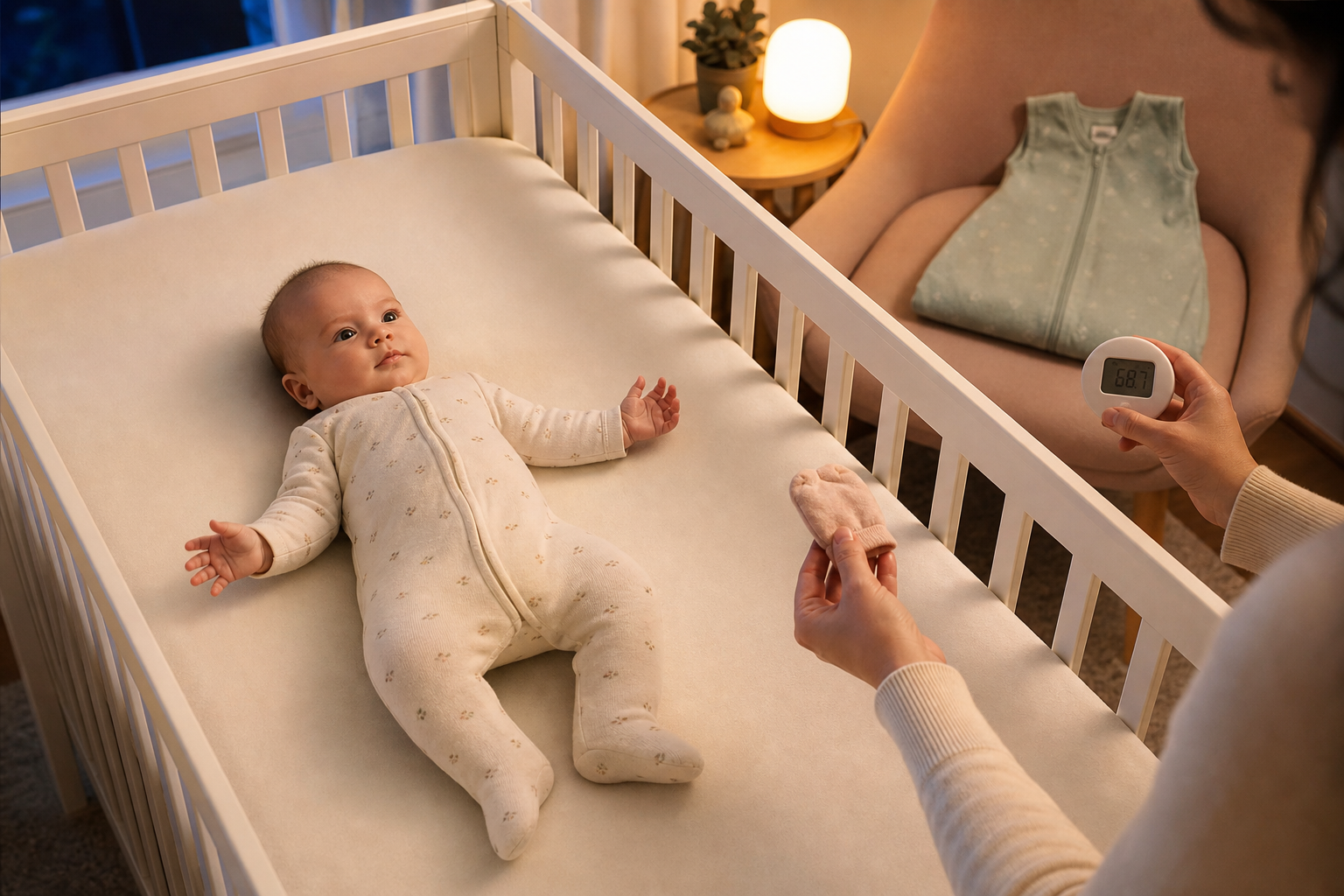

First, name the job you are asking the mittens to do
A parent usually reaches for mittens for one of three reasons: the baby’s hands feel cold, the fingernails are scratching the face, or irritated skin is being rubbed. Those are three different jobs. Treating them as one problem is how a small clothing choice turns into six conflicting tabs at midnight.
I would begin by saying the reason out loud. “I am worried she is cold.” “I am trying to stop a sharp nail from catching her cheek.” “He keeps rubbing an itchy patch.” Once the job has a name, the answer gets less foggy.
Cool hands are commonly normal in young babies. They do not tell you reliably whether the baby’s whole body is cold. Scratches may be better addressed by smoothing the nail edge. Persistent rubbing may need a skin-care conversation with the pediatrician rather than an all-night barrier. A mitten can cover a hand, but it cannot explain why the hand needs covering.
Sort the mitten question by its real job
- “The hands feel cold.”
- Check the chest, upper back, or neck. If the core feels comfortably warm and the baby is otherwise well, cool hands alone do not call for another layer.
- “The nails are scratching.”
- Inspect and gently file or trim sharp edges during awake care. If temporary covering is still useful, prefer an attached fold-over cuff over a separate loose mitten.
- “The skin is itchy or injured.”
- Protect the skin from sharp edges, but ask what is causing the rubbing. Seek clinical advice for spreading rash, oozing, swelling, warmth, significant bleeding, or signs of infection.
- “The mitten keeps coming off.”
- That is the answer: remove it from sleep rather than engineering a tighter attachment.

A loose mitten and a fold-over cuff are not the same thing
Separate scratch mittens depend on a narrow band staying in exactly the right place while a baby flexes, startles, sucks, rubs, and waves both arms with the commitment of someone directing airport traffic. Some stay put. Some migrate toward the fingertips. Some appear beside the baby after the next feed, which means they did not remain clothing.
A fold-over cuff is sewn into the sleeve. When it fits correctly and the garment itself fits correctly, there is no separate piece to shed into the crib. That does not make every cuffed sleeper automatically right. You still need to check size, seams, wear, temperature, and whether the cuff is intended to be used that way. But attachment changes the practical risk.
I would not improvise by taping, pinning, tying, or clipping a mitten on. I would not use a mitten with glued decorations, bows, beads, bells, pom-poms, or loose appliqués. The U.S. Consumer Product Safety Commission has recalled infant mittens when decorations could detach and create a choking hazard. “Cute” is not a structural feature.
Nor would I choose a very tight band just to prevent escape. A wrist should not show deep marks, swelling, color change, or coolness below the band. If you are debating whether the elastic is leaving too much of an imprint, take the mitten off. Clothing should accommodate ordinary movement without requiring a nightly engineering review.
The 30-second fit-and-condition check
Before any hand covering becomes part of sleep clothing, I would check it in bright light while the baby is awake. This is intentionally boring. Safe clothing decisions often are.
- Pull test: Give the cuff or mitten a gentle tug. A separate mitten that slides off easily does not belong in the sleep space.
- Finger-room check: Confirm the fabric is not compressing the fingers into a fixed position and there are no loose internal threads that could wind around a finger.
- Wrist check: Look for deep elastic marks, swelling, unusual paleness, bluish color, or coolness beyond the band.
- Surface check: Reject holes, unraveling seams, peeling prints, glued decorations, loose labels, or any added piece.
- Moisture check: Replace a wet mitten or cuff. Damp fabric from sucking is not a useful overnight skin treatment.
- Temperature check: Count the hand covering as part of the clothing layers and check the baby’s core warmth.
If any step fails, remove the hand covering. There is no prize for persuading a questionable mitten to survive until morning.

Cold baby hands do not necessarily mean a cold baby
This is the detail that calms a lot of mitten questions. Young babies can have hands and feet that feel cooler than the center of the body. The American Academy of Pediatrics notes that cool or bluish extremities can be normal in healthy newborns, and its parent guidance says mittens are rarely needed. The NHS likewise advises checking the tummy and looking for signs such as sweating rather than judging temperature from the hands or feet.
I would slide two fingers against the upper chest, upper back, or back of the neck. Comfortably warm is the goal. Hot, sweaty, flushed, or damp means remove a layer and reassess the room and clothing. A cold torso, persistent unusual color, poor feeding, lethargy, or an unwell baby changes the question and deserves clinical guidance.
The general clothing rule is modest: usually about one more layer than an adult would wear comfortably in the same environment. That is a starting point, not a command to bundle. Fabric weight, room temperature, illness, prematurity, and the individual baby all matter. Hats should come off indoors for sleep, and weighted infant sleep products should not be used.
Hands are convenient little weather stations, but they are not especially accurate ones. If the core is comfortable, adding mittens for warmth can solve a problem the baby does not have while making overheating harder to notice.
Warmth check: start at the center
Hands cool, chest comfortable: leave the layers alone and recheck at the next natural care moment.
Chest hot, damp, or baby flushed: remove a layer and check the room; do not add mittens.
Chest cool and baby otherwise well: add one appropriate lightweight clothing layer rather than a loose crib item, then reassess.
Abnormal color, breathing, responsiveness, feeding, or illness signs: stop troubleshooting clothing and get the appropriate medical help.
If scratches are the problem, work on the nail edge
Newborn nails can be astonishingly thin and sharp. A baby can produce a cheek scratch with the same hands that, five minutes earlier, could not reliably find their own mouth. The scratch looks dramatic because facial skin is visible and well supplied with blood, but a superficial line and a recurring skin problem are not the same thing.
For an ordinary sharp edge, choose a calm awake moment with good light. Some parents use a baby nail file; others use infant clippers or scissors designed for the job. Follow the tool instructions, stabilize one finger at a time, and stop if the baby is moving too much. You do not have to complete ten nails in one sitting. Babies have not signed a manicure deadline.
If a small scratch happens, gently clean it and watch it. Contact the pediatrician for a deep or gaping wound, persistent bleeding, increasing redness, warmth, swelling, pus, fever, or a baby who seems unwell. If scratching is frequent because the skin is persistently dry, inflamed, oozing, or intensely itchy, ask about the underlying skin issue rather than keeping both hands covered indefinitely.
Hand discovery also matters. Babies use touch, grasping, and bringing hands to the mouth as part of ordinary sensory and motor development. That is another reason I would use covering only for a clear, time-limited job—not because bare hands look untidy in the crib.

What if your baby scratches because of eczema or irritated skin?
Mittens may reduce direct contact between a nail and irritated skin, but they do not treat inflammation, infection, allergy, or another cause of itching. Covering can also become damp from sucking and may trap heat. The right plan depends on what the skin actually looks like and what your child’s clinician has recommended.
I would take a clear photo in daylight and note where the rash is, whether it is spreading, whether it disrupts feeding or sleep, and which products touch the area. Do not introduce fragranced lotions, essential oils, or an unprescribed treatment simply because the rubbing is worse at night. Ask the pediatrician about gentle skin care and whether temporary hand covering is appropriate for your baby’s age and condition.
Seek prompt advice for skin that is hot, increasingly red, swollen, painful, blistered, crusted, oozing, or accompanied by fever or an unwell baby. For facial swelling, breathing difficulty, abnormal color, limpness, or trouble waking, seek emergency help.
Age and movement change the mitten calculation
A very young newborn with a carefully fitted integrated cuff is different from an older baby who can pull, mouth, and remove a separate mitten. As grasping strengthens, anything detachable becomes more likely to be investigated. Babies conduct product testing with their mouths and do not file reports afterward.
Rolling does not make secure sleeves unsafe by itself, but it changes the broader sleep setup: always place the baby on the back, stop swaddling when rolling attempts begin, and give the arms freedom to move. Do not use mittens as a way to keep hands trapped inside a swaddle or to delay that transition.
If your baby is premature, has circulation concerns, receives care in a neonatal unit, or has been given specific temperature or skin instructions, follow the clinical plan. Advice designed for a healthy term baby at home may not fit. Ask the care team exactly what should stay on during sleep after discharge rather than copying what was used under hospital monitoring.
My mitten decision path
- Why cover? Cold hands, scratching, or a skin concern?
- Can I solve the cause? Check core temperature, smooth the nail edge, or ask about irritated skin.
- Is covering still needed? Use the shortest practical period and prefer a secure integrated cuff.
- Can it detach or constrict? If yes—or if you are unsure—remove it for sleep.
- Does another symptom change the answer? Escalate for breathing, color, responsiveness, circulation, wound, infection, or illness concerns.
Three pieces of mitten advice that need more context
Short answers about baby clothing tend to become absolute. “Never cover the hands” ignores the limited situations in which a clinician may recommend protection. “Mittens are perfectly safe” ignores fit, detachment, moisture, heat, and construction. “Just trim the nails” skips the parent holding one translucent newborn fingernail while the owner of that fingernail performs enthusiastic jazz hands. A useful answer has to survive contact with an actual evening.
“Babies need mittens so they do not get cold”
Warmth is a whole-body clothing decision. If the baby’s core feels comfortable, the hands can be cooler without needing their own insulation project. If the core feels cool, look at the room and the baby’s overall clothing. One appropriate lightweight layer is more predictable than adding several small accessories. If the core is hot or damp, remove a layer. The goal is not warm fingers at any cost; it is a comfortably dressed baby who is not overheating.
“Scratches mean you must keep the hands covered”
A superficial scratch tells you that skin met a sharp edge. It does not automatically mean both hands should stay covered through every nap and night. Look at the nails, the frequency and depth of scratches, and whether the baby is rubbing because the skin is irritated. A smooth nail edge, ordinary skin care recommended for your baby, and a brief secure cuff when truly needed form a more targeted plan.
I would also notice when the scratches occur. A baby who catches a cheek during an uncoordinated startle is different from a baby who repeatedly rubs one inflamed patch until it breaks. The first may need nothing more than nail care. The second deserves attention to the skin underneath the behavior.
“If the mitten is tight enough, it cannot come off”
Preventing detachment by increasing pressure is not a good trade. A covering should never rely on an aggressive elastic band, and improvised ties or clips introduce their own hazards. Secure means correctly designed and correctly fitted—not cinched until the wrist files a complaint.
This is why I keep returning to the integrated cuff. It is not magical, and it still needs inspection, but it solves the attachment question through garment design rather than extra pressure. If the only way to trust a separate mitten is to modify it, I would remove it and choose a different approach.
The question to take to your pediatrician
If you are stuck between “leave the hands alone” and “cover them every night,” bring a concrete description rather than the word scratching by itself. Say where the marks appear, how often they happen, what the skin looks like before the rubbing, whether the covering becomes damp, and whether uncovered awake time seems comfortable.
I would ask: “Do you want us to treat the skin, change nail care, use a temporary integrated cuff, or leave the hands uncovered?” That gives the clinician four distinct decisions to consider. Mention prematurity, circulation concerns, prescribed creams, allergies, or previous skin infection. If possible, bring a photo of the rash or wound and the garment you are using.
The point is not to obtain permanent permission for mittens. It is to identify the smallest safe intervention that matches the actual reason your baby is rubbing or scratching.
A useful buy when scratching—not cold hands—is the real problem
My article-specific pick: the haakaa electric baby nail trimmer
If you keep reaching for sleep mittens because one razor-thin nail edge finds your baby’s cheek, I would put the money toward the haakaa electric baby nail trimmer with age-appropriate filing pads. It addresses the repeat job behind the mitten question: gently smoothing a sharp edge during supervised awake care.
This is a better fit here than buying another pack of detachable mittens. The tool remains useful after the newborn mitten stage, and it does not add a loose item to the sleep space. Use it only according to the manufacturer’s instructions, choose the correct pad, work in good light while an adult is fully awake, and make no assumption that any grooming tool can guarantee scratch-free skin.
See the haakaa baby nail trimmer on Amazon
As an Amazon Associate, SleepBaby may earn from qualifying purchases.
Watch the whole sleep setup, not only the hands
CDC safe-sleep guidance in one clear visual reset
The mitten question lives inside a bigger bedtime picture. This CDC video helps reset attention on the choices that matter most: back placement and a clear, firm, flat sleep space.
Takeaway: Clothing should stay clothing; anything that comes loose does not belong beside the baby.
What I would do before the next sleep
- Place your baby on their back in the clear crib or bassinet.
- Remove separate mittens that are loose, decorated, damaged, damp, or questionable.
- Check warmth at the chest, upper back, or neck—not the hands.
- If scratching is the concern, inspect the nails in good light and smooth a sharp edge during awake care.
- If brief hand covering still helps, use a properly fitted sleeper with integrated cuffs and inspect the garment.
- Leave hands uncovered for ordinary awake play and exploration unless a clinician has advised otherwise.
- Ask the pediatrician about persistent rash, intense itching, circulation changes, wounds, infection signs, or a special medical plan.
I would not wake a comfortably sleeping baby simply because their fingers feel cool. I would check the center of the body, confirm that the clothing is secure, and let the crib remain boring. Boring is doing excellent work here.

Questions parents ask after the first mitten disappears
Can newborns sleep with scratch mittens?
Most newborns do not need them routinely. If temporary scratch protection is useful, choose plain, correctly fitted clothing with integrated fold-over cuffs rather than a separate mitten that can come off. Inspect the fit and condition and avoid overheating.
Should I put mittens on because my baby’s hands are cold?
Not based on the hands alone. Check the chest, upper back, or neck. Cool hands and feet can be normal, while a hot or sweaty core means the baby may need fewer layers.
Are mittens safe for babies who suck their hands?
A separate mitten can become wet or be pulled loose. Hand sucking is also a normal behavior. I would not use a detachable mitten to block it. If skin protection is medically needed, ask the pediatrician what covering and care plan fit your baby.
When should babies stop wearing mittens?
There is no universal birthday. Routine mitten use is usually unnecessary from the start, and growing grasping and mouthing skills make detachable mittens increasingly impractical. Address the reason for covering and discontinue it when that reason no longer applies.
What if the scratch is bleeding?
Apply gentle pressure with clean gauze for a superficial scratch. Seek medical advice for persistent bleeding, a deep or gaping wound, increasing redness, swelling, warmth, drainage, fever, or an unwell baby.
Let the missing mitten answer the question
Back at the crib, the tiny piece of cotton has not become sinister. It has simply told you something useful. If it can leave the hand, it can stop being clothing. Remove it.
I would return my attention to the clearer signals: a comfortably warm chest, secure intact sleepwear, smooth nail edges, healthy skin, easy breathing, normal color, and a bare sleep space. That is enough information for one night.
The mitten question began with a hand. The safest answer comes from looking at the whole baby and the whole crib.
Sources
- American Academy of Pediatrics: How long is it appropriate to keep hand mittens on a newborn baby?
- American Academy of Pediatrics: How to Keep Your Sleeping Baby Safe
- NHS: How to dress a newborn baby
- U.S. Consumer Product Safety Commission: Newborn mitten recall due to choking hazard
- NHS-hosted Lullaby Trust fact sheet: Temperature and safer sleep
For the next tiny bedtime object that suddenly feels enormous
Build sleep decisions around the whole baby, not one cold hand
SleepBaby helps you sort ordinary nighttime details from the setup choices and symptoms that deserve action—so one escaped mitten does not get to run the entire evening.






What viewers said10 comments · 4 replies+
Archived comments from the original Baby Sleep Miracle presentation. Not independently verified by SleepBaby.org; individual experiences vary.
Thank you so much for this video! I had no idea about the dangers of baby swings :O
Hi Mary-Ann. I have a question: Is method in any way similar to the ones recommended by Dr Bucknam, Dr. Weissbluth or Dr. Karp? We tried those but none of them help.
Hi Regina, thank you for your question. The short answer is no. The techniques I share in my guide are based on newest scientific research and this is why I have never seen any approach similar to the one I recommend.
This method really works! I tried it on my son Jesus and after just one week he went from waking up more than 5 times a night to waking up just once or twice. You are a lifesaver, Mary-Ann!
I'm truly impressed with how much information you share in your video. And all for free! I can feel that you truly care about mothers like myself, and that's hard to find these days. I have recommended your site to several of my friends already.
Mary-Ann, our child suffers from autism. Is your approach still suited?
Chloe, I made sure my method can be used with any child, even babies who are special like yours. Please note that I'm not a doctor and that I always advice to consult with your physician because nothing is more important than the safety and well-being of your love.
Hallo Mary-Ann, I'm from Germany. Do you have your guide in German?
Hello Heide, we do! Normally you should already see our video in German. If not, please contact our support so they can guide you
Thenk you for your answer, Mary-Ann!
I just completed your approach and I have to say, it worked almost too well. Yes, it took a bit of getting used to with your bedtime routine but the difference is huge. My son George used to take 1 hours to go down and now he's firmly asleep in no more than 10 minutes! You're the best!
It seems I'm the only man watching this video, lol! What you shared about the 'emotional backpack' made immediate sense to me and I can't wait to help my little girl Mila to unpack it!
Hey there, just discovered your site and this really sounds different. Just wanted to say thanks for sharing :)
For everyone who's still thinking about getting Mary-Ann's guide I want to advise you to go ahead. I wasn't sure myself but now I'm so thankful I invested in this program. It made a huge difference in our life as a family and yes, my baby girl does sleep through the night now.