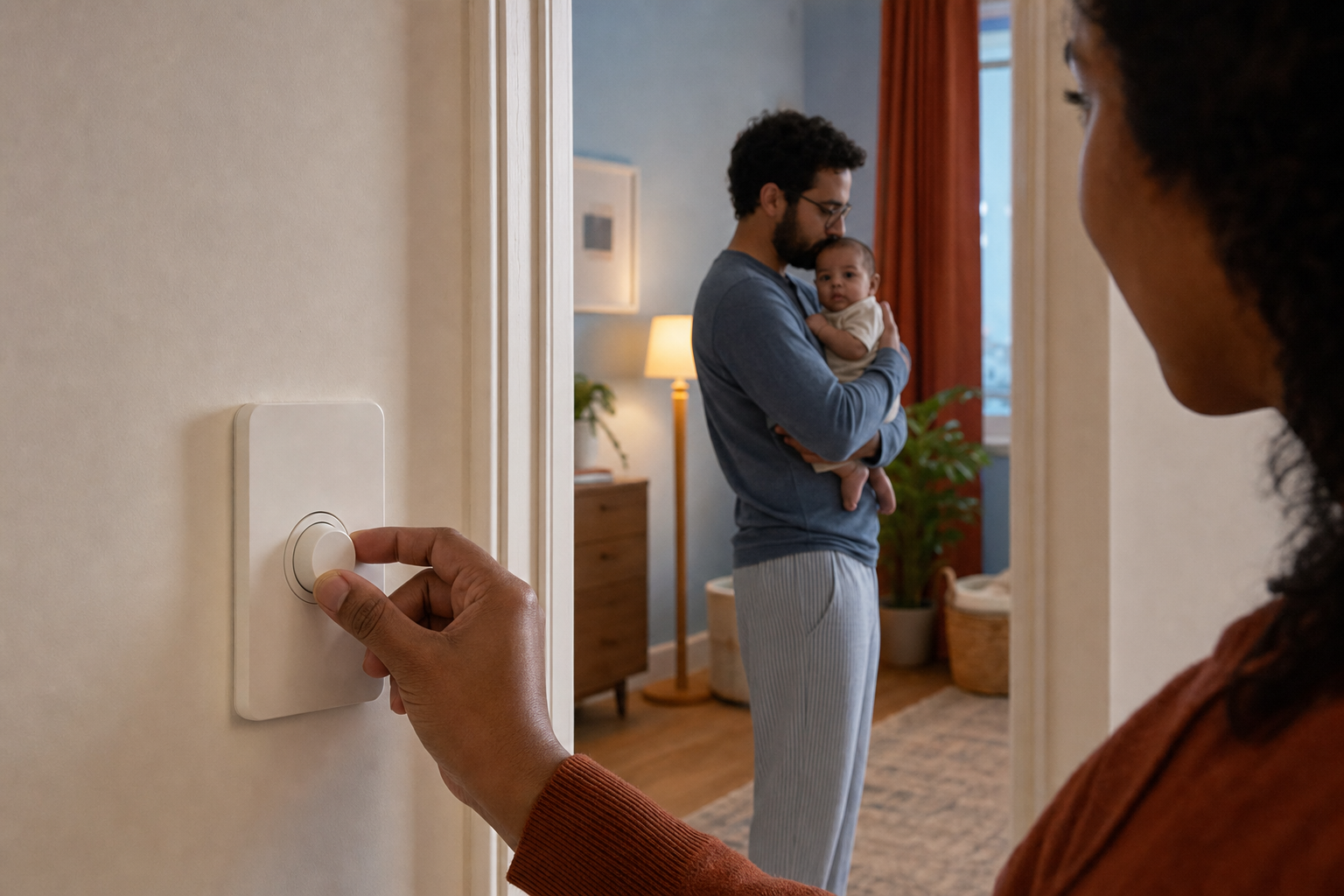
You switch on the overhead light at 2:18 a.m. because the bottle markings have disappeared, the diaper tabs have become advanced geometry, and your baby is suddenly staring at the ceiling as if the room just opened for business. The question arrives before you have even sat down: can my baby sleep with lights on, or am I making this harder?
Yes, a baby can sleep with some light on, but dark or very dim is the better default for sleep. If you need light to feed, change, give prescribed medicine, or walk safely, use the lowest steady light that lets you do the job. Keep it away from your baby’s face and sleep space, then turn it off when you no longer need it. I would not turn this into a purity test about perfect darkness. The useful goal is a clear contrast: brighter, ordinary life by day; lower light and less stimulation at night.
The two-light answer
Use darkness for sleep and just enough light for care
Sleep light
Off, or as dark as practical
The baby does not need a glowing object to sleep. Darkness keeps the room visually quiet and makes nighttime feel different from daytime.
Care light
Low, steady, brief, and useful
Use enough light to see breathing, feeding, diapering, medication labels, and the floor. Adult safety is part of the setup.
What matters most: brightness, placement, duration, and what everyone does under the light. A tiny lamp beside a changing pad is a different experience from an overhead fixture shining toward the crib all night.
The private worry beneath this search is often not really about bulbs. It is: Did I accidentally teach my baby to need this, and have I ruined the night? Usually, no. A light can become part of a familiar settling pattern, but it is one cue among feeding, age, sleep pressure, sound, touch, and the baby’s need for help. You can change it gradually without staging a midnight showdown.
SleepBaby.org · The original video
A little help
for the night ahead.
Take a moment to watch the original Baby Sleep Miracle presentation. Your article will be right here when you’re ready to keep reading.
What viewers said10 comments · 4 replies
Archived comments from the original Baby Sleep Miracle presentation. Not independently verified by SleepBaby.org; individual experiences vary.
Hi Mary-Ann. I have a question: Is method in any way similar to the ones recommended by Dr Bucknam, Dr. Weissbluth or Dr. Karp? We tried those but none of them help.
Hi Regina, thank you for your question. The short answer is no. The techniques I share in my guide are based on newest scientific research and this is why I have never seen any approach similar to the one I recommend.
This method really works! I tried it on my son Jesus and after just one week he went from waking up more than 5 times a night to waking up just once or twice. You are a lifesaver, Mary-Ann!
I'm truly impressed with how much information you share in your video. And all for free! I can feel that you truly care about mothers like myself, and that's hard to find these days. I have recommended your site to several of my friends already.
Mary-Ann, our child suffers from autism. Is your approach still suited?
Chloe, I made sure my method can be used with any child, even babies who are special like yours. Please note that I'm not a doctor and that I always advice to consult with your physician because nothing is more important than the safety and well-being of your love.
Hallo Mary-Ann, I'm from Germany. Do you have your guide in German?
Hello Heide, we do! Normally you should already see our video in German. If not, please contact our support so they can guide you
Thenk you for your answer, Mary-Ann!
I just completed your approach and I have to say, it worked almost too well. Yes, it took a bit of getting used to with your bedtime routine but the difference is huge. My son George used to take 1 hours to go down and now he's firmly asleep in no more than 10 minutes! You're the best!
It seems I'm the only man watching this video, lol! What you shared about the 'emotional backpack' made immediate sense to me and I can't wait to help my little girl Mila to unpack it!
Hey there, just discovered your site and this really sounds different. Just wanted to say thanks for sharing :)
For everyone who's still thinking about getting Mary-Ann's guide I want to advise you to go ahead. I wasn't sure myself but now I'm so thankful I invested in this program. It made a huge difference in our life as a family and yes, my baby girl does sleep through the night now.
Ready to get started?Take the next step with SleepBaby.
Pick your price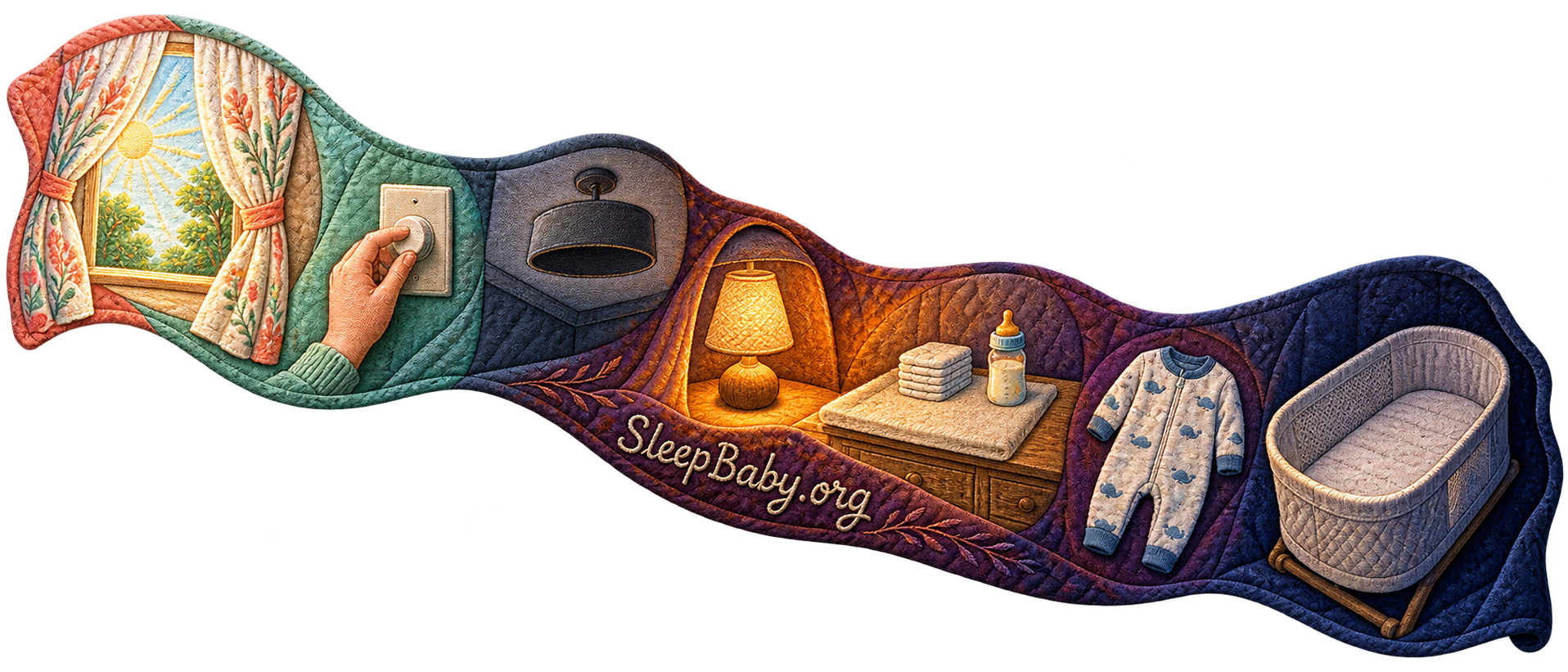
What does light actually change about baby sleep?
Light is one of the signals that helps the body organize day and night. That organization is immature at birth and develops over time. In a small observational study of 56 healthy full-term infants, babies with more nighttime sleep also had greater early-afternoon light exposure. The finding suggests that ordinary daytime light may help the developing circadian system, but it does not prove that opening a curtain will fix one baby’s nights.[3]
That distinction matters. Newborns still wake around the clock to feed, and lighting does not override hunger, growth needs, or short sleep cycles. I would use light as a background signal, not a lever I expect to move the entire night. During the day, open the curtains and let normal household life happen. At night, lower the lights, lower the conversation, and make care efficient without becoming abrupt. Both the NHS and the American Academy of Pediatrics recommend that day/night contrast.[1][2]
Brightness is the part parents can see, but placement and duration change the experience too. A lamp behind your shoulder, aimed toward the changing surface, is less visually interesting than a glowing orb beside the crib rail. A light used for six minutes during a feed is not the same as a bright ceiling fixture burning until morning. A steady light is less likely to invite attention than a projector, color cycle, flashing toy, or screen.
Color is only one piece. Shorter-wavelength, blue-enriched light is biologically active in human circadian systems, but the infant evidence does not justify promising that one red or amber bulb will improve melatonin or make a baby sleep longer. If you are choosing a care light, a dim warm or amber setting is a sensible practical choice because it can feel less stark than cool white. Keep the brightness low enough for the task. If you want the narrower answer, our guide to using a red light around baby sleep explains why color is not a treatment.
The Light Path
Three zones, three different jobs
Day
Open the room
Curtains open, faces visible, normal conversation, and ordinary household sound. A nap can still be dark if that helps; waking time should not look like midnight.
Wind-down
Lower the invitation
Dim the main lights before the final routine steps. Keep the room readable but less interesting. The same short sequence matters more than theatrical darkness.
Overnight care
Light the task, not the room
Aim a dim steady glow where your hands need it. Feed, change, check, and return the baby to the safe sleep space. Then let the room go dark again.
This is a sequence, not a score. A chaotic evening does not erase the signal. Repeat the broad contrast often enough that nighttime becomes recognizable.
Original teaching component created for SleepBaby.org.
Why can turning the light off suddenly backfire?
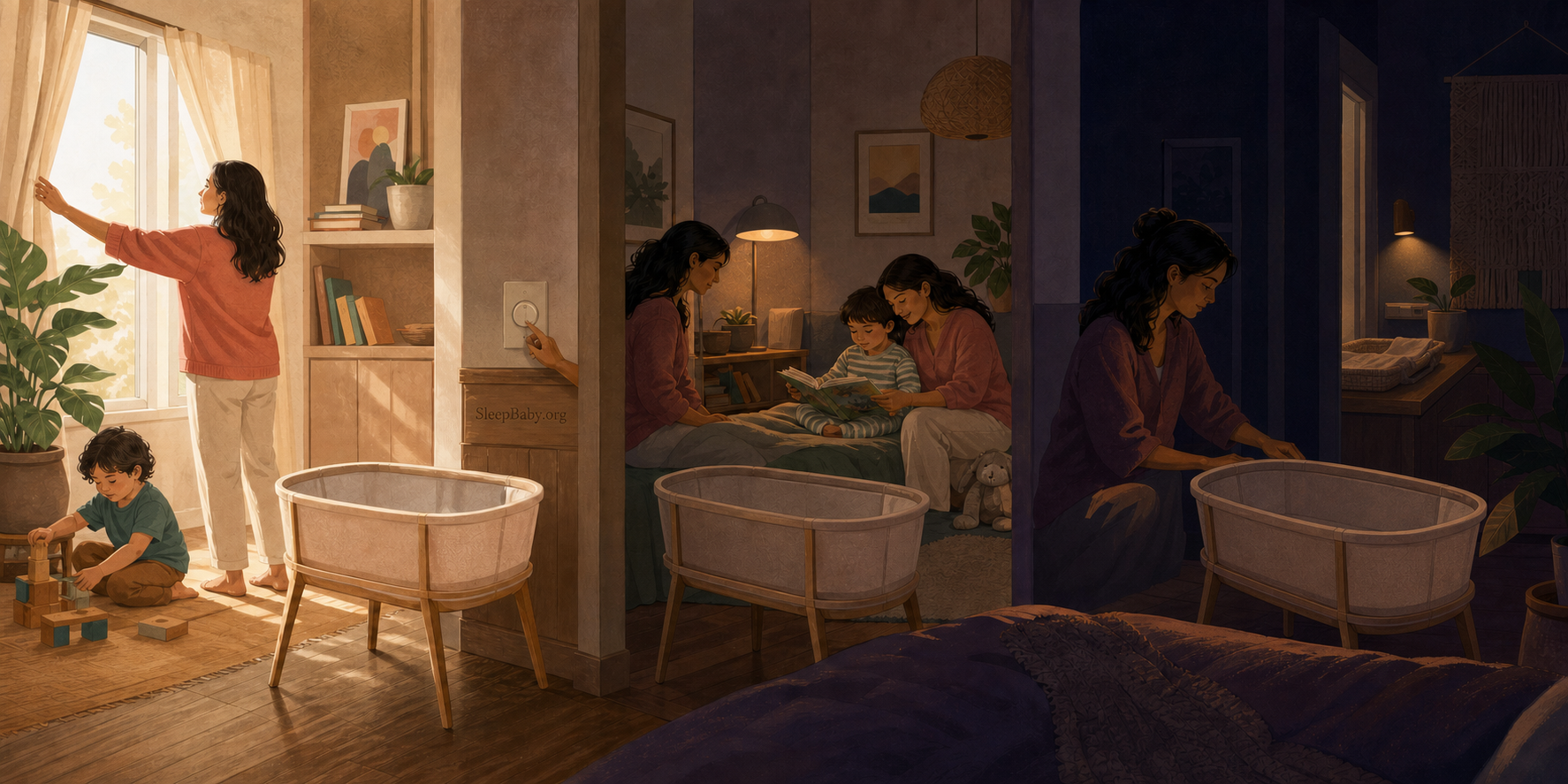
That hypothetical scene is not evidence about Kacey’s real family, and Benjamin is not being used to prove a sleep claim. It illustrates a common household pattern: when we alter one visible cue, we often alter our own behavior at the same time. That is useful, because it gives you more than one gentle way to make the night less stimulating.
Does a newborn need darkness to sleep?
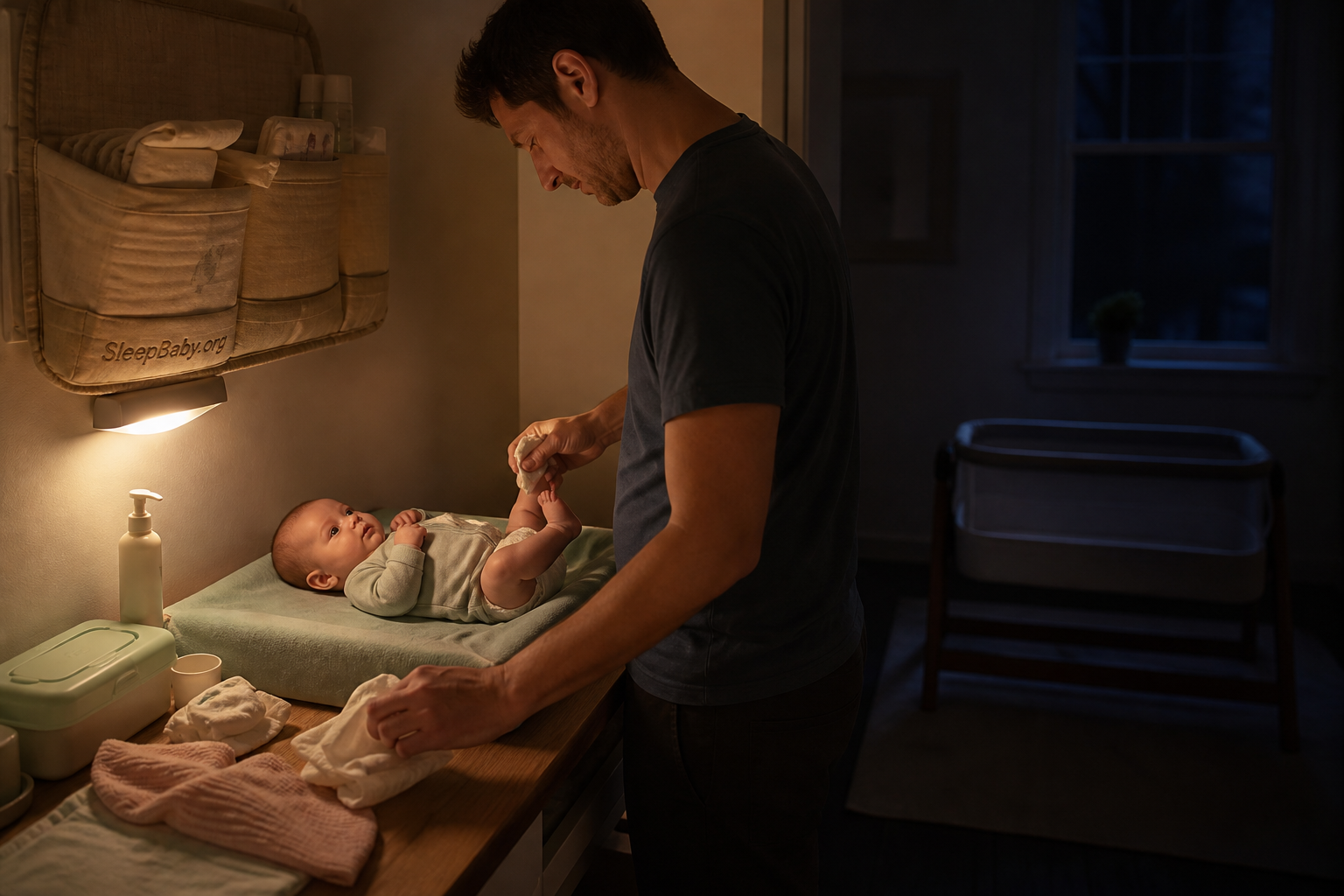
A newborn can sleep in daylight, lamplight, noise, and the middle of family life. Newborn sleep is distributed across day and night, and waking frequently for feeds is expected. Darkness is not a switch that installs an adult schedule. The goal in the early weeks is to offer clear environmental contrast while protecting feeding and safe sleep.
During waking periods in the day, open the curtains and let your baby see faces and normal activity. At night, keep lights low, voices soft, and interaction simple. If your baby is feeding, has expected diapers, and wakes often, do not keep darkening the room in the hope that biology will surrender. Our guide to what a newborn night can realistically look like puts those short stretches in context.
I would also refuse the idea that you must perform care blindly. You need to see whether a latch looks workable, whether a bottle is positioned correctly, whether a diaper is soiled, whether prescribed medication is measured correctly, and whether the baby looks and breathes as expected. Use light. Just make it local, steady, and no brighter than the task requires.
If a newborn is unusually hard to wake, feeds poorly, has fewer wet diapers, struggles to breathe, looks blue, gray, or unusually pale, has a fever or seems seriously ill, lighting is not the problem to troubleshoot. Contact the baby’s clinician or seek urgent care according to the symptoms and your local emergency guidance.

What if my baby only falls asleep with the light on?
First, decide whether the light is truly the cue. For two or three ordinary sleep attempts, notice what else changes when the light stays on: where you stand, how long you stay, whether you talk, whether the baby can see you, and whether the room remains active. If the baby settles under a dim lamp but protests when you leave, your presence may be the stronger cue. If the baby keeps staring at the fixture, the light may be increasing visual interest rather than offering comfort.
Do not remove every familiar cue at once. Dim the existing light one step, or move it farther from the baby’s line of sight while preserving the rest of the routine. After several well nights, dim it again. If you use an overhead fixture now, replace it with a small task light first; that is usually a more meaningful change than debating bulb color while the whole room remains bright.
A baby who looks at lamps, windows, and bright edges may simply be drawn to contrast. That behavior by itself does not diagnose a developmental condition or prove fear of darkness. If the fascination is the real question, read why babies stare at lights and what other patterns would make the observation worth discussing with a pediatrician.
Keep the experiment small enough to interpret. I would change either brightness or placement, not brightness, color, bedtime, feeding, white noise, and the sleep garment on the same night. Babies produce enough variables without us applying for an assistant position.
A real-world dimmer test
Find the lowest useful light in five steps
- Set up before bedtime. Put diapers, wipes, feeding supplies, water, and any prescribed medicine where you can reach them.
- Turn off the overhead light. Use one small steady light aimed at the care surface, not the crib.
- Begin at a safe working level. You must be able to read labels, see the baby’s color, and move without tripping.
- Dim until the task becomes difficult, then move up one step. That is your lowest useful level. Do not compete for the darkest room award.
- End the light with the task. Use a timer or switch it off after care unless an older child has a genuine reassurance need.
Write down one thing: did the care stay safe and did the room return to quiet faster? You are testing a household setup, not measuring your baby’s melatonin.
Original decision tool created for SleepBaby.org.
What kind of night-light works best for a baby room?
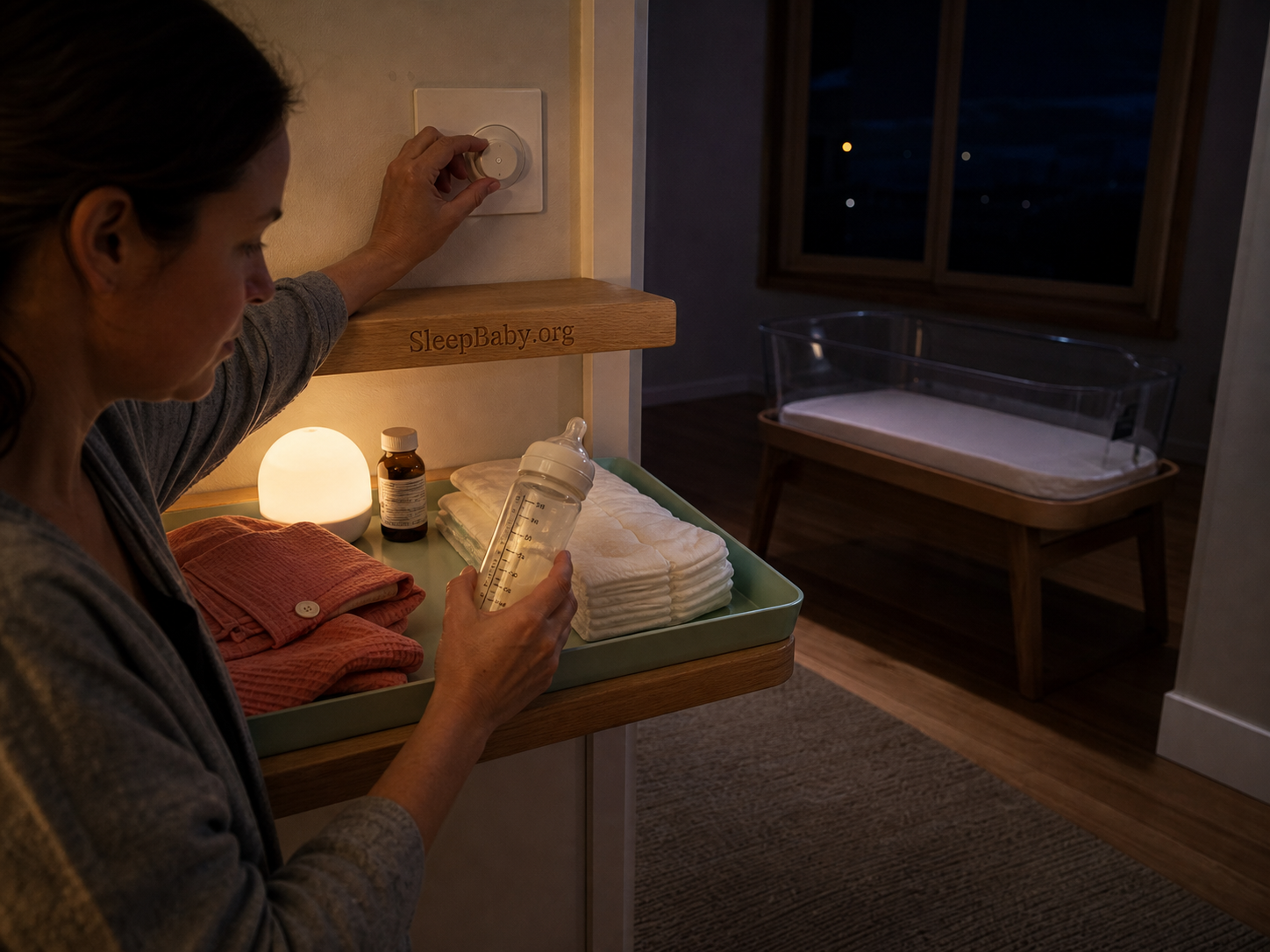
Choose the boring features first. The light should dim very low, stay steady, turn on without a phone, and sit securely where the baby cannot reach it. A warm or amber option is reasonable for nighttime care, but I would choose excellent dimming over an impressive color menu. The words “red,” “amber,” or “sleep” on a box do not tell you how bright the lamp will look from the crib.
- Brightness control: look for continuous or several useful low settings, not merely “on” and “slightly less on.”
- Simple control: touch or a physical button is easier during a feed than unlocking a phone and negotiating an app.
- Steady output: skip color cycling, projections, blinking, and animated patterns during sleep.
- Placement: set it below the baby’s eye line or behind the caregiver, aimed toward the task.
- Automatic shutoff: a timer can prevent a brief care light from becoming an accidental all-night room light.
- Safe hardware: keep lamps, batteries, plugs, and cords outside the crib and out of reach. Charge portable lights away from the sleep space.
I would skip a feature-heavy lamp if the basic operation is confusing in the dark. Midnight is a poor time to remember which triple tap begins the sunrise simulation and which one starts a rainbow. The best care light is the one both caregivers can use quietly without consulting documentation.
One useful tool for this exact job
JolyWell JW-CL002 Baby Egg Night Light
For a parent who needs to see a latch, diaper, medicine label, or path to the bassinet without flooding the room, this is the kind of product I would choose. Its warm-light mode, stepless touch dimming, portable rechargeable design, and one-hour timer all serve the lowest-useful-light test. That fits this situation better than a fixed plug-in light you cannot dim, a smart lamp that needs an app, or a light-and-sound bundle that adds a second sleep decision.
The specific reason to buy: you can tap it with one occupied hand, lower it until the care task is still safe, and let the timer end a brief night visit. Keep the lamp and charging cable on a stable caregiver-controlled surface outside the crib or bassinet and out of your baby’s reach. It is a caregiving light, not a sleep treatment or guarantee.
See the JolyWell dimmable care light on Amazon
As an Amazon Associate, SleepBaby may earn from qualifying purchases.
Is it okay to leave a night-light on all night?
It can be, especially when an older child has a real fear of the dark or when a caregiver needs a stable safety light. But an infant does not require a light simply because the room is dark. If the light has no job after care ends, turn it off or use a timer. If it stays on, make it very dim, steady, and out of the baby’s direct line of sight.
Watch what happens rather than assuming. Does the baby glance at the light and settle, or keep tracking it? Does the room look softly visible, or can you read a paperback across the room? Does the light spill directly into the crib? Can it be moved lower or behind furniture without creating a hot surface, reachable cord, or trip hazard?
For an older baby moving toward toddlerhood, fear and imagination may become more relevant. A tiny constant night-light can be a reasonable reassurance tool. Keep the response calm and predictable: the light stays in one place, does not become a toy, and does not begin a long negotiation about colors. For a young infant, crying when the room goes dark is more likely to reflect the transition, separation, or changed routine than a clearly formed fear of darkness.
What should you change first?
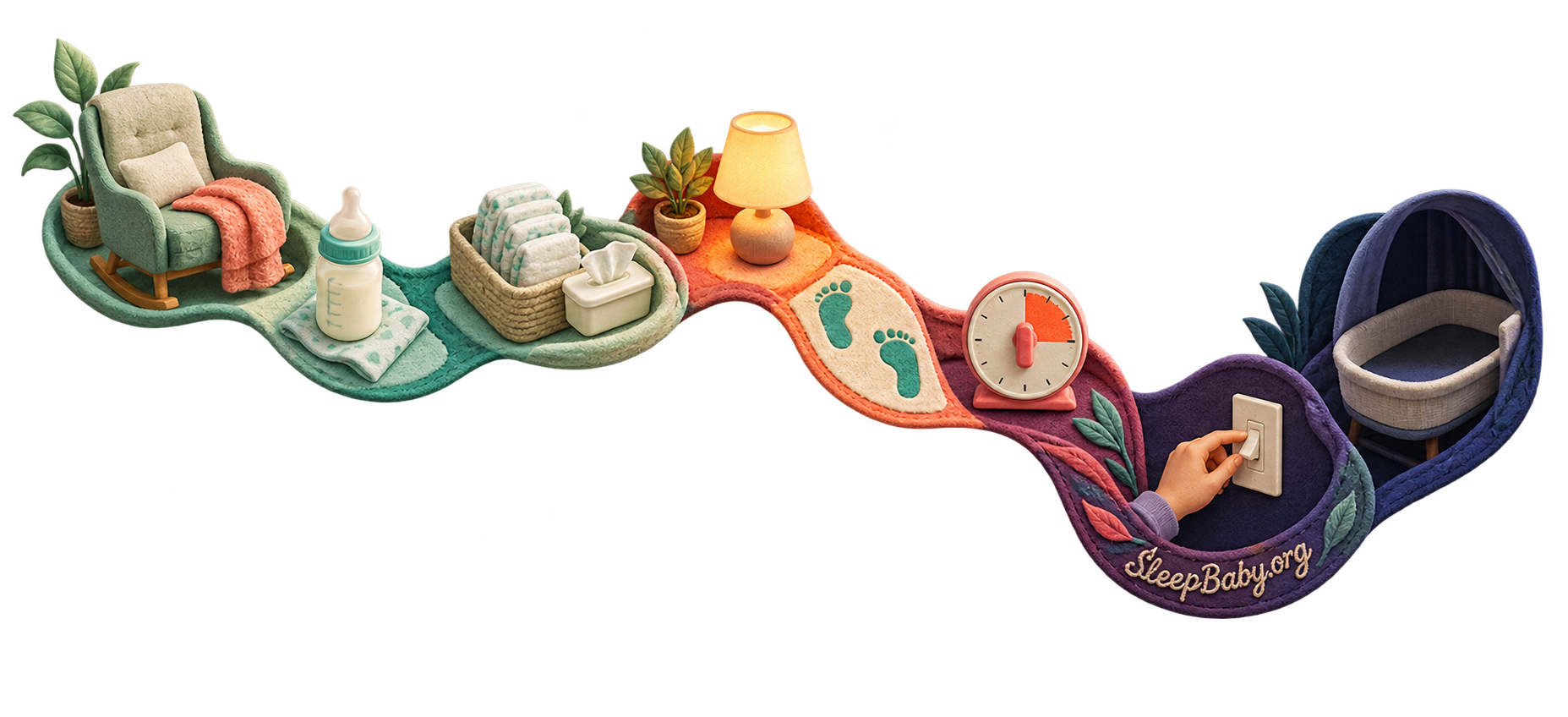
Use the problem you can see. “The room has light” is too vague to troubleshoot. A baby staring at the lamp, an adult waking everyone with the overhead fixture, daylight leaking at 5:10 a.m., and a toddler asking for reassurance are four different jobs.
| What you notice | Try first | Do not assume |
|---|---|---|
| Baby watches the lamp | Move it below eye level, aim it away, dim it, or end it with the care task. | Do not assume the baby fears darkness or has a developmental problem. |
| Overhead light wakes everyone | Prepare supplies and use one local dimmable task light. | Do not perform feeding or medication care in unsafe darkness. |
| Early sun enters the room | Block the leak with well-fitted window covering while keeping cords inaccessible. | Do not assume light is the only cause of an early wake. |
| Newborn seems awake at night | Use brighter days, dimmer quiet nights, and age-appropriate feeding care. | Do not expect darkness to remove normal feeding-led waking. |
| Older child asks for light | Offer one dim, steady, predictable night-light and a brief response. | Do not turn reassurance into a changing light show. |
Change one line of the table at a time. If nothing improves after several comparable nights, restore the simpler setup. A lighting experiment should reduce work, not create a nightly engineering department.
Should naps be completely dark?
Naps do not have to be completely dark. Some babies nap well in ordinary daylight; others settle more easily when outside light is reduced. If darkness helps your baby nap, use it. Then open the curtains after waking so daytime still looks and feels like daytime.
Blackout curtains are most useful when the problem is specific: late summer light at bedtime, a streetlamp aimed at the window, or dawn light arriving much earlier than the household wants to start. Install window coverings with cords completely inaccessible to children. Do not drape fabric over a crib, bassinet, stroller, or carrier to block light. Loose coverings can create suffocation and overheating hazards, and safety-critical observation should never depend on peeking under a blanket.
If a room must be dark for a daytime nap, create your day signal elsewhere: open curtains during feeds and play, step outdoors when practical, and return to ordinary household interaction after sleep. The goal is not to keep a baby in darkness for more hours. It is to make sleep periods visually quieter while preserving a strong daytime environment.
What about screens, hall lights, and door cracks?
A dim landing light spilling under the door may be less disruptive than a bright lamp inside the room, especially for an older child who wants reassurance. Test the view from the sleep space. If the crack forms a bright stripe at eye level, lower the hall light or adjust the door rather than escalating to a brighter room.
Phones and tablets are different from simple night-lights. They change images, invite interaction, and often end up near the face. Use your phone as a tool only when needed—timer, feeding record, or prescribed-care reference—and turn the screen down and away. Do not play videos beside the crib as a substitute for a steady care light.
Projectors and color-changing lamps can be pleasant during a wind-down when an awake adult is present, but switch them off for sleep if they keep your baby visually engaged. If the baby needs a cue, the same brief book, phrase, cuddle, or song is easier to repeat than a ceiling full of moving galaxies. The stars are charming until you are troubleshooting whether Orion caused a 3:40 a.m. party.
Lighting can be flexible. Safe sleep cannot.
The room may be dark, dim, or briefly brighter for care. The infant sleep space still needs the same safety floor: put your baby on their back for every sleep, on a firm, flat, non-inclined sleep surface designed for infant sleep, with only a fitted sheet. Keep blankets, pillows, bumpers, toys, positioners, and other soft items out. Room-share without bed-sharing for at least the first six months.[4][5]
Never put a night-light, projector, battery device, power bank, extension cord, or charging cable in or on the crib or bassinet. Keep any cord outside reach, including reach that expands when a baby begins rolling, scooting, pulling, or standing. Place the lamp on a stable surface where a sleepy adult cannot knock it into bedding or water.
And never create darkness by covering the sleep space. A blanket over a crib or carrier can reduce airflow, trap heat, obstruct your view, and enter the baby’s space. If you need to block a window, treat the window. If you need to block a lamp, move or shield the lamp with a purpose-built fixture away from the baby.
Watch: the safety rules underneath every lighting choice
Five safe-sleep essentials from the American Academy of Pediatrics
Lighting can be adjusted to fit the room. This short AAP video shows the parts I would not negotiate: a clear sleep space, a firm flat mattress, and back placement for every sleep.
SleepBaby takeaway: dim light may make a night feed less stimulating, but it never makes an unsafe sleep surface acceptable. Keep every safety instruction available in writing even if the video does not play.
The lighting questions that usually arrive next
Can a baby sleep with the overhead light on?
Yes, but a bright overhead light is rarely necessary for sleep and may keep the room more visually stimulating. Use it when you need full visibility for a safety or care task. For routine feeds and changes, a small dimmable light aimed at the work area is usually a better fit.
Is pitch-black always best?
No. Darkness is a useful default, not a moral requirement. A very dim light is reasonable when it helps an adult provide safe care or reassures an older child. If darkness makes you unable to read a medicine label or walk safely, add enough light to do the job.
Will a night-light stop my baby waking?
There is no good basis for that promise. A light may make care calmer or reduce the disruption caused by an overhead fixture, but babies wake for age, feeding, comfort, illness, sleep-cycle, and environmental reasons. Judge it by the specific job you chose, not by whether it produces an all-night stretch.
Should I use red, amber, or warm white?
Any can be workable when very dim. Warm or amber often feels less stark for nighttime care; a red setting is also an option. Brightness, placement, duration, and steadiness matter more than the color name alone. Avoid claims that a color guarantees melatonin production or longer sleep.
Can I leave the bathroom or hallway light on?
Yes. Indirect light may give you a safe path without placing a bright source inside the room. Look from the baby’s sleep position and reduce direct glare. Secure doors and cords so the workaround does not create another hazard.
What if my baby cries when I dim the light?
Pause before deciding the baby is afraid. Dim in smaller steps and preserve the familiar order of feeding, cuddling, and settling. Notice whether your presence, the end of play, or the move toward the crib is the stronger trigger. If the baby appears in pain, ill, unusually distressed, or different from baseline, address that instead of pushing a lighting transition.
What I would do tonight
- Open the day tomorrow. Let waking hours include daylight, faces, play, and ordinary household sound.
- Lower the main lights before bed. Use the same small wind-down steps without demanding perfect darkness.
- Prepare the care station. Put what you need within adult reach and outside the sleep space.
- Use one low steady task light overnight. Aim it at your hands, not the crib, and find the lowest safe working level.
- Keep the interaction quiet and purposeful. Meet feeding, diapering, medicine, and comfort needs; do not turn the room into daytime.
- End the light with the task. Switch it off or use a timer, unless an older child’s reassurance need makes a tiny constant light useful.
- Protect safe sleep every time. Back, firm, flat, clear, and separate—whatever the bulb is doing.
I would try that setup for several ordinary nights before changing anything else. Look for a quieter return to sleep, less time under the overhead fixture, and a care routine another adult can repeat. If the baby still wakes, that does not mean the light experiment failed; it may mean the waking was never about light.
The rectangle of ceiling light from the opening does not have to govern the room. You need enough visibility to care for your baby and enough darkness to make the night feel like night. Once the bottle is read, the diaper is fastened, and the path to the crib is clear, the light has finished its shift.
Sources
- NHS: Helping Your Baby to Sleep.
- American Academy of Pediatrics: Safe Sleep Tips for Sleep-Deprived Parents.
- Harrison: The Relationship Between Daytime Exposure to Light and Night-Time Sleep in 6–12-Week-Old Infants.
- American Academy of Pediatrics: A Parent’s Guide to Safe Sleep.
- NIH/NICHD Safe to Sleep: Safe Sleep Environment.
- McGraw et al.: The Development of Circadian Rhythms in a Human Infant. This was a single-infant study and is used only as developmental context.
When the lamp is only one piece of a very awake night
Build a bedtime that still makes sense after the light goes out
You have lowered the glow, prepared the diaper station, and stopped turning every wake into morning. If the rest of bedtime still feels impossible to read, SleepBaby can help you shape the cues, timing, and responses into a calmer plan for your family—without promising a perfect night or replacing feeding and medical care.
SleepBaby.org · The original video
A next step for
the next bedtime.
Still thinking about sleep? Watch the presentation here, then explore the SleepBaby program whenever you’re ready.
What viewers said10 comments · 4 replies
Archived comments from the original Baby Sleep Miracle presentation. Not independently verified by SleepBaby.org; individual experiences vary.
Thank you so much for this video! I had no idea about the dangers of baby swings :O
Hi Mary-Ann. I have a question: Is method in any way similar to the ones recommended by Dr Bucknam, Dr. Weissbluth or Dr. Karp? We tried those but none of them help.
Hi Regina, thank you for your question. The short answer is no. The techniques I share in my guide are based on newest scientific research and this is why I have never seen any approach similar to the one I recommend.
This method really works! I tried it on my son Jesus and after just one week he went from waking up more than 5 times a night to waking up just once or twice. You are a lifesaver, Mary-Ann!
I'm truly impressed with how much information you share in your video. And all for free! I can feel that you truly care about mothers like myself, and that's hard to find these days. I have recommended your site to several of my friends already.
Mary-Ann, our child suffers from autism. Is your approach still suited?
Chloe, I made sure my method can be used with any child, even babies who are special like yours. Please note that I'm not a doctor and that I always advice to consult with your physician because nothing is more important than the safety and well-being of your love.
Hallo Mary-Ann, I'm from Germany. Do you have your guide in German?
Hello Heide, we do! Normally you should already see our video in German. If not, please contact our support so they can guide you
Thenk you for your answer, Mary-Ann!
I just completed your approach and I have to say, it worked almost too well. Yes, it took a bit of getting used to with your bedtime routine but the difference is huge. My son George used to take 1 hours to go down and now he's firmly asleep in no more than 10 minutes! You're the best!
It seems I'm the only man watching this video, lol! What you shared about the 'emotional backpack' made immediate sense to me and I can't wait to help my little girl Mila to unpack it!
Hey there, just discovered your site and this really sounds different. Just wanted to say thanks for sharing :)
For everyone who's still thinking about getting Mary-Ann's guide I want to advise you to go ahead. I wasn't sure myself but now I'm so thankful I invested in this program. It made a huge difference in our life as a family and yes, my baby girl does sleep through the night now.
Ready to get started?Take the next step with SleepBaby.
Pick your price


Thank you so much for this video! I had no idea about the dangers of baby swings :O