The answer beside the bassinet
Yes—if the nose is blocked but the breathing is still easy
Many babies can sleep safely with ordinary nasal congestion when they are breathing without visible struggle, their color and alertness look normal, and they are taking enough milk and fluids. A blocked nose does not change the safe-sleep setup: put your baby on their back on a firm, flat, level, empty crib, bassinet, or play-yard surface.
Do not raise the mattress, tuck a towel underneath it, add a wedge or pillow, or let a baby sleep in a swing, rocker, bouncer, or car seat to “help” the congestion. If each breath looks hard, the lips or face look blue or gray, there are pauses, your baby is hard to wake, or feeding is failing, this is no longer a sleep-comfort question. It is a medical-help question.
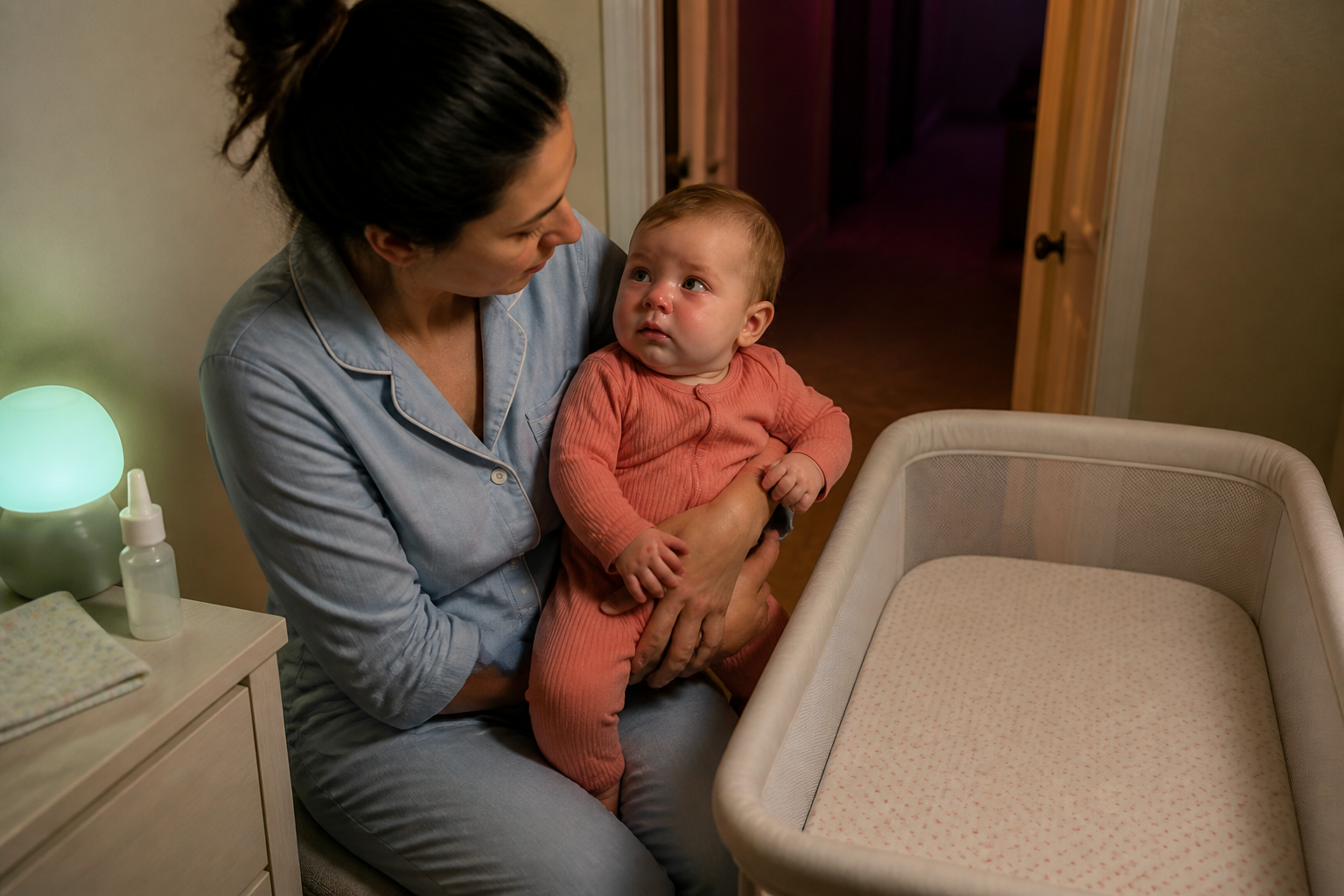
Composite scene — an illustration, not medical evidence
Kacey, Benjamin, and the folded towel that stays out of the crib
Picture a composite version of me, Kacey, standing beside Benjamin’s bassinet with a folded towel in one hand and an awake, snuffly baby against my shoulder. The adult logic feels persuasive: if my own nose were blocked, I would want my head raised. At night, that thought can turn one ordinary towel into a piece of improvised medical equipment in about six seconds.
But I would leave the mattress alone. First I would look at Benjamin, not the towel: Is his chest moving easily? Is the skin pulling between or under his ribs? Are his lips their usual color? Can he stay awake for a feed, latch or take the bottle, and pause to breathe? If those observations are reassuring, I can use plain saline and gentle suction while he is awake, hold him upright for comfort while I am fully alert, and then put him back on his back in the empty, flat bassinet.
That is the separation I want you to carry through the whole article: relief belongs to the awake part of the night; safe sleep stays deliberately boring. This composite is not proof that a particular baby is well. It shows how I would organize the next decision without turning a congested nose into a reason to create a risky sleep surface.


The distinction that makes the night clearer
Nose noise is something you hear. Body work is something you see.
A tiny nasal passage can produce snorts, whistles, rattles, and wet-sounding breaths that seem enormous through a monitor microphone. Noise alone cannot tell you the cause or severity. I would lower the volume in my own head by watching the whole baby for a calm minute—not by deciding that louder automatically means more dangerous, and not by deciding that “just congestion” means everything is fine.
More consistent with a comfort problem
- Chest and belly move without marked pulling at the ribs or neck.
- Lips and face keep their usual color.
- Your baby wakes and responds normally for them.
- They can feed with manageable pauses and continue taking milk.
- The pattern does not keep worsening while you watch.
Needs medical attention, not a sleep hack
- Skin pulls in deeply around the ribs, breastbone, or throat.
- Nostrils flare, the baby grunts, or each breath looks effortful.
- Color turns blue, gray, very pale, or unlike your baby’s usual color.
- There are pauses, weak crying, unusual floppiness, or hard-to-wake behavior.
- Feeding drops sharply because breathing and sucking cannot coordinate.
This is an observation guide, not a diagnostic score. If you cannot tell whether the breathing looks easy, call your pediatric clinician and describe exactly what you see. If an emergency sign is present, act on it rather than waiting for certainty.
Topic-specific observation path created for SleepBaby.org from AAP and CDC escalation guidance.
Check the feed before chasing a perfectly clear nose
Babies need to coordinate sucking, swallowing, and breathing. A stuffy nose can make that work slower and more frustrating, so a baby may pull away, take shorter bursts, or need more pauses. That does not automatically mean the illness is severe, but it gives you functional information that the snorting sound cannot.
I would notice whether my baby can begin the feed, stay alert enough to continue, and take a recognizable amount over the day—not demand one flawless feed during a cold. Plain saline and gentle suction shortly before a feed may make nasal breathing easier. Keep the care gentle and stop if the nostrils bleed or become irritated; repeated aggressive suction can make tender tissue more swollen.
Call sooner when intake is changing
Feeding and wet diapers help show whether the baby is coping
Contact your pediatric clinician when your baby is taking much less milk than usual, cannot stay awake to feed, repeatedly cannot coordinate breathing and sucking, has clearly fewer wet diapers than their normal pattern, has a dry mouth or no tears when crying, or is getting worse. A single diaper does not diagnose dehydration; the change across feeds and diapers is what you report.
For a premature baby or a child with a heart, lung, airway, immune, or other complex medical condition, use the care plan you were given and a lower threshold to call. Do not use a general article to override individualized advice.
If your baby is congested enough that every feed has become a struggle, the goal is no longer to perfect the bedtime routine. It is to get help protecting breathing and hydration. I would rather make that call with a plain description—“she took half her usual amount and is working harder to breathe”—than wait until I could name the virus.

Two parts of the same night, two different jobs
Do congestion care while your baby is awake; keep sleep flat and empty
This is where internet advice often collapses comfort and sleep into one pile. Holding an awake baby upright while you are alert may feel soothing. That does not make an inclined mattress or a sitting device a safe place for unattended sleep. The moment your baby is sleeping—or you might fall asleep—the safe-sleep rules take over.
| When your baby is awake | When your baby sleeps | Why the line matters |
|---|---|---|
| Use plain saline according to its directions and gentle suction when mucus is interfering with a feed or settling. | Place baby on the back on a firm, flat, level mattress with only a fitted sheet. | Care can address the nose without changing the protected sleep surface. |
| Hold your baby upright for comfort or a calm feed while you are fully awake and watching them. | Transfer a sleeping baby out of a swing, rocker, bouncer, car seat, couch, adult bed, or your arms to the dedicated sleep space. | A position that feels comfortable under direct awake supervision is not automatically safe for sleep. |
| Run a clean cool-mist humidifier out of reach if dry air seems to worsen comfort; clean and maintain it as directed. | Keep pillows, towels, wedges, positioners, blankets, toys, nests, and loose items out of the crib or bassinet. | Room comfort is separate from anything placed under or around the sleeping baby. |
| Offer normal breast milk or formula feeds and observe breathing, alertness, and intake. | Do not side-sleep or stomach-sleep a congested infant unless a qualified clinician has given a child-specific medical plan. | Congestion does not cancel back sleeping or create a home exception. |
AAP guidance is unusually direct here: a stuffed-up baby still sleeps on an even, firm, flat surface, with no props and no inclined or sitting-device sleep. I know the towel can look like the most logical object in the room. It is still the wrong object to put under a baby’s mattress.

Watch the awake-care step
AAP: how to use nasal saline with a child
The American Academy of Pediatrics’ Dr. Joanna Parga-Belinkie demonstrates nasal saline. Watch it as a technique companion, not as the only safety instruction: breathing effort, feeding, fever, and the flat-sleep boundary remain in writing on this page.
SleepBaby takeaway: do the saline-and-suction step while your baby is awake, keep it gentle, then return to the unchanged firm, flat sleep surface.
Creator: American Academy of Pediatrics · Watch on YouTube
Medicine, age, and worsening symptoms can change the plan
A blocked nose is a symptom, not a diagnosis. Colds and respiratory viruses can begin with congestion, but you cannot identify RSV—or rule it out—from a snort, a cough, or one quiet stretch of sleep. Watch the direction of the illness. New breathing difficulty, reduced fluid intake, or symptoms that are getting worse deserve clinician contact.
I would also call sooner for a young infant with poor feeding, decreased activity, unusual irritability, breathing difficulty, or a pattern that is changing quickly. A parent does not need to prove the cause before asking for help. “My eight-week-old has a blocked nose, is taking much less milk, and has a rectal temperature of 100.4” is already useful information.
A useful call without a home diagnosis
Tell the clinician what the breath, feed, and night actually did
Once emergency signs are absent, a short observation note can make a pediatric call more efficient. Do not delay care to fill every line. I would write what I can see, not what I think the virus is:
- When it began: sudden or gradual, and whether symptoms are stable, improving, or worsening.
- Breathing: noisy only, or visible pulling, flaring, grunting, pauses, color change, or a faster/harder pattern than usual.
- Feeding: breast or bottle, how the last several feeds compare with normal, and whether breathing interrupts sucking.
- Hydration: the wet-diaper pattern across the day and any dry mouth, absent tears, or unusual sleepiness.
- Temperature and age: the exact number, how it was measured, and your baby’s age in weeks or months.
- What you tried: plain saline, gentle suction, or cool mist; whether it changed comfort; and whether there was bleeding or irritation.
A short video of the breathing can sometimes help a clinician understand an intermittent pattern, if taking it does not delay care. Never use a recording as a reason to stay home when your baby is visibly struggling.
Four blocked-nose nights that need four different next steps
The phrase blocked nose can describe a baby who is noisy but coping, a baby whose breathing is becoming difficult, a baby who can breathe comfortably but is no longer taking enough milk, or a very young infant whose fever changes the urgency. I would not treat those as variations of the same bedtime problem. These examples apply the breathing, feeding, and age boundaries without pretending to diagnose the cause.
Night one: the nose sounds terrible, but the body looks easy
Your baby snorts loudly when lying down. Their chest and belly move smoothly, the skin is not pulling around the ribs or throat, color is normal, and they wake with their usual energy. They take a slightly slower feed but finish a recognizable amount and have their usual wet-diaper pattern. Plain saline and gentle suction loosen visible mucus while they are awake.
Next step: this pattern is more consistent with home comfort care and observation. Put the baby down on the back in the flat, empty sleep space. You can listen, but also look: noise may continue after the nose has been cleared as much as it reasonably can be.
I would not keep suctioning until every sound disappears. The useful finish line is a baby who is breathing comfortably enough to feed and sleep safely, not a silent monitor. If the breath starts looking harder, feeding drops, or the illness worsens, reassess the care level rather than repeating the same step indefinitely.
Night two: the chest is pulling and the cry is getting weak
The congestion is loud, but now you can see the skin drawing in under the ribs and at the base of the throat. The nostrils flare. Your baby cannot sustain the usual cry, seems pale or blue around the mouth, or becomes floppy or hard to rouse. A feed is impossible because every breath requires visible work.
Next step: call emergency services. Do not prop the mattress, put the baby in a swing, or spend time testing whether another round of suction fixes the problem. Those actions do not make respiratory distress safe at home.
This is the branch where I would stop narrating the night and act. If you are speaking with emergency responders, follow their instructions and tell them the baby’s age, the color or alertness change, and what the breathing looks like. The exact virus can be worked out later.
Night three: breathing looks easy, but feeds and diapers are sliding
Your baby is not pulling at the ribs and the color looks normal, but each feed ends after a few short sucks. Over several feeds, intake is much lower than usual. Wet diapers are clearly less frequent, the mouth looks dry, or your baby is sleepier and harder to engage for the next feed. Saline briefly opens the nose, but it does not restore the feeding pattern.
Next step: contact your pediatric clinician promptly. Breathing effort is not the only way a respiratory illness becomes important; inadequate fluids and worsening symptoms are reasons to call. Report the change across several feeds and diapers instead of trying to diagnose dehydration from one moment.
I would keep offering the baby’s normal breast milk or formula as advised, but I would not substitute water, dilute formula, force a feed, or use a commercial cold medicine. A clinician can tell you whether the baby needs assessment and what feeding plan fits their age and condition.
Night four: an eight-week-old has a rectal temperature of 100.4°F
The baby’s breathing may look easy and the congestion may seem mild. The detail that changes the plan is age plus temperature: three months or younger, with a rectal temperature of 100.4°F (38°C) or higher. The absence of dramatic breathing trouble does not turn this into a watch-until-morning situation.
Next step: contact the pediatric clinician immediately, exactly as the AAP advises. Say the age in weeks, the temperature, how it was measured, the feeding pattern, and any activity or breathing change. Follow the clinician’s direction about where and how quickly the baby should be evaluated.
I would not give fever medicine first and wait to see what happens unless a clinician has already given an exact plan for this baby. The purpose of the threshold is not to frighten you; it is to prevent a young infant’s apparently quiet illness from being underestimated.
Across all four nights, the sound may be similar. The next step changes because the baby’s function changes. Easy breathing plus adequate feeding can fit home support. Visible breathing struggle requires emergency action. Falling intake and hydration deserve prompt guidance. Young age plus fever carries its own threshold. That is why I keep coming back to the whole baby instead of asking the nose to tell the entire story.
The towel can stay folded
A blocked nose can make the night louder and the feeds slower without making the crib unsafe—provided the baby’s breathing remains easy, color and alertness stay normal, and intake remains adequate. Your job is not to manufacture silent breathing. It is to recognize when the whole baby is coping, support the nose gently while awake, and keep sleep on the same firm, flat, empty surface.
I would put the folded towel back on the shelf. Not because the congestion is imaginary, and not because every snuffly baby is automatically fine. Because the safer plan is clearer now: watch the breath, check the feed, know the age-and-fever boundary, and let the bassinet do only the job it was built to do.
Optional tool for the awake-care step
A powered aspirator when you want adjustable suction in one kit
If plain saline has loosened mucus and you prefer powered suction before a feed or the next sleep, the Frida Baby Electric NoseFrida Nasal Aspirator is the article-specific tool I would compare. It has three suction levels, two silicone tips, a cleaning brush, a USB rechargeable cable, and a storage case.
It fits this situation better than a crib wedge because it addresses mucus while your baby is awake instead of changing the sleep surface. It also gives a caregiver selectable powered suction in a contained rechargeable kit, unlike the manual mouth-tube version. Use it gently and follow its directions; stop and ask for guidance if suction causes bleeding or irritation.
This device does not treat the underlying illness, make labored breathing safe at home, guarantee sleep, or replace medical assessment. Choose it if you want the saline-and-suction step organized in one case—not as a substitute for the breathing, feeding, fever, and safe-sleep boundaries above.
See the Electric NoseFrida on Amazon
As an Amazon Associate, SleepBaby may earn from qualifying purchases.
Sources
- American Academy of Pediatrics / HealthyChildren.org: My baby has a stuffy nose. How can I help them sleep safely?
- American Academy of Pediatrics / HealthyChildren.org: Sudden Infant Death Syndrome—common questions and concerns
- U.S. Food and Drug Administration: Use Caution When Giving Cough and Cold Products to Kids
- Centers for Disease Control and Prevention: Symptoms and Care of RSV
- American Academy of Pediatrics / HealthyChildren.org: Fever and Your Baby
From listening to every snort to knowing what matters
Let the next sleep have a simpler job
Watch the breath. Check the feed. Keep the sleep space flat. Once those decisions are clear, the nursery can stop being a late-night engineering project and become a place for rest again. SleepBaby is here for the next bedtime question, with calm steps that fit a real household.






What viewers said10 comments · 4 replies+
Archived comments from the original Baby Sleep Miracle presentation. Not independently verified by SleepBaby.org; individual experiences vary.
Thank you so much for this video! I had no idea about the dangers of baby swings :O
Hi Mary-Ann. I have a question: Is method in any way similar to the ones recommended by Dr Bucknam, Dr. Weissbluth or Dr. Karp? We tried those but none of them help.
Hi Regina, thank you for your question. The short answer is no. The techniques I share in my guide are based on newest scientific research and this is why I have never seen any approach similar to the one I recommend.
This method really works! I tried it on my son Jesus and after just one week he went from waking up more than 5 times a night to waking up just once or twice. You are a lifesaver, Mary-Ann!
I'm truly impressed with how much information you share in your video. And all for free! I can feel that you truly care about mothers like myself, and that's hard to find these days. I have recommended your site to several of my friends already.
Mary-Ann, our child suffers from autism. Is your approach still suited?
Chloe, I made sure my method can be used with any child, even babies who are special like yours. Please note that I'm not a doctor and that I always advice to consult with your physician because nothing is more important than the safety and well-being of your love.
Hallo Mary-Ann, I'm from Germany. Do you have your guide in German?
Hello Heide, we do! Normally you should already see our video in German. If not, please contact our support so they can guide you
Thenk you for your answer, Mary-Ann!
I just completed your approach and I have to say, it worked almost too well. Yes, it took a bit of getting used to with your bedtime routine but the difference is huge. My son George used to take 1 hours to go down and now he's firmly asleep in no more than 10 minutes! You're the best!
It seems I'm the only man watching this video, lol! What you shared about the 'emotional backpack' made immediate sense to me and I can't wait to help my little girl Mila to unpack it!
Hey there, just discovered your site and this really sounds different. Just wanted to say thanks for sharing :)
For everyone who's still thinking about getting Mary-Ann's guide I want to advise you to go ahead. I wasn't sure myself but now I'm so thankful I invested in this program. It made a huge difference in our life as a family and yes, my baby girl does sleep through the night now.