The first-year answer
Can a baby sleep with a blanket?
For a healthy baby younger than 12 months, do not put a loose blanket in the crib, bassinet, portable crib, or play yard—for naps or overnight. Use a firm, flat, level sleep surface with a fitted sheet and nothing else. Place your baby on the back for every sleep. Rolling, watching the nap, choosing a small or “breathable” blanket, or tucking fabric under the mattress does not create an exception to the first-year rule.[1]
If warmth is the worry, move the warmth into fitted sleep clothing or a correctly sized, non-weighted wearable blanket that cannot ride over the baby’s head. That keeps the sleep space bare while giving you a practical layer to adjust. I know an empty crib can look oddly unfinished when your instinct says a sleeping baby should be tucked in. In infancy, though, bare is not uncaring. It is the safer setup.

A composite Kacey-and-Benjamin bedtime scene
When the bare crib feels too bare
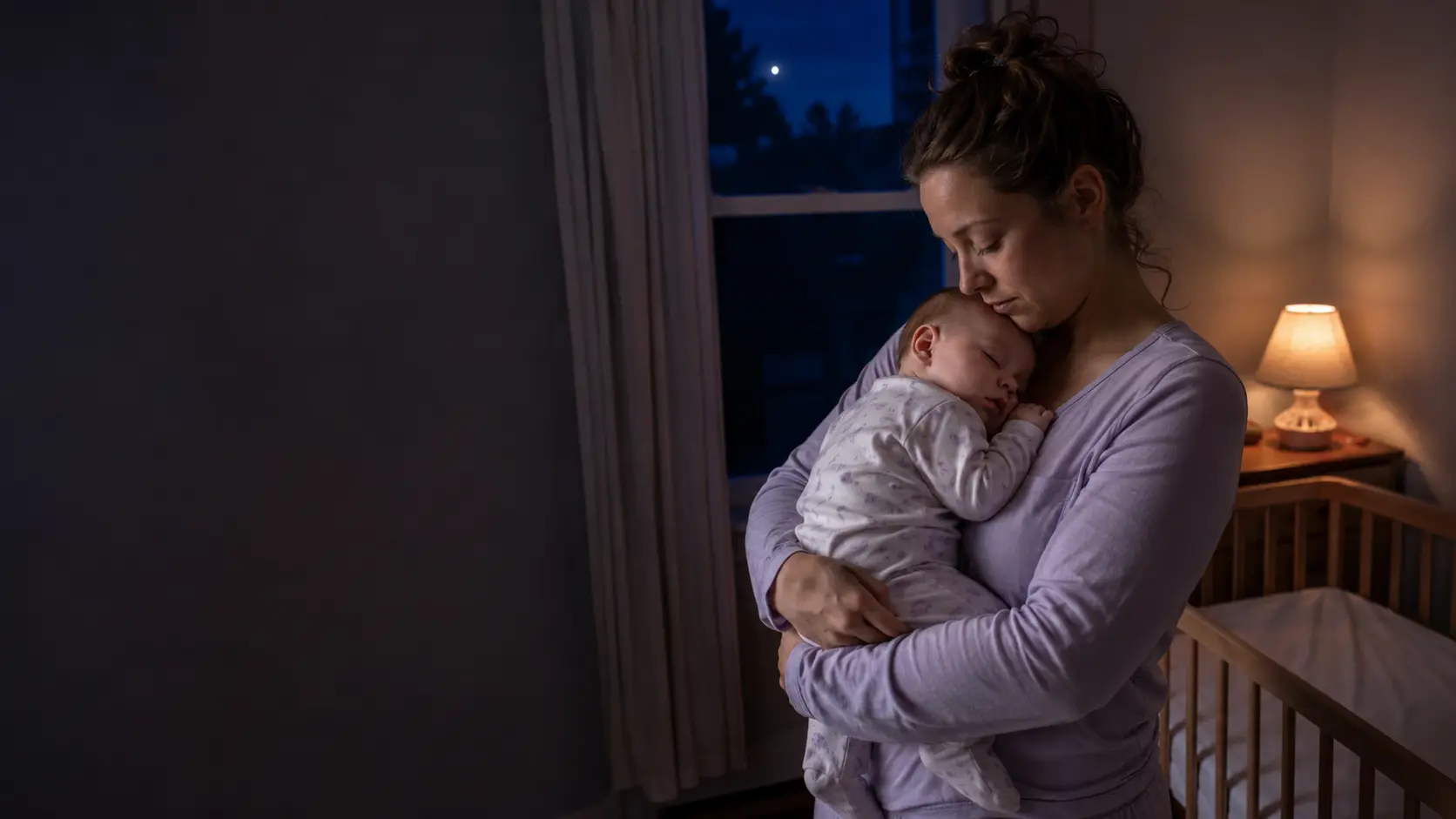
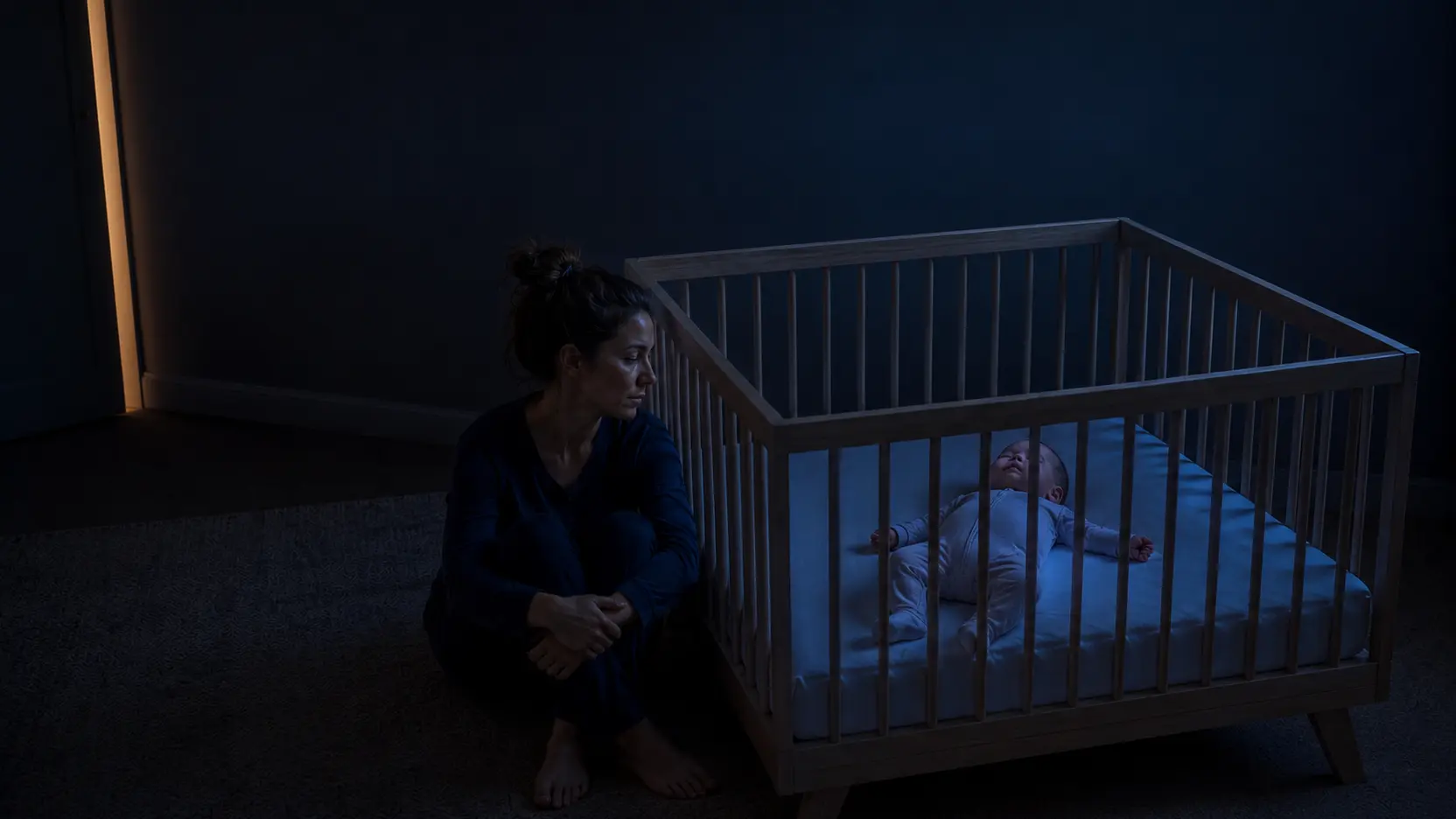
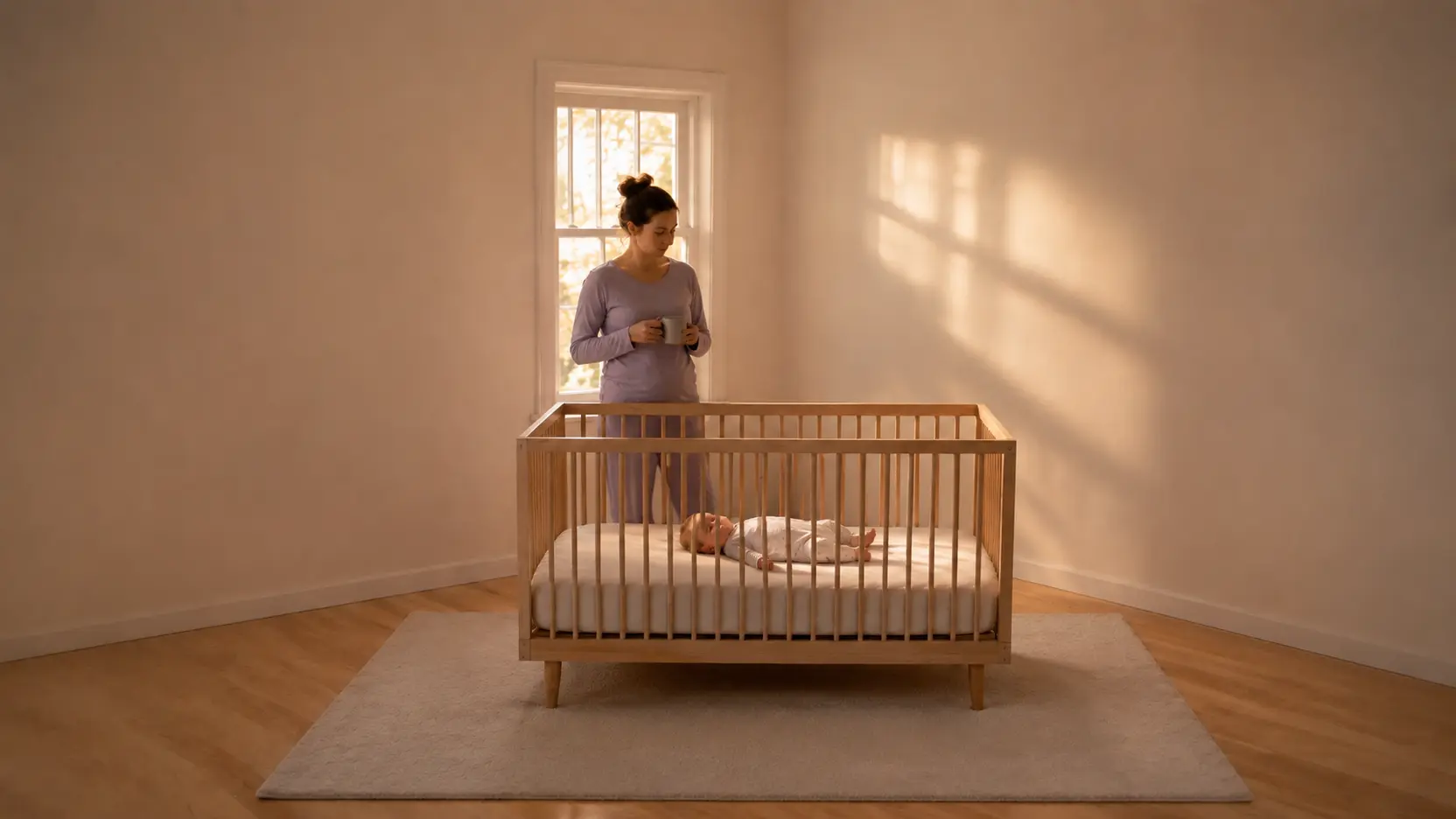
Picture me at bedtime with a soft gifted blanket folded over one arm. Benjamin’s sleep space is waiting—flat, fitted, and empty—and the blanket makes the empty part feel emotionally louder. The fabric is warm in my hand. The bare mattress looks almost stern beside it. That is the moment behind this search: not “Do I know what a blanket is?” but “Am I leaving my baby cold if I take it away?”
In this composite scene, I set the blanket outside the crib. I check Benjamin’s chest rather than treating cool hands as a diagnosis, then I choose fitted sleep clothing or a properly sized non-weighted wearable layer if he needs more warmth. I do not use this scene as evidence; the safe-sleep guidance comes from pediatric and public-health sources. The scene is here because the emotional tug is real even when the safety answer is firm.
I also separate two jobs that can blur together at bedtime. A loose blanket may symbolize comfort to an adult, but an infant does not need that fabric in the sleep space to be cared for. Warmth is a clothing-and-fit decision. Comfort comes from the whole wind-down—your voice, your hands, the familiar order of bedtime—and then from a clear place to sleep.

Four things that are not interchangeable
What belongs in an infant sleep space?
Loose blanket
No during the first year. Not over the baby, under the baby, tucked at the sides, or reserved for watched naps. Loose bedding can obstruct breathing or contribute to suffocation, entrapment, and strangulation risks.[2]
Arms-free wearable blanket
Potentially useful when it is non-weighted, the correct size, permits free movement, and cannot rise over the face. It is clothing, not a reason to add bedding.
Swaddle or compression garment
A different category. If it restrains or compresses the arms, chest, or body, stop at the first signs of trying to roll. Do not wait for a completed roll.
Weighted product
No for infant sleep. That includes weighted blankets, sleepers, swaddles, and sleep sacks. A product being sold for sleep does not make it appropriate for an infant.
I would make this distinction before shopping, because product names are not always as clear as the job the garment performs. Ask: Is it loose? Does it compress? Is it weighted? Can it cover the head? Those answers matter more than a soothing label on the package.

The no-loopholes rail
Do rolling, supervision, or “breathable” fabric change the rule?
No. I would not spend tonight engineering a version of loose bedding that feels almost fitted. During the first year, the cleaner decision is to remove the blanket and solve warmth another way. The CDC and CPSC likewise advise keeping blankets and other soft objects out of an infant’s sleep area.[3][4]
Supervision does not turn loose bedding into a fitted sheet. The rule applies to every sleep.
Rolling affects swaddling and repositioning questions. It does not add a blanket exception.
Lightweight marketing language does not remove the risks created by a loose object near the face.
Small is still loose. NICHD specifically excludes small non-fitted items.
A tucked blanket is not a fitted sheet, and it can loosen. Do not rely on the tuck.
Under is not safer than over. Keep the sleep surface firm, flat, and bare except for its fitted sheet.
This section is intentionally repetitive in one way only: every proposed exception arrives at the same action. Remove the loose item. That simplicity is useful at bedtime, when six nearly identical internet arguments can make a straightforward boundary feel negotiable.
If your baby has a medical condition or an individualized sleep plan, follow guidance from the clinician who treats your child. Do not invent a blanket exception from general online advice, including this article.
One rule across every sleep setting
Does the blanket answer change in a bassinet or travel crib?
No. The first-year boundary follows the baby, not the room. It applies in the regular crib, bassinet, portable crib, and play yard; at home, while traveling, and during care by someone else. Use the sleep surface and fitted sheet intended for the product. Do not add a blanket because the portable setup looks less cozy than the nursery.
I would also keep the rule the same for daytime sleep. A sunny room, an adult sitting nearby, or a shorter nap can make the risk feel different, but none changes loose fabric into fitted bedding. Consistency helps because nobody has to decide whether this particular sleep is supervised enough, short enough, or close enough to morning to deserve an exception.
Firm, flat, level surface; fitted sheet only; no loose blanket.
Use only the manufacturer-intended sleep surface and fitted sheet; do not pad or soften it.
Do not add a loose covering or an aftermarket mattress to make travel sleep resemble the nursery.
Send the same written rule with the baby’s correctly fitting sleep clothing; do not rely on “they know what I mean.”
A monitor, motion sensor, or adult presence is not a substitute for the safe-sleep environment. Monitoring may help a caregiver notice something, but it does not prevent a loose item from reaching the baby’s face. I would spend my effort on the setup that exists before everyone goes to sleep, not on technology that asks a tired adult to catch a hazard later.
What do I say to a grandparent or babysitter?
Keep the handoff short enough to survive a busy evening: “For every sleep, please place the baby on the back in the bare crib with only the fitted sheet. If warmth is a concern, use this fitted non-weighted sleep layer in this size—do not add a blanket.”
Then show where the approved clothing is, how it fits, and what to do if the baby feels hot. Remove decorative blankets from the room or place them somewhere clearly outside the sleep setup. I would rather make the right action obvious than leave a beautiful folded blanket on the rail and hope everyone remembers it is decorative.
If a caregiver pushes back with older tucked-blanket advice, stay with the current rule rather than debating whose babies slept well decades ago. This is not a judgment on how someone cared in the past. It is a clear instruction for this baby and this sleep.
Warmth moves into the layer
How do I keep my baby warm without a blanket?
Start with the room your baby is actually sleeping in and the clothing already on the body. There is no single thermostat number that fits every home, climate, garment, health situation, and baby. Current AAP parent guidance emphasizes comfortable room conditions and generally no more than one additional clothing layer than a comfortable adult would wear.[5]
I would check the chest or upper back. Hands and feet can feel cooler because of circulation, so they are poor stand-alone thermostats. If the chest is hot or the baby is sweating, remove a layer and reassess. If the core feels comfortably warm and the baby is otherwise well, cool fingers alone do not prove that a blanket belongs in the crib.
- Look at the existing layers. Count the diaper, pajamas, bodysuit, and wearable layer rather than thinking of the sleep sack as invisible.
- Check the core. Use the chest or upper back and notice sweating, damp hair, flushed skin, or a hot chest rather than guessing from hands.
- Use one change at a time. Add or remove one fitted layer, then reassess. Do not add both heavier pajamas and a warmer wearable at once unless the current product guidance supports that combination.
- Follow the exact garment guidance. TOG, layering, sizing, and care instructions belong to the specific product and room conditions; they are not universal prescriptions.
- Keep the surface unchanged. Adjust clothing without adding a blanket, pillow, bumper, toy, positioner, or other object.
If you want a fuller way to work through this without defaulting to a loose covering, see how to tell whether your baby’s room and sleep layers are warm enough. That is the next useful question—not how to make loose bedding stay put.


One minute, one complete sleep picture
Watch the blanket rule in context
This concise NICHD Safe to Sleep video places the blanket answer beside the other basics: back placement and a firm, flat, bare sleep space. Watch it as a whole setup, not as a substitute for the written guidance above.[6]
The takeaway: warmth belongs in fitted sleep clothing or a correctly sized non-weighted wearable layer. The infant sleep surface stays bare.
If the player does not load, watch the official NICHD video on YouTube.
The fit inspection
How should a wearable blanket fit?
A sleep sack is not automatically appropriate because it zips. The useful distinction is whether the exact garment fits the exact baby and behaves like unrestricted sleep clothing. I would inspect it before the first sleep, after every size change, and again if the garment stretches, shrinks, tears, or starts sitting differently.
The opening should not be able to slide over the chin, mouth, or nose. Do not size up for growth if that makes the neckline unsafe.
They should match the manufacturer’s fit guidance and should not allow the body to slip down inside the garment.
An arms-free, non-swaddling sack should permit free movement. Compression changes the category and the rolling rule.
Use the current size chart. Extra length is not a reason to choose a garment that is too loose around the upper body.
Read the product’s current TOG and layering information, then compare it with the room and the baby’s core warmth.
Check zippers, seams, fasteners, fabric, current instructions, and recall notices. Stop using damaged or altered sleepwear.
A garment that once fit can become wrong as the baby grows or the fabric changes. That is why I prefer a repeatable inspection over a one-time “safe” label. For a deeper walkthrough, use how to check an unweighted sleep sack for fit, warmth, damage, and recalls.
If the baby can pull the neckline toward the face, slip inside the garment, or move in a way the product instructions do not allow, stop and reassess. Do not compensate with pins, ties, rolled fabric, extra fasteners, or another layer placed over the sleep sack.
The three-screen label check
How do I read a sleep-product label without getting lost?
Baby-sleep packaging can put several reassuring words on the front and the actual decision points in smaller type. I use three screens before I consider color, softness, or convenience.
- Category screen: Is the item loose bedding, an unrestricted wearable, a swaddle or compression product, or a weighted product? If it is loose or weighted, the infant answer is no. If it compresses the arms, chest, or body, the rolling cutoff applies.
- Fit screen: Does the current size range match your baby’s measurements? Can the neckline or arm openings permit the body to slip down? Does the garment leave the head uncovered and movement unrestricted? An age range alone cannot answer those questions.
- Use screen: What do the current instructions say about clothing layers, room conditions, washing, drying, fasteners, damage, and discontinuation? Is there a recall or updated warning? Use the exact instructions for the exact product, not a screenshot from a different model.
Marketing words such as breathable, calming, ergonomic, transitional, or premium do not override any of those screens. Neither does popularity. I am not looking for the product that sounds most comforting in a description; I am looking for the category and fit that keep the warmth job out of the sleep space.
Do not modify a sleep sack to make it work. Adding a tie, pin, blanket, insert, or improvised fastener can create a new hazard and means the garment is no longer being used as designed. The correct response to poor fit is a different size or product—not home tailoring at bedtime.

Rolling changes one decision
Does rolling make a blanket safe?
No. Rolling changes the swaddle decision; it does not change the loose-bedding boundary. Continue placing your baby on the back for every sleep and keep the infant sleep space empty through the first year. If your baby independently changes position, follow current safe-sleep guidance—but do not add a blanket because motor skills have improved.
Arms restrained or body compressed
Stop at the first signs of trying to roll. Do not wait for the baby to roll successfully in the garment. Transition to an appropriate arms-free option that permits movement.[7]
Arms free and unrestricted
A correctly fitted, non-weighted sleep sack is not the same as swaddling. It may continue when it fits properly and follows its current instructions.
The internet often turns “my baby can roll” into “my baby can escape any hazard.” Those are not the same claim. A rolling baby can still encounter loose fabric near the face, and motor skill does not transform a blanket into fitted sleepwear.
If you find fabric over the face
What if I find the blanket over my baby’s face?
Remove the blanket immediately and clear the sleep space. Check your baby’s breathing, color, responsiveness, and overall condition. If your baby is not breathing normally, is blue or gray, is unusually difficult to wake, or seems in immediate danger, call emergency services and begin the emergency steps you are trained to provide.
If your baby appears well, the next step is still to change the setup before the next sleep. Do not tuck the same blanket more tightly, switch to a smaller one, or rely on the monitor. Use fitted clothing or a properly fitting non-weighted wearable layer if warmth is needed.
I would also pause before turning one frightening moment into a product experiment. The useful response is not to buy several gadgets at once. It is to remove the loose object, restore the bare surface, and contact a pediatric clinician if you have any concern about what happened or how your baby looks or acts afterward.
What about weighted blankets and sleep sacks?
Do not use weighted blankets, weighted swaddles, weighted sleepers, or weighted sleep sacks for an infant. Current guidance does not establish adequate safety or a proven home-sleep benefit. Plausible concerns include restricted chest expansion, difficulty changing position, and overheating.[8]
I would not let reassuring packaging outrank that boundary. “Calming,” “gentle pressure,” and “sleep support” are marketing ideas unless strong evidence and current infant guidance say otherwise. For this article’s decision, weight is a disqualifier—not a feature to balance against price, softness, or popularity.
What changes—and what does not
How does the answer change as my baby grows?
Use the bare sleep surface and back placement for every sleep. If you swaddle, use current guidance and prepare to stop before rolling is established. A loose or weighted blanket is not part of the setup.
Stop arm- or body-compressing swaddling products. A properly fitted arms-free, non-weighted wearable may be an option. The sleep space stays bare even when the baby rolls independently.
For a healthy child, soft objects are generally considered much lower risk, but there is no universal 100-percent-safe birthday. Discuss individual health or mobility concerns and follow the sleep-space and product instructions.
Notice what never becomes useful: a watched-nap exception, a breathable-fabric exception, or a weighted-product bargain. The age discussion opens after the first birthday; it does not rewrite the first-year rule retroactively.
This map also prevents two opposite mistakes. You do not keep using a compressive swaddle simply because loose blankets are still excluded, and you do not introduce loose bedding simply because swaddling has ended. The arms-free wearable category exists between those choices when the product fits and permits movement.
If your baby is close to a birthday or a developmental milestone, make the decision from the age they are now and the sleep space they use tonight. Do not round up to the next stage, and do not let a new skill erase a separate safety rule. When individual health, muscle tone, mobility, or breathing concerns complicate the transition, ask the child’s clinician about that exact child and setting instead of borrowing another family’s timeline.
After one: lower risk, not a magic switch
When can a child start using a blanket?
The first birthday is the earliest evidence-based transition point to discuss for a healthy baby; it is not a guarantee that every soft object becomes 100 percent safe at midnight. AAP parent guidance says research has not established one universally safe date, although most experts consider soft objects to pose little risk to healthy babies after 12 months.[5]
That wording matters. “Much lower risk” is not the same as “required now,” and it is not permission to add a blanket, pillow, stuffed animal, bumper, and several sentimental objects together. Your child may continue using a freely moving, correctly fitted sleep sack if it still works for the sleep setting and product instructions.
Before introducing a blanket after 12 months, consider:
- your child’s health, mobility, and individualized clinician guidance;
- the exact crib, toddler-bed, and product instructions;
- whether a blanket is actually needed or an unrestricted wearable layer already works;
- whether the sleep space remains uncluttered rather than receiving several soft items at once;
- how you will notice and remove a blanket that is damaged, oversized, or used in a way you did not intend.
I would treat the transition as a deliberate choice, not a birthday obligation. There is no prize for adding a blanket on the earliest possible night. If the current setup is comfortable, allowed by the product instructions, and working, you do not have to change it for the sake of ceremony.


Tonight, in order
What should I do if my baby has a blanket now?
- Remove the loose blanket and other soft objects. Clear the infant sleep space down to the firm, flat, level surface and its fitted sheet. Do this for naps and nighttime.
- Place your baby on the back. Use back placement for every sleep, even if your baby sometimes rolls independently after being placed down.
- Check warmth at the core. Feel the chest or upper back. Look for sweating or a hot chest before deciding another layer is needed.
- If needed, choose a fitted non-weighted layer. Follow the current size, TOG, clothing, room, and care guidance. Make sure the neckline and arm openings cannot allow the garment to cover the head.
- Recheck the rolling category. If the garment restrains or compresses, stop it at the first signs of trying to roll. Move to an appropriate arms-free option rather than adding loose bedding.
If your baby seems unusually hot or cold, is difficult to wake, has breathing trouble, looks unwell, or has a medical condition that changes sleep guidance, contact an appropriate clinician promptly; seek emergency help for urgent breathing or responsiveness concerns. A blanket article cannot diagnose the cause.
You do not need to redesign the whole bedtime routine tonight. Clear the surface, check the layer, check the fit, and keep the category distinctions straight. That is enough useful work for one bedtime.
A practical blanket-to-wearable option
A fitted wearable layer for the warmth job
If you keep reaching for loose crib bedding because the room feels cool, the Burt’s Bees Baby Beekeeper Wearable Blanket is an article-specific option worth considering. It is a sleeveless, non-weighted wearable layer with a bottom-opening zipper, zipper guard, and washable cotton construction. That makes it a closer fit for this exact problem than a monitor, thermometer, generic routine product, or another loose covering: it changes where the warmth sits.
The observed Medium 1.5 TOG variant is not a universal recommendation. Use the manufacturer’s current size chart, neckline and arm-opening fit, room and clothing guidance, care instructions, and recall information for your exact baby and product. Do not size up for growth if the garment could rise over the face, do not add a loose blanket on top, and do not treat any sleep sack as SIDS prevention or a guarantee of safer or longer sleep.
See the Beekeeper wearable blanket on Amazon
As an Amazon Associate, SleepBaby may earn from qualifying purchases.
The blanket is not rejected. It has a new place.
Return to that folded blanket from the composite bedtime scene. It can still belong to the family. It can wait outside the crib, cover your own knees during a feed, sit on a chair, or become part of supervised awake time when appropriate. What changes is not whether the blanket is loved. What changes is where it goes during infant sleep.
That is the distinction I want beside you at bedtime: an empty infant sleep space is not less caring; the care has moved into the setup. The firm surface is clear. The baby goes down on the back. The warmth is fitted. The garment fits. The loose fabric stays out.
Once I stop asking the blanket to perform every job—warmth, comfort, tradition, and proof that bedtime feels cozy—the decision gets quieter. I can keep the tenderness and remove the loose object. The crib may still look bare to adult eyes. It is not missing the thing that makes it loving.
Sources
- American Academy of Pediatrics: Sleep-Related Infant Deaths—Updated 2022 Recommendations.
- NICHD Safe to Sleep: Safe Sleep Environment for Baby.
- CDC: Helping Babies Sleep Safely.
- U.S. Consumer Product Safety Commission: Safe Sleep—Cribs and Infant Products.
- HealthyChildren.org / AAP: Safe Sleep—9 Ways to Reduce a Baby’s Risk of SIDS & Suffocation.
- NICHD Safe to Sleep: Safe Sleep For Your Baby—60 Seconds.
- HealthyChildren.org / AAP: Swaddling—Is it Safe for Your Baby?.
- NICHD Safe to Sleep: Frequently Asked Questions.
When the crib looks bare but bedtime still needs warmth
Put the warmth in the plan—not the crib
You cleared the loose blanket, checked the fitted layer, and gave the first-year boundary a job you can actually follow tonight. If the rest of bedtime still feels like a pile of disconnected decisions, SleepBaby can help you turn those pieces into a calmer, more understandable rhythm.
SleepBaby does not replace your pediatric clinician or current safe-sleep guidance, and it does not promise a particular sleep outcome.