
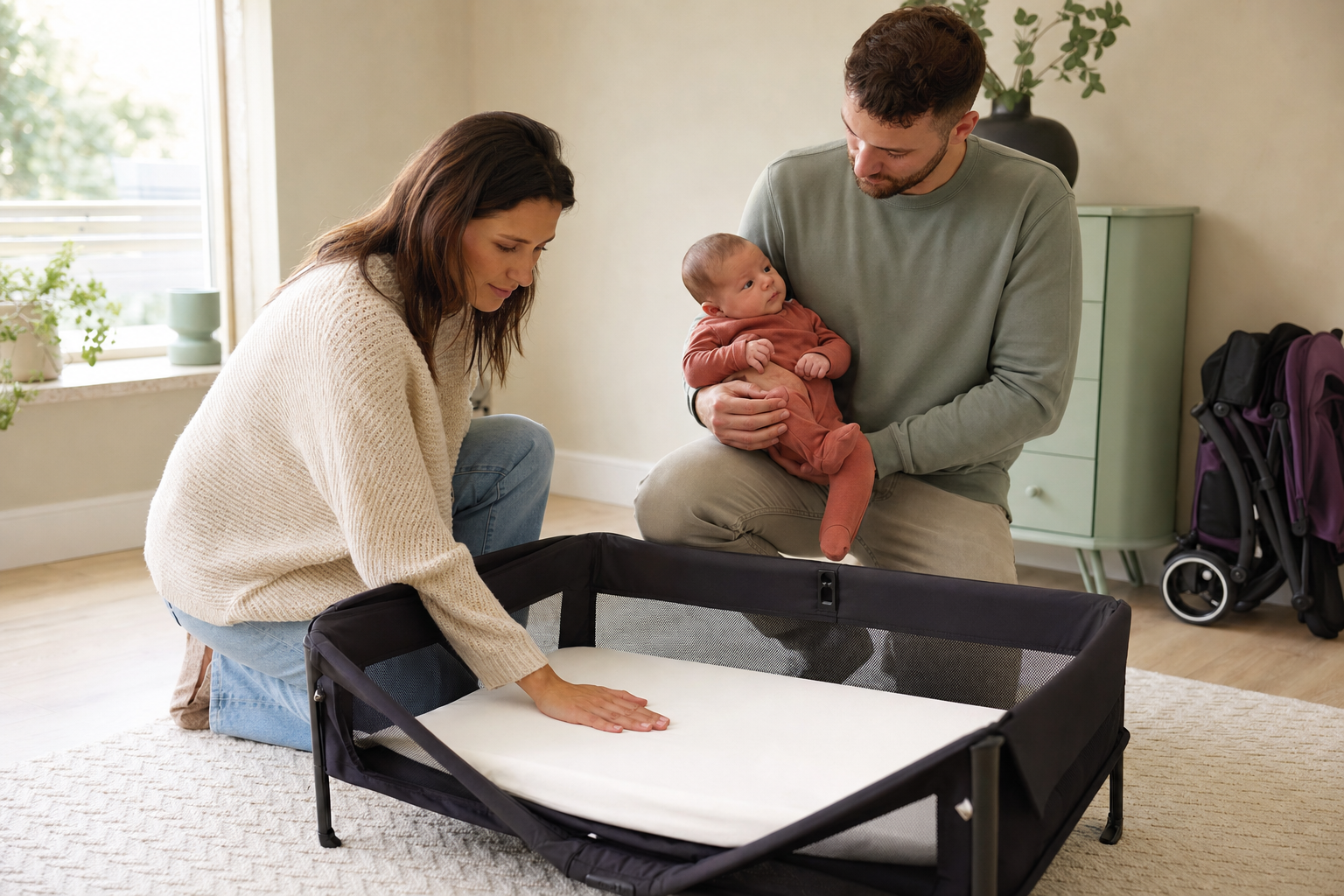
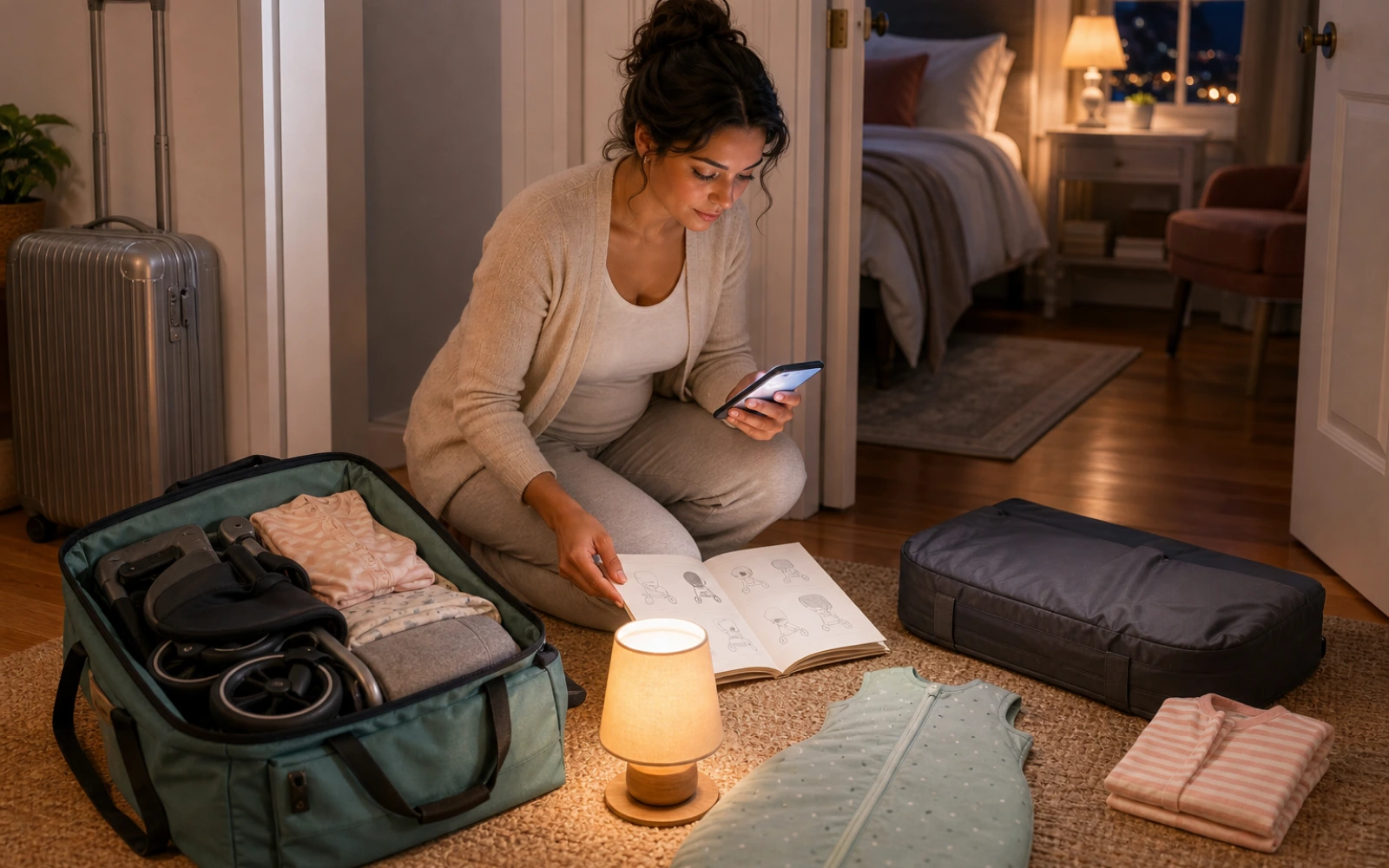
The folded YOYO is by the hotel-room door. The sleep sack is in the bag. And the word bassinet on the stroller attachment seems to promise that you have already packed the baby’s bed.
But no: do not plan naps or overnight sleep in the YOYO bassinet or the newer YOYO newborn shell. Stokke’s current manuals say these products are not intended for sleeping and direct parents to an appropriate product, such as a cot, for prolonged sleep. If your baby dozes while the stroller is moving, transfer them to a firm, flat, noninclined sleep surface intended for infant sleep as soon as practical when travel stops.
I know why this answer feels irritating. You chose compact travel gear because babies already require the luggage footprint of a small touring company. The important distinction is not whether the YOYO looks flat or includes the word “bassinet.” It is whether the manufacturer intends that exact product to be a sleep space. Here, the manual says no.
The answer to pack around
Wheels for movement. A sleep product for sleep.
Use the YOYO bassinet or newborn shell as the stroller component described in its manual. For planned sleep, use a separate crib, bassinet, play yard, or bedside sleeper that is intended for infant sleep and follow that product’s instructions and limits.
Why the word “bassinet” does not decide this
A product name can describe shape or function without giving permission for sleep. The older U.S. YOYO bassinet guide says the bassinet is not intended for sleeping. The current YOYO newborn shell guide gives the same instruction. Both tell caregivers to use an appropriate product, such as a cot, for prolonged sleeping.
That instruction matters more than a retailer headline, a flat-looking pad, a friend’s travel routine, or a forum thread full of confident strangers. The American Academy of Pediatrics recommends a firm, flat, noninclined surface intended for infant sleep. The U.S. Consumer Product Safety Commission likewise tells caregivers to use a crib, bassinet, play yard, or bedside sleeper intended for sleep and to move a baby who falls asleep elsewhere to one of those spaces.
The name creates a very understandable shortcut in a tired parent’s head: bassinet equals bed. I would replace it with a better question: What job does this exact manual authorize this exact product to do? For the YOYO attachment, the answer is transporting a young baby with the stroller—not becoming the baby’s planned sleep space after the journey ends.
I use the manual as the boundary because I do not want a tired parent forced to interpret a product name at bedtime.
SleepBaby.org decision tool
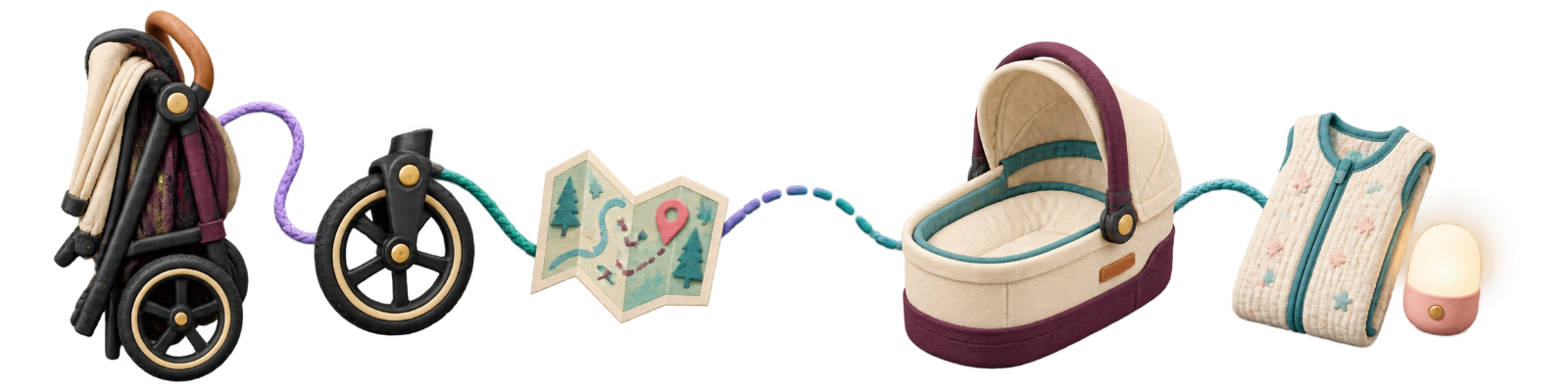
Two labels, two jobs
MOVE
YOYO bassinet or newborn shell
A stroller component for carrying a baby during travel, used only as its model-specific manual allows.
SLEEP
Crib, sleep bassinet, play yard, or bedside sleeper
A separate product intended for infant sleep, used on a firm, flat, level surface with the baby on their back and the space bare.
The shape may look similar. The intended job is not.
What if my baby falls asleep in the YOYO?
Babies doze in motion. That does not mean you did something reckless, and it does not turn the stroller accessory into an approved sleep space. The practical answer is to notice the state you are in and choose the next safe step without turning the sidewalk into a panic scene.
The travel-state decision
Use the moment you are actually in
- The stroller is moving: keep the baby attended, follow every restraint and use instruction for your exact YOYO setup, and make the sleep-surface plan for the stop.
- Travel has stopped: transfer the baby to a sleep-intended crib, bassinet, play yard, or bedside sleeper as soon as practical.
- The baby wakes during transfer: settle them in the approved sleep space rather than returning to the YOYO for a planned nap.
- No compliant sleep surface is available: do not improvise with a bed, sofa, counter, table, stand, added mattress, or other soft or elevated surface. The plan needs to change before the sleep setup does.
I would not turn “as soon as practical” into a fantasy in which a parent teleports home the second an eyelid closes. It means the stroller nap is not the destination. Once you reach the place where planned sleep can happen, move the baby to the product intended for it.
Can I detach the YOYO bassinet and put it somewhere else?
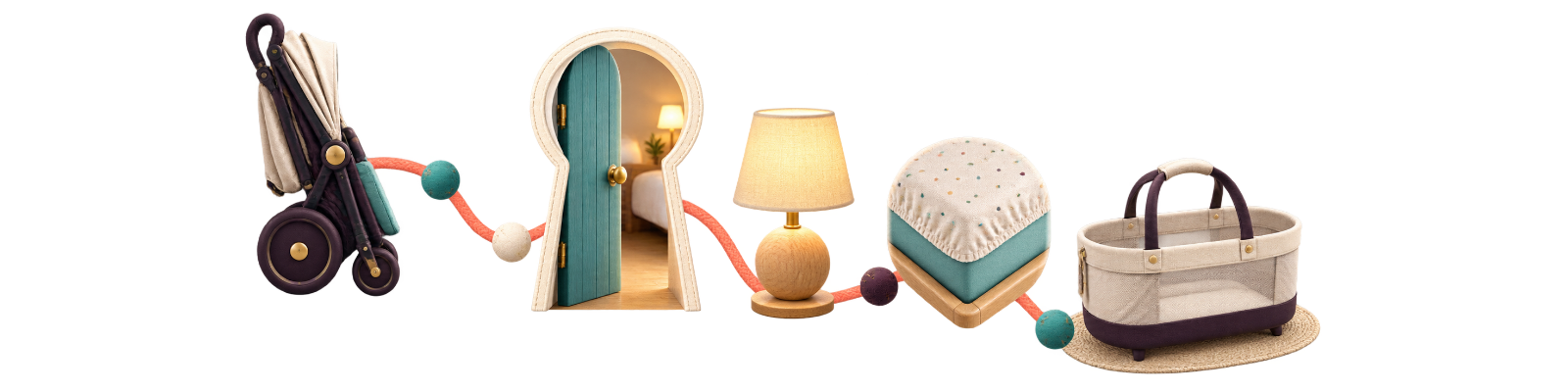
Detaching the attachment does not change its intended use. The U.S. YOYO bassinet manual says to use it only on a firm, horizontal, level, dry surface and warns against placing it on a bed, sofa, counter, table, or other soft or elevated surface. The newer newborn shell manual says not to use it on a stand. Neither permits adding another mattress.
This is where “it looks stable” can become an unsafe test. A soft adult bed can contour around a baby. A counter or table adds a fall hazard. An improvised stand may not support the attachment as intended. Another pad changes the space the manufacturer tested and can create gaps or softness. I would not try to engineer around the manual with a towel, travel stand, spare mattress, or strategically optimistic hotel furniture.
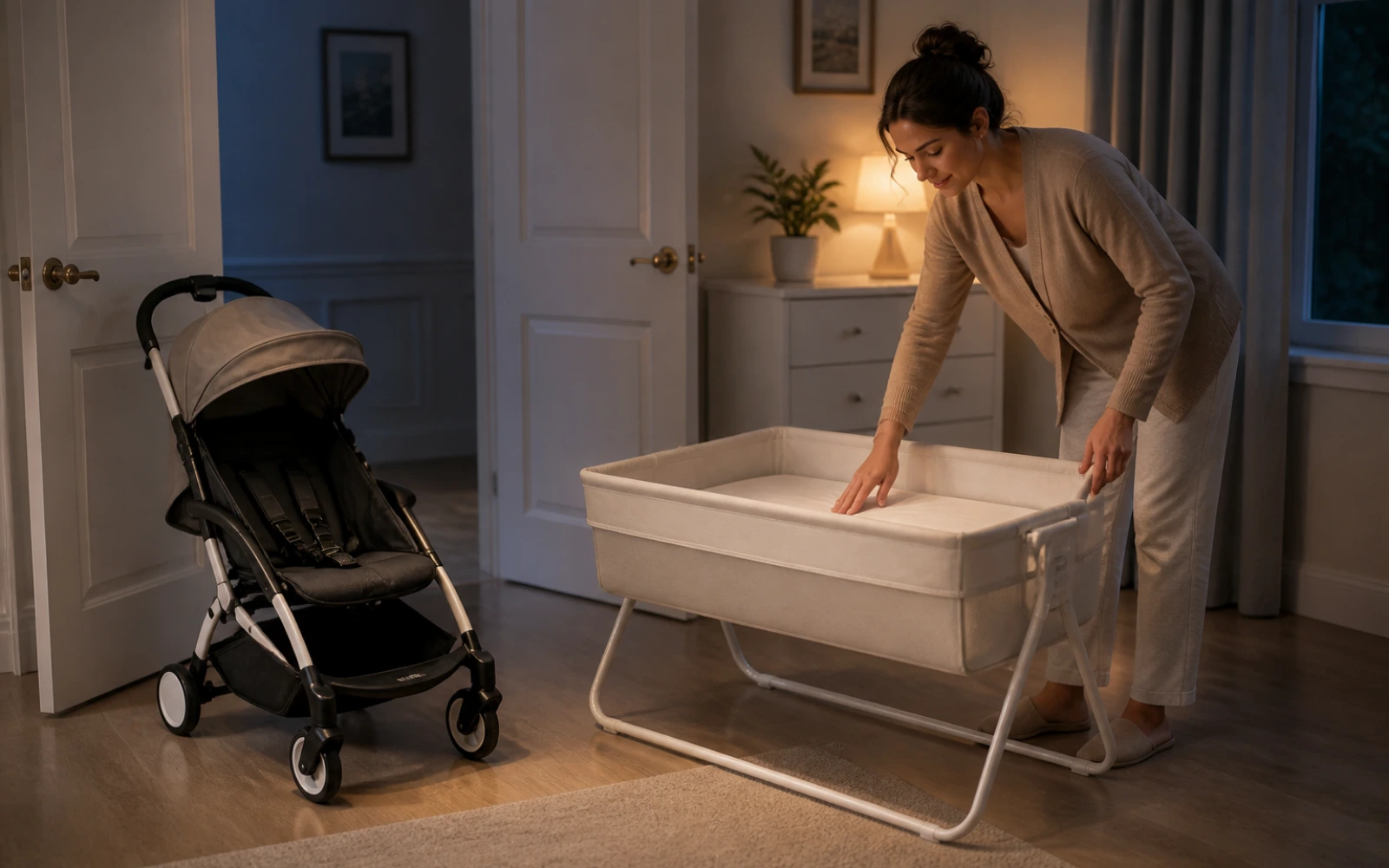
Know the limits for the exact YOYO version you own
Model names and generations matter, so use the manual that came with your product and check Stokke’s current support materials. The limits below help you understand why the attachment is temporary gear for a very young baby; they do not convert it into a sleep product.
| Product named in manual | Stated limit | Developmental stop |
|---|---|---|
| YOYO bassinet, U.S. guide | Maximum 9 kg / 20 lb and 72 cm / 28.5 in | Stop when the child can sit unaided |
| YOYO newborn shell, current guide | Maximum 9 kg / 20 lb | Only for a child who cannot sit, roll, or push up on hands and knees |
A child can reach a developmental stop before the weight number. I would treat the first reached limit as the limit, not as an invitation to compare the baby with the chart and bargain for another weekend. Also check compatibility with the exact YOYO frame and adaptors you own; a name shared across generations does not guarantee every part belongs together.
Use the manual for your product and market
Baby gear can keep a familiar name while its frame, attachment, warnings, or approved combinations change. Instructions can also differ by market. That is why I would not use a screenshot from a retailer, a manual for somebody else’s YOYO generation, or a search snippet as the final word on the piece in front of me.
Find the model label and the instructions supplied with your attachment. Confirm the product name, frame compatibility, adaptor requirements, restraint setup, child limits, cleaning instructions, and every warning. If you obtained the product secondhand and cannot identify it confidently, ask Stokke before using it. A missing label, unknown generation, incomplete attachment, damaged part, or improvised adaptor is not a puzzle to solve by comparing online photos.
The sleep answer in the current manuals is consistent, but the details around use still matter. The older U.S. bassinet guide includes a height limit and stops at sitting unaided. The newer newborn shell guide describes a broader developmental stop that includes rolling and pushing up. Those are not competing internet opinions; they are reasons to match instructions to the exact product rather than blending two guides into one homemade rule.
I also would not let a standards badge do more work than it actually does. A stroller component may comply with rules for the job it is designed to perform without becoming a sleep product. CPSC’s infant-sleep framework turns on whether a product is marketed or intended to provide sleeping accommodation. The word on the side of the attachment is not as useful as the intended-use statement inside the manual.
A hypothetical Kacey-and-Benjamin travel moment
The packing list gains one line
Imagine me by the door with the folded YOYO, a sleep sack, and Benjamin’s tiny pajamas packed into a cube that somehow still takes up half the bag. I read the word “bassinet” and briefly enjoy the fantasy that one piece of gear has agreed to do two jobs.
Then I open the manual. The fantasy lasts roughly as long as it takes to reach the warning that the product is not intended for sleeping.
In this clearly hypothetical scene, Benjamin has not used either product and no personal result is being claimed. The scene helps me make one practical change: I keep the YOYO on the movement side of the list and add a separate sleep-intended surface on the overnight side. The manual closes. The packing list gets longer by one line, but the decision gets much simpler.
Plan each travel segment, not just bedtime
A travel sleep plan often fails in the gaps. The overnight bassinet is booked, but nobody has decided what happens between the train platform and check-in. Or the family has a beautiful portable crib in the trunk while the baby is asleep in the stroller inside an airport terminal. The equipment is present; the handoff plan is missing.
I would walk through the trip in order:
- Departure: Where is the sleep-intended product packed, and can you reach it without unpacking the entire car or checking the only bag that contains it?
- Movement: How will you use the YOYO exactly as instructed while the stroller is in use? Who is attending the baby, and what is the next realistic stop?
- Arrival: Can one adult set up the sleep space while the other keeps the baby attended? Is the room placement already chosen?
- Overnight: Does the baby still fit every limit of the sleep product, and is the surface bare, firm, flat, level, and assembled with only approved parts?
- Morning and checkout: Which product gets packed last so the baby does not lose the sleep-intended option before the next travel segment begins?
This does not require a color-coded itinerary. It requires one sentence for each handoff. “If the baby falls asleep on the walk from the station, we will set up the travel bassinet first and transfer them there.” That is much more useful than arriving with three excellent products and no idea which one can legally remain open on the hotel floor.
Travel delays do not change the product instructions. If check-in is late, a room is not ready, or luggage is separated from you, the inconvenience is real—but it is not evidence that a stroller attachment becomes a cot for the evening. A backup may be a verified destination crib, a second sleep-intended product kept accessible, or a change in the travel plan. It is not an added pad, a soft adult bed, or a promise to stay awake and watch.
What should I pack for sleep instead?
Choose a product explicitly intended for infant sleep that fits your baby’s age, size, and developmental stage. It should provide a firm, flat, level surface and be used exactly as its manufacturer instructs. Put the baby down on their back. Keep the space bare except for the product’s properly fitted sheet. Do not add a pillow, loose blanket, positioner, bumper, or extra pad.
For some families, the destination will provide a compliant crib or play yard. Confirm that before travel rather than discovering at bedtime that “crib available” meant a decorative wooden object last inspected during the previous century. Ask what product it is, whether all parts are present, and whether you can see the setup before the baby needs it.
If you bring your own, practice opening and locking it at home. Check the manual, locate the fitted sheet, and know the stop limits. The best travel sleep product is not the one with the cleverest fold in an airport video; it is the one that is intended for sleep, fits the baby now, can be set up correctly, and does not require exhausted improvisation after dark.
A portable sleep surface for the other half of the trip
Chicco LullaGo Anywhere LE Portable Bassinet
If the YOYO is your travel stroller, I would give sleep its own piece of equipment. The Chicco LullaGo Anywhere LE folds flat into a carry bag and is sold as a portable bassinet with a firm, flat sleep surface. That makes it a better fit for this exact overnight job than trying to turn the YOYO carrycot into a cot, and it is more newborn-specific and lighter than packing a full travel play yard when you do not need the play-yard function.
The practical reason to consider it is simple: a family already packing the YOYO can give planned sleep a separate destination without depending on the stroller accessory. Use only the supplied pad and a properly fitted sheet, keep the space empty, place the baby on their back, and stop at the first listed product limit. Buying any product does not replace reading its current manual.
See the Chicco LullaGo Anywhere LE on Amazon
As an Amazon Associate, SleepBaby may earn from qualifying purchases.
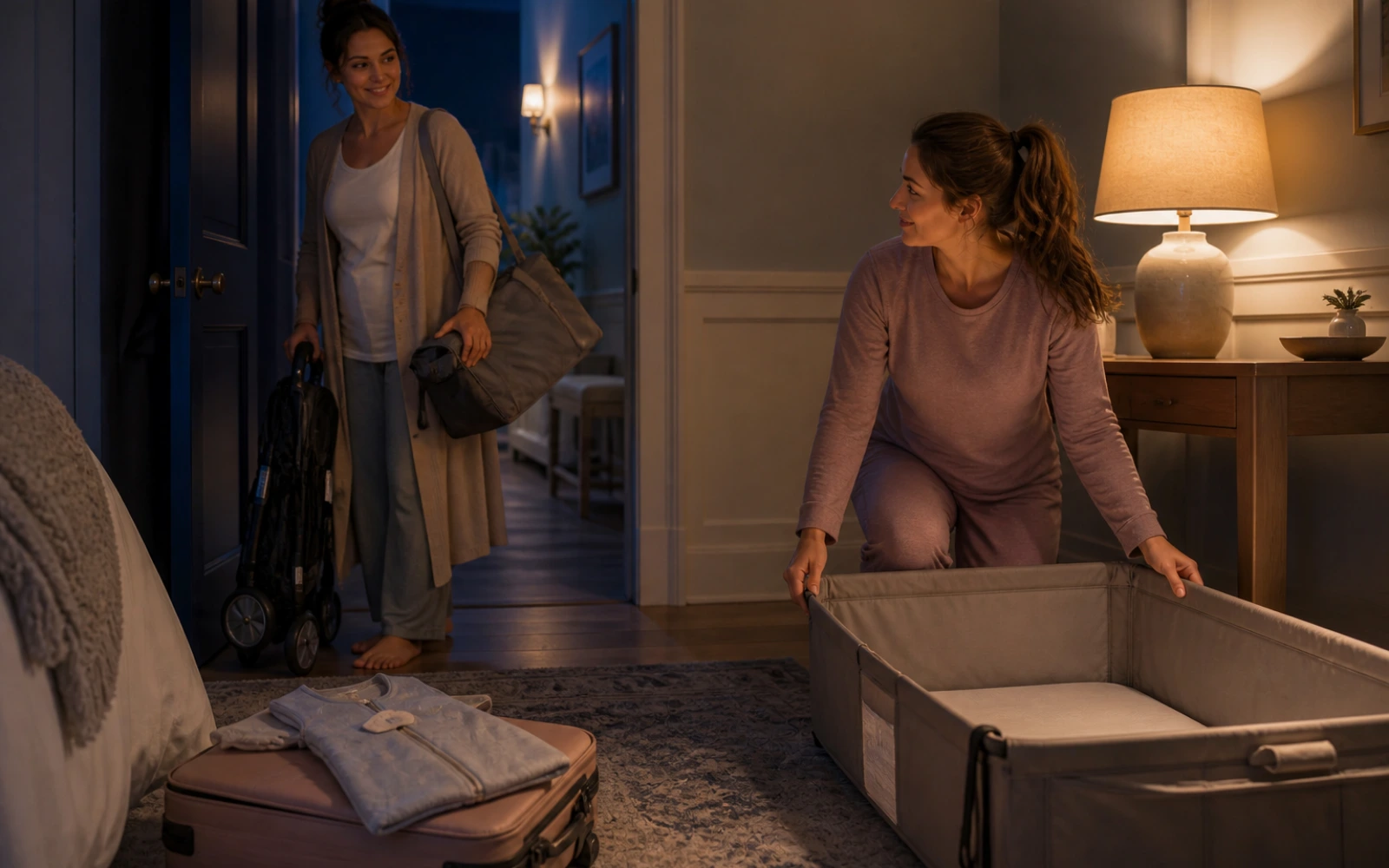
The five-minute check before you leave
Before the zipper closes
Give movement and sleep separate checkmarks
My packing test is intentionally plain: I want to point to one item for movement and a different, clearly sleep-intended item for bedtime.
- YOYO manual: correct attachment, compatible frame, restraint instructions, current size and developmental limits.
- Sleep product: intended for infant sleep, complete, undamaged, and appropriate for your baby now.
- Sleep surface: supplied mattress or pad only, properly fitted sheet, no added softness.
- Room plan: firm level floor location away from cords, windows, heaters, unstable furniture, pets, and foot traffic.
- Transfer plan: know where the baby will go if they fall asleep during the journey.
Inspect a hotel or rental sleep space before you need it
“Crib available” is a useful starting point, not a completed safety check. Ask for the product name and whether the property provides a crib, bassinet, or play yard intended for infant sleep. When you arrive, look before bedtime has already collapsed into hunger, pajamas, and one parent trying to remember where the clean pacifier went.
Confirm that the product appears complete and undamaged, stands firmly on a level floor, and uses its intended mattress or pad. The fitted sheet should fit properly. Remove pillows, quilts, loose blankets, bumpers, toys, positioners, and decorative pieces. Move the sleep space away from blind cords, electrical cords, heaters, windows, unstable furniture, and anything the baby could reach. If the product has an identification label or instructions, check its limits against your baby’s current size and development.
Do not assume a folded extra mattress belongs inside because it was stored beside the crib. Do not stack a hotel pad over the supplied one to make it feel softer. And do not use a product that is missing hardware, will not lock, has torn mesh, has a visibly sagging surface, or cannot be identified well enough to use correctly.
If the provided setup is unsuitable, call the property and ask for a complete replacement. If that cannot be provided, use the separate sleep-intended product you brought or change the plan. The YOYO remains useful for moving through the trip; it does not become the backup bed because the first crib failed inspection.
I like doing this check in daylight, or at least before the room is dark and everyone is tired. The goal is not to turn a family visit into a compliance audit. It is to make the important decision while your brain still has access to words longer than one syllable.
What if my baby wakes during the transfer?
This is often the private question hiding under the product question. You may already understand that the YOYO is not the planned bed; you are worried that moving the baby will end the nap, restart bedtime, or turn a quiet hotel room into a tiny protest venue.
Make the approved sleep space ready before the stroller stops. Dim the room, turn on the usual sound machine if you use one safely, put the fitted sheet on, and remove everything else. Keep the transfer boring. Support the baby, place them on their back, and use the same short settling cue you use at home. If they wake, settle them there instead of putting them back into the YOYO to preserve the nap.
I would rather handle one inconvenient wake-up than build the night around a product whose own manual says it is not for sleeping. That is not a judgment on a parent who hoped the stroller attachment could do both jobs. It is simply the point where the written instruction makes the decision for us.
If transfers are the real struggle, the next useful read is our guide for when your baby wakes or refuses the safe bassinet. That article helps with the settling problem after the surface decision is already made; it does not change which products are intended for sleep.
What safe sleep looks like after travel stops
The endpoint is refreshingly plain: baby on their back, on a firm and flat noninclined surface intended for infant sleep, with only a fitted sheet in the sleep space. Keep the baby’s sleep area in your room, but not in your bed, ideally for at least the first six months. Follow the product’s instructions and stop limits.
A canopy, travel bag, stroller frame, monitoring app, or adult supervision does not alter those basics. Neither does a beautiful hotel room. Safe sleep is less about producing a photogenic nest and more about removing the things adults are tempted to add.
Watch: the safe-sleep destination
The manual answers the YOYO question; CPSC shows the sleep setup
The YOYO manual decides whether that stroller attachment is a sleep product. This U.S. Consumer Product Safety Commission video reinforces the separate endpoint: a back-sleeping baby in a bare product intended for infant sleep.
Takeaway: The stroller gets the baby there. A sleep-intended crib, bassinet, play yard, or bedside sleeper is where the planned sleep happens. If the player is unavailable, watch it directly on YouTube.
Questions parents usually ask next
Is the YOYO newborn shell different from the YOYO bassinet?
They are different product names and generations with different manuals and compatibility details. For this question, the controlling point is the same: the current guides for both the YOYO bassinet and the YOYO newborn shell say the product is not intended for sleeping. Check the manual for the exact item you own.
Does a flat mattress make the YOYO safe for overnight sleep?
No. A flat appearance is not permission for planned sleep. Intended use, applicable product standards, the complete construction, and the manufacturer’s instructions all matter. The manual’s no-sleep statement controls this decision.
Can my baby nap in it if I supervise?
Do not plan a nap in it. Supervision does not change the intended use. If the baby falls asleep during stroller travel, transfer them to a sleep-intended surface as soon as practical when you stop.
Can I use the detached YOYO bassinet on a hotel bed or floor?
Do not use it on a bed or other soft or elevated surface. The manuals require a firm, horizontal, level, dry surface for allowed product use, but they still say the attachment is not intended for sleeping. Putting it on the floor does not convert it into a planned sleep space.
When should I stop using the YOYO attachment?
Follow your exact manual and stop at the first applicable size or developmental limit. The U.S. bassinet guide lists 9 kg/20 lb, 72 cm/28.5 inches, and sitting unaided. The current newborn shell guide lists 9 kg/20 lb and use only before the child can sit, roll, or push up on hands and knees.
Sources
- Stokke/BABYZEN, YOYO Bassinet U.S. User Guide.
- Stokke, YOYO Newborn Shell User Guide.
- U.S. Consumer Product Safety Commission, Safe Sleep.
- U.S. Consumer Product Safety Commission, Infant Sleep Products FAQ.
- American Academy of Pediatrics / HealthyChildren, Safe Sleep Recommendations.
- Chicco, LullaGo Anywhere LE Portable Bassinet and product manual.
When the stroller stops, the sleep plan begins
Make the next bedtime decision feel this clear
The folded YOYO can stay by the door. The baby’s sleep gets its own line on the packing list, its own safe surface, and fewer decisions made under hotel-room lamplight. SleepBaby helps you bring that same calm, practical order to the rest of the night.
SleepBaby offers educational sleep guidance and does not replace your pediatric clinician, product instructions, or current safe-sleep recommendations.