The short answer
Morning puffiness is a clue, not a diagnosis
A baby’s eyes can look puffy after sleep because fluid has collected in the loose tissue around the eyelids, or because of rubbing, congestion, allergy, irritation, or infection. But the fact that it appeared after sleep does not prove it is harmless. Look at three things: whether the puffiness is around one eye or both, what other symptoms are present, and whether it fades, persists, recurs, worsens, or spreads after your baby wakes.
If your baby is breathing normally, acting like themselves, moving both eyes normally, and has no pain, fever, marked redness, or swelling elsewhere, you can pause long enough to observe the pattern. The urgent signs below change that plan.
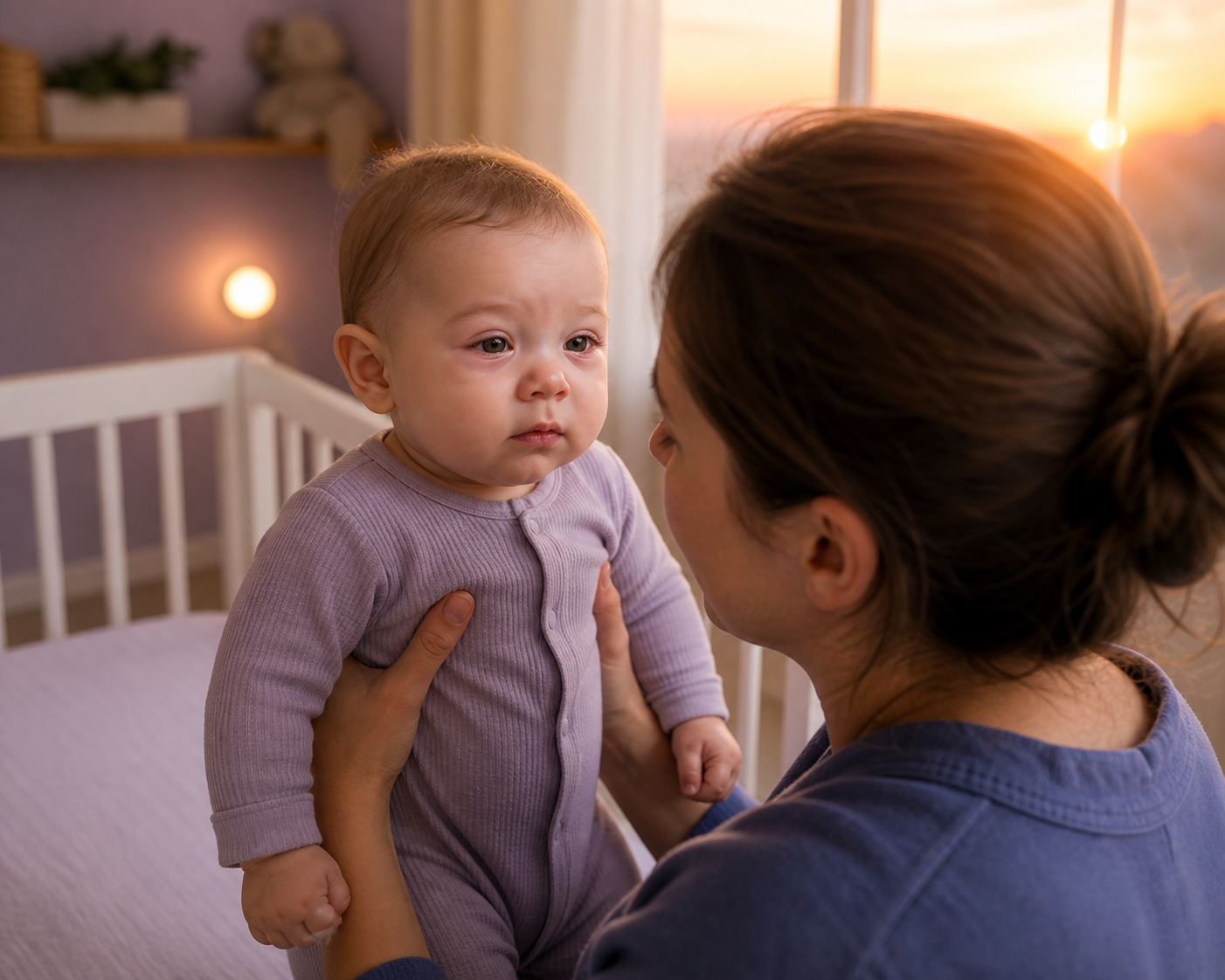
Composite scene — an illustration, not medical evidence
Kacey, Benjamin, and the terrible view from the doorway
Picture this composite version of me, Kacey, in the pale first light, looking at Benjamin after sleep and thinking, His face looks different. That is the private jolt inside this search. Morning light can make a familiar little face look startlingly unfamiliar, and a tired brain wants one quick label: sleep face, allergy, infection, something worse.
I would not try to solve that from the doorway. I would move close enough to check Benjamin’s breathing and color, then look at the pattern rather than the word puffy. Is it one eyelid or both? Is the eye itself red? Does he seem bothered when looking around? Is there watering, crusting, fever, swelling of the lips, or swelling somewhere else? Once the urgent signs are absent, I can notice whether the puffiness changes as he becomes fully awake.
That sequence matters because it turns a frightening snapshot into useful information without pretending a parent can diagnose an eye condition at home. I use it throughout this guide: Side, Symptoms, Shift.

A SleepBaby observation path
Side → Symptoms → Shift
This is not a diagnostic test. It is a way to notice the details that determine whether you need emergency help, urgent assessment, a prompt pediatric call, or a short period of calm observation.
Side
Is the swelling around one eye or both? Is it the upper lid, lower lid, skin around the eye, or the eye itself? Laterality narrows the questions, but it never supplies a diagnosis by itself.
Symptoms
Look for itch, watering, discharge, redness, pain, tenderness, fever, vision or eye-movement change, a bulging eye, airway symptoms, swelling elsewhere, urine changes, or a change in feeding and responsiveness.
Shift
Does it clearly lessen after waking, or persist? Does it return each morning, worsen, spread, or appear with new symptoms? Improvement is context; it is not proof that the cause is benign.
Tonight connection: note what the eyes looked like at the last calm bedtime check, then compare in similar light after waking. Consistent light makes your observation more useful than a dramatic bathroom mirror or a phone flash.
Observation framework created for SleepBaby.org; it organizes questions and does not diagnose illness.

One puffy eye and two puffy eyes lead to different questions
One side versus both is one of the quickest useful observations you can make. It is not a verdict. A rubbed eye can be one-sided; some infections begin on one side; allergy often affects both eyes; and systemic fluid retention tends to be bilateral. The accompanying symptoms decide how urgently a clinician needs to assess your baby.
| Pattern | Notice next | Why it matters |
|---|---|---|
| Mostly one eye | Rubbing, a bite or bump, a focal lump, redness, warmth, pain, tenderness, discharge, fever, or trouble moving the eye | Painful or red one-sided swelling can require urgent assessment because parents cannot safely distinguish a surface problem from deeper infection at home. |
| Both eyes | Itching, watering, generalized facial swelling, congestion, a new exposure, swelling elsewhere, or urine changes | Bilateral puffiness can fit allergy or temporary fluid pooling, but recurrent morning swelling with other edema or urine changes deserves pediatric review. |
| Started on one, then both | Redness, tearing, crusting, discharge, irritation, illness symptoms, pain, light sensitivity, or blurred vision | Some conjunctivitis patterns begin in one eye and spread. Color or texture of discharge alone cannot tell you the cause. |
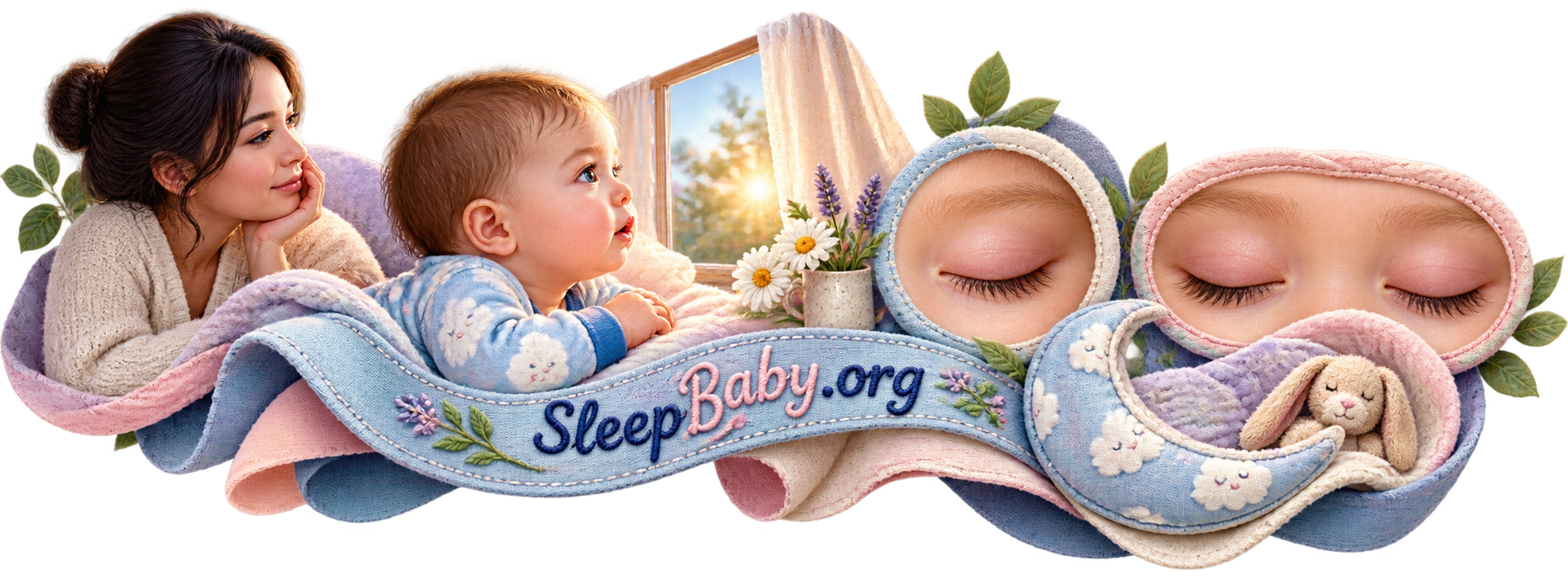
What the common patterns can look like
I am deliberately saying can look like, not is. Puffy eyelids are a visible description shared by several very different causes. The safest home job is to notice the pattern and choose the right level of care, not to name the disease.
Temporary fluid pooling after sleep
The tissue around the eyes is loose and shows small changes easily. Fluid can collect there while a person is lying down, so mild puffiness may look stronger immediately after waking and soften as the day begins. This is a plausible mechanism, not a baby-specific rule-out test. Timing alone cannot tell you whether the swelling is ordinary.
A mild, even pattern that clearly improves, with normal breathing, normal behavior, comfortable eye movement, and no redness, pain, fever, discharge, swelling elsewhere, or urine change is more suitable for brief observation than a pattern with those added symptoms. Recurrence still belongs in a pediatric conversation.
Allergy or irritation
Allergic eye symptoms more often affect both eyes and commonly bring strong itching, watering, pinkness or redness, and mild lid swelling without pain or fever. Rubbing can make the eyelids look much puffier. Airborne pollen and other particles can be triggers, but puffiness alone cannot confirm an allergy.
Do not start borrowed drops or use another family member’s eye medicine. Ask your baby’s pediatric clinician or pharmacist what is appropriate for your child’s age and symptoms. If there is face, lip, or tongue swelling or any breathing, swallowing, voice, color, tone, or responsiveness change, leave the allergy-guessing behind and follow the emergency boundary above.
Conjunctivitis or another infection
Conjunctivitis can include redness, tearing, irritation or itching, crusting, discharge, and eyelid swelling. Viral conjunctivitis may begin in one eye and spread; allergic conjunctivitis usually affects both. A parent cannot reliably identify the cause by discharge color, and a red eye in an infant deserves pediatric guidance.
A very red, painful, hot, or tender swollen lid—especially on one side—raises a different concern. Periorbital and orbital infections need clinical assessment; pain with eye movement, vision change, a bulging eye, severe headache, fever, or a very unwell child requires urgent care. Lack of fever does not prove infection is absent.
A blocked tear duct
A simple blocked tear duct is usually a constantly watery eye without eye redness or true eyelid swelling. That distinction matters because parents often hear “tear duct” attached to every watery or crusty infant eye. A red or swollen lid, pus, a tender lump near the inner corner, a cloudy-looking cornea, fever, or a baby who seems sick changes the plan.
I would rather give the pediatrician an accurate description—watery eye, lid swelling, redness, discharge—than squeeze a complicated picture into the wrong familiar label.
A pattern worth a prompt pediatric call
Repeated morning puffiness plus swelling elsewhere or urine changes
Swelling around both eyes that is strongest in the morning can occur in childhood nephrotic syndrome and may initially be mistaken for seasonal allergy. That does not mean morning puffiness means kidney disease. It means a recurring or persistent bilateral pattern deserves attention, especially if you also notice swelling of the feet, legs, hands, abdomen, or face; foamy urine; noticeably reduced or changed urine; or unusual fatigue.
Contact your baby’s pediatric clinician promptly and describe the whole pattern. Do not wait for it to become dramatic, and do not use a home observation to diagnose the cause. This is the branch where the question shifts from “What did the eyelids do after sleep?” to “Is the body retaining fluid, and what does the clinician need to check?”

Use a lower threshold with a young infant
Very young babies can become unwell quickly, and eye infections in newborns can be serious. Seek prompt same-day pediatric guidance for a young infant with a red or swollen eyelid, pus, a cloudy-looking cornea, poor feeding, unusual sleepiness, or an ill appearance. Fever in a baby younger than 12 weeks needs prompt medical assessment.
If you are unsure whether you are seeing the eyelid, the eye surface, or the skin around it, say exactly that when you call. You do not have to translate the picture into medical vocabulary before asking for help. A plain description is useful: “The right upper lid is swollen and red,” or “Both lower lids look puffy every morning, and today the feet look swollen too.”
Make the pediatric call easier
A six-line note is more useful than “the eyes looked weird”
Once the emergency and urgent signs are absent, write down these details. Do not delay care to complete the list.
- When: first noticed after bedtime, a nap, or morning sleep; one-time or recurring.
- Where: right, left, or both; upper lid, lower lid, surrounding skin, or eye surface.
- What else: itch, watering, redness, crusting, discharge, pain, tenderness, fever, cold symptoms, feeding or behavior change.
- Movement and sight: whether your baby tracks normally for their age and moves the eyes comfortably.
- Shift: same, better, or worse after becoming fully awake; take one photo in consistent, soft light if doing so does not delay care.
- Whole-body clues: breathing or swallowing change, swelling elsewhere, foamy or changed urine, new exposure, bite, bump, or illness.
If the clinician’s office asks for a photo, send the clearest unfiltered image you already have and pair it with words. A picture cannot show pain, tenderness, fever, comfortable eye movement, breathing, urine changes, or how your baby is behaving. Say what the camera misses and when the appearance changed. If the office offers video triage, keep your baby comfortable and let the clinician guide what they need to see; do not force the eyelid open or repeatedly shine a light into the eye. The goal is not to prove your theory. It is to give the clinician a reliable starting point while you follow the urgency they recommend.
I like this note because it does not ask a tired parent to be a clinician. It simply saves the details that vanish once the morning starts moving.
Walk four real-looking mornings through the same questions
The words puffy eyes flatten very different situations into one search phrase. These examples show how the observation path changes the next step. They are not diagnoses, and they do not replace a clinician’s judgment.
Morning A: both lower lids look a little full, then soften
Side: both. Symptoms: no redness, pain, fever, discharge, breathing change, swelling elsewhere, urine change, or behavior change. Shift: the appearance clearly softens after the baby is fully awake.
This is the kind of pattern that may fit temporary fluid pooling and brief observation. Take note of how long it lasts and whether it returns. “It improved” is useful information, but it is not a permanent all-clear. If it becomes a repeated morning pattern, persists longer, or gains another symptom, bring the record to the pediatrician.
Morning B: both eyes are itchy, watery, and pink
Side: both. Symptoms: obvious rubbing, watering, and pinkness, without pain or fever. Shift: symptoms continue after waking and may track with a season, room, pet, open window, or other exposure.
That cluster fits an allergic pattern better than puffiness alone does. It still does not prove a trigger or tell you which medicine is appropriate for a baby. Describe the exposure pattern to the pediatric clinician or pharmacist and ask for age-specific guidance. New face, lip, tongue, breathing, swallowing, voice, tone, color, or responsiveness changes belong to the emergency branch, not this routine discussion.
Morning C: one upper lid is red, tender, and getting larger
Side: one. Symptoms: redness and tenderness, perhaps fever or recent cold symptoms. Shift: worsening rather than easing.
This pattern does not belong in an all-day photo experiment. A clinician needs to assess painful or tender one-sided swelling promptly because the surface appearance cannot show a parent how deep an infection may be. Pain with eye movement, vision change, a bulging eye, severe headache, confusion, severe swelling, or very ill appearance raises the urgency further.
Morning D: both eyes are puffy again, and the socks leave marks
Side: both. Symptoms: swelling at the feet or legs, possible abdominal or hand swelling, foamy or changed urine, or unusual fatigue. Shift: stronger in the morning and recurring.
This is not a reason to diagnose kidney disease from the nursery. It is a reason to contact the pediatrician promptly and mention the eyes, the other swelling, and the urine pattern together. Those details change what the clinician considers and what they may need to examine or test.
What I want you to notice is that the next step never comes from puffiness alone. It comes from the company the puffiness keeps. Side organizes the picture. Symptoms set the level of concern. Shift tells you whether this is a fading snapshot or an evolving pattern.
Protect the eye and the decision
What not to do in the first hour
- Do not use leftover or shared eye drops. Different causes can look similar, some products are not appropriate for infants, and an opened container can be contaminated. A prior prescription belongs to the prior diagnosis, not today’s photograph.
- Do not press hard on the eyelid or force the eye open. Observe what your baby comfortably shows you. If swelling prevents the eye from opening, or the baby resists because of pain, that finding itself deserves medical guidance.
- Do not let a phone flash become the exam. One soft-light photo can help document change when the situation is nonurgent. Repeated close flashes, dramatic filters, and different angles make comparison harder and can upset a baby whose eye is already uncomfortable.
- Do not prop, incline, or pad the sleep surface. Trying to drain facial fluid or ease congestion is not a reason to change safe-sleep basics. Keep the sleep space firm, flat, and clear.
- Do not let “no fever” end the check. Fever matters, but its absence cannot rule out an eye infection or another cause. Pain, tenderness, redness, eye movement, vision, behavior, laterality, recurrence, and whole-body swelling still count.
- Do not wait for a better comparison when an urgent sign is present. The perfect before-and-after picture is never worth delaying emergency or urgent care.
This is one of those mornings when restraint is an action. You are protecting the eye from an improvised treatment and protecting yourself from false reassurance while you choose the right care.
Where congestion and the sleep environment fit
A stuffy nose, rubbing, mouth-open sleep, and an irritated bedroom environment can travel with watery or puffy eyes, but they do not cancel the red flags. If nasal stuffiness is part of the picture, our guide to a congested baby who is not sleeping explains how to support comfort without changing the safe sleep surface. If you are also noticing noisy nasal breathing or an open mouth during sleep, read what mouth-open sleep can mean and what to tell your clinician.
Keep the sleep space firm, flat, clear, and appropriate for your baby’s age. Do not prop the mattress, add pillows, or improvise a tilted sleep position to “drain” the eyelids or relieve congestion. If the eye change comes with a broader feeding, hydration, responsiveness, or sleep concern, use our guide on when a baby’s sleep change deserves medical attention as a companion—not a substitute for the urgent boundaries on this page.

When to call, in plain language
Emergency now
Breathing, swallowing, or voice trouble; tongue or lip swelling; pallor or floppiness; collapse; unresponsiveness; or severe rapidly spreading swelling.
Urgent assessment
Very red, painful, hot, or tender lid; fever with a red swollen eye; vision change; pain or restriction with eye movement; bulging eye; severe headache; severe swelling; confusion; or very ill appearance.
Prompt pediatric contact
Recurring or persistent morning swelling, swelling elsewhere, foamy or changed urine, unusual fatigue, eye discharge in a young infant, or a pattern you cannot confidently describe as mild and improving.
Brief observation
Mild puffiness only, with normal breathing and behavior, comfortable eye movement, and no pain, fever, notable redness, discharge, swelling elsewhere, or urine change. Contact the clinician if it persists or returns.
Questions parents ask in the first ten minutes
If the puffiness goes away after my baby gets up, is it definitely harmless?
No. Improvement after waking is useful context and can fit temporary fluid pooling, but it does not rule out allergy, infection, or a recurring systemic cause. Record how quickly it changes and whether it returns, then consider the other symptoms and the whole-body pattern.
Can teething make a baby’s eyes puffy?
Teething is often blamed for symptoms that happen in the same age window, but puffy eyelids still deserve their own Side, Symptoms, Shift check. Do not let teething explain away redness, pain, fever, discharge, swelling elsewhere, urine changes, or a baby who seems unwell.
Should I use a cold compress?
Comfort measures depend on the cause, the baby’s age, and the condition of the skin and eye. If the pattern is not clearly mild, ask your pediatric clinician what is appropriate. A compress should never delay urgent assessment, and no home measure can rule out infection or an allergic emergency.
Is crusting always pink eye?
No. Crusting and discharge can occur with conjunctivitis, but a watery blocked tear duct can also leave residue. The eye’s redness, the lid’s swelling or tenderness, associated illness, and your baby’s age all matter. A clinician should assess a red eye or concerning discharge in an infant.
Can I wait until tomorrow?
Only the mild observation branch is suited to watching briefly: normal breathing and behavior, comfortable eye movement, no fever, pain, marked redness, significant discharge, swelling elsewhere, or urine change, and puffiness that is improving. Emergency and urgent signs should not wait. For a very young infant or a recurring pattern, use a lower threshold to call now.
Pediatric eye specialist video
When puffiness is one small, defined eyelid bump
Diffuse morning puffiness and a focal eyelid lump are not the same pattern. If you can see or feel one small, defined bump, this explainer from the American Association for Pediatric Ophthalmology and Strabismus shows how a blocked eyelid oil gland can form a chalazion. It is one possible pattern, not a diagnosis for every swollen eyelid.
Video: AAPOS Chalazion, American Association for Pediatric Ophthalmology and Strabismus. Watch on YouTube
Optional bedroom-air support — not eye treatment
A room-sized particle filter when bedroom air is part of the pattern
After urgent signs have been excluded, if your clinician thinks a repeated, bilateral morning pattern may involve airborne bedroom particles, the Levoit Core 300-P Air Purifier is a practical room-level change to consider alongside source control and ventilation. It filters airborne particles; it does not diagnose, prevent, or treat eyelid swelling, allergy, infection, or kidney disease.
This is a stronger fit for that specific job than a humidifier, which adds moisture rather than filtering particles, or scented sprays and oils, which can add another irritant. It is also more useful than an unmeasured desktop gadget because Levoit publishes a 143 CFM clean-air delivery rate and a 222-square-foot room figure at 4.8 air changes per hour. The unit includes sleep mode and a filter indicator, and the manufacturer describes it as ozone-free.
The persuasive reason to choose it is simple: it gives you one consistent, measurable bedroom-air intervention without turning the nursery into a treatment experiment. No portable purifier removes every pollutant, so continue source control, sensible ventilation when appropriate, regular filter replacement, and the pediatric follow-up your baby’s pattern requires.
See the Levoit Core 300-P on Amazon
As an Amazon Associate, SleepBaby may earn from qualifying purchases.
Sources
- Seattle Children’s: Eyelid Swelling
- HealthyChildren.org: Eyelid Swelling
- HealthyChildren.org: Eye Allergy
- CDC: Symptoms of Conjunctivitis
- HealthyChildren.org: Eye Infections in Infants and Children
- Seattle Children’s: Blocked Tear Duct
- Manchester University NHS Foundation Trust: Periorbital Cellulitis
- NHS Greater Glasgow and Clyde: Orbital and Periorbital Cellulitis in Children
- North Tees and Hartlepool NHS Foundation Trust: Emergency Treatment of Allergic Reactions in Children
- NIDDK: Nephrotic Syndrome in Children
- Johns Hopkins Medicine: Under-eye Fluid Pooling Context
- American Association for Pediatric Ophthalmology and Strabismus: Chalazion
From the startled doorway to a steadier morning
You do not have to solve the whole face before the day begins
Check breathing and urgent signs. Notice Side, Symptoms, and Shift. Carry the right details to your baby’s clinician. Then let the nursery become a sleep space again, not a place where every shadow has to be decoded alone. SleepBaby is here for the next bedtime, the next waking, and the calm practical decisions between them.





What viewers said10 comments · 4 replies+
Archived comments from the original Baby Sleep Miracle presentation. Not independently verified by SleepBaby.org; individual experiences vary.
Thank you so much for this video! I had no idea about the dangers of baby swings :O
Hi Mary-Ann. I have a question: Is method in any way similar to the ones recommended by Dr Bucknam, Dr. Weissbluth or Dr. Karp? We tried those but none of them help.
Hi Regina, thank you for your question. The short answer is no. The techniques I share in my guide are based on newest scientific research and this is why I have never seen any approach similar to the one I recommend.
This method really works! I tried it on my son Jesus and after just one week he went from waking up more than 5 times a night to waking up just once or twice. You are a lifesaver, Mary-Ann!
I'm truly impressed with how much information you share in your video. And all for free! I can feel that you truly care about mothers like myself, and that's hard to find these days. I have recommended your site to several of my friends already.
Mary-Ann, our child suffers from autism. Is your approach still suited?
Chloe, I made sure my method can be used with any child, even babies who are special like yours. Please note that I'm not a doctor and that I always advice to consult with your physician because nothing is more important than the safety and well-being of your love.
Hallo Mary-Ann, I'm from Germany. Do you have your guide in German?
Hello Heide, we do! Normally you should already see our video in German. If not, please contact our support so they can guide you
Thenk you for your answer, Mary-Ann!
I just completed your approach and I have to say, it worked almost too well. Yes, it took a bit of getting used to with your bedtime routine but the difference is huge. My son George used to take 1 hours to go down and now he's firmly asleep in no more than 10 minutes! You're the best!
It seems I'm the only man watching this video, lol! What you shared about the 'emotional backpack' made immediate sense to me and I can't wait to help my little girl Mila to unpack it!
Hey there, just discovered your site and this really sounds different. Just wanted to say thanks for sharing :)
For everyone who's still thinking about getting Mary-Ann's guide I want to advise you to go ahead. I wasn't sure myself but now I'm so thankful I invested in this program. It made a huge difference in our life as a family and yes, my baby girl does sleep through the night now.