
Your baby’s cold hands are a clue, not a thermometer. Hands and feet often feel cooler than the chest or back of the neck, especially after sleep. Before you add a layer, check the part of the baby that tells you more: the chest, tummy, or upper back; breathing; skin color; alertness; and feeding. If the core feels comfortably warm and your baby wakes, breathes, and feeds normally, cool fingers alone usually do not mean your baby is dangerously cold.
I would not use the hands to make the whole decision. I would use them as the reason to pause and do a better check. If illness or an abnormal body temperature is possible, use a digital body thermometer and act on the measured temperature, your baby’s age, and the way your baby looks and behaves. A room thermometer answers a different question: what the nursery is like, not what the baby’s body temperature is.
Urgent signs come before temperature troubleshooting
Get urgent help when the whole baby looks unwell
Call emergency services now for severe breathing difficulty, blue or gray lips or skin, unusual limpness or unresponsiveness, or a baby who is extremely difficult to wake. Use your local emergency service; do not delay care to finish a room or clothing check.7
For a baby younger than 3 months, a measured temperature of 100.4°F (38°C) or higher needs prompt medical guidance.45 Seek medical advice sooner whenever your baby seems seriously ill, is unusually listless, is feeding poorly, or you are worried by a meaningful change.6
The useful answer in four checks
Touch the core, look at the baby, read the room, measure when indicated
Does the chest, tummy, or back of the neck feel comfortably warm, cool, hot, sweaty, or clammy?
Is breathing easy, color normal, and waking, feeding, and behavior usual for this baby?
What does the nursery thermometer show, and what fitted layers is the baby wearing?
If illness is possible, use a digital medical thermometer rather than guessing from fingers.
What would change my mind: a cool or hot core, sweating, abnormal measured temperature, breathing or color change, poor feeding, unusual sleepiness, or a baby who simply does not seem like themselves.
SleepBaby.org original teaching component · Hands start the check; the whole baby completes it.
A clearly labeled hypothetical Kacey-and-Benjamin moment
The two-second hand check that can become a twenty-minute worry spiral
Imagine I lift Benjamin after an early-morning wake and his fingers feel startlingly cool against my wrist. My first thought is not elegant: Is he cold? Did I get the whole night wrong? But instead of reaching for another blanket or turning myself into the overnight weather desk, I check his upper chest and the back of his neck. I notice his breathing, color, alertness, and interest in feeding. Then I look at the room reading and the fitted layer he wore.
That sequence changes the question from “How do I warm these hands?” to “Is this baby comfortable and well?” In this hypothetical scene, Benjamin’s core is comfortably warm and he wakes normally, so the cool hands do not earn a crib makeover. If his core were cool, he seemed unwell, or a measured temperature were abnormal, I would take a different branch. This scene is not family history and is not medical evidence; it is a model for slowing the decision down.

Why can a baby’s hands feel cold after sleep?
Hands and feet sit at the edge of the circulation system. They are exposed, small, and farther from the center of the body than the chest or upper back. They can feel cool even while the body is keeping its core at a comfortable temperature. A UK safer-sleep guide from the Lullaby Trust specifically notes that babies’ hands and feet will often feel cooler and recommends checking the chest or back of the neck instead.1 An NHS-affiliated pathway for young babies makes the same practical distinction: cold hands and feet can be common, so feel the tummy or back when deciding whether the baby is cold.5
That does not mean peripheral temperature is meaningless. It means it is low-resolution information. Cool fingers tell you to look again; they do not tell you whether the nursery is too cold, whether your baby has a low body temperature, whether a fever is developing, or whether illness is present. Those questions need different evidence.
Sleep also changes what you notice. The hands may stay uncovered while the torso sits inside pajamas or a wearable blanket. The room may cool toward dawn. When you touch the hand immediately after lifting the baby, your own warm skin exaggerates the contrast. None of that proves the baby woke because of cold hands. The waking and the cool fingers can happen at the same time without one causing the other.
I would be especially cautious with any explanation that jumps from cool hands alone to a heart condition, poor circulation disorder, or another diagnosis. A diagnosis is not a helpful shortcut for an isolated touch sensation in an otherwise well baby. If your baby has a known medical condition, was born prematurely, has had trouble maintaining body temperature, or has a clinician-provided plan, follow that individual guidance. Otherwise, begin with the whole-baby check and let symptoms—not internet speculation—decide whether to call.

The four-zone check: hands, core, room, measured temperature
When a tiny observation carries a big emotional charge, a fixed sequence helps. I use four zones because each one answers a different question. Mixing them together is how a room reading gets mistaken for a diagnosis or a cold finger becomes a reason to pile on layers.
Touch → check → decide
Four readings, four different jobs
-
Hands and feet: the prompt. Notice coolness, color, and whether both sides feel similar, but do not use this touch as the final body‑temperature judgment.
-
Chest, tummy, or back of the neck: the comfort check. Comfortably warm supports staying the course. Cool suggests checking room and clothing. Hot, sweaty, or clammy suggests removing excess warmth and considering illness when other signs are present.
-
Room and fitted layers: the environment check. Read the nursery thermometer, note drafts or a heating change, and count what the baby is wearing. The number guides room and clothing decisions; it does not diagnose the baby.
-
Digital body thermometer: the illness check. Use the method recommended for your baby’s age when fever or abnormal body temperature is possible. Act on the measurement, age, symptoms, and clinical advice.
This tool organizes observations; it does not diagnose fever, hypothermia, infection, or a circulation problem.
If the core is comfortably warm and your baby seems well
This is the branch most parents are hoping to reach. Your baby’s hands feel cool, but the chest or upper back is comfortably warm. Breathing looks easy. Skin color is normal for your baby. The baby wakes as expected, feeds normally, and settles in the usual way. There is no fever concern, unusual limpness, or striking behavior change.
In that picture, I would not make cold hands alone the reason to add a blanket, hat, pair of detachable mittens, or several clothing layers. I would keep the safe sleep space unchanged: baby on the back, on a firm, flat, level approved surface, with only a fitted sheet and no soft or loose objects.28
You can still note the room reading and the clothes your baby wore. If the same pattern repeats and the core remains comfortable, you have useful evidence that the hands run cooler than the center of the body in those conditions. That is more reassuring than trying three changes at once and never learning which condition was actually comfortable.
I would also leave the baby’s head uncovered indoors. The American Academy of Pediatrics advises dressing a baby in no more than one extra layer than an adult would wear in the same environment and says hats should not be worn indoors except in the first hours of life or in a neonatal intensive care setting.2 A cool hand does not override that guidance.
If you still feel uncertain, ask the next useful question rather than repeating the first one: does the baby’s chest or back also feel cool? Our guide to checking whether a baby is actually cold during sleep continues from that point. It is a better next step than searching for a product to warm the hands.
If the chest, tummy, or upper back also feels cool
A cool core gives the room and clothing branch more weight. Start by looking at the nursery conditions and the fitted layers already on your baby. Has the room cooled sharply toward dawn? Is there a draft near the sleep space? Did a heating schedule change? Is the baby wearing a layer that is lighter than usual for the conditions? Is the clothing damp from a leak or spit-up? These questions are concrete and changeable.
Make one modest, safe adjustment rather than stacking solutions. Depending on the room, your baby’s age, and the product instructions, that may mean a slightly warmer fitted pajama layer or a correctly sized, nonweighted wearable blanket. It may mean adjusting the room temperature. It does not mean putting a loose blanket over the baby, adding a heated product, placing a hot-water bottle in the sleep space, or covering the head.
Then recheck the core after the change has had time to matter. If the core becomes comfortably warm and the baby remains well, you have a coherent result. If the core stays unusually cool, your baby seems unwell, or a body-temperature problem is possible, stop treating the room as the whole explanation. Measure body temperature with an appropriate digital medical thermometer and contact a clinician according to the reading, age, symptoms, and your concern.
I would not promise that a particular room number or sleep-sack rating will solve every cool-core night. Buildings, humidity, drafts, clothing fabrics, product fit, and individual babies differ. A room-temperature guide can help you choose a starting point, but your baby’s core comfort and overall condition remain the check that closes the loop.


What nursery temperature should you use?
This is where online advice often becomes more certain than the underlying guidance. The AAP material used for this article does not give a universal 68–72°F rule. It says to keep the room at a temperature that feels comfortable to an adult and avoid overheating, with no more than one extra clothing layer for the baby.2 The Lullaby Trust, a UK safer-sleep organization, offers 16–20°C as a room-temperature guide and pairs that number with checking the baby’s chest or back of the neck.1
Those statements can coexist without turning either one into a diagnosis. A numerical room guide is useful for recognizing that the nursery is much cooler or warmer than expected. It cannot tell you whether your baby has a fever, whether a low body temperature is present, or whether the hands are cold because of illness. It also cannot select a layer without reference to product instructions and the baby in front of you.
I would place a room thermometer on a stable surface outside the crib, away from the baby’s reach and not pressed against a cold window, heater, or direct vent. Give it time to reflect the room rather than the temperature of one drafty spot. Keep batteries and the battery compartment secure. The goal is a useful nursery reading, not another object inside the sleep space.
Humidity readings can be interesting, but they should not distract from the immediate decision. This article’s question is whether cool hands mean the baby needs warming. Room temperature, fitted clothing, core feel, and the baby’s overall condition answer that more directly. Do not chase a perfect humidity number while a baby has concerning symptoms or an abnormal measured body temperature.
When to use a digital body thermometer
Use a digital medical thermometer when illness or an abnormal body temperature is possible. NHS guidance explains that feeling the back or chest can help you notice that a baby feels hotter than usual, but a thermometer is how you check for fever; 38°C or higher is commonly treated as a high temperature in babies and children.4 Follow current local guidance and the thermometer instructions for the method appropriate to your baby’s age.
Do not use a nursery thermometer, bath thermometer, forehead sticker, phone app, your palm, or the color of the hands as a substitute for a body-temperature measurement. A medical thermometer and a room thermometer are both useful because they do different jobs. Confusing them creates false reassurance in one direction and needless alarm in the other.
For a baby younger than 3 months, a measured temperature of 100.4°F (38°C) or higher needs prompt medical guidance.5 Do not wait for the hands to warm, add layers to test a theory, or rely on an article to decide whether a very young baby is ill. If your baby has recently been vaccinated, has a condition that changes the care plan, or has received specific instructions from a clinician, follow that individualized advice.
A low measured body temperature can matter too, especially in a young or unwell baby, but this article cannot set one universal action threshold across ages, measurement methods, and clinical contexts. If a reading is unexpectedly low, repeat it as directed by your thermometer or clinician, keep the baby safely attended, and seek medical advice—urgently if the baby is listless, difficult to wake, breathing abnormally, feeding poorly, or otherwise looks seriously unwell.6

If the baby feels hot, sweaty, or clammy
Cool hands do not rule out overheating. The torso can be hot or sweaty while the fingers still feel cooler to you. AAP guidance lists sweating, a hot chest, and flushed skin among signs a baby may be too warm.3 If the core feels hot or damp, review the layers and room conditions instead of warming the hands.
Remove excess insulation one safe step at a time. Keep the head and face uncovered. Do not aim a heater directly at the sleep surface, use an electric blanket or heated mattress product, or put a hot-water bottle near the baby. If fever or illness is possible, use a body thermometer and follow medical guidance rather than treating the situation as a clothing puzzle.
Red or flushed cheeks by themselves are not a reliable cold-versus-hot test, and restlessness alone is not proof that temperature caused a waking. Read those observations beside the core, measured temperature when indicated, breathing, color, feeding, alertness, room, and clothing. One clue should not be made to carry the entire diagnosis.
How to dress a baby without changing the safe sleep foundation
Temperature troubleshooting should change fitted clothing or room conditions, not the structure of the sleep space. Place the baby on the back for every sleep on a firm, flat, level, safety-approved surface with only a fitted sheet. Keep blankets, pillows, bumpers, positioners, toys, loose fabric, and other soft items out.8
Use sleepwear that fits correctly and does not cover the face. A correctly sized, nonweighted wearable blanket can be an option when appropriate for the conditions and product instructions.2 The arm and neck openings should not allow the baby to slip inside. Stop swaddling when the baby shows signs of trying to roll, and never use weighted swaddles, weighted blankets, or weighted sleep sacks.
Think in complete fitted layers, not improvised hand fixes. A long-sleeved sleeper may warm the arms and torso more coherently than covering only the hands. A wearable blanket may provide a consistent fitted layer without becoming loose bedding. But neither is automatically correct: product fit, room conditions, baby’s developmental stage, and the core check still matter.
The rule about one extra layer is a guardrail, not a competition. More layers are not more loving when the baby is already comfortable. Overheating is a safer-sleep concern, and adding several layers at once makes it harder to tell what changed. I would rather make one modest adjustment and learn from the recheck.
Dress the baby; do not furnish the worry
Safer fitted options versus unsafe loose additions
Consider, when appropriate
- One modest fitted clothing adjustment
- A correctly sized nonweighted wearable blanket
- A room adjustment that avoids direct heat on the baby
- A core recheck after the change
Keep out of the infant sleep space
- Loose blankets, towels, pads, or quilts
- Indoor sleep hats or face coverings
- Hot-water bottles or heated sleep products
- Weighted or improvised warming products
SleepBaby.org original comparison · The safe sleep foundation stays fixed while fitted clothing or room conditions change.
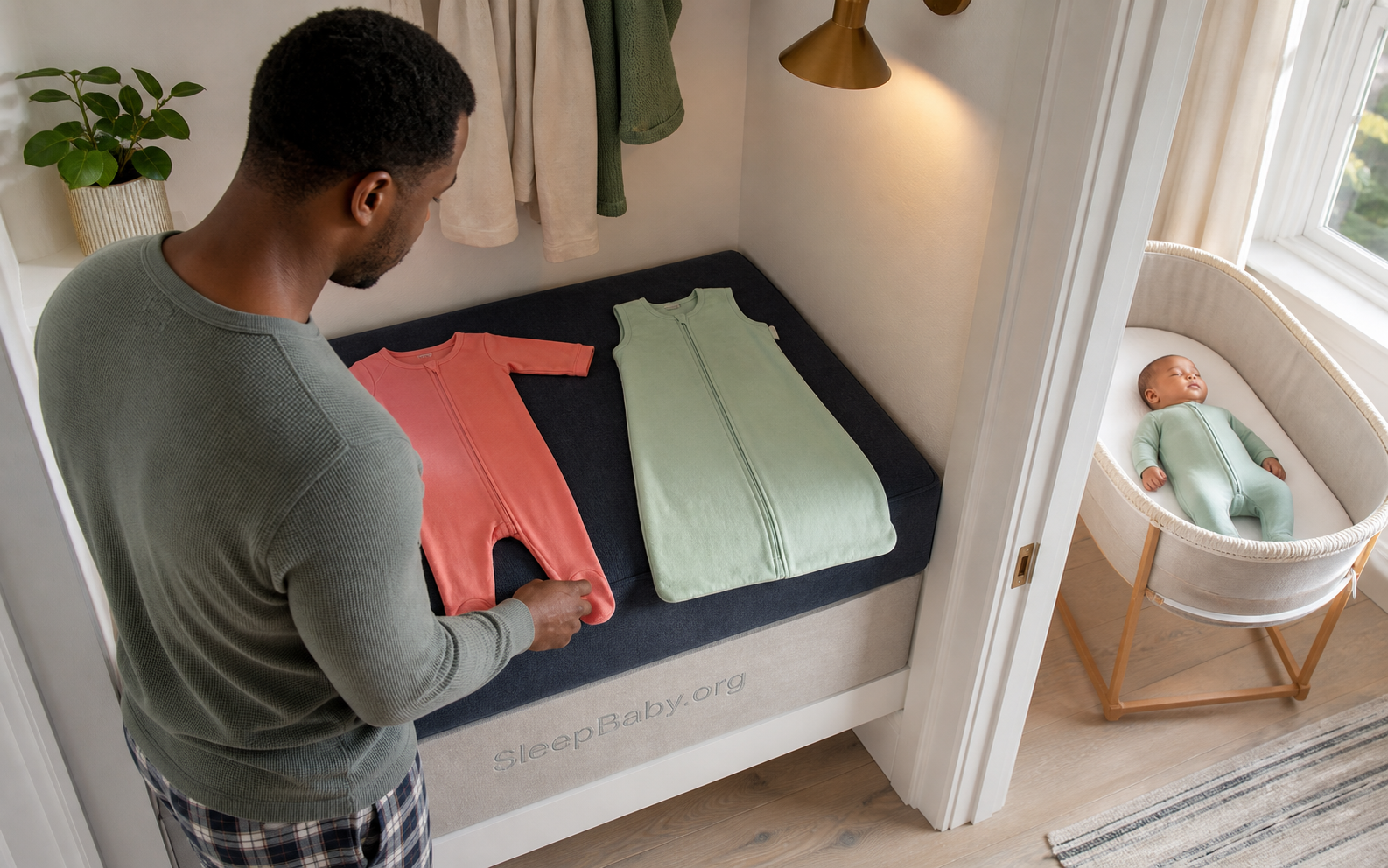
Should a baby sleep in mittens because the hands feel cold?
Detachable mittens are not my automatic answer. A mitten that can come off becomes a loose object near the baby’s face. Socks improvised over the hands can do the same. Even when a garment has fold-over cuffs, the decision should begin with fit, product instructions, the baby’s development, and whether the baby is actually cool at the core—not a reflex to hide the symptom.
Cool hands alone also do not show that the hands need to be insulated. Covering them can conceal the clue without changing what matters. If the chest is comfortable and the baby is well, the mitten may solve the parent’s touch sensation rather than a problem in the baby. If the core is cool, a fitted whole-body adjustment makes more sense than a detachable hand covering.
There are separate reasons a clinician may recommend hand coverings, such as protecting damaged skin, and those individualized plans should be followed exactly. That is different from treating routine cool fingers. If you are considering hand coverings for sleep, our detailed guide to whether babies can safely sleep with mittens walks through attachment, fit, age, and the sleep-space boundary.
What about a sleep sack or wearable blanket?
A correctly sized, nonweighted wearable blanket can provide fitted insulation without a loose blanket, but it is not a diagnosis and it is not always the first thing to buy. Check the room, current sleepwear, core comfort, and product instructions first. Choose a size that cannot ride over the face, and use only products appropriate for your baby’s developmental stage.
TOG labels describe insulation under specified conditions; they do not measure the nursery or the baby. Manufacturer charts can help pair a product with room conditions, but the core recheck still matters. Do not combine a high-insulation sleep sack with multiple heavy layers simply because the hands remain cool.
If your baby is rolling or trying to roll, arms must be free and swaddling must stop. Avoid weighted options. For a deeper fit and safer-use check, see our guide to using baby sleeping bags safely. That is a natural next question only after you have established that a wearable layer is actually needed.
Did cold hands cause the waking?
Maybe the room or clothing contributed to discomfort—but the timing alone cannot prove it. Babies wake and surface for many reasons, including feeding, developmental changes, noise, light, ordinary sleep transitions, illness, and the need for care. Finding cool fingers at the end of sleep does not establish that the fingers woke the baby.
I would compare patterns instead of assigning a cause after one night. Does the waking repeat only when the room is much cooler? Does the core also feel cool? Does one modest, safe adjustment improve comfort without making the baby hot or sweaty? Or do the hands feel cool across different room readings while the core stays comfortable and the waking pattern remains the same?
The last pattern points away from cold hands as the useful explanation. The first may justify a room or fitted-layer adjustment. Neither result requires a loose object in the crib. This is why one-change observation beats a bundle of bedtime experiments: it gives you evidence about comfort without weakening the sleep setup.
Keep the comparison practical. Write down what was true at the start, make the single change, and return to the same checks: core comfort, breathing, color, waking, and feeding. Do not keep adding warmth because the fingertips have not matched your own skin temperature. The goal is not to manufacture warm hands; it is to find conditions in which the baby is comfortably dressed, looks well, and sleeps on an unchanged safe surface. If the result is unclear after a reasonable observation, or worry keeps rising despite reassuring room and core checks, a clinician can help you decide whether the pattern needs individual assessment.
One night, one useful comparison
Record just enough to learn
Reading and any obvious draft or heating change
Exactly what fitted sleepwear the baby wore
Comfortably warm, cool, hot, sweaty, or clammy
Breathing, color, waking, feeding, and behavior
Only when illness or abnormal temperature is suspected
What happened after one modest safe change
Stop the experiment and call if symptoms, age, measured temperature, or your concern call for medical guidance. This observation tool is not a symptom tracker, treatment plan, or reason to delay care.
Watch before adding warmth to the sleep space
NICHD’s safe-sleep foundation does not change on a cold-hands night
This official one-minute Safe to Sleep video reinforces the back, firm-flat, bare-space setup. Temperature troubleshooting belongs in fitted clothing, room conditions, and medical assessment when indicated—not in loose crib additions.
Cold-hands takeaway: adjust one fitted layer or the room when the core check supports it; never add loose warmth to the crib.
If the player does not load, the complete guidance is written above. Watch the NICHD video on YouTube.
When individual medical guidance matters more
Some babies need a narrower plan than a general article can give. Premature or medically complex babies may have different temperature-regulation needs. A baby who has recently left neonatal care may have discharge instructions about clothing, room conditions, temperature measurement, feeding, or when to call. A baby with a known heart, lung, endocrine, neurologic, or circulation condition may have symptoms that the treating team interprets in a specific way.
Follow that plan. Do not replace it with a generic room-temperature target or a product chart. If the written plan and the current situation do not seem to match, call the care team rather than improvising. Cool hands alone still do not authorize an internet diagnosis, but your baby’s history can lower the threshold for asking a professional who knows that history.
Newborns and very young infants also deserve a lower threshold for medical advice because illness can be subtle. Feeding change, unusual sleepiness, abnormal breathing, color change, a measured high or low temperature, or the caregiver’s sense that the baby is seriously unwell matters more than the hands.6 I would rather make an appropriate call than spend the night trying to perfect the nursery number around a sick baby.
When to call the pediatrician or urgent service
Call promptly for a measured temperature of 100.4°F (38°C) or higher in a baby younger than 3 months, or according to your local age-and-temperature guidance.45 Call when the baby has an unexpectedly low body-temperature reading, the core remains unusually cool despite a safe environment, or you cannot get a reliable reading and the baby looks unwell.
Also seek medical advice for poor feeding, fewer wet diapers than expected, repeated vomiting, unusual sleepiness, marked irritability, breathing changes, concerning color, or a behavior change that does not fit your baby. These signs are not included because cold hands diagnose a disease. They are included because the whole baby can tell you that the question is no longer about nursery comfort.
Use emergency services for severe breathing difficulty, blue or gray lips or skin, unusual limpness or unresponsiveness, or extreme difficulty waking the baby.7 If it is safe to do so, note the measured temperature and relevant symptoms for the clinician. Do not spend time photographing the room thermometer or changing outfits before seeking emergency help.
The full path in one view
Touch → check → decide → dress → call
Cold-hands questions parents ask at dawn
Can a baby’s hands be cold while the baby is warm?
Yes. Hands and feet commonly feel cooler than the chest, tummy, or upper back. That is why the core and the baby’s overall condition are more useful comfort checks.15 Cool hands do not rule out overheating, so also notice a hot chest, sweating, or clamminess.
Should I wake my baby to check?
If the only observation is cool hands and the baby is breathing comfortably, has normal color, and otherwise looks peaceful, you can check the chest or upper back gently without turning the moment into a full experiment. If you are worried about illness, abnormal breathing, color, responsiveness, or body temperature, wake and assess the baby as needed and seek medical guidance. Safety outranks preserving the nap.
Do purple-looking hands mean the baby is cold?
Color needs context and cannot be safely classified through text alone. Brief peripheral color changes can occur, particularly in young babies, but blue or gray lips, tongue, face, or skin with breathing difficulty, limpness, or poor responsiveness is an emergency.7 For a new, persistent, one-sided, or concerning hand-color change, contact a clinician rather than assuming room temperature is the cause.
Can I put a blanket over the baby’s hands?
No loose blanket belongs in an infant sleep space. Keep the surface firm, flat, level, and bare except for the fitted sheet.8 If the baby’s core is cool and the baby is otherwise well, choose one fitted clothing or room adjustment appropriate to the conditions and recheck.
Is a room thermometer enough?
It is enough to answer one question: what the room is like where the device sits. It cannot measure the baby’s body temperature, diagnose illness, or decide whether a particular layer fits safely. Pair the room reading with the core check and the whole baby; use a digital medical thermometer when body temperature needs measuring.
What if the hands are cold every morning?
Compare the repeated pattern. Record the nursery reading, fitted layers, core feel, and how the baby wakes and feeds. If the core is consistently comfortable and the baby is well, cool hands may simply be the baby’s peripheral pattern in those conditions. If the core is cool, the baby seems unwell, or the pattern changes, seek individual guidance.
One useful purchase for this exact question
Check the nursery before buying more insulation
If I were choosing one product for a parent who keeps finding cool fingers at wake-up, I would choose the ThermoPro TP49 Digital Indoor Hygrometer / Room Thermometer. Its job is simple: give you a room-temperature reading before you add layers based on the hands alone. That makes the next decision more informed without putting anything on the baby or inside the crib.
It fits this situation better than detachable mittens because mittens cover the clue and can become a loose-object concern; the room thermometer checks an environmental condition you can actually adjust. It fits better than buying a new sleep sack as the first move because a sleep sack changes insulation before you know whether the room is unusually cool. The specific reason to buy is not that it warms or diagnoses your baby. It is that it replaces a vague nursery guess with one stable room reading you can compare with the baby’s core comfort and current fitted layers.
Boundary: this product does not measure body temperature, diagnose fever or hypothermia, prevent SIDS, or replace a digital medical thermometer or clinical assessment. Keep it on a stable surface outside the crib, keep the battery compartment secure, and keep the entire device out of reach.
See the ThermoPro TP49 on Amazon
As an Amazon Associate, SleepBaby may earn from qualifying purchases.

Your plan for tonight
When you touch those cool fingers, move inward. Check the chest, tummy, or back of the neck. Look at breathing, color, alertness, and feeding. If the core is comfortably warm and the baby is well, keep the bare sleep space and resist the urge to add a hand-specific fix. If the core is cool, read the room and inspect the fitted layers; make one modest, safe adjustment and recheck.
If illness or abnormal body temperature is possible, use a digital medical thermometer. Respect the younger-than-3-month threshold of 100.4°F (38°C) for prompt medical guidance, and use urgent or emergency care whenever the baby’s symptoms require it. No room number, TOG chart, or article outranks the baby in front of you.
That is the changed understanding I want you to carry back to the next waking: cold hands do not automatically mean a cold baby. Hands invite a better check. The better check tells you whether to stay the course, adjust one fitted layer or the room, measure body temperature, or call.
Sources
- The Lullaby Trust. How to dress your baby for sleep. Used for cooler hands and feet, core checks, overheating avoidance, room‑temperature guidance, and fitted sleep layers.
- American Academy of Pediatrics / HealthyChildren.org. Back to Sleep, Tummy to Play. Used for back sleep, firm and flat sleep surface, comfortable room, layer guidance, uncovered head, and nonweighted wearable blankets.
- American Academy of Pediatrics / HealthyChildren.org. SIDS and other sleep‑related infant deaths: common questions. Used for overheating clues and a clear sleep space.
- NHS. How to take your baby’s temperature. Used for digital temperature measurement and the 38°C fever definition.
- West Yorkshire Healthier Together / NHS pathway. New baby: what’s normal and what’s not. Used for the hand-versus-core distinction and young-infant fever escalation.
- NHS. Is your baby or toddler seriously ill? Used for whole-baby warning context and acting on caregiver concern.
- NHS. Bronchiolitis. Used narrowly for emergency signs including serious breathing difficulty, blue or gray color, limpness, and inability to wake or stay awake; cold hands do not diagnose bronchiolitis.
- Eunice Kennedy Shriver National Institute of Child Health and Human Development, Safe to Sleep. Safe sleep environment. Used for a separate, firm, flat, bare infant sleep surface and the official safe-sleep video context.
From one cold hand to a calmer whole-night plan
Bring the better check to the next waking
The next time cool fingers wake your worry, you already know the sequence: core, whole baby, room, measurement when indicated. SleepBaby can help you carry that same evidence-first calm into schedules, night waking, safe sleep, and the questions that follow.



What viewers said10 comments · 4 replies+
Archived comments from the original Baby Sleep Miracle presentation. Not independently verified by SleepBaby.org; individual experiences vary.
Thank you so much for this video! I had no idea about the dangers of baby swings :O
Hi Mary-Ann. I have a question: Is method in any way similar to the ones recommended by Dr Bucknam, Dr. Weissbluth or Dr. Karp? We tried those but none of them help.
Hi Regina, thank you for your question. The short answer is no. The techniques I share in my guide are based on newest scientific research and this is why I have never seen any approach similar to the one I recommend.
This method really works! I tried it on my son Jesus and after just one week he went from waking up more than 5 times a night to waking up just once or twice. You are a lifesaver, Mary-Ann!
I'm truly impressed with how much information you share in your video. And all for free! I can feel that you truly care about mothers like myself, and that's hard to find these days. I have recommended your site to several of my friends already.
Mary-Ann, our child suffers from autism. Is your approach still suited?
Chloe, I made sure my method can be used with any child, even babies who are special like yours. Please note that I'm not a doctor and that I always advice to consult with your physician because nothing is more important than the safety and well-being of your love.
Hallo Mary-Ann, I'm from Germany. Do you have your guide in German?
Hello Heide, we do! Normally you should already see our video in German. If not, please contact our support so they can guide you
Thenk you for your answer, Mary-Ann!
I just completed your approach and I have to say, it worked almost too well. Yes, it took a bit of getting used to with your bedtime routine but the difference is huge. My son George used to take 1 hours to go down and now he's firmly asleep in no more than 10 minutes! You're the best!
It seems I'm the only man watching this video, lol! What you shared about the 'emotional backpack' made immediate sense to me and I can't wait to help my little girl Mila to unpack it!
Hey there, just discovered your site and this really sounds different. Just wanted to say thanks for sharing :)
For everyone who's still thinking about getting Mary-Ann's guide I want to advise you to go ahead. I wasn't sure myself but now I'm so thankful I invested in this program. It made a huge difference in our life as a family and yes, my baby girl does sleep through the night now.