Pacifiers, night waking & safe sleep
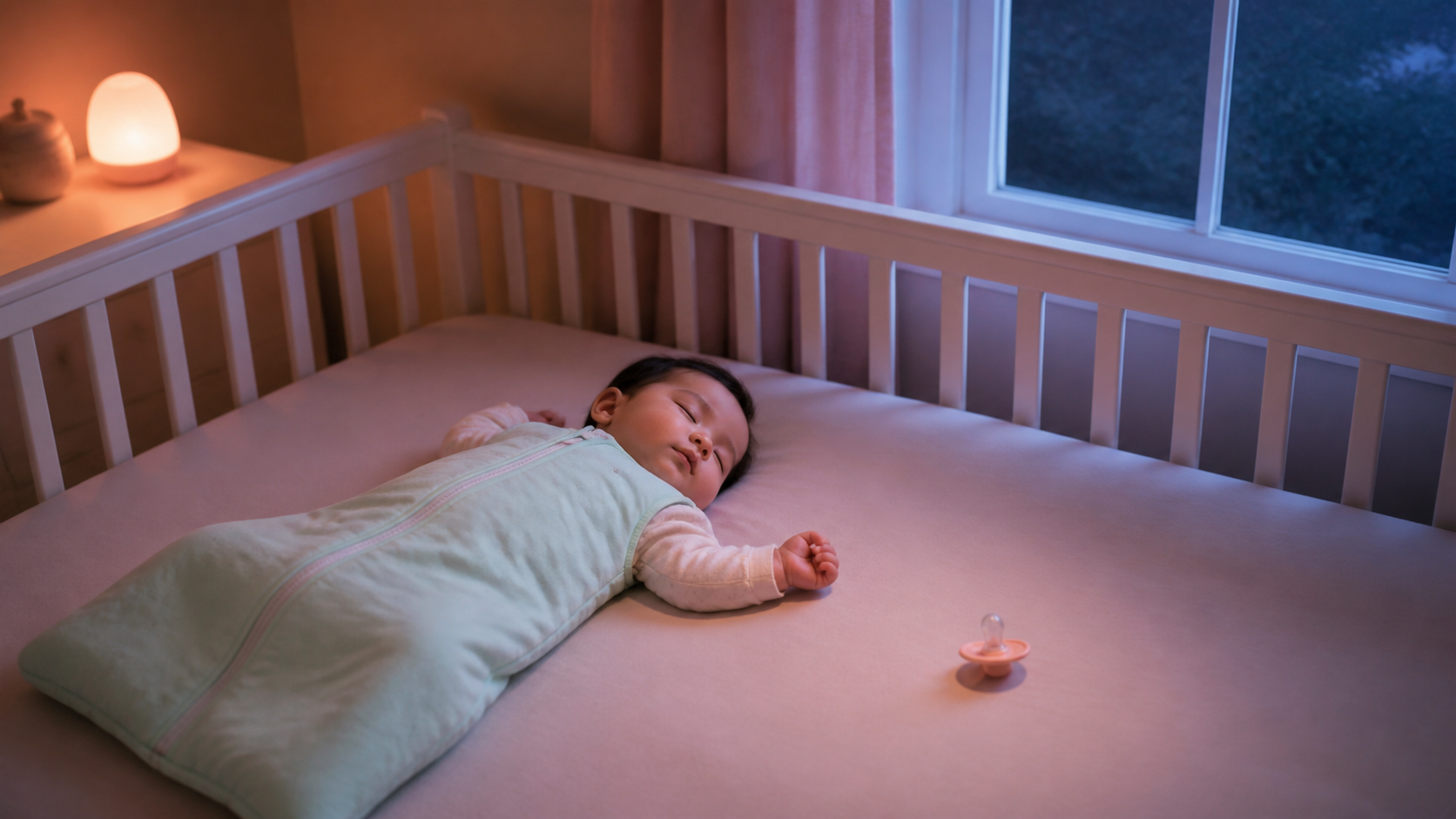
The pacifier is on the mattress. Your baby is awake. Before you begin another barefoot retrieval mission, separate the object that fell from the reason your baby woke.
If the pacifier falls out while your baby sleeps, leave it out
At 2:26 a.m., a pacifier can acquire the emotional importance of a missing passport. You see it six inches from your baby’s hand. Your baby makes one sound. You are already halfway out of bed.
If your baby is still asleep, you do not need to replace a pacifier that fell out. The American Academy of Pediatrics recommends that families who use a pacifier offer it when placing a baby down for naps and bedtime, but says it does not need to be reinserted after the baby falls asleep. If your baby fully wakes and cries, the pacifier may be one useful settling option—but first check whether the waking is asking for food, comfort, a diaper, relief from illness or pain, or simply a brief chance to resettle.
The repeated pattern becomes exhausting when the pacifier is the only familiar bridge back to sleep and your baby cannot find or replace it. That is a practical sleep problem, not proof that you caused bad sleep. Tonight, use the smallest safe response that meets the real need. Over several ordinary nights, decide whether you want to keep replacing the pacifier consistently or gradually make it less central to falling asleep.
SleepBaby.org · The original video
A little help
for the night ahead.
Take a moment to watch the original Baby Sleep Miracle presentation. Your article will be right here when you’re ready to keep reading.
Ready to get started?Take the next step with SleepBaby.
Help my baby sleep
The question underneath “How do I keep it in?”
Most parents are not deeply invested in pacifier physics. They want to know whether they are required to repeat the same tiny task every hour until sunrise—and whether refusing the task would mean ignoring a baby who needs them.
I would make that question kinder and more useful: What is my baby asking for at this waking, and how much help actually fits? Sometimes the answer is a feed. Sometimes it is a hand on the chest, a clean pacifier offered once, or nothing more than a quiet pause. Sometimes the pattern has become so repetitive that changing how bedtime begins is reasonable. None of those answers requires a clip, cord, stuffed attachment, blanket, wedge, or gadget that holds a pacifier near the mouth.
The pacifier is visible, so it gets blamed. Hunger, congestion, discomfort, a schedule change, or an ordinary arousal can be less obvious. I do not want the most photogenic clue on the monitor to become the entire diagnosis.
Why does a baby wake when the pacifier falls out?
Babies naturally move between lighter and deeper sleep. During a brief arousal, they may wiggle, sigh, open their eyes, make a sound, or reach toward the place where the pacifier had been. Many continue sleeping. Others become fully awake.
If the pacifier was part of the exact sensation present at sleep onset—sucking, a particular mouth position, a caregiver leaning over the crib—its absence may be noticeable during a later arousal. An older child might adjust a pillow. A baby has fewer options and may call for the adult who knows where everything is.
That does not mean the pacifier physically falling out caused every wake. Pacifiers often fall out soon after sleep begins. A baby can sleep for a long stretch without one and later wake for an unrelated reason. The timing matters:
- Falls out, baby stays asleep: no action is needed.
- Falls out, baby stirs briefly, then settles: the arousal resolved; rushing in might have made it larger.
- Baby wakes, then accepts the pacifier and immediately relaxes: replacement probably helped, though it still may not explain why the arousal happened.
- Baby wakes and keeps crying after replacement: the pacifier was not the whole request. Check feeding, diaper, temperature, breathing, pain, congestion, and comfort.
- Wakes repeat at short, regular intervals: look at the whole night. The pacifier may be one repeated response inside a broader pattern.
If your night looks more like the last two lanes, my guide to separating ordinary arousals from needs-help wakes can help you track feeding, symptoms, and the longest sleep block without deciding in advance that every wake has the same cause.
Three scenes that look identical on a monitor
Asleep without the pacifier
Eyes closed, breathing easy, body relaxed. The pacifier is nearby. Your job is gloriously brief: leave the baby and the pacifier exactly where they are.
Briefly aroused
A wiggle, a whimper, perhaps open eyes. Give the moment enough room to show its direction while you stay available. Fading sound and a relaxing body usually mean wait.
Fully awake and asking
Crying builds, the body stays active, or another need is visible. Respond. You can offer the pacifier once while also checking the baby rather than treating replacement as the entire care plan.
The safe-sleep boundary does not move at 3 a.m.
This is where I need to be blunt, because exhausted adults are exactly who convenience products are designed to persuade. Do not attach a sleeping baby’s pacifier to clothing, the crib, a cord, a strap, a clip, a ribbon, a blanket, or a stuffed toy. Do not use a product intended to prop it in the mouth. Do not add a pillow, rolled blanket, bumper, wedge, or positioner so it cannot roll away.
Place your baby on their back for every sleep on a firm, flat, safety-approved crib, bassinet, portable crib, or play yard mattress with a fitted sheet only. Keep the infant sleep space clear. A plain, intact pacifier may be offered at sleep onset; if it falls out after sleep begins, the AAP says you do not have to replace it.
The old version of this page suggested a blanket or soft comfort object as a substitute. That does not belong in infant safe-sleep guidance. A soft toy attached to a pacifier does not become safe merely because it makes the pacifier easier to locate. The goal is not to engineer a pacifier that can never leave. The goal is to respond safely when it does.
What I would do tonight, in order
A tired brain does not need thirteen pacifier strategies. It needs a sequence that works in the dark.
-
Check whether your baby is actually awake
Look at the body, not only the sound. Closed eyes, a loose face, easy breathing, and a whimper that fades are different from sustained crying and active searching. If the baby is asleep, leave the pacifier out.
-
Check the baby before the habit
Consider age-appropriate feeding needs, the effectiveness of the last feed, diapers, temperature, congestion, breathing, pain, teething symptoms, and whether this is a sudden change. In early infancy especially, a feeding need is not a “bad association” to eliminate.
-
Use one low-stimulation response
Keep the room dark and your voice quiet. If the pacifier fits your baby’s usual routine, offer a clean intact one once. You can pair it with the same short phrase or touch each time, then return the baby to the clear sleep surface on their back.
-
Watch what the response accomplished
Did sucking produce immediate relaxation? Did crying continue? Was a feed actually needed? Did the baby settle before you arrived? That information is more useful than the number of times you saw the pacifier fall.
-
Decide tomorrow, not during the fifth wake
After an ordinary night, choose whether to keep the familiar response or begin a gradual change. The middle of a rough night is excellent for surviving and poor for designing policy.
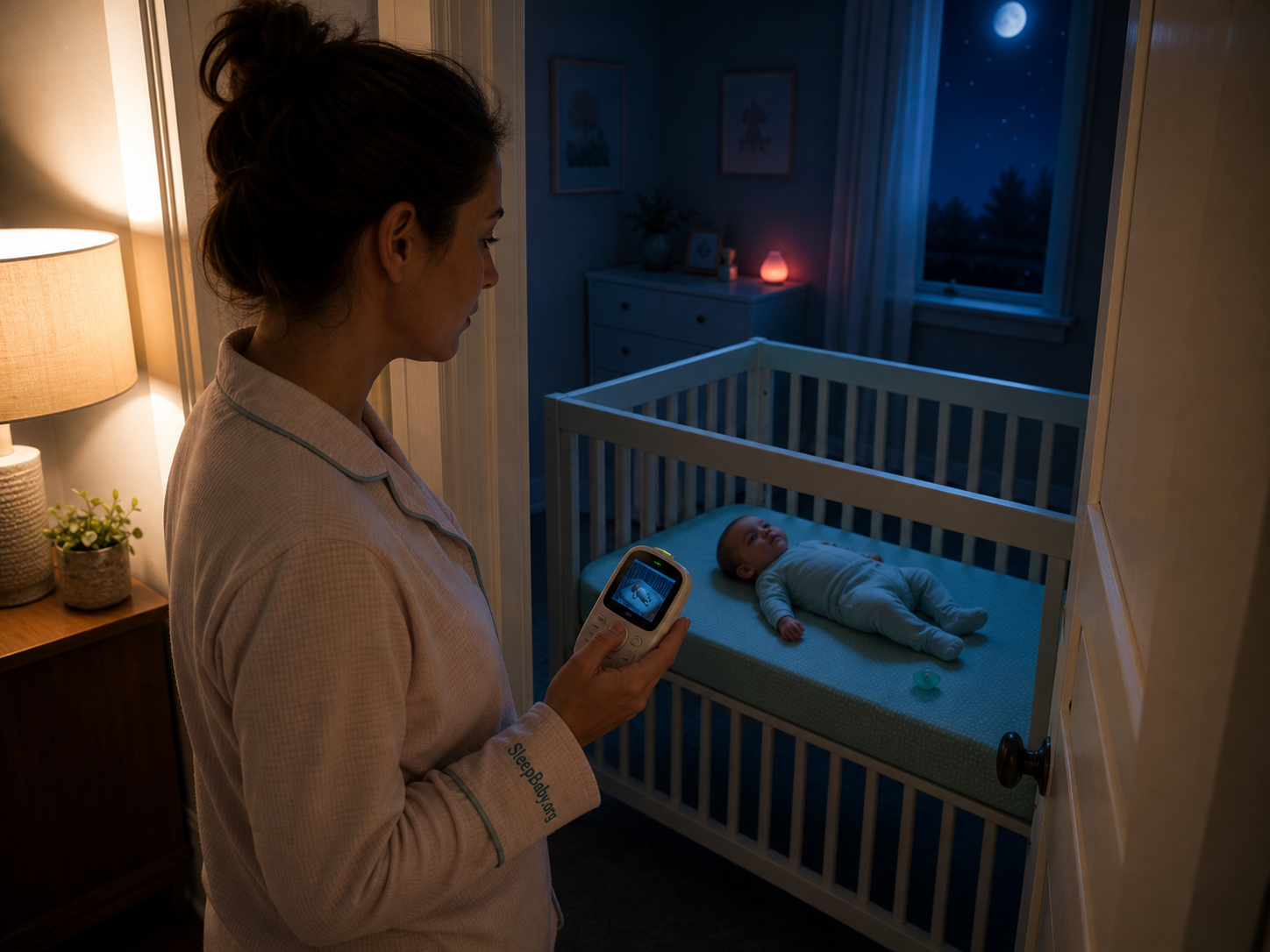
Clearly labeled hypothetical Kacey-and-Benjamin scene
The six-inch problem
Imagine Benjamin asleep in a clear crib, the pacifier resting six inches from his shoulder. On the monitor he makes one offended goat sound, then goes still. Hypothetical-me is already standing in the hallway, because apparently my body has accepted employment as overnight pacifier logistics.
Hypothetical Benjamin opens his eyes, turns his head, and gives one more complaint. I whisper to hypothetical Benjamin, “I am gathering data, which is a very dignified way to describe staring at you in the dark.” Then he sighs and falls quiet without me entering.
The scene is not evidence, and it is not a promise that waiting will work for your baby. Its job is to show the distinction: a pacifier can be out while sleep is still intact. If Benjamin’s cry had built, if his breathing sounded wrong, or if feeding cues were clear, I would have responded. The useful pause was not refusal. It was enough time to learn which direction the wake was moving.
Age changes what “help” can look like
A newborn or young infant
Young babies wake often and may need frequent feeding, diaper care, and close responsive help. Do not stretch feeds or delay a needed response to prove the pacifier is not necessary. If breastfeeding, AAP guidance recommends waiting until breastfeeding is established before introducing a pacifier. Follow your child’s clinician and feeding plan, especially with prematurity, growth concerns, jaundice, illness, or uncertain milk transfer.
A very young baby cannot retrieve a pacifier. If offering it again is part of settling after needs are met, that is ordinary caregiving. The realistic goal may be a calm, repeatable response—not independent replacement.
An older infant who can reach and bring objects to the mouth
During awake supervised play, you can let an older baby practice finding a pacifier, grasping the handle, turning it, and bringing it to the mouth. This is motor practice, not a nighttime test. Some babies learn to retrieve it; some call for help anyway; some reject every pacifier except the one currently under the crib.
Do not train the skill with clips, cords, or stuffed attachments. Keep the sleep space clear. Ask your pediatrician about what is appropriate for your baby’s age, development, and sleep setup rather than using an arbitrary month as a universal deadline.
A toddler or older child
The conversation can shift toward oral health, ear infections, daytime use, and a planned transition away from the pacifier. That is a different job from removing comfort abruptly from a young infant at night. Your pediatrician or pediatric dentist can help you choose timing that fits the child rather than turning “six months” into a cliff edge unsupported by context.
A three-night pattern board
Use this only on ordinary nights. Stop tracking and respond or call when a health concern appears.
| Notice | Write down | What it may change |
|---|---|---|
| Sleep onset | Feed quality, bedtime, whether the pacifier remained in at the moment of sleep | Shows what cues were present when sleep began |
| First audible arousal | Time, eyes open or closed, sound fading or building | Separates a brief arousal from a full wake |
| Your response | Pause, feed, diaper, touch, pickup, or pacifier replacement | Shows what was actually required |
| Result | Immediate relaxation, continued crying, effective feed, or independent return to sleep | Tests whether the pacifier explained the wake |
| Body clues | Congestion, fever, breathing, vomiting, rash, pain behavior, wet diapers, daytime alertness | Moves the problem out of sleep troubleshooting when needed |
Change one safe variable after you see the pattern. If you alter bedtime, feeding, room temperature, response timing, and pacifier use simultaneously, the night may change but you will not know why.

You can keep the pacifier—or change the pattern
Repeated replacement is not automatically a crisis. If your baby settles quickly, the wakes are manageable, feeding and health are on track, and you are comfortable with the routine, you may choose to continue. Parenting already contains enough compulsory projects; this does not need to become one merely because the internet enjoys a before-and-after story.
If you want to keep it
- Use a one-piece or manufacturer-approved pacifier that is intact and appropriate for your baby’s age.
- Inspect it before use for tears, weakness, discoloration, stickiness, or damage; replace it according to the manufacturer and at the first sign of wear.
- Clean and sanitize according to age, health needs, and manufacturer instructions.
- Offer it at sleep onset; do not wake a sleeping baby to replace it.
- When a baby fully wakes, keep replacement brief and low stimulation after checking the real need.
- Never attach it during sleep.
If you want to make it less central
Pick one small shift and repeat it. You might move the pacifier earlier in the bedtime sequence—feed, diaper, pajamas, pacifier and cuddle, book or song, then down—so the last moment before sleep contains another familiar cue too. Or you might continue offering it at the start of sleep but use a short pause and one consistent phrase before replacement at selected ordinary wakes.
Another option for an older baby is to practice finding and orienting the pacifier during awake play, then keep nighttime help boring. None of this requires leaving a hungry, sick, frightened, or distressed baby without care. “Gradual” should describe the change in the cue, not a gradual erosion of your willingness to respond.
If your chosen approach produces escalating distress, worsens feeding, or feels impossible to apply safely, stop and reassess. A plan is allowed to be wrong for your family.
Pick one job: replace, practice, or gradually change the cue
These three approaches solve different problems. Mixing them randomly—replacement at one wake, a long wait at the next, removal at bedtime, then four pacifiers after midnight—can make the response harder for everyone to recognize. I would choose one job for several ordinary nights, keep feeding and health needs outside the experiment, and then judge what actually happened.
Job 1: Replace it consistently and briefly
This fits a younger baby who cannot retrieve the pacifier, settles quickly when it is offered, and still needs responsive nighttime care. Check the baby, offer one clean unattached pacifier, use the same short phrase or touch, and leave when your baby is calm. The goal is not to eliminate every wake. It is to prevent each replacement from becoming a bright, chatty restart of bedtime.
Consistency here means the response is recognizable. It does not mean ignoring hunger because “we only do pacifiers now,” or inserting the pacifier repeatedly into a baby who refuses it.
Job 2: Practice retrieval while awake
This fits an older infant who can intentionally reach, grasp, turn an object, and bring it to the mouth. Place the pacifier within reach during supervised floor play. Let your baby feel the handle, rotate it, and try again when the nipple lands sideways. You can guide the hand without making it a performance review.
Awake practice may make nighttime retrieval possible, but it cannot guarantee that a sleepy child will use the skill at every arousal. Keep the crib clear and do not attach a cord or toy to make the lesson easier. The motor skill is the useful part; the attachment is the hazard.
Job 3: Make the pacifier one cue among several
This fits a family ready to reduce repeated adult replacement. Keep a small set of predictable cues around sleep: the same dim room, sleep clothing, short song, phrase, and calm placement. Move pacifier use earlier by a small step, or offer it at sleep onset while delaying replacement briefly at selected ordinary wakes to see whether another cue can carry the transition.
You do not need to remove every soothing cue and demand that a baby manufacture serenity alone in a dark room. The practical aim is flexibility: sometimes the pacifier helps, and sometimes familiar conditions are enough. Change one piece, stay responsive, and give the new pattern more than one difficult night before calling it impossible.
When the wake deserves more than a pacifier plan
Move feeding, health, and safety ahead of sleep troubleshooting when the pattern changes sharply or another body clue appears. Contact your baby’s clinician promptly for a rectal temperature of 100.4°F (38°C) or higher in a baby three months or younger; poor or weak feeding; a notable drop in wet diapers; repeated vomiting; unusual sleepiness; pain behavior; persistent cough or congestion that interferes with feeding; growth concerns; or a sudden night-waking change that remains unlike your baby.
Get urgent or emergency help for blue or gray color, severe trouble breathing, ribs pulling in with breaths, a prolonged breathing pause, seizure, unusual limpness, or extreme difficulty waking. Do not use a pacifier to delay assessment of breathing, feeding, pain, or illness.
If sleep is the only concern but the replacements are so frequent that caregiver exhaustion is creating unsafe situations—especially falling asleep on a couch, chair, or adult bed while holding the baby—ask for help. A safe handoff between adults and returning the baby to a separate clear sleep space matters more than completing any settling method perfectly.
Watch the safety boundary
What “safe to sleep” still means on a pacifier night
The NICHD Safe to Sleep campaign demonstrates the clear, firm, flat infant sleep space that stays nonnegotiable even when you are solving a repeated night-waking problem.
Video by NICHD Safe to Sleep: watch on YouTube.
Takeaway: offer a plain pacifier if you use one; do not build an unsafe sleep environment around keeping it attached or within reach.
Back to the pacifier six inches away
The monitor still shows the same little object on the mattress. What has changed is the question.
You no longer need to decide whether every fallen pacifier must be retrieved. If your baby is asleep, leave it. If your baby briefly stirs, watch the direction. If your baby fully wakes, check the whole request and use the smallest safe response that fits. If the pattern repeats and exhausts your household, choose one gradual change in daylight rather than one unsafe shortcut in darkness.
I cannot promise the pacifier will stop rolling into the least convenient square inch of the crib. It has shown no interest in professional development. But you can stop treating its location as the only fact that matters.
Sources
- American Academy of Pediatrics: How to Keep Your Sleeping Baby Safe
- AAP evidence base for the 2022 safe infant sleep recommendations
- American Academy of Pediatrics: Getting Your Baby to Sleep
- CDC: Pacifier inspection and replacement guidance within infant feeding-item hygiene
- The Lullaby Trust: Using a dummy safely
- American Academy of Pediatrics: Pacifiers and Thumb Sucking
Build the rest of the night around the wake you actually have
If the pacifier is only one piece of a larger bedtime or night-waking pattern, SleepBaby.org can help you sort the next question without stacking five new experiments tonight.
If the pacifier is only one piece of a larger bedtime or night-waking pattern, SleepBaby.org can help you sort the next question without stacking five new experiments tonight.
This guidance supports practical decision-making and does not replace your baby’s clinician or feeding plan.
SleepBaby.org · The original video
A next step for
the next bedtime.
Still thinking about sleep? Watch the presentation here, then explore the SleepBaby program whenever you’re ready.
Ready to get started?Take the next step with SleepBaby.
Help my baby sleep