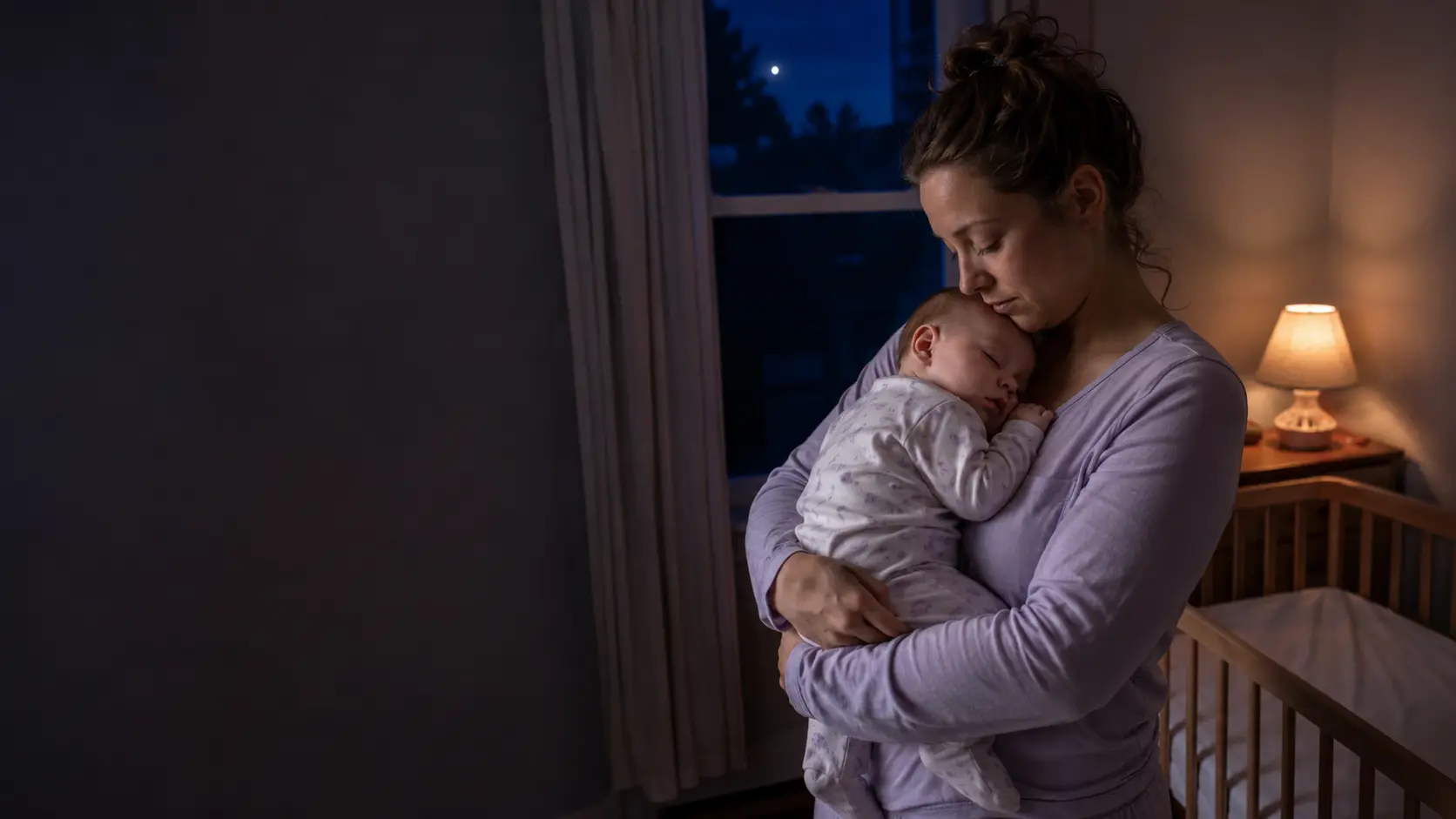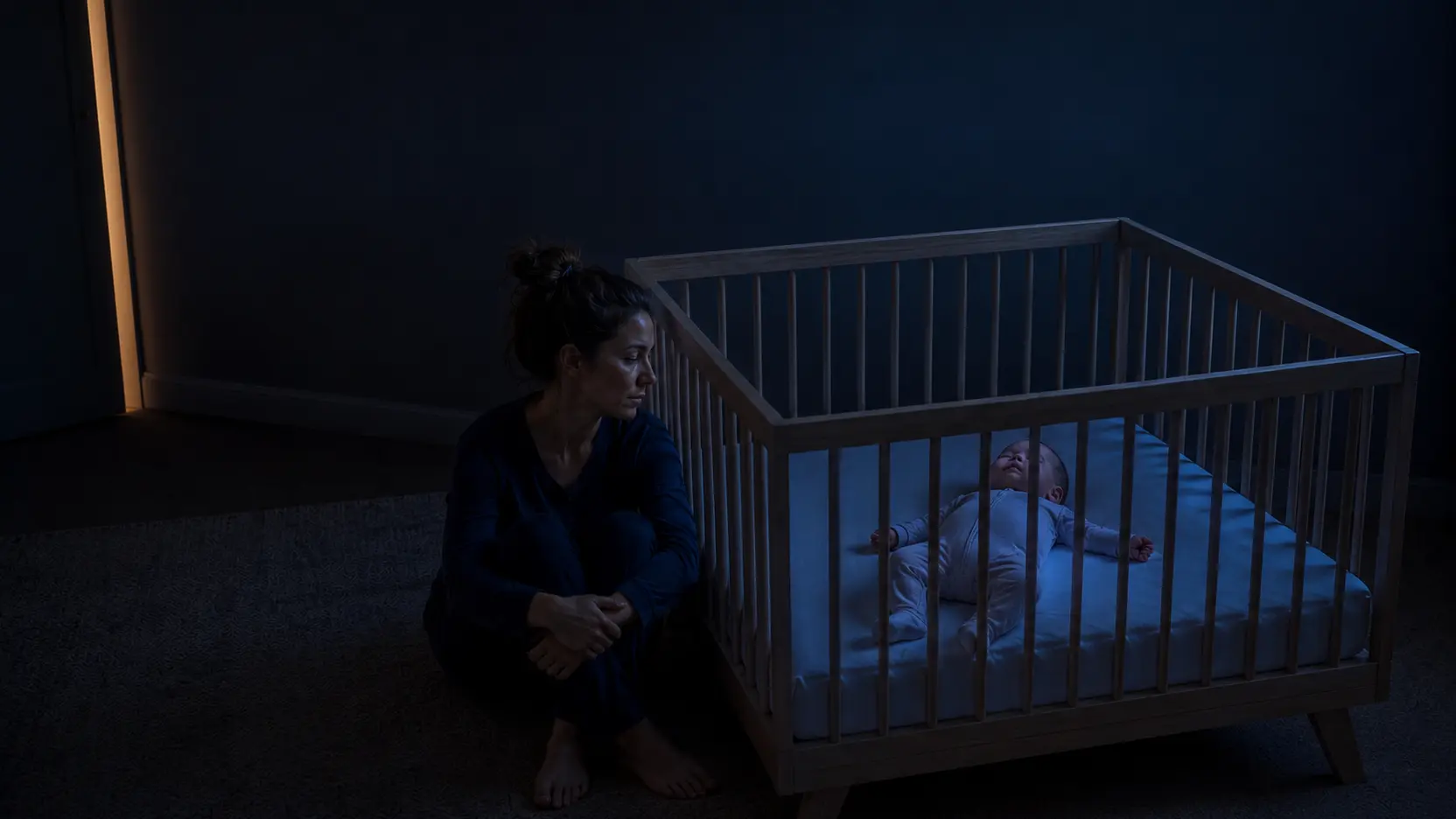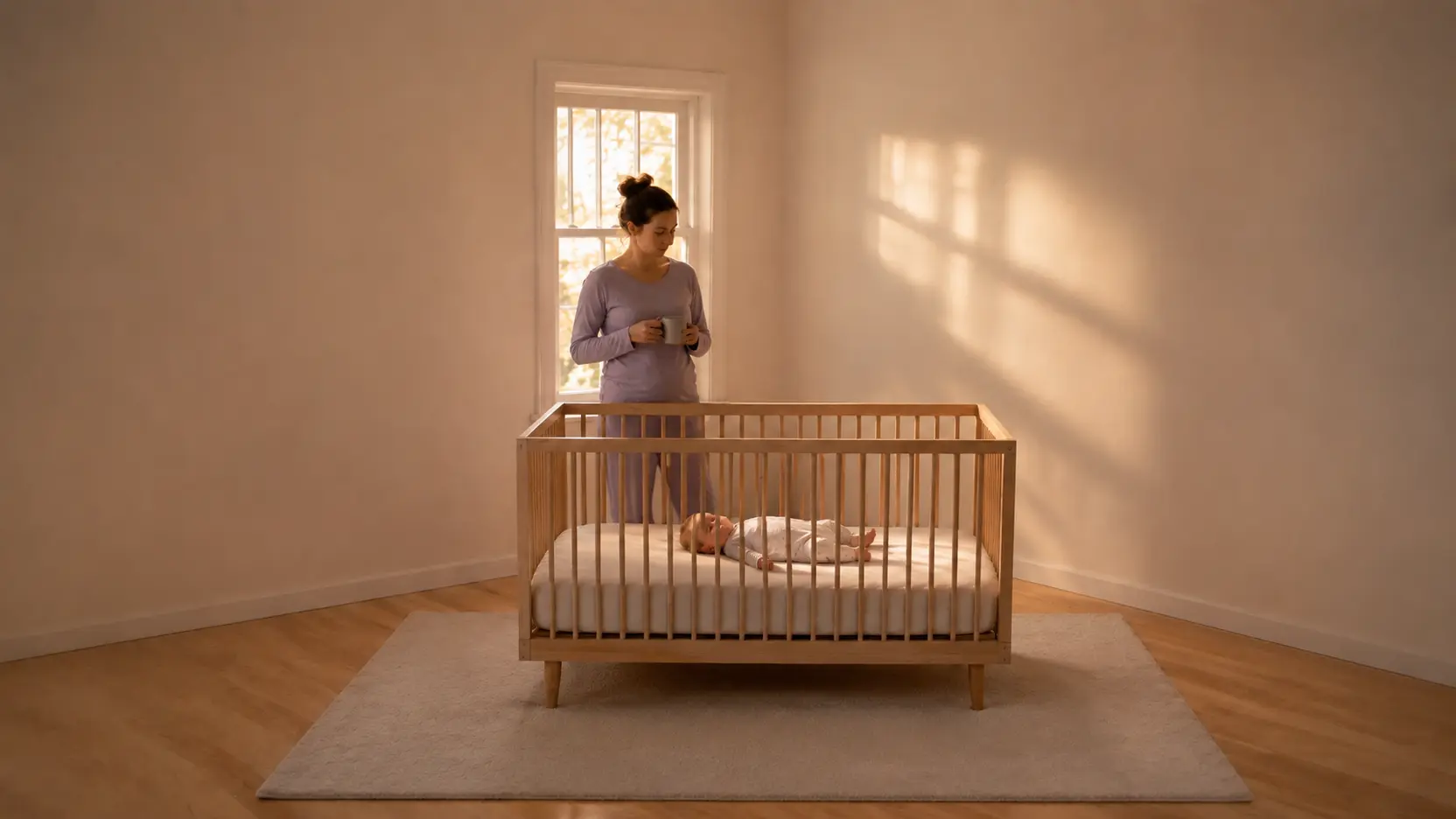
The moment your hand reaches the latch
The doorway is a timestamp, not always the cause
You wait until the breathing sounds even. You ease out of the chair. One foot reaches the hall—and your baby’s eyes open as if somebody installed a tiny parent-detector behind the crib mattress.
My early answer: your baby may be responding to your absence, but the timing alone cannot prove it. The wake may have started before you moved, landed on a floorboard, door latch, light change, or sudden silence, or followed the moment your baby noticed you were gone. Watch what happens before, during, and after you cross the threshold. That order tells you more than the doorway itself.
I would keep feeding needs, safe sleep, and any medical guidance fixed. Then I would change one nonessential cue at a time. This turns “How does my baby know?” into a smaller question you can actually answer: “What happened first?”

That distinction matters because an ordinary arousal can become visible at exactly the moment a parent stands up. Babies stir, move, vocalize, and wake for many reasons. Sometimes our departure is the cause. Sometimes it is the first thing we notice after the wake has already begun. And sometimes the chair creak is doing far more work than the emotional meaning we assign to it at 9:47 p.m.
I know the private worry underneath this search. It is not only, “How do I leave?” It is, “Have I made my presence necessary?” I do not think blame helps us read the night. A baby can learn the conditions present at sleep onset, and a baby can also need feeding, reassurance, pain relief, or developmental support. Responsive care is not a character flaw in either of you. The goal is to identify the pattern, not to put the parent on trial.
A hypothetical Kacey-and-Benjamin doorway moment
If I freeze at the latch, what am I waiting to see?
This scene is hypothetical, not a memory and not evidence: imagine me watching Benjamin on a parent unit while one hand rests near the door. His fingers move a beat before the latch clicks. In the old version of the story, I might think, “He knew I was leaving.” In the more useful version, I notice that the wake began first.
Now imagine the opposite. Benjamin remains still while I stand, walk, and cross the threshold, then startles at the same hinge squeak. That is a different first experiment. Or imagine he stays settled through every sound and protests only after the room has been empty for a moment. That is different again.
I use this hypothetical because it changes the parent’s role. I am no longer trying to disappear perfectly. I am watching a sequence with enough humility to admit that the doorway can be innocent.
What happened first: before, during, or after you left?
Do not turn bedtime into a controlled trial with clipboards and a lab coat. One or two calm observations can still give you useful information. I would look for a repeatable order, not a single dramatic night. Teething, a missed nap, illness, a late feed, travel, or a new skill can make any one evening noisy.
Read the sequence, not the guilt
Three doorway patterns, three different first moves
1. The wake begins before you move
Eyelids flutter, hands move, breathing changes, the face tightens, or a sound begins while you are still. Compare sleep timing, feeding, comfort, and any clock-led pattern. The doorway may only be where you noticed it.
2. The wake lands on a physical cue
The same chair, floorboard, latch, light wedge, voice stopping, or sound change aligns with the response. Repair that exact cue first. Do not rebuild the whole routine to solve one squeak.
3. The wake follows your absence
Your baby stays settled through movement and sound, then protests after you are gone. Developmental separation behavior or an expectation of parental presence at sleep onset may be part of the pattern.
The useful standard: a cue earns a change only when it repeats. One coincidence is a clue, not a verdict.
Created for SleepBaby.org
If the wake begins before you move, stay with the baby rather than protecting the experiment. A very young baby may need a feed. An older baby may have reached an ordinary arousal, become uncomfortable, or simply be done with that sleep stretch. Notice the relationship to bedtime, the last feed, the last nap, and the baby’s usual pattern.
If the response repeatedly lands on the physical cue, I would start with the cue. Close the door earlier so the latch is already settled. Take the quieter side of the floor. Keep the hallway light from changing sharply. If a steady sleep sound is already part of the routine, avoid switching it off at departure. I would not add a new sound machine just because it appears on a list; first prove that an abrupt sound change is part of this baby’s sequence.
If the response follows absence, the next question is not “How do I sneak better?” It is “What kind of predictable separation can my baby tolerate right now?” That answer depends on age, health, feeding, temperament, family values, and how sleep begins.

How can a baby know when a parent leaves?
Babies do become more aware of people coming and going. The CDC lists reacting when a caregiver leaves—looking, reaching, or crying—as a social-emotional milestone that many babies show by nine months. It also lists looking for an object dropped out of sight as a separate cognitive milestone. Those are useful observations. They do not let us diagnose the cause of one nighttime wake from the hallway.
Separation behavior varies widely. The American Academy of Pediatrics notes that many infants show stronger separation reactions in the later part of the first year, while timing and intensity differ. Hunger, tiredness, and illness can make a separation harder. That is why I would not stamp “object permanence” onto every six-month-old’s wake or dismiss an older child’s protest as manipulation.
A second process can overlap with development: sleep may begin with a particular combination of touch, voice, rocking, or a parent sitting nearby. At a later arousal, the baby may look for the same conditions. I prefer the phrase sleep-onset expectation to “overdependence.” It describes a pattern without pretending the parent has damaged independence by offering comfort.
There may also be a plain sensory explanation. A parent stops humming. The mattress no longer carries movement from a hand. The air shifts when a door opens. A shadow changes. Those possibilities should stay possibilities until the same cue repeats. I want parents to feel observant, not supernatural and not guilty.
See the developmental observation—then return to the night
CDC: “Reacts when you leave” at nine months
This short CDC milestone clip shows an awake baby reacting when a caregiver leaves. It helps make the developmental behavior concrete. It does not prove why a sleeping baby woke at a doorway, and the written explanation remains complete if the video is unavailable.
Article takeaway: the reaction can be developmentally real, while the before/during/after sequence still decides what to try at bedtime.
Before any doorway experiment, keep these things fixed
I would never trade safe sleep or a baby’s needs for a cleaner experiment. Put an infant down on the back for every nap and night on a firm, flat sleep surface that meets current safety standards, with only a fitted sheet. Keep pillows, blankets, toys, bumpers, positioners, and other soft or loose objects out. A doorway routine does not make a comfort object safe in an infant crib.
The American Academy of Pediatrics recommends room sharing without bed sharing for at least the first six months. If your baby is in that stage, do not move the crib to another room merely to “solve” parental presence. You can still notice what happens when you leave after bedtime or a nap, but overnight room sharing remains its own safety decision. Same room does not mean same bed.
Keep the feeding and medical plan fixed too. Newborns and young infants wake to eat. A baby with growth, feeding, prematurity, reflux, breathing, or other medical concerns may have individualized guidance. Do not stretch a feed, delay a response, or withdraw support to complete a three-night test. I would rather lose a data point than miss a need.
The stop rule
Respond to the baby, not the experiment
Pause the doorway plan when your baby is due for a feed under their care plan, ill, in pain, unusually difficult to wake, feeding poorly, or simply not acting like themselves. Call the pediatrician for a sudden or persistent sleep change alongside illness, pain, poor feeding or growth, repeated snoring, gasping, labored breathing, or breathing pauses.
Use emergency services for severe trouble breathing, blue, purple, or gray lips or face, collapse, marked unresponsiveness, or another severe acute change. Those are not sleep-training questions.

Run one small threshold test across three well nights
When the baby is well and the basic needs are covered, I would use three ordinary nights or naps to find the sequence. Three is not a magic clinical number. It is simply long enough to see whether a pattern repeats and short enough to avoid turning the family into unpaid night-shift researchers.
Keep bedtime, feeding, sleep location, and safe-sleep setup as steady as family life allows. Before you stand, watch for a few seconds. Then leave in the usual way. Record only what you can observe: what moved first, which cue occurred, how long it took for the response to begin, what the cry or movement looked like, and what happened when you returned. Do not infer “anxiety,” “manipulation,” or “deep sleep” in the note.
One variable, three well nights
Write the sequence in six plain lines
- Before standing: still asleep, already stirring, or fully awake?
- Departure cue: chair, footsteps, floorboard, latch, light, voice, or sound change?
- Response timing: before the cue, on the cue, or after the room is empty?
- Need check: feed timing, diaper, temperature, congestion, pain, illness, or an unusual cry?
- Return: did voice, touch, pickup, feeding, or simply time change what happened?
- Repeat: did the same order appear on another well night?
Change only after the order repeats. If you change the chair, light, sound, timing, and response together, you may get a different night without learning which part mattered.
Created for SleepBaby.org
If the wake begins before you move and repeats at the same clock time or the same interval after bedtime, the threshold may be a bystander. You can decode a wake that follows the clock instead of the doorway without forcing the leaving-the-room explanation.
If you cannot observe the sequence without reopening the door, a monitor you already own may help. Keep it outside the crib, follow its placement and cord instructions, and remember that consumer monitoring does not prevent SIDS or replace direct care. A purchase is optional; the decision tool works with a quiet pause at the bedside too.

Choose the response lane that matches the sequence
The American Academy of Sleep Medicine supports behavioral approaches for bedtime resistance and night waking in otherwise healthy children, but the evidence does not establish one method as best for every child. That matters here. A squeaky floorboard, a nine-month-old’s separation protest, and a newborn’s feeding wake should not all receive the same answer.
Lane 1: repair the cue
If the same physical cue repeatedly lines up with the wake, make the smallest repair. I might settle the door before the final goodnight, move the chair so it does not scrape, take a different step across the room, dim the hallway earlier, or keep an existing steady sound from changing abruptly. Then I would repeat the same observation rather than adding three more tricks.
The cue should be ordinary and controllable. Do not chase scent theories, tape every hinge, or try to make the home silent. Babies live in homes, not recording studios. The aim is to remove one sharp transition that has earned suspicion, not to train a baby never to notice sound.
Lane 2: shift parental presence gradually
If the baby stays settled only while you remain and the family wants to change that pattern, gradual presence is one legitimate lane. Start from the support that currently works. Over several nights, reduce one part: less continuous touch, a quieter voice, a chair slightly farther away, or leaving before complete sleep while remaining available to respond.
I would choose steps small enough to repeat. The goal is not to surprise the baby by vanishing. It is to make the transition predictable. If moving the chair makes the whole evening unravel, the step may be too large, the timing may be poor, or the baby may need something unrelated to the plan. Return to the last workable point and reconsider rather than declaring the baby stubborn.
Age changes the expectation. A newborn is not practicing independence by waiting alone. A later infant may be navigating stronger separation awareness. A toddler can understand a simple repeated phrase and a visible sequence. The same method name does not make the plan developmentally identical.

Lane 3: use a short, predictable goodbye and return
Some families prefer a brief, consistent goodnight followed by short returns when needed. The AAP’s separation guidance emphasizes loving, matter-of-fact, predictable transitions. At bedtime, that can mean the same final phrase, the same departure, and a return that is calm and boring enough not to restart the entire evening.
I would decide the response before the crying begins. Who goes in? What support is offered? When does feeding or pickup take priority? What signs end the plan? Predictability is not the same as rigidity. A parent can respond more fully when the cry, breathing, health, or circumstances are different.
Timed checks are not the only behavioral option, and staying in the room is not a failure. Parental-presence approaches, gradual approaches, positive routines, and other behavioral strategies all have evidence in young children. Family values and the child’s needs matter. If a method requires you to ignore a genuine feeding, safety, or medical concern, it is the wrong application of the method.
Match the move to the evidence
Which first step has earned a try?
Repeatable physical cue
Repair only that cue, then observe again.
Presence at sleep onset
Reduce one layer of help gradually while staying responsive.
Absence triggers protest
Use a short, loving, repeatable goodbye and a pre-decided return plan.
If no lane fits: stop adding technique. Recheck timing, feeding, comfort, illness, and whether the problem needs a pediatric or sleep-specialist conversation.

Why it may happen at naps but not bedtime
Naps and bedtime do not carry the same sleep pressure, light, household noise, routine, or feeding context. A baby who tolerates your departure at bedtime may notice the same threshold cue during a lighter daytime settling period. The reverse can happen when evening separation is more emotionally charged or the baby is overtired.
I would compare the sequence, not assume the night plan should be copied into the nap. Does the nap wake begin before you move? Is the room brighter? Is the door used differently? Is the baby put down more awake or more asleep? Is the interval since the last feed different? Pick the smallest difference that could reasonably explain the pattern.
If naps are the only problem, start there. If bedtime is the only problem, protect successful naps while you work on the evening. A family does not need to overhaul every sleep period to prove consistency.
What if entering the room wakes the baby too?
That is useful evidence for a sensory cue. If both entering and leaving align with the wake, the baby may be responding to the latch, footsteps, light, voice, or airflow rather than the emotional meaning of departure. I would compare what entering and leaving share.
Do not tiptoe into increasingly elaborate silence. Make the transition gentle and repeatable. If the room must be entered for feeding, care, or safety, enter. Sleep troubleshooting should bend around caregiving, not the other way around.
When to involve the pediatrician or a sleep specialist
Talk with the pediatrician when the pattern is sudden, persistent, or paired with feeding difficulty, poor growth, pain, reflux concerns, eczema itching, congestion, repeated snoring, gasping, labored breathing, breathing pauses, unusual movements, developmental concerns, or a baby who seems unwell. Bring the factual sequence: when sleep began, when movement started, what cue occurred, how the baby responded, and what helped.
For a healthy child whose bedtime resistance or night waking remains complex or does not improve with a reasonable behavioral plan, the American Academy of Sleep Medicine recommends evaluation by a sleep physician. I would seek that help sooner when exhaustion is making it hard for the caregiver to function safely.
A clinician does not need a theory about object permanence. A short timeline, a naturally occurring video if safe to capture, feeding and growth context, and a description of breathing or movement are more useful. Never delay urgent care to record the perfect clip.

Optional tool when you cannot see the sequence
Infant Optics DXR-8 PRO Video Baby Monitor
If you cannot currently see whether your baby moves before, during, or after you leave, this dedicated non-Wi-Fi video monitor is a more exact fit than a white-noise machine, nightlight, or audio-only monitor. Its separate parent-unit screen can stay with you outside the room while video shows whether eyes, hands, or the body moved before the floorboard or latch. That sequence—not a promise of better sleep—is the reason I would consider it here.
An app camera can perform a similar observation job, but a dedicated local screen avoids making your phone and household Wi-Fi part of this narrow bedtime test. This is not a medical monitor, a SIDS-prevention device, or a substitute for direct checks. Keep the camera and every cord outside the crib and out of reach, follow the current manufacturer setup and charging instructions, and respond whenever feeding, illness, comfort, or safety calls for you.
See the Infant Optics DXR-8 PRO on Amazon
As an Amazon Associate, SleepBaby may earn from qualifying purchases.

What I would do tonight
I would keep the bedtime routine and safe sleep setup ordinary. Before standing, I would pause long enough to see whether the wake is already beginning. Then I would leave in the usual way and notice the first repeatable cue. I would not sneak more theatrically, add three products, or decide that my presence has ruined sleep.
If the baby stirs first, I would look at timing, feeding, comfort, and the existing wake pattern. If the same floorboard, latch, light, or sound transition lines up with the wake, I would repair only that cue. If the baby remains settled through the movement and protests after I am gone, I would choose one predictable response lane that fits the baby’s age and our family’s values.
I would stop the plan whenever my baby needs me. I would keep room sharing, back sleep, a firm flat bare surface, and individualized feeding or medical advice out of the experiment. I would give the pattern a few well nights, not an indefinite deadline.
The scene at the end may look exactly like the beginning: your hand near the latch, a tiny body moving on the screen, your heart dropping because the timing feels personal. What changes is the question. You are no longer asking how your baby detected an escape. You are asking what happened first—and that is a question the night can answer.
Sources
- CDC: Milestones in Action—By 9 Months.
- HealthyChildren.org: How to Ease Your Child’s Separation Anxiety.
- American Academy of Sleep Medicine: Insomnia in Children Health Advisory.
- American Academy of Sleep Medicine: Practice Parameters for Behavioral Treatment of Bedtime Problems and Night Wakings.
- HealthyChildren.org: How to Keep Your Sleeping Baby Safe.
- HealthyChildren.org: When to Call Emergency Medical Services for Your Child.
- Infant Optics: DXR-8 PRO User Manual, version 3.7.
- Amazon Associates Central: Direct item text-link format.
When the doorway stops feeling psychic
Bring the better question into the rest of bedtime.
The threshold was only one moment. SleepBaby helps you connect timing, feeding, settling support, room cues, and your baby’s changing stage into one calmer plan—without turning every wake into a verdict on your parenting.