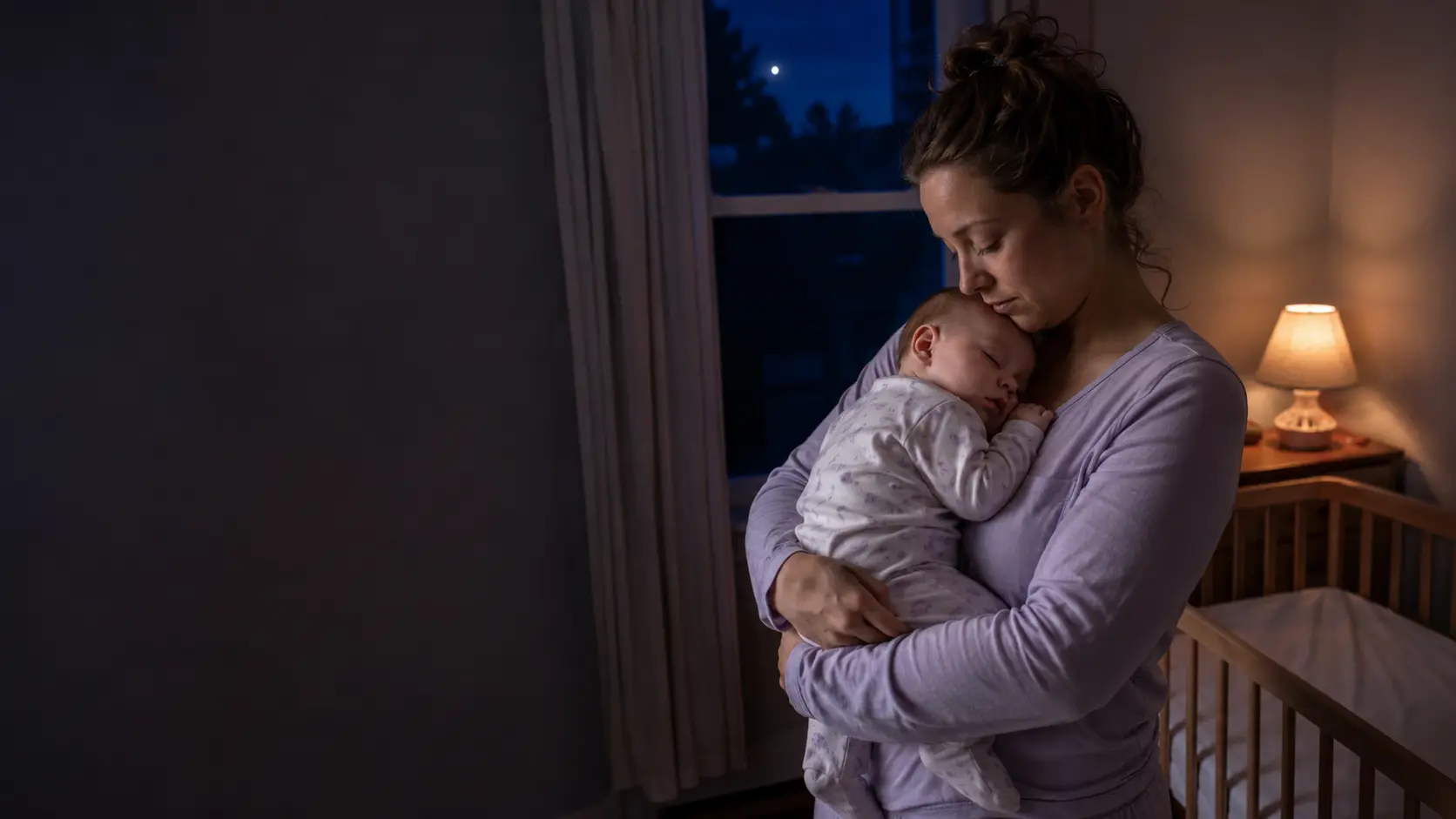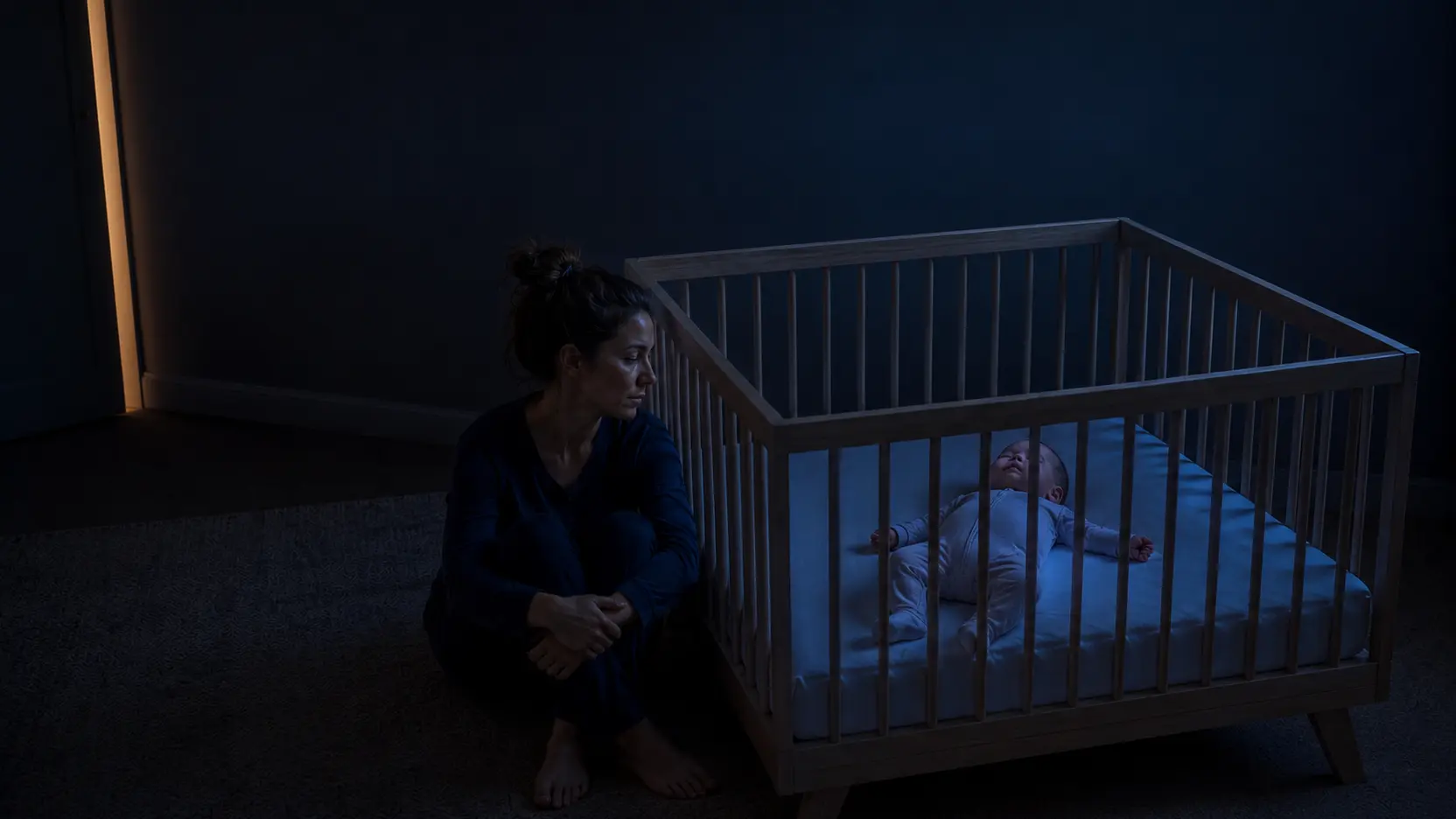

When 2:17 a.m. starts feeling suspiciously scheduled
The clock is evidence, not the boss
A baby who wakes at the same time every night is usually showing you a repeatable pattern, not handing you a diagnosis. A normal arousal may be meeting the same hunger cue, sleep timing, light or sound, discomfort, or familiar response at roughly the same point each night. The timestamp alone cannot tell you which one.
Check the baby, the feeding and growth plan, and urgent health signs first. Then record three to five nights, compare the wake with bedtime, the last feed, and anything timed in the room, and change one safe variable at a time.
Skip the experiment and get help: trouble breathing, blue or gray lips or skin, unusual limpness or unresponsiveness, or a prolonged breathing pause needs urgent care. A rectal temperature of 100.4 F (38 C) or higher in a baby younger than three months needs immediate contact with the baby’s clinician.49
The precision can be unnerving. A random wake feels like baby life; a wake that arrives at 2:17 three nights in a row feels as if somebody put it on the family calendar. But the clock has only recorded when the wake became visible. It has not recorded why.
Young babies naturally wake often. Newborn sleep comes in short stretches, and hunger is not a bad habit hiding behind good timing. As babies grow, their sleep cycles become more regular, yet brief arousals still happen. Whether an arousal turns into a full wake can depend on what the baby needs, what is happening in the room, how sleep began, and what usually happens next.12
That gives you a more useful question than “How do I stop 2:17?” Ask: “What keeps meeting my baby at 2:17?” Once you know which clock you are seeing, the night becomes less mysterious and your next step can become much smaller.


Start with the baby, not the clock
Before changing bedtime, feeds, or your response, take sixty seconds to decide whether this is still a sleep-troubleshooting problem. Look at your baby in decent light. Notice breathing, color, temperature, alertness, feeding, wet diapers, congestion, and whether the cry sounds like the usual “I am awake” cry or like pain or illness.
Persistent snoring, gasping, labored breathing, or repeated breathing pauses deserves a pediatric conversation. A wake that suddenly appears alongside feeding difficulty, poor growth, fever, unusual sleepiness, pain, or a baby who simply seems unwell also belongs outside a do-it-yourself sleep experiment.4 If you want the fuller red-flag decision path, use when to worry about a baby not sleeping; this guide stays with a well baby whose repeat wake is ready to be decoded.
Next, protect feeding. Most healthy, full-term babies can be fed responsively to their hunger cues, but prematurity, a medical condition, or slow weight gain may come with a clinician-directed schedule. Do not stretch a feed or remove a night feed because an online age chart says the baby “should” be done. Rooting, bringing hands to the mouth, lip smacking, and becoming more alert can be hunger cues; crying is often a later cue.313
And keep every proposed fix inside the safe-sleep boundary. Put the baby on the back for every sleep, on a firm, flat surface with no loose bedding, pillows, positioners, or soft objects. Room sharing without bed sharing is recommended, and overheating is not a sleep solution.5 If exhaustion is pulling you toward a sofa or armchair while holding the baby, move the feeding or soothing setup somewhere safer before you try to solve the wake itself.1
Work out which clock you are actually seeing
Sleep moves through recurring REM and non-REM states, and babies can surface between sleep periods without anything being wrong.10 The useful detective work is not calculating a universal infant cycle length. It is comparing the wake with four different reference points.
Four clocks can point to four different first experiments
Compare the wake with bedtime, feeding, and the room
- The wall clock
- The wake stays near the same clock time even when bedtime moves. Look for dawn light, a heating or cooling cycle, a neighbor, a pet, a parent coming to bed, a timed sound machine, or another household event.
- The bedtime clock
- The wake moves when bedtime moves but stays roughly the same interval after sleep begins. Sleep pressure, the bedtime sequence, or the conditions present at sleep onset become more plausible lanes.
- The feeding clock
- The wake tracks the last substantial feed more closely than the wall clock and comes with recognizable hunger cues. Feeding and daytime intake deserve attention before behavioral changes.
- The temporary clock
- The pattern began with congestion, teething discomfort, travel, a developmental change, or another disruption and does not yet have a stable baseline. Comfort, health, and time may matter more than a new system.
The useful distinction: “same time” can mean the same number on the clock or the same distance from another event. Those are not the same pattern.
Write down the actual numbers rather than rounding every wake to “around 2.” A ten-minute shift may be noise. A wake that consistently follows bedtime by four hours while moving with bedtime is meaningful. So is a wake that remains fixed just before dawn while bedtime and feeding change. You are not collecting data to make your baby perform. You are giving yourself enough context to stop changing three things at once.
Use three nights if the pattern is obvious and the baby is well; use up to five if the nights are variable. A longer diary is not automatically wiser. Illness, travel, vaccination discomfort, or a feeding concern can make old data less useful than tonight’s baby.


Choose the first cause lane without declaring a winner
Several explanations can be true at once. A baby may surface normally, notice hunger, and then need the same support used at bedtime. Your job is not to name the one permanent cause. It is to identify the safest first lane to test.
Need, cue, timing, or health?
Pick the lane that explains the most with the fewest assumptions
NEED
Hunger cues, feeding or growth instructions, a wet diaper, temperature discomfort, pain, or illness. Meet the need before asking the baby to respond differently.
CUE
A light, sound, HVAC cycle, household routine, or the familiar conditions the baby expects when returning to sleep. Change only the most plausible cue.
TIMING
The wake tracks bedtime, the last nap, or the last feed. Review the interval before making a small, age-appropriate schedule experiment.
HEALTH
Snoring, gasping, breathing pauses, fever, feeding trouble, poor growth, unusual sleepiness, or a sudden change. Pause sleep experiments and call the baby’s clinician.
No blame required: a cue is simply something the baby notices or expects. It is not proof that a parent caused the waking.
Normal arousal and age
For a newborn or young infant, frequent waking may be the whole explanation. The American Academy of Pediatrics notes that newborns may wake at the end of sleep cycles every one to two hours.1 A precise-looking time can emerge because bedtime, feeds, and household rhythms are precise too. At this age, the goal is not to break a habit. It is to feed, keep sleep safe, notice health concerns, and survive the night with as little unnecessary stimulation as you can manage.
Around four months, sleep cycles generally become more regular.2 That does not mean a four-month-old should sleep through or no longer need feeding. It means a repeated interval after bedtime may become easier to see. Age gives context; it does not issue a deadline.
Hunger and the feeding plan
If the baby wakes with hunger cues and feeds actively, take that evidence seriously. Review daytime opportunities to feed, but do not force larger feeds or stretch intervals to buy sleep. Babies regulate intake differently, and a clinician may want a specific schedule when growth, prematurity, or health is involved.3
The related guide why a baby only wakes up to eat goes deeper into that branch. This article will not call hunger a habit from across the internet, and it will not give every family the same night-weaning age.
Bedtime, naps, and sleep pressure
If the wake keeps the same distance from sleep onset, look at bedtime and the last nap before blaming the wall clock. A baby who goes to bed at a very different biological moment after an unusually long or short day may surface differently. Make any schedule change small enough to observe. Moving bedtime dramatically while also changing naps, feeds, and your response makes the result unreadable.
An earlier bedtime is not automatically the answer, but it can be a sensible branch when the day and the baby’s cues point that way. Use whether a baby may sleep longer with an earlier bedtime for that decision rather than turning tonight’s experiment into a universal rule.
Light, sound, temperature, and household timers
A fixed clock-time wake asks for a quiet room audit. Stand in the sleep space at the usual time if you can. Does dawn reach the wall or baby’s face? Does a sound machine stop? Does the heat click on? Does a parent shower, a dog move, a neighbor leave, or a phone start charging with a sound? The NHS recommends using light and activity to help babies learn day from night and keeping nighttime interaction low-key.8
Keep the fix proportionate. Darken intrusive light; do not make the room impossible to navigate safely. Remove a timed sound; do not increase white noise until it overwhelms the room. Dress the baby appropriately; do not add loose bedding or heat the room as a shortcut. The sleep environment still has to meet safe-sleep guidance.5
Sleep-onset and response cues
Sometimes the important repetition is what surrounds sleep. If the baby falls asleep with feeding, rocking, a pacifier replacement, or a caregiver’s hand and then asks for the same help after a normal arousal, that is information. It is not a moral verdict on the routine. You can keep a support that works, reduce it gradually, or choose an evidence-based behavioral option when the baby is healthy, old enough for the plan, and needs are met.
For babies around four months and older, AAP guidance describes putting a baby down drowsy but awake and waiting briefly before responding as possible ways to support settling.2 “Possible” matters. A hungry, ill, very young, or distressed baby still needs care. A caregiver is also allowed to decide that a method does not fit the family.
Temporary disruption
Growth, teething, congestion, illness, travel, and developmental change can disturb a pattern that was working. The NHS notes that baby sleep patterns change as babies grow and with events such as teething and illness.8 When the wake is new and the baby is uncomfortable, focus on the baby’s condition and familiar care. Do not build a permanent sleep system around three unusual nights.
Run one small experiment for three to five well nights
Once feeding, health, and safe sleep are accounted for, turn the most plausible lane into one test. The goal is not to prove that you understand your baby perfectly. It is to learn more than you would learn by changing bedtime, feeds, sound, light, and response all on the same night.
- Name one hypothesis. “Dawn light is waking her” is testable. “She is a bad sleeper” is not. Keep hunger, discomfort, breathing, and illness out of the experiment lane.
- Change one safe variable. Block the intrusive light, remove the timed sound, make the bedtime sequence more consistent, or adjust one response cue. Do not pair it with an unapproved feeding change.
- Hold the rest steady when practical. Record bedtime, last nap, last feed, wake time, cues, response, and settling time. Real family nights will never be laboratory-perfect; note the exceptions instead of discarding the whole night.
- Review after three to five nights. Better, worse, unchanged, or unclear are all usable outcomes. Keep a helpful change, undo an unhelpful one, or choose the next most plausible lane.
- Stop when the problem changes. Illness, pain, feeding trouble, poor growth, unusual breathing, or a suddenly different wake resets the question. Return to the baby’s needs and clinical guidance.
What counts as improvement? Not only “slept through.” A later wake, an easier resettle, a clearer hunger pattern, or proof that the room timer is irrelevant can all move the family toward a better next decision.
A bedtime routine is a reasonable variable when it is currently unpredictable. In a randomized trial of children ages 7 to 36 months, a consistent nightly routine improved parent-reported sleep outcomes and maternal mood.11 That finding does not prove a routine will stop exact-time waking, and it should not be generalized to newborns. It does support trying a calm, repeatable sequence in the ages studied instead of adding an elaborate collection of sleep tricks.


Let age and feeding needs shape the response
The same clock does not create the same job at every age
Choose care first, then the lightest useful sleep response
NEWBORN OR YOUNG INFANT
Expect frequent waking. Feed according to cues and the growth plan, keep nighttime care calm, preserve safe sleep, and respond to discomfort or illness. Do not make habit-breaking the priority.
ROUGHLY FOUR MONTHS AND OLDER
After needs are met, timing and response patterns may be easier to test. A consistent routine, a brief pause, or drowsy-awake placement can be options. None is a requirement to ignore a hungry or distressed baby.
OLDER INFANT OR TODDLER
Healthy children with a stable pattern may be candidates for a preference-sensitive behavioral plan. Pick one method, keep the response predictable, and seek professional help when the case is medically complex or does not improve.
Family preference belongs in the plan: evidence offers options; it does not require every household to use the same method.
The American Academy of Sleep Medicine considers behavioral interventions a first option for healthy children with bedtime resistance or night waking and recommends sleep-specialist involvement for more complex medical cases or lack of response.7 Its practice parameters describe several effective approaches and do not identify one method as best for every child.6
A trial in infants ages 6 to 8 months found improvement in parent-reported sleep-problem severity and caregiver outcomes after a behavioral intervention.12 Keep the outcome honest: parent-reported improvement is valuable, but it is not proof that every objective wake disappeared. It also tells us nothing about whether the same intervention fits a younger baby with feeding needs.
If your family does not want a formal sleep-training method, that is not a failure to choose. The guide on whether a baby can learn to sleep without sleep training offers a gentler branch. Consistency can mean responding in a familiar way; it does not have to mean choosing the most intensive plan available.
Scheduled awakenings are a real method, not a first-night trick
You may see advice to wake the baby before the usual wake. In sleep-medicine guidance, scheduled awakening is a defined behavioral approach: caregivers document a predictable waking pattern, wake the child before the expected spontaneous wake, provide the usual brief response, and gradually adjust or fade the schedule as the pattern improves.6
That does not make it the right opening move for a newborn, a hungry baby, an infant with uncertain growth, or a wake accompanied by pain or breathing signs. It also costs caregiver sleep and requires a truly stable pattern. Consider it only for a healthy older baby or young child after the log confirms predictability, the family’s feeding and medical boundaries are clear, and the approach fits the caregivers. If you are unsure, bring the log to the pediatrician rather than pre-emptively waking on a guess.
Dream feeding is a different idea: feeding a sleeping or drowsy baby before the caregiver goes to bed. It may shift a feed for some families, but it is not a diagnostic test and it should not be used to override hunger cues, growth guidance, or safe handling. If a dream feed creates more waking or turns one clear feed into several uncertain ones, it has not earned a permanent place just because the original wake looked punctual.
What to do when the usual wake arrives tonight
Keep the room dim and your sequence simple. Pause long enough to observe if that is age-appropriate and the baby is safe; then check position, breathing, temperature, diaper, and hunger. Feed when feeding is due or cues are present. Keep conversation and light low. Use the one response you chose for this experiment rather than cycling through every possible technique.12
If the baby settles, record what happened in the morning. If the baby does not settle, needs care, or seems different, abandon the experiment without treating that as a ruined night. The baby is not the control group. The method exists to serve the baby and family, not the other way around.
Protect the adult too. Prepare water, feeding supplies, and a safe place to sit before bed. If you might fall asleep while feeding, avoid couches and armchairs and return the baby to the separate safe sleep surface when you are awake enough to do so.15 A clever sleep experiment is not worth an unsafe exhausted-caregiver setup.


Know when the pattern needs care, not another variable
Now, today, or keep observing?
Move the wake into the right care lane
GET URGENT HELP NOW
Difficulty breathing, blue or gray lips or skin, unusual unresponsiveness or limpness, or a breathing pause longer than 20 seconds – especially with a color or tone change – needs emergency help.4
CALL THE CLINICIAN PROMPTLY
Call immediately for a rectal temperature of 100.4 F (38 C) or higher in a baby younger than three months. Also call for persistent snoring or gasping, feeding difficulty, poor growth, pain, unusual sleepiness, or a sudden pattern change with illness.49
KEEP OBSERVING
The baby is well, breathing normally, feeding and growing according to plan, and settles with ordinary care. Continue the short log and one safe change; bring the pattern to the pediatrician if it persists or worries you.
Trust the change you can see: a familiar wake in a well baby and a sudden wake in a baby who seems unwell are different questions, even when the clock time matches.
Questions that tend to arrive around the same time as the baby
Is it normal for a baby to wake at exactly the same time every night?
It can be. Babies have recurring sleep states, young babies wake frequently, and regular household, feeding, bedtime, and environmental rhythms can make a wake look impressively precise.12 The time itself is not a diagnosis. What matters is the baby’s age and condition, feeding and growth plan, breathing, cues, and whether the wake follows clock time or another event.
If my baby wakes at 3 a.m., does that mean hunger?
Not automatically, but hunger is a real possibility and should not be dismissed as habit. Look for hunger cues and active feeding, compare the wake with the last feed, and follow any clinician-directed plan. No online article can set one night-weaning age for every baby.313
Should I feed the baby before the usual wake?
Do not add a pre-emptive feed solely because the wake is punctual. If the baby needs a night feed, the timing may be worth discussing with the pediatrician, especially when growth or prematurity is involved. If you try a dream feed with a healthy baby, keep it safe, observe whether it actually helps, and stop if it adds disruption. It is an experiment, not proof that hunger caused the original wake.
Should I wake my baby before the usual wake time?
Not as the first move. Scheduled awakening is a formal behavioral option for a documented predictable pattern, not a universal newborn strategy.6 Rule out feeding and health needs, log the pattern, consider the baby’s age, and decide whether the extra caregiver waking is acceptable. Ask the pediatrician or a pediatric sleep professional when the fit is unclear.
Does the pattern mean we have to sleep train?
No. Behavioral approaches are options for healthy children, and several methods have evidence; no single method is best for every family.67 You can first address light, sound, timing, routine, feeding, and a consistent gentle response. If you choose a formal method, use one that fits the baby’s age, health, and your family’s values.
How many nights should I track the wake?
Three to five well nights is usually enough for this troubleshooting pass. It is not a medical threshold and it does not promise a cure. Stop earlier when the baby becomes ill, feeding or breathing changes, or the hypothesis is clearly wrong. If the pattern persists, the short log is useful information to bring to the pediatrician.
What if the waking started with teething, congestion, or illness?
Care for the baby in front of you and let the old baseline wait. Sleep patterns can change with growth, teething, and illness.8 Keep sleep safe, meet feeding and comfort needs, and contact the clinician for concerning symptoms. Reassess the clock pattern after the baby is well rather than adding a permanent intervention during a temporary disruption.
The repeating time may keep its dramatic entrance for a few nights. You do not have to answer with an equally dramatic plan. Check the baby. Name the clock. Change one thing. Review what actually happened.
I would keep the log simple enough to read at breakfast and kind enough that nobody is graded by it. The useful ending is not always “the baby never woke again.” Sometimes it is “we found the dawn light,” “that wake is a real feed,” “bedtime needed a small shift,” or “this belongs with the pediatrician.” Clarity is progress, especially at 2:17 a.m.
Sources
- American Academy of Pediatrics: Safe Sleep Tips for Sleep-Deprived Parents – newborn waking, simple routines, low-stimulation night care, safe sleep, and exhausted-caregiver precautions.
- American Academy of Pediatrics: Getting Your Baby to Sleep – sleep-cycle development, calm nighttime care, drowsy-awake placement, and brief age-appropriate pauses.
- American Academy of Pediatrics: How Often and How Much Should Your Baby Eat? – responsive feeding, hunger cues, growth concerns, and clinician-directed schedules.
- American Academy of Pediatrics: Sleep Apnea in Children – Detection and Treatment – snoring, breathing difficulty, pauses, clinical review, and urgent signs.
- CDC: Providing Care for Babies to Sleep Safely – back sleeping, a firm flat surface, a clear sleep space, room sharing, and overheating prevention.
- American Academy of Sleep Medicine: Practice Parameters for Behavioral Treatment of Bedtime Problems and Night Wakings – evidence-based behavioral options, including scheduled awakenings, and the absence of one universally best method.
- American Academy of Sleep Medicine: Insomnia in Children Health Advisory – behavioral interventions for healthy children and referral for complex or nonresponsive cases.
- NHS: Helping your baby to sleep – normal variation, day and night cues, soothing routines, feeding, growth, teething, and illness-related changes.
- American Academy of Pediatrics: Fever and Your Baby – the immediate clinician-contact threshold for a baby younger than three months.
- NICHD: What Happens During Sleep? – background on recurring REM and non-REM sleep states.
- Mindell et al.: A nightly bedtime routine – impact on sleep in young children and maternal mood – randomized trial in children ages 7 to 36 months.
- Behavioral sleep intervention trial in infants ages 6 to 8 months – parent-reported sleep-problem and caregiver outcomes with stated outcome limits.
- CDC: Signs Your Child Is Hungry or Full – age-varying hunger and fullness cues.
When the clock stops running the meeting
Turn the pattern into a gentler next night
Bring the bedtime, feed, wake, and response notes you already gathered. The SleepBaby.org Workshop can help you sort the next sleep decision without pretending every baby, age, or family needs the same answer.