The movement before the cry is the clue
If your baby keeps waking himself up, watch the ten seconds before he wakes
Most babies who seem to wake themselves are not doing anything wrong. A newborn may fling his arms because of the involuntary Moro reflex, grunt and squirm during active sleep, or wake because hunger arrives at the end of a short sleep cycle. An older baby may roll, kick, practice a new movement, or briefly surface between cycles and discover that the conditions around him have changed. The useful question is not simply, “How do I stop the movement?” It is, “What happened immediately before his eyes opened, and what does his age make likely?”
I know how quickly this can turn into a midnight investigation. You lower a sleeping baby into a quiet crib, tiptoe away as if the floorboards have signed a confidentiality agreement, and then one arm shoots into the air. His eyes open. Yours never really closed. It can feel as though his body has betrayed the sleep you both worked so hard to reach.
Here is the reassuring part: noisy, twitchy, mobile sleep is often normal infant sleep. The safety part is equally important: do not try to pin, prop, weight, position, or cushion a baby into stillness. Start every sleep on the back on a firm, flat, level surface with only a fitted sheet. Then use the pattern of the wake—not a product promise—to decide what to do next.
SleepBaby.org · The original video
A little help
for the night ahead.
Take a moment to watch the original Baby Sleep Miracle presentation. Your article will be right here when you’re ready to keep reading.
Ready to get started?Take the next step with SleepBaby.
Help my baby sleep

Why a baby can wake himself up
“He wakes himself” describes the final moment, not the cause. I separate these wakes into six buckets because each one asks for a different response. The buckets can overlap—hunger may arrive during active sleep, for example—but the first visible clue usually points you in the right direction.
The wake decoder: what you see, what it may mean, what to try
SleepBaby.org wake-pattern decoder
First, make sure he is actually awake
Newborn sleep is not the still, silent sleep adults imagine when we say, “sleeping like a baby.” The American Academy of Pediatrics describes lighter active sleep as a state in which babies move, startle at noise, and may cycle toward drowsiness with stretches or arm and leg jerks. Eyelids can flutter. Breathing can sound irregular. A baby may squeak, grunt, briefly fuss, or open his eyes for a sliver of time and then sink back down.
When I hear a small sound, my first step is a short pause—not abandonment, not a timed crying exercise, just enough observation to answer: are the eyes truly open, is the cry building, and does the body look distressed? If the sound fades and the face stays relaxed, I let sleep keep doing its strange newborn choreography. If the cry builds, the eyes remain open, or hunger cues appear, I respond.
This distinction matters because fast intervention can become the wake-up. A hand on the chest, a bright phone screen, a lifted bassinet mattress, or a quick scoop into your arms adds touch, light, movement, and temperature change. Sometimes the kindest response is ten calm seconds of seeing what happens next.
A calm sixty-second sequence
- See: Are the eyes closed? Is the face relaxed? Is the color normal?
- Listen: Is this one grunt, rhythmic active-sleep noise, or a cry that is clearly escalating?
- Scan: Did an arm fling, noise, pacifier loss, roll, cough, or hunger cue come first?
- Respond: Do the smallest thing that meets the actual need—wait, replace calm presence, feed, adjust clothing, or pick up.
- Escalate: If breathing, color, responsiveness, feeding, or illness looks wrong, leave the sleep experiment behind and get medical help.


When the startle reflex is the culprit
The Moro reflex is an involuntary newborn response. A sudden sound or movement—or simply a shift in head position—can send the arms outward before they fold back toward the body. A baby may cry afterward. The reflex is expected in newborns and fades during early infancy, though the exact timeline varies.
The revealing pattern is consistent: your baby is asleep or nearly asleep, both arms suddenly open, the torso tightens, and the eyes pop open. That is different from slowly wriggling toward hunger or repeatedly rolling onto the side. Once you have seen the same arm-fling pattern several times, you can reduce avoidable triggers: lower your baby slowly with the whole body supported, keep one steady hand in place for a moment after the mattress takes the weight, avoid abrupt noise, and make overnight care boring and dim.
Do not repeatedly test the reflex yourself. Clinicians assess newborn reflexes during examinations; parents do not need to recreate a head-drop maneuver. Contact your baby’s clinician if movements are consistently one-sided, the baby seems unusually stiff or floppy, the reflex appears abnormal for age, or you have any concern about development.
The swaddle gate has two doors, and rolling closes one permanently
Pre-rolling newborn
If the wake reliably begins with an arm startle, a correctly fitted, nonweighted swaddle may help some babies stay calmer. Always place a swaddled baby on the back. Keep hips able to flex and move, avoid overheating, and follow the product’s size and fit instructions.
Any sign of trying to roll
Stop swaddling. Do not wait for a successful full roll or a particular birthday. The arms need to be free so the baby can use them to reposition. Move to an arms-free wearable layer if one is needed for warmth.
Never use a weighted swaddle, weighted blanket, sleep positioner, pillow, rolled towel, or crib bumper to suppress movement. Swaddling can calm some babies; it is not a SIDS-prevention strategy and never replaces the rest of the safe-sleep setup.
The private question beneath “he wakes himself”
A clearly labeled hypothetical Kacey-and-Benjamin scene: I picture myself standing beside Benjamin’s crib after the third false start, one hand still hovering above him because I am afraid to remove it. His arms jump. His eyes open. In that moment, the private question is not really whether a swaddle exists. It is, “Am I failing to help my baby do something every other baby can do?”
Hypothetical-me wants to fix every twitch. Benjamin’s imaginary arm shoots up again, and I start mentally auditing the feed, the burp, the thermostat, the sound machine, the transfer, and possibly the alignment of the moon. Then I notice the useful detail: his eyes close again before I touch him. The movement was not a request. It was sleep being young and untidy.
That distinction changes the job. I am not trying to manufacture a motionless baby. I am learning which movement needs me. A hunger cue needs a feed. A rolling attempt changes the swaddle plan. A breathing change needs medical attention. A brief active-sleep grunt may need nothing at all. The parent is not powerless; the parent is observing.

Match the plan to your baby’s age and skill
Advice about “self-soothing” becomes confusing when it treats a two-week-old and an eight-month-old as the same sleeper. They are not. Young infants have short cycles, immature rhythms, frequent feeding needs, and involuntary reflexes. Older babies can develop stronger sleep associations and spend their crib time practicing new motor skills. I use age as context, not as a deadline.
Newborn and early weeks
Expect active sleep, frequent waking, feeding, and startles. Keep care responsive. A brief observational pause is reasonable when eyes stay closed and breathing and color look normal; it is not a reason to delay a needed feed or comfort. If a nonweighted swaddle is used, back-sleep placement and careful fit remain essential.
Approaching rolling
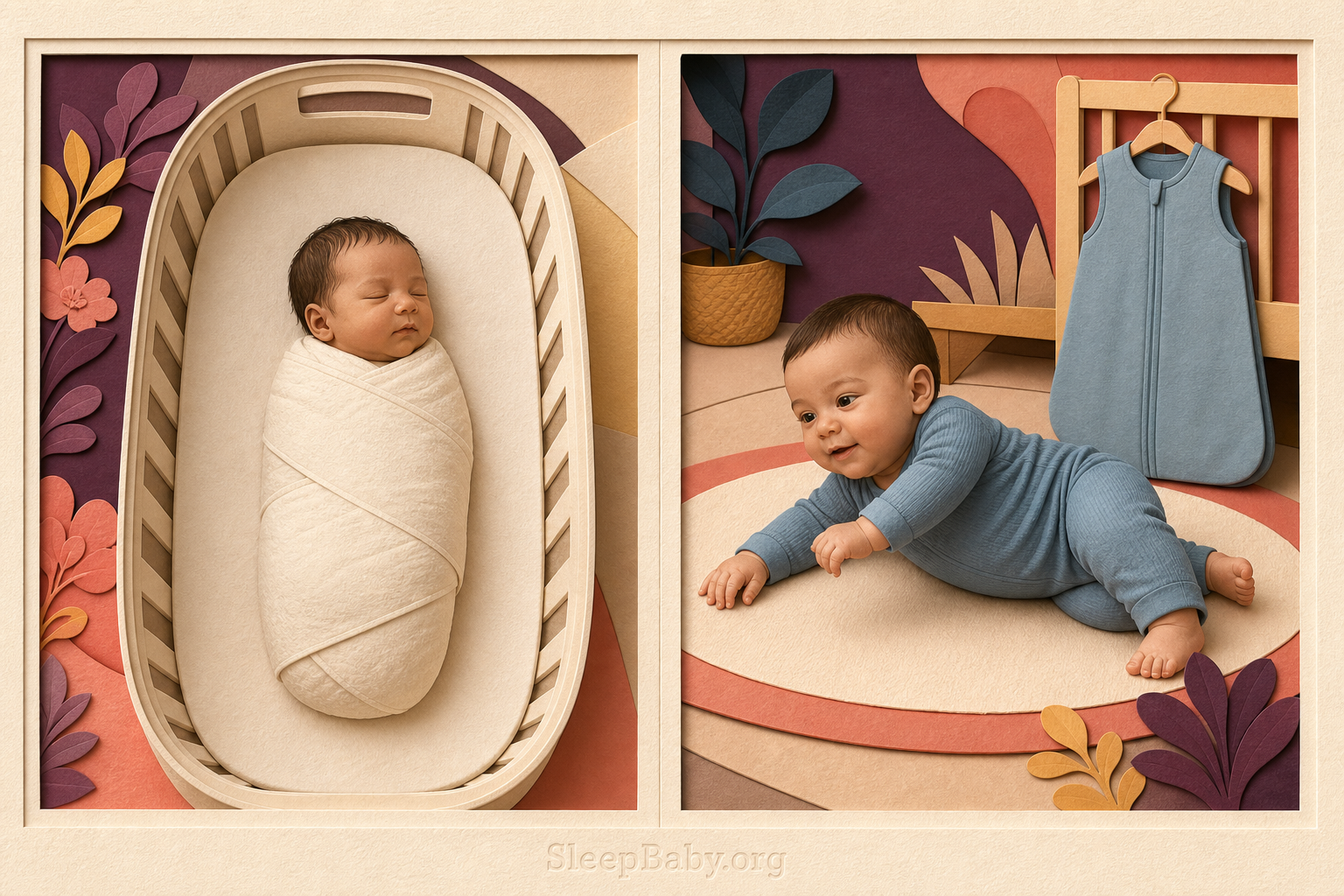
Watch for side rocking, hip twisting, shoulder rotation, repeated attempts to turn, or any other sign of trying to roll. Stop swaddling when attempts begin, even if startles still happen. Practice rolling and reaching during supervised awake floor time so new skills have somewhere safer to rehearse.
Rolling both ways
Always place baby on the back at the start of sleep. When a baby can roll from back to stomach and stomach to back independently, safe-sleep guidance allows the baby to remain in the position reached independently, while the crib stays firm, flat, and empty. Do not add a positioner to keep baby on the back.
Four months and beyond
Sleep cycles become more organized, but brief waking between them is still normal. If your baby wakes whenever rocking stops, a pacifier falls out, or your body disappears, work gradually on making the conditions at sleep onset resemble the conditions available later. Use a consistent wind-down and offer age-appropriate opportunities to settle without turning normal wakes into a test of endurance.
SleepBaby.org age-and-skill ladder
Check the triggers that are easy to misread
Hunger can look like restless hands
Hands at the mouth are not automatically “self-soothing.” For babies in the first months, the CDC lists hand-to-mouth movement, head turning toward the breast or bottle, lip movements, and clenched hands among hunger cues. If those cues arrive before the wake, feed according to your baby’s needs and the plan you have with the clinician overseeing growth and feeding. A product cannot stretch a biologically necessary feed.
The transfer may be the trigger
A baby who falls asleep in warm arms experiences a large sensory change at transfer: movement stops, pressure changes, temperature shifts, and the caregiver’s scent and heartbeat move away. Lower slowly, support the head and trunk together, and let the mattress take the baby’s weight gradually. Keep the final sleep surface flat; do not incline the mattress or add padding to make it feel more like arms.
Noise, light, and temperature matter—but perfection is not required
A slammed door can startle a light sleeper, while ordinary household sound may be tolerated. Reduce sudden peaks rather than trying to create laboratory silence. Keep nighttime light low and interaction calm. Dress your baby for the room without head covering or excessive layers, and check the chest or back rather than judging warmth by cool hands and feet alone. Sweating, damp hair, flushed skin, or unusually rapid breathing can signal overheating and deserve prompt correction and, when concerning, medical guidance.
Pacifier loss is not always a problem to solve
Offering a pacifier at naps and bedtime is part of AAP safe-sleep guidance when appropriate for feeding circumstances, but you do not need to replace it after the baby falls asleep. If an older baby fully wakes every time it falls out, you can decide whether to keep replacing it, help the baby learn to find it when developmentally able, or gradually reduce reliance. Never attach it with a cord, clip, stuffed animal, or other object in the sleep space.
Rolling, leg slamming, and crib practice can be developmental
New skills are compelling. A baby may lift legs, thump the mattress, rock on the side, roll, push up, or get briefly frustrated by a position. Offer generous supervised movement practice while awake. At night, keep the crib boring and empty. If the baby has reached a position independently but cannot yet roll both ways, follow your pediatric clinician’s guidance about repositioning; do not use devices to hold a posture.
A response ladder that does not confuse “less help” with “no help”
I prefer a ladder because it gives a tired parent something between instant pickup and leaving a baby to cry. Start at the lowest step that fits the situation and move up when your baby tells you it is not enough.
- Pause and observe. Use this only when the baby appears safe, eyes are closed or briefly fluttering, and the sound is not escalating.
- Make the environment boring. Keep light dim, voice quiet, and movements slow. Remove a sudden noise or fix an obvious clothing issue without adding objects to the crib.
- Offer calm presence. A soft voice or still hand may be enough for some babies. Keep touch light and never apply pressure or restraint.
- Meet the need. Feed, change, burp, comfort, or pick up when cues call for it. Newborn responsiveness is not a bad habit.
- Reset safely. Return the baby to the back on the firm, flat, empty sleep surface once the need is met.
For an older baby, you can pause slightly longer when the fuss is mild and the baby is practicing a familiar settling skill. For a newborn, a hungry baby, or any baby with unusual symptoms, climb the ladder quickly. The goal is accurate help, not winning a contest for the least intervention.

Keep the sleep foundation steady while you decode the wake
Movement changes; the safe sleep space does not
Startle, active sleep, hunger, and new motor skills call for different responses, but every response returns to the same firm, flat, empty sleep surface. This American Academy of Pediatrics video reinforces that foundation before you troubleshoot the movement itself.
Takeaway: observe what wakes your baby, meet the actual need, and reset every sleep on the back in a clear, firm, flat space.
Amazon recommendation disclosure: SleepBaby may earn from qualifying purchases if Affiliate Control later activates the governed destination. The recommendation below is currently an inactive placement and does not change safe-sleep guidance.
A practical pre-roll option when the arm fling is clearly the trigger
Love to Dream Swaddle Up Original 1.0 TOG Cotton
I would consider this only for a newborn who is not showing any sign of trying to roll and whose wakes consistently begin with the same arm-fling startle. Its arms-up zip design gives the hands access near the face while providing a repeatable wrap after feeds and diaper changes. That is a stronger fit for this exact problem than a plain arms-free sleep sack, which provides warmth but does not offer the same pre-roll startle containment.
It also avoids relying on a loose blanket wrap that can vary at 2 a.m. The reason to buy is practical, not magical: if observation has already identified the newborn arm startle, the zipper makes the same fitted setup easier to reproduce each time. It does not guarantee longer sleep, prevent SIDS, treat reflux, replace feeding, or make an unsafe sleep space safe.
Skip it if your baby is trying to roll, has outgrown the manufacturer’s fit range, wakes from hunger or illness, or simply does not settle well with arms contained. Stop using it immediately at the first rolling attempt. Never add weight, blankets, positioners, or padding.
When waking himself is a reason to call the doctor
A pattern that is normal for one baby can be concerning when it is new, one-sided, painful, or paired with other symptoms. Call your baby’s clinician promptly when repeated waking comes with poor feeding, fewer wet diapers, persistent vomiting, fever, worsening cough or congestion, a new rash, a pain-like cry, unusual stiffness or floppiness, movements that are consistently one-sided, or a baby who is much harder to wake than usual. For a young infant, ask the clinician for exact fever instructions rather than waiting to see whether sleep improves.
Seek emergency help for severe breathing difficulty, pauses in breathing, blue or gray lips or skin, a seizure-like episode, or a baby who is unresponsive or cannot be awakened normally. If your instincts say this is not ordinary sleep movement, you do not need to finish a checklist before getting help.
Use a tiny pattern note, not an all-night surveillance project
If the cause is unclear, write down only four facts for three to seven nights: the baby’s age and current motor skill, what moved first, whether the eyes were open, and what actually settled the wake. Add feeding time or illness symptoms when relevant. You do not need a minute-by-minute sleep spreadsheet.
- If arms fling first and the baby is pre-roll, reduce sudden triggers and consider the bounded swaddle option.
- If eyes stay closed and sounds fade, allow a brief observation pause.
- If hunger cues lead, feed rather than extending the interval with soothing tricks.
- If rolling or new movement leads, prioritize awake practice and arms-free sleep.
- If the same external condition is always missing, gradually make sleep-onset support more sustainable for an older baby.
- If symptoms or behavior changed suddenly, call the clinician.
The note is useful only if it changes a decision. Once the pattern is obvious, stop collecting data. You already have the answer you needed.

Questions parents ask at 3 a.m.
Should I hold my baby’s arms down so he cannot startle?
No. Do not restrain a sleeping baby with your hands, straps, positioners, or weight. For a pre-rolling newborn, a correctly fitted nonweighted swaddle may be considered. At any sign of trying to roll, stop swaddling and keep the arms free.
Can I put him on his stomach if he sleeps more deeply there?
Place babies on their backs for every sleep through the first year. If an older baby can independently roll both ways and moves into another position, safe-sleep guidance allows the baby to remain there; still start every sleep on the back and keep the crib empty.
Is grunting a sign that he is uncomfortable?
Not always. Newborn active sleep can include grunts, twitches, brief cries, and irregular-looking movement. Look at the whole baby: color, breathing effort, feeding, wakefulness, and whether the sound resolves. Grunting with breathing difficulty, color change, poor feeding, or illness needs medical assessment.
Will responding create a bad habit?
Meeting a newborn’s feeding, comfort, and safety needs is not a bad habit. With an older baby, you can use a graded response when the baby is safe and only mildly fussing, but responsiveness and independent sleep are not opposites.
Why does he wake as soon as I put him down?
The transfer changes pressure, motion, warmth, scent, and support all at once. Lower slowly and keep the environment calm, but always finish on the firm, flat sleep surface. If transfer is the consistent trigger in an older baby, gradually practice falling asleep with conditions that can remain available after you step away.
You are not trying to stop a baby from moving; you are learning which movement needs you
The arm fling that looked like sabotage may be a normal newborn reflex. The grunt may be active sleep. The hands may be asking for milk. The roll may be a new skill announcing that the swaddle chapter is over. Once you watch what comes first, “my baby wakes himself up” becomes a smaller, more answerable problem.
Tonight, keep the crib safe, pause long enough to see the clue, and meet the need you actually find. That is not doing too little. It is the calm precision tired parents deserve.
Sources
SleepBaby.org · The original video
A next step for
the next bedtime.
Still thinking about sleep? Watch the presentation here, then explore the SleepBaby program whenever you’re ready.
Ready to get started?Take the next step with SleepBaby.
Help my baby sleep