
If your baby may have swallowed an earphone rubber or silicone tip, call your pediatrician or U.S. Poison Control at 1-800-222-1222 now. Call 911 for choking, trouble breathing, blue or gray color, or unresponsiveness. If a whole electronic earbud, battery, or magnet may be missing, seek emergency care immediately. Do not induce vomiting, push the object down with food, or sweep blindly inside the mouth. [1] [2]
I would start with your baby, then the earphones. A missing tip can leave you trying to remember whether you heard a gulp, a cough, or nothing at all. You do not need to solve that uncertainty before calling for help. Say exactly what you found and what you do not know.
Look at breathing before looking for the tip
Cannot breathe, cry, or cough effectively? Call your local emergency number and begin age-appropriate choking first aid. Breathing normally? Keep your baby with you and get prompt medical advice. A quiet baby still needs the missing-object story checked.
If your baby is choking right now
Put the emergency call on speaker and follow the dispatcher. For a responsive infant younger than 1 year with severe choking, current American Heart Association guidance calls for cycles of 5 back blows and 5 chest thrusts. Support the head and neck; use the heel of one hand for the chest thrusts. Do not use abdominal thrusts on an infant. If your baby becomes unresponsive, begin CPR starting with chest compressions, following the dispatcher’s instructions. Remove an object only if you can see it when opening the airway; do not perform a blind finger sweep. [3]
A baby who is coughing strongly and moving air needs close attention, not automatic back blows. Stay with them and be ready to act if the cough becomes weak or breathing worsens. Do not stop to watch a video during an emergency. First-aid steps change with age, so tell the dispatcher your child’s age rather than applying infant instructions to an older toddler.
Even if the piece comes out, tell the clinician about the choking and any first aid you gave. Persistent coughing, noisy breathing, or difficulty swallowing after that episode still needs urgent assessment. A successful-looking moment is not a reason to leave new symptoms unexplained. [4]
Work out what is missing without delaying the call
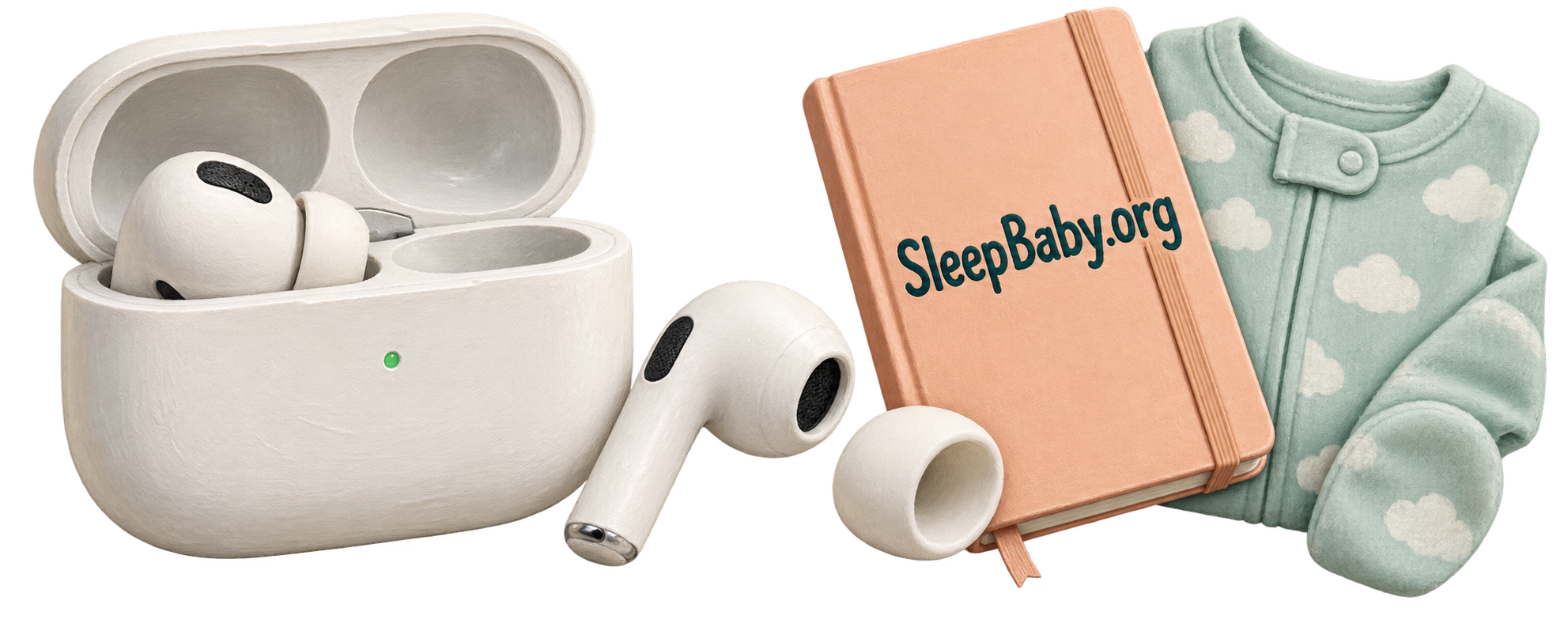
“Earphone rubber” usually means the small removable cushion fitted over the end of an in-ear headphone. That description is not precise enough to establish what your baby encountered. Some cushions are silicone, some are foam, and a chewed or broken device can leave more than one kind of part missing.
If another adult is there, one of you can stay with your baby and make the call while the other gathers the earphones. If you are alone, bring your baby with you. I would not leave them unattended to search the sofa or compare product photos.
THE PART CHANGES THE CONVERSATION
What can you account for?
- Only the soft, detachable tip is missing
- Both electronic earpieces are intact and present. Call now for advice specific to your baby; report any cough or choking, even if it stopped.
- An entire earbud or broken electronic part is missing
- Get emergency assessment. Bring the remaining device or its model details. Do not treat it as a simple silicone-tip ingestion.
- You cannot tell which part is missing
- Say “I’m not sure.” If a battery-containing earbud or loose battery could have been swallowed, go for emergency care without waiting to prove it.
This is a way to describe the event, not a test that clears your baby for home care. Check both earpieces, the charging case, and the other tip if those items are immediately available. Do not pull a damaged earbud apart or scatter extra tiny pieces to investigate it.
A whole wireless earbud needs a different response
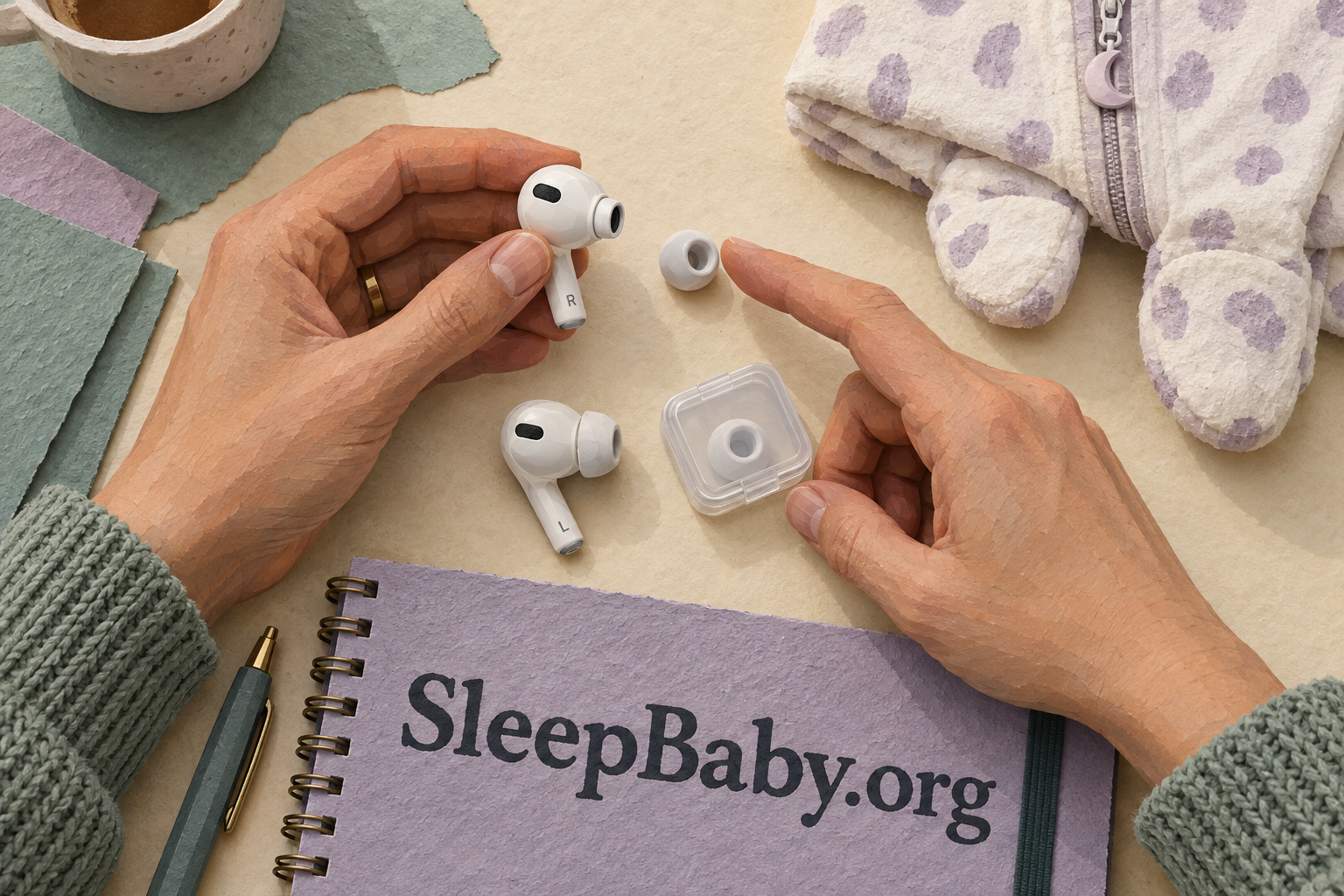
A wireless earbud is an electronic object containing a battery. Depending on the device and damage, other components may matter too. Its risks cannot be assessed from the softness of the ear tip. Seek emergency evaluation if your baby may have swallowed the whole device, a battery, a magnet, or a sharp broken part. [2] [5]
Do not wait for symptoms or try a location app, Bluetooth connection, sound playback, or a home magnet as a test of where the object is. Being able to connect to a device does not give you a medical answer. Bring the model name and the matching earbud if doing so will not delay leaving.
You may see honey mentioned in advice about swallowed button batteries. That is a specific emergency protocol with age and other restrictions, not a treatment for an earphone tip. Never give honey to a baby younger than 12 months. Get immediate specialist instructions for suspected battery ingestion and do not delay emergency care. [5]
If a loose magnet may be involved, our guide to a baby swallowing a magnet explains why that possibility needs urgent care even when a child seems well. Reading it should not hold up your departure.
Tell the clinician what happened, including the part that stopped
The useful details are usually simpler than the story racing through your head. Your baby’s age, the approximate time, the missing object, and any symptoms give the clinician a starting point. “I saw it in their mouth” and “I noticed the tip was gone” are different observations; either is worth reporting.
Include any earlier gagging or coughing even if your baby now looks comfortable. Also mention drooling, refusing feeds, vomiting, breathing sounds, or pain. If your baby has a known swallowing problem or previous surgery affecting the food pipe or gut, tell the clinician early. [2] [6]
Bring the matching tip in a secure container, or take a clear photo beside a ruler away from your baby. The clinician may ask about its size, shape, material, and whether more than one piece could be missing. You do not need an exact measurement before making the first call. [7]

Why “they seem fine” does not settle it
A foreign object can enter the food pipe or the airway. Those are different problems. Some objects in the food pipe cause little trouble at first; an inhaled object can also produce an initial coughing episode followed by a quieter period. That is why the history matters alongside how your baby looks now. [1] [6]
I would tell the clinician, “The cough stopped, but this happened while a tip was missing,” rather than describing only the current calm. Do not re-create the event by offering another tip, put a finger deep into the mouth, or try to make your baby cough for you.
Plastic and other materials do not always show clearly on an X-ray. A normal film does not by itself rule out every swallowed or inhaled object. The medical team decides what examination, imaging, observation, or further assessment fits the story. Tell them you suspect a soft ear tip rather than assuming the scan will show it. [4] [6]
You can ask, “What does this result rule out, and what should bring us back?” That gives you something useful to take home. It is more helpful than asking for a promise that nothing can happen.
Do not use a feed to push it down or test swallowing
Do not induce vomiting or give bread, extra water, oil, laxatives, or another home remedy to move the object along. Ask the clinician what to do about your baby’s next feed, especially if they are directing you to hospital. If swallowing is difficult, do not keep offering food or drink to see whether it improves. [2] [7]
A baby crying for a usual feed can make this feel especially hard. Say so on the call: “They are due to feed now. Should I wait until they are assessed?” You should not have to guess at a feeding plan while also arranging care. If you already fed your baby, report that honestly; it is information for the team, not something to hide.

If the clinician says you can watch at home
Home observation should come with instructions for your particular baby and the particular object. Small, blunt objects often pass through the gut, but that general fact is not permission to skip the first call. Ask what the clinician expects, whether any follow-up is needed, and whom to contact after hours. [4]
Write the advice down while it is fresh. If the instructions are “call if anything changes,” ask for examples you can recognize. You can also ask whether they want you to check diapers, and when to contact them if you have not seen the tip. Recommendations differ according to the object and the situation; use your baby’s plan rather than choosing a deadline from another family’s story.
New symptoms change the plan
Emergency help: trouble breathing, an ineffective cough with choking, blue or gray color, collapse, or unresponsiveness.
Urgent medical reassessment: new or persistent coughing or noisy breathing; drooling or trouble swallowing; repeated vomiting; neck, chest, or tummy pain; blood in vomit or stool; or a baby who becomes unwell.
Tell the team about the possible earphone-tip ingestion, even if the first assessment was reassuring. Follow any additional warning signs they gave you. [2] [4] [6]
Do not wait until the next scheduled call if those problems appear. If you are unsure whether a change is important, describe what you can see: “They cough each time they try to feed” is more useful than trying to label it yourself.
Leave the assessment with a plan you can actually use
Before a phone consultation ends or you leave the clinic, check that you know who to call again. The answer may be your pediatrician during office hours, an after-hours service, or the emergency department. Save the number while you have it in front of you. If the advice came from more than one team, ask which instructions you should follow rather than trying to combine conflicting plans yourself.
Ask whether a follow-up appointment is needed and whether the team expects you to report that the object has passed. If a test was done, ask how you will receive any outstanding results. You can say, “Could you write down the next step for me? I’m worried I will forget part of this.” That is a reasonable request after a stressful event.
Keep a brief record of any changes the clinician has asked you to watch. A time and an observation are enough: a vomit, a refused feed, or a new cough. You do not need a long diary of every movement. If a concerning symptom appears, getting help matters more than finishing the note or taking a video.
If someone else will be caring for your baby soon, include that in the plan before you leave. A nursery worker or relative needs to know what happened and what would require a call. They should not have to piece the story together from a missing earphone and a vague instruction to “keep an eye out.”
Can your baby sleep after swallowing an earphone tip?
Get the medical plan before treating this as an ordinary nap or bedtime. Falling asleep does not confirm where an object is. If your baby is unusually difficult to wake, has abnormal breathing, or seems seriously unwell, seek emergency help rather than assuming they are tired.
Once the clinician says home care and usual sleep are appropriate, follow their monitoring instructions. For an infant, keep the usual safe sleep setup: on the back, on a firm, flat sleep surface, with no pillows, positioners, loose bedding, or other objects in the cot. Do not incline the mattress or put your baby on their stomach to “help the tip pass.” [8]
I would ask directly whether any overnight checks or changes to feeding are needed. Do not invent a schedule of constant waking from internet comments. If two adults are sharing care, decide who has the phone, where the written advice is, and what you will do if symptoms change.
Once the incident is resolved, our guide to finding your baby’s bedtime can help you return to your usual evening rhythm. There is no need to overhaul a working routine because one frightening evening ran late.

Give earphones a home your baby cannot reach
The practical problem is often where earphones land between uses. A bedside table, the edge of a feeding chair, or an open handbag is convenient for an adult and accessible to a mobile baby. A closed charging case helps organize the pieces, but it should not be treated as a child-resistant container.
Choose an adult-controlled storage place out of reach, preferably a locked cabinet. Put the earphones away as a complete set after use, including spare tips. Keep charging cables away from the cot and from your baby’s reach. Small objects and accessible cords need attention throughout the home, not only beside the bed. [9]
I would make the new routine one clear action: earphones go straight into their storage place before you pick up your baby. A rule that depends on finding a different safe spot every evening is harder for everyone to follow.

Check the places the earphones have been: under the chair, between sofa cushions, inside a reachable bag, and around the charging spot. Do this after the urgent care tasks are covered. If you find the missing tip, tell the clinician, but also report any symptoms that remain. Finding one piece does not explain away a cough or prove that nothing else was involved.
Ask older children and visitors to use the same storage place. “Please put the whole set in this cabinet” is easier to follow than “be careful with your things.” Include earbuds from school bags, spare silicone tips in tiny packets, and the case someone leaves charging on the floor.
Make the storage place work for the adult who uses the earphones most. If the safe cabinet is across the house from the usual charging spot, move the charging routine rather than relying on a nightly reminder. Keep the cabinet key or opening mechanism inaccessible too. Check that a chair, low shelf, or open drawer does not create an easy route up to the equipment.
Before travel or an overnight visit, decide where the set will go in the new room. The pocket you use at home may become a bag left beside a travel cot. Tell the other adults where the equipment belongs, and collect loose tips before you pack. These are small housekeeping changes you can make with equipment you already have; buying something is not the first step.
Why small batteries need secure storage
This brief U.S. Consumer Product Safety Commission video was made for households caring for people with intellectual and developmental disabilities. Its reminder to keep button batteries inaccessible also applies when you have a baby. It is about battery safety, not a demonstration of infant choking first aid or proof that a soft tip contains a battery.
If the player does not load, watch the CPSC battery-safety reminder on YouTube. Do not wait for a video when your baby needs care.
Questions you may still have
Will silicone dissolve in the stomach?
Do not count on an earphone tip dissolving. The useful questions are what the object is, where it may be, and what follow-up your baby needs. “Soft” does not establish that an object can pass safely, and the material of a missing tip may not be obvious. Bring the product information rather than guessing.
What if I never saw my baby swallow it?
Tell the clinician it is suspected, not witnessed. Explain where your baby was, where the earphones were, and what is missing. You can keep looking while another adult makes the call, but do not make finding the object a condition for getting advice.
What if the coughing starts later?
Get medical advice urgently and mention the earlier missing tip. Inhaled objects can produce delayed symptoms. Our baby coughing guide covers broader cough questions, but a cough connected to a possible foreign object needs that specific history assessed. Do not assume it is an ordinary cold. [6]
Should I keep searching every dirty diaper?
Ask the team caring for your baby whether they want that done and what to do if you do not find the piece. A missed sighting does not tell you its location. Avoid turning a general estimate for another object into your baby’s follow-up deadline. [4]

Make the handoff easy for the next caregiver
Before another adult takes over, share the same short account you gave the clinician: what may be missing, when it happened, what symptoms occurred, and what advice you received. Leave the contact number and any follow-up time together. A screenshot of the written instructions can be easier to use than a worried retelling.
You do not need to settle who left the earphones out before caring for your baby. Once the immediate concern is handled, change the storage routine together. For now, the next useful step is the medical call, the assessment if advised, and a clear plan everyone caring for your baby understands.
Sources
- Children’s Hospital of Philadelphia: foreign bodies
- HealthyChildren.org: swallowed foreign object symptom guidance
- American Heart Association and AAP: 2025 pediatric basic life support
- Royal Children’s Hospital: swallowed objects
- National Capital Poison Center: swallowed batteries
- Royal Children’s Hospital: inhaled foreign bodies
- Children’s Hospital Colorado: swallowed foreign objects
- American Academy of Pediatrics: safe infant sleep
- American Academy of Pediatrics: home safety






What viewers said10 comments · 4 replies+
Archived comments from the original Baby Sleep Miracle presentation. Not independently verified by SleepBaby.org; individual experiences vary.
Thank you so much for this video! I had no idea about the dangers of baby swings :O
Hi Mary-Ann. I have a question: Is method in any way similar to the ones recommended by Dr Bucknam, Dr. Weissbluth or Dr. Karp? We tried those but none of them help.
Hi Regina, thank you for your question. The short answer is no. The techniques I share in my guide are based on newest scientific research and this is why I have never seen any approach similar to the one I recommend.
This method really works! I tried it on my son Jesus and after just one week he went from waking up more than 5 times a night to waking up just once or twice. You are a lifesaver, Mary-Ann!
I'm truly impressed with how much information you share in your video. And all for free! I can feel that you truly care about mothers like myself, and that's hard to find these days. I have recommended your site to several of my friends already.
Mary-Ann, our child suffers from autism. Is your approach still suited?
Chloe, I made sure my method can be used with any child, even babies who are special like yours. Please note that I'm not a doctor and that I always advice to consult with your physician because nothing is more important than the safety and well-being of your love.
Hallo Mary-Ann, I'm from Germany. Do you have your guide in German?
Hello Heide, we do! Normally you should already see our video in German. If not, please contact our support so they can guide you
Thenk you for your answer, Mary-Ann!
I just completed your approach and I have to say, it worked almost too well. Yes, it took a bit of getting used to with your bedtime routine but the difference is huge. My son George used to take 1 hours to go down and now he's firmly asleep in no more than 10 minutes! You're the best!
It seems I'm the only man watching this video, lol! What you shared about the 'emotional backpack' made immediate sense to me and I can't wait to help my little girl Mila to unpack it!
Hey there, just discovered your site and this really sounds different. Just wanted to say thanks for sharing :)
For everyone who's still thinking about getting Mary-Ann's guide I want to advise you to go ahead. I wasn't sure myself but now I'm so thankful I invested in this program. It made a huge difference in our life as a family and yes, my baby girl does sleep through the night now.