
Tonight’s calm answer
A tiny sleep-only eyelid gap is different from an eye that cannot close
If your baby is breathing normally, has their usual color, wakes and feeds in their usual way, and the eye looks clear and closes fully while awake, a brief sliver of eye during sleep is usually something to observe and mention—not proof of an emergency. Newborn active sleep can include eye movement beneath drooping lids, and a rolling eye can briefly become visible at a sleep transition.
A gap that is persistent, always on the same side, present during awake blinking, or paired with redness, cloudiness, discharge, swelling, apparent pain, unusual eye movement, or new facial asymmetry deserves medical attention. Do not tape the lid, press it closed, add an eye mask to the sleep space, or start drops or ointment unless your child’s clinician has told you exactly what to use.
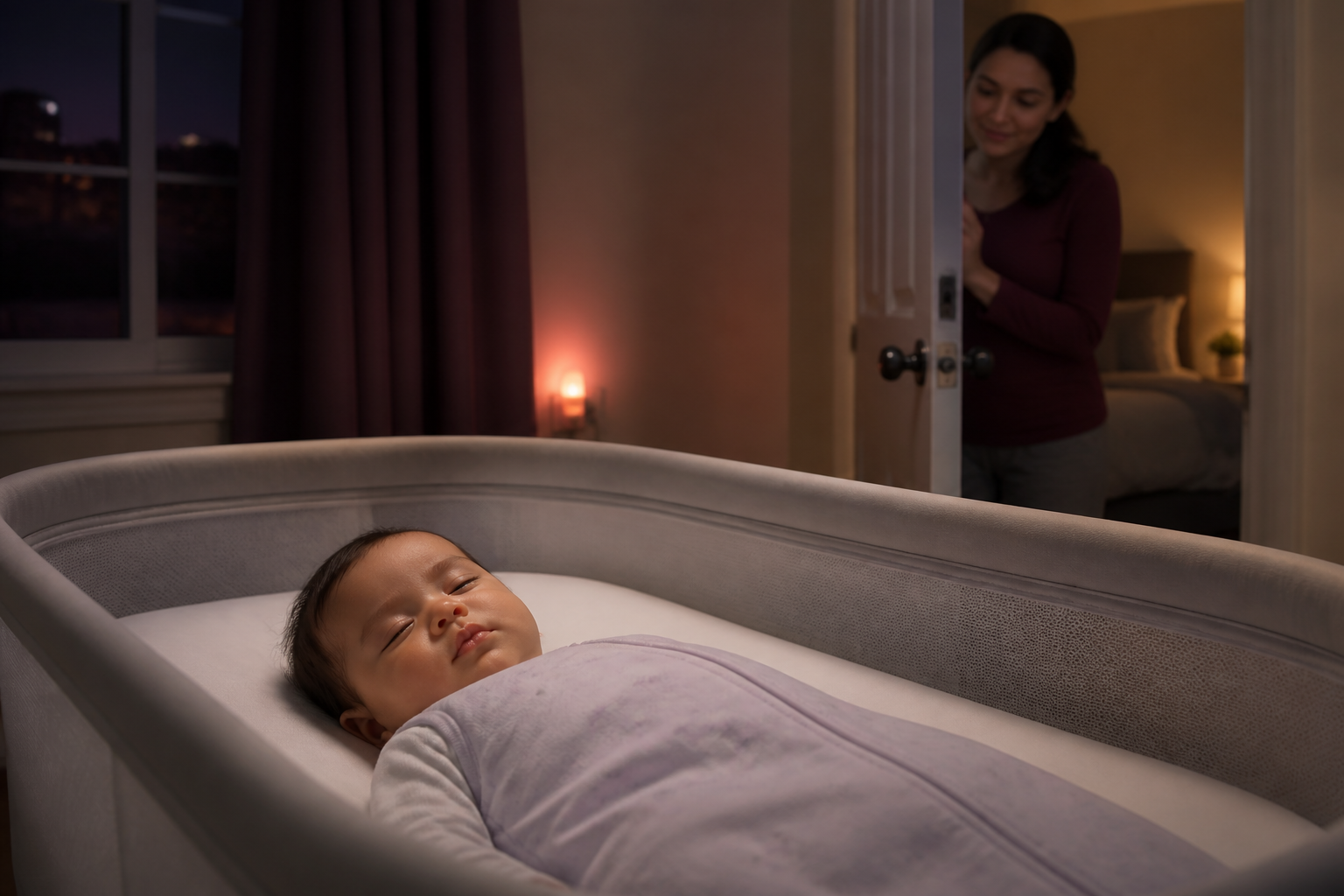
There is a particular kind of parenting alarm that arrives when the room is finally quiet: the baby is asleep, the white-noise machine is doing its tiny ocean impression, and one eyelid looks as if it never received the bedtime memo. I understand why your brain jumps from “odd” to “what if something is wrong?” before you have even leaned over the bassinet.
What I want to do first is separate three pictures that can look similar in dim light: a normal-looking sleep transition, a small eyelid gap that happens only in sleep, and an eye that is not closing well because the lid or facial muscles are not doing their usual job. Those are not diagnoses you have to make at home. They are simply better descriptions to bring to the right person.
What you may be seeing
During active sleep, young babies can twitch, make faces, move their eyes beneath their lids, breathe less regularly than they do in quiet sleep, and briefly look almost awake. The American Academy of Pediatrics’ parent resources describe eye movement beneath closed or drooping lids during active sleep and drowsy transitions. If the lid is not sealed at that exact moment, you may catch a thin crescent of white or a quick glimpse of the eye rolling before the lid settles.
If you want a fuller map of those busy-versus-still phases, our guide to baby sleep cycles by age explains why the same safely sleeping baby can look surprisingly animated in one phase and wonderfully motionless in another. That context can lower the temperature of the moment, but it does not replace checking a persistent one-sided eyelid gap.
The medical term nocturnal lagophthalmos means incomplete eyelid closure during sleep. Most published descriptions and studies involve adults, so I would not turn the label into an internet diagnosis for a baby or pretend we have strong infant prevalence numbers. The useful part of the term is mechanical: when a lid stays open enough for the eye’s surface to remain exposed, the eye can dry or become irritated. That is why comfort and awake closure matter more than how dramatic the gap looks in one dim photograph.
The four-look check
Describe the pattern without touching the eyelid
- Sleep: Is the gap a moment at sleep onset, or does it remain through a longer stretch of sleep? Does it happen on one side every time?
- Awake blink: In ordinary daylight, does that eye close fully during a natural blink? Do not pry, press, or repeatedly startle your baby to test it.
- Eye comfort: Is the white of the eye clear rather than red? Is there unusual tearing, discharge, swelling, light avoidance, rubbing, or a cloudy or white-looking area?
- Whole face: Does your baby’s smile, brow, cheek, suck, and facial movement look usual on both sides? Is feeding and behavior otherwise typical?
This is an observation tool, not a diagnostic test. One calm look while asleep and one natural look while awake usually tell a clinician more than repeated checking under a bright phone light.
SleepBaby.org original teaching component · Use it to describe, never to delay care.
A pattern decoder for tonight and tomorrow
I would make the next decision from the pattern, not from the uncanny factor. Babies are exquisitely talented at looking strange while doing ordinary baby things. The important question is whether the odd-looking moment stays confined to sleep and whether the eye and face work normally when your baby is awake.
| What you notice | What it may describe | Best next step |
|---|---|---|
| A brief sliver during drowsiness; eye later closes; baby otherwise usual | A sleep-transition view or active-sleep movement | Observe once, keep normal safe sleep, and mention it at routine care if it repeats |
| The same eyelid stays partly open through sleep but closes fully awake; eye looks clear | Possible sleep-only incomplete closure; a clinician should decide whether it matters | Take a short steady video if safe, note frequency, and contact the pediatrician |
| Eye does not close during awake blinking, or the face moves differently on one side | A lid or facial-movement problem that needs prompt assessment | Call the pediatrician or urgent care service the same day for direction |
| Redness, cloudiness, swelling, apparent pain, injury, unusual pupil appearance, or baby seems unwell | Possible eye-surface irritation, injury, infection, or another problem that cannot be sorted online | Seek prompt medical assessment; use emergency services for severe or sudden whole-baby symptoms |
This table is intentionally cautious. It cannot tell you why the eyelid is open, and it should not be used to rule out a problem. It does give you language that is more useful than “the eye looked weird”: sleep-only or awake too; brief or persistent; comfortable or irritated; face symmetric or changed.
When I would call now, today, or routinely
The call path
Let the whole baby set the urgency
Emergency help now
Call emergency services for trouble breathing, blue or gray color, inability to wake normally, seizure-like activity, sudden weakness involving more than the eyelid, major trauma, or a chemical exposure to the eye.
Prompt same-day guidance
Call for an eye that cannot close awake, new uneven smile or facial movement, marked redness, cloudiness, swelling, discharge, apparent pain, light avoidance, injury, or a white-looking pupil or reflex.
Routine-but-real follow-up
Message or call the pediatrician when the same sleep-only gap keeps returning, even if the eye closes awake and looks comfortable. Ask whether an eye examination is appropriate.
If your instincts say your baby is not acting like themselves, use the clinician’s triage line rather than waiting for the pattern to become textbook-perfect.
Facial weakness matters because the same muscles and nerve pathways that shape a smile can also affect eyelid closure. The Royal Children’s Hospital guidance on facial palsy specifically lists inability to close the affected eye and recommends eye protection directed by clinicians because an exposed eye can become dry or irritated. A new uneven smile, weaker brow movement, drooling, or feeding change is not a “watch for a week” detail in a baby.
An unusual pupil deserves its own lane. A white pupil or white reflex is not the same thing as seeing the white of the eye through an eyelid gap. The American Association for Pediatric Ophthalmology and Strabismus advises medical evaluation for leukocoria—a white-looking pupil—because several eye conditions can cause it. If you are unsure what you saw, show the photo or video to a clinician rather than trying to diagnose it from image search results.
How to record the pattern without turning bedtime into a stakeout
A clinician may never see the eyelid gap during a daytime appointment, so a short, steady clip can be useful. I would record only if I could do it without touching the baby, adding bright light, leaning equipment over the sleep space, or delaying care. Ten to twenty seconds in the room’s normal light is enough to show the eyelid, the other side of the face, and whether the gap changes as sleep settles.
- Keep the phone and any stand on stable furniture outside the crib or bassinet and fully out of reach.
- Do not attach a stand, cord, light, or accessory to the crib rail.
- Do not use flash directly into the eye.
- Note whether this was sleep onset, a nap, nighttime sleep, or waking.
- Capture an ordinary awake blink later; do not force the eyelid or repeatedly wake the baby.
- Write down redness, tearing, discharge, swelling, facial difference, fever, injury, and feeding or behavior changes.
I prefer one useful clip over forty nearly identical ones. Continuous surveillance can make a tired parent feel busier without making the pattern clearer. If the baby looks unwell or the eye appears injured, the next useful recording is a phone call, not a better camera angle.
Keep the sleep space beautifully boring
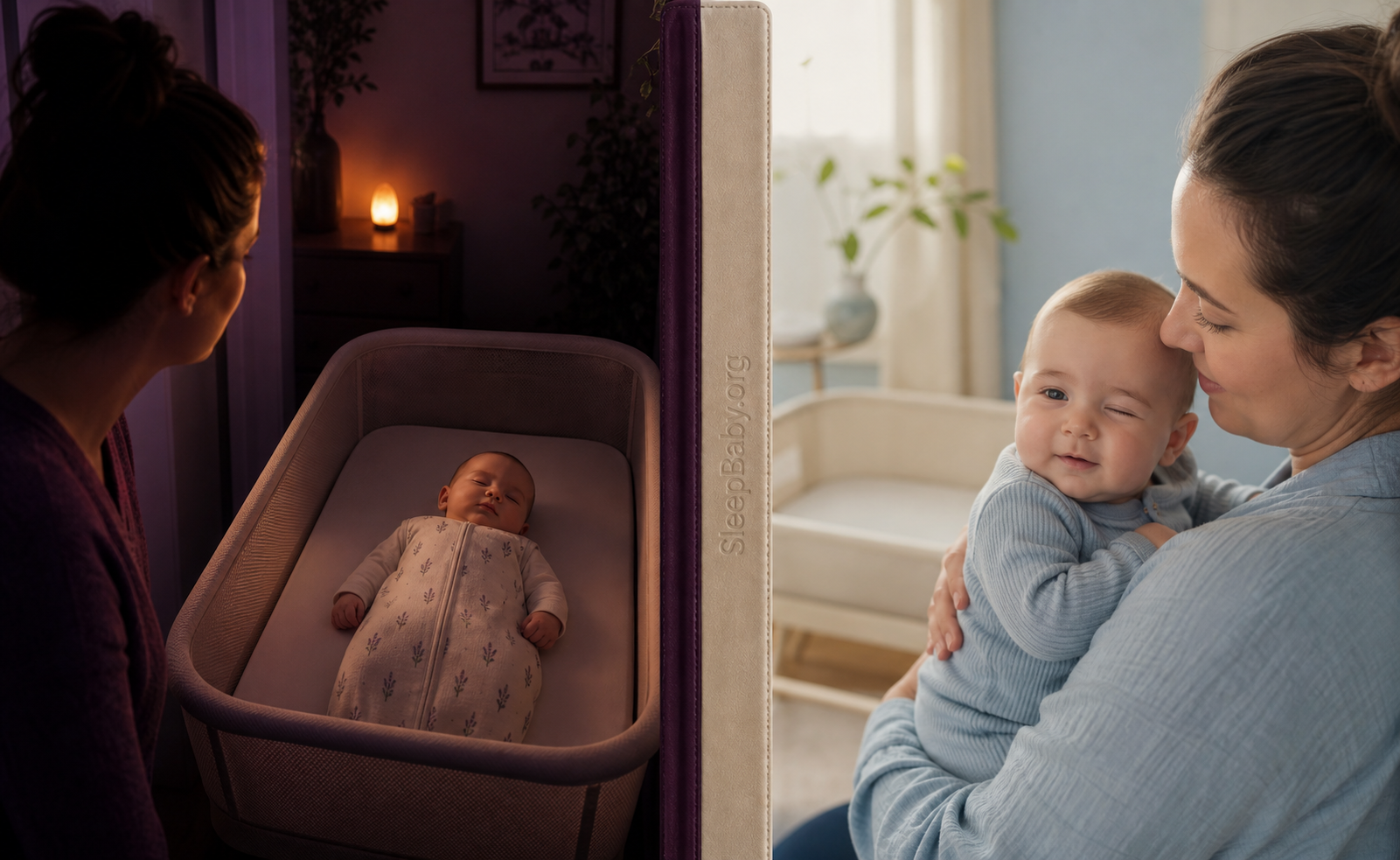
The eyelid question does not change safe sleep. Place your baby on their back on a firm, flat, noninclined sleep surface with a fitted sheet and no pillows, positioners, eye masks, loose blankets, toys, cords, or improvised props. Do not tilt the mattress to “help” the eye close. The NICHD and AAP safe-sleep guidance remains the same whether both lids are sealed or one looks slightly open.
If your baby falls asleep in a sitting device while you are puzzling over the eye, move them to an appropriate firm, flat sleep surface as soon as it is safe and practical. Our guide explaining why a baby should not sleep in a bouncer is the next useful read for that separate decision. An eyelid gap is not a reason to accept a less safe sleep position.
Watch: protect the sleep space while you observe
NICHD’s “Safe Sleep for Your Baby”
The eye question can tempt a parent to add a mask, positioner, towel, wedge, light, or monitoring accessory near the baby. This official Safe to Sleep video shows what belongs in the infant sleep space—and, just as importantly, what stays out.
Article-specific takeaway: observe the eyelid from outside the crib; do not change the baby’s position or add anything to the sleep space to make the eye look closed.
What I would not do to a baby’s eyelid at home
I would not tape it shut, press it closed, cover it with an eye patch, massage the lid, or put breast milk, water, saline, redness drops, lubricating drops, or ointment into the eye unless a pediatrician or eye professional gives specific instructions for this child. The right treatment depends on the reason the lid is open and on the condition of the eye’s surface. Advice written for an adult after surgery is not a safe substitute for an infant examination.
I also would not keep waking a comfortable baby to see if the slit is still there. One observation in sleep and one ordinary awake check are enough to decide whether you need a call. Repeated flash photos can create reflections that look alarming and can muddy the very detail you are trying to document.
If a clinician decides the eye needs protection, follow the exact product, amount, timing, and technique they give you. Eye care is one of those places where “something gentle” is not a complete instruction.
What the pediatrician or eye professional may ask
Expect questions about when you first noticed the gap, whether it is always the same eye, how long it lasts, whether the eye closes awake, and whether there has been birth trauma, another injury, swelling, illness, ear symptoms, rash, or a change in facial movement. They may ask about tearing, discharge, redness, light sensitivity, rubbing, sleep position, and any medicines or drops already used.
They may watch blinking and facial movement and look at the eye’s surface. A pediatric ophthalmologist can assess the eyelids, cornea, pupils, alignment, and vision development when needed. That is why the goal of your home observation is not to name the cause. It is to preserve the pattern clearly enough that the examination starts with good information.
Sometimes the outcome will be reassurance and watching. Sometimes a clinician will want eye-surface protection or further evaluation. The honest answer is that a nighttime photo cannot sort those branches, especially in a young baby. I would rather give you a clean decision boundary than a falsely confident label.
What one night can tell you—and what it cannot
A single bedtime can show timing. You may see the sliver appear while your baby is drifting off, disappear after the face becomes still, and return briefly during a busier stretch of sleep. That sequence is useful because it keeps the observation tied to sleep state. It still does not prove why the lid opened, and it does not guarantee that the eye’s surface is comfortable. Think of it as a timestamp, not a diagnosis.
A second useful detail is repeatability. “It happened for five seconds once” is a different history from “the same eye remains partly open through every nap.” Neither sentence tells you the cause, but the second gives the pediatrician a clearer reason to look at lid closure and the eye surface. You do not need to stay awake counting every episode. Note the side, the approximate duration, and whether the gap closes as sleep deepens. Then return to sleeping when you can.
Morning adds information that darkness cannot. In ordinary room light, notice one natural blink rather than asking the baby to perform. Look at both eyes, the brow, smile, cheek, and suck during normal interaction or feeding. Check whether the eye looks clear and comfortable. A camera flash can create a bright reflection or make a tiny gap look enormous, so the awake observation deserves more weight than the most dramatic freeze-frame.
If you do save a photo, include both eyes and enough of the face to preserve context. Record whether flash was used and whether the bright spot appeared in several images or only one angle. A photograph can document what prompted the call; it cannot confirm normal vision, rule out an eye-surface problem, or replace an examination. If the pupil itself looks white in person or repeatedly in photographs, contact a clinician promptly rather than spending the night recreating the picture.
A clinician-ready note
Four facts are more useful than a theory
- When: sleep onset, settled sleep, waking, or awake blinking.
- How: which eye, about how long, and whether the lid eventually sealed without being touched.
- Eye: clear or red, comfortable or irritated, with or without tearing, discharge, swelling, cloudiness, or an unusual pupil reflection.
- Whole baby: usual breathing, color, alertness, feeding, smile, brow, and facial movement—or any change.
Write what you observed, not “probably dreaming” or “definitely nerve damage.” A short clip plus these four facts helps the clinician decide whether routine follow-up, same-day assessment, or an eye examination fits the actual pattern.
SleepBaby.org original teaching component · Observation language, never a home diagnosis.
Waiting until daylight is reasonable only when the baby otherwise looks and acts usual, the eye is comfortable, and the gap is brief or sleep-only. “Check in the morning” is not a rule for an eye that will not close while awake, a new uneven face, marked redness, cloudiness, injury, apparent pain, a white-looking pupil, or a baby with breathing, color, responsiveness, or seizure-like concerns. Those findings use the call path above now, not after a better video.
Your two-light plan
Dim-light observation tonight, daylight check tomorrow
Tonight
Check breathing, color, comfort, and safe sleep. Notice whether the eyelid gap is brief or persistent. Record one short clip only if it is easy and safe.
Tomorrow
Watch a natural awake blink and both sides of the face in ordinary light. Contact the pediatrician if the pattern repeats or any comfort, eye, or facial concern appears.
Memorable line: baby first, eye second, theory last.
SleepBaby.org original teaching component · A timing tool, not a medical test.
Common parent questions, answered without guesswork
Can babies sleep with their eyes partly open because they are dreaming?
Active sleep includes eye movement and other visible activity, but we cannot look at one eyelid gap and know what a baby is dreaming—or whether dreaming explains the gap. Describe what you can actually observe: timing, duration, awake closure, eye comfort, and facial movement.
Is one eye more concerning than both?
A consistently one-sided pattern is worth describing to the pediatrician because asymmetry can help guide an examination. It is not proof of nerve damage or any other particular cause. The urgency comes from associated signs: failure to close awake, facial change, irritation, injury, unusual pupil appearance, or a baby who seems unwell.
Should I close the eyelid with my finger?
No. Do not press, rub, or repeatedly manipulate the lid. Observe a natural blink while your baby is awake. If the eye cannot close or looks exposed and irritated, contact a clinician for specific care instructions.
Can a baby monitor tell me whether this is safe?
A monitor may help you notice when the pattern happens, but it cannot assess the cornea, facial movement, vision, or the reason the lid is open. Consumer monitoring should never replace checking a baby who looks unwell or contacting a clinician about a persistent pattern.
What if it happened once and never again?
If it was a brief sleep-transition glimpse, the eye closes normally awake, the eye remains clear and comfortable, and your baby is entirely well, write down what you saw and bring it up at routine care if you remain concerned. Seek earlier guidance if it returns or any red flag appears.
Sources
- American Academy of Pediatrics: Phases of Sleep
- American Academy of Pediatrics: States of Consciousness in Newborns
- PubMed: Nocturnal Lagophthalmos—An Overview and Classification
- Royal Children’s Hospital: Facial Weakness and Bell’s Palsy Clinical Guideline
- Royal Children’s Hospital: Facial Palsy Parent Information
- American Association for Pediatric Ophthalmology and Strabismus: Leukocoria
- American Academy of Pediatrics: A Parent’s Guide to Safe Sleep
- NICHD Safe to Sleep: Safe Sleep for Your Baby
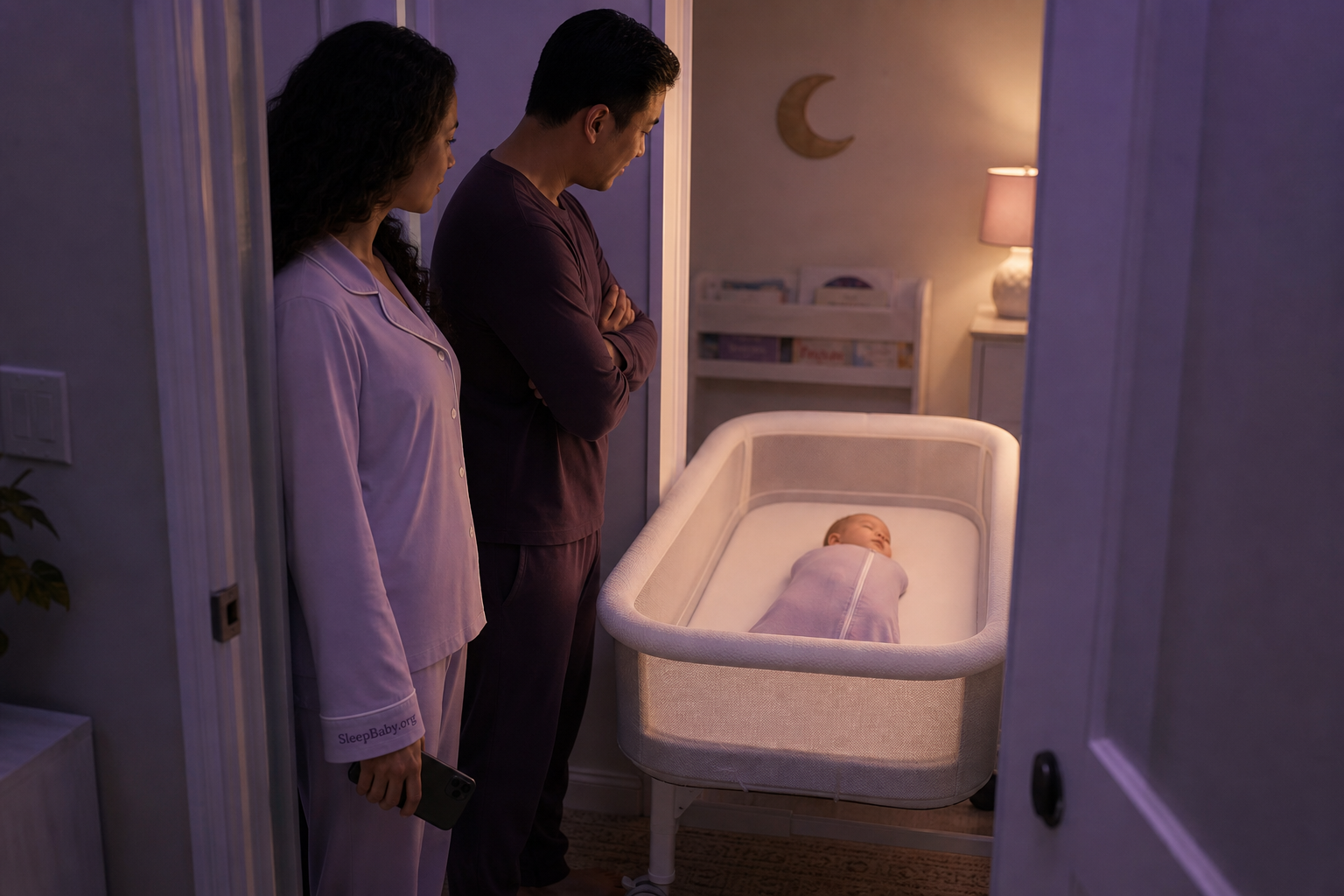
When the hallway light turns every detail into a question
Bring tonight back to one calm check at a time
You do not have to solve an eyelid mystery beside the crib. Check the baby, note the pattern, make the right call, and let the rest of the night return to sleep. SleepBaby offers practical, evidence-aware guidance for the next bedtime question without pretending to replace your child’s clinician.