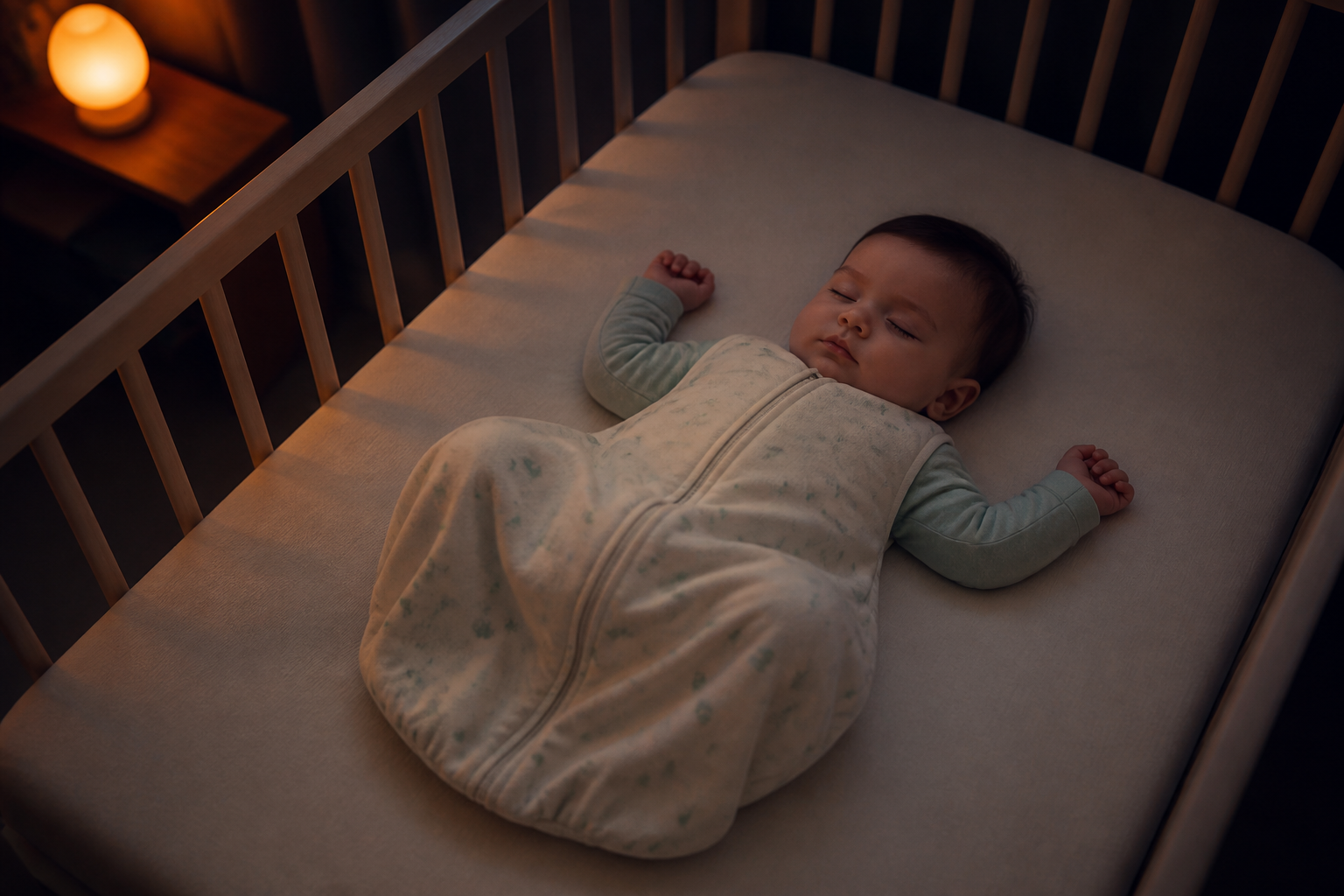
Baby sleep positions
Baby Sleeps With Legs Up: What the Position Means—and What to Watch
Bent knees and raised legs are often ordinary infant movement. The useful question is not what one frozen pose “means,” but what your baby’s comfort, symmetry, movement, and overall health show around it.

The monitor catches a strange little silhouette: your baby is flat on their back, but both knees are lifted as though they paused halfway through an invisible bicycle ride. It is exactly the kind of image that looks harmless at 2 p.m. and medically significant at 2 a.m.
Is it normal for a baby to sleep with their legs up?
Often, yes. Newborns normally spend time in a flexed posture, and babies move their legs during sleep. If both legs bend and relax similarly, your baby seems comfortable, and they move, feed, wake, and behave normally, raised legs by themselves usually do not require you to “fix” the position. Keep placing your baby on their back on a firm, flat, empty sleep surface.
The answer changes when the posture is persistently one-sided, movement seems painful or limited, one leg is used less, a joint is hot or swollen, or your baby also seems unwell. Those surrounding signs—not a single monitor frame—are what deserve pediatric attention.
I would resist assigning a grand theory to the knees alone. A baby sleeping with legs up is not, by that fact, proving gas, constipation, colic, hip dysplasia, or a neurologic problem. It is a position. Your next job is to watch what the body does before and after it.
Why babies often bend or lift their legs
Flexion is part of early infant posture. A newborn examination guideline from the NHS describes a normal term newborn as assuming a flexed posture with intermittent extension. In plain language: bent arms and legs can be ordinary, and they should also move out of that posture. The same clinical guidance emphasizes symmetrical spontaneous movement and some movement against gravity in all four limbs.
That distinction matters. “Bent” is not the same as “stuck.” “Legs up” is not the same as “unable to lower them.” A sleepy baby may draw both knees toward the body, kick, relax, and do it again without waking. Older babies may briefly lift their legs while shifting between sleep states or settling their body. None of those observations lets us diagnose a cause from the monitor, but they do explain why a moving baby can create a very dramatic still image.
The current version of this page used to say that lifting the legs helps digestion or moves gas along. That is too certain. A baby may lift their legs near the same time they grunt, pass stool, feed, or seem uncomfortable, but timing does not prove the leg position caused or relieved anything. If digestion is your concern, observe the digestion clues directly: feeding, vomiting, abdominal swelling, stool pattern, consolability, and whether discomfort continues while awake.
A position cannot diagnose the reason
- What you can see
- Both knees rise, both feet kick, the legs relax again.
- What you cannot conclude from that alone
- Gas, colic, constipation, reflux, hip dysplasia, or abnormal muscle tone.
- What adds useful context
- Symmetry, comfort, awake movement, feeding, temperature, swelling, color, and whether the pattern is new.
Composite Kacey-and-Benjamin scene: This clearly labeled scene combines common parent observations and is not a claim about a documented family event or medical evidence.
The monitor frame that looked like a conclusion
Imagine me pausing the monitor over Benjamin’s crib. His sleep sack is flat against the mattress, both knees are pointing toward the camera, and for one second he looks less like a sleeping baby than a tiny person attempting a yoga pose without instruction or consent.
My first thought is not especially scientific: Why are your legs doing that? My second thought arrives carrying a clipboard and several alarming search terms. But then the video continues. One knee lowers. Both feet kick. His face stays loose. A minute later his legs are resting differently, and he never fully wakes.
That short sequence is the useful part of the composite. A paused image invited me to name a condition; the moving picture gave me observations. I could describe symmetry, comfort, change, and function. Those are facts I could use. The scary label I nearly supplied was not.

Use the “still photo versus short film” check
If the posture is worrying you tonight, watch for a minute or two before touching or repositioning your baby. You are not conducting a home neurologic or orthopedic examination. You are gathering ordinary observations that help you decide whether this is comfortable movement or something worth discussing.
1. Both sides
Do both legs lift, kick, and relax? Does one leg consistently stay still, look shorter, or move through noticeably less range?
2. Comfort
Is your baby sleeping or settling peacefully? Do they cry when a leg moves, resist ordinary diapering, or seem unable to get comfortable?
3. Function while awake
During ordinary awake time, do you see spontaneous kicks and movement from both legs? An awake comparison is more informative than sleep posture alone.
4. Change
Has your baby always curled this way, or is this new, persistent, or becoming more pronounced? A clear change from baseline deserves more attention.
5. Company
Is the pose accompanied by fever, swelling, unusual color, breathing trouble, vomiting, poor feeding, unusual sleepiness, or a cry that sounds wrong?
If everything around the position looks ordinary, I would make a brief note and leave the sleeping baby asleep. If one of those surrounding details is off, you now have something concrete to tell the pediatrician: “The left leg has moved less since this afternoon,” is far more useful than, “The pose looked strange.”
Age changes what you can observe—not the safe-sleep starting point
A curled newborn, a four-month-old thumping both heels, and a mobile nine-month-old folding their knees after rolling are not doing exactly the same developmental job. That is why the baby’s age and current skills belong in your description. It is also why a universal internet timetable for when legs should “straighten” is not very useful.
With a newborn, I would focus on whether flexion alternates with spontaneous extension and whether both sides move. During diaper changes, you may see the hips and knees naturally open and close without needing to test them. Keep scheduled newborn and well-child examinations, because clinicians are trained to assess posture, tone, and hip stability in context.
As babies gain strength, leg lifting can become louder and more deliberate. Both heels may rise and land against the mattress. A baby may grab their feet while awake, carry the movement into drowsiness, or briefly repeat a new skill around sleep. The sound can wake a parent long before it wakes the person producing it. What keeps this in the ordinary column is comfortable, varied, symmetric movement—not reaching a particular milestone on a particular date.
Once a baby is rolling, crawling, or pulling into different positions independently, the crib may show more creative geometry. You still place the baby down on the back. If they can roll comfortably both ways, you can leave them in the position they choose while maintaining an empty sleep space. If they get into a position and cannot get out, become distressed, or repeatedly need help, that is a different practical problem from simply sleeping with knees raised.
When Should a Baby’s Legs Straighten Out?
“Six months old” is useful. “Rolls both ways, kicks both legs, and lowers the knees without waking” is much more informative. If you call the pediatrician, include both.
What if the raised legs come with grunting or straining?
Grunting is a sound, not a diagnosis. Very young babies can be noisy sleepers, and they can also grunt while learning to coordinate pressure and relaxation for a bowel movement. But a parent watching from across the room cannot safely decide from sound plus raised knees that the answer is “just gas.”
First check breathing. A brief digestive-sounding grunt in an otherwise pink, comfortably breathing baby is not the same as repeated grunting with every breath, nostril flaring, the chest or belly pulling in, pauses, fast breathing, or blue, grey, pale, or blotchy color. Breathing difficulty belongs in the urgent category regardless of where the legs are.
Next look at the pattern outside sleep. Is feeding normal? Is the abdomen becoming swollen or firm? Is there repeated vomiting, blood, a major change in stool, fewer wet diapers, fever, or a baby who cannot be consoled? Those details give a clinician something meaningful to assess. Bicycle-leg exercises or gentle knee movement are sometimes discussed for awake, supervised comfort, but they should never become forceful manipulation and never justify placing props in the crib.
I would also avoid treating every noisy effort as constipation. Stool consistency and the baby’s overall condition matter more than the facial expression alone. If you are unsure—especially with a young infant—call the pediatrician rather than cycling through remedies based on a monitor clip.
The safe-sleep rules do not change because the legs look unusual
Always place an infant on their back for naps and nighttime sleep. Use a crib, bassinet, portable crib, or play yard with a firm, flat, noninclined surface that meets current safety standards. The mattress needs its fitted sheet and nothing else: no pillow, loose blanket, bumper, toy, wedge, rolled towel, or positioner.
Please do not add equipment to hold the knees down, prop the hips, or keep the body at an angle. A sleep positioner does not make an unexplained pose safer. It introduces a suffocation or entrapment hazard into a space that should remain bare.
If your baby falls asleep in a car seat, swing, stroller, carrier, or sling, move them to a firm, flat sleep surface on their back as soon as practical. The fact that the legs appear straighter or more bent in a sitting device does not make that device a safe routine sleep location.
Keep the sleep setup boring
- Back: begin every infant sleep on the back.
- Flat: use a firm, level, noninclined approved surface.
- Bare: fitted sheet only; no positioning products.
- Free: let the legs rest and move naturally rather than binding them straight.
Babies who can comfortably roll both ways may choose another position after being placed on their back. The American Academy of Pediatrics says you do not need to keep turning such a baby back over, but the sleep space must remain empty. Rolling ability does not make pillows, blankets, toys, or positioners safe.
Let the hips bend and move inside a swaddle
A baby’s legs do not need to be wrapped straight to look tidy. In fact, the American Academy of Pediatrics and the Pediatric Orthopaedic Society of North America promote hip-healthy swaddling that leaves room for the legs to bend up and out. Straightening the legs and wrapping them tightly can contribute to hip problems.
That does not mean every bent-knee sleeper has a hip condition. It means we should not fight normal hip movement with tight fabric. Check that the lower portion of the swaddle allows flexion and movement, while following the product’s instructions and all safe-sleep guidance.
Stop swaddling when your baby shows signs of trying to roll. At that point the problem is not the angle of the knees; it is the possibility of a swaddled baby rolling onto the stomach without free arms to help reposition. A correctly sized, nonweighted sleep sack that does not restrict the hips can provide warmth without loose bedding.
Room to move
Hips and knees can bend; legs can move up and out; fabric is not forcing them straight.
Not tightly bound
Legs are not pulled straight together, weighted, pinned, or held by a positioner.
When does a leg position raise a hip question?
Developmental dysplasia of the hip cannot be confirmed from a sleeping pose. Pediatric clinicians check hip stability and movement after birth and during well-child visits. The AAP notes that breech presentation and family history can increase risk, and clinicians pay attention to limited motion, one leg appearing shorter, and uneven thigh or buttock creases.
Skin-fold asymmetry by itself is not a home diagnosis, and parents should not try to reproduce the clinician’s hip maneuvers. Do not force the knees apart, repeatedly test a “click,” or compare the baby to an online demonstration. If you notice persistent asymmetry or limited use, record what you see during ordinary care and ask the pediatrician to examine it.
Useful questions to bring to the pediatrician
- “Both legs lift during sleep, but does their awake movement look symmetric to you?”
- “This leg seems to open less during diaper changes. Would you examine the hip range of motion?”
- “My baby was breech / has a family history of hip dysplasia. Is the usual screening plan enough?”
- “Could you show me what normal hip-friendly movement and swaddling space look like?”

What would make me call the pediatrician?
I would call for advice if the position is consistently one-sided, one leg moves less, ordinary movement seems painful, a joint is red, hot, or swollen, or the pattern is new and persistent. I would also call if the baby is feeding differently, vomiting repeatedly, unusually difficult to console, or generally not acting like themselves. The purpose is not to attach a frightening diagnosis; it is to have a clinician assess a meaningful change.
Get urgent medical help now when the posture appears with serious illness signs
- difficulty breathing, very fast breathing, pauses, or the chest pulling in;
- blue, grey, very pale, or blotchy skin, lips, or tongue;
- being difficult to wake, unusually floppy, unresponsive, or having a seizure;
- a serious injury, a limb at an abnormal angle, or severe pain;
- an age-specific fever or low temperature that meets urgent-care guidance;
- not using a limb normally together with illness, swelling, heat, or worsening symptoms.
In the United States, call 911 for an emergency. For urgent but non-emergency concerns, contact your pediatrician or local urgent-care line. Follow the emergency guidance where you live.
Urgent guidance belongs before storytelling when a baby seems ill. A peaceful baby with two comfortably moving legs is a different situation from a baby who cannot be woken or is struggling to breathe, even if the monitor screenshot looks similar at first glance.
What to do tonight
- Keep the safe setup unchanged. Back placement, firm flat surface, fitted sheet only.
- Watch briefly before intervening. Notice whether both legs lower, kick, and relax.
- Compare during normal awake care. Look for comfortable movement from both sides without forcing a range-of-motion test.
- Write down a concrete change. Time, side, duration, comfort, feeding, temperature, swelling, and other symptoms are useful.
- Escalate according to the company it keeps. Call the pediatrician for persistent asymmetry, pain, reduced use, or concern; seek urgent help for serious illness signs.
I would not change the mattress, add a positioner, stop normal kicking, or spend the night pushing the knees down. If your baby is comfortable and the short film looks ordinary, the most useful intervention may be no intervention at all.
Watch the safety boundary
Back placement matters more than making the legs look straight
In this American Academy of Pediatrics video, use the five essentials to check the sleep surface and back-placement rule—not to diagnose a movement pattern from a screen.
Takeaway: start on the back, keep the surface firm and bare, and never add a device to control the legs.
Questions parents ask about raised legs during sleep
Does lifting the legs mean my baby has gas?
Not by itself. Leg lifting can happen near grunting, stooling, or passing gas, but the posture alone does not establish the cause. Look at feeding, vomiting, abdominal swelling, stool pattern, comfort, and what happens while awake. Ask the pediatrician about persistent discomfort rather than treating the leg pose as proof.
Should I lower my baby’s legs while they sleep?
Usually not if your baby is comfortable and both legs move normally. Do not force the legs flat or add a prop. Keep the safe sleep space bare and let the body move naturally.
Is a frog-leg posture normal?
Young babies often rest with hips and knees flexed, but “frog-leg” is used loosely online and can describe different things. What matters is whether movement is symmetric, spontaneous, and comfortable. A baby who is unusually floppy, moves very little, or holds a persistent abnormal posture needs clinical assessment.
Can tight swaddling straighten the legs?
It should not. Hip-healthy swaddling leaves room for the legs to bend up and out. Tight straight-leg wrapping can harm hip development. Stop swaddling when rolling attempts begin.
What if only one leg stays raised?
Watch awake movement and comfort. If one leg persistently moves less, seems painful, looks shorter, has swelling or color change, or the difference is new, contact the pediatrician. Seek urgent help when serious injury or illness signs are present.
Sources
- American Academy of Pediatrics: How to Keep Your Sleeping Baby Safe
- Norfolk and Norwich University Hospitals NHS: Newborn and Infant Physical Examination guideline
- American Academy of Pediatrics: Hip Dysplasia
- American Academy of Pediatrics: Swaddling—Is It Safe?
- American Academy of Orthopaedic Surgeons: DDH Plain-Language Summary
- NHS: When to Get Urgent Medical Help for Babies and Children Under 5
The same monitor frame, with a better question
Your baby’s knees may still be hovering above the sleep sack when you look again. The picture has not changed. What changed is the question you bring to it.
Instead of asking the pose to name a diagnosis, you can watch the short film: both sides, comfort, awake function, change, and the symptoms keeping it company. You can keep the crib flat and bare, leave the hips free to bend, and know exactly which details deserve a call.
That is the kind of nighttime certainty I trust—not certainty about why one knee rose at 2:13 a.m., but certainty about what keeps a baby safe and what would change my mind.
I would carry that distinction into my next check: we can notice the position without asking it to explain everything, and we can keep our attention on comfort, symmetry, awake movement, and change.






What viewers said10 comments · 4 replies+
Archived comments from the original Baby Sleep Miracle presentation. Not independently verified by SleepBaby.org; individual experiences vary.
Thank you so much for this video! I had no idea about the dangers of baby swings :O
Hi Mary-Ann. I have a question: Is method in any way similar to the ones recommended by Dr Bucknam, Dr. Weissbluth or Dr. Karp? We tried those but none of them help.
Hi Regina, thank you for your question. The short answer is no. The techniques I share in my guide are based on newest scientific research and this is why I have never seen any approach similar to the one I recommend.
This method really works! I tried it on my son Jesus and after just one week he went from waking up more than 5 times a night to waking up just once or twice. You are a lifesaver, Mary-Ann!
I'm truly impressed with how much information you share in your video. And all for free! I can feel that you truly care about mothers like myself, and that's hard to find these days. I have recommended your site to several of my friends already.
Mary-Ann, our child suffers from autism. Is your approach still suited?
Chloe, I made sure my method can be used with any child, even babies who are special like yours. Please note that I'm not a doctor and that I always advice to consult with your physician because nothing is more important than the safety and well-being of your love.
Hallo Mary-Ann, I'm from Germany. Do you have your guide in German?
Hello Heide, we do! Normally you should already see our video in German. If not, please contact our support so they can guide you
Thenk you for your answer, Mary-Ann!
I just completed your approach and I have to say, it worked almost too well. Yes, it took a bit of getting used to with your bedtime routine but the difference is huge. My son George used to take 1 hours to go down and now he's firmly asleep in no more than 10 minutes! You're the best!
It seems I'm the only man watching this video, lol! What you shared about the 'emotional backpack' made immediate sense to me and I can't wait to help my little girl Mila to unpack it!
Hey there, just discovered your site and this really sounds different. Just wanted to say thanks for sharing :)
For everyone who's still thinking about getting Mary-Ann's guide I want to advise you to go ahead. I wasn't sure myself but now I'm so thankful I invested in this program. It made a huge difference in our life as a family and yes, my baby girl does sleep through the night now.