
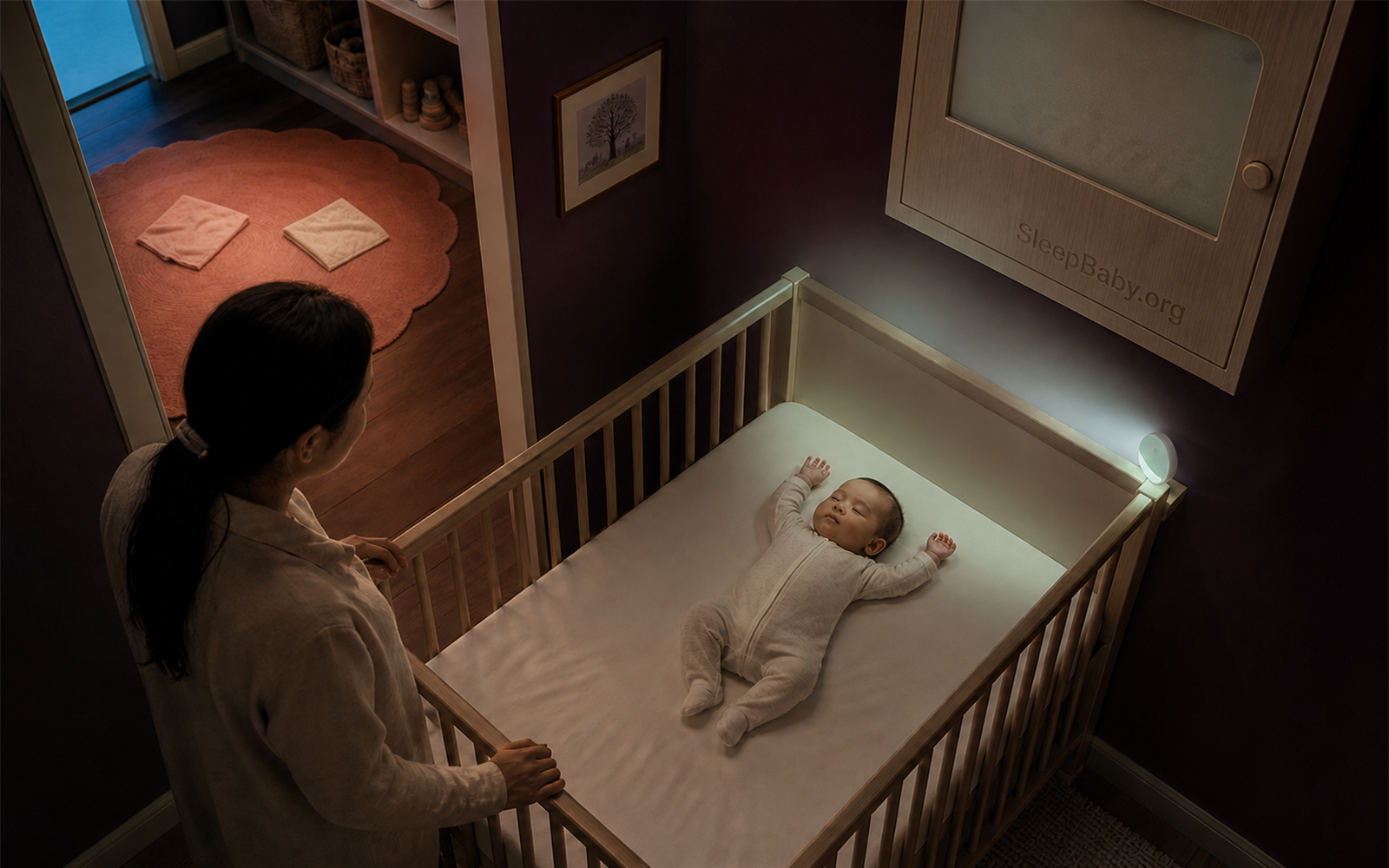
The monitor catches one quiet frame: your baby is flat on their back, both elbows above the head, hands parked near the ears as if bedtime involved a tiny victory pose. Most of the time, relaxed arms up during sleep are not something you need to correct. A newborn may fling the arms outward during the normal Moro, or startle, reflex; at other times, the arms have simply settled where they are comfortable.
I would not push the arms down or assign a medical, emotional, or sleep-stage meaning to the angle. I would look at the whole baby and the sleep space: comfortable breathing, usual color and responsiveness, broadly similar movement on both sides while awake, the baby’s rolling stage, and a firm, flat, level, bare surface with back placement for every sleep. Those details answer the safety question. The silhouette alone does not.
Persistent one-sided movement, pain, swelling, stiffness, unusual limpness, or an injury concern belongs with the pediatrician. Inability to wake, severe trouble breathing, blue or gray lips or face, marked weakness, or seizure-like rhythmic jerking with loss of responsiveness requires emergency help.
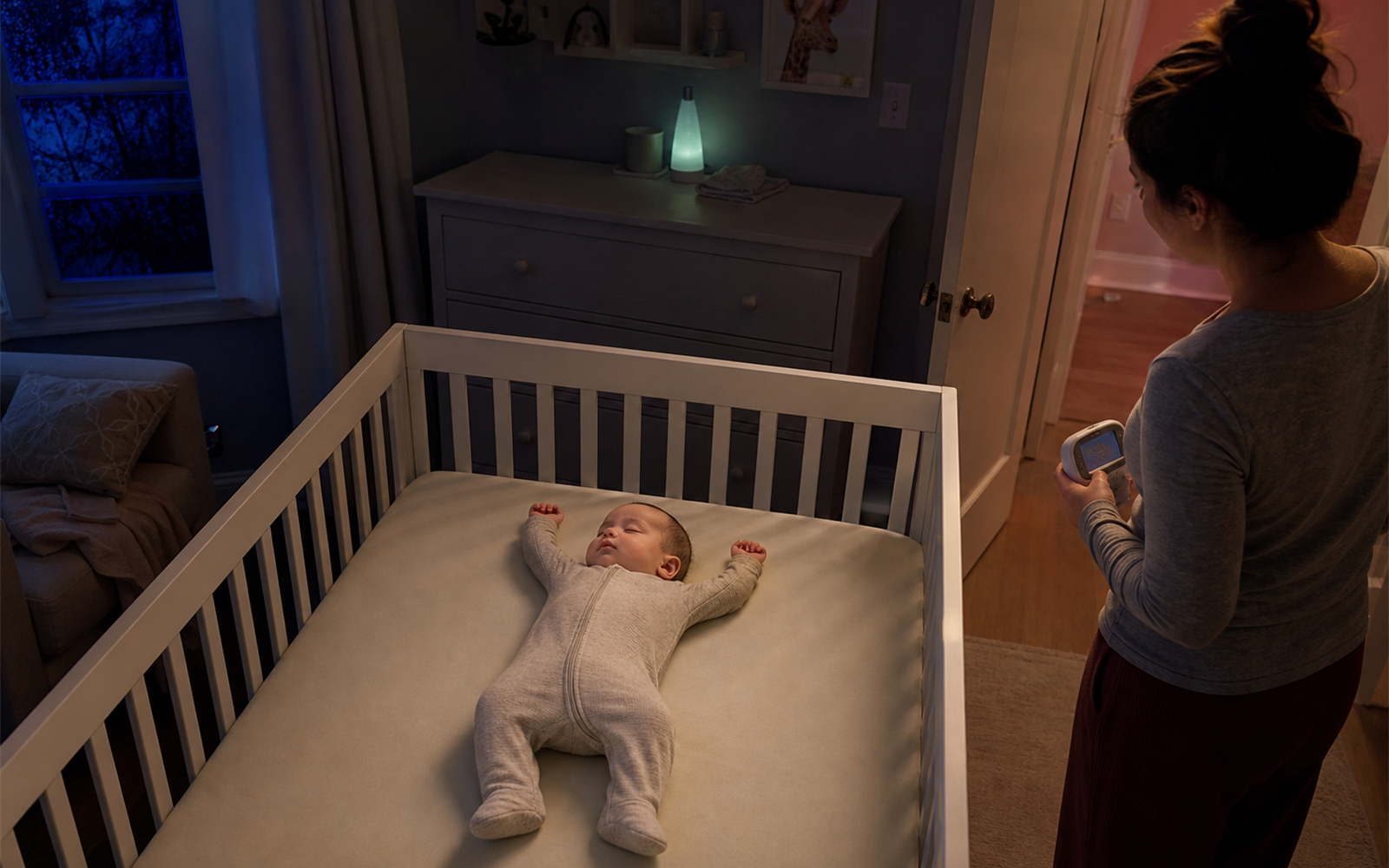
Why do babies sleep with their arms up?
There is no single meaning stamped onto this position. In a newborn, a sudden sound, a movement of the head, or the sensation of being lowered can trigger the Moro reflex. The arms move outward, the hands open, and then the arms return toward the body. That is a movement sequence, not a permanent sleeping pose. It is common in newborns and normally fades during the early months as the nervous system matures.
A still photograph can catch the middle or the end of that sequence. It can also catch something much simpler: your baby’s shoulders are externally rotated, the elbows are bent, and gravity has let the hands rest near the head. The monitor supplies one silent frame and, rather unhelpfully, no footnotes. You need the few seconds before and after the picture to know whether you saw a startle or a resting position.
Another normal newborn posture is the tonic-neck, or fencing, reflex, in which the head turns and one arm extends while the other bends. That is not the same as both arms resting overhead. The useful distinction is not to name every shape from the crib. It is to notice whether movement is broadly similar on both sides during ordinary awake time and whether anything else about your baby has changed.
I would also retire the tempting stories that raised arms prove deep sleep, emotional security, good circulation, temperature control, or a memory of the womb. A baby can be perfectly comfortable with arms up, but the position does not verify those explanations. Reassurance is stronger when it rests on observable facts rather than a charming pose mythology.

The ARMS check
Move your attention outward from the elbows
This is an observation tool, not a home test or diagnosis. Its job is to help you notice what deserves no change, what deserves a pediatric call, and what belongs in emergency care.
-
Alertness, breathing, and color.
Comfortable breathing, usual color, normal responsiveness when awake, and expected feeding matter more than where the hands landed. Difficulty waking, severe breathing trouble, blue-gray color, marked weakness, or seizure-like rhythmic movement with loss of responsiveness requires emergency help. -
Range and symmetry while awake.
Watch ordinary reaching, stretching, feeding, and play rather than trying to trigger a reflex. Tell the pediatrician if one arm repeatedly moves less, a reflex looks consistently one-sided, or there is stiffness, limpness, pain, swelling, or possible injury. -
Milestone and rolling status.
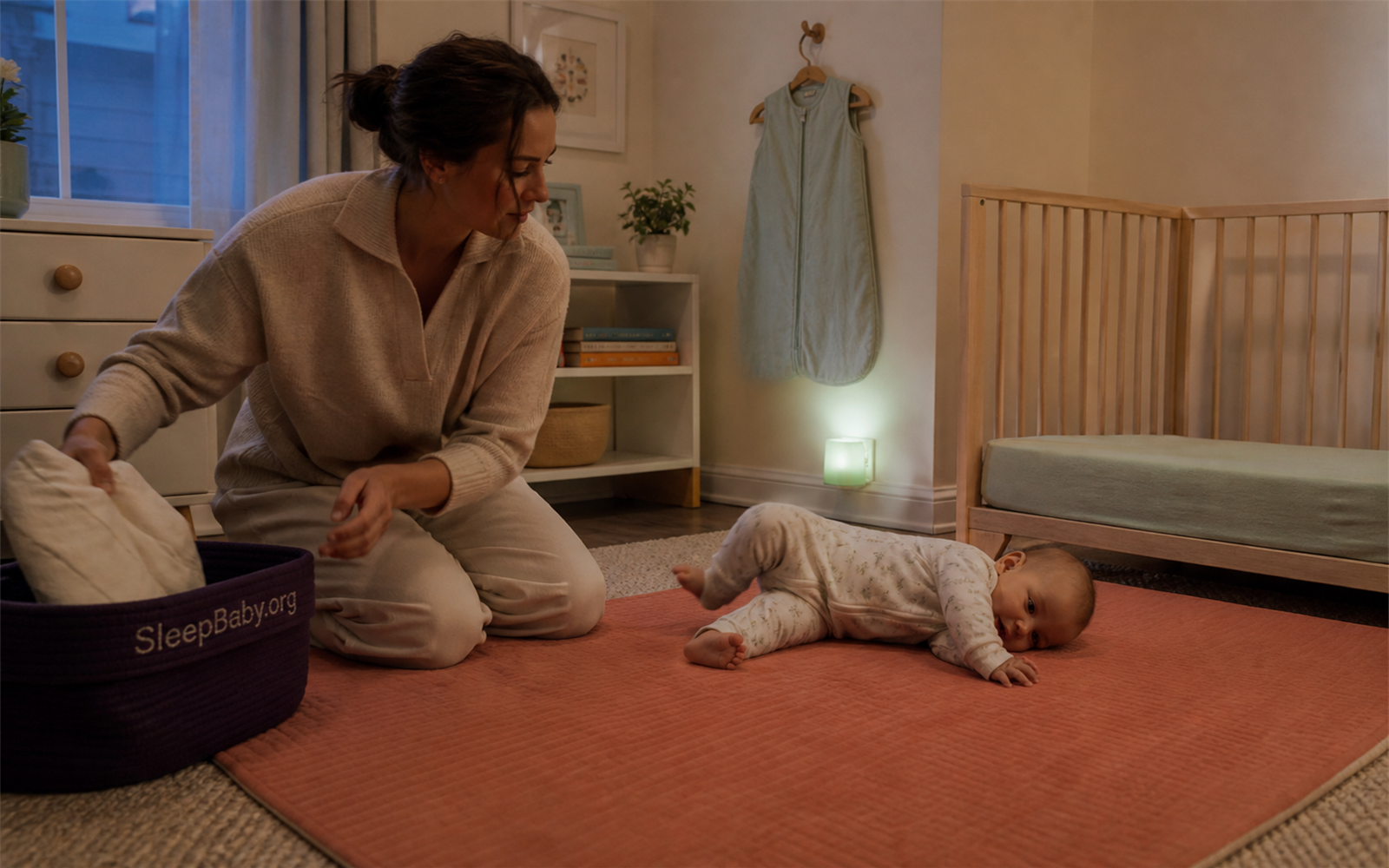
The arm preference does not decide whether a swaddle continues. The first sign that a baby is trying to roll ends swaddling. A date on the calendar never outranks the movement your baby is showing today. -
Surface and sleepwear.
Begin every sleep on the back on a firm, flat, level infant sleep surface with only a fitted sheet. Keep pillows, loose blankets, toys, bumpers, positioners, and weighted sleep products out. Use correctly fitted sleepwear instead of adding loose bedding.
Created for SleepBaby.org. The ARMS check organizes observations; it cannot rule a condition in or out.
Is it the Moro reflex or just a resting pose?
The easiest way to separate them is time. A resting pose persists. The Moro reflex unfolds. You may see the arms shoot outward, the hands open, and the arms return inward after a sound, a head movement, or a transfer. Some babies cry; others settle again quickly. The exact trigger is not always obvious from the monitor.
You do not need to reproduce the movement to check it. Please do not drop, jostle, or deliberately startle a baby. Clinicians assess newborn reflexes in a controlled examination because symmetry and context matter. At home, an ordinary observation is enough: did you see a brief sequence, or did you look over and find two relaxed elbows above the head?
A still shape versus a few moving seconds
What the monitor can show — and what it cannot prove
| What you notice | What it may describe | What to do |
|---|---|---|
| Both arms remain relaxed overhead | A comfortable resting position may be all you are seeing. | Use the ARMS check. Do not push relaxed arms down. |
| Arms fling out, hands open, then return | This sequence can fit the newborn Moro or startle reflex. | Observe naturally. Do not try to trigger it at home. |
| One arm repeatedly moves less, hurts, swells, or stays unusually stiff or limp | That is no longer only a sleep-position question. | Contact the pediatrician promptly; use emergency care when alertness, breathing, color, strength, or responsiveness is seriously abnormal. |
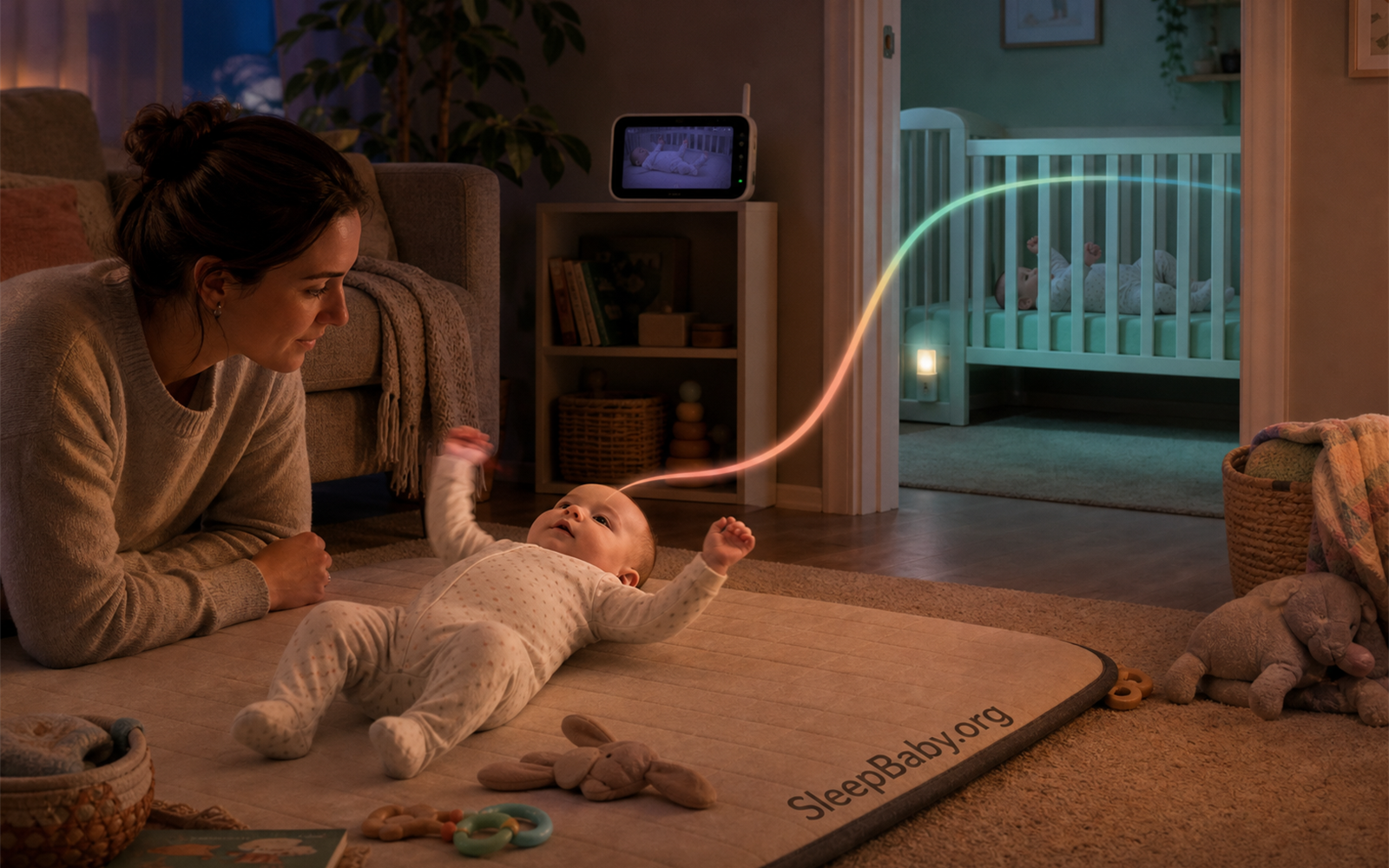
The reflex normally fades over the early months, but bodies do not replace it with one approved sleeping-arm location. An older baby may still choose hands near the head. A toddler may stretch both arms overhead. Age changes which reflex explanation is plausible; it does not turn the pose into a personality test.
The arm angle is not the safe-sleep test
This is the distinction I most want to protect. Safe infant sleep does not depend on arranging the arms into a particular shape. Place your baby on the back for every nap and every night. Use a firm, flat, level sleep surface designed for infant sleep, covered only by a fitted sheet. Keep loose blankets, pillows, toys, positioners, bumpers, and other soft objects out of the sleep space.
If your baby rolls independently from back to stomach and stomach to back, continue placing the baby down on the back; you generally do not need to turn a baby back repeatedly after they roll on their own. Swaddling must already have stopped at the first sign of trying to roll. The arms-up pose does not postpone that transition.
Do not add a wedge, rolled towel, pillow, restraint, or sleep positioner to keep the arms down or hold the body in place. Do not use a weighted swaddle, weighted blanket, or weighted sleep garment. And do not buy a consumer monitor in order to make the arm angle meaningful. No product turns a monitor silhouette into a SIDS screen or a medical assessment.
If your baby fusses when placed on the back, the answer is still not to switch to an unsafe surface or prop the body. These safe steps when a baby cries on their back can help you troubleshoot the handoff while preserving the back, firm-flat, bare setup.
What to do in the first few minutes after you notice it
If your baby is already asleep, resist the reflex to rush in and straighten every visible joint. I know how quickly a monitor picture can make one ordinary elbow feel like a household assignment. Start where you are. Watch the chest rise, look at color, and ask whether your baby entered sleep in the usual way. If breathing, color, and responsiveness are seriously abnormal, use emergency help. If they are usual, let the next questions be quieter.
Notice now, compare when awake
A four-stop nighttime sequence
- 1. Observe.
Is this a still relaxed pose, or did you see a brief arms-out-and-return movement? - 2. Scan.
Check breathing, color, the bare surface, and anything else that changes the care level. - 3. Remember.
How did both arms move during feeding, dressing, reaching, and play while awake? - 4. Place the milestone.
Has your baby shown any attempt to roll? That answer governs swaddling.
When your baby wakes, observe ordinary movement rather than conducting a test. Let the baby reach during play, bring hands toward the mouth, move during a diaper change, and settle into familiar feeding positions. One sleepy photograph is weak evidence; repeated one-sided limitation while awake is useful information for the pediatrician. If the movement happens naturally again, note the timing or record a short video only when doing so does not delay care.
If the arms-up movement seems to happen during transfers and wakes a not-yet-rolling newborn, check the handoff before changing the whole bedtime routine. Move steadily, support the head and body, lower close to the sleep surface, and keep the room cues familiar. Swaddling is one optional choice for an eligible baby, not the default answer and never a substitute for the safe sleep setup. Once rolling attempts begin, the practical task changes from containing the startle to helping your baby settle with the arms free.
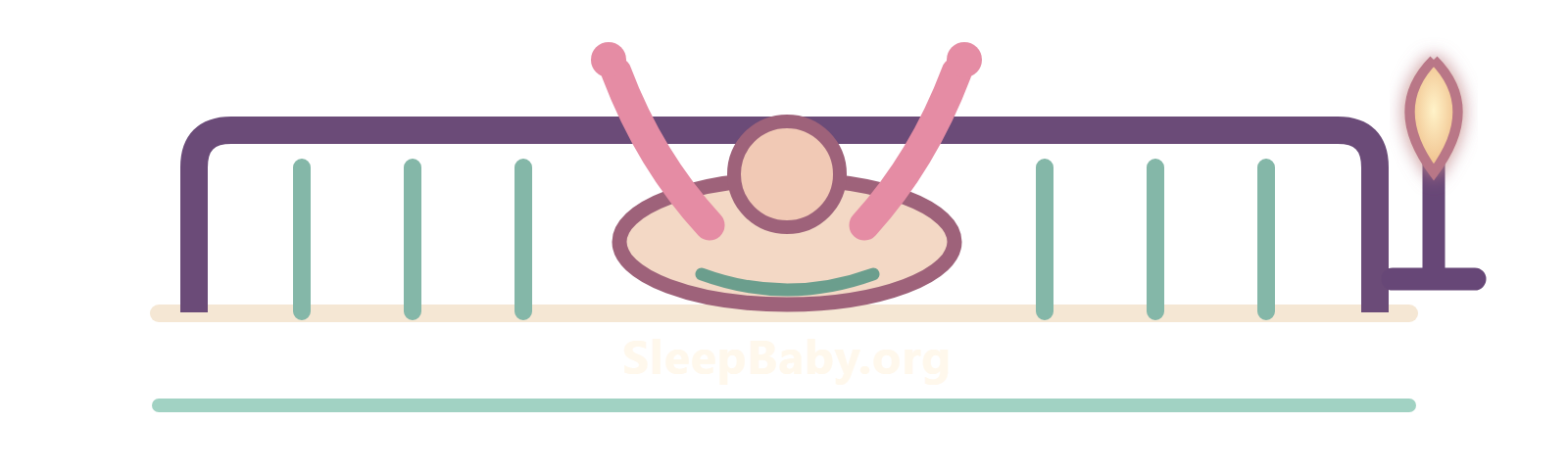
Can you swaddle a baby with the arms up or out?
Swaddling is a separate decision from the resting pose. The American Academy of Pediatrics says there is no evidence that SIDS risk differs according to whether a swaddled baby’s arms are in or out. That sentence is narrower than a product promise: it does not mean swaddling prevents SIDS, and it does not mean every swaddle arrangement is safe.
If a young baby is not showing any sign of trying to roll and you choose to swaddle, always place the baby on the back. Use a correctly sized, unweighted garment or a wrap that cannot come loose around the face. Keep the hips and knees able to bend and move. Dress for the room rather than piling on layers, and watch for overheating. Follow the current manufacturer instructions for fit, weight range, layers, care, and stop-use signs.
Stop swaddling at the first sign of trying to roll. Do not wait for a successful roll. Do not use an age cutoff to overrule what your baby is doing. Do not keep compressing the chest or torso while merely freeing the arms and calling the garment a sleep sack. Once the swaddle stage ends, an unweighted, arms-free wearable blanket can provide warmth without loose bedding when it is correctly sized and used as labeled.
The rolling milestone owns the handoff
Three lanes, no calendar loophole
No rolling attempt
Swaddling is optional. If chosen, use back placement, correct fit, hip room, no weights, and the manufacturer’s current instructions.
Any sign of trying to roll
Stop swaddling now. A favorite arms-up position does not extend the swaddle stage.
Arms-free stage
Use fitted pajamas or an unweighted, arms-free wearable blanket for warmth. Keep the sleep space bare.
The rule that wins: your baby’s current movement, not the garment’s marketing age or your hoped-for final night in it.
Created for SleepBaby.org
What if one arm looks different?
A single monitor frame can exaggerate asymmetry. The head may be turned. One shoulder may be closer to the camera. The baby’s clothing may hide one hand. I would not diagnose a nerve, joint, muscle-tone, or seizure problem from that image.
I would notice what happens while the baby is awake. Does each arm reach, stretch, flex, and relax in broadly similar ways? Is one arm consistently still while the other moves? Does touching or dressing the arm seem painful? Is there swelling, discoloration, an unusual angle, or a recent fall or difficult delivery concern that the clinician should know about? A video of the naturally occurring movement can be useful to a pediatrician, but do not provoke the movement or delay care in order to record it.
Tell the pediatrician promptly about a reflex or movement that repeatedly differs between sides, one arm moving less, pain, swelling, stiffness, unusual limpness, or possible injury. Use emergency services for inability to wake, severe breathing difficulty, blue, purple, or gray lips or face, collapse, marked weakness or lack of movement, or rhythmic jerking with loss of responsiveness. Those are whole-baby emergency signs, not ordinary variations of an arms-up sleep pose.
What changes the care level
The pose is low-information. The company it keeps is not.
Usually observe
Both arms relaxed overhead, comfortable breathing, usual color and responsiveness, normal feeding, and broadly similar awake movement.
Call the pediatrician
Persistent asymmetry, one arm moving less, pain, swelling, stiffness, limpness, unusual posture while awake, or an injury concern.
Get emergency help
Inability to wake, severe breathing trouble, blue-gray color, collapse, marked weakness, or seizure-like rhythmic jerking with lost responsiveness.

What about an older baby, a toddler, or circulation?
An older baby or toddler may sleep with the arms overhead for the same unremarkable reason an adult sometimes does: the position feels comfortable. The fading Moro reflex makes a newborn-reflex explanation less likely, but it does not create a new proof of emotional security, deep sleep, or developmental status. Look at function while awake, not symbolism while asleep.
For circulation, check observable changes rather than assuming flexibility makes every position harmless. A warm hand with usual color and normal awake movement is different from a hand or arm that is persistently pale, blue, cold, swollen, painful, or weak. Reposition a child who is obviously trapped or uncomfortable; do not routinely rearrange relaxed arms simply because they are above the head.
A useful note for the pediatrician
When the concern is not an emergency, a short factual note is more helpful than a theory. Record when you noticed the movement, whether the baby was awake or asleep, whether it involved one arm or both, what happened immediately before and after, whether it repeats, and how both arms move during ordinary awake activity. Add any pain, swelling, color change, injury, feeding change, fever, unusual sleepiness, or change in responsiveness.
Watch the setup, not the elbow angle
Safe Sleep for Your Baby: Every Nap & Every Night
The American Academy of Pediatrics brings the focus back to what a caregiver controls at every sleep: back placement, the sleep surface, and an empty sleep space. The written guidance above remains complete if the video is unavailable.
Article takeaway: arms up does not change the back, firm-flat-level, bare setup, and swaddling still ends at the first attempt to roll.
Optional pre-rolling arms-up swaddle
Love to Dream Swaddle UP Original 1.0 TOG
If you have independently chosen to swaddle a young baby who shows no sign of trying to roll, this garment is a more exact fit for the arms-up question than a conventional loose wrap. Its zip-up wing shape gives the hands a purpose-built position near the face, and its two-way zipper avoids improvising an arms-up fold with loose fabric. That specificity is why I would consider it here; pajamas, white noise, and generic nursery gear do not answer the arm-position decision.
This is optional, not a treatment for the Moro reflex and not a promise of longer sleep. Choose the current size and layers for your baby’s measurements and room conditions, follow the manufacturer’s current fit and care instructions, place your baby on the back in an otherwise empty firm-flat-level sleep space, use no weighted product, and stop swaddling immediately at any attempt to roll. After that milestone, move to fitted sleepwear or an unweighted, arms-free wearable blanket.
See the Love to Dream Swaddle UP Original on Amazon
As an Amazon Associate, SleepBaby may earn from qualifying purchases.

What I would do tonight
I would return to the monitor without trying to read a biography from two elbows. I would check the whole baby, remember how both arms moved while awake, confirm the rolling stage, and scan the sleep space. If breathing, color, responsiveness, feeding, and movement are usual, and the baby is on the back in a firm, flat, level, bare sleep space, I would leave relaxed arms alone.
If a swaddle is still developmentally appropriate, I would use the rolling milestone rather than the arm preference to decide whether it stays. If anything is one-sided, painful, swollen, stiff, unusually limp, or functionally different, I would call the pediatrician. If alertness, breathing, color, strength, or responsiveness is seriously abnormal, I would get emergency help.
The picture at the end of the night may be identical to the one that started your search: hands near the ears, elbows high, chest rising quietly. What changes is not the pose. It is that you now know which details deserve your attention—and which ones you can let sleep.
Sources
- American Academy of Pediatrics: Sleep-Related Infant Deaths—Updated 2022 Recommendations.
- HealthyChildren.org: Safe Sleep—9 Ways to Reduce Your Baby’s Risk.
- HealthyChildren.org: Swaddling—Is It Safe for Your Baby?.
- NICHD Safe to Sleep: Ways to Reduce Baby’s Risk.
- MedlinePlus: Moro Reflex.
- HealthyChildren.org: Newborn Reflexes.
- Children’s Hospital of Philadelphia: Newborn Reflexes.
- HealthyChildren.org Symptom Checker: Newborn Reflexes and Behavior.
- HealthyChildren.org: When to Call Emergency Medical Services for Your Child.
When the elbows stop being the mystery
Let the arms rest. Make the rest of bedtime clearer.
The monitor will keep offering silent little mysteries. SleepBaby helps you sort the harmless quirks from the bedtime details worth changing, so you can spend less of the night interpreting one frozen frame and more of it following a plan that fits your baby.





What viewers said10 comments · 4 replies+
Archived comments from the original Baby Sleep Miracle presentation. Not independently verified by SleepBaby.org; individual experiences vary.
Thank you so much for this video! I had no idea about the dangers of baby swings :O
Hi Mary-Ann. I have a question: Is method in any way similar to the ones recommended by Dr Bucknam, Dr. Weissbluth or Dr. Karp? We tried those but none of them help.
Hi Regina, thank you for your question. The short answer is no. The techniques I share in my guide are based on newest scientific research and this is why I have never seen any approach similar to the one I recommend.
This method really works! I tried it on my son Jesus and after just one week he went from waking up more than 5 times a night to waking up just once or twice. You are a lifesaver, Mary-Ann!
I'm truly impressed with how much information you share in your video. And all for free! I can feel that you truly care about mothers like myself, and that's hard to find these days. I have recommended your site to several of my friends already.
Mary-Ann, our child suffers from autism. Is your approach still suited?
Chloe, I made sure my method can be used with any child, even babies who are special like yours. Please note that I'm not a doctor and that I always advice to consult with your physician because nothing is more important than the safety and well-being of your love.
Hallo Mary-Ann, I'm from Germany. Do you have your guide in German?
Hello Heide, we do! Normally you should already see our video in German. If not, please contact our support so they can guide you
Thenk you for your answer, Mary-Ann!
I just completed your approach and I have to say, it worked almost too well. Yes, it took a bit of getting used to with your bedtime routine but the difference is huge. My son George used to take 1 hours to go down and now he's firmly asleep in no more than 10 minutes! You're the best!
It seems I'm the only man watching this video, lol! What you shared about the 'emotional backpack' made immediate sense to me and I can't wait to help my little girl Mila to unpack it!
Hey there, just discovered your site and this really sounds different. Just wanted to say thanks for sharing :)
For everyone who's still thinking about getting Mary-Ann's guide I want to advise you to go ahead. I wasn't sure myself but now I'm so thankful I invested in this program. It made a huge difference in our life as a family and yes, my baby girl does sleep through the night now.