
Upright at midnight · one calm safety check
If your baby sat up independently in an empty crib, check before you keep laying them down
You look at the monitor and find a tiny person asleep upright, chin drifting toward the chest, like bedtime ended halfway through a meeting. Your hand is already on the doorknob. The useful answer depends first on where the baby is sitting.
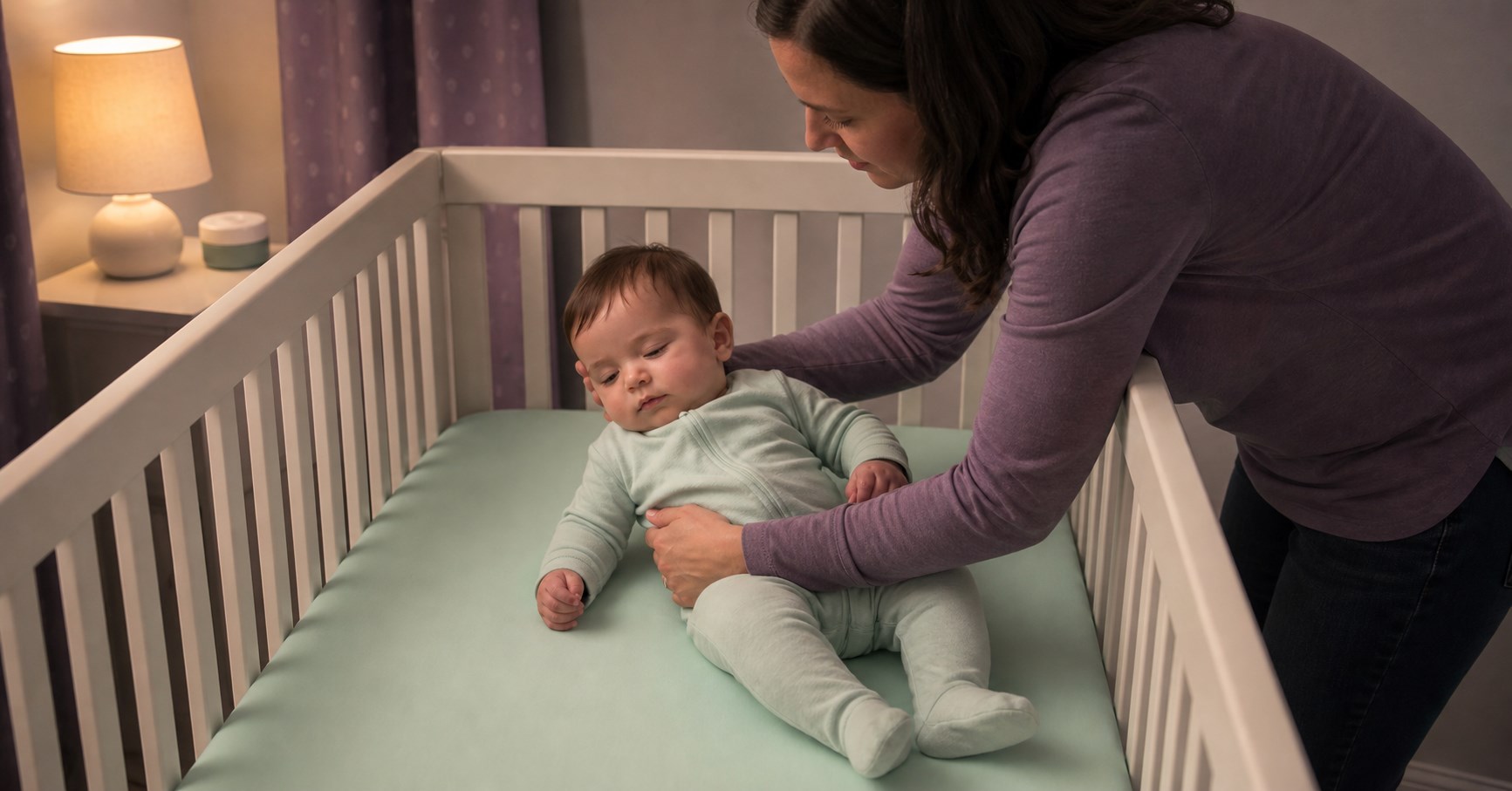
Start every infant sleep on the back on a firm, flat, level mattress in an approved, empty crib, bassinet, or play yard. If a developmentally capable baby independently sits up inside that safe space, check breathing, head and neck position, crib setup, and whether the baby can change position. A calm, limited reposition may be reasonable when posture worries you. Repeatedly forcing a comfortable, capable baby flat can wake everyone without solving a hazard.
A baby asleep in a car seat, swing, bouncer, stroller, carrier, or sling is a different situation. Outside travel, move the baby to the regular flat sleep space as soon as practical. Do not treat “sitting in an empty crib” and “sleeping in a sitting device” as interchangeable because the silhouettes look similar on a grainy monitor.
The private question underneath the search is usually: If I leave my baby alone, am I ignoring danger; if I go in again, am I causing this whole night? I would not make that decision from the word sitting. I would use a short posture-and-place check, then respond to what is actually in front of me.

First split the problem: safe crib or sitting device?
The first ten-second decision
Where did sleep happen?
- Baby sat up independently in an empty crib or play yard
- Check breathing, posture, ability to move, mattress height, and the empty sleep space. Decide whether one calm reposition is needed.
- Baby fell asleep in a car seat, swing, bouncer, stroller, carrier, or sling
- When not traveling, move the baby to a firm, flat, level approved sleep surface as soon as practical.
- Baby is propped, wedged, restrained, or surrounded by soft items
- Remove the unsafe setup. Pillows, wedges, bumpers, rolled blankets, nests, and positioners do not make upright sleep safer.
NIH Safe to Sleep, the American Academy of Pediatrics, and the U.S. Consumer Product Safety Commission all center the same sleep environment: back placement, a firm flat level surface, and no soft objects or loose bedding. They also advise moving a sleeping baby out of sitting devices to a regular safe sleep surface when practical. A semi-reclined device can allow the head to fall forward and compromise the airway; it was not designed to become the baby’s routine bed.
An older baby who used their own muscles to sit on a flat crib mattress presents a different decision. The mattress has not become inclined. The baby is not held by a harness or molded seat. That does not mean every upright posture is automatically fine, but it means the answer begins with the baby’s actual capability and posture rather than panic at the camera image.

Use three looks: breathing, head position, movement
I would rather give a tired parent three observable questions than a command to “trust your instincts.” At 2 a.m., instinct often wears a trench coat and calls itself catastrophe.
The upright-sleep posture check
- Breathing: Is breathing regular for your baby, with normal color and no struggling, gasping, grunting, or unusual pauses?
- Head and neck: Is the face clear? Is the head supported by the baby’s own control rather than tightly folded chin-to-chest or trapped against a rail?
- Movement: Did the baby get there independently, and can they shift, turn, lower, or otherwise change position?
If breathing or color is abnormal, the baby is limp or cannot be awakened, or the posture looks trapped, act immediately and get emergency help as appropriate. Do not watch the monitor longer to collect better evidence. If breathing looks normal but the chin is persistently folded hard to the chest, head control appears poor, or the baby cannot move out of the position, go in and reposition the baby onto the back on the empty mattress and contact the pediatric clinician about the pattern.
If the baby got to sitting independently, the face is unobstructed, breathing and color look normal, the head is not trapped, and the baby can move, you can pause. One direct check may settle an ambiguous camera angle. After that, repeated interventions are not automatically safer.

Should I lay the baby down every time?
Place your baby on the back at the beginning of every sleep. If you find the baby newly sitting and you cannot tell whether the posture is comfortable, lay the baby gently onto the back once. Keep the crib empty. Do not pin the body with blankets, tuck anything around the hips, or introduce a positioner to make the result last.
Then observe what happens. Some babies immediately sit again because the new skill is currently more interesting than every other human achievement. If your baby is capable, breathing normally, and sitting freely in a correctly configured empty crib, you do not have to spend the night in a repetitive loop of lay down, wake up, sit up, repeat. Your job is to provide the safe starting position and safe environment, not to freeze a mobile baby into one pose.
One calm response ladder
- Pause: verify the crib is empty and look at breathing, head position, and movement.
- Check directly if the picture is unclear: camera angles flatten depth and can exaggerate a head tilt.
- Reposition once if needed: gently place the baby on the back.
- Limit the loop: if the capable baby sits again safely, use the same agreed check rather than inventing a new intervention.
I would change this plan for a young baby who cannot sit independently, a baby with poor head control, a baby who seems stuck, a baby repeatedly falling hard against the crib, or any child whose movement looks newly weak, painful, asymmetric, or different from usual. Those details turn a settling question into a developmental or medical one.

The monitor can make two loving adults invent two different emergencies
A clearly labeled hypothetical Kacey-and-Benjamin scene
Imagine Benjamin and I see a hypothetical baby asleep sitting in a bare crib. I see the head tipped forward and reach for the door. Benjamin sees a baby who spent all day practicing sitting and says, “Wait—look at the shoulders.” We do not vote on which adult is calmer. We use the same three looks: breathing is regular, face clear, body free to move. We agree on one direct check because the camera angle is poor, gently lay the baby down once, and decide what will happen if the baby sits again.
The baby does sit again. This time the head rests differently, breathing and color remain normal, and the baby soon lowers to the mattress without our help. The scene is invented to teach the decision, not to claim a real event or offer evidence. Its useful part is the agreement: Benjamin and I do not take alternating shifts undoing each other’s choices.
A shared response is kinder to the baby and the adults. “If breathing, head position, and movement pass, we pause. If one fails, we go in.” That sentence prevents the monitor from becoming a courtroom where every shadow needs a new ruling.

Practice getting down while the baby is awake
Getting into sitting can arrive before getting out of sitting feels smooth. The CDC lists getting into a sitting position independently among common movement milestones around nine months, while developmental timing varies. The exact calendar matters less here than the skill mismatch you can see: up is easy; down still ends in surprise.
Use supervised floor time during the day to help the baby explore transitions. Place an interesting toy slightly to the side and low enough that reaching encourages a hand to the floor, a side lean, and a move toward the belly. Let the baby solve as much of the movement as possible. Support lightly at the trunk or hips when needed rather than pulling the arms or repeatedly placing the baby into a position they cannot reach.
Awake practice: sit, side, hands, floor
- Begin on a firm floor with an alert baby and close supervision.
- Invite a small side reach, not a dramatic forward lunge.
- Let one or both hands find the floor.
- Help the hips rotate only as much as needed.
- Finish on the side or belly, then allow another attempt after rest.
Practice is not a bedtime rescue ritual. Do not put toys, pillows, rolled towels, wedges, or teaching props in the crib. Do not hold the baby awake for a midnight physical-therapy seminar. Daytime repetition builds options; nighttime stays dark, brief, and boring.
If the baby consistently cannot bear weight through an arm, always falls to one side, appears painful, loses a skill, or shows movement that concerns you, record what you observe and contact the pediatric clinician. A short video of the awake movement may be useful for the clinician, but it should not delay urgent care when the baby looks acutely unwell.

Once sitting begins, lower and clear the crib
The most important fix may not be the sleeping posture. It may be the crib height. The American Academy of Pediatrics advises lowering the crib mattress before a baby can sit and moving it to the lowest position before standing. Follow the crib manufacturer’s instructions and limits; the goal is to prevent a newly mobile baby from getting over the rail.
Lower, clear, reach-check, recheck
- Lower: set the mattress to the manufacturer-approved level for a baby who can sit.
- Clear: remove bumpers, pillows, blankets, toys, positioners, wedges, and anything used as a step.
- Reach-check: move monitor cords, blind cords, mobiles, wall décor, lamps, and nearby furniture beyond reach.
- Recheck: confirm hardware, mattress fit, fitted sheet, and crib condition.
A sitting baby has a longer reach than yesterday’s mental picture. Objects that once looked safely decorative can become handles, cords, or climbing aids. Camera placement belongs outside the crib with every cord secured according to the manufacturer’s instructions. Never attach a monitor to the rail in a way that brings a cord or device within reach.
Stop swaddling when the baby shows signs of trying to roll. Do not use a weighted sleep product, restraint, or extra-tight garment to prevent sitting. Mobility is not a defect to strap out of the child; it is a signal to update the environment.
Optional practical pick · destination inactive
When opening the door keeps restarting the sitting loop
The VTech VM819 Digital Video Baby Monitor fits one narrow job in this situation: letting you see whether a sitting baby has changed posture or lowered to the mattress without repeatedly entering the room. Its dedicated parent-unit screen and automatic night vision are a stronger fit for that posture question than an audio-only monitor, while avoiding the need to use a phone app for every check.
Consider it when door-opening repeatedly wakes the baby and you do not already have a clear night-view monitor. Skip it if your existing video monitor already shows the crib well. It does not assess breathing, prevent SIDS, replace direct checks or medical evaluation, or make an unsafe sleep space safe. Place the camera and every cord outside the crib and follow the manufacturer’s instructions.
SleepBaby may earn from qualifying purchases after Affiliate Control verifies and activates the exact eligible destination.
When sitting sleep needs a clinician, not another settling technique
Get emergency help for trouble breathing, blue or gray color, a seizure, unusual limpness, inability to wake, or a suspected serious injury. If the baby has fallen and then vomits repeatedly, behaves unusually, becomes hard to wake, or has another concerning change, seek urgent medical care rather than assuming sleepiness is ordinary bedtime.
Contact the pediatric clinician promptly about persistent chin-to-chest slumping, poor head control, a baby who cannot change position as expected, repeated hard falls or head impacts, new weakness, pain, marked asymmetry, or loss of a skill. Also call when sitting sleep arrives with fever, breathing symptoms, unusual lethargy, poor feeding, or a child who simply looks unwell.
Reflux, congestion, ear pain, and other discomforts can change how a baby rests, but an upright pose does not diagnose the cause. Avoid inclining the mattress or using a wedge. Describe the pattern to the clinician: when it began, whether the baby can lie flat while awake, how breathing looks, whether feeding or movement changed, and whether the baby can get down independently.

When the baby sits up again and again
A new motor skill can visit bedtime with the persistence of a door-to-door salesperson. The baby sits, calls, nods off, tips, wakes, and sits again. That pattern can be exhausting without being an emergency. Keep the safety check separate from the settling response so concern does not expand the intervention every round.
At the beginning of the night, verify the lowered mattress, empty crib, normal breathing, and the baby’s ability to move. If the baby is awake and upset, use your usual brief settling approach—voice, a short check, or whatever consistent response fits your family and keeps the crib empty. If the baby is asleep upright and passes the posture check, you can allow a pause. If the body is folded awkwardly or the baby appears stuck, reposition once.
Try not to add a new sleep association solely to prevent sitting. Holding the baby until deeply asleep, feeding at every sit-up, or staying beside the crib to lower the baby twenty times may work for one night and become tomorrow’s new requirement. Sometimes a few nights of daytime skill practice and a boring, predictable bedtime response are enough for the movement to lose its novelty.
I would also look at timing. An overtired baby may fall asleep before smoothly lowering from sitting; an undertired baby may have enough energy to conduct a full crib-skills exhibition. That observation can guide a modest schedule check, but it should not turn this page into a promise that one wake-window adjustment will cure a developmental phase. Safety comes first. Schedule fine-tuning comes after.
A younger, premature, or medically complex baby gets a narrower answer
The phrase “baby sleeps sitting up” can describe very different children. A sturdy older infant who independently moves into sitting is not the same as a young infant placed upright with support, a premature baby with limited head control, or a child whose medical team has given positioning instructions. Do not borrow reassurance from one situation and apply it to another.
If your baby cannot independently get into sitting, do not arrange upright sleep with pillows, wedges, rolled towels, inclined sleepers, or a sitting device. Begin on the back on the approved flat surface and ask the clinician about symptoms that make flat sleep difficult. If a baby appears to choose upright sleep because lying flat is painful, repeatedly coughs or chokes, has feeding difficulty, or shows breathing changes, that pattern deserves medical assessment rather than a home positioning invention.
For a baby with low muscle tone, neuromuscular concerns, airway differences, seizures, recent surgery, or individualized equipment, follow the care plan. Ask the team specifically what to do if the child becomes upright during sleep and what findings require immediate action. A general article cannot safely replace instructions built from that child’s anatomy and history.
Developmental milestones are guides, not permission slips. Getting into sitting independently is commonly seen around the latter part of the first year, but children reach skills at different times. What matters tonight is whether this baby’s movement is self-generated, controlled, and consistent with their usual abilities.
Car seats and strollers: keep travel rules from becoming sleep rules
Babies often fall asleep during necessary travel. Use the car seat exactly as directed while the child is riding in the vehicle. When you arrive and the seat is no longer being used for travel, move the sleeping baby to the regular firm, flat, level sleep surface as soon as practical. Do not place the car seat on a bed, sofa, counter, or other soft or elevated surface to finish the nap.
The same transfer principle applies after a stroller, swing, bouncer, carrier, or sling nap. These products have different purposes and angles; they are not substitutes for an approved crib, bassinet, play yard, or bedside sleeper. Watch for the head falling forward, the face pressed into fabric or an adult’s body, and any breathing concern during use. A sleeping baby needs an unobstructed airway and the regular flat sleep destination.
Travel can blur the distinction because adults are tired and the portable crib is still folded in the trunk. Assemble the approved travel sleep space according to its instructions before the next sleep. Use only its intended mattress and fitted sheet. Do not add hotel pillows, folded blankets, or aftermarket padding to make it look more comfortable.
If the baby transfers and then sits up in the portable crib, return to the crib decision: breathing, head position, movement, and setup. The location changed; the logic did not. The device nap ended, and the safe flat sleep environment now owns the question.
Give every caregiver the same threshold for going in
One adult may reposition at the first glimpse of an upright silhouette. Another may assume any self-chosen position is fine. Neither extreme makes a useful handoff. Before bedtime, agree on observable thresholds: abnormal breathing or color means immediate action; a trapped head or inability to move means go in; an unclear camera angle means one direct check; a capable baby sitting freely in an empty crib can have a pause.
Tell a babysitter or relative that the crib must stay empty even if the baby keeps sitting. “Do not add a pillow to catch the head” is worth saying aloud. Confirm the mattress level and point out that monitor cords, blind pulls, furniture, and wall items must remain out of reach. A newly sitting baby changes the room’s reach map, not only the bedtime routine.
If someone repositions the baby, keep the interaction low-key: dim light, few words, onto the back, then leave according to the family’s plan. The next caregiver should not assume that one reposition failed because the baby sat again. They should rerun the same posture check.
A short note can help: “Back at bedtime. Crib empty and lowered. If sitting: check breath, head, movement. Reposition once if stuck.” That is enough structure to prevent six different solutions from arriving before midnight.
Four fixes that feel helpful but create new problems
- Propping the baby upright. A pillow, bumper, rolled blanket, wedge, or nest introduces soft objects and possible entrapment. The empty crib is the safer tool.
- Holding the baby down. Restraints and weighted products do not belong in the sleep space. Update the crib rather than suppressing a motor skill.
- Practicing in the crib. Teaching objects and toys can stay on the supervised floor. The crib remains boring, dark, and empty.
- Watching instead of checking a red flag. A monitor can clarify posture, but abnormal breathing, color, responsiveness, or movement requires direct action.
The pattern underneath all four is understandable: a parent wants to make the position stop happening. A safer goal is different. Make the environment ready for a mobile baby, teach the missing transition while awake, and reserve intervention for a posture or symptom that actually needs it.

Watch the safe surface, then judge the posture
Keep the crib foundation unchanged when a new motor skill appears
A baby sitting independently can create a new decision, but it does not change the safe-sleep starting point. This American Academy of Pediatrics video reinforces the firm, flat, empty sleep space that makes your posture check meaningful.
Takeaway: place the baby on the back in a bare, flat crib; if the baby later sits independently, check breathing, head position, and movement without adding props.
A plan for tonight
- Start sleep on the back in the firm, flat, level, empty crib or play yard.
- If the baby sits, identify the place first: safe crib versus sitting device.
- Check breathing, head and neck position, and ability to move.
- Reposition gently once when needed; do not add props or restraints.
- Confirm the crib mattress is lowered appropriately and the reach zone is clear.
- Practice sitting-to-floor transitions only during supervised awake time.
- Escalate breathing, color, responsiveness, injury, weakness, pain, or regression concerns.
If two caregivers respond differently, write the three-look rule where both can see it. The baby does not need one adult repeatedly laying them down while the other watches the monitor and whispers, “But they were fine.” A shared threshold turns the night from an argument into a plan.
For the next upright monitor surprise
Check the place, the posture, and the skill—not the panic
Start flat and empty. Look at breathing, head position, and movement. Update the crib for the child you have tonight. SleepBaby helps you turn a strange sleep pose into the next calm, safe decision.
Sources
- NIH/NICHD Safe to Sleep: Ways to Reduce Baby’s Risk
- American Academy of Pediatrics: How to Keep Your Sleeping Baby Safe
- U.S. Consumer Product Safety Commission: Safe Sleep
- American Academy of Pediatrics: Make Baby’s Room Safe
- CDC Learn the Signs. Act Early: Developmental Milestones
- American Academy of Pediatrics: Movement, 4 to 7 Months
- VTech VM819 Product Support (product identity and listed monitor features only)