
The monitor catches a shape you were not expecting: your baby’s knees tucked underneath, bottom in the air, face turned to one side. It looks part yoga pose, part tiny folded lawn chair. Then the private question arrives: Is my baby comfortable—or have I missed something unsafe?
The short answer
A mobile baby who gets into a knees-tucked or bottom-up position independently is often simply using a position that feels available and comfortable. The posture alone does not prove reflux, pain, a developmental problem, or poor sleep. Always place your baby on the back at the start of every sleep on a firm, flat, level, bare infant sleep surface. If your baby can roll both ways independently, AAP and Safe to Sleep guidance says you do not need to keep turning them back after they choose another position.
Do not place, prop, wedge, or restrain a baby on the knees or stomach. Stop swaddling as soon as rolling attempts begin. What matters tonight is not whether the silhouette looks unusual; it is how your baby got there, what your baby can do, whether the sleep space is safe, and whether any concerning symptom travels with the pose.
I would treat “baby sleeps on knees” as a sorting question, not a diagnosis. First sort the safe-sleep setup. Then sort self-chosen movement from a position an adult created. Only after those two answers would I interpret the posture itself.
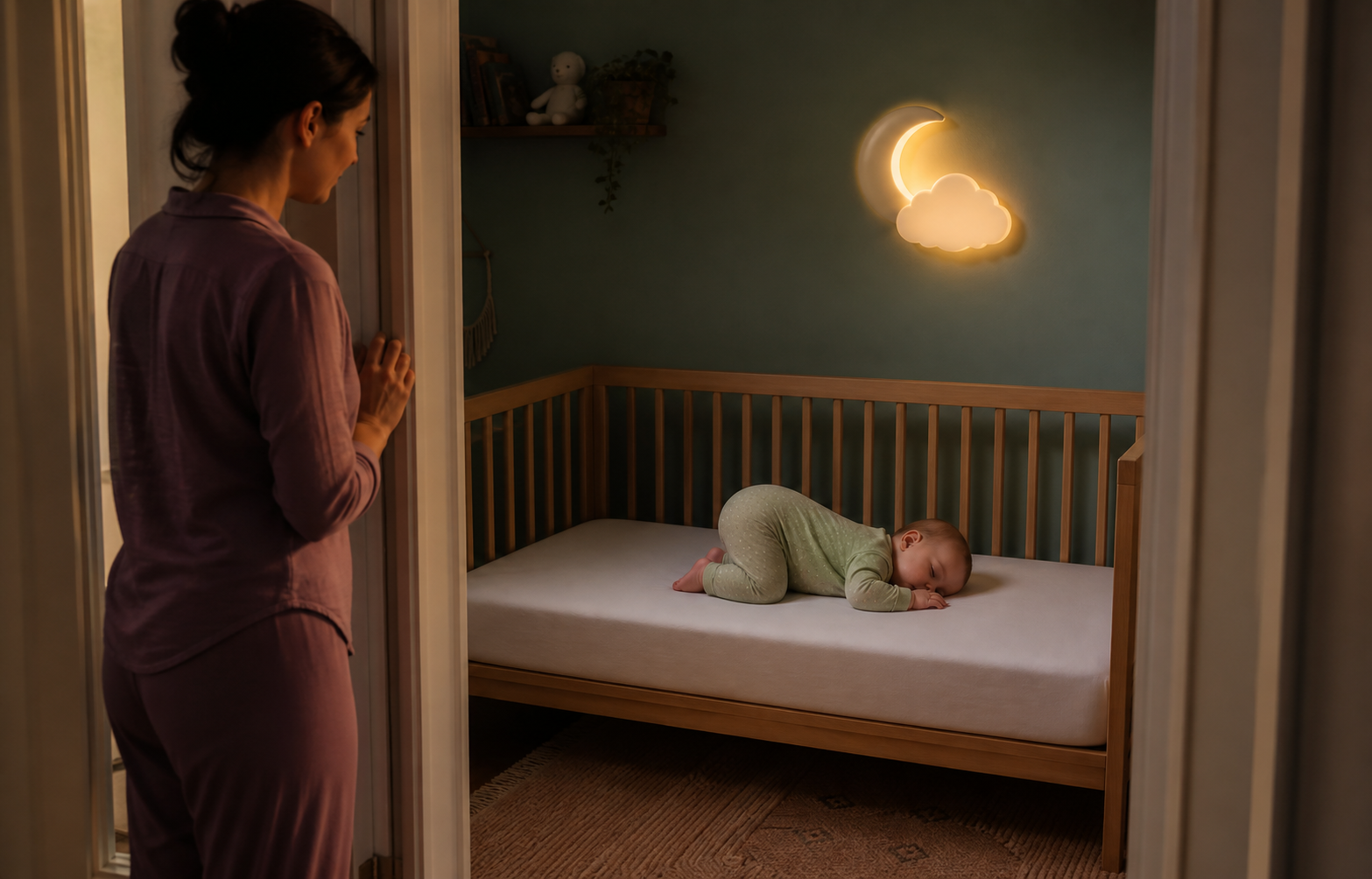
The four-question crib-side check
When a monitor picture makes your pulse jump, more watching is not always more information. I use four questions because each one changes a real decision. They turn a strange-looking pose into a short sequence you can actually complete.
-
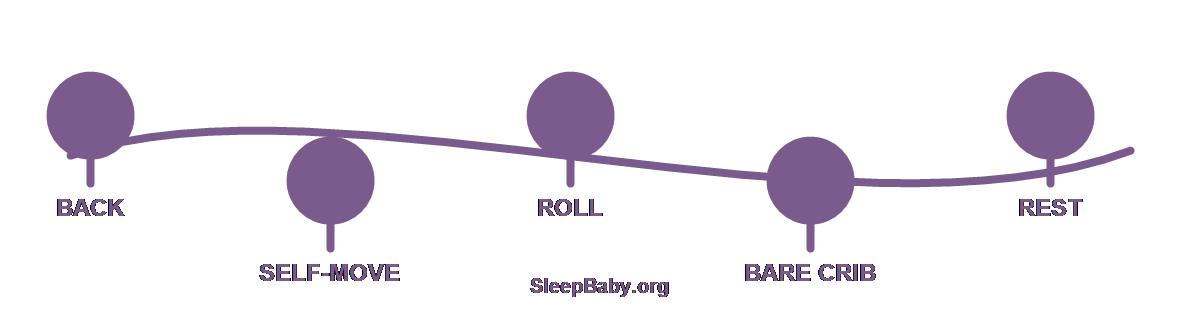
1. How did sleep begin?
Place every infant on the back for every sleep. Back placement remains the caregiver’s job even after rolling begins. Do not start sleep on the stomach, side, knees, or folded over a support because that seems to be the preferred finish.
-
2. Did baby move there independently?
A position reached through the baby’s own rolling and mobility is different from a position created with a wedge, pillow, rolled towel, bumper, blanket, or adult hand. Remove positioning objects; do not “secure” the pose.
-
3. Can baby roll both ways?
If your baby rolls from back to stomach and stomach to back independently, you can leave the position they assume while keeping the sleep space bare. If rolling is one-way only, follow the more cautious Safe to Sleep guidance below.
-
4. Is anything else wrong?
Comfortable breathing, usual color, ordinary movement, and familiar behavior make a self-chosen posture less concerning. Breathing difficulty, blue or gray color, unresponsiveness, pain, injury, or a trapped baby changes the answer immediately.
SleepBaby.org four-question crib-side check
Why some babies fold their knees underneath
There is no single medical meaning hidden in the bottom-up pose. Older infants spend awake time discovering hands-and-knees movement, rocking, pivoting, crawling, sitting transitions, and ways to get unstuck. Sleep does not erase that new movement vocabulary. A baby may settle after moving around the crib and simply stop in a compact position.
That does not mean sleeping on the knees is a milestone test. Some babies crawl on hands and knees; some scoot, creep, roll, or use another pattern. HealthyChildren describes wide variation in mobility between about 8 and 12 months. I care more about the whole awake pattern—progress, symmetry, comfort, and participation—than whether one sleeping pose resembles a textbook crawl.
The posture can also look more dramatic than it is. Night-vision flattens depth. Pajamas blur the line between hips and knees. A baby with the chest close to the mattress and bottom raised can look “stuck” in a still image even after moving there smoothly. If you are uncertain, look directly rather than diagnosing from pixels.
I would not call the position a guaranteed sign of gas, reflux, teething, being cold, being overtired, or needing sleep training. Any of those issues can coexist with unusual sleep, but the posture does not identify the cause. A claim that explains everything usually explains nothing.
Read the pattern around the posture
- Self-chosen + rolls both ways + bare crib
- Usually leave baby in the assumed position and continue back placement at the next sleep.
- Self-chosen + only rolls one way
- Keep the crib bare, stop swaddling, and use the one-way rolling guidance below rather than inventing a restraint.
- Adult-placed or propped
- Remove the prop and return to back placement on the approved flat sleep surface.
- Pose + pain, breathing trouble, weakness, injury, or illness
- Act on the associated sign; the posture is no longer the main question.
The monitor makes a folded baby look like an emergency symbol
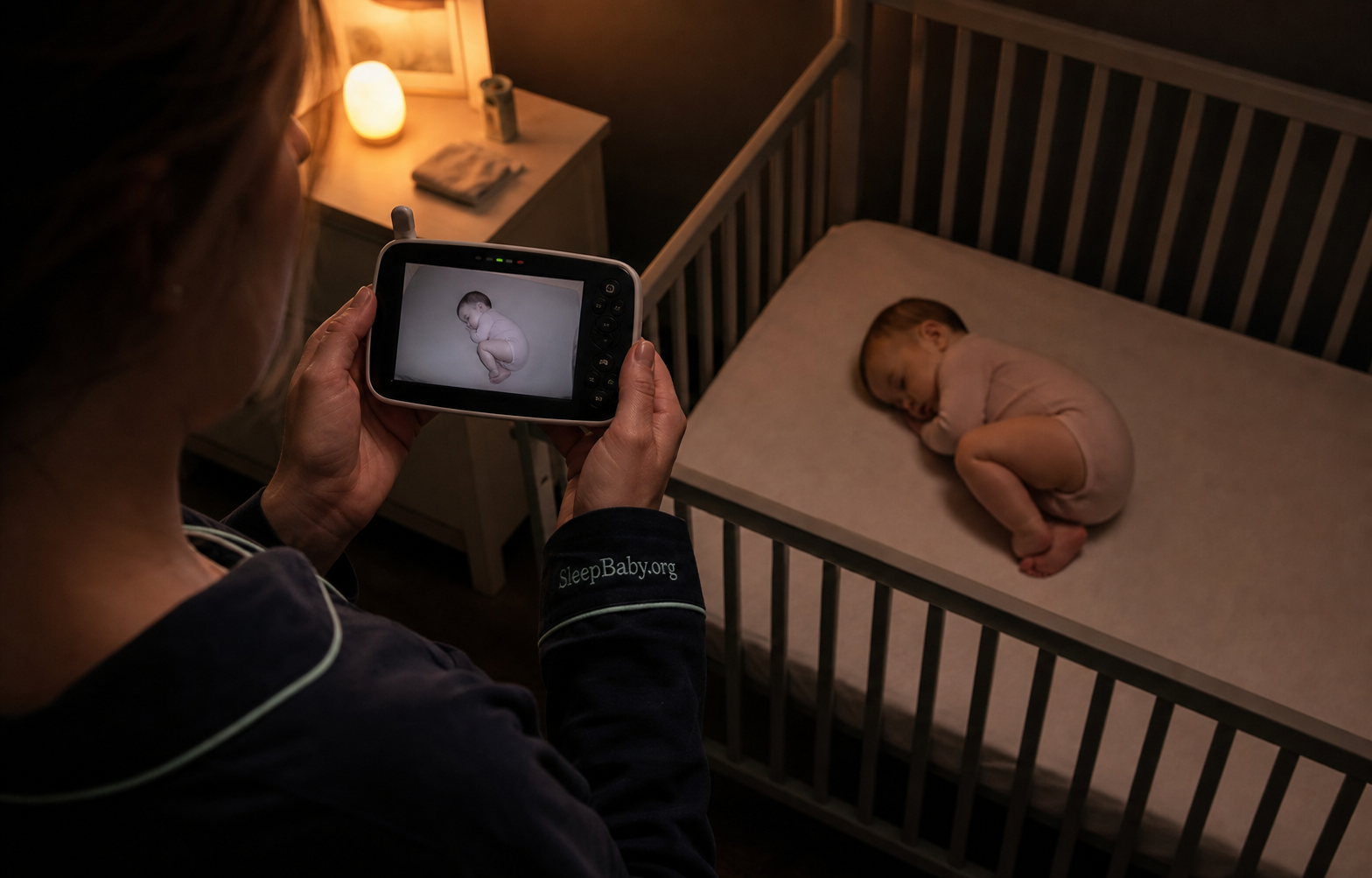
Composite scene: Imagine me—Kacey—seeing Benjamin asleep with his bottom raised after a week of practicing hands-and-knees movement. I reach for the monitor as though the shape itself has sounded an alarm. In the blue night image, he looks impossibly folded. My brain supplies a full case file before I have even looked at the crib.
Then I separate surprise from evidence. In this composite, I had placed Benjamin on his back. He had moved there himself. I had watched him roll in both directions while awake. The mattress was flat and tight-fitting, and the crib held nothing except a fitted sheet. His breathing and color looked ordinary. The picture was unfamiliar; the safety facts were not.
I still look directly if the monitor cannot answer a real concern. But I do not rearrange him merely to make the image look more adult. That is the practical work of this scene: it moves me from “that looks strange” to four answerable questions.
This scene is clearly labeled composite. It is not family biography and it is not evidence. The safe-sleep guidance comes from the AAP, NICHD, CDC, and CPSC sources below.
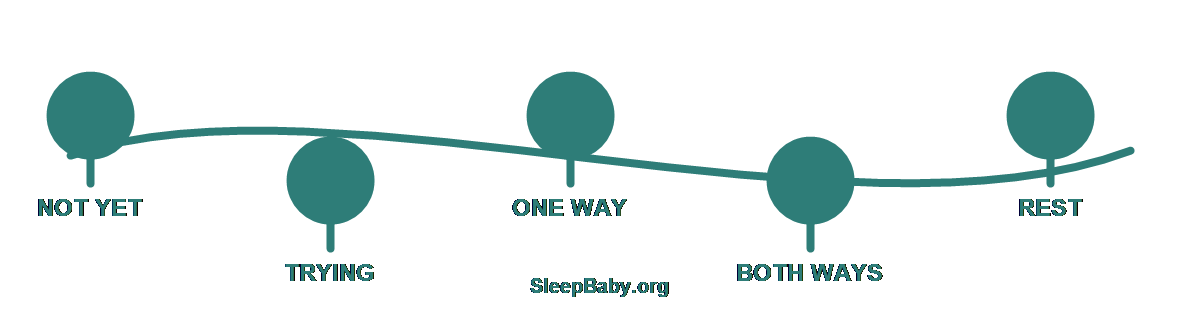
The rolling decision: both ways, one way, or not yet
Rolling ability is the hinge in this question. The AAP says that when a baby can comfortably roll from back to stomach and stomach to back, you do not need to keep returning the baby to the back after they independently change position. You still begin every sleep on the back, and the sleep space still stays firm, flat, level, and bare.
NICHD gives a useful nuance for a baby who rolls only one way. If your baby can roll back to stomach but not stomach to back, you may reposition to the back when you notice the stomach position. You do not need to stand guard all night or add a device to prevent rolling. Give supervised, awake floor time so your baby can practice movement, and ask the pediatric clinician if mobility seems persistently one-sided or difficult.
“Both ways” means the baby performs both transitions independently, not that an adult once helped complete them. It also does not require identical technique on both sides. If you are unsure what you have seen, discuss it at the well-child visit and observe ordinary awake movement on a firm floor—not in the crib with pillows or positioners.
Tonight’s rolling path
Not rolling: place on the back; do not introduce the knees-tucked pose.
Trying to roll: stop swaddling now; use arms-free, correctly fitted sleep clothing if needed.
Rolling one way: keep back placement and the bare crib; reposition when noticed according to NICHD guidance, without restraints.
Rolling both ways: begin on the back, then leave the independently assumed position while the crib remains bare.
If your baby rolls only one way, you do not have to build a night shift
The one-way stage is often the most emotionally expensive because the rule sounds simple while the night is not. You may turn your baby back, walk away, and see the bottom rise again before you reach the door. That repetition does not mean you need to buy a restraint, sleep beside the crib with one hand through the slats, or prevent every movement.
Keep beginning on the back. Keep the crib bare. Reposition when you notice the stomach position according to NICHD guidance, but do not use an alarm or constant monitor watching to catch every roll. If your baby repeatedly reaches a position and seems unable to free an arm, turn the head, or move comfortably, look directly and contact the pediatric clinician for individualized guidance. The question becomes ability and comfort, not whether you were vigilant enough to intercept every attempt.
During supervised awake time, offer several short opportunities to move on a firm floor. Place an interesting face or toy where your baby can turn toward it without being pulled through the motion. Practice can fit naturally after a diaper change or before pajamas, when your baby is alert. Stop if your baby is distressed, in pain, or too tired to participate. Awake floor practice supports movement experience; it is not a guarantee that the next night will look different.
I would also tell another caregiver exactly what you observed: “Back to belly is easy; belly to back has not happened yet.” That is more useful than “she sleeps weird.” It gives the caregiver a clear starting rule, explains why the swaddle is finished, and prevents a well-meaning person from adding a rolled blanket to hold the baby still.
Swaddling, wedges, and the urge to keep baby still
A baby who is trying to roll should no longer be swaddled. The issue is not whether the arms happen to be inside or whether the wrap seems loose enough. Rolling changes what the baby needs to do with the arms and body. The safer transition is to arms-free sleep clothing that fits correctly, not a tighter wrap that tries to preserve the old arrangement.
Do not use a wedge, sleep positioner, rolled blanket, towel, pillow, bumper, strap, or weighted product to stop the knees-tucked posture. Do not incline the mattress for reflux. A device that makes the baby stay where an adult put them does not convert an unsafe setup into a safe one. “Bare is best” is intentionally unglamorous.
If your baby falls asleep in a swing, bouncer, lounger, or car seat outside travel, move them to an approved infant sleep surface as soon as practical. A knees-tucked pose on a flat crib mattress is not permission to accept a curled posture in a sitting device. Surface and product category matter.
A one-minute crib audit for the baby who moves everywhere
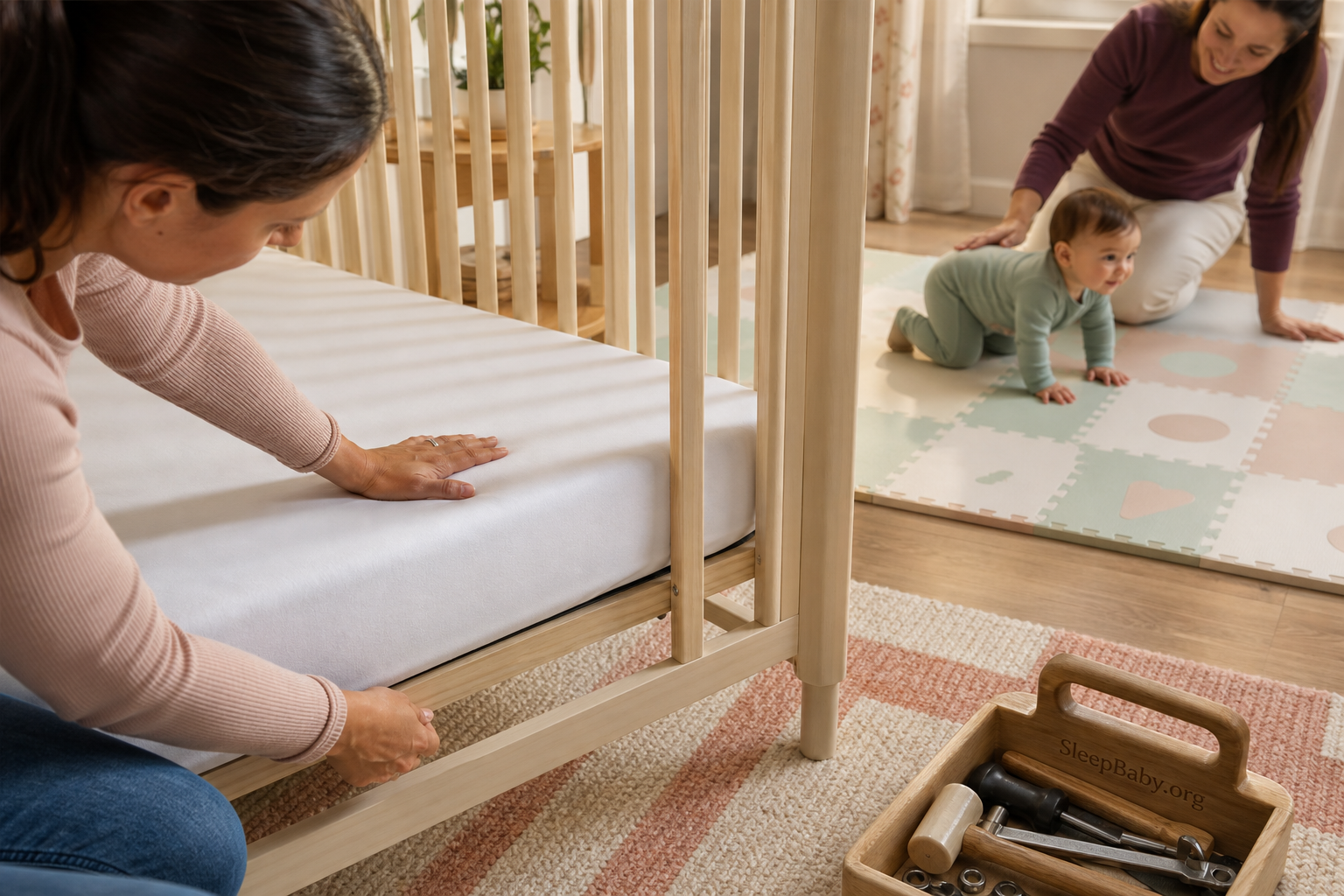
Mobility turns the entire crib into reachable territory. That makes a short environment check more useful than trying to control one pose. I would do it in daylight, when I can see hardware and fit, rather than during a 2 a.m. monitor spiral.
| Check | What you want | What leaves |
|---|---|---|
| Surface | Firm, flat, level mattress made for the sleep product | Inclines, toppers, extra pads, second mattresses |
| Fit | Tight-fitting mattress and fitted sheet only | Gaps, sagging, loose fabric, makeshift fill |
| Crib contents | Baby and fitted sheet | Pillows, quilts, toys, bumpers, positioners |
| Structure | Correct assembly, intact parts, stage and mattress height appropriate to manufacturer limits | Broken, missing, substituted, or improvised parts |
| Clothing | Correctly fitted, appropriate for room temperature, arms free once rolling starts | Swaddling after rolling attempts, loose or weighted layers |
A “breathable” marketing claim does not cancel any of these requirements. No mattress turns stomach sleeping into a caregiver-recommended starting position, and no accessory makes a cluttered crib acceptable.
Does sleeping on the knees mean crawling is coming?
It can occur during a season when hands-and-knees movement is developing, but the sleep pose is not a milestone forecast. A baby may rock on hands and knees for weeks, crawl quickly, skip a classic crawl, scoot, or use several movement styles. The CDC and AAP encourage parents to watch development across many ordinary activities, not score a child from a single nighttime shape.
During supervised awake time, notice whether your baby uses both sides of the body, bears weight comfortably, reaches in both directions, changes positions, and continues gaining skills. For a closer age-based view, our guide to 9-month movement and communication milestones helps you place one motor skill inside the wider pattern.
I would bring a concern to the pediatric clinician when movement is markedly one-sided, a limb seems painful or swollen, your baby is unusually stiff or floppy, a previously used skill disappears, or progress has stalled in a way that worries you. Early conversation is not an accusation that something is wrong. It is how you get a whole-child assessment instead of asking a sleep pose to do diagnostic work.
One pose versus the whole movement pattern
One pose: knees tucked during sleep, bottom raised, face turned, position changes between checks.
Whole pattern: rolling, reaching, sitting transitions, bearing weight, using both sides, comfort, and continued skill development while awake.
The decision: ordinary variation earns observation; pain, asymmetry, stiffness/floppiness, regression, or caregiver concern earns a clinician conversation.
Age changes the context, not the safe starting position
In a newborn who is not independently mobile, a knees-under-body position deserves a different interpretation because the baby probably did not create it through ordinary rolling and crawling practice. Return to back placement on the flat approved surface and look at how the position happened. A newborn should not be propped prone or curled over a support for sleep, even if an adult is watching.
In a young infant beginning to roll, the posture is a signal to reassess swaddling and mobility rather than celebrate a milestone from the crib. Rolling attempts end swaddling. The arms need to be free, the sleep space needs to be empty, and awake practice belongs on the floor under supervision.
In an older infant who rolls both ways and spends the day rocking, pivoting, crawling, or moving between sitting and hands-and-knees, the position has more ordinary developmental context. It still does not prove that crawling will happen tomorrow, and it does not exempt the crib from safe-sleep rules. It simply makes a self-chosen compact pose less mysterious.
For a toddler, the infant rolling rule may no longer be the central issue, but the sleep product’s current height, weight, climbing, and conversion limits become increasingly important. A child who can climb over the rail has presented an enclosure problem, not a posture problem. Follow the crib manufacturer’s transition instructions and discuss uncertain timing with the pediatric clinician.
A daylight plan for a nighttime pose
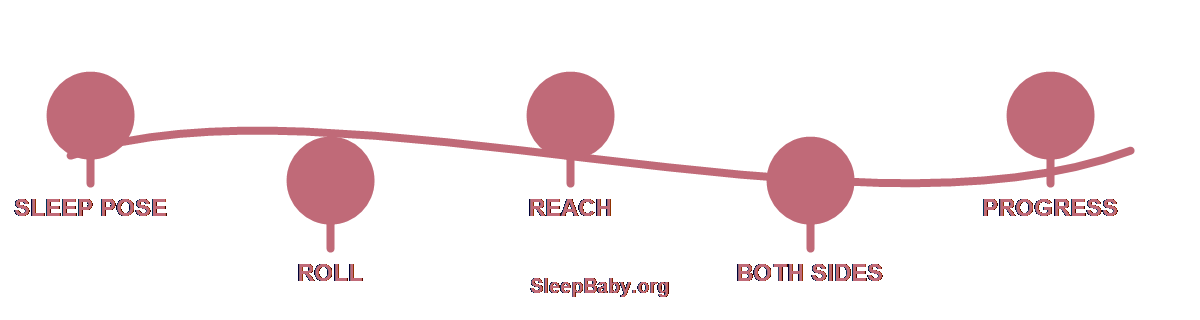
- Watch ordinary movement: rolling in both directions, reaching across the body, weight-bearing, and using both sides.
- Offer supervised floor time: short, alert practice on a firm clear surface, never on a bed or sofa.
- Describe, do not diagnose: record what your baby can do, what seems difficult, and whether there is pain or asymmetry.
- Share the exact pattern: bring concise observations to the pediatric clinician when you are concerned.
When the posture is not the main problem
Most questions about a comfortable, self-positioning baby can wait for calm observation. Some associated signs cannot. Seek emergency help for difficulty breathing, blue or gray lips, tongue, face, or skin, unusual unresponsiveness, seizure-like activity, or a baby who is visibly trapped and cannot free the airway.
Call the pediatric clinician promptly for persistent pain, swelling, a limb that will not move normally, a new movement difference after injury, repeated vomiting with illness signs, fever in a young infant, feeding difficulty, or a baby who seems distinctly unwell. Mention if the posture is always strongly one-sided or if your baby cannot change out of it while awake.
Arrange a developmental conversation for unusual stiffness or floppiness, loss of a previously used skill, marked one-sided movement, or any concern that persists across awake play—not just sleep. You do not need to wait until a milestone checklist becomes a verdict. You also do not need to collect a perfect video before asking for help.

Two practical replacements—only when replacement is already needed
Neither recommendation below corrects a knees-tucked posture, prevents SIDS, or makes stomach sleep safe. They belong here only for families who have already found a concrete equipment problem: an unsuitable mattress or an outgrown or unsuitable sleep enclosure. If your current approved crib and mattress are intact, correctly assembled, tight-fitting, firm, flat, and appropriate for your baby, the best purchase may be no purchase at all.
Regular pick · replace the mattress only when the mattress is the problem
Newton Baby Essential Crib Mattress
If you are already replacing a damaged, sagging, poorly fitting, or unsuitable mattress, this standard-size option addresses that exact job. Its washable cover and washable core make cleanup more practical than adding a pad, topper, or positioner—objects that can change the sleep surface and do not solve mattress fit.
I prefer a true replacement mattress to an accessory marketed around the baby’s position. Confirm that it fits your crib tightly, remains firm and flat, and is used with a fitted sheet only. “Washable” is a care benefit, not a safety guarantee; it does not prevent SIDS or make prone placement safe.
See the Newton Baby Essential Crib Mattress on Amazon
As an Amazon Associate, SleepBaby may earn from qualifying purchases.
Luxury pick · replace the whole sleep enclosure when that is the real job
Babyletto Rolli 9-in-1 Convertible All-Stages Crib
For a family already moving an increasingly mobile baby out of an outgrown or unsuitable sleep space, the Rolli solves a different structural problem from the mattress above: it supplies a full-size crib stage and included conversion hardware for longer service. That makes it a thoughtful premium buy when the enclosure itself needs replacement, not when a parent merely dislikes the baby’s pose.
Use the correct stage, original parts, manufacturer-approved mattress dimensions, mattress-height setting, and current limits. Proper assembly and fit matter more than furniture finish. This crib does not restrain rolling, correct posture, prevent SIDS, or promise better sleep.
See the Babyletto Rolli convertible crib on Amazon
As an Amazon Associate, SleepBaby may earn from qualifying purchases.
Watch the setup that stays constant
Safe sleep rules do not change when baby changes position
An official AAP or Safe to Sleep video will be bound here only after its exact embed passes fresh availability immediately before READY. The article’s written rule remains complete without video: back placement, a firm flat level surface, and a bare sleep space.
Takeaway: Your job is the safe starting setup. A mobile baby’s self-chosen finish is not an invitation to add a positioning device.
What I would do tonight
Place your baby on the back in the approved sleep space. Confirm the mattress is firm, flat, level, and tight-fitting, with a fitted sheet and nothing else. If rolling attempts have begun, stop swaddling. If your baby independently moves into the knees-tucked position, use the rolling branch that matches what your baby can actually do.
Look for ordinary breathing, color, comfort, and movement. If your baby rolls both ways and is otherwise well, let the pose be a pose. If rolling is one-way, use NICHD’s repositioning guidance without turning yourself into an all-night sentry. If a concerning symptom appears, act on that symptom rather than debating the meaning of raised hips.
In daylight, give supervised awake floor time and watch the whole movement pattern. Check the crib hardware, mattress fit, and contents once. Ask the clinician about persistent asymmetry, pain, unusual tone, regression, or anything that keeps feeling wrong.
I began with a monitor silhouette that looked like a question mark. The changed understanding is quieter: the shape does not need an explanation before the setup and the baby do. When those facts are reassuring, the little bottom in the air can return to being what it often was all along—a mobile baby’s surprisingly compact way of resting.
Sources
- American Academy of Pediatrics: Sleep-Related Infant Deaths—Updated 2022 Recommendations
- HealthyChildren: How to Keep Your Sleeping Baby Safe
- NICHD Safe to Sleep: About Back Sleeping
- NICHD Safe to Sleep: Ways to Reduce Baby’s Risk
- CDC: Providing Care for Babies to Sleep Safely
- CPSC: Safe Sleep—Cribs and Infant Products
- CPSC: Crib Safety Tips
- HealthyChildren: Movement Milestones, 8 to 12 Months
- CDC: Developmental Milestones
- HealthyChildren: Putting Back-Sleeping Concerns to Rest
Keep the setup steady; let movement belong to baby
Build a bedtime plan that does not require controlling every pose
If each new monitor position starts another round of second-guessing, SleepBaby can help you separate the parts of bedtime you can make safer and calmer from the normal baby movements you can release.






What viewers said10 comments · 4 replies+
Archived comments from the original Baby Sleep Miracle presentation. Not independently verified by SleepBaby.org; individual experiences vary.
Thank you so much for this video! I had no idea about the dangers of baby swings :O
Hi Mary-Ann. I have a question: Is method in any way similar to the ones recommended by Dr Bucknam, Dr. Weissbluth or Dr. Karp? We tried those but none of them help.
Hi Regina, thank you for your question. The short answer is no. The techniques I share in my guide are based on newest scientific research and this is why I have never seen any approach similar to the one I recommend.
This method really works! I tried it on my son Jesus and after just one week he went from waking up more than 5 times a night to waking up just once or twice. You are a lifesaver, Mary-Ann!
I'm truly impressed with how much information you share in your video. And all for free! I can feel that you truly care about mothers like myself, and that's hard to find these days. I have recommended your site to several of my friends already.
Mary-Ann, our child suffers from autism. Is your approach still suited?
Chloe, I made sure my method can be used with any child, even babies who are special like yours. Please note that I'm not a doctor and that I always advice to consult with your physician because nothing is more important than the safety and well-being of your love.
Hallo Mary-Ann, I'm from Germany. Do you have your guide in German?
Hello Heide, we do! Normally you should already see our video in German. If not, please contact our support so they can guide you
Thenk you for your answer, Mary-Ann!
I just completed your approach and I have to say, it worked almost too well. Yes, it took a bit of getting used to with your bedtime routine but the difference is huge. My son George used to take 1 hours to go down and now he's firmly asleep in no more than 10 minutes! You're the best!
It seems I'm the only man watching this video, lol! What you shared about the 'emotional backpack' made immediate sense to me and I can't wait to help my little girl Mila to unpack it!
Hey there, just discovered your site and this really sounds different. Just wanted to say thanks for sharing :)
For everyone who's still thinking about getting Mary-Ann's guide I want to advise you to go ahead. I wasn't sure myself but now I'm so thankful I invested in this program. It made a huge difference in our life as a family and yes, my baby girl does sleep through the night now.